

Chapter 1 A Square and A Cube (Class 8 - Latest Maths NCERT (Ganita Prakash I) Solutions)
Looking for precise and easy-to-understand NCERT Solutions for Chapter 1: A Square and A Cube? You’ve come to the right place! This page provides comprehensive, step-by-step answers to all exercises in the latest Class 8 Maths textbook, Ganita Prakash I. We start by solving the logic behind Queen Ratnamanjuri’s "Locker Puzzle," helping you see exactly how the number of factors determines whether a number is a Square Number, turning a mysterious riddle into clear mathematical proof.
Our solutions offer detailed walkthroughs for mastering the properties of Perfect Squares and Perfect Cubes. You will find solved examples of patterns involving consecutive odd numbers and Triangular Numbers, alongside robust methods for calculating Square Roots and Cube Roots. Whether you are using successive subtraction or the Prime Factorization method, our guides break down each calculation to ensure accuracy. We also provide full explanations for problems involving the famous Hardy-Ramanujan Number (1729) and the intuitive brilliance of Taxicab Numbers.
To ensure you build a deep understanding, this page includes visual proofs, historical context regarding the term "root" (mula), and algorithmic guides for every exercise. These resources, curated by learningspot.co, are designed to help you verify your homework, prepare for exams, and transform abstract powers into clear geometric insights. Master your Class 8 geometry and arithmetic with our expert-curated solutions today!
| Content On This Page | ||
|---|---|---|
| Figure It Out (Page No. 10 - 11) | Figure It Out (Page No. 16 - 17) | |
Figure It Out (Page No. 10 - 11)
Question 1. Which of the following numbers are not perfect squares?
(i) $2032$
(ii) $2048$
(iii) $1027$
(iv) $1089$
Answer:
Property: A perfect square number never ends with the digits $2$, $3$, $7$, or $8$ at the unit's place. It always ends with $0$, $1$, $4$, $5$, $6$, or $9$.
Analysis:
(i) $2032$: This number ends with the digit $2$. According to the property, numbers ending in $2$ are not perfect squares.
(ii) $2048$: This number ends with the digit $8$. Therefore, it is not a perfect square.
(iii) $1027$: This number ends with the digit $7$. Therefore, it is not a perfect square.
(iv) $1089$: This number ends with $9$, so it could be a perfect square. Let us check using prime factorisation:
$$\begin{array}{c|cc} 3 & 1089 \\ \hline 3 & 363 \\ \hline 11 & 121 \\ \hline 11 & 11 \\ \hline & 1 \end{array}$$
Since $1089 = 3 \times 3 \times 11 \times 11 = (3 \times 11)^2 = 33^2$, it is a perfect square.
Conclusion:
The numbers $2032$, $2048$, and $1027$ are not perfect squares.
Question 2. Which one among $64^2$, $108^2$, $292^2$, $36^2$ has last digit $4$?
Answer:
To find the last digit of the square of a number, we only need to square the unit digit of that number.
Calculation:
| Number | Unit Digit | Square of Unit Digit | Last Digit of Square |
| $64$ | $4$ | $4^2 = 16$ | $6$ |
| $108$ | $8$ | $8^2 = 64$ | $4$ |
| $292$ | $2$ | $2^2 = 4$ | $4$ |
| $36$ | $6$ | $6^2 = 36$ | $6$ |
Conclusion:
From the table above, the squares that have the last digit $4$ are $108^2$ and $292^2$.
Question 3. Given $125^2 = 15625$, what is the value of $126^2$?
(i) $15625 + 126$
(ii) $15625 + 26^2$
(iii) $15625 + 253$
(iv) $15625 + 251$
(v) $15625 + 51^2$
Answer:
Given:
$125^2 = 15625$
To Find:
The value of $126^2$ in the form of the given options.
Solution:
We can write $126$ as the sum of $125$ and $1$.
$126^2 = (125 + 1)^2$
Now, we apply the algebraic identity $(a + b)^2 = a^2 + 2ab + b^2$ to solve this.
$(125 + 1)^2 = 125^2 + 2(125)(1) + (1)^2$
By substituting the given value of $125^2$:
$126^2 = 15625 + 250 + 1$
$126^2 = 15625 + 251$
Conclusion:
Comparing this with the given options, the correct value is (iv) $15625 + 251$.
Question 4. Find the length of the side of a square whose area is $441 \text{ m}^2$.
Answer:
Given:
Area of the square = $441 \text{ m}^2$
To Find:
Length of the side of the square.
Formula:
$\text{Area} = \text{side} \times \text{side} = s^2$
(Formula for area of square)
Therefore, $\text{side} = \sqrt{\text{Area}}$
Solution:
We need to find $\sqrt{441}$ using the long division method:
$$\begin{array}{c|cc} & 2 \ 1 & \\ \hline \phantom{()} 2 & \overline{4} \ \overline{41} \\ + \ 2 & 4 \phantom{(..)} \\ \hline \phantom{()} 4 \ 1 & \phantom{.} 0 \ 41 \\ \phantom{()} + 1 & 41 \\ \hline & 0 \end{array}$$
Thus, $\sqrt{441} = 21$.
Conclusion:
The length of the side of the square is $21 \text{ m}$.
Alternate Solution:
Using Prime Factorisation:
$$\begin{array}{c|cc} 3 & 441 \\ \hline 3 & 147 \\ \hline 7 & 49 \\ \hline 7 & 7 \\ \hline & 1 \end{array}$$
$441 = 3 \times 3 \times 7 \times 7$
$\sqrt{441} = \sqrt{(3 \times 7)^2} = 3 \times 7 = 21$
Question 5. Find the smallest square number that is divisible by each of the following numbers: $4$, $9$, and $10$.
Answer:
Given:
Numbers: $4, 9,$ and $10$.
To Find:
Smallest square number divisible by these numbers.
Solution:
First, we find the Least Common Multiple (LCM) of $4, 9,$ and $10$.
$$\begin{array}{c|cc} 2 & 4 \; , & 9 \; , & 10 \\ \hline 2 & 2 \; , & 9 \; , & 5 \\ \hline 3 & 1 \; , & 9 \; , & 5 \\ \hline 3 & 1 \; , & 3 \; , & 5 \\ \hline 5 & 1 \; , & 1 \; , & 5 \\ \hline & 1 \; , & 1 \; , & 1 \end{array}$$
LCM of $4, 9,$ and $10 = 2 \times 2 \times 3 \times 3 \times 5 = 180$.
Now, we check the prime factors of $180$ to see if they are in pairs:
$180 = \underline{2 \times 2} \times \underline{3 \times 3} \times 5$
Here, the prime factor $5$ does not have a pair. Therefore, $180$ is not a perfect square.
To make $180$ a perfect square, we must multiply it by $5$.
The smallest square number $= 180 \times 5$
$= 900$
Conclusion:
The smallest square number divisible by $4, 9,$ and $10$ is $900$.
Question 6. Find the smallest number by which $9408$ must be multiplied so that the product is a perfect square. Find the square root of the product.
Answer:
Given:
Number $= 9408$
To Find:
1. Smallest multiplier to make it a perfect square.
2. Square root of the resulting product.
Solution:
We start by finding the prime factorisation of $9408$.
$$\begin{array}{c|cc} 2 & 9408 \\ \hline 2 & 4704 \\ \hline 2 & 2352 \\ \hline 2 & 1176 \\ \hline 2 & 588 \\ \hline 2 & 294 \\ \hline 3 & 147 \\ \hline 7 & 49 \\ \hline 7 & 7 \\ \hline & 1 \end{array}$$
Prime factorisation of $9408 = \underline{2 \times 2} \times \underline{2 \times 2} \times \underline{2 \times 2} \times 3 \times \underline{7 \times 7}$.
The prime factor $3$ is left unpaired.
Thus, $9408$ must be multiplied by $3$ to become a perfect square.
New product $= 9408 \times 3 = 28224$.
Now, we find the square root of $28224$.
$\sqrt{28224} = 2 \times 2 \times 2 \times 7 \times \sqrt{3 \times 3}$
$\sqrt{28224} = 2 \times 2 \times 2 \times 7 \times 3$
$\sqrt{28224} = 168$
Conclusion:
The smallest number to be multiplied is $3$ and the square root of the product is $168$.
Question 7. How many numbers lie between the squares of the following numbers?
(i) $16$ and $17$
(ii) $99$ and $100$
Answer:
Property: Between the squares of two consecutive numbers $n$ and $(n+1)$, there are $2n$ non-perfect square numbers.
(i) $16$ and $17$:
Here, $n = 16$.
Number of non-perfect square numbers between $16^2$ and $17^2$ $= 2n$
$= 2 \times 16 = 32$
(ii) $99$ and $100$:
Here, $n = 99$.
Number of non-perfect square numbers between $99^2$ and $100^2$ $= 2n$
$= 2 \times 99 = 198$
Conclusion:
(i) There are $32$ numbers between $16^2$ and $17^2$.
(ii) There are $198$ numbers between $99^2$ and $100^2$.
Question 8. In the following pattern, fill in the missing numbers:
$1^2 + 2^2 + 2^2 = 3^2$
$2^2 + 3^2 + 6^2 = 7^2$
$3^2 + 4^2 + 12^2 = 13^2$
$4^2 + 5^2 + 20^2 = (\text{___})^2$
$9^2 + 10^2 + (\text{___})^2 = (\text{___})^2$
Answer:
Pattern Analysis:
Let the numbers be $a^2 + b^2 + c^2 = d^2$.
Observing the given rows:
1. The third number '$c$' is the product of the first two numbers: $c = a \times b$.
2. The fourth number '$d$' is one more than the third number: $d = c + 1$.
Applying the pattern:
For the fourth row:
$a = 4, b = 5$
$c = 4 \times 5 = 20$
$d = 20 + 1 = 21$
So, $4^2 + 5^2 + 20^2 = \mathbf{21^2}$.
For the fifth row:
$a = 9, b = 10$
$c = 9 \times 10 = 90$
$d = 90 + 1 = 91$
So, $9^2 + 10^2 + \mathbf{90^2} = \mathbf{91^2}$.
Final Filled Pattern:
$1^2 + 2^2 + 2^2 = 3^2$
$2^2 + 3^2 + 6^2 = 7^2$
$3^2 + 4^2 + 12^2 = 13^2$
$4^2 + 5^2 + 20^2 = (\mathbf{21})^2$
$9^2 + 10^2 + (\mathbf{90})^2 = (\mathbf{91})^2$
Question 9. How many tiny squares are there in the following picture? Write the prime factorisation of the number of tiny squares.
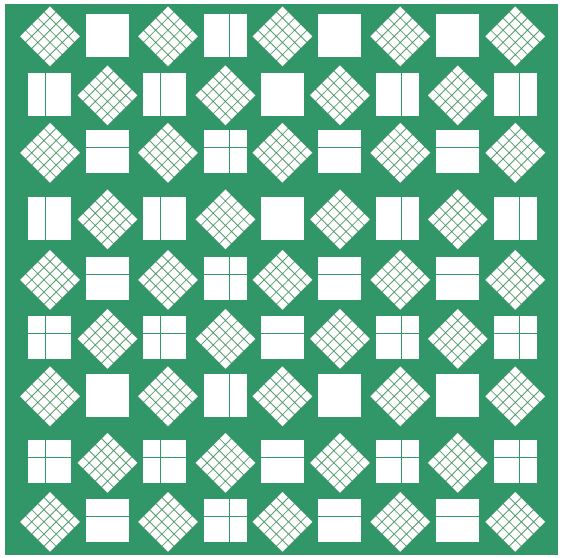
Answer:
Given:
1. A large image containing a grid of pattern blocks.
2. Number of pattern blocks in each row = $9$.
3. Number of pattern blocks in each column = $9$.
4. Each individual pattern block is composed of a $5 \times 5$ grid of tiny squares.
To Find:
1. Total number of tiny squares in the picture.
2. The prime factorisation of the total number of tiny squares.
Solution:
First, we calculate the total number of pattern blocks present in the image:
$\text{Total Blocks} = 9 \times 9 = 81$
Next, we determine the number of tiny squares within each single pattern block. Each block is a square arrangement of $5$ tiny squares by $5$ tiny squares:
$\text{Tiny squares per block} = 5 \times 5 = 25$
Now, to find the total number of tiny squares in the entire picture, we multiply the total number of blocks by the number of squares per block:
$\text{Total Tiny Squares} = 81 \times 25$
Performing the multiplication:
$\text{Total Tiny Squares} = 2025$
[Final Count]
Prime Factorisation:
We will now find the prime factorisation of $2025$ using the division method:
$$\begin{array}{c|cc} 3 & 2025 \\ \hline 3 & 675 \\ \hline 3 & 225 \\ \hline 3 & 75 \\ \hline 5 & 25 \\ \hline 5 & 5 \\ \hline & 1 \end{array}$$
The prime factorisation of $2025$ is:
$2025 = 3 \times 3 \times 3 \times 3 \times 5 \times 5$
In index form, it can be written as $3^4 \times 5^2$.
Conclusion:
There are $2025$ tiny squares in the picture, and its prime factorisation is $3 \times 3 \times 3 \times 3 \times 5 \times 5$.
Figure It Out (Page No. 16 - 17)
Question 1. Find the cube roots of $27000$ and $10648$.
Answer:
To Find:
The cube root ($\sqrt[3]{\quad}$) of the given numbers $27000$ and $10648$.
Solution for (i) $27000$:
We use the prime factorisation method:
$$\begin{array}{c|cc} 2 & 27000 \\ \hline 2 & 13500 \\ \hline 2 & 6750 \\ \hline 3 & 3375 \\ \hline 3 & 1125 \\ \hline 3 & 375 \\ \hline 5 & 125 \\ \hline 5 & 25 \\ \hline 5 & 5 \\ \hline & 1 \end{array}$$
$27000 = \underline{2 \times 2 \times 2} \times \underline{3 \times 3 \times 3} \times \underline{5 \times 5 \times 5}$
$\sqrt[3]{27000} = 2 \times 3 \times 5$
$\sqrt[3]{27000} = 30$
Solution for (ii) $10648$:
We use the prime factorisation method:
$$\begin{array}{c|cc} 2 & 10648 \\ \hline 2 & 5324 \\ \hline 2 & 2662 \\ \hline 11 & 1331 \\ \hline 11 & 121 \\ \hline 11 & 11 \\ \hline & 1 \end{array}$$
$10648 = \underline{2 \times 2 \times 2} \times \underline{11 \times 11 \times 11}$
$\sqrt[3]{10648} = 2 \times 11$
$\sqrt[3]{10648} = 22$
Conclusion:
The cube root of $27000$ is $30$ and the cube root of $10648$ is $22$.
Question 2. What number will you multiply by $1323$ to make it a cube number?
Answer:
Given:
Number = $1323$
To Find:
The smallest number to be multiplied by $1323$ to make it a perfect cube.
Solution:
First, we find the prime factorisation of $1323$.
$$\begin{array}{c|cc} 3 & 1323 \\ \hline 3 & 441 \\ \hline 3 & 147 \\ \hline 7 & 49 \\ \hline 7 & 7 \\ \hline & 1 \end{array}$$
The prime factorisation of $1323$ is:
$1323 = \underline{3 \times 3 \times 3} \times 7 \times 7$
In a perfect cube, every prime factor must appear in triples (groups of three). In the factorisation above, the factor $3$ is in a triple, but the factor $7$ appears only twice.
To make it a triple, we need one more $7$.
Conclusion:
The smallest number by which $1323$ must be multiplied is $7$.
The resulting perfect cube would be $1323 \times 7 = 9261$, which is $21^3$.
Question 3. State true or false. Explain your reasoning.
(i) The cube of any odd number is even.
(ii) There is no perfect cube that ends with $8$.
(iii) The cube of a $2$-digit number may be a $3$-digit number.
(iv) The cube of a $2$-digit number may have seven or more digits.
(v) Cube numbers have an odd number of factors.
Answer:
(i) The cube of any odd number is even.
False. The cube of an odd number is always odd. For example, $3$ is an odd number and its cube $3^3 = 27$ is also an odd number.
(ii) There is no perfect cube that ends with $8$.
False. A perfect cube can end with any digit. For example, the cube of $2$ is $2^3 = 8$, which ends with the digit $8$. Also, the cube of $12$ is $1728$, which ends with $8$.
(iii) The cube of a $2$-digit number may be a $3$-digit number.
False. The smallest $2$-digit number is $10$. Its cube is $10^3 = 1000$. Since $1000$ is a $4$-digit number, the cube of any $2$-digit number must have at least $4$ digits.
(iv) The cube of a $2$-digit number may have seven or more digits.
False. The largest $2$-digit number is $99$. Its cube is $99^3 = 970299$. This is a $6$-digit number. Since the smallest $3$-digit number is $100$ and its cube is $100^3 = 1,000,000$ (a $7$-digit number), no $2$-digit number's cube can have $7$ or more digits.
(v) Cube numbers have an odd number of factors.
False. Only perfect square numbers have an odd number of factors. A perfect cube that is not a perfect square will have an even number of factors. For example, $8$ is a perfect cube and its factors are $1, 2, 4,$ and $8$. The number of factors is $4$, which is even.
Question 4. You are told that $1331$ is a perfect cube. Can you guess without factorisation what its cube root is? Similarly, guess the cube roots of $4913$, $12167$, and $32768$.
Answer:
Concept: To find the cube root of a perfect cube by estimation, we group the digits into threes starting from the unit's place and use the property of cubes of numbers from $1$ to $10$.
Solution for $1331$:
Step 1: Group the digits from right to left: $\overline{1}, \overline{331}$.
Step 2: Take the first group $331$. It ends in $1$. We know that the cube of a number ending in $1$ also ends in $1$ ($1^3 = 1$). So, the unit digit of the cube root is $1$.
Step 3: Take the second group $1$. Since $1^3 = 1$, the tens digit of the cube root is $1$.
Thus, $\sqrt[3]{1331} = 11$.
Solution for $4913$:
Step 1: Grouping: $\overline{4}, \overline{913}$.
Step 2: Group $913$ ends in $3$. We know that a number ending in $7$ has its cube ending in $3$ ($7^3 = 343$). So, the unit digit is $7$.
Step 3: Group $4$ lies between $1^3 = 1$ and $2^3 = 8$. We take the smaller number. So, the tens digit is $1$.
Thus, $\sqrt[3]{4913} = 17$.
Solution for $12167$:
Step 1: Grouping: $\overline{12}, \overline{167}$.
Step 2: Group $167$ ends in $7$. A number ending in $3$ has its cube ending in $7$ ($3^3 = 27$). So, the unit digit is $3$.
Step 3: Group $12$ lies between $2^3 = 8$ and $3^3 = 27$. We take the smaller number. So, the tens digit is $2$.
Thus, $\sqrt[3]{12167} = 23$.
Solution for $32768$:
Step 1: Grouping: $\overline{32}, \overline{768}$.
Step 2: Group $768$ ends in $8$. A number ending in $2$ has its cube ending in $8$ ($2^3 = 8$). So, the unit digit is $2$.
Step 3: Group $32$ lies between $3^3 = 27$ and $4^3 = 64$. We take the smaller number. So, the tens digit is $3$.
Thus, $\sqrt[3]{32768} = 32$.
Conclusion:
The estimated cube roots are $11$, $17$, $23$, and $32$ respectively.
Question 5. Which of the following is the greatest? Explain your reasoning.
(i) $67^3 - 66^3$
(ii) $43^3 - 42^3$
(iii) $67^2 - 66^2$
(iv) $43^2 - 42^2$
Answer:
Analysis of the expressions:
We will calculate the value of each expression using the identities for the difference of consecutive squares and cubes.
(iv) Solution for $43^2 - 42^2$:
Using the identity $a^2 - b^2 = (a - b)(a + b)$:
$43^2 - 42^2 = (43 - 42)(43 + 42)$
$= 1 \times (43 + 42)$
Value of (iv) = $85$.
(iii) Solution for $67^2 - 66^2$:
Using the identity $a^2 - b^2 = (a - b)(a + b)$:
$67^2 - 66^2 = (67 - 66)(67 + 66)$
$= 1 \times (67 + 66)$
Value of (iii) = $133$.
(ii) Solution for $43^3 - 42^3$:
Using the property for the difference of consecutive cubes: $n^3 - (n - 1)^3 = 1 + 3n(n - 1)$.
$43^3 - 42^3 = 1 + 3 \times 43 \times 42 = 5419$
Value of (ii) = $5419$.
(i) Solution for $67^3 - 66^3$:
Using the property for the difference of consecutive cubes: $n^3 - (n - 1)^3 = 1 + 3n(n - 1)$.
$67^3 - 66^3 = 1 + 3 \times 67 \times 66 = 13267$
Value of (i) = $13267$.
Conclusion:
Comparing all the calculated values:
(i) $13267$
(ii) $5419$
(iii) $133$
(iv) $85$
Since $13267 > 5419 > 133 > 85$, the expression (i) $67^3 - 66^3$ is the greatest.