

Chapter 3 A Story of Numbers (Class 8 - Latest Maths NCERT (Ganita Prakash I) Solutions)
Looking for accurate and insightful NCERT Solutions for Chapter 3: A Story of Numbers? You’ve come to the right place! This page provides comprehensive, step-by-step answers to the exercises in your Ganita Prakash I textbook. We help you navigate the fascinating historical journey of mathematics, from the primitive one-to-one mapping of the Stone Age to the sophisticated symbols we use today. Our solutions are designed to show you that math is a creative invention, making the evolution of counting relatable and easy to understand.
Our solutions offer detailed breakdowns of various ancient systems, including the Tally Marks of the Ishango bone and the "landmark number" logic of the Roman Number System. We provide clear guidance on solving problems related to Base-n Systems, such as the Mesopotamian base-60, Egyptian base-10, and Mayan base-20 systems. By following our step-by-step explanations, you will understand the historical "need for a placeholder" and how different civilizations tackled mathematical ambiguity.
A key focus of our resources is the Hindu Number System and the revolutionary concept of zero. We provide historical and mathematical context for the Bakhshali Manuscript and the contributions of legendary Indian mathematicians like Aryabhata and Brahmagupta. These resources, curated by learningspot.co, explain how the decimal place-value system transformed global commerce and science, ensuring you master both the history and the logic of the numbers we use every day.
Figure It Out (Page No. 54)
Question 1. Suppose you are using the number system that uses sticks to represent numbers, as in Method $1$. Without using either the number names or the numerals of the Hindu number system, give a method for adding, subtracting, multiplying and dividing two numbers or two collections of sticks.
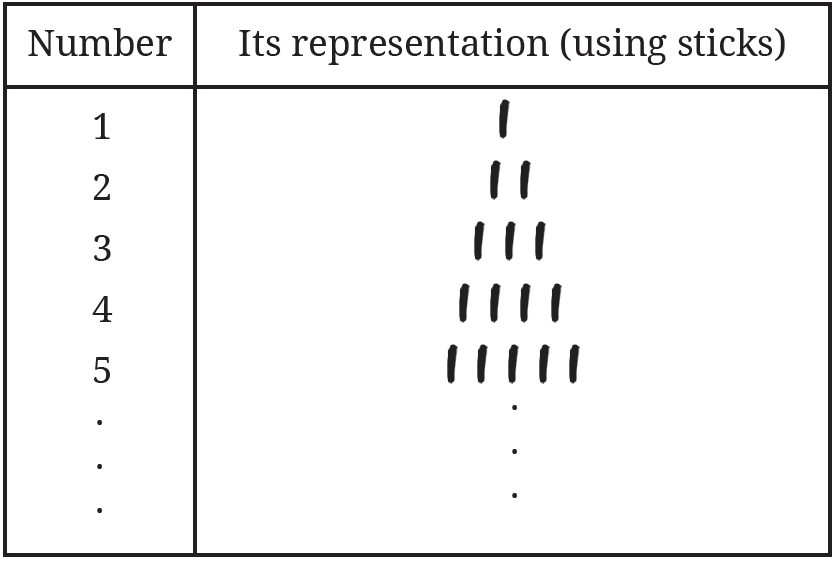
Answer:
Given:
A number system where each number is represented by a collection of vertical sticks ($|$), such that one stick represents one unit.
To Find:
Methods for arithmetic operations (Addition, Subtraction, Multiplication, and Division) using only sticks.
Solution:
1. Addition:
To add two collections, simply place all the sticks from the first collection and the second collection together into a single pile. The total number of sticks in the combined pile represents the sum.
$||$ $+$ $|||$ $=$ $\bcancel{||||}$
[Combining two piles] ... (i)
2. Subtraction:
To subtract a smaller collection from a larger one, line up the sticks from both collections side-by-side. For every stick in the smaller collection, remove or cross out one corresponding stick from the larger collection. The remaining sticks in the larger collection represent the difference.
$\bcancel{||||}$ $-$ $||$ $=$ $|||$
[Removing matching sticks] ... (ii)
3. Multiplication:
To multiply two collections, look at the number of sticks in the second collection. Place the entire first collection of sticks on the ground that many times. For example, if multiplying three sticks by two sticks, place a group of three sticks down twice. The total resulting sticks represent the product.
$|||$ $\times$ $||$ $=$ $|||$ $+$ $|||$ $=$ $||||||$
[Repeated addition of groups] ... (iii)
4. Division:
To divide a large collection (dividend) by a smaller collection (divisor), keep taking away a group of sticks equal to the divisor from the dividend until the remaining sticks are fewer than the divisor. The number of times you successfully took away a group is the quotient, and the leftover sticks are the remainder.
$||||||$ $\div$ $|||$ $=$ (one group of $|||$) $+$ (one group of $|||$)
[Grouping process] ... (iv)
The total count of groups formed represents the result of the division.
Question 2. One way of extending the number system in Method $2$ is by using strings with more than one letter — for example, we could use ‘aa’ for $27$. How can you extend this system to represent all the numbers? There are many ways of doing it!
Answer:
Solution:
In this system, we assign numerical values to the English alphabets starting from $a$ up to $z$.
$a, b, c, \dots, z$ are 26 numbers representing values from $1$ to $26$.
$aa, bb, \dots, zz$ are 26 more numbers that extend the sequence.
Detailed Explanation:
To represent all numbers systematically, we can use a positional notation system similar to the base-10 (decimal) system we use in India, but here the base is $26$.
1. Single-letter strings: $a=1, b=2, c=3, \dots, z=26$.
2. Two-letter strings: After $z$ ($26$), we start with $aa$ ($27$), $ab$ ($28$), $ac$ ($29$), and so on, until $az$ ($52$). Then we continue with $ba, bb, \dots, bz$, and finally reaching $zz$.
The total number of two-letter combinations possible is $26 \times 26 = 676$.
3. Three-letter strings: After $zz$ is exhausted, we move to $aaa$, $aab$, and so on. This allows us to represent infinitely many numbers by simply increasing the length of the string.
Question 3. Try making your own number system.
Answer:
Given:
The requirement is to design an original number system with unique symbols and rules for representation.
Construction (The Symbolic System):
In this new system, we will use symbols inspired by Indian nature to represent different values. This is an Additive Number System where the total value is found by adding the values of the individual symbols together.
The basic symbols are defined in the table below:
| Symbol Name | Visual Representation | Value in Decimal |
| Lotus (Kamal) | $\clubsuit$ | $100$ |
| Lamp (Diya) | $\triangle$ | $10$ |
| Petal (Pankhudi) | $\mid$ | $1$ |
Solution:
Rule 1: Symbols are written from largest value to smallest value.
Rule 2: To find the total value, simply add the values of all symbols shown.
Rule 3: A symbol can be repeated as many times as needed to reach the desired amount.
For example, if we want to represent the price of a book which is $\textsf{₹} 123$, we would use:
1. One Lotus ($\clubsuit$) for $100$.
2. Two Lamps ($\triangle \triangle$) for $10 + 10 = 20$.
3. Three Petals ($\mid \mid \mid$) for $1 + 1 + 1 = 3$.
$\text{Decimal } 123 = \clubsuit \triangle \triangle \mid \mid \mid$
[Representation in the New System]
Figure It Out (Page No. 59)
Question. Represent the following numbers in the Roman system.
(i) $1222$
(ii) $2999$
(iii) $302$
(iv) $715$
Answer:
To Find:
The Roman numeral representation for the decimal numbers: (i) $1222$, (ii) $2999$, (iii) $302$, and (iv) $715$.
Solution:
In the Indian school curriculum, Roman numerals are taught as an ancient system of notation. The basic symbols used in this system are:
| Roman Symbol | I | V | X | L | C | D | M |
| Decimal Value | 1 | 5 | 10 | 50 | 100 | 500 | 1000 |
(i) For the number $1222$:
We expand the number according to its place values:
$1222 = 1000 + 200 + 20 + 2$
[Expansion]
$1222 = \text{M} + \text{CC} + \text{XX} + \text{II}$
[Roman mapping]
Thus, $1222$ in Roman system is MCCXXII.
(ii) For the number $2999$:
We expand the number as:
$2999 = 2000 + 900 + 90 + 9$
[Expansion]
Converting each part to Roman numerals using the subtractive principle:
$2000 = \text{MM}$
$900 = \text{CM}$ (which is $1000 - 100$)
$90 = \text{XC}$ (which is $100 - 10$)
$9 = \text{IX}$ (which is $10 - 1$)
$2999 = \text{MM} + \text{CM} + \text{XC} + \text{IX}$
[Combining symbols]
Thus, $2999$ in Roman system is MMCMXCIX.
(iii) For the number $302$:
Expanding the number:
$302 = 300 + 2$
[Expansion]
$302 = \text{CCC} + \text{II}$
[Roman mapping]
Thus, $302$ in Roman system is CCCII.
(iv) For the number $715$:
Expanding the number:
$715 = 700 + 10 + 5$
[Expansion]
$715 = 500 + 200 + 10 + 5$
[Simplified expansion]
$715 = \text{D} + \text{CC} + \text{X} + \text{V}$
[Roman mapping]
Thus, $715$ in Roman system is DCCXV.
Figure It Out (Page No. 60 - 61)
Question 1. A group of indigenous people in a Pacific island use different sequences of number names to count different objects. Why do you think they do this?
Answer:
Solution:
The use of different number sequences for different categories of objects is a fascinating linguistic and mathematical phenomenon found in several indigenous cultures. They probably use different number sequences to make counting more meaningful, accurate, and culturally appropriate, depending on the type of object.
Here is a detailed breakdown of why this happens:
1. Nature of the Object: Different objects have different physical properties. For example, counting round objects (like coconuts or fruit) might require a different set of number names compared to counting long, flat, or living objects (like canoes, fish, or people).
2. Cultural Context and Utility: In traditional societies, numbers are not always purely abstract entities. They are tied to daily survival and trade. A specific sequence might embed units of measurement or bundling (e.g., counting items in pairs, bundles of $10$, or baskets of $20$).
3. Historical and Ancestral Tradition: These number systems preserve ancient knowledge and classification systems handed down through generations. The counting words often describe the shape, value, or sacred nature of the items being counted.
Question 2. Consider the extension of the Gumulgal number system beyond $6$ in the same way of counting by $2$s. Come up with ways of performing the different arithmetic operations ($+$, $-$, $\times$, $\div$) for numbers occurring in this system, without using Hindu numerals. Use this to evaluate the following:
(i) $(ukasar-ukasar-ukasar-ukasar-urapon) $$ + (ukasar-ukasar-ukasar-urapon)$
(ii) $(ukasar-ukasar-ukasar-ukasar-urapon) $$ - (ukasar-ukasar-ukasar)$
(iii) $(ukasar-ukasar-ukasar-ukasar-urapon) $$ \times (ukasar-ukasar)$
(iv) $(ukasar-ukasar-ukasar-ukasar-ukasar-ukasar $$-ukasar-ukasar) \div (ukasar-ukasar)$
Answer:
Given:
In the Gumulgal system:
$urapon = 1$
$ukasar = 2$
Rules for Arithmetic:
1. Addition: Combine all the terms from both numbers. If you have two $urapon$, replace them with one $ukasar$.
2. Subtraction: Remove the terms of the second number from the first number. If you need to subtract an $urapon$ but only have $ukasar$, decompose one $ukasar$ into two $urapon$.
3. Multiplication: Repeat the sequence of the first number as many times as there are units in the second number.
4. Division: See how many times the sequence of the divisor fits into the sequence of the dividend.
Solution (i): Addition
$(ukasar-ukasar-ukasar-ukasar-urapon) $$ + (ukasar-ukasar-ukasar-urapon)$
Combining them: $ukasar-ukasar-ukasar-ukasar $$-ukasar-ukasar-ukasar-urapon-urapon$
$urapon + urapon = ukasar$
[Rule of replacement]
Result: $ukasar-ukasar-ukasar-ukasar-ukasar $$-ukasar $$-ukasar-ukasar$ (Total eight $ukasar$s)
Solution (ii): Subtraction
$(ukasar-ukasar-ukasar-ukasar-urapon) $$ - (ukasar-ukasar-ukasar)$
We remove three $ukasar$s from the first group.
Remaining: $ukasar-urapon$
Result: $ukasar-urapon$
Solution (iii): Multiplication
$(ukasar-ukasar-ukasar-ukasar-urapon) $$ \times (ukasar-ukasar)$
The second number is $ukasar-ukasar$, which is $4$ in decimal. We repeat the first sequence four times.
Total count of $ukasar$s: $4 \times 4 = 16$.
Total count of $urapon$s: $1 \times 4 = 4$ (which becomes $2$ $ukasar$s).
Result: $ukasar-ukasar-ukasar-ukasar-ukasar-ukasar $$-ukasar-ukasar-ukasar-ukasar-ukasar-ukasar $$-ukasar-ukasar-ukasar-ukasar-ukasar-ukasar$ (Total eighteen $ukasar$s)
Solution (iv): Division
$(ukasar-ukasar-ukasar-ukasar-ukasar-ukasar $$-ukasar-ukasar) \div (ukasar-ukasar)$
We group the eight $ukasar$s into sets of two $ukasar$s.
There are $4$ such sets. In this system, $4$ is $ukasar-ukasar$.
Result: $ukasar-ukasar$
Question 3. Identify the features of the Hindu number system that make it efficient when compared to the Roman number system.
Answer:
Solution:
The Hindu-Arabic number system (which originated in India) is considered the most efficient system in the world due to the following features:
1. The Concept of Zero (Shunya): The inclusion of '0' as a placeholder and a value is the greatest contribution of Indian mathematicians like Aryabhata and Brahmagupta. It allows us to distinguish between numbers like $1, 10,$ and $100$ easily, whereas the Roman system has no symbol for zero.
2. Place Value System: In the Hindu system, the position of a digit determines its value (Units, Tens, Hundreds, etc.). In the Roman system, the value is mostly additive (e.g., $\text{III} = 1+1+1$) or subtractive ($\text{IV} = 5-1$), which makes representing large numbers extremely cumbersome.
3. Limited Symbols: We only need ten symbols ($0, 1, 2, 3, 4, 5, 6, 7, 8, 9$) to represent any number, no matter how large. The Roman system requires new symbols for larger values ($\text{I, V, X, L, C, D, M}$) and eventually runs out of standard symbols.
4. Ease of Calculation: Performing arithmetic operations like multiplication and long division is straightforward in a positional system. In the Roman system, even a simple multiplication like $\text{XVIII} \times \text{XXIV}$ is nearly impossible to do without converting it to another system first.
Comparison Table:
| Feature | Hindu Number System | Roman Number System |
| Base | Base 10 (Decimal) | No fixed base (Mixed) |
| Zero | Exists ($0$) | Does not exist |
| Logic | Positional Value | Additive/Subtractive |
| Calculations | Very Simple | Very Complex |
Question 4. Using the ideas discussed in this section, try refining the number system you might have made earlier.
Answer:
Earlier System (Simple Additive):
In the previous version, we used symbols: Lotus ($\clubsuit = 100$), Lamp ($\triangle = 10$), and Petal ($\mid = 1$). To write $111$, we had to write $\clubsuit \triangle \mid$.
Refined System (Positional with Zero):
Taking inspiration from the Hindu-Arabic system, I will refine the "Nature System" into a Positional Base-10 system. Instead of the symbols having fixed values, their value will now depend on their position.
1. New Symbols: We use 10 nature-based digits: $\text{Seed } (0), \text{Leaf } (1), \text{Bud } (2), \text{Flower } (3), \dots$ and so on.
2. Introduction of Shunya (Zero): The Seed ($\cdot$) will represent Zero. This is the most critical refinement.
3. Place Value Columns:
$\text{Value} = (d_2 \times 10^2) + (d_1 \times 10^1) + (d_0 \times 10^0)$
Example of Refinement:
To represent the number $102$ (e.g., $\textsf{₹} 102$ in an Indian shop):
Old System: $\clubsuit \mid \mid$ (Lotus + Petal + Petal)
Refined System: $\text{Leaf} \text{ Seed} \text{ Bud}$
Here, the Leaf is in the hundreds place, the Seed acts as a placeholder for zero in the tens place, and the Bud is in the units place.
Conclusion:
This refinement makes the system much more efficient. We no longer need to invent new symbols like "Sun" for 1000 or "Mountain" for 10,000. By using just 10 symbols and the concept of Shunya, we can represent infinite quantities, making it as powerful as the modern system used across India today.
Figure It Out (Page No. 62)
Question 1. Represent the following numbers in the Egyptian system: $10458$, $1023$, $2660$, $784$, $1111$, $70707$.

Answer:
Solution:
Given:
The numbers $10458$, $1023$, $2660$, $784$, $1111$, and $70707$ represented step-by-step with their corresponding Egyptian hieroglyphic symbol images.
To Find:
The hieroglyphic breakdown and visual representation for each number.
1. Representation of $10458$:
Breakdown: $10000 + 400 + 50 + 8$
2. Representation of $1023$:
Breakdown: $1000 + 20 + 3$
3. Representation of $2660$:
Breakdown: $2000 + 600 + 60$
4. Representation of $784$:
Breakdown: $700 + 80 + 4$
5. Representation of $1111$:
Breakdown: $1000 + 100 + 10 + 1$
6. Representation of $70707$:
Breakdown: $70000 + 700 + 7$
Question 2. What numbers do these numerals stand for?
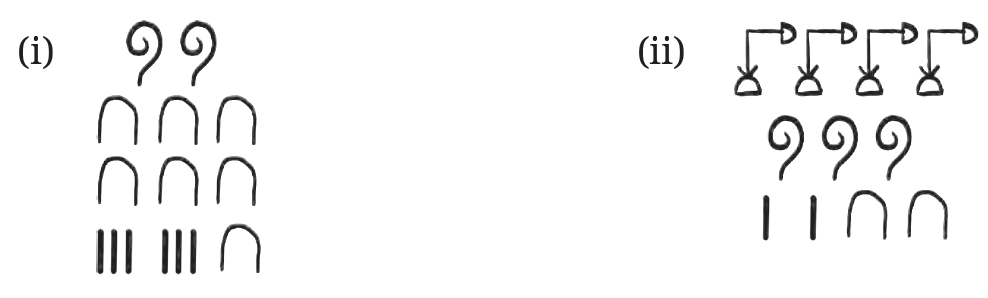
Answer:
Given:
Two sets of ancient Egyptian hieroglyphic numerals marked as (i) and (ii).
To Find:
The standard Hindu-Arabic numeral value represented by each Egyptian numeral set.
Analysis of Set (i):
Let us count the symbols in part (i) based on the standard Egyptian values ($1$ stroke = $1$, $1$ heel bone = $10$, $1$ coil of rope = $100$):
1. Coils of rope ($100$): There are $2$ coils.
$\text{Value from coils} = 2 \times 100 = 200$
2. Heel bones ($10$): There are $7$ heel bones.
$\text{Value from heel bones} = 7 \times 10 = 70$
3. Vertical strokes ($1$): There are $6$ strokes.
$\text{Value from strokes} = 6 \times 1$
[Single units]
Adding them all up:
$\text{Total for (i)} = 200 + 70 + 6 = 276$
Analysis of Set (ii):
Let us count the symbols in part (ii) based on the Egyptian values ($1$ stroke = $1$, $1$ heel bone = $10$, $1$ coil of rope = $100$, $1$ lotus flower = $1000$):
1. Lotus flowers ($1000$): There are $4$ lotus flowers.
$\text{Value from lotus flowers} = 4 \times 1000 = 4000$
2. Coils of rope ($100$): There are $3$ coils.
$\text{Value from coils} = 3 \times 100 = 300$
3. Heel bones ($10$): There are $2$ heel bones.
$\text{Value from heel bones} = 2 \times 10 = 20$
4. Vertical strokes ($1$): There are $2$ strokes.
$\text{Value from strokes} = 2 \times 1$
Adding them all up:
$\text{Total for (ii)} = 4000 + 300 + 20 + 2 = 4322$
Summary Table:
| Numeral Set | Symbols Present | Calculated Value |
| (i) | $2$ Coils ($200$), $7$ Bones ($70$), $6$ Strokes ($6$) | $276$ |
| (ii) | $4$ Lotuses ($4000$), $3$ Coils ($300$), $2$ Bones ($20$), $2$ Strokes ($2$) | $4322$ |
Figure It Out (Page No. 63)
Question 1. Write the following numbers in the above base-$5$ system using the symbols in Table $2$: $15$, $50$, $137$, $293$, $651$.

Answer:
Step-by-Step Representation with Images:
1. Representing $15$:
$15 = (3 \times 5) + (0 \times 1)$
2. Representing $50$:
$50 = (2 \times 25) + (0 \times 5) + (0 \times 1)$
3. Representing $137$:
$137 = (1 \times 125) + (0 \times 25) + (2 \times 5) + (2 \times 1)$
4. Representing $293$:
$293 = (2 \times 125) + (1 \times 25) + (3 \times 5) + (3 \times 1)$
5. Representing $651$:
$651 = (1 \times 625) + (0 \times 125) + (1 \times 25) + (0 \times 5) + (1 \times 1)$
Question 2. Is there a number that cannot be represented in our base-$5$ system above? Why or why not?
Answer:
Solution:
No, there is no natural number that cannot be represented in the base-$5$ system.
Reasoning:
The base-$5$ system is a Positional Number System, much like the decimal system we use in India. Just as we can represent any number in base-$10$ using digits $0-9$, we can represent any number in base-$5$ using digits $0-4$.
1. Infinite Positions: We can always add a new place value to the left (powers of $5$: $5^0, 5^1, 5^2, \dots$) to represent larger and larger quantities.
2. Completeness: The digits $0, 1, 2, 3,$ and $4$ cover all possible remainders when any integer is divided by $5$. This ensures that every number has a unique and valid representation.
Question 3. Compute the landmark numbers of a base-$7$ system. In general, what are the landmark numbers of a base-$n$ system?
Answer:
To Find:
The landmark numbers for base-$7$ and the general formula for base-$n$.
Solution:
In any positional system, Landmark Numbers are those numbers that represent the start of a new place value (the powers of the base). In our common decimal system, the landmarks are $10, 100, 1000, \dots$.
1. Landmark Numbers for Base-$7$:
These are calculated by finding the powers of $7$:
$7^1 = 7$
$7^2 = 7 \times 7 = 49$
$7^3 = 49 \times 7 = 343$
$7^4 = 343 \times 7 = 2401$
The landmark numbers for base-$7$ are $7, 49, 343, 2401, \dots$
2. Landmark Numbers for Base-$n$:
In general, for any system with base $n$, the landmark numbers are the successive powers of that base:
$\text{Landmarks} = n^1, n^2, n^3, n^4, \dots, n^k$
[Where $k$ is a natural number]
Example Table:
| System | 1st Landmark | 2nd Landmark | 3rd Landmark |
| Base-10 (Decimal) | 10 | 100 | 1000 |
| Base-7 (Septenary) | 7 | 49 | 343 |
| Base-2 (Binary) | 2 | 4 | 8 |
Figure It Out (Page No. 65)
Question 1. Add the following Egyptian numerals:
(i)
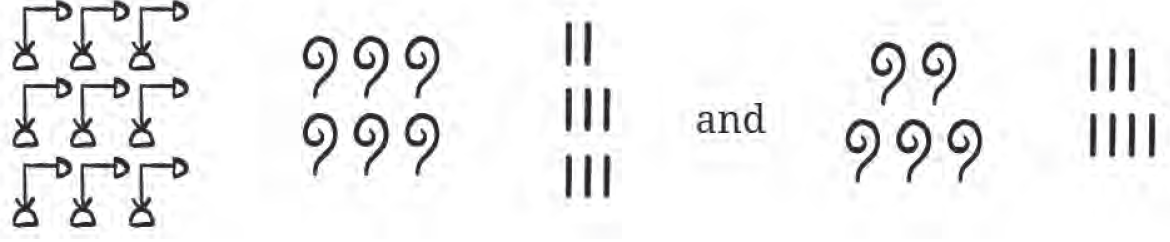
(ii)
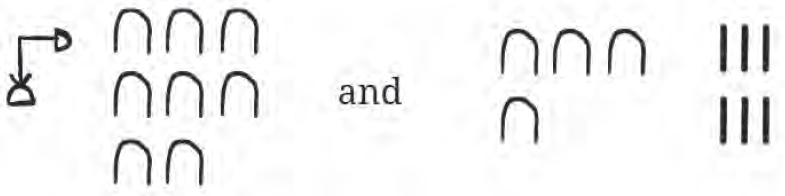
Answer:
Part (i):
1. First Number: There are $9$ Lotus flowers ($9000$), $6$ Coils of rope ($600$), and $8$ Vertical strokes ($8$).
$\text{First Numeral} = 9000 + 600 + 8 = 9608$
2. Second Number: There are $5$ Coils of rope ($500$) and $7$ Vertical strokes ($7$).
$\text{Second Numeral} = 500 + 7 = 507$
Adding them together with regrouping (carrying over):
$\text{Sum} = 9608 + 507 = 10115$
Part (ii):
1. First Number: There is $1$ Lotus flower ($1000$) and $8$ Heel bones ($80$).
$\text{First Numeral} = 1000 + 80 = 1080$
2. Second Number: There are $4$ Heel bones ($40$) and $6$ Vertical strokes ($6$).
$\text{Second Numeral} = 40 + 6 = 46$
Adding them together:
$\text{Sum} = 1080 + 46 = 1126$
Summary Table:
| Part | First Number Breakdown | Second Number Breakdown | Total Sum |
| (i) | $9000 + 600 + 8 = 9608$ | $500 + 7 = 507$ | $10115$ |
| (ii) | $1000 + 80 = 1080$ | $40 + 6 = 46$ | $1126$ |
Question 2. Add the following numerals that are in the base-$5$ system that we created:

Remember that in this system, $5$ times a landmark number gives the next one!
Answer:
Given:
An addition problem in the custom base-$5$ geometric symbol system where:
$\bullet$ Triangle = $1$ ($5^0$)
$\bullet$ Square = $5$ ($5^1$)
$\bullet$ Hexagon = $25$ ($5^2$)
$\bullet$ Circle = $125$ ($5^3$)
To Find:
The sum of the two base-$5$ numbers represented by the geometric symbols in the image.
Step-1: Value of the First Numeral (Left Side):
Looking at the symbols before the '$+$' sign:
$\bullet$ $1$ Circle $= 1 \times 125 = 125$
$\bullet$ $2$ Hexagons $= 2 \times 25 = 50$
$\bullet$ $1$ Square $= 1 \times 5 = 5$
$\bullet$ $2$ Triangles $= 2 \times 1 = 2$
$\text{First Number} = 125 + 50 + 5 + 2 = 182$
Step-2: Value of the Second Numeral (Right Side):
Looking at the symbols after the '$+$' sign:
$\bullet$ $3$ Circles $= 3 \times 125 = 375$
$\bullet$ $1$ Hexagon $= 1 \times 25 = 25$
$\bullet$ $2$ Squares $= 2 \times 5 = 10$
$\bullet$ $2$ Triangles $= 2 \times 1 = 2$
$\text{Second Number} = 375 + 25 + 10 + 2 = 412$
Step-3: Performing the Addition:
Adding the decimal values together:
$\text{Total Sum} = 182 + 412 = 594$
[Decimal Sum]
Now let's add the base-$5$ numerals directly using the rule that $5$ of any symbol regroup into $1$ of the next higher symbol:
$\bullet$ Triangles: $2 + 2 = 4$ Triangles
$\bullet$ Squares: $1 + 2 = 3$ Squares
$\bullet$ Hexagons: $2 + 1 = 3$ Hexagons
$\bullet$ Circles: $1 + 3 = 4$ Circles
Figure It Out (Page No. 69 - 70)
Question 1. Can there be a number whose representation in Egyptian numerals has one of the symbols occurring $10$ or more times? Why not?
Answer:
No, in the Egyptian numeral system, if a symbol occurs $10$ times, it is replaced by the next landmark symbol. So, no symbol is used $10$ or more times in a valid representation.
Here is a detailed explanation of this rule:
1. Base-$10$ Grouping Principle: The Egyptian system is a decimal (base-$10$) additive system. Every landmark symbol represents a power of $10$ ($1, 10, 100, 1000$, etc.).
$\text{10 Strokes} (\text{I}) = 1 \text{ Heel Bone} (\cap)$
$\text{10 Heel Bones} (\cap) = 1 \text{ Coil of Rope} (\text{e})$
2. Compactness and Efficiency: Writing the same symbol $10$ or more times defeats the purpose of having a higher-level landmark symbol. For example, writing $10$ vertical strokes ($\text{IIIIIIIIII}$) is redundant and inefficient when it can be written compactly as a single heel bone ($\cap$).
$\text{Max count per symbol} \leq 9$
[Standard Rule]
| Lower Symbol Count | Equivalence Rule | Next Higher Symbol |
| $10$ Strokes ($\text{I}$) | Replaced by | $1$ Heel Bone ($\cap$) |
| $10$ Heel Bones ($\cap$) | Replaced by | $1$ Coil of Rope ($\text{e}$) |
| $10$ Coils of Rope ($\text{e}$) | Replaced by | $1$ Lotus Flower ($\text{f}$) |
Question 2. Create your own number system of base $4$, and represent numbers from $1$ to $16$.
Answer:
Construction:
We will create a Base-4 system using symbols inspired by the four directions (North, South, East, West), which are significant in Indian Vastu Shastra.
| Decimal Digit | 0 | 1 | 2 | 3 |
| New Symbol | $\cdot$ (Dot) | $\uparrow$ (Up) | $\downarrow$ (Down) | $\leftrightarrow$ (Side) |
Solution:
In a base-$4$ system, the place values are $4^0=1, 4^1=4, 4^2=16,$ and so on. Below is the representation of numbers from $1$ to $16$:
| Decimal | Base-4 Calculation | New System Symbols |
| 1 | $1$ | $\uparrow$ |
| 2 | $2$ | $\downarrow$ |
| 3 | $3$ | $\leftrightarrow$ |
| 4 | $1 \times 4 + 0$ | $\uparrow \cdot$ |
| 5 | $1 \times 4 + 1$ | $\uparrow \uparrow$ |
| 6 | $1 \times 4 + 2$ | $\uparrow \downarrow$ |
| 7 | $1 \times 4 + 3$ | $\uparrow \leftrightarrow$ |
| 8 | $2 \times 4 + 0$ | $\downarrow \cdot$ |
| 9 | $2 \times 4 + 1$ | $\downarrow \uparrow$ |
| 10 | $2 \times 4 + 2$ | $\downarrow \downarrow$ |
| 11 | $2 \times 4 + 3$ | $\downarrow \leftrightarrow$ |
| 12 | $3 \times 4 + 0$ | $\leftrightarrow \cdot$ |
| 13 | $3 \times 4 + 1$ | $\leftrightarrow \uparrow$ |
| 14 | $3 \times 4 + 2$ | $\leftrightarrow \downarrow$ |
| 15 | $3 \times 4 + 3$ | $\leftrightarrow \leftrightarrow$ |
| 16 | $1 \times 16 + 0 \times 4 + 0$ | $\uparrow \cdot \cdot$ |
Observation:
Notice that for the number $16$, we have reached the second landmark ($4^2$), which requires a three-digit string in our base-4 system.
Question 3. Give a simple rule to multiply a given number by $5$ in the base-$5$ system that we created.
Answer:
Visual Reference for Multiplication by $5$:
Rule for Multiplication by $5$:
To multiply any number by $5$ in the base-$5$ system, you simply shift every symbol up to the next higher landmark symbol (i.e., upgrade each shape to the next shape in sequence). Alternatively, in numeral notation, you append a zero ($0$) to the right of the base-$5$ number.
Example Illustration:
Suppose we want to multiply the number $2$ (represented as $2$ triangles: $\triangle \triangle$) by $5$:
1. In base-$5$, $2 \times 5 = 10_{10}$, which is written as $20_5$ ($2$ Fives and $0$ Units).
2. Using our geometric symbols, the two triangles ($\triangle \triangle$) each shift up to squares ($\square \square$), giving us two squares representing $10$.
Figure It Out (Page No. 73)
Question. Represent the following numbers in the Mesopotamian system —
(i) $63$
(ii) $132$
(iii) $200$
(iv) $60$
(v) $3605$
Answer:
Solution:
Given:
The numbers to be represented in the ancient Mesopotamian (Babylonian) base-$60$ (sexagesimal) cuneiform system are: (i) $63$, (ii) $132$, (iii) $200$, (iv) $60$, and (v) $3605$.
To Find:
The equivalent cuneiform representation for each number using the Mesopotamian wedge symbols.
Reference Images for Mesopotamian System:
The Mesopotamian system used a base-$60$ place-value system.
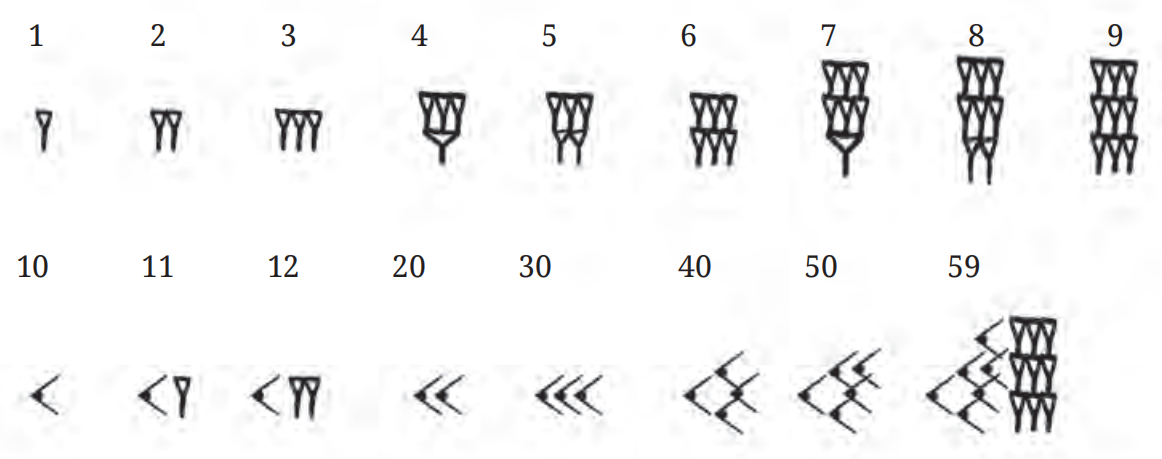
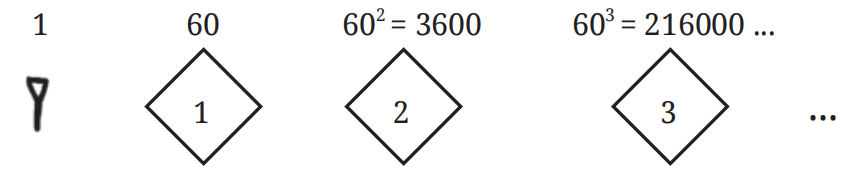
Step-by-Step Representation:
(i) Representation of $63$:
Breakdown: $1 \times 60 + 3$
(ii) Representation of $132$:
Breakdown: $2 \times 60 + 12$
(iii) Representation of $200$:
Breakdown: $3 \times 60 + 20$
(iv) Representation of $60$:
Breakdown: $1 \times 60 + 0$
(v) Representation of $3605$:
Breakdown: $1 \times 3600 + 0 \times 60 + 5$
Figure It Out (Page No. 80)
Question 1. Why do you think the Chinese alternated between the Zong and Heng symbols? If only the Zong symbols were to be used, how would $41$ be represented? Could this numeral be interpreted in any other way if there is no significant space between two successive positions?
Answer:
Solution:
Given:
A question regarding the Chinese Rod Numeral system, specifically exploring why alternating Zong and Heng symbols were used, how $41$ would look using only Zong symbols, and the ambiguity that arises without spacing.
Reference Image (Chinese Number System):
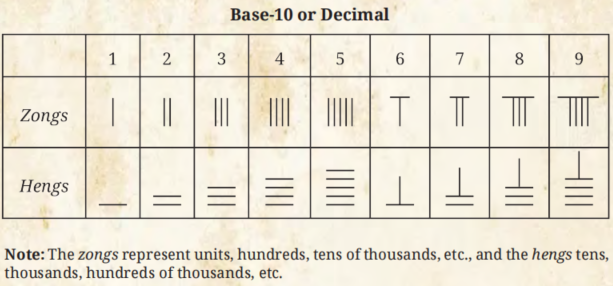
Part 1: Why did the Chinese alternate between Zong and Heng symbols?
The Chinese alternated between Zong and Heng symbols to clearly separate adjacent place-value positions and prevent confusion between numbers like tens and units, especially before the widespread use of a placeholder zero.
As shown in the reference chart:
$\bullet$ Zongs represent units, hundreds, tens of thousands, etc.
$\bullet$ Hengs represent tens, thousands, hundreds of thousands, etc.
$\text{Alternation Pattern} = \text{Zong} \to \text{Heng} \to \text{Zong} \to \text{Heng}$
Part 2: Representation of $41$ using only Zong symbols
In the decimal system, $41$ means $4$ tens and $1$ unit.
$\bullet$ If only Zong symbols were used for both positions, $4$ tens would be written with a Zong symbol ($||||$) and $1$ unit with a Zong symbol ($\mid$). Thus, $41$ would appear as:
$\text{Zong-only } 41 = |||| \mid$
[Ambiguous notation]
Part 3: Ambiguity without significant spacing
If there is no significant space between two successive positions and only Zong symbols are used, the numeral could be misinterpreted entirely.
For instance, using only Zong symbols:
$\bullet$ $|||| \mid$ could mean $4$ tens and $1$ unit ($41$).
$\bullet$ However, without spacing, $|||| \mid$ could also be misread as a single group representing the digit $5$ ($|||||$), or as $4$ units and $1$ something else depending on where the grouping starts.
By alternating between vertical (Zong) and horizontal (Heng) rods, ancient Chinese mathematicians created an immediate visual boundary between adjacent columns, making place values distinct even without an explicit zero symbol.
Question 2. Form a base-$2$ place value system using ‘ukasar’ and ‘urapon’ as the digits. Compare this system with that of the Gumulgal’s.
Answer:
Step-1: Establishing the Base-$2$ Place Value System:
Following the given algebraic notation for powers of $2$:
$\text{Let } 2^0 = 1 = A, \; 2^1 = 2 = B, \; 2^2 = 4 = C, \; 2^4 = 16 = D, \dots$
... (i)
Using 'ukasar' ($uk$) and 'urapon' ($ur$) as the digits in our base-$2$ place-value framework, numbers are represented by combining these positional landmark values.
Step-2: Comparison Table (Base-$2$ System vs Gumulgal System):
The table below compares how numbers from $1$ to $8$ are represented in the constructed base-$2$ place-value system versus the traditional Gumulgal system:
| Decimal / Value | Base-$2$ System | Gumulgal System |
| $1$ | $A$ | ur |
| $2$ | $B$ | uk |
| $3$ | $BA$ | uk – ur |
| $4$ | $C$ | uk – uk |
| $5$ | $CA$ | uk – uk – ur |
| $6$ | $CB$ | uk – uk – uk |
| $7$ | $CBA$ | uk – uk – uk – ur |
| $8$ | $D$ | uk – uk – uk – uk |
Conclusion & Comparison:
Both have the same base $2$, but the base-$2$ system has many landmark numbers, whereas the Gumulgal system has only two landmark numbers.
Question 3. Where in your daily lives, and in which professions, do the Hindu numerals, and $0$, play an important role? How might our lives have been different if our number system and $0$ hadn’t been invented or conceived of?
Answer:
They are useful wherever we have to read unit numbers or do any calculation in daily life and various professions.
In case ‘0’ was not there, all the above would have become much more tedious and cumbersome.
Also, there would have been no computers or digital technology.
Question 4. The ancient Indians likely used base $10$ for the Hindu number system because humans have $10$ fingers, and so we can use our fingers to count. But what if we had only $8$ fingers? How would we be writing numbers then? What would the Hindu numerals look like if we were using base $8$ instead? Base $5$? Try writing the base-$10$ Hindu numeral $25$ as base-$8$ and base-$5$ Hindu numerals, respectively. Can you write it in base-$2$?
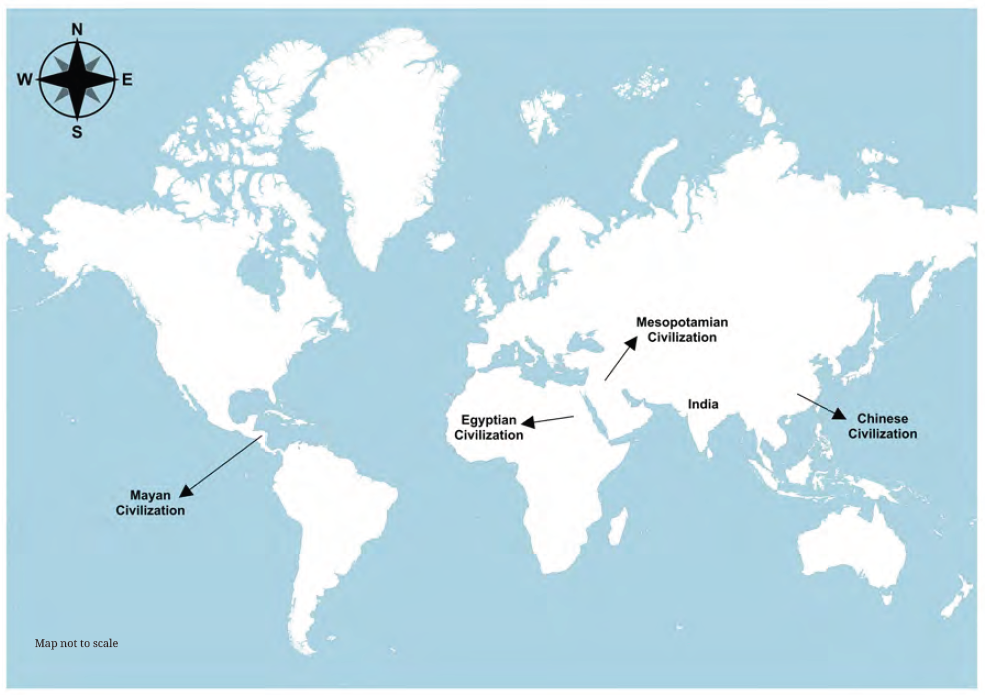
The map shows the locations of the different civilisations. They existed in different time periods.
Answer:
Solution:
Given:
Converting the decimal number $25$ into base-$8$, base-$5$, and base-$2$ numerals using successive division structures.
To Find:
The step-by-step successive division representations for converting $25$ into base-$8$, base-$5$, and base-$2$.
1. Converting $25$ to Base-$8$:
We divide $25$ successively by $8$ and record the remainders:
$\begin{array}{c|cc} 8 & 25 \\ \hline 8 & 3 & \text{rem } 1 \\ \hline & 0 & \text{rem } 3 \end{array}$
Reading the remainders from bottom to top, we get $31_8$.
2. Converting $25$ to Base-$5$:
We divide $25$ successively by $5$ and record the remainders:
$\begin{array}{c|cc} 5 & 25 \\ \hline 5 & 5 & \text{rem } 0 \\ \hline & 1 & \text{rem } 0 \end{array}$
Reading the remainders from bottom to top, we get $100_5$.
3. Converting $25$ to Base-$2$:
We divide $25$ successively by $2$ and record the remainders:
$\begin{array}{c|cc} 2 & 25 \\ \hline 2 & 12 & \text{rem } 1 \\ \hline 2 & 6 & \text{rem } 0 \\ \hline 2 & 3 & \text{rem } 0 \\ \hline 2 & 1 & \text{rem } 1 \\ \hline & 0 & \text{rem } 1 \end{array}$
Reading the remainders from bottom to top, we get $11001_2$.
Summary Table:
| Target Base | Successive Division Process | Converted Numeral |
| Base $8$ (Octal) | Divide by $8$ | $31_8$ |
| Base $5$ (Quinary) | Divide by $5$ | $100_5$ |
| Base $2$ (Binary) | Divide by $2$ | $11001_2$ |