

Chapter 4 Quadrilaterals (Class 8 - Latest Maths NCERT (Ganita Prakash I) Solutions)
Looking for the most reliable NCERT Solutions for Chapter 4: Quadrilaterals? You’ve come to the right place! This page provides clear, step-by-step guidance for the exercises in the latest Class 8 Maths textbook, Ganita Prakash I. We help you move beyond simple shape identification by solving the "Carpenter’s Problem" and demonstrating exactly how the lengths and angles of diagonals serve as the internal skeleton for every four-sided figure.
Our solutions focus on Geometric Reasoning and Deduction, providing formal proofs for essential theorems. We show you how to use triangle congruence to prove properties of parallelograms and why the diagonals of a square must bisect each other at $90^\circ$. By following our detailed explanations, you will master the Angle Sum Property (proving the $360^\circ$ total) and understand the hierarchy of shapes through Venn Diagrams, making it easy to explain why a square is always a rectangle but a rectangle isn't always a square.
Whether you are tackling complex diagonal constructions or classifying special figures like the Kite and Isosceles Trapezium, these resources are designed to help you succeed. Curated by learningspot.co, these solutions offer visual proofs, logical breakdowns, and "Data Detective" tips for solving geometry problems with precision. Strengthen your architectural thinking and ace your CBSE Class 8 Maths exams with our expert-prepared materials.
| Content On This Page | ||
|---|---|---|
| Figure It Out (Page No. 94) | Figure It Out (Page No. 102) | Figure It Out (Page No. 107 - 109) |
Figure It Out (Page No. 94)
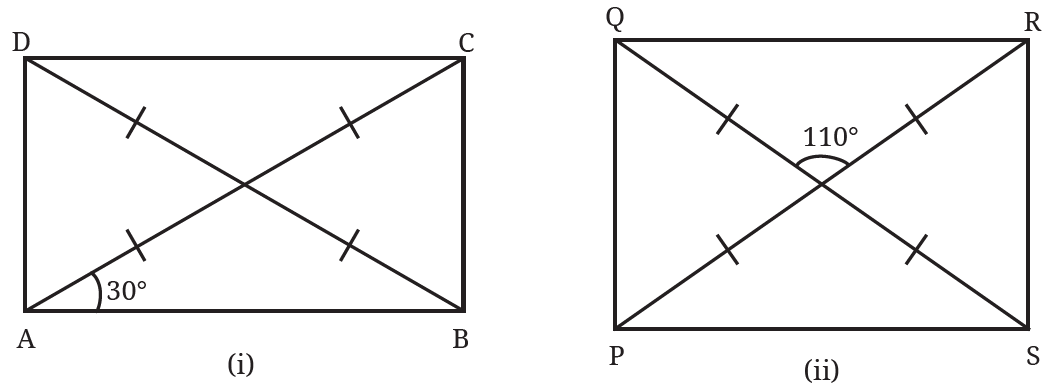
Question 1. Find all the other angles inside the following rectangles.
Answer:
Solution:
Given:
Two rectangles with properties of their diagonals indicated by tick marks (showing diagonals are equal and bisect each other).
$\bullet$ In rectangle (i) ($ABCD$): Diagonal $AC$ and $BD$ intersect at point $O$, and $\angle CAB = 30^\circ$.
$\bullet$ In rectangle (ii) ($PQRS$): Diagonal $PR$ and $QS$ intersect at point $O$, and the angle between the intersecting diagonals is $110^\circ$ ($\angle POQ = 110^\circ$).
To Find:
All other interior and diagonal intersection angles in both rectangles.
Part (i): Analysis of Rectangle $ABCD$
Let the intersection of diagonals $AC$ and $BD$ be point $O$.
1. Since $ABCD$ is a rectangle, its diagonals are equal and bisect each other:
$OA = OB = OC = OD$
(Property of rectangle diagonals)
2. In $\triangle OAB$, since $OA = OB$, it is an isosceles triangle. Therefore, the base angles are equal:
$\angle OBA = \angle OAB = 30^\circ$
[Base angles of isosceles $\triangle OAB$]
3. Using the angle sum property in $\triangle OAB$:
$\angle AOB = 180^\circ - (30^\circ + 30^\circ) = 120^\circ$
4. Since adjacent angles on a straight line ($BD$) are supplementary ($\angle AOB + \angle AOD = 180^\circ$):
$\angle AOD = 180^\circ - 120^\circ = 60^\circ$
5. Similarly, using the isosceles triangles $\triangle OBC$, $\triangle OCD$, and $\triangle ODA$, all corresponding corner and central angles can be determined:
$\angle OBC = \angle OCB = 90^\circ - 30^\circ = 60^\circ$
Visual Angle Breakdown for Rectangle (i):
Part (ii): Analysis of Rectangle $PQRS$
Let the intersection of diagonals $PR$ and $QS$ be point $O$, and given $\angle POQ = 110^\circ$.
1. Since vertically opposite angles are equal:
$\angle ROS = \angle POQ = 110^\circ$
(Vertically opposite angles)
2. Since adjacent angles on line segment $PR$ are supplementary:
$\angle QOR = 180^\circ - 110^\circ = 70^\circ$
[Linear pair on diagonal $PR$]
3. Consequently, its vertically opposite angle is also equal:
$\angle POS = \angle QOR = 70^\circ$
4. In the isosceles triangle $\triangle POQ$ ($OP = OQ$), the base angles are:
$\angle OPQ = \angle OQP = \frac{180^\circ - 110^\circ}{2} = 35^\circ$
5. Similarly, in $\triangle QOR$ ($OQ = OR$), the base angles are:
$\angle ORQ = \angle OQR = \frac{180^\circ - 70^\circ}{2} = 55^\circ$
Visual Angle Breakdown for Rectangle (ii):
Summary Table of Angles:
| Rectangle | Central Angles at $O$ | Corner Angles (Vertices) |
| (i) ($ABCD$) | $120^\circ, 60^\circ, 120^\circ, 60^\circ$ | $30^\circ, 60^\circ, 30^\circ, 60^\circ$ |
| (ii) ($PQRS$) | $110^\circ, 70^\circ, 110^\circ, 70^\circ$ | $35^\circ, 55^\circ, 35^\circ, 55^\circ$ |
Question 2. Draw a quadrilateral whose diagonals have equal lengths of $8 \text{ cm}$ that bisect each other, and intersect at an angle of
(i) $30^\circ$
(ii) $40^\circ$
(iii) $90^\circ$
(iv) $140^\circ$
Answer:
Solution:
Given:
A quadrilateral whose diagonals: 1. Have equal lengths of $8 \text{ cm}$. 2. Bisect each other. 3. Intersect at an angle of (i) $30^\circ$, (ii) $40^\circ$, (iii) $90^\circ$, and (iv) $140^\circ$.
To Find / Construct:
The geometric classification and step-by-step construction procedure for the quadrilateral in each of the four cases.
Geometric Property Note:
Any quadrilateral whose diagonals are equal in length and bisect each other is fundamentally a Rectangle (or specifically a square when the intersection angle is $90^\circ$). The shape of the rectangle changes depending on the angle between the intersecting diagonals.
$\text{Diagonal length} = 8 \text{ cm} \implies \text{Half-diagonal} = \frac{8}{2} = 4 \text{ cm}$
General Steps of Construction (For all cases):
Step 1: Draw a line segment $AC = 8 \text{ cm}$ (representing the first diagonal).
Step 2: Find the midpoint $O$ of segment $AC$ by drawing its perpendicular bisector ($OA = OC = 4 \text{ cm}$).
Step 3: At midpoint $O$, construct the given intersecting angle using a protractor to draw a line intersecting the perpendicular bisector line.
Step 4: Cut off arcs of length $4 \text{ cm}$ on both sides of $O$ along this new line to get the second diagonal $BD = 8 \text{ cm}$ ($OB = OD = 4 \text{ cm}$).
Step 5: Join the outer vertex points $A, B, C,$ and $D$ in order to form the required quadrilateral ($ABCD$).
Case-by-Case Breakdown:
(i) Intersection Angle = $30^\circ$:
The diagonals intersect at $30^\circ$. The resulting quadrilateral is a narrow rectangle.
$\text{Given angle} = 30^\circ \implies \text{Construct } 30^\circ \text{ at midpoint } O$
(ii) Intersection Angle = $40^\circ$:
The diagonals intersect at $40^\circ$. The resulting quadrilateral is a rectangle slightly broader than the $30^\circ$ case.
$\text{Given angle} = 40^\circ \implies \text{Construct } 40^\circ \text{ at midpoint } O$
(iii) Intersection Angle = $90^\circ$:
The diagonals intersect at $90^\circ$. Since the diagonals are equal ($8 \text{ cm}$) and bisect each other at right angles ($90^\circ$), the resulting quadrilateral is a Square.
$\text{Given angle} = 90^\circ \implies \text{Quadrilateral is a Square}$
(iv) Intersection Angle = $140^\circ$:
The diagonals intersect at an obtuse angle of $140^\circ$ (which means the acute angle between them is $180^\circ - 140^\circ = 40^\circ$). The resulting quadrilateral is a rectangle identical in proportions to case (ii), oriented differently.
$\text{Given angle} = 140^\circ \implies \text{Acute angle between diagonals } = 40^\circ$
Summary Table:
| Case | Diagonal Length | Intersection Angle | Type of Quadrilateral Formed |
| (i) | $8 \text{ cm}$ | $30^\circ$ | Rectangle |
| (ii) | $8 \text{ cm}$ | $40^\circ$ | Rectangle |
| (iii) | $8 \text{ cm}$ | $90^\circ$ | Square |
| (iv) | $8 \text{ cm}$ | $140^\circ$ | Rectangle |
Question 3. Consider a circle with centre $O$. Line segments $PL$ and $AM$ are two perpendicular diameters of the circle. What is the figure $APML$? Reason and/or experiment to figure this out.
Answer:
Solution:
Given:
1. A circle with centre $O$.
2. Line segments $PL$ and $AM$ are two perpendicular diameters of the circle ($PL \perp AM$).
To Find:
Identify the geometric figure formed by connecting the points $A, P, M,$ and $L$ in order ($APML$), and provide reasoning.
Solution / Identification:
The figure $APML$ is a Square.
Reasoning and Proof:
To prove that $APML$ is a square, let us examine the lengths of its sides and the angles between them using the properties of a circle:
1. Diagonals are Diameters: In quadrilateral $APML$, the line segments $PL$ and $AM$ are the diagonals. Since both are diameters of the same circle:
$PL = AM = 2 \times r$
(Both are diameters)
2. Diagonals are Equal in Length: Because $PL$ and $AM$ are both diameters, their lengths are equal.
$PL = AM$
[Equal radii from centre $O$]
3. Diagonals Bisect Each Other: Since $O$ is the centre of the circle, it is the midpoint of both diameters $PL$ and $AM$:
$OA = OM = OP = OL = \text{radius } (r)$
4. Diagonals are Perpendicular: We are given that the two diameters are perpendicular to each other ($PL \perp AM$), meaning they intersect at $90^\circ$ at centre $O$:
$\angle AOP = \angle POM = \angle MOL = \angle LOA = 90^\circ$
5. Conclusion on Quadrilateral Type: A quadrilateral whose diagonals are equal, bisect each other, and intersect at right angles ($90^\circ$) is always a Square.
Summary Table:
| Property of $APML$ | Mathematical Reason |
| Diagonals ($PL$ and $AM$) | Equal ($2 \times \text{radius}$) |
| Bisect each other at $O$ | Both pass through the centre $O$ |
| Intersection Angle | $90^\circ$ (Given as perpendicular diameters) |
| Final Shape | Square |
Question 4. We have seen how to get $90^\circ$ using paper folding. Now, suppose we do not have any paper but two sticks of equal length, and a thread. How do we make an exact $90^\circ$ using these?
Answer:
Given:
Two sticks of equal length and a piece of thread. We need to construct an exact $90^\circ$ angle using only these tools (without paper folding).
To Construct:
An exact $90^\circ$ angle (perpendicular intersection) using two equal sticks and a thread.
Steps of Construction:
Step 1: Let $AB$ and $CD$ be two sticks of equal length.
Step 2: Find and mark the midpoints of both sticks using a measuring thread or ruler.
Step 3: Fix a pivot (like a pin or screw) at the midpoints of the two sticks so they can rotate freely like an adjustable cross ($X$-shape).
Step 4: Using a piece of thread, measure the distance between endpoint $A$ and endpoint $D$ ($AD$), and between endpoint $B$ and endpoint $D$ ($BD$).
Step 5: Pivot and adjust the sticks about the central screw until the distance $AD$ is exactly equal to the distance $BD$.
$AD = BD$
(Adjusted condition)
Step 6: When this condition is met, lock the screw to fix the sticks in place. The angle between the sticks at the centre is now exactly $90^\circ$.
Proof/Verification:
Let the intersection point (midpoint) be $M$. Since $M$ is the midpoint of both sticks:
$AM = BM \quad \text{and} \quad DM = CM$
[Midpoint property]
Consider $\triangle AMD$ and $\triangle BMD$:
$\bullet$ $AM = BM$ (Midpoint of stick $AB$)
$\bullet$ $AD = BD$ (Constructed equal using thread measurement)
$\bullet$ $MD = MD$ (Common side)
$\triangle AMD \cong \triangle BMD$
[By SSS Congruence Rule]
Therefore, by Corresponding Parts of Congruent Triangles (CPCT):
$\angle AMD = \angle BMD$
Since angles $AMD$ and $BMD$ form a linear pair along the straight line $AB$:
$\angle AMD + \angle BMD = 180^\circ$
(Linear Pair)
Substituting $\angle AMD$ for $\angle BMD$:
$\angle AMD + \angle AMD = 180^\circ \implies 2\angle AMD = 180^\circ$
$\angle AMD = \frac{180^\circ}{2} = 90^\circ$
[Final Angle]
Thus, $\angle AMD = \angle BMD = 90^\circ$, proving that the sticks intersect at an exact right angle.
Question 5. We saw that one of the properties of a rectangle is that its opposite sides are parallel. Can this be chosen as a definition of a rectangle?
In other words, is every quadrilateral that has opposite sides parallel and equal, a rectangle?
Answer:
Given:
A question asking whether a quadrilateral with opposite sides parallel and equal can be defined as a rectangle.
To Find / Prove:
Whether every quadrilateral that has opposite sides parallel and equal is necessarily a rectangle, or if another shape satisfies these conditions.
Solution:
Let $ABCD$ be a quadrilateral in which opposite sides are parallel and equal.
$AB \parallel DC \quad \text{and} \quad AD \parallel BC$
(Parallel opposite sides)
$AB = DC \quad \text{and} \quad AD = BC$
[Equal opposite sides]
Any quadrilateral satisfying the condition of having opposite sides parallel and equal is defined as a Parallelogram, not necessarily a rectangle.
Why it cannot be chosen as a definition for a Rectangle:
1. By definition, a Rectangle is a quadrilateral in which all four interior angles are right angles ($90^\circ$).
$\angle A = \angle B = \angle C = \angle D = 90^\circ$
(Rectangle condition)
2. The given information ($AB \parallel DC$ and $AD \parallel BC$ along with equal lengths) only guarantees that $ABCD$ is a parallelogram. It does not provide any information to prove that the interior angles are $90^\circ$.
3. A parallelogram can be slanted (like a rhombus or generic parallelogram) where interior angles are acute and obtuse (e.g., $60^\circ$ and $120^\circ$).
$\angle A \neq 90^\circ \implies \text{It is a Parallelogram, not a Rectangle}$
Conclusion:
$\therefore ABCD$ may not be a rectangle. $\therefore$ A rectangle cannot be defined as a quadrilateral with equal and parallel opposite sides.
Summary Table:
| Quadrilateral Property | Parallelogram | Rectangle |
| Opposite sides parallel and equal | Yes | Yes |
| All interior angles equal to $90^\circ$ | No (Can be any angle) | Yes (Mandatory) |
Figure It Out (Page No. 102)
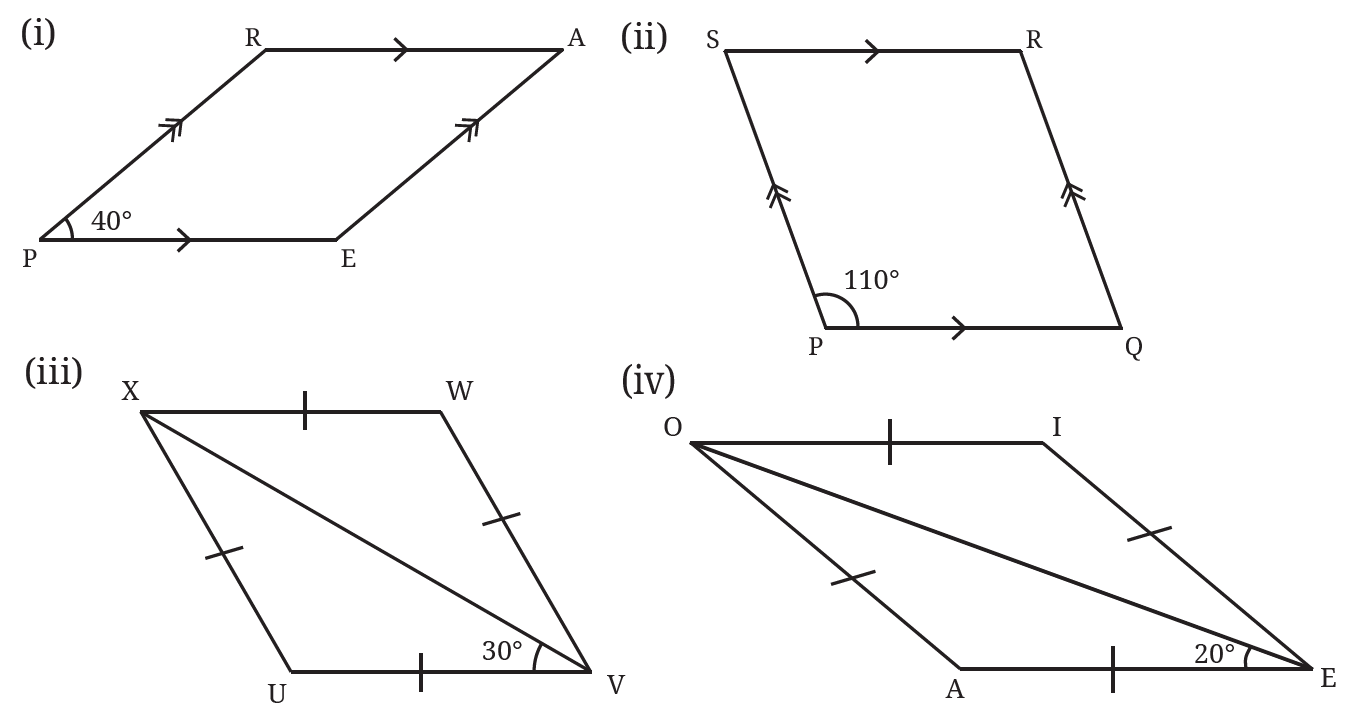
Question 1. Find the remaining angles in the following quadrilaterals.
Answer:
(i) Parallelogram PEAR
Given: $PEAR$ is a parallelogram with $\angle P = 40^\circ$.
To Find: Remaining angles $\angle E, \angle A, \text{ and } \angle R$.
Solution:
In a parallelogram, opposite angles are equal and adjacent angles are supplementary.
$\angle A = \angle P = 40^\circ$
(Opposite angles of a parallelogram are equal)
$\angle E = 180^\circ - \angle P$
(Adjacent angles are supplementary)
$\angle E = 180^\circ - 40^\circ = 140^\circ$
$\angle R = \angle E = 140^\circ$
(Opposite angles are equal)
Remaining angles of $PEAR$ are $140^\circ, 40^\circ, \text{ and } 140^\circ$.
(ii) Parallelogram PQRS
Given: $PQRS$ is a parallelogram with $\angle P = 110^\circ$.
To Find: Remaining angles $\angle Q, \angle R, \text{ and } \angle S$.
Solution:
$\angle R = \angle P = 110^\circ$
(Opposite angles are equal)
$\angle Q = 180^\circ - 110^\circ = 70^\circ$
(Adjacent angles are supplementary)
$\angle S = \angle Q = 70^\circ$
(Opposite angles are equal)
Remaining angles of $PQRS$ are $70^\circ, 110^\circ, \text{ and } 70^\circ$.
(iii) Rhombus XUVW
Given: $XUVW$ is a rhombus. Side marks indicate all sides are equal. Diagonal $XV$ is drawn and $\angle UVX = 30^\circ$.
To Find: All internal angles of the rhombus.
Solution:
In a rhombus, diagonals bisect the vertex angles.
$\angle WVX = \angle UVX = 30^\circ$
(Diagonal bisects vertex angle)
Total $\angle V = \angle WVX + \angle UVX = 30^\circ + 30^\circ = 60^\circ$
$\angle X = \angle V = 60^\circ$
(Opposite angles of a rhombus are equal)
$\angle U = 180^\circ - 60^\circ = 120^\circ$
(Adjacent angles are supplementary)
$\angle W = \angle U = 120^\circ$
(Opposite angles are equal)
The angles of the rhombus are $60^\circ, 120^\circ, 60^\circ, \text{ and } 120^\circ$.
(iv) Rhombus OAIE
Given: $OAIE$ is a rhombus. Diagonal $OE$ is drawn and $\angle AEO = 20^\circ$.
To Find: All internal angles of the rhombus.
Solution:
Diagonal $OE$ bisects $\angle E$.
$\angle IEO = \angle AEO = 20^\circ$
Total vertex angle $\angle E = 20^\circ + 20^\circ = 40^\circ$
$\angle O = \angle E = 40^\circ$
(Opposite angles are equal)
$\angle A = 180^\circ - 40^\circ = 140^\circ$
(Adjacent angles are supplementary)
$\angle I = \angle A = 140^\circ$
(Opposite angles are equal)
The angles of the rhombus are $140^\circ, 40^\circ, 140^\circ, \text{ and } 40^\circ$.
Question 2. Using the diagonal properties, construct a parallelogram whose diagonals are of lengths $7 \text{ cm}$ and $5 \text{ cm}$, and intersect at an angle of $140^\circ$.
Answer:
Given:
1. Diagonal $d_1 = 7 \text{ cm}$.
2. Diagonal $d_2 = 5 \text{ cm}$.
3. Angle of intersection between diagonals = $140^\circ$.
Properties Used:
The diagonals of a parallelogram bisect each other. Therefore, the halves of the diagonals are:
$\frac{d_1}{2} = \frac{7}{2} = 3.5 \text{ cm} \quad \text{and} \quad \frac{d_2}{2} = \frac{5}{2} = 2.5 \text{ cm}$
Steps of Construction for Parallelogram:
Step 1: Draw a line segment $AC = 7 \text{ cm}$ (the first diagonal).
Step 2: Locate the midpoint $O$ of $AC$ by drawing a perpendicular bisector ($AO = OC = 3.5 \text{ cm}$).
Step 3: At point $O$, construct an angle of $140^\circ$ (or its supplementary angle $180^\circ - 140^\circ = 40^\circ$) using a protractor, and draw a line passing through $O$.
Step 4: With centre $O$ and radius $2.5 \text{ cm}$ ($\frac{5}{2} \text{ cm}$), cut arcs on both sides of $O$ along this line to mark points $B$ and $D$ ($OB = OD = 2.5 \text{ cm}$).
$BD = 5 \text{ cm}$
[Second diagonal length]
Step 5: Join $AB$, $BC$, $CD$, and $DA$ to complete the required parallelogram $ABCD$.
Question 3. Using the diagonal properties, construct a rhombus whose diagonals are of lengths $4 \text{ cm}$ and $5 \text{ cm}$.
Answer:
Given:
1. Diagonal $d_1 = 4 \text{ cm}$.
2. Diagonal $d_2 = 5 \text{ cm}$.
Properties Used:
The diagonals of a rhombus bisect each other at right angles ($90^\circ$). Therefore:
$\frac{d_1}{2} = \frac{4}{2} = 2 \text{ cm} \quad \text{and} \quad \frac{d_2}{2} = \frac{5}{2} = 2.5 \text{ cm}$
Steps of Construction for Rhombus:
Step 1: Draw a line segment $AC = 5 \text{ cm}$ (the first diagonal).
Step 2: Construct the perpendicular bisector of $AC$ intersecting at midpoint $O$ ($AO = OC = 2.5 \text{ cm}$).
Step 3: Since diagonals intersect at $90^\circ$, draw a line perpendicular to $AC$ passing through $O$.
Step 4: With centre $O$ and radius $2 \text{ cm}$ ($\frac{4}{2} \text{ cm}$), cut arcs on the perpendicular line above and below $O$ to mark points $B$ and $D$ ($OB = OD = 2 \text{ cm}$).
$BD = 4 \text{ cm}$
Step 5: Join $AB$, $BC$, $CD$, and $DA$ to complete the required rhombus $ABCD$.
Figure It Out (Page No. 107 - 109)
Question 1. Find all the sides and the angles of the quadrilateral obtained by joining two equilateral triangles with sides $4 \text{ cm}$.
Answer:
Given:
Two equilateral triangles, each having a side length of $4 \text{ cm}$, are joined together along a common side to form a quadrilateral.
To Find:
All the side lengths and interior angles of the resulting quadrilateral.
Geometric Analysis:
1. An equilateral triangle has all three sides equal and all three interior angles equal to $60^\circ$.
$\text{Side length of each triangle} = 4 \text{ cm}$
2. When two equilateral triangles are joined along one of their sides (base), they share that common side of $4 \text{ cm}$, forming a Rhombus (or a symmetric kite).
$\text{All 4 sides of the quadrilateral} = 4 \text{ cm}$
3. Finding the Interior Angles:
$\bullet$ Two angles of the quadrilateral are formed by single corner angles of the equilateral triangles. Therefore, each of these two opposite angles is equal to $60^\circ$.
$\bullet$ The other two opposite angles are formed by combining two adjacent $60^\circ$ angles from the two triangles ($60^\circ + 60^\circ = 120^\circ$).
$\text{Interior Angles} = 60^\circ, 120^\circ, 60^\circ, 120^\circ$
Summary Table:
| Feature | Values |
| Side Lengths | $4 \text{ cm}, 4 \text{ cm}, 4 \text{ cm}, 4 \text{ cm}$ |
| Interior Angles | $60^\circ, 120^\circ, 60^\circ, 120^\circ$ |
| Geometric Name | Rhombus |
Question 2. Construct a kite whose diagonals are of lengths $6 \text{ cm}$ and $8 \text{ cm}$.
Answer:
Given:
A kite whose diagonals measure $6 \text{ cm}$ and $8 \text{ cm}$.
To Construct:
A kite using the given diagonal lengths.
Properties of a Kite:
1. The diagonals of a kite are perpendicular to each other ($90^\circ$).
2. One diagonal (the main diagonal) bisects the other diagonal (the cross diagonal).
$\text{Let diagonal } AC = 8 \text{ cm} \quad \text{and diagonal } BD = 6 \text{ cm}$
Steps of Construction:
Step 1: Draw a line segment $AC = 8 \text{ cm}$ (representing the longer diagonal).
Step 2: Construct the perpendicular bisector of $AC$. Let it intersect $AC$ at midpoint $O$ ($AO = OC = 4 \text{ cm}$).
$AO = OC = 4 \text{ cm}$
[Midpoint division]
Step 3: Since the second diagonal ($BD = 6 \text{ cm}$) must be bisected by the first diagonal, cut off arcs of length $3 \text{ cm}$ ($\frac{6}{2} = 3 \text{ cm}$) on both sides of $O$ along the perpendicular bisector line to mark points $B$ and $D$ ($OB = OD = 3 \text{ cm}$).
$OB = OD = 3 \text{ cm}$
Step 4: Join $AB$, $BC$, $CD$, and $DA$ using a straightedge to form the required kite $ABCD$.
Summary Table:
| Diagonal | Total Length | Bisected Segments |
| $AC$ | $8 \text{ cm}$ | $4 \text{ cm}$ and $4 \text{ cm}$ |
| $BD$ | $6 \text{ cm}$ | $3 \text{ cm}$ and $3 \text{ cm}$ |
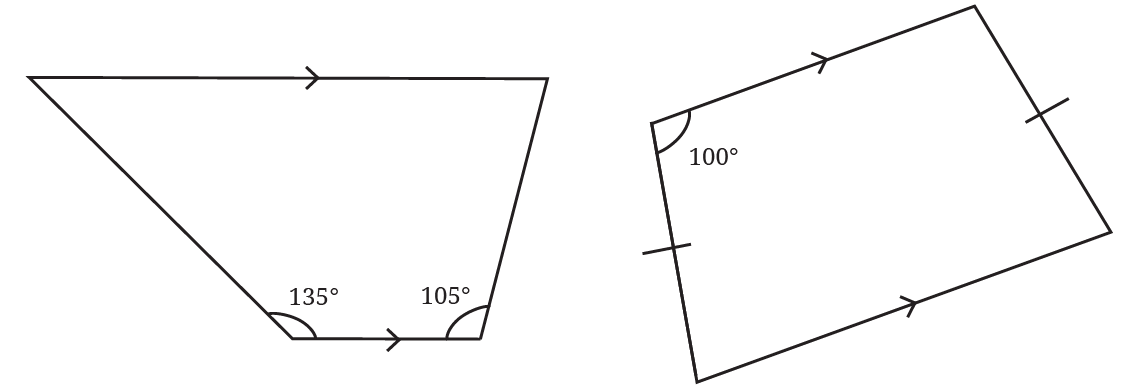
Question 3. Find the remaining angles in the following trapeziums —
Answer:
Property: In a trapezium, the angles on the same side of the non-parallel legs (consecutive interior angles) are supplementary, i.e., their sum is $180^\circ$.
(i) First Trapezium:
The top and bottom sides are parallel (indicated by arrows).
1. Angle at bottom left is $135^\circ$. Let the top left angle be $x$.
$x + 135^\circ = 180^\circ$
$x = 180^\circ - 135^\circ = 45^\circ$
2. Angle at bottom right is $105^\circ$. Let the top right angle be $y$.
$y + 105^\circ = 180^\circ$
$y = 180^\circ - 105^\circ = 75^\circ$
Result: The remaining angles are $45^\circ$ and $75^\circ$.
(ii) Second Trapezium:
This is an Isosceles Trapezium as indicated by the equal side markings on the non-parallel sides.
1. In an isosceles trapezium, base angles are equal and top angles are equal.
2. Given top left angle is $100^\circ$. Thus, the top right angle is also $100^\circ$.
3. Let the bottom angles be $z$. Since they are supplementary to the top angles:
$z + 100^\circ = 180^\circ$
$z = 180^\circ - 100^\circ = 80^\circ$
[Consecutive interior angles] ... (i)
Result: The remaining angles are $100^\circ, 80^\circ, \text{ and } 80^\circ$.
Question 4. Draw a Venn diagram showing the set of parallelograms, kites, rhombuses, rectangles, and squares. Then, answer the following questions —
(i) What is the quadrilateral that is both a kite and a parallelogram?
(ii) Can there be a quadrilateral that is both a kite and a rectangle?
(iii) Is every kite a rhombus? If not, what is the correct relationship between these two types of quadrilaterals?
Answer:
Venn Diagram Representation:
The hierarchical relationship among quadrilaterals (Parallelograms, Kites, Rhombuses, Rectangles, and Squares) can be visualized as follows:
Answers to Sub-Questions:
(i) What is the quadrilateral that is both a kite and a parallelogram?
A Rhombus (and by extension, a Square) is a quadrilateral that is both a kite and a parallelogram. A rhombus has adjacent sides equal (kite property) and opposite sides parallel and equal (parallelogram property).
$\text{Both Kite and Parallelogram} = \text{Rhombus / Square}$
(ii) Can there be a quadrilateral that is both a kite and a rectangle?
Yes. A Square is a quadrilateral that is both a kite and a rectangle. A square has all sides equal (making it a kite) and all angles equal to $90^\circ$ (making it a rectangle).
$\text{Both Kite and Rectangle} = \text{Square}$
(iii) Is every kite a rhombus? If not, what is the correct relationship between these two types of quadrilaterals?
No, every kite is not a rhombus. In a kite, only two pairs of adjacent sides are equal, whereas in a rhombus, all four sides are equal.
Correct Relationship: Every rhombus is a kite, but every kite is not a rhombus.
$\text{Every rhombus is a kite, but not every kite is a rhombus}$
Summary Table:
| Intersection | Resulting Quadrilateral |
| Kite and Parallelogram | Rhombus / Square |
| Kite and Rectangle | Square |
| Rhombus to Kite | True (Every rhombus is a kite) |
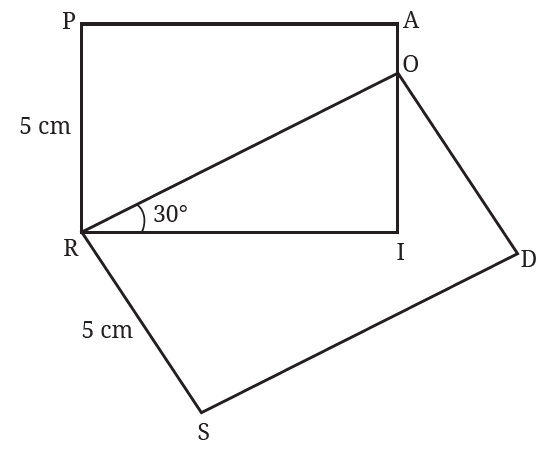
Question 5. If $PAIR$ and $RODS$ are two rectangles, find $\angle IOD$.
Answer:
Given: $PAIR$ and $RODS$ are two rectangles. In rectangle $PAIR$, $PR = 5 \text{ cm}$. In rectangle $RODS$, $RS = 5 \text{ cm}$. The angle $\angle ORI = 30^\circ$. Point $O$ lies on the side $AI$ of rectangle $PAIR$.
To Find: The measure of $\angle IOD$.
Solution:
In rectangle $PAIR$, the side $RI$ is perpendicular to side $AI$.
$\angle RIA = 90^\circ$ (Vertex angle of a rectangle)
Since point $O$ lies on the segment $AI$, we consider the right-angled triangle $ROI$.
In $\triangle ROI$:
$\angle ORI = 30^\circ$ (Given)
$\angle RIO = 90^\circ$
Using the angle sum property of a triangle:
$\angle ROI = 180^\circ - (90^\circ + 30^\circ)$
$\angle ROI = 180^\circ - 120^\circ = 60^\circ$
Now, consider the rectangle $RODS$. In a rectangle, the angle at each vertex is $90^\circ$.
$\angle ROD = 90^\circ$ (Vertex angle of rectangle $RODS$)
From the figure, $\angle ROD$ is composed of $\angle ROI$ and $\angle IOD$.
$\angle IOD = \angle ROD - \angle ROI$
$\angle IOD = 90^\circ - 60^\circ$
$\angle IOD = 30^\circ$
Conclusion: The measure of $\angle IOD$ is $30^\circ$.
Question 6. Construct a square with diagonal $6 \text{ cm}$ without using a protractor.
Answer:
Given:
A square whose diagonal length is $6 \text{ cm}$.
To Construct:
A square using only a ruler and compass (without a protractor), utilizing diagonal properties.
Properties Used:
The diagonals of a square are equal in length ($6 \text{ cm}$), bisect each other, and intersect at right angles ($90^\circ$).
$\text{Diagonal } d = 6 \text{ cm} \implies \text{Half-diagonal} = \frac{6}{2} = 3 \text{ cm}$
Steps of Construction:
Step 1: Draw a line segment $AC = 6 \text{ cm}$ (the first diagonal).
Step 2: Construct the perpendicular bisector of $AC$. Let it intersect $AC$ at midpoint $O$ ($AO = OC = 3 \text{ cm}$).
$AO = OC = 3 \text{ cm}$
[Midpoint division]
Step 3: Since diagonals of a square intersect at $90^\circ$, the perpendicular bisector line already passes through $O$ at $90^\circ$.
Step 4: With centre $O$ and radius $3 \text{ cm}$, cut arcs on the perpendicular bisector line above and below $O$ to mark points $B$ and $D$ ($OB = OD = 3 \text{ cm}$).
$BD = 6 \text{ cm}$
Step 5: Join $AB$, $BC$, $CD$, and $DA$ using a straightedge to complete the required square $ABCD$.
Summary Table:
| Parameter | Value / Property |
| Diagonal Length | $6 \text{ cm}$ |
| Intersection Angle | $90^\circ$ (Perpendicular bisector) |
| Segment Halves | $3 \text{ cm}$ each |
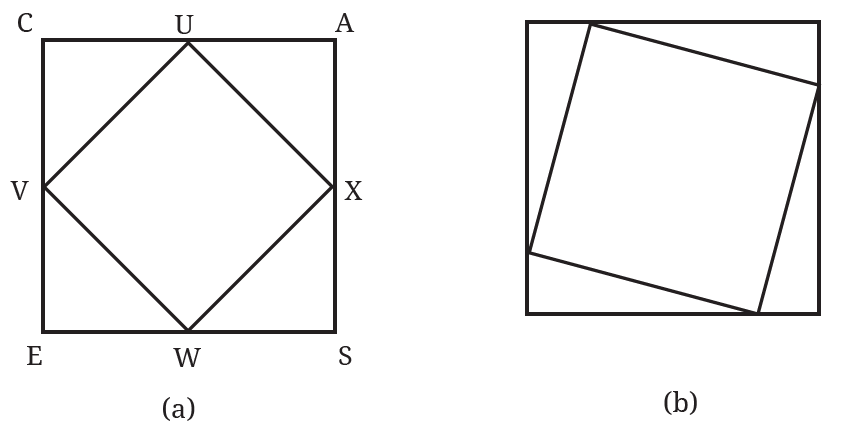
Question 7. $CASE$ is a square. The points $U$, $V$, $W$ and $X$ are the midpoints of the sides of the square. What type of quadrilateral is $UVWX$? Find this by using geometric reasoning, as well as by construction and measurement. Find other ways of constructing a square within a square such that the vertices of the inner square lie on the sides of the outer square, as shown in Figure (b).
Answer:
Part (a): Geometric Reasoning for Quadrilateral $UVWX$
Given:
$CASE$ is a square where $U, V, W,$ and $X$ are the midpoints of sides $CA, CE, ES,$ and $SA$ respectively.
To Find:
The type of quadrilateral formed by $UVWX$.
Geometric Proof (Side Lengths):
Consider $\triangle VCU$ and $\triangle UAX$:
$\bullet$ $VC = UA$ (Halves of equal sides of square $CASE$)
$\bullet$ $\angle VCU = \angle UAX = 90^\circ$ (Corner angles of the square)
$\bullet$ $CU = AX$ (Halves of equal sides)
$\triangle VCU \cong \triangle UAX$
(By SAS Congruence Condition)
Therefore, by Corresponding Parts of Congruent Triangles (CPCT):
$VU = UX$
[Corresponding sides]
Similarly, by proving the other corner triangles congruent, we get $VU = XW = WV$. Thus, all sides of quadrilateral $UVWX$ are equal.
Geometric Proof (Interior Angles):
In the isosceles right-angled triangle $\triangle VCU$ ($VC = CU$):
$\angle 1 = \angle 2 = 45^\circ$
(Base angles of isosceles right triangle)
Similarly, for triangle $\triangle UAX$, the base angles are also $45^\circ$.
Now, considering the straight line angle at vertex $U$:
$\angle 2 + \angle VUX + \angle 3 = 180^\circ$
$45^\circ + \angle VUX + 45^\circ = 180^\circ \implies \angle VUX = 90^\circ$
Similarly, all other interior angles ($\angle VXW$, $\angle XWV$, and $\angle WVU$) are each equal to $90^\circ$.
Conclusion for Part (a): Since all sides are equal and all interior angles are $90^\circ$, quadrilateral $UVWX$ is a Square.
Part (b): Alternative Construction of a Square within a Square (Figure b)
Given:
A square $ABCD$ (or $CASE$) where vertices of the inner square lie on the sides of the outer square at unequal division points, as shown in Figure (b).
Steps of Construction:
Step 1: Let $ABCD$ be any given square.
Step 2: Take four points $P, Q, R,$ and $S$ on the four sides of the square such that they divide the sides at unequal but equal-offset lengths:
$AS = BP = CQ = DR$
(Equal offset distances)
Step 3: Since the sides of the outer square are equal, the remaining segments are also equal:
$DS = AP = BQ = CR$
[Remaining side segments]
Step 4: Join $PS$, $SR$, $RQ$, and $QP$ to form the inner quadrilateral $PQRS$.
Geometric Proof for Figure (b):
Consider $\triangle PAS$ and $\triangle SDR$:
$\bullet$ $PA = SD$
$\bullet$ $\angle PAS = \angle SDR = 90^\circ$
$\bullet$ $AS = DR$
$\triangle PAS \cong \triangle SDR$
(By SAS Congruence Condition)
Therefore, by CPCT, $PS = SR$. Similarly, $PS = RQ = QP$, meaning all sides are equal.
By congruent angle addition and straight-line supplementary angles ($180^\circ$), all interior angles of quadrilateral $PQRS$ are $90^\circ$.
Conclusion for Part (b): The inner quadrilateral $PQRS$ is a Square, demonstrating that a square can be constructed inside another square at any rotated angle as long as the offset distances from the corners are equal.
Summary Table:
| Inner Square Type | Vertex Placement | Geometric Result |
| Figure (a) ($UVWX$) | Exact midpoints of outer sides | Square (Symmetric) |
| Figure (b) ($PQRS$) | Equal offset from corners ($AS=BP=\dots$) | Square (Rotated) |
Question 8. If a quadrilateral has four equal sides and one angle of $90^\circ$, will it be a square? Find the answer using geometric reasoning as well as by construction and measurement.
Answer:
Solution:
Given:
A quadrilateral with: 1. Four equal sides. 2. Exactly one interior angle equal to $90^\circ$.
To Find:
Whether this quadrilateral is guaranteed to be a square.
Geometric Reasoning:
1. Properties of a Rhombus: Any quadrilateral with four equal sides is a rhombus. A rhombus also has its opposite sides parallel ($AB \parallel DC$ and $AD \parallel BC$).
$\text{Side lengths: } AB = BC = CD = DA$
2. Consecutive Angles in a Parallelogram / Rhombus: Since opposite sides are parallel, the consecutive angles are supplementary (their sum is $180^\circ$).
$\text{If } \angle A = 90^\circ \implies \angle B = 180^\circ - 90^\circ = 90^\circ$
3. Similarly, the opposite angle will also be $90^\circ$ ($\angle C = 90^\circ$), and the fourth angle will be $90^\circ$ ($\angle D = 90^\circ$).
4. Therefore, having one interior angle equal to $90^\circ$ in a four-equal-sided quadrilateral forces all four interior angles to be $90^\circ$. Combined with four equal sides, the shape becomes a Square.
Construction and Measurement Method:
Step 1: Draw a base line segment $AB$ of any length (e.g., $5 \text{ cm}$).
Step 2: At vertex $A$, construct an angle of $90^\circ$ using a compass or set-square.
Step 3: Cut an arc of radius $5 \text{ cm}$ from $A$ along the perpendicular line to mark vertex $D$ ($AD = 5 \text{ cm}$).
Step 4: With centre $D$ and radius $5 \text{ cm}$, draw an arc. With centre $B$ and radius $5 \text{ cm}$, draw another arc intersecting the previous arc at point $C$.
Step 5: Join $DC$ and $BC$. Measure all interior angles ($\angle B, \angle C, \angle D$) using a protractor. You will find each of them measures exactly $90^\circ$, and all diagonals are equal in length, confirming it is a Square.
Question 9. What type of a quadrilateral is one in which the opposite sides are equal? Justify your answer.
Hint: Draw a diagonal and check for congruent triangles.
Answer:
Solution:
Given:
A quadrilateral in which both pairs of opposite sides are equal ($AB = DC$ and $AD = BC$).
To Find / Prove:
Identify the type of quadrilateral and justify the answer using a diagonal and congruent triangles.
Identification:
A quadrilateral in which both pairs of opposite sides are equal is a Parallelogram.
Geometric Justification (Proof):
Let $ABCD$ be a quadrilateral where opposite sides are equal:
$AB = DC \quad \text{and} \quad AD = BC$
(Given)
Step 1: Construct a Diagonal.
Draw the diagonal $AC$, which divides the quadrilateral $ABCD$ into two triangles: $\triangle ABC$ and $\triangle CDA$.
Step 2: Check for Congruent Triangles.
In $\triangle ABC$ and $\triangle CDA$:
$\bullet$ $AB = DC$ (Given opposite sides)
$\bullet$ $BC = DA$ (Given opposite sides)
$\bullet$ $AC = CA$ (Common diagonal shared by both triangles)
$\triangle ABC \cong \triangle CDA$
[By SSS Congruence Condition]
Step 3: Establish Parallelism.
Since the triangles are congruent, their corresponding parts (CPCT) are equal:
$\angle BAC = \angle DCA \quad \text{and} \quad \angle BCA = \angle DAC$
... (ii)
These alternate interior angles formed by the transversal line $AC$ with lines $AB, DC$ and $AD, BC$ are equal. Therefore:
$AB \parallel DC \quad \text{and} \quad AD \parallel BC$
(Alternate interior angles are equal)
Conclusion: Since both pairs of opposite sides are parallel, $ABCD$ is a Parallelogram.
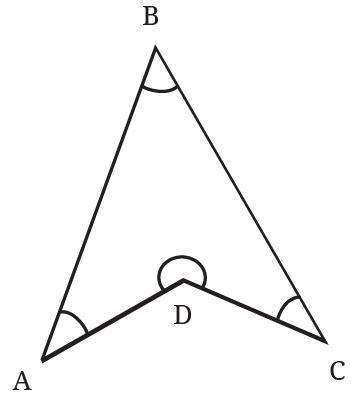
Question 10. Will the sum of the angles in a quadrilateral such as the following one also be $360^\circ$? Find the answer using geometric reasoning as well as by constructing this figure and measuring.
Answer:
Given:
A concave quadrilateral $ABCD$ (where one interior angle is reflex/pointing inwards).
To Find:
Whether the sum of the interior angles in this quadrilateral is also $360^\circ$, using geometric reasoning and construction/measurement.
Geometric Reasoning (Proof):
1. Construct a Diagonal: Join the non-adjacent vertices $B$ and $D$ with a line segment (diagonal $BD$).
2. Splitting into Triangles: The diagonal $BD$ divides the concave quadrilateral $ABCD$ into two separate triangles: $\triangle ABD$ and $\triangle CBD$.
$\text{Total quadrilateral} = \triangle ABD + \triangle CBD$
3. Angle Sum Property of Triangles: We know that the sum of interior angles in any triangle is $180^\circ$:
$\text{Sum of angles in } \triangle ABD = 180^\circ$
$\text{Sum of angles in } \triangle CBD = 180^\circ$
4. Combining the Angles: Adding the angles of both triangles gives the total sum of interior angles of the quadrilateral $ABCD$:
$\text{Total Angle Sum} = 180^\circ + 180^\circ = 360^\circ$
Conclusion: Yes, the sum of the interior angles in a concave quadrilateral is also $360^\circ$.
Question 11. State whether the following statements are true or false. Justify your answers.
(i) A quadrilateral whose diagonals are equal and bisect each other must be a square.
(ii) A quadrilateral having three right angles must be a rectangle.
(iii) A quadrilateral whose diagonals bisect each other must be a parallelogram.
(iv) A quadrilateral whose diagonals are perpendicular to each other must be a rhombus.
(v) A quadrilateral in which the opposite angles are equal must be a parallelogram.
(vi) A quadrilateral in which all the angles are equal is a rectangle.
(vii) Isosceles trapeziums are parallelograms.
Answer:
(i) A quadrilateral whose diagonals are equal and bisect each other must be a square.
False. A quadrilateral whose diagonals are equal and bisect each other is a Rectangle. For it to be a square, the diagonals must also be perpendicular to each other.
(ii) A quadrilateral having three right angles must be a rectangle.
True. The sum of angles in a quadrilateral is $360^\circ$. If three angles are $90^\circ$, the fourth angle must be $360^\circ - (90^\circ + 90^\circ + 90^\circ) = 90^\circ$. A quadrilateral with all four angles as $90^\circ$ is a Rectangle.
(iii) A quadrilateral whose diagonals bisect each other must be a parallelogram.
True. By definition, if the diagonals of a quadrilateral bisect each other, it is a Parallelogram.
(iv) A quadrilateral whose diagonals are perpendicular to each other must be a rhombus.
False. A Kite also has perpendicular diagonals, but it is not necessarily a rhombus (since all four sides of a kite are not necessarily equal).
(v) A quadrilateral in which the opposite angles are equal must be a parallelogram.
True. This is a fundamental property. If opposite angles are equal, the adjacent angles become supplementary, implying the opposite sides are parallel.
(vi) A quadrilateral in which all the angles are equal is a rectangle.
True. If all angles are equal, each must be $360^\circ / 4 = 90^\circ$. An equiangular quadrilateral is a Rectangle.
(vii) Isosceles trapeziums are parallelograms.
False. A parallelogram must have two pairs of parallel sides. An isosceles trapezium has only one pair of parallel sides.