

Chapter 5 Number Play (Class 8 - Latest Maths NCERT (Ganita Prakash I) Solutions)
Searching for precise and easy-to-understand NCERT Solutions for Chapter 5: Number Play? You’ve come to the right place! This page provides detailed, step-by-step answers for the latest Class 8 Maths curriculum, turning complex numerical puzzles into clear logical proofs. We help you move beyond simple arithmetic by providing Algebraic Explanations for patterns in consecutive numbers and the parity of expressions, ensuring you understand exactly why certain mathematical results are inevitable.
Our solutions focus on the "why" behind Checking Divisibility Quickly. Instead of just memorizing shortcuts, we use algebra to "pull apart" place values, providing clear derivations for the divisibility rules of 3, 9, and 11. You will also find comprehensive guides on calculating Digital Roots—the ancient method from Aryabhata II’s Mahāsiddhānta—and using them to verify your calculations. By following our step-by-step logic, you will master the art of finding remainders without long division.
Whether you are solving Cryptarithms (Digits in Disguise) or analyzing "Always, Sometimes, or Never" scenarios, our resources provide the deductive clarity you need. These solutions, curated by learningspot.co, include visual token models and place-value derivations based on the Ganita Prakash I textbook. Designed for CBSE students, these materials ensure you build the strong reasoning skills necessary to excel in higher-level mathematics and competitive exams.
| Content On This Page | ||
|---|---|---|
| Figure It Out (Page No. 122 - 123) | Figure It Out (Page No. 126) | Figure It Out (Page No. 131) |
| Figure It Out (Page No. 132 - 134) | ||
Figure It Out (Page No. 122 - 123)
Question 1. The sum of four consecutive numbers is $34$. What are these numbers?
Answer:
Given:
The sum of four consecutive numbers is $34$.
To Find:
The values of these four consecutive numbers.
Solution:
Let the four consecutive numbers be $x, x+1, x+2,$ and $x+3$.
According to the problem, their sum is $34$:
$x + (x+1) + (x+2) + (x+3) = 34$
Combining the like terms, we get:
$4x + 6 = 34$
Subtracting $6$ from both sides of the equation:
$4x = 34 - 6$
$4x = 28$
Now, dividing both sides by $4$ to find the value of $x$:
$x = \frac{28}{4}$
$x = 7$
Now that we have the first number, we can find the others:
First number = $x = 7$
Second number = $x + 1 = 7 + 1 = 8$
Third number = $x + 2 = 7 + 2 = 9$
Fourth number = $x + 3 = 7 + 3 = 10$
Final Answer: The four consecutive numbers are $7, 8, 9,$ and $10$.
Question 2. Suppose $p$ is the greatest of five consecutive numbers. Describe the other four numbers in terms of $p$.
Answer:
Given:
The greatest of five consecutive numbers is $p$.
To Find:
The description of the other four numbers using the variable $p$.
Solution:
Consecutive numbers follow one after another with a constant difference of $1$. Since $p$ is the largest (greatest) number in the sequence, the other four numbers must be smaller than $p$. We can find them by subtracting $1$ successively.
1. The number immediately before $p$ is $p - 1$.
2. The number before $p - 1$ is $p - 2$.
3. The number before $p - 2$ is $p - 3$.
4. The smallest of the five numbers is $p - 4$.
Final Answer: The other four numbers in terms of $p$ are $p - 1, p - 2, p - 3,$ and $p - 4$.
Question 3. For each statement below, determine whether it is always true, sometimes true, or never true. Explain your answer. Mention examples and non-examples as appropriate. Justify your claim using algebra.
(i) The sum of two even numbers is a multiple of $3$.
(ii) If a number is not divisible by $18$, then it is also not divisible by $9$.
(iii) If two numbers are not divisible by $6$, then their sum is not divisible by $6$.
(iv) The sum of a multiple of $6$ and a multiple of $9$ is a multiple of $3$.
(v) The sum of a multiple of $6$ and a multiple of $3$ is a multiple of $9$.
Answer:
(i) The sum of two even numbers is a multiple of $3$.
Verdict: Sometimes True
Explanation: The sum of two even numbers is always even, but it is only a multiple of $3$ if the sum is also divisible by $3$.
Example: $2 + 4 = 6$ (Even and multiple of $3$).
Non-example: $2 + 2 = 4$ (Even but not a multiple of $3$).
Algebraic Justification: Let the numbers be $2m$ and $2n$. Sum $= 2(m + n)$. This is a multiple of $3$ only if $(m + n)$ is a multiple of $3$.
(ii) If a number is not divisible by $18$, then it is also not divisible by $9$.
Verdict: Sometimes True
Explanation: A number can be a multiple of $9$ without being a multiple of $18$.
Example: $7$ is not divisible by $18$ and not divisible by $9$ (Statement is True here).
Non-example: $9$ is not divisible by $18$ ($18 \times 0.5 = 9$), but $9$ is divisible by $9$ ($9 \div 9 = 1$). (Statement is False here).
(iii) If two numbers are not divisible by $6$, then their sum is not divisible by $6$.
Verdict: Sometimes True
Example: $1$ and $2$ are not divisible by $6$, and their sum ($1 + 2 = 3$) is not divisible by $6$.
Non-example: $2$ and $4$ are not divisible by $6$, but their sum ($2 + 4 = 6$) is divisible by $6$.
(iv) The sum of a multiple of $6$ and a multiple of $9$ is a multiple of $3$.
Verdict: Always True
Algebraic Justification: Let the numbers be $6a$ and $9b$, where $a$ and $b$ are integers.
$\text{Sum} = 6a + 9b$
$\text{Sum} = 3(2a + 3b)$
Since the sum is in the form $3k$ (where $k = 2a + 3b$), it is always a multiple of $3$.
(v) The sum of a multiple of $6$ and a multiple of $3$ is a multiple of $9$.
Verdict: Sometimes True
Example: $6$ (multiple of $6$) and $3$ (multiple of $3$) gives $6 + 3 = 9$, which is a multiple of $9$.
Non-example: $12$ (multiple of $6$) and $3$ (multiple of $3$) gives $12 + 3 = 15$, which is not a multiple of $9$.
Question 4. Find a few numbers that leave a remainder of $2$ when divided by $3$ and a remainder of $2$ when divided by $4$. Write an algebraic expression to describe all such numbers.
Answer:
Given:
The number leaves a remainder of $2$ when divided by $3$.
The same number leaves a remainder of $2$ when divided by $4$.
To Find:
A few examples of such numbers and a general algebraic expression that represents all such numbers.
Solution:
If a number $N$ leaves a remainder of $2$ when divided by both $3$ and $4$, it means that if we subtract $2$ from that number, the result $(N - 2)$ will be exactly divisible by both $3$ and $4$.
Therefore, $(N - 2)$ must be a multiple of the Least Common Multiple (LCM) of $3$ and $4$.
$\text{LCM}(3, 4) = 12$
Since $(N - 2)$ is a multiple of $12$, we can write it in the form of $12k$, where $k$ is any whole number ($0, 1, 2, 3, \dots$).
$N - 2 = 12k$
Adding $2$ to both sides of the equation to isolate $N$:
$N = 12k + 2$
This is the required algebraic expression.
Finding a few numbers:
We can find specific numbers by substituting different values for $k$:
1. For $k = 0$: $N = 12(0) + 2 = \mathbf{2}$
2. For $k = 1$: $N = 12(1) + 2 = \mathbf{14}$
3. For $k = 2$: $N = 12(2) + 2 = \mathbf{26}$
4. For $k = 3$: $N = 12(3) + 2 = \mathbf{38}$
Final Answer: A few such numbers are $2, 14, 26,$ and $38$. The algebraic expression for all such numbers is $12k + 2$.
Question 5. “I hold some pebbles, not too many,
When I group them in $3$’s, one stays with me.
Try pairing them up — it simply won’t do,
A stubborn odd pebble remains in my view.
Group them by $5$, yet one’s still around,
But grouping by seven, perfection is found.
More than one hundred would be far too bold,
Can you tell me the number of pebbles I hold?”
Answer:
Given:
Let the number of pebbles be $N$. Based on the riddle, we have the following conditions:
1. When divided by $3$, the remainder is $1$.
2. When divided by $2$ (paired), the remainder is $1$. This means the number is odd.
3. When divided by $5$, the remainder is $1$.
4. When divided by $7$, the remainder is $0$. This means the number is a multiple of 7.
5. The number is less than 100.
To Find:
The total number of pebbles ($N$).
Solution:
From the first three conditions, we see that if we subtract $1$ from the total number of pebbles, the remaining number $(N - 1)$ must be exactly divisible by $2, 3,$ and $5$.
Therefore, $(N - 1)$ must be a multiple of the Least Common Multiple (LCM) of $2, 3,$ and $5$.
$\text{LCM}(2, 3, 5) = 2 \times 3 \times 5 = 30$
Now, we look for multiples of $30$ that are less than $100$. These are $30, 60,$ and $90$.
Since $(N - 1)$ can be $30, 60,$ or $90$, we add $1$ back to these values to find the possible number of pebbles ($N$):
If $N - 1 = 30$, then $N = 31$
If $N - 1 = 60$, then $N = 61$
If $N - 1 = 90$, then $N = 91$
Finally, we must check which of these numbers is perfectly divisible by $7$:
Checking $31$: $31 \div 7$ leaves a remainder of $3$. (Incorrect)
Checking $61$: $61 \div 7$ leaves a remainder of $5$. (Incorrect)
Checking $91$: $91 \div 7 = 13$. It leaves no remainder. (Correct)
The number $91$ satisfies all the conditions given in the poem.
Final Answer:
The number of pebbles held is 91.
Question 6. Tathagat has written several numbers that leave a remainder of $2$ when divided by $6$. He claims, “If you add any three such numbers, the sum will always be a multiple of $6$.” Is Tathagat’s claim true?
Answer:
Given:
Tathagat has numbers that leave a remainder of $2$ when divided by $6$. He claims the sum of any three such numbers is always a multiple of $6$.
To Find:
Verify whether the claim is true.
Proof:
Any number that leaves a remainder of $2$ when divided by $6$ can be written in the algebraic form $6n + 2$, where $n$ is a whole number.
Let the three numbers be:
$n_1 = 6a + 2$
$n_2 = 6b + 2$
$n_3 = 6c + 2$
where $a, b,$ and $c$ are integers.
Now, let us find their sum:
$\text{Sum} = (6a + 2) + (6b + 2) + (6c + 2)$
$\text{Sum} = 6a + 6b + 6c + (2 + 2 + 2)$
$\text{Sum} = 6a + 6b + 6c + 6$
Taking $6$ as a common factor:
$\text{Sum} = 6(a + b + c + 1)$
Since the sum is expressed as $6 \times (\text{an integer})$, it is always a multiple of $6$.
Final Answer: Yes, Tathagat's claim is true.
Question 7. When divided by $7$, the number $661$ leaves a remainder of $3$, and $4779$ leaves a remainder of $5$. Without calculating, can you say what remainders the following expressions will leave when divided by $7$? Show the solution both algebraically and visually.
(i) $4779 + 661$
(ii) $4779 - 661$
Answer:
Given:
1. When $661$ is divided by $7$, the remainder is $3$.
2. When $4779$ is divided by $7$, the remainder is $5$.
To Find:
The remainders when (i) $(4779 + 661)$ and (ii) $(4779 - 661)$ are divided by $7$.
Solution:
(i) Remainder of $4779 + 661$
Algebraic Method: Any number can be written as a multiple of the divisor plus the remainder. Let $4779 = 7a + 5$ and $661 = 7b + 3$, where $a$ and $b$ are whole numbers.
$\text{Sum} = (7a + 5) + (7b + 3)$
$\text{Sum} = 7a + 7b + (5 + 3)$
$\text{Sum} = 7(a + b) + 8$
Since $8$ is greater than $7$, we can write it as $7 + 1$.
$\text{Sum} = 7(a + b) + 7 + 1 = 7(a + b + 1) + 1$
The extra part left over after forming groups of $7$ is $1$. Therefore, the remainder is $1$.
Visual Method: Imagine $4779$ as several groups of $7$ with $5$ extra dots ($\bullet \bullet \bullet \bullet \bullet$). Imagine $661$ as several groups of $7$ with $3$ extra dots ($\bullet \bullet \bullet$). When we add the numbers, we combine the extra dots: $5 + 3 = 8$ dots. From these $8$ dots, we can form one more group of $7$, leaving only $1$ dot behind. Thus, the remainder is $1$.
(ii) Remainder of $4779 - 661$
Algebraic Method: Using the expressions $4779 = 7a + 5$ and $661 = 7b + 3$:
$\text{Difference} = (7a + 5) - (7b + 3)$
$\text{Difference} = 7a - 7b + (5 - 3)$
$\text{Difference} = 7(a - b) + 2$
The expression shows a multiple of $7$ with $2$ left over. Therefore, the remainder is $2$.
Visual Method: Start with the $5$ extra dots from $4779$ ($\bullet \bullet \bullet \bullet \bullet$). We need to subtract the $3$ extra dots from $661$ ($\bullet \bullet \bullet$). After removing $3$ dots from the $5$ dots, we are left with $2$ dots. Since the full groups of $7$ in both numbers cancel each other out, only these $2$ dots remain. Thus, the remainder is $2$.
Final Answer:
(i) The remainder of $4779 + 661$ divided by $7$ is $1$.
(ii) The remainder of $4779 - 661$ divided by $7$ is $2$.
Question 8. Find a number that leaves a remainder of $2$ when divided by $3$, a remainder of $3$ when divided by $4$, and a remainder of $4$ when divided by $5$. What is the smallest such number? Can you give a simple explanation of why it is the smallest?
Answer:
Given:
A number $N$ such that:
1. $N \div 3 \rightarrow$ Remainder is $2$.
2. $N \div 4 \rightarrow$ Remainder is $3$.
3. $N \div 5 \rightarrow$ Remainder is $4$.
To Find:
The smallest such number $N$ and an explanation for it being the smallest.
Solution:
In each case, notice that the remainder is exactly $1$ less than the divisor:
$3 - 2 = 1$
$4 - 3 = 1$
$5 - 4 = 1$
This means if we add $1$ to the number $N$, the resulting number ($N + 1$) will be exactly divisible by $3, 4,$ and $5$. Therefore, $(N + 1)$ must be a multiple of the Least Common Multiple (LCM) of $3, 4,$ and $5$.
$\text{LCM}(3, 4, 5) = 3 \times 4 \times 5 = 60$
To find the smallest number $N$, we take the smallest multiple of $60$ and subtract $1$:
$N + 1 = 60$
$N = 60 - 1 = 59$
Explanation: Any number satisfying these conditions must "fall short" of being a multiple of $3, 4,$ and $5$ by exactly $1$. Since $60$ is the lowest number that $3, 4,$ and $5$ can all divide into, $59$ is the first and smallest number that satisfies this property.
Final Answer: The smallest such number is $59$.
Figure It Out (Page No. 126)
Question 1. Find, without dividing, whether the following numbers are divisible by $9$.
(i) $123$
(ii) $405$
(iii) $8888$
(iv) $93547$
(v) $358095$
Answer:
Rule: A number is divisible by $9$ if the sum of its digits is divisible by $9$.
(i) $123$
Sum of digits $= 1 + 2 + 3 = 6$
Since $6$ is not divisible by $9$, $123$ is not divisible by $9$.
(ii) $405$
Sum of digits $= 4 + 0 + 5 = 9$
Since $9$ is divisible by $9$, $405$ is divisible by $9$.
(iii) $8888$
Sum of digits $= 8 + 8 + 8 + 8 = 32$
Since $32$ is not divisible by $9$, $8888$ is not divisible by $9$.
(iv) $93547$
Sum of digits $= 9 + 3 + 5 + 4 + 7 = 28$
Since $28$ is not divisible by $9$, $93547$ is not divisible by $9$.
(v) $358095$
Sum of digits $= 3 + 5 + 8 + 0 + 9 + 5 = 30$
Since $30$ is not divisible by $9$, $358095$ is not divisible by $9$.
Question 2. Find the smallest multiple of $9$ with no odd digits.
Answer:
Given:
The number must be a multiple of $9$ and contain only even digits ($0, 2, 4, 6, 8$).
To Find:
The smallest such number.
Solution:
For a number to be a multiple of $9$, its digit sum must be $9, 18, 27, \dots$
Since all digits must be even, their sum must also be an even number. Therefore, the smallest possible digit sum is $18$.
We check for the smallest number of digits:
1. Two-digit numbers: The maximum sum of two even digits is $8 + 8 = 16$. This is less than $18$, so no $2$-digit number exists.
2. Three-digit numbers: We want the smallest number, so we start with the smallest even digit $2$ in the hundreds place.
If the first digit is $2$, the sum of the remaining two digits must be $18 - 2 = 16$.
The only pair of even digits that sums to $16$ is $(8, 8)$.
Thus, the number is $288$.
Final Answer: The smallest multiple of $9$ with no odd digits is $288$.
Question 3. Find the multiple of $9$ that is closest to the number $6000$.
Answer:
Given:
The reference number is $6000$.
To Find:
The multiple of $9$ nearest to $6000$.
Solution:
We first divide $6000$ by $9$ to find the remainder.
$6000 \div 9 = 666$ with a remainder of $6$.
There are two multiples of $9$ near $6000$:
1. One just below $6000$: $6000 - 6 = \mathbf{5994}$
2. One just above $6000$: $6000 + (9 - 6) = 6000 + 3 = \mathbf{6003}$
Now, we compare the differences:
Difference between $6000$ and $5994$ is $6$.
Difference between $6003$ and $6000$ is $3$.
Since $3 < 6$, the number $6003$ is closer to $6000$.
Final Answer: The multiple of $9$ closest to $6000$ is $6003$.
Question 4. How many multiples of $9$ are there between the numbers $4300$ and $4400$?
Answer:
Given:
Range: Between $4300$ and $4400$.
To Find:
The count of multiples of $9$ in this range.
Solution:
Step 1: Find the first multiple of $9$ after $4300$.
$4300 \div 9 = 477$ remainder $7$.
The first multiple is $9 \times 478 = \mathbf{4302}$.
Step 2: Find the last multiple of $9$ before $4400$.
$4400 \div 9 = 488$ remainder $8$.
The last multiple is $9 \times 488 = \mathbf{4392}$.
Step 3: Count the number of terms.
$\text{Number of terms} = \frac{4392 - 4302}{9} + 1$
$\text{Number of terms} = \frac{90}{9} + 1$
$\text{Number of terms} = 10 + 1 = 11$
Final Answer: There are $11$ multiples of $9$ between $4300$ and $4400$.
Figure It Out (Page No. 131)
Question 1. The digital root of an $8$-digit number is $5$. What will be the digital root of $10$ more than that number?
Answer:
Given:
The digital root (Bijank) of an 8-digit number = $5$.
To Find:
The digital root of (number + 10).
Solution:
In Vedic Mathematics, the digital root or Bijank of a number is the single-digit sum of its digits. A key property is that the digital root of a sum is equal to the digital root of the sum of the individual digital roots.
Let the original number be $N$. We are given:
$DR(N) = 5$
... (i)
We need to find the digital root of $N + 10$. First, we calculate the digital root of $10$:
$DR(10) = 1 + 0 = 1$
... (ii)
Now, applying the sum property of digital roots:
$DR(N + 10) = DR(DR(N) + DR(10))$
... (iii)
Substituting the values from equations (i) and (ii) into equation (iii):
$DR(N + 10) = DR(5 + 1)$
(Calculation)
$DR(N + 10) = 6$
Conclusion:
The digital root of $10$ more than the number is $6$.
Question 2. Write any number. Generate a sequence of numbers by repeatedly adding $11$. What would be the digital roots of this sequence of numbers? Share your observations.
Answer:
Solution:
Let us choose a starting number, for example, $7$. We will generate a sequence by repeatedly adding $11$ and then calculate the digital root (Beejank) of each term.
| Term | Calculation | Number | Digital Root |
| 1st | Starting Number | 7 | 7 |
| 2nd | $7 + 11$ | 18 | $1 + 8 = 9$ |
| 3rd | $18 + 11$ | 29 | $2 + 9 = 11 \to 1 + 1 = 2$ |
| 4th | $29 + 11$ | 40 | $4 + 0 = 4$ |
| 5th | $40 + 11$ | 51 | $5 + 1 = 6$ |
| 6th | $51 + 11$ | 62 | $6 + 2 = 8$ |
| 7th | $62 + 11$ | 73 | $7 + 3 = 10 \to 1 + 0 = 1$ |
| 8th | $73 + 11$ | 84 | $8 + 4 = 12 \to 1 + 2 = 3$ |
| 9th | $84 + 11$ | 95 | $9 + 5 = 14 \to 1 + 4 = 5$ |
| 10th | $95 + 11$ | 106 | $1 + 0 + 6 = 7$ (Pattern repeats) |
Observations:
1. The sequence of digital roots is: $7, 9, 2, 4, 6, 8, 1, 3, 5, 7, \dots$
2. We observe that each subsequent digital root is obtained by adding $2$ to the previous one (because the digital root of $11$ is $1 + 1 = 2$).
3. If the sum exceeds $9$, we subtract $9$ to find the new digital root (e.g., $9 + 2 = 11 \to 11 - 9 = 2$).
4. The sequence will eventually repeat the starting digital root after $9$ additions.
Question 3. What will be the digital root of the number $9a + 36b + 13$?
Answer:
To Find:
The digital root (Bijank) of the expression $9a + 36b + 13$.
Solution:
In Indian Mathematics, the digital root or Bijank of a number is the single-digit sum of its digits. An important property is that any multiple of $9$ has a digital root of $9$.
Let us analyze each term of the expression $9a + 36b + 13$:
1. The term $9a$: Since $9a$ is a multiple of $9$, its digital root will always be $9$ (assuming $a$ is a positive integer).
$DR(9a) = 9$
[Multiple of 9] ... (i)
2. The term $36b$: Since $36$ is a multiple of $9$ ($9 \times 4$), any multiple of $36$ is also a multiple of $9$. Therefore, its digital root is also $9$.
$DR(36b) = 9$
[Multiple of 9] ... (ii)
3. The constant $13$: The digital root is found by adding its digits.
$DR(13) = 1 + 3 = 4$
... (iii)
Now, we find the digital root of the entire expression by adding the individual digital roots:
$DR(9a + 36b + 13) = DR(DR(9a) + DR(36b) + DR(13))$
Substituting values from equations (i), (ii), and (iii):
$DR(9a + 36b + 13) = DR(9 + 9 + 4)$
$DR(9a + 36b + 13) = DR(22)$
Since $22$ is a two-digit number, we add the digits again:
$2 + 2 = 4$
Conclusion:
The digital root of the number $9a + 36b + 13$ is $4$.
Question 4. Make conjectures by examining if there are any patterns or relations between
(i) the parity of a number and its digital root.
(ii) the digital root of a number and the remainder obtained when the number is divided by $3$ or $9$.
Answer:
To Find: Patterns and relations between a number's parity, its digital root, and remainders when divided by 3 or 9.
(i) The parity of a number and its digital root
Let us examine the pattern by looking at the multiples of 8. The digital root (also called Bijank) is found by adding the digits of the number until a single digit is obtained.
| Number | Parity of Number | Digital Root Calculation | Digital Root (Bijank) | Parity of Digital Root |
| 8 | Even | 8 | 8 | Even |
| 16 | Even | 1 + 6 | 7 | Odd |
| 24 | Even | 2 + 4 | 6 | Even |
| 32 | Even | 3 + 2 | 5 | Odd |
| 40 | Even | 4 + 0 | 4 | Even |
Observation: Even though all the numbers in our list ($8, 16, 24, 32, 40$) are even, their digital roots alternate between even ($8, 6, 4$) and odd ($7, 5$).
Conjecture: There is no fixed relation between the parity of a number and its digital root. An even number can have an odd digital root, and an odd number can have an even digital root.
(ii) The digital root of a number and the remainder obtained when divided by 3 or 9
Let us examine the remainders when our sample numbers are divided by 3 and 9, and compare them with their digital roots.
1. Division by 3:
$8 \div 3 = 2$
(Remainder is 2)
$24 \div 3 = 0$
(Remainder is 0)
$32 \div 3 = 2$
(Remainder is 2)
$40 \div 3 = 1$
(Remainder is 1)
Observation for 3: The remainder when a number is divided by 3 is the same as the remainder when its digital root is divided by 3. For example, the digital root of 40 is 4. When 4 is divided by 3, the remainder is 1, which matches the remainder of 40 divided by 3.
2. Division by 9:
$8 \div 9 = 8$
(Remainder is 8)
$24 \div 9 = 6$
(Remainder is 6)
$32 \div 9 = 5$
(Remainder is 5)
$40 \div 9 = 4$
(Remainder is 4)
Observation for 9: In each case, the remainder obtained after dividing the number by 9 is exactly equal to its digital root.
Conjecture: The digital root of any number is equal to the remainder when that number is divided by 9 (except when the remainder is 0, then the digital root is 9).
Figure It Out (Page No. 132 - 134)
Question 1. If $31z5$ is a multiple of $9$, where $z$ is a digit, what is the value of $z$? Explain why there are two answers to this problem.
Answer:
Given:
The number $31z5$ is a multiple of $9$.
To Find:
The value of the digit $z$ and the reason why there are two possible solutions.
Solution:
According to the divisibility rule for $9$, a number is divisible by $9$ if the sum of its digits is a multiple of $9$.
Sum of digits of $31z5 = 3 + 1 + z + 5$
Sum of digits = $9 + z$
For $31z5$ to be a multiple of $9$, the value of $(9 + z)$ must be a multiple of $9$. Since $z$ is a single digit, its possible values are $\{0, 1, 2, 3, 4, 5, 6, 7, 8, 9\}$.
Case 1:
$9 + z = 9$
$z = 9 - 9$
$z = 0$
Case 2:
$9 + z = 18$
$z = 18 - 9$
$z = 9$
Explanation for two answers:
There are two answers because $z$ is a placeholder for a digit. Within the range of single digits ($0$ to $9$), there are two values that, when added to the existing sum of $9$, result in a total that is perfectly divisible by $9$ (namely $9$ and $18$). Both $3105$ and $3195$ are valid multiples of $9$.
Question 2. “I take a number that leaves a remainder of $8$ when divided by $12$. I take another number which is $4$ short of a multiple of $12$. Their sum will always be a multiple of $8$”, claims Snehal. Examine his claim and justify your conclusion.
Answer:
Given:
Number 1 ($n_1$): Leaves a remainder of $8$ when divided by $12$.
Number 2 ($n_2$): Is $4$ short of a multiple of $12$.
To Find:
Determine if the sum $(n_1 + n_2)$ is always a multiple of $8$.
Solution:
Let us represent the numbers algebraically:
$n_1 = 12a + 8$ (where $a$ is an integer)
A number that is "$4$ short of a multiple of $12$" can be written as $(12b - 4)$, which is equivalent to $12(b - 1) + 8$. Essentially, it also leaves a remainder of $8$ when divided by $12$.
$n_2 = 12b - 4$ (where $b$ is an integer)
Now, let us find their sum:
$\text{Sum} = (12a + 8) + (12b - 4)$
$\text{Sum} = 12a + 12b + (8 - 4)$
$\text{Sum} = 12(a + b) + 4$
To check if this is always a multiple of $8$, let us test with examples:
Example 1: Let $a = 0$ and $b = 1$.
$n_1 = 8$ and $n_2 = 12 - 4 = 8$.
$\text{Sum} = 8 + 8 = 16$. (This is a multiple of $8$)
Example 2: Let $a = 1$ and $b = 1$.
$n_1 = 12(1) + 8 = 20$ and $n_2 = 8$.
$\text{Sum} = 20 + 8 = 28$. (This is NOT a multiple of $8$)
Conclusion:
Snehal's claim is False. The sum is only a multiple of $8$ if $12(a+b)+4$ is divisible by $8$, which is not true for all values of $a$ and $b$.
Question 3. When is the sum of two multiples of $3$, a multiple of $6$ and when is it not? Explain the different possible cases, and generalise the pattern.
Answer:
Solution:
Multiples of $3$ can be either even (which are also multiples of $6$) or odd. Let us examine the possible cases when adding two multiples of $3$.
Case 1: Both numbers are even multiples of $3$ (Multiples of $6$).
Example: $6 + 12 = 18$ (A multiple of $6$).
Algebraically: $6a + 6b = 6(a + b)$. This is always a multiple of $6$.
Case 2: Both numbers are odd multiples of $3$.
Odd multiples of $3$ are $3, 9, 15, \dots$ which can be written as $(6n + 3)$.
Example: $3 + 9 = 12$ (A multiple of $6$).
Algebraically: $(6a + 3) + (6b + 3) = 6a + 6b + 6 = 6(a + b + 1)$. This is always a multiple of $6$.
Case 3: One is an even multiple of $3$ and the other is an odd multiple of $3$.
Example: $6 + 3 = 9$ (NOT a multiple of $6$).
Algebraically: $6a + (6b + 3) = 6(a + b) + 3$. This will never be a multiple of $6$ because of the remainder $3$.
Generalisation:
The sum of two multiples of $3$ is a multiple of $6$ if both numbers are of the same parity (either both are even multiples or both are odd multiples). It is not a multiple of $6$ if one is even and the other is odd.
Question 4. Sreelatha says, “I have a number that is divisible by $9$. If I reverse its digits, it will still be divisible by $9$”.
(i) Examine if her conjecture is true for any multiple of $9$.
(ii) Are any other digit shuffles possible such that the number formed is still a multiple of $9$?
Answer:
Basic Concept: Divisibility Rule of 9
In mathematics, a number is divisible by $9$ if and only if the sum of its digits is also divisible by $9$. For example, for the number $72$, the sum of digits is $7 + 2 = 9$, which is divisible by $9$.
(i) Examine if her conjecture is true for any multiple of 9
To Examine: If reversing the digits of a multiple of $9$ results in another multiple of $9$.
Solution: Let us test this with a few examples:
Example 1: Take the number $54$.
Sum of digits = $5 + 4 = 9$
(Divisible by 9)
On reversing the digits, we get $45$.
Sum of digits = $4 + 5 = 9$
(Still divisible by 9)
Example 2: Take a three-digit number $108$.
Sum of digits = $1 + 0 + 8 = 9$
(Multiple of 9)
On reversing the digits, we get $801$.
Sum of digits = $8 + 0 + 1 = 9$
(Multiple of 9)
Conclusion: Yes, her conjecture is true. Reversing a number does not change the digits it contains; it only changes their positions. Since the sum of digits remains unchanged, the new number remains divisible by $9$.
(ii) Are any other digit shuffles possible?
To Find: If shuffling digits in any other way keeps the number divisible by $9$.
Solution: Yes, any shuffle of the digits will result in a number that is still a multiple of $9$.
This is because of the Commutative Property of Addition. This property states that the order in which we add numbers does not change the result.
$a + b + c = b + c + a = c + a + b$
[Sum of digits remains same]
Since the divisibility by $9$ depends only on the total sum of the digits, the arrangement of those digits (shuffling) does not affect whether the number is a multiple of $9$.
Example: Using digits $1, 2,$ and $6$ (Sum = $9$).
Possible shuffles: $126, 162, 216, 261, 612, 621$.
All these numbers are divisible by $9$ because their digit sum is always $9$.
Final Answer: Sreelatha's observation is a direct result of the divisibility rule. Any rearrangement of the digits of a multiple of $9$ will always be another multiple of $9$.
Question 5. If $48a23b$ is a multiple of $18$, list all possible pairs of values for $a$ and $b$.
Answer:
Given:
The given number is $48a23b$, and it is a multiple of $18$.
To Find:
All possible pairs of values for the digits $a$ and $b$.
Solution:
For a number to be a multiple of $18$, it must be divisible by both $2$ and $9$ simultaneously.
Step 1: Check for divisibility by $2$
A number is divisible by $2$ if its last digit is even. Here, the last digit is $b$.
$b = 0, 2, 4, 6, 8$
Step 2: Check for divisibility by $9$
A number is divisible by $9$ if the sum of its digits is a multiple of $9$.
Sum of digits = $4 + 8 + a + 2 + 3 + b$
Sum = $17 + a + b$
Since the sum must be a multiple of $9$, possible values for $17 + a + b$ are $18, 27, 36$, etc.
If $17 + a + b = 18$, then:
$a + b = 1$
[Case 1]
If $17 + a + b = 27$, then:
$a + b = 10$
[Case 2]
Note: $a + b = 19$ is not possible because the maximum sum of two single digits is $9 + 9 = 18$.
Step 3: Finding the possible pairs $(a, b)$
We test the even values of $b$ in our cases.
For Case 1 ($a + b = 1$):
If $b = 0$, then $a = 1$.
Other even values of $b$ ($2, 4, 6, 8$) would make $a$ negative, which is not possible for a digit.
For Case 2 ($a + b = 10$):
If $b = 0$, then $a = 10$ (Not possible as $a$ is a single digit).
If $b = 2$, then $a = 8$.
If $b = 4$, then $a = 6$.
If $b = 6$, then $a = 4$.
If $b = 8$, then $a = 2$.
Final Answer:
The following table lists all possible pairs of $(a, b)$:
| Digit a | Digit b | Pair (a, b) |
| 1 | 0 | (1, 0) |
| 8 | 2 | (8, 2) |
| 6 | 4 | (6, 4) |
| 4 | 6 | (4, 6) |
| 2 | 8 | (2, 8) |
Question 6. If $3p7q8$ is divisible by $44$, list all possible pairs of values for $p$ and $q$.
Answer:
Playing with Numbers Class 8 Solutions Maths
Given:
The number $3p7q8$ is divisible by $44$.
To Find:
All possible pairs of values for digits $p$ and $q$.
Solution:
For a number to be divisible by $44$, it must be divisible by both $4$ and $11$ (as $4 \times 11 = 44$).
Step 1: Check for divisibility by $4$
A number is divisible by $4$ if its last two digits are divisible by $4$. Here, the last two digits are $q8$.
The values of $q$ for which $q8$ is divisible by $4$ are:
$q = 0, 2, 4, 6, 8$
Step 2: Check for divisibility by $11$
A number is divisible by $11$ if the difference between the sum of digits at odd places and even places is $0$ or a multiple of $11$.
Sum of digits at odd places (from right) = $8 + 7 + 3 = 18$.
Sum of digits at even places (from right) = $q + p$.
Difference = $18 - (p + q)$.
For this to be $0$:
$p + q = 18$
[Case 1]
For this to be $11$ ($18 - (p + q) = 11$):
$p + q = 7$
[Case 2]
Step 3: Finding the possible pairs $(p, q)$
Using the values of $q$ from above equation:
For Case 1 ($p + q = 18$):
If $q = 8$, then $p = 10$ (Not possible as $p$ is a single digit).
If $q = 9$ (Not possible as $q$ must be even from equation i).
For Case 2 ($p + q = 7$):
If $q = 0$, then $p = 7$.
If $q = 2$, then $p = 5$.
If $q = 4$, then $p = 3$.
If $q = 6$, then $p = 1$.
If $q = 8$, then $p = -1$ (Not possible).
Final Answer:
The possible pairs $(p, q)$ are listed below:
| Digit p | Digit q | Pair (p, q) |
| 7 | 0 | (7, 0) |
| 5 | 2 | (5, 2) |
| 3 | 4 | (3, 4) |
| 1 | 6 | (1, 6) |
Question 7. Find three consecutive numbers such that the first number is a multiple of $2$, the second number is a multiple of $3$, and the third number is a multiple of $4$.
Are there more such numbers? How often do they occur?
Answer:
Playing with Numbers Class 8 Solutions Maths
Given:
Three consecutive numbers, let them be $n$, $n+1$, and $n+2$.
To Find:
Sets of three consecutive numbers satisfying the given conditions and the frequency of their occurrence.
Solution:
Let the three consecutive numbers be $n$, $n+1$, and $n+2$. According to the question:
$n \text{ is a multiple of } 2$
[Condition 1] ... (i)
$n+1 \text{ is a multiple of } 3$
[Condition 2] ... (ii)
$n+2 \text{ is a multiple of } 4$
[Condition 3] ... (iii)
Case 1: Testing small numbers
Let $n = 2$:
First number: $2$ (Multiple of $2$)
Second number: $2 + 1 = 3$ (Multiple of $3$)
Third number: $2 + 2 = 4$ (Multiple of $4$)
The first set of numbers is (2, 3, 4).
Case 2: Finding more such numbers
Let us check further multiples of $2$ for the first number $n$:
If $n = 14$:
First number: $14$ (Multiple of $2$, since $2 \times 7 = 14$)
Second number: $15$ (Multiple of $3$, since $3 \times 5 = 15$)
Third number: $16$ (Multiple of $4$, since $4 \times 4 = 16$)
The second set of numbers is (14, 15, 16).
Frequency of Occurrence:
To find how often they occur, we observe the difference between the starting numbers of the sets:
$14 - 2 = 12$
This happens because for the conditions to repeat, the number must be related to the Lowest Common Multiple (LCM) of the divisors. The cycle depends on the LCM of $3$ and $4$.
$\text{LCM of 3 and 4} = 12$
Since the conditions involve consecutive numbers, the pattern repeats every $12$ integers.
| Set Number | First Number (n) | The Consecutive Numbers |
| 1 | 2 | 2, 3, 4 |
| 2 | 14 | 14, 15, 16 |
| 3 | 26 | 26, 27, 28 |
| 4 | 38 | 38, 39, 40 |
Final Answer:
The first set of such numbers is (2, 3, 4). Yes, there are infinitely more such numbers, and they occur every 12 numbers.
Question 8. Write five multiples of $36$ between $45,000$ and $47,000$.
Share your approach with the class.
Answer:
Playing with Numbers Class 8 Solutions Maths
Approach:
To find multiples of $36$, we need to identify numbers that are divisible by both $4$ and $9$ (since $4 \times 9 = 36$). Our first step is to check if the starting number of the range, $45,000$, is a multiple of $36$.
Step 1: Testing $45,000$ for divisibility by $36$
1. Divisibility by 4: A number is divisible by $4$ if its last two digits are $00$ or a multiple of $4$. The last two digits of $45,000$ are $00$. Thus, it is divisible by $4$.
2. Divisibility by 9: A number is divisible by $9$ if the sum of its digits is a multiple of $9$.
$4 + 5 + 0 + 0 + 0 = 9$
(Sum of digits)
Since $9$ is divisible by $9$, the number $45,000$ is divisible by $9$.
Since $45,000$ is divisible by both $4$ and $9$, it is completely divisible by 36.
Step 2: Finding the next five multiples
Since $45,000$ is a multiple of $36$, we can find the subsequent multiples by repeatedly adding $36$ to it.
Following this logic, the next five multiples are calculated as follows:
$45,000 + 36 = 45,036$
... (i)
$45,036 + 36 = 45,072$
... (ii)
$45,072 + 36 = 45,108$
... (iii)
$45,108 + 36 = 45,144$
... (iv)
$45,144 + 36 = 45,180$
... (v)
Final Answer:
The five multiples of $36$ between $45,000$ and $47,000$ are:
45,036, 45,072, 45,108, 45,144, and 45,180.
Summary Table:
| Count | Calculation | Multiple of 36 |
| 1 | $45,000 + (1 \times 36)$ | 45,036 |
| 2 | $45,000 + (2 \times 36)$ | 45,072 |
| 3 | $45,000 + (3 \times 36)$ | 45,108 |
| 4 | $45,000 + (4 \times 36)$ | 45,144 |
| 5 | $45,000 + (5 \times 36)$ | 45,180 |
Question 9. The middle number in the sequence of $5$ consecutive even numbers is $5p$. Express the other four numbers in sequence in terms of $p$.
Answer:
Given:
The sequence consists of $5$ consecutive even numbers.
The middle number (the 3rd term) is $5p$.
To Find:
Expressions for the other four numbers in the sequence in terms of $p$.
Solution:
Consecutive even numbers always have a common difference of $2$. Since the middle number is $5p$, the numbers following it are obtained by adding $2$ successively, and the numbers preceding it are obtained by subtracting $2$ successively.
Middle number = $5p$
1. The next even number (4th term) = $5p + 2$
2. The following even number (5th term) = $(5p + 2) + 2 = 5p + 4$
3. The even number before the middle one (2nd term) = $5p - 2$
4. The even number before that (1st term) = $(5p - 2) - 2 = 5p - 4$
Final Answer: The other four numbers in the sequence are $5p - 4, 5p - 2, 5p + 2,$ and $5p + 4$.
Question 10. Write a $6$-digit number that it is divisible by $15$, such that when the digits are reversed, it is divisible by $6$.
Answer:
Playing with Numbers Class 8 Solutions Maths
Approach:
To solve this, we must remember two important divisibility rules:
1. A number is divisible by $15$ if it is divisible by both $3$ and $5$.
2. A number is divisible by $6$ if it is divisible by both $2$ and $3$.
Step 1: Finding a suitable 6-digit number
Consider the number $412125$.
First, we check for divisibility by $3$ by calculating the sum of its digits:
$\text{Sum of digits} = 4 + 1 + 2 + 1 + 2 + 5 = 15$
(Multiple of 3)
Since the sum is $15$, the number $412125$ is divisible by $3$.
Next, we check for divisibility by $5$. A number is divisible by $5$ if its one's place is $0$ or $5$.
$One's \ place = 5$
[Divisible by 5]
Since it is divisible by both $3$ and $5$, $412125$ is divisible by $15$.
Note: We ensure the one's place is not $0$, because when the digits are reversed, the number must remain a $6$-digit number. Also, we choose the Lakhs place digit ($4$) to be an even number so that the reversed number becomes even.
Step 2: Reversing the digits
When we reverse the digits of $412125$, we get $521214$.
Now, we check if $521214$ is divisible by $6$.
1. Divisibility by 2: A number is divisible by $2$ if its one's place is an even digit.
$One's \ place = 4$
(Even number)
2. Divisibility by 3: We calculate the sum of the digits for the reversed number.
$\text{Sum} = 5 + 2 + 1 + 2 + 1 + 4 = 15$
Since $15$ is a multiple of $3$, the number $521214$ is divisible by $3$.
Since the reversed number is divisible by both $2$ and $3$, it is divisible by 6.
Final Answer:
One such $6$-digit number is $412125$. Its reverse is $521214$, which is divisible by $6$.
Question 11. Deepak claims, “There are some multiples of $11$ which, when doubled, are still multiples of $11$. But other multiples of $11$ don’t remain multiples of $11$ when doubled”. Examine if his conjecture is true; explain your conclusion.
Answer:
Conclusion: Deepak's conjecture is False.
Reasoning:
By definition, any multiple of $11$ can be expressed in the form $11k$, where $k$ is an integer.
When this number is doubled, it becomes:
$2 \times (11k) = 22k$
The resulting value $22k$ can be rewritten as:
$11 \times (2k)$
Since $(2k)$ is also an integer, the doubled value is still a multiple of $11$. This property holds true for all multiples of $11$, without exception.
Example:
Let the multiple of $11$ be $33$.
Double of $33 = 33 \times 2 = 66$.
Since $66 = 11 \times 6$, it remains a multiple of $11$.
Therefore, every multiple of $11$ remains a multiple of $11$ when doubled.
Question 12. Determine whether the statements below are ‘Always True’, ‘Sometimes True’, or ‘Never True’. Explain your reasoning.
(i) The product of a multiple of $6$ and a multiple of $3$ is a multiple of $9$.
(ii) The sum of three consecutive even numbers will be divisible by $6$.
(iii) If $abcdef$ is a multiple of $6$, then $badcef$ will be a multiple of $6$.
(iv) $8 (7b - 3) - 4 (11b + 1)$ is a multiple of $12$.
Answer:
(i) The product of a multiple of $6$ and a multiple of $3$ is a multiple of $9$.
Verdict: Always True
Reasoning: Let the multiple of $6$ be $6m$ and the multiple of $3$ be $3n$, where $m$ and $n$ are integers.
$\text{Product} = 6m \times 3n$
$\text{Product} = 18mn$
$\text{Product} = 9(2mn)$
[Factorising 9]
Since the product is expressed as $9 \times (2mn)$, it will always be divisible by $9$. For example, $6 \times 3 = 18$ (multiple of $9$) and $12 \times 6 = 72$ (multiple of $9$).
(ii) The sum of three consecutive even numbers will be divisible by $6$.
Verdict: Always True
Reasoning: Let the three consecutive even numbers be $2n, 2n+2,$ and $2n+4$.
$\text{Sum} = 2n + (2n + 2) + (2n + 4)$
$\text{Sum} = 6n + 6$
$\text{Sum} = 6(n + 1)$
[Common factor 6]
Since the sum is a multiple of $6$, it is always divisible by $6$. For example, $2+4+6 = 12$ (divisible by $6$) and $10+12+14 = 36$ (divisible by $6$).
(iii) If $abcdef$ is a multiple of $6$, then $badcef$ will be a multiple of $6$.
Verdict: Always True
Reasoning: Divisibility by $6$ requires a number to be divisible by both 2 and 3.
1. Divisibility by 2: Depends on the last digit being even. In both $abcdef$ and $badcef$, the last digit is $f$. If $abcdef$ is divisible by $2$, then $f$ is even, making $badcef$ also divisible by $2$.
2. Divisibility by 3: Depends on the sum of digits. Both numbers consist of the same set of digits $\{a, b, c, d, e, f\}$.
$a+b+c+d+e+f = b+a+d+c+e+f$
Since the sum of digits and the last digit remain unchanged, if the first number is a multiple of $6$, the second must be as well.
(iv) $8 (7b - 3) - 4 (11b + 1)$ is a multiple of $12$.
Verdict: Never True
Reasoning: Let us simplify the expression by expanding the brackets.
$8(7b - 3) = 56b - 24$
$-4(11b + 1) = -44b - 4$
Combining the terms:
$\text{Expression} = 56b - 44b - 24 - 4$
$\text{Expression} = 12b - 28$
We can write this as:
$\text{Expression} = 12(b - 3) + 8$
(By division)
While $12b$ is a multiple of $12$, the number $28$ is not a multiple of $12$. Dividing $28$ by $12$ leaves a remainder of $4$. Therefore, $12b - 28$ will never be a multiple of $12$ for any integer value of $b$.
Conclusion: Statements (i), (ii), and (iii) are Always True based on general divisibility rules, whereas statement (iv) is Never True due to the constant remainder after simplification.
Question 13. Choose any $3$ numbers. When is their sum divisible by $3$? Explore all possible cases and generalise.
Answer:
Playing with Numbers Class 8 Solutions Maths
Introduction:
Every number, when divided by $3$, can leave one of three possible remainders: $0$, $1$, or $2$. We can categorize all numbers based on these remainders:
1. Category A (Remainder 0): Multiples of $3$ like $3, 6, 9, \dots$
2. Category B (Remainder 1): Numbers like $1, 4, 7, \dots$
3. Category C (Remainder 2): Numbers like $2, 5, 8, \dots$
Exploration of Cases:
The sum of three numbers is divisible by $3$ if the sum of their remainders is divisible by $3$. Let us explore the possible cases:
Case 1: All three numbers are from the same category.
If we pick three numbers from Category B (Remainder 1), such as $1, 4,$ and $7$:
$\text{Sum} = 1 + 4 + 7 = 12$
$\text{Sum of remainders} = 1 + 1 + 1 = 3$
(Divisible by 3)
Similarly, if we pick three numbers from Category C (Remainder 2), such as $2, 5,$ and $8$:
$\text{Sum} = 2 + 5 + 8 = 15$
$\text{Sum of remainders} = 2 + 2 + 2 = 6$
(Divisible by 3)
Case 2: One number from each of the three different categories.
Let us pick $3$ (Category A), $4$ (Category B), and $5$ (Category C):
$\text{Sum} = 3 + 4 + 5 = 12$
$\text{Sum of remainders} = 0 + 1 + 2 = 3$
[Each category represented]
Case 3: Other combinations (Sometimes True).
If we pick two numbers from Category B and one from Category A (e.g., $1, 4, 3$):
$\text{Sum} = 1 + 4 + 3 = 8$
(Not divisible by 3)
$\text{Sum of remainders} = 1 + 1 + 0 = 2$
Generalization:
Based on our exploration, we can formulate the following rule for three numbers:
The sum of three numbers is divisible by $3$ in only two scenarios:
1. All three numbers have the same remainder when divided by $3$.
2. All three numbers have different remainders when divided by $3$.
Summary Table:
| Combination Type | Remainders | Divisible by 3? |
| All same (Type A) | 0, 0, 0 | Yes |
| All same (Type B) | 1, 1, 1 | Yes |
| All same (Type C) | 2, 2, 2 | Yes |
| All different | 0, 1, 2 | Yes |
| Mixed (Two same) | 1, 1, 2 | No |
This generalization helps us quickly identify if a sum is divisible by $3$ without performing the full addition, simply by looking at the nature of the numbers.
Question 14. Is the product of two consecutive integers always multiple of $2$? Why? What about the product of three consecutive integers? Is it always a multiple of $6$? Why or why not? What can you say about the product of $4$ consecutive integers? What about the product of five consecutive integers?
Answer:
Playing with Numbers Class 8 Solutions Maths
Part 1: Product of Two Consecutive Integers
Question: Is the product of two consecutive integers always a multiple of $2$? Why?
Solution: Yes, the product of two consecutive integers is always a multiple of $2$.
Reasoning: Any two consecutive integers will always consist of one even number and one odd number. Since one of the numbers is even, it is divisible by $2$.
$\text{Product} = \text{Even} \times \text{Odd} = \text{Even}$
(Property of Multiplication)
Let the integers be $n$ and $n+1$.
$P_2 = n(n+1)$
[Divisible by 2]
Example: $3 \times 4 = 12$ (Multiple of $2$) and $10 \times 11 = 110$ (Multiple of $2$).
Part 2: Product of Three Consecutive Integers
Question: Is the product of three consecutive integers always a multiple of $6$? Why or why not?
Solution: Yes, it is always a multiple of $6$.
Reasoning: For a number to be divisible by $6$, it must be divisible by both $2$ and $3$.
1. In any three consecutive integers, at least one number (and sometimes two) must be even. Therefore, the product is divisible by $2$.
2. In any three consecutive integers, exactly one number must be a multiple of 3.
$P_3 = n(n+1)(n+2)$
[Divisible by $2 \times 3 = 6$]
Example: $2 \times 3 \times 4 = 24$ (Multiple of $6$) and $4 \times 5 \times 6 = 120$ (Multiple of $6$).
Part 3: Product of Four Consecutive Integers
Observation: Following the same logic, in four consecutive integers:
1. One number is a multiple of $4$.
2. At least one other number is even (multiple of $2$).
3. At least one number is a multiple of $3$.
Therefore, the product is divisible by $4 \times 3 \times 2 = 24$.
$P_4 \text{ is a multiple of } 24$
Example: $1 \times 2 \times 3 \times 4 = 24$.
Part 4: Product of Five Consecutive Integers
Observation: In five consecutive integers, we have a multiple of $5$, a multiple of $4$, a multiple of $3$, and at least two multiples of $2$.
The product is divisible by $5 \times 4 \times 3 \times 2 \times 1 = 120$.
$P_5 \text{ is a multiple of } 120$
Example: $1 \times 2 \times 3 \times 4 \times 5 = 120$.
Generalisation:
In general, the product of $n$ consecutive integers is always divisible by $n!$ (n-factorial), which is the product of all integers from $1$ to $n$.
| No. of Consecutive Integers | Always a Multiple of... | Reasoning |
| 2 | 2 | Contains one even number |
| 3 | 6 | Contains one multiple of 2 and one of 3 |
| 4 | 24 | Contains multiples of 4, 3, and 2 |
| 5 | 120 | Contains multiples of 5, 4, 3, and 2 |
Question 15. Solve the cryptarithms —
(i) $EF \times E = GGG$
(ii) $WOW \times 5 = MEOW$
Answer:
(i) Solving the cryptarithm $EF \times E = GGG$
In this problem, $EF$ represents a two-digit number, $E$ is a single digit, and $GGG$ is a three-digit number with identical digits.
First, we can express the three-digit number $GGG$ as a product of $111$ and $G$.
$GGG = 111 \times G$
We know that $111$ can be prime factorised as $37 \times 3$. Substituting this into our equation:
$EF \times E = 37 \times 3 \times G$
Since $37$ is a prime number and $EF$ is a two-digit number, $EF$ must be a multiple of $37$. The possible two-digit multiples of $37$ are $37$ and $74$.
Case 1: Let $EF = 37$. This implies that $E = 3$ and $F = 7$.
Now, let's calculate the product $EF \times E$:
$37 \times 3 = 111$
[Here G = 1]
In this case, the digits $E=3, F=7,$ and $G=1$ are all distinct and satisfy the condition $GGG$.
Case 2: Let $EF = 74$. This implies that $E = 7$ and $F = 4$.
The product $EF \times E$ would be $74 \times 7 = 518$. This does not result in a number where all three digits are the same ($GGG$).
Thus, the final values for the first cryptarithm are $E = 3, F = 7, G = 1$.
(ii) Solving the cryptarithm $WOW \times 5 = MEOW$
Step 1: Finding the value of W.
When a number ending in $W$ is multiplied by $5$, the product ends in $W$. This only happens when $W$ is $0$ or $5$.
Since $W$ is the leading digit of the three-digit number $WOW$, it cannot be $0$.
$W = 5$
Step 2: Finding the value of O.
The equation now is $5O5 \times 5 = ME O 5$. From the units place, $5 \times 5 = 25$, so we carry over $2$ to the tens place.
In the tens place, $(5 \times O) + 2$ must end in $O$. We test digits for $O$:
If $O = 7$, then $(5 \times 7) + 2 = 35 + 2 = 37$. This ends in $7$, which matches the value of $O$.
$O = 7$
Step 3: Finding M and E.
Now we calculate the full product using $W = 5$ and $O = 7$:
$575 \times 5 = 2875$
[Comparing with MEOW]
By comparing $2875$ with $MEOW$, we find that $M = 2$ and $E = 8$. All the digits ($M=2, E=8, O=7, W=5$) are distinct and unique.
Final Solution:
The solved cryptarithms are:
(i) $E = 3, F = 7, G = 1$ ($37 \times 3 = 111$)
(ii) $M = 2, E = 8, O = 7, W = 5$ ($575 \times 5 = 2875$)
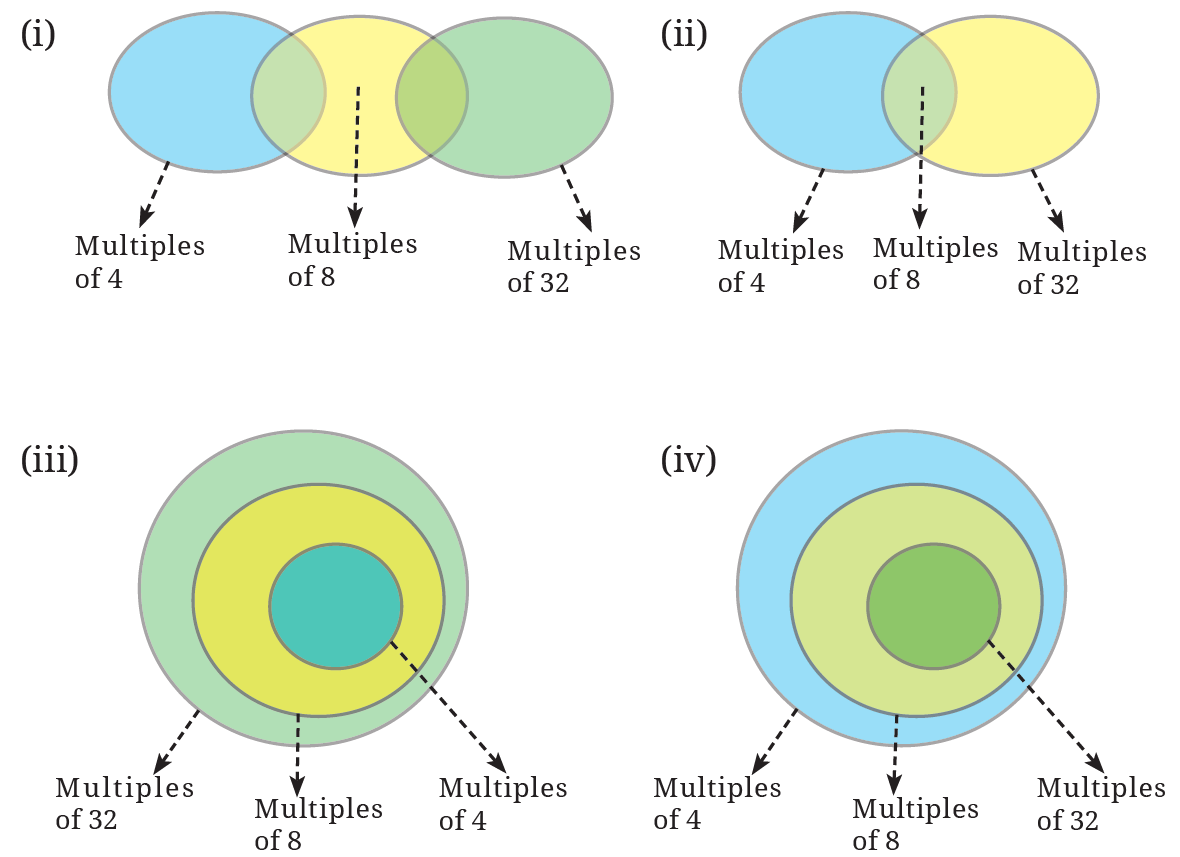
Question 16. Which of the following Venn diagrams captures the relationship between the multiples of $4$, $8$, and $32$?
Answer:
Playing with Numbers Class 8 Solutions Maths
Given:
Three sets of numbers: Multiples of $4$, Multiples of $8$, and Multiples of $32$.
To Find:
The correct Venn diagram that represents the logical relationship between these three groups of numbers.
Solution:
Let us examine the numbers belonging to each group:
1. Multiples of 4: $4, 8, 12, 16, 20, 24, 28, 32, 36, 40, \dots$
2. Multiples of 8: $8, 16, 24, 32, 40, 48, \dots$
3. Multiples of 32: $32, 64, 96, 128, \dots$
By comparing these lists, we can see a clear nesting relationship:
Every number that is a multiple of 32 is also a multiple of 8 because $32 = 8 \times 4$.
$\text{Multiples of 32 are contained within Multiples of 8}$
Similarly, every number that is a multiple of 8 is also a multiple of 4 because $8 = 4 \times 2$.
$\text{Multiples of 8 are contained within Multiples of 4}$
From these two observations, it is clear that the Multiples of 32 form the smallest group, which sits inside the Multiples of 8, and both these groups sit inside the largest group, which is the Multiples of 4.
$\text{Nested Relationship: 32 } \rightarrow \text{ 8 } \rightarrow \text{ 4}$
[Concentric Circle Representation]
In Venn diagrams, this "contained within" relationship is represented by concentric circles (circles inside one another).
1. The innermost circle must be Multiples of 32.
2. The middle circle must be Multiples of 8.
3. The outermost circle must be Multiples of 4.
Diagram (iv) is the only one that shows this exact arrangement where the circle for 32 is inside 8, and the circle for 8 is inside 4.
Final Answer:
The correct Venn diagram is (iv).