

Chapter 6 We Distribute, Yet Things Multiply (Class 8 - Latest Maths NCERT (Ganita Prakash I) Solutions)
Looking for accurate and easy-to-follow NCERT Solutions for Chapter 6: We Distribute, Yet Things Multiply? This page provides comprehensive, step-by-step answers for the latest Class 8 Maths curriculum. We help you master the Distributive Property—the fundamental engine of algebra—ensuring you understand how to move beyond basic calculations to justify numerical patterns and solve complex problems with mathematical precision.
Our solutions offer detailed breakdowns for the three pillar Algebraic Identities: $(a+b)^2$, $(a-b)^2$, and $(a+b)(a-b)$. Instead of just providing formulas, we walkthrough the Geometric Visualizations and area models that prove these identities. Whether you are expanding binomial expressions or using Fast Multiplication shortcuts for numbers like 11, 101, or 99, our guides ensure you grasp the multiplicative growth occurring behind the symbols.
From historical methods like Brahmagupta's khaṇḍa-guṇanam to Sridharacharya’s clever squaring rules, these resources bridge the gap between ancient wisdom and modern exams. Curated by learningspot.co, these Ganita Prakash I solutions include step-by-step expansions, visual area-model derivations, and "Mind the Mistake" checks to help you build a rewarding and successful mathematical journey.
| Content On This Page | ||
|---|---|---|
| Figure It Out (Page No. 142 - 143) | Figure It Out (Page No. 149) | Figure It Out (Page No. 154 - 156) |
Figure It Out (Page No. 142 - 143)
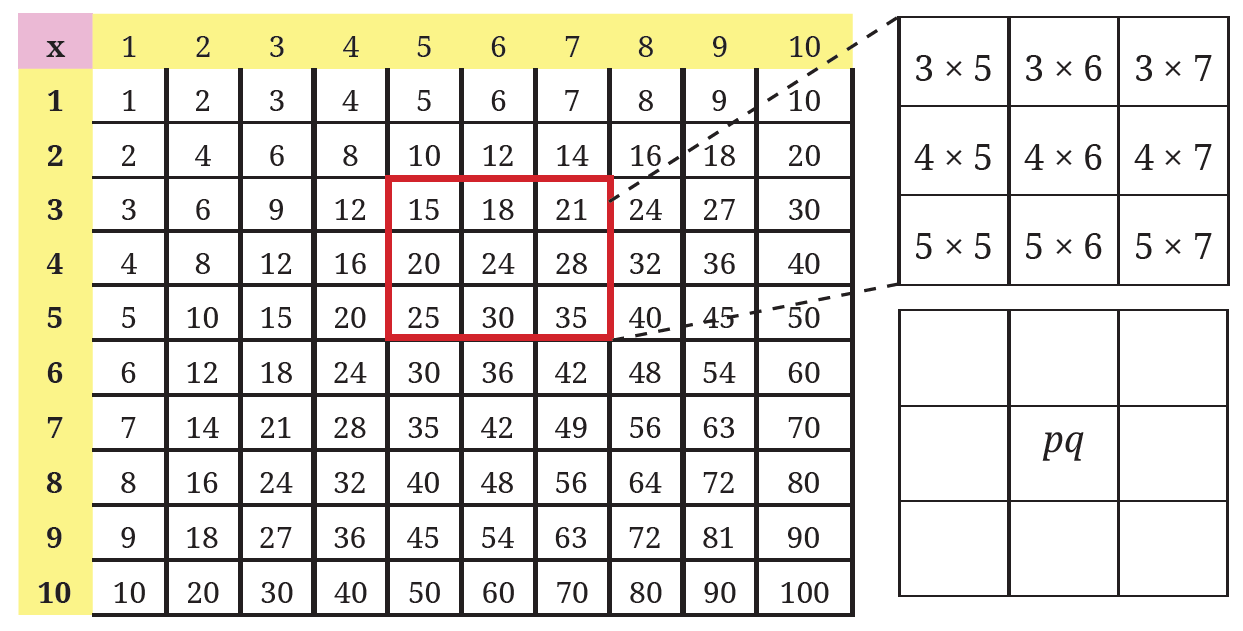
Question 1. Observe the multiplication grid below. Each number inside the grid is formed by multiplying two numbers. If the middle number of a $3 \times 3$ frame is given by the expression $pq$, as shown in the figure, write the expressions for the other numbers in the grid.
Answer:
Given:
A multiplication grid where each entry at the intersection of a row and a column is the product of the row number and the column number. A $3 \times 3$ frame is chosen such that the middle element is $pq$, where $p$ represents the row index and $q$ represents the column index.
To Find:
The algebraic expressions for the remaining $8$ cells in the $3 \times 3$ frame.
Solution:
In a multiplication table, the rows are consecutive integers and the columns are also consecutive integers. If the middle cell corresponds to row $p$ and column $q$, then:
1. The row above the middle row is $(p - 1)$ and the row below it is $(p + 1)$.
2. The column to the left of the middle column is $(q - 1)$ and the column to the right is $(q + 1)$.
We can now calculate the products for all nine cells in the frame as follows:
| Position | Calculation (Row $\times$ Column) | Expression |
| Top-Left | $(p - 1) \times (q - 1)$ | $(p - 1)(q - 1)$ |
| Top-Middle | $(p - 1) \times q$ | $(p - 1)q$ |
| Top-Right | $(p - 1) \times (q + 1)$ | $(p - 1)(q + 1)$ |
| Middle-Left | $p \times (q - 1)$ | $p(q - 1)$ |
| Center | $p \times q$ | $pq$ |
| Middle-Right | $p \times (q + 1)$ | $p(q + 1)$ |
| Bottom-Left | $(p + 1) \times (q - 1)$ | $(p + 1)(q - 1)$ |
| Bottom-Middle | $(p + 1) \times q$ | $(p + 1)q$ |
| Bottom-Right | $(p + 1) \times (q + 1)$ | $(p + 1)(q + 1)$ |
Therefore, the complete $3 \times 3$ grid around the center $pq$ can be represented as:
| $(p - 1)(q - 1)$ | $(p - 1)q$ | $(p - 1)(q + 1)$ |
| $p(q - 1)$ | $pq$ | $p(q + 1)$ |
| $(p + 1)(q - 1)$ | $(p + 1)q$ | $(p + 1)(q + 1)$ |
Question 2. Expand the following products.
(i) $(3 + u) (v - 3)$
(ii) $\frac{2}{3} (15 + 6a)$
(iii) $(10a + b) (10c + d)$
(iv) $(3 - x) (x - 6)$
(v) $(-5a + b) (c + d)$
(vi) $(5 + z) (y + 9)$
Answer:
To Find:
The expansion of the given algebraic products using the Distributive Property: $a(c + d) = ac + ad$.
Solution:
(i) $(3 + u) (v - 3)$
$3(v - 3) + u(v - 3)$
$(3 \times v) - (3 \times 3) + (u \times v) - (u \times 3)$
$3v - 9 + uv - 3u$
(ii) $\frac{2}{3} (15 + 6a)$
$\frac{2}{3} \times 15 + \frac{2}{3} \times 6a$
$\frac{2 \times \cancel{15}^{5}}{\cancel{3}_{1}} + \frac{2 \times \cancel{6}^{2}a}{\cancel{3}_{1}}$
$(2 \times 5) + (2 \times 2a)$
$10 + 4a$
(iii) $(10a + b) (10c + d)$
$10a(10c + d) + b(10c + d)$
$(10a \times 10c) + (10a \times d) + (b \times 10c) + (b \times d)$
$100ac + 10ad + 10bc + bd$
(iv) $(3 - x) (x - 6)$
$3(x - 6) - x(x - 6)$
$(3x - 18) - (x^2 - 6x)$
$3x - 18 - x^2 + 6x$
$-x^2 + 9x - 18$
(v) $(-5a + b) (c + d)$
$-5a(c + d) + b(c + d)$
$-5ac - 5ad + bc + bd$
(vi) $(5 + z) (y + 9)$
$5(y + 9) + z(y + 9)$
$(5 \times y) + (5 \times 9) + (z \times y) + (z \times 9)$
$5y + 45 + zy + 9z$
Question 3. Find $3$ examples where the product of two numbers remains unchanged when one of them is increased by $2$ and the other is decreased by $4$.
Answer:
Given:
Let the two numbers be $x$ and $y$. The condition is that the product remains unchanged when $x$ is increased by $2$ and $y$ is decreased by $4$.
Solution:
We can write the condition as an algebraic equation:
$xy = (x + 2)(y - 4)$
Expanding the Right Hand Side (RHS):
$xy = x(y - 4) + 2(y - 4)$
$xy = xy - 4x + 2y - 8$
Subtracting $xy$ from both sides:
$0 = -4x + 2y - 8$
Rearranging the equation to solve for $y$:
$2y = 4x + 8$
Dividing by $2$:
$y = 2x + 4$
Now, we can find three examples by choosing any value for $x$ and calculating $y$.
Example 1: Let $x = 1$
$y = 2(1) + 4 = 6$
Checking: Original product $= 1 \times 6 = 6$. New product $= (1+2)(6-4) = 3 \times 2 = 6$. Matches!
Example 2: Let $x = 3$
$y = 2(3) + 4 = 10$
Checking: Original product $= 3 \times 10 = 30$. New product $= (3+2)(10-4) = 5 \times 6 = 30$. Matches!
Example 3: Let $x = 5$
$y = 2(5) + 4 = 14$
Checking: Original product $= 5 \times 14 = 70$. New product $= (5+2)(14-4) = 7 \times 10 = 70$. Matches!
Final Answer: Three pairs of numbers are (1, 6), (3, 10), and (5, 14).
Question 4. Expand:
(i) $(a + ab - 3b^2) (4 + b)$
(ii) $(4y + 7) (y + 11z - 3)$
Answer:
(i) $(a + ab - 3b^2) (4 + b)$
We use the distributive property to multiply each term in the first bracket by each term in the second:
$4(a + ab - 3b^2) + b(a + ab - 3b^2)$
$(4a + 4ab - 12b^2) + (ab + ab^2 - 3b^3)$
Combining the like terms ($4ab$ and $ab$):
$4a + 5ab - 12b^2 + ab^2 - 3b^3$
(ii) $(4y + 7) (y + 11z - 3)$
Expanding the terms:
$4y(y + 11z - 3) + 7(y + 11z - 3)$
$(4y^2 + 44yz - 12y) + (7y + 77z - 21)$
Combining the like terms ($-12y$ and $7y$):
$4y^2 + 44yz - 5y + 77z - 21$
Question 5. Expand:
(i) $(a - b) (a + b)$
(ii) $(a - b) (a^2 + ab + b^2)$
(iii) $(a - b)(a^3 + a^2b + ab^2 + b^3)$
Do you see a pattern? What would be the next identity in the pattern that you see? Can you check it by expanding?
Answer:
(i) $(a - b) (a + b)$
$a(a + b) - b(a + b)$
$a^2 + ab - ba - b^2$
$a^2 - b^2$
(ii) $(a - b) (a^2 + ab + b^2)$
$a(a^2 + ab + b^2) - b(a^2 + ab + b^2)$
$(a^3 + a^2b + ab^2) - (ba^2 + ab^2 + b^3)$
All middle terms cancel out:
$a^3 - b^3$
(iii) $(a - b)(a^3 + a^2b + ab^2 + b^3)$
$a(a^3 + a^2b + ab^2 + b^3) - b(a^3 + a^2b + ab^2 + b^3)$
$(a^4 + a^3b + a^2b^2 + ab^3) - (ba^3 + a^2b^2 + ab^3 + b^4)$
All middle terms cancel out:
$a^4 - b^4$
Pattern and Generalisation:
We observe that in each case, the expansion results in the difference of $n^{th}$ powers, where $n$ is the total number of terms in the second bracket plus one. The general pattern is:
$(a - b)(a^{n-1} + a^{n-2}b + ... + b^{n-1}) = a^n - b^n$
Next identity in the pattern:
$(a - b)(a^4 + a^3b + a^2b^2 + ab^3 + b^4) = a^5 - b^5$
Verification:
$a(a^4 + a^3b + a^2b^2 + ab^3 + b^4) - b(a^4 + a^3b + a^2b^2 + ab^3 + b^4)$
$(a^5 + a^4b + a^3b^2 + a^2b^3 + ab^4) - (ba^4 + a^3b^2 + a^2b^3 + ab^4 + b^5)$
After cancelling common terms, we are left with:
$a^5 - b^5$
The identity is verified.
Figure It Out (Page No. 149)
Question 1. Which is greater: $(a - b)^2$ or $(b - a)^2$? Justify your answer.
Answer:
Given:
Two algebraic expressions: $(a - b)^2$ and $(b - a)^2$.
To Find:
Which of the two expressions is greater and provide a justification.
Solution:
Let us expand both expressions using the algebraic identity $(x - y)^2 = x^2 - 2xy + y^2$.
Expanding the first expression:
$(a - b)^2 = a^2 - 2ab + b^2$
Expanding the second expression:
$(b - a)^2 = b^2 - 2ba + a^2$
Since multiplication is commutative, we know that $ba = ab$. Thus, the second expression can be rewritten as:
$(b - a)^2 = a^2 - 2ab + b^2$
Comparing the two results, we see that they are exactly the same.
Final Answer: Neither is greater; both expressions are equal.
Question 2. Express $100$ as the difference of two squares.
Answer:
Given:
The number to be expressed as a difference of two squares is $100$.
To Find:
Two perfect squares $a^2$ and $b^2$ such that their difference is $100$.
Solution:
We use the algebraic identity for the difference of two squares:
$a^2 - b^2 = (a + b)(a - b)$
…(i)
We need to find two integers $a$ and $b$. Let $a + b = x$ and $a - b = y$. Then $x \times y = 100$. For $a$ and $b$ to be integers, $x$ and $y$ must both be even or both be odd. Since their product $100$ is even, both factors must be even.
Let us choose the even factors $50$ and $2$ of $100$ ($50 \times 2 = 100$).
$a + b = 50$
[Sum of factors] ... (ii)
$a - b = 2$
[Difference of factors] ... (iii)
By adding equations (ii) and (iii), we get:
$2a = 52$
$a = 26$
Now, we substitute the value of $a$ in equation (ii):
$26 + b = 50$
$b = 24$
To verify, we calculate the squares of these numbers:
$26^2 = 676$
$24^2 = 576$
The difference is:
$676 - 576 = 100$
Thus, $100$ can be expressed as $26^2 - 24^2$.
Question 3. Find $406^2, 72^2, 145^2, 1097^2,$ and $124^2$ using the identities you have learnt so far.
Answer:
To Find:
The squares of the given numbers using algebraic identities.
Solution:
We will use the identity $(a + b)^2 = a^2 + 2ab + b^2$ or $(a - b)^2 = a^2 - 2ab + b^2$.
1. Solving $406^2$
$406^2 = (400 + 6)^2$
$406^2 = 400^2 + 2(400)(6) + 6^2$
$406^2 = 160000 + 4800 + 36$
$406^2 = 164836$
2. Solving $72^2$
$72^2 = (70 + 2)^2$
$72^2 = 70^2 + 2(70)(2) + 2^2$
$72^2 = 4900 + 280 + 4$
$72^2 = 5184$
3. Solving $145^2$
$145^2 = (140 + 5)^2$
$145^2 = 140^2 + 2(140)(5) + 5^2$
$145^2 = 19600 + 1400 + 25$
$145^2 = 21025$
4. Solving $1097^2$
$1097^2 = (1100 - 3)^2$
$1097^2 = 1100^2 - 2(1100)(3) + 3^2$
$1097^2 = 1210000 - 6600 + 9$
$1097^2 = 1203409$
5. Solving $124^2$
$124^2 = (120 + 4)^2$
$124^2 = 120^2 + 2(120)(4) + 4^2$
$124^2 = 14400 + 960 + 16$
$124^2 = 15376$
Question 4. Do Patterns $1$ and $2$ hold only for counting numbers? Do they hold for negative integers as well? What about fractions? Justify your answer.
Answer:
To Examine:
Whether Pattern 1 $[2(a^2 + b^2) = (a + b)^2 + (a - b)^2]$ and Pattern 2 $[a^2 - b^2 = (a + b)(a - b)]$ hold for counting numbers, negative integers, and fractions.
Justification for Pattern 1: $2(a^2 + b^2) = (a + b)^2 + (a - b)^2$
Case I: Counting Numbers
Let $a = 4$ and $b = 2$.
$\text{LHS} = 2(4^2 + 2^2) = 2(16 + 4) = 40$
$\text{RHS} = (4 + 2)^2 + (4 - 2)^2 = 6^2 + 2^2 = 40$
$\therefore$ Pattern 1 holds for counting numbers.
Case II: Negative Integers
Let $a = -4$ and $b = -2$.
$\text{LHS} = 2((-4)^2 + (-2)^2) = 2(16 + 4) = 40$
$\text{RHS} = (-4 + (-2))^2 + (-4 - (-2))^2$
$\text{RHS} = (-6)^2 + (-2)^2 = 36 + 4 = 40$
$\therefore$ Pattern 1 holds for negative integers.
Case III: Fractions
Let $a = \frac{1}{2}$ and $b = \frac{1}{4}$.
$\text{LHS} = 2((\frac{1}{2})^2 + (\frac{1}{4})^2) = 2(\frac{1}{4} + \frac{1}{16}) = \frac{5}{8}$
$\text{RHS} = (\frac{1}{2} + \frac{1}{4})^2 + (\frac{1}{2} - \frac{1}{4})^2 = (\frac{3}{4})^2 + (\frac{1}{4})^2 = \frac{5}{8}$
$\therefore$ Pattern 1 holds for fractions also.
Justification for Pattern 2: $a^2 - b^2 = (a + b)(a - b)$
Case I: Counting Numbers
Let $a = 5$ and $b = 3$.
$\text{LHS} = 5^2 - 3^2 = 25 - 9 = 16$
$\text{RHS} = (5 + 3)(5 - 3) = 8 \times 2 = 16$
$\therefore \text{LHS} = \text{RHS}$. Pattern 2 holds for counting numbers.
Case II: Negative Integers
Let $a = -5$ and $b = -3$.
$\text{LHS} = (-5)^2 - (-3)^2 = 25 - 9 = 16$
$\text{RHS} = [(-5) + (-3)][(-5) - (-3)]$
$\text{RHS} = (-8) \times (-2) = 16$
$\therefore \text{LHS} = \text{RHS}$. Pattern 2 holds for negative integers.
Case III: Fractions
Let $a = \frac{3}{4}$ and $b = \frac{1}{4}$.
$\text{LHS} = (\frac{3}{4})^2 - (\frac{1}{4})^2 = \frac{9}{16} - \frac{1}{16} = \frac{1}{2}$
$\text{RHS} = (\frac{3}{4} + \frac{1}{4})(\frac{3}{4} - \frac{1}{4}) = (1) \times (\frac{1}{2}) = \frac{1}{2}$
$\therefore \text{LHS} = \text{RHS}$. Pattern 2 holds for fractions also.
Conclusion: Both patterns are universal algebraic identities. They hold Always True for all real numbers, including counting numbers, negative integers, and fractions.
Figure It Out (Page No. 154 - 156)
Question 1. Compute these products using the suggested identity.
(i) $46^2$ using Identity 1A for $(a + b)^2$
(ii) $397 \times 403$ using Identity 1C for $(a + b) (a - b)$
(iii) $91^2$ using Identity 1B for $(a - b)^2$
(iv) $43 \times 45$ using Identity 1C for $(a + b) (a - b)$
Answer:
(i) $46^2$ using Identity $(a + b)^2 = a^2 + 2ab + b^2$
We can write $46$ as $(40 + 6)$.
Here, $a = 40$ and $b = 6$.
$(40 + 6)^2 = 40^2 + 2(40)(6) + 6^2$
$40^2 = 1600$
$2 \times 40 \times 6 = 480$
$6^2 = 36$
Adding the values: $1600 + 480 + 36$
$46^2 = 2116$
(ii) $397 \times 403$ using Identity $(a - b)(a + b) = a^2 - b^2$
We can write $397$ as $(400 - 3)$ and $403$ as $(400 + 3)$.
Here, $a = 400$ and $b = 3$.
$(400 - 3)(400 + 3) = 400^2 - 3^2$
$400^2 = 160000$
$3^2 = 9$
Subtracting: $160000 - 9$
$397 \times 403 = 159991$
(iii) $91^2$ using Identity $(a - b)^2 = a^2 - 2ab + b^2$
We can write $91$ as $(100 - 9)$.
Here, $a = 100$ and $b = 9$.
$(100 - 9)^2 = 100^2 - 2(100)(9) + 9^2$
$100^2 = 10000$
$2 \times 100 \times 9 = 1800$
$9^2 = 81$
Calculation: $10000 - 1800 + 81$
$91^2 = 8281$
(iv) $43 \times 45$ using Identity $(a - b)(a + b) = a^2 - b^2$
We find the middle number between $43$ and $45$, which is $44$.
We can write $43$ as $(44 - 1)$ and $45$ as $(44 + 1)$.
Here, $a = 44$ and $b = 1$.
$(44 - 1)(44 + 1) = 44^2 - 1^2$
$44^2 = 1936$
$1^2 = 1$
Subtracting: $1936 - 1$
$43 \times 45 = 1935$
Question 2. Use either a suitable identity or the distributive property to find each of the following products.
(i) $(p - 1) (p + 11)$
(ii) $(3a - 9b) (3a + 9b)$
(iii) $-(2y + 5) (3y + 4)$
(iv) $(6x + 5y)^2$
(v) $(2x - \frac{1}{2})^2$
(vi) $(7p) \times (3r) \times (p + 2)$
Answer:
(i) $(p - 1)(p + 11)$
Using the distributive property:
$p(p + 11) - 1(p + 11)$
$p^2 + 11p - p - 11$
$p^2 + 10p - 11$
(ii) $(3a - 9b)(3a + 9b)$
Using the identity $(x - y)(x + y) = x^2 - y^2$:
$(3a)^2 - (9b)^2$
$9a^2 - 81b^2$
(iii) $-(2y + 5)(3y + 4)$
First, we multiply the two brackets:
$(2y + 5)(3y + 4) = 2y(3y + 4) + 5(3y + 4)$
$6y^2 + 8y + 15y + 20$
$6y^2 + 23y + 20$
Now, applying the negative sign outside:
$-6y^2 - 23y - 20$
(iv) $(6x + 5y)^2$
Using the identity $(a + b)^2 = a^2 + 2ab + b^2$:
$(6x)^2 + 2(6x)(5y) + (5y)^2$
$36x^2 + 60xy + 25y^2$
(v) $(2x - \frac{1}{2})^2$
Using the identity $(a - b)^2 = a^2 - 2ab + b^2$:
$(2x)^2 - 2(2x)(\frac{1}{2}) + ( \frac{1}{2} )^2$
$4x^2 - 2x + \frac{1}{4}$
(vi) $(7p) \times (3r) \times (p + 2)$
First, multiply the monomials:
$7p \times 3r = 21pr$
Now, multiply the result by the binomial $(p + 2)$:
$21pr(p + 2) = (21pr \times p) + (21pr \times 2)$
$21p^2r + 42pr$
Question 3. For each statement identify the appropriate algebraic expression(s).
(i) Two more than a square number.
$2 + s$
$(s + 2)^2$
$s^2 + 2$
$s^2 + 4$
$2s^2$
$2^{2}s$
(ii) The sum of the squares of two consecutive numbers
$m^2 + n^2$
$(m + n)^2$
$m^2 + 1$
$m^2 + (m + 1)^2$
$m^2 + (m - 1)^2$
$(m + (m + 1))^2$
$(2m)^2 + (2m + 1)^2$
Answer:
(i) Two more than a square number:
Let the number be $s$. Its square is $s^2$. "Two more than" means we add $2$ to this square.
The appropriate expression is: $s^2 + 2$
(ii) The sum of the squares of two consecutive numbers:
Consecutive numbers differ by $1$. If the first number is $m$, the next is $(m + 1)$ and the previous is $(m - 1)$.
1. Using $m$ and $m + 1$: The sum of their squares is $m^2 + (m + 1)^2$.
2. Using $m$ and $m - 1$: The sum of their squares is $m^2 + (m - 1)^2$.
3. Also, $2m$ and $2m + 1$ are always consecutive numbers (an even followed by an odd). The sum of their squares is $(2m)^2 + (2m + 1)^2$.
The appropriate expressions are: $m^2 + (m + 1)^2$, $m^2 + (m - 1)^2$, and $(2m)^2 + (2m + 1)^2$.
Question 4. Consider any $2$ by $2$ square of numbers in a calendar, as shown in the figure.
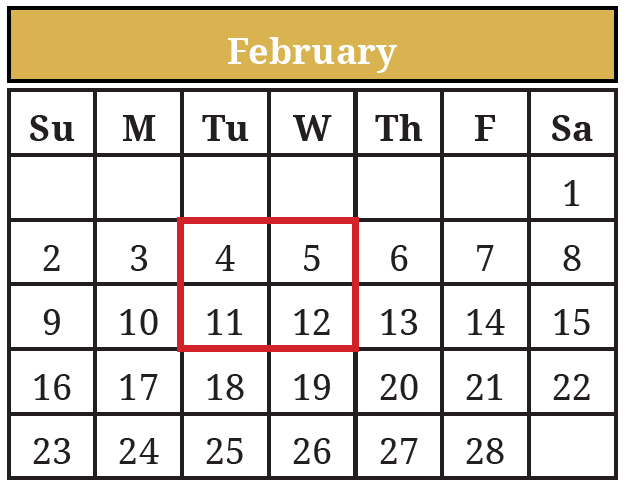
Find products of numbers lying along each diagonal — $4 \times 12 = 48$, $5 \times 11 = 55$. Do this for the other $2$ by $2$ squares. What do you observe about the diagonal products? Explain why this happens.
Hint: Label the numbers in each $2$ by $2$ square as:
| $a$ | $(a + 1)$ |
| $(a + 7)$ | $(a + 8)$ |
Answer:
Given:
A $2 \times 2$ square of numbers in a calendar. For example, the numbers $4, 5, 11,$ and $12$.
The products of the diagonals are given as:
$4 \times 12 = 48$
(First diagonal)
$5 \times 11 = 55$
(Second diagonal)
To Find:
1. Diagonal products for other $2 \times 2$ squares in the calendar.
2. Observation regarding the relationship between these products.
3. Algebraic justification for the observation.
Solution:
Let us choose another $2 \times 2$ square from the calendar, such as the numbers $9, 10, 16,$ and $17$.
| $9$ | $10$ |
| $16$ | $17$ |
$9 \times 17 = 153$
(Diagonal from top-left to bottom-right)
$10 \times 16 = 160$
(Diagonal from top-right to bottom-left)
Observation:
In both cases, we see that the product of the diagonal starting from the top-right ($5 \times 11 = 55$ and $10 \times 16 = 160$) is exactly $7$ more than the product of the diagonal starting from the top-left ($4 \times 12 = 48$ and $9 \times 17 = 153$).
$55 - 48 = 7$
$160 - 153 = 7$
Algebraic Explanation:
In any calendar, a week consists of $7$ days. If we let the first number in our $2 \times 2$ square be $a$, then the number to its right is $(a + 1)$. The number directly below $a$ represents the same day of the next week, which is $(a + 7)$. The number to the right of $(a + 7)$ is $(a + 8)$.
The general $2 \times 2$ square table is as follows:
| $a$ | $a + 1$ |
| $a + 7$ | $a + 8$ |
Let $P_1$ be the product of the first diagonal (Top-Left to Bottom-Right):
$P_1 = a(a + 8) = a^2 + 8a$
[Multiplying first diagonal]
Let $P_2$ be the product of the second diagonal (Top-Right to Bottom-Left):
$P_2 = (a + 1)(a + 7)$
[Multiplying second diagonal]
Expanding the expression for $P_2$:
$P_2 = a^2 + 7a + a + 7$
$P_2 = a^2 + 8a + 7$
Now, let us calculate the difference between the two products ($P_2 - P_1$):
$\text{Difference} = (a^2 + 8a + 7) - (a^2 + 8a)$
$\text{Difference} = 7$
Conclusion: Since the algebraic difference is a constant $7$, the product of the second diagonal will always be exactly $7$ more than the product of the first diagonal in any $2 \times 2$ square on a calendar. This happens because the vertical gap between dates in a calendar is always $7$.
Question 5. Verify which of the following statements are true.
(i) $(k + 1) (k + 2) - (k + 3)$ is always a multiple $2$.
(ii) $(2q + 1) (2q - 3)$ is a multiple of $4$.
(iii) Squares of even numbers are multiples of $4$, and squares of odd numbers are $1$ more than multiples of $8$.
(iv) $(6n + 2)^2 - (4n + 3)^2$ is $5$ less than a square number.
Answer:
(i) Verification of $(k + 1) (k + 2) - (k + 3)$ as a multiple of $2$
First, we simplify the expression:
$(k + 1)(k + 2) - (k + 3) = k^2 + 3k + 2 - k - 3$
$= k^2 + 2k - 1$
Let us test for an even value of $k$. Let $k = 2$:
$2^2 + 2(2) - 1 = 4 + 4 - 1 = 7$
(Which is Odd)
Since $7$ is not a multiple of $2$, the statement is False.
(ii) Verification of $(2q + 1) (2q - 3)$ as a multiple of $4$
Expanding the expression:
$(2q + 1)(2q - 3) = 4q^2 - 6q + 2q - 3$
[Using Distributive Property]
$= 4q^2 - 4q - 3$
$= 4(q^2 - q) - 3$
The term $4(q^2 - q)$ is always a multiple of $4$, but subtracting $3$ leaves a remainder of $1$ (or $-3$). For example, if $q = 1$, the result is $-3$, which is not a multiple of $4$. Therefore, the statement is False.
(iii) Verification of Squares of Even and Odd numbers
Part A: Squares of even numbers. Let an even number be $2n$.
$(2n)^2 = 4n^2$
[Which is a multiple of 4]
Part B: Squares of odd numbers. Let an odd number be $2n + 1$.
$(2n + 1)^2 = 4n^2 + 4n + 1$
$= 4n(n + 1) + 1$
Since $n(n+1)$ is the product of two consecutive integers, it is always even ($2m$). Substituting this:
$4(2m) + 1 = 8m + 1$
(1 more than multiple of 8)
Thus, the statement is True.
(iv) Verification of $(6n + 2)^2 - (4n + 3)^2$ as $5$ less than a square number
Using the identity $a^2 - b^2 = (a + b)(a - b)$:
$a = 6n + 2, b = 4n + 3$
$\text{Exp} = (6n + 2 + 4n + 3)(6n + 2 - 4n - 3)$
$= (10n + 5)(2n - 1)$
$= 5(2n + 1)(2n - 1) = 5(4n^2 - 1)$
$= 20n^2 - 5$
For this to be "$5$ less than a square number" ($x^2 - 5$), the term $20n^2$ must be a perfect square. However, $20$ is not a perfect square ($20 = 2^2 \times 5$). Thus, $20n^2$ is not a square for all $n$. For example, if $n=1$, the value is $15$, and $15+5=20$ (not a square). Therefore, the statement is False.
Conclusion: Only statement (iii) is true. The others are false based on algebraic expansion and testing of values.
Question 6. A number leaves a remainder of $3$ when divided by $7$, and another number leaves a remainder of $5$ when divided by $7$. What is the remainder when their sum, difference, and product are divided by $7$?
Answer:
Given:
Let the first number be $x$ and the second number be $y$.
$x = 7m + 3$
$y = 7n + 5$
To Find:
Remainders of $(x + y)$, $(y - x)$, and $(xy)$ when divided by $7$.
Solution:
1. For the Sum $(x + y)$:
$x + y = (7m + 3) + (7n + 5)$
$= 7(m + n) + 8$
$= 7(m + n) + 7 + 1$
$= 7(m + n + 1) + 1$
The remainder is $1$.
2. For the Difference $(y - x)$:
$y - x = (7n + 5) - (7m + 3)$
$= 7(n - m) + 2$
The remainder is $2$.
3. For the Product $(xy)$:
$xy = (7m + 3)(7n + 5)$
$= 49mn + 35m + 21n + 15$
$= 7(7mn + 5m + 3n) + 14 + 1$
$= 7(7mn + 5m + 3n + 2) + 1$
The remainder is $1$.
Question 7. Choose three consecutive numbers, square the middle one, and subtract the product of the other two. Repeat the same with other sets of numbers. What pattern do you notice? How do we write this as an algebraic equation? Expand both sides of the equation to check that it is a true identity.
Answer:
Solution:
Let us test with examples:
Example 1: $4, 5, 6$
$5^2 - (4 \times 6) = 25 - 24 = 1$
Example 2: $10, 11, 12$
$11^2 - (10 \times 12) = 121 - 120 = 1$
Pattern: The result is always $1$.
Algebraic Equation:
Let the three consecutive numbers be $(n - 1), n,$ and $(n + 1)$.
$n^2 - (n - 1)(n + 1) = 1$
Verification:
LHS: $n^2 - (n - 1)(n + 1)$
$= n^2 - (n^2 - 1)$
$= n^2 - n^2 + 1$
$= 1$
RHS: $1$
Since LHS = RHS, the identity is verified.
Question 8. What is the algebraic expression describing the following steps — add any two numbers. Multiply this by half of the sum of the two numbers? Prove that this result will be half of the square of the sum of the two numbers.
Answer:
Step 1: Frame the Algebraic Expression
Let the two numbers be $x$ and $y$.
1. Add the two numbers: $(x + y)$
2. Multiply this by half of the sum: $(x + y) \times \frac{x + y}{2}$
The resulting expression is: $\frac{(x + y)^2}{2}$
Step 2: Proof
To Prove:
The result is half of the square of the sum of the two numbers.
Proof:
Square of the sum $= (x + y)^2$
Half of the square of the sum $= \frac{(x + y)^2}{2}$
From Step 1, our result was:
$(x + y) \times \frac{1}{2}(x + y) = \frac{1}{2} \times (x + y) \times (x + y) = \frac{(x + y)^2}{2}$
Both expressions are identical. Thus, the statement is proved.
Question 9. Which is larger? Find out without fully computing the product.
(i) $14 \times 26$ or $16 \times 24$
(ii) $25 \times 75$ or $26 \times 74$
Answer:
To Find:
Which product is larger without performing full multiplication by using algebraic identities.
Solution:
We use the algebraic identity $(a - b)(a + b) = a^2 - b^2$. To compare two products where the sum of the factors is the same, the product where the numbers are closer together will always be larger.
(i) $14 \times 26$ or $16 \times 24$
Both pairs have the same sum: $14 + 26 = 40$ and $16 + 24 = 40$. Their average is $20$.
For $14 \times 26$: $(20 - 6)(20 + 6) = 20^2 - 6^2 = 400 - 36$
For $16 \times 24$: $(20 - 4)(20 + 4) = 20^2 - 4^2 = 400 - 16$
Since $16 < 36$, subtracting $16$ from $400$ leaves a larger result than subtracting $36$.
Therefore, $16 \times 24$ is larger.
(ii) $25 \times 75$ or $26 \times 74$
Both pairs have the same sum: $25 + 75 = 100$ and $26 + 74 = 100$. Their average is $50$.
For $25 \times 75$: $(50 - 25)(50 + 25) = 50^2 - 25^2$
For $26 \times 74$: $(50 - 24)(50 + 24) = 50^2 - 24^2$
Since $24^2$ is smaller than $25^2$, the second expression $(50^2 - 24^2)$ will have a larger value.
Therefore, $26 \times 74$ is larger.
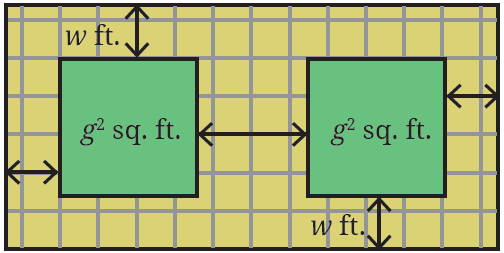
Question 10. A tiny park is coming up in Dhauli. The plan is shown in the figure. The two square plots, each of area $g^2$ sq. ft., will have a green cover. All the remaining area is a walking path $w$ ft. wide that needs to be tiled. Write an expression for the area that needs to be tiled.
Answer:
Given:
Area of each square green plot = $g^2$ sq. ft.
$\text{Side of each square plot} = g$ ft.
Width of the walking path = $w$ ft.
Space between the two square plots = $2w$ ft.
To Find:
The algebraic expression for the total area that needs to be tiled (the walking path).
Solution:
First, we determine the total dimensions of the rectangular park based on the plan.
1. Total Length of the park: The length consists of the path on the left, the first square plot, the space between the plots, the second square plot, and the path on the right.
$\text{Total Length} = w + g + 2w + g + w$
$\text{Total Length} = 2g + 4w$
2. Total Breadth (Height) of the park: The breadth consists of the path at the top, the square plot, and the path at the bottom.
$\text{Total Breadth} = w + g + w$
$\text{Total Breadth} = g + 2w$
3. Total Area of the park:
$\text{Total Area} = \text{Length} \times \text{Breadth}$
$\text{Total Area} = (2g + 4w) \times (g + 2w)$
Using the distributive property to expand the expression:
$= 2g(g + 2w) + 4w(g + 2w)$
$= 2g^2 + 4gw + 4gw + 8w^2$
$= 2g^2 + 8gw + 8w^2$
4. Area to be tiled: To find the tiled area, we subtract the area of the two green squares from the total area.
$\text{Area of green plots} = g^2 + g^2 = 2g^2$
$\text{Tiled Area} = (2g^2 + 8gw + 8w^2) - 2g^2$
$\text{Tiled Area} = 8gw + 8w^2$
Final Answer:
The expression for the area that needs to be tiled is $8gw + 8w^2$ sq. ft.
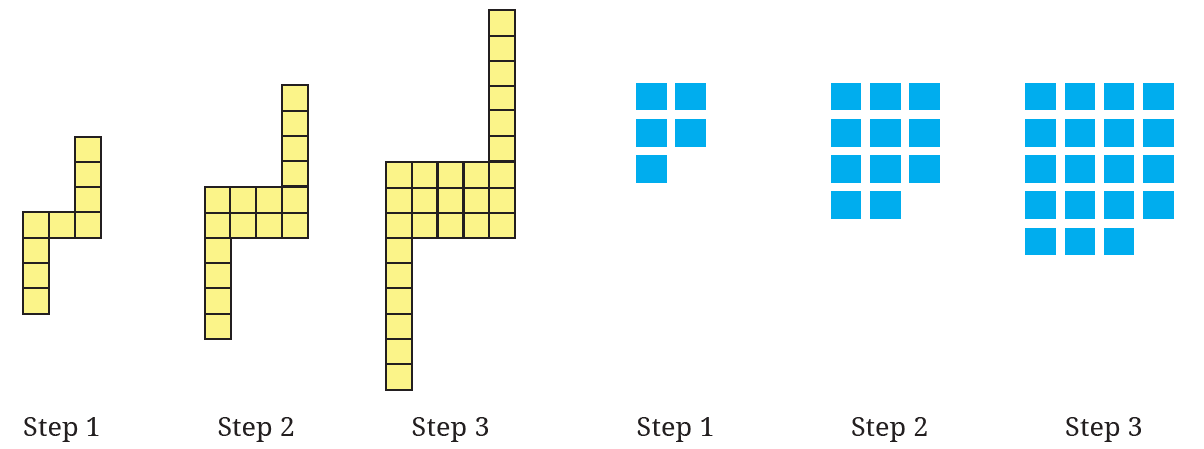
Question 11. For each pattern shown below,
(i) Draw the next figure in the sequence.
(ii) How many basic units are there in Step $10$?
(iii) Write an expression to describe the number of basic units in Step $y$.
Answer:
(a) Yellow Pattern Analysis:
By observing the first pattern, we see that each step forms a square of unit squares where the side of the square increases with each step.
In Step $1$:
$3 \times 3 = 9$
[$(1 + 2)^2$ unit squares]
In Step $2$:
$4 \times 4 = 16$
[$(2 + 2)^2$ unit squares]
In Step $3$:
$5 \times 5 = 25$
[$(3 + 2)^2$ unit squares]
(a) Solutions:
(i) Draw the next figure: Step $4$ will consist of $6$ strips of $6$ units each (a $6 \times 6$ square).
(ii) Number of unit squares in Step $10$:
$(10 + 2)^2 = 12^2 = 144$
(iii) Number of unit squares in Step $y$:
$U_y = (y + 2)^2$
(b) Blue Pattern Analysis:
By observing the blue unit squares, we see a different growth pattern.
In Step $1$:
$5 = 2^2 + 1$
[$(1 + 1)^2 + 1$ squares]
In Step $2$:
$11 = 3^2 + 2$
[$(2 + 1)^2 + 2$ squares]
In Step $3$:
$19 = 4^2 + 3$
[$(3 + 1)^2 + 3$ squares]
(b) Solutions:
(i) Draw the next figure: Step $4$ will have $(4 + 1)^2 + 4 = 25 + 4 = 29$ squares.
(ii) Number of unit squares in Step $10$:
$(10 + 1)^2 + 10 = 11^2 + 10 = 121 + 10 = 131$
(iii) Number of unit squares in Step $y$:
$U_y = (y + 1)^2 + y$