

Chapter 7 Proportional Reasoning-1 (Class 8 - Latest Maths NCERT (Ganita Prakash I) Solutions)
Looking for clear and accurate NCERT Solutions for Chapter 7: Proportional Reasoning-1? This page provides step-by-step answers and logical explanations for the exercises in the latest Ganita Prakash I textbook. We help you master the art of "similarity in change"—whether you are calculating the exact proportions for a recipe, resizing digital images without distortion, or mixing the perfect ratio for filter coffee. Our solutions turn complex scaling problems into simple, intuitive calculations.
Our solutions offer detailed guidance on the formal language of Ratios and Proportions. You will find comprehensive walkthroughs for the ancient Trairasika (The Rule of Three) method, where we show you exactly how to identify the pramāṇa (measure), phala (fruit), and ichchhā (requisition) to find the unknown result. By following our cross-multiplication guides, you will learn to solve for variables with confidence and master the technique of "Sharing but Not Equally" to divide quantities into specific parts.
Whether you are solving problems about tractor ploughing rates or the metallic composition of ₹10 coins, our resources are designed to ensure your success. Curated by learningspot.co, these Class 8 Maths solutions provide visual sharing models, unit conversion tips, and logical problem sets. These materials are tailored to the latest CBSE curriculum, helping you build a deep sense of scale and proportionality for both exams and real-life applications.
| Content On This Page | ||
|---|---|---|
| Figure It Out (Page No. 165 - 167) | Figure It Out (Page No. 170 - 171) | Figure It Out (Page No. 175) |
| Figure It Out (Page No. 176 - 177) | ||
Figure It Out (Page No. 165 - 167)
Question 1. Circle the following statements of proportion that are true.
(i) $4 : 7 :: 12 : 21$
(ii) $8 : 3 :: 24 : 6$
(iii) $7 : 12 :: 12 : 7$
(iv) $21 : 6 :: 35 : 10$
(v) $12 : 18 :: 28 : 12$
(vi) $24 : 8 :: 9 : 3$
Answer:
Given:
A set of ratios in proportion form ($a : b :: c : d$).
To Find:
Determine which of the given statements are true proportions. A statement is true if $\frac{a}{b} = \frac{c}{d}$.
Solution:
(i) $4 : 7 :: 12 : 21$
First ratio = $\frac{4}{7}$
Second ratio = $\frac{\cancel{12}^{4}}{\cancel{21}_{7}} = \frac{4}{7}$
Since $\frac{4}{7} = \frac{4}{7}$, this statement is TRUE.
(ii) $8 : 3 :: 24 : 6$
First ratio = $\frac{8}{3}$
Second ratio = $\frac{\cancel{24}^{4}}{\cancel{6}_{1}} = 4$
Since $\frac{8}{3} \neq 4$, this statement is FALSE.
(iii) $7 : 12 :: 12 : 7$
$\frac{7}{12}$ is not equal to $\frac{12}{7}$. This statement is FALSE.
(iv) $21 : 6 :: 35 : 10$
First ratio = $\frac{\cancel{21}^{7}}{\cancel{6}_{2}} = \frac{7}{2}$
Second ratio = $\frac{\cancel{35}^{7}}{\cancel{10}_{2}} = \frac{7}{2}$
Since $\frac{7}{2} = \frac{7}{2}$, this statement is TRUE.
(v) $12 : 18 :: 28 : 12$
First ratio = $\frac{\cancel{12}^{2}}{\cancel{18}_{3}} = \frac{2}{3}$
Second ratio = $\frac{\cancel{28}^{7}}{\cancel{12}_{3}} = \frac{7}{3}$
Since $\frac{2}{3} \neq \frac{7}{3}$, this statement is FALSE.
(vi) $24 : 8 :: 9 : 3$
First ratio = $\frac{\cancel{24}^{3}}{\cancel{8}_{1}} = 3$
Second ratio = $\frac{\cancel{9}^{3}}{\cancel{3}_{1}} = 3$
Since $3 = 3$, this statement is TRUE.
Final Answer: The true statements of proportion are (i), (iv), and (vi).
Question 2. Give 3 ratios that are proportional to $4 : 9$.
______ : ______ , ______ : ______ , ______ : ______
Answer:
To Find:
Ratios that are proportional to $4 : 9$.
Solution:
To find proportional ratios, we multiply both terms of the original ratio ($4$ and $9$) by the same non-zero number.
1. Multiplying by $2$: $(4 \times 2) : (9 \times 2) = \mathbf{8 : 18}$
2. Multiplying by $3$: $(4 \times 3) : (9 \times 3) = \mathbf{12 : 27}$
3. Multiplying by $10$: $(4 \times 10) : (9 \times 10) = \mathbf{40 : 9 0}$
Final Answer: Three proportional ratios are $8 : 18$, $12 : 27$, and $40 : 90$.
Question 3. Fill in the missing numbers for these ratios that are proportional to $18 : 24$.
$3$ : ______ , $12$ : ______ , $20$ : ______ , $27$ : ______
Answer:
Given:
The base ratio is $18 : 24$.
To Find:
The missing values to maintain proportionality.
Solution:
First, let us simplify the base ratio:
Base Ratio = $\frac{\cancel{18}^{3}}{\cancel{24}_{4}} = \frac{3}{4}$
All proportional ratios must simplify to $3 : 4$.
1. $3 : \text{______}$
Comparing $\frac{3}{\text{blank}} = \frac{3}{4}$, the missing number is $4$.
2. $12 : \text{______}$
Since $12 = 3 \times 4$, we multiply the denominator by the same factor:
$4 \times 4 = 16$. The missing number is $16$.
3. $20 : \text{______}$
We solve the equation $\frac{20}{x} = \frac{3}{4}$:
$3x = 80$
$x = \frac{80}{3} \approx \mathbf{26.67}$
4. $27 : \text{______}$
Since $27 = 3 \times 9$, we multiply the denominator by the same factor:
$4 \times 9 = 36$. The missing number is $36$.
Final Answer: The completed ratios are $3 : 4$, $12 : 16$, $20 : \frac{80}{3}$, and $27 : 36$.
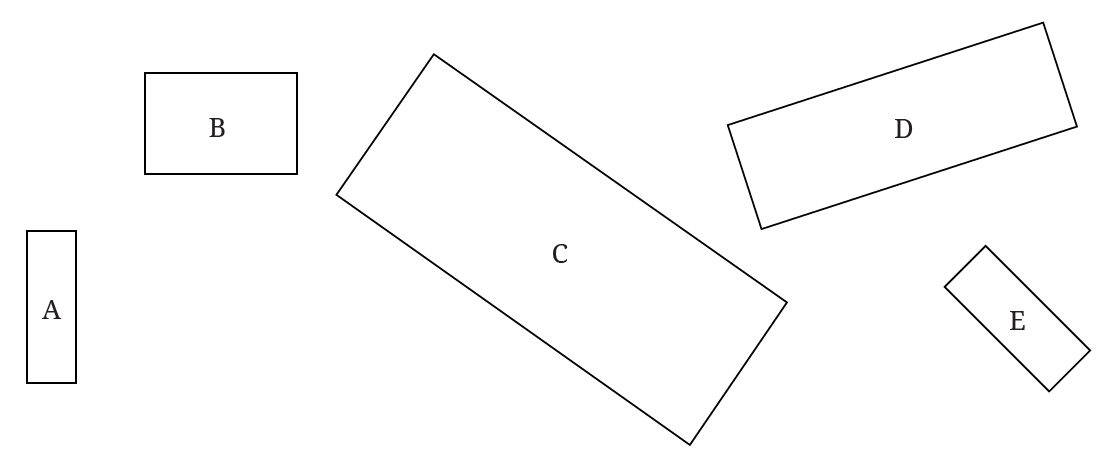
Question 4. Look at the following rectangles. Which rectangles are similar to each other? You can verify this by measuring the width and height using a scale and comparing their ratios.
Answer:
Proportional Reasoning Class 8 Solutions Ganita Prakash Maths Chapter 7 Page 162 Q4
Given:
Measurements of height ($h$) and width ($w$) for five rectangles $A, B, C, D,$ and $E$ are as follows:
1. Rectangle $A$: $h = 15$ mm, $w = 5$ mm
2. Rectangle $B$: $h = 10$ mm, $w = 15$ mm
3. Rectangle $C$: $h = 20$ mm, $w = 45$ mm
4. Rectangle $D$: $h = 10$ mm, $w = 35$ mm
5. Rectangle $E$: $h = 5$ mm, $w = 15$ mm
To Find:
Identify which rectangles are similar to each other by comparing the ratios of their corresponding sides.
Solution:
Two rectangles are said to be similar if the ratio of their corresponding sides (Length to Breadth) is the same. Let us calculate the ratio of the longer side to the shorter side for each rectangle:
For Rectangle A:
$\text{Ratio} = \frac{15}{5} = 3$
For Rectangle B:
$\text{Ratio} = \frac{15}{10} = 1.5$
For Rectangle C:
$\text{Ratio} = \frac{45}{20} = 2.25$
For Rectangle D:
$\text{Ratio} = \frac{35}{10} = 3.5$
For Rectangle E:
$\text{Ratio} = \frac{15}{5} = 3$
Comparison Table:
| Rectangle | Dimensions (mm) | Ratio (Longer : Shorter) |
| A | $15 \times 5$ | $3 : 1$ |
| B | $15 \times 10$ | $3 : 2$ |
| C | $45 \times 20$ | $2.25 : 1$ |
| D | $35 \times 10$ | $3.5 : 1$ |
| E | $15 \times 5$ | $3 : 1$ |
Observation:
From the table, we can see that Rectangle A and Rectangle E have the same ratio of sides ($3:1$). Although their orientations are different (A is vertical and E is horizontal), they possess the same proportional shape.
Final Answer:
Rectangles A and E are similar to each other because the ratio of their height and width results in the same value ($3$ or $\frac{1}{3}$).
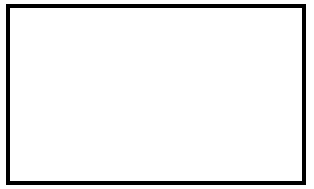
Question 5. Look at the following rectangle. Can you draw a smaller rectangle and a bigger rectangle with the same width to height ratio in your notebooks? Compare your rectangles with your classmates’ drawings. Are all of them the same? If they are different from yours, can you think why? Are they wrong?
Answer:
Given:
Dimensions of the reference rectangle:
$\text{Height } (h) = 18\text{ mm}$
$\text{Width } (w) = 32\text{ mm}$
To Find:
Dimensions for a smaller and a bigger rectangle that maintain the same width-to-height ratio.
Solution:
First, we calculate the simplest ratio of the width to the height of the given rectangle:
$\text{Ratio} = \frac{\text{Width}}{\text{Height}} = \frac{32}{18}$
On simplifying the fraction by dividing both terms by their common factor ($2$):
$\frac{\cancel{32}^{16}}{\cancel{18}_{9}} = \frac{16}{9}$
The constant ratio for any similar rectangle must be $16:9$.
1. Drawing a Smaller Rectangle:
To draw a smaller rectangle, we can multiply the simplified ratio by a smaller factor. If we take the factor as $0.5$ (or simply use the simplified values):
$\text{New Width} = 16\text{ mm}$
$\text{New Height} = 9\text{ mm}$
2. Drawing a Bigger Rectangle:
To draw a bigger rectangle, we can multiply the original dimensions or the simplified ratio by a larger factor, say $2$:
$\text{New Width} = 32 \times 2 = 64\text{ mm}$
$\text{New Height} = 18 \times 2 = 36\text{ mm}$
Comparison and Reasoning:
When you compare your rectangles with your classmates, you might find that the sizes are different. This is because different students might have used different scaling factors (e.g., one student might have tripled the size, while another might have doubled it).
Are they wrong? No. As long as the ratio of width to height remains $16:9$ (or approx $1.78$), the rectangles are mathematically similar and correct. Similarity depends on the proportionality of the sides, not the absolute measurements.
| Type of Rectangle | Width (mm) | Height (mm) | Ratio (w : h) |
| Smaller | 16 | 9 | 1.78 |
| Original | 32 | 18 | 1.78 |
| Bigger | 64 | 36 | 1.78 |
Final Conclusion: To maintain the same shape, any new rectangle must follow the 16:9 ratio. Multiple correct drawings are possible by using different multipliers.
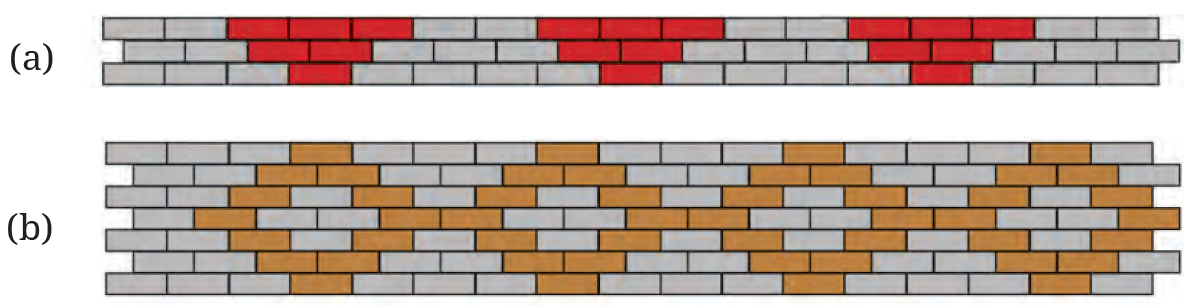
Question 6. The following figure shows a small portion of a long brick wall with patterns made using coloured bricks. Each wall continues this pattern throughout the wall. What is the ratio of grey bricks to coloured bricks? Try to give the ratios in their simplest form.
Answer:
(a) Analysis of the first wall pattern:
To find the ratio, we identify one repeating unit (one set) of the pattern. In this wall, the red bricks form inverted triangles. We count the bricks in one such cycle.
Given:
Number of coloured (red) bricks in one set of the pattern:
$3 + 2 + 1 = 6$
Number of grey bricks in the same repeating unit:
$2 + 3 + 4 = 9$
To Find:
The simplest ratio of grey bricks to coloured bricks.
Solution:
$\text{Ratio} = 9 : 6$
Dividing both sides by the common factor 3:
$\frac{\cancel{9}^3}{\cancel{6}_2} = \frac{3}{2}$
$\therefore$ The ratio of grey bricks to coloured bricks in the first wall is 3 : 2.
(b) Analysis of the second wall pattern:
In this wall, the coloured (orange) bricks form diamond shapes. We examine one complete diamond cycle to determine the counts.
Given:
Number of coloured bricks in one set of the pattern:
$1 + 2 + 2 + 2 + 2 + 2 + 1 = 12$
Number of grey bricks in one set of the pattern:
$3 + 2 + 2 + 2 + 2 + 2 + 3 = 16$
To Find:
The simplest ratio of grey bricks to coloured bricks.
Solution:
$\text{Ratio} = 16 : 12$
Dividing both sides by the common factor 4:
$\frac{\cancel{16}^4}{\cancel{12}_3} = \frac{4}{3}$
$\therefore$ The ratio of grey bricks to coloured bricks in the second wall is 4 : 3.
Summary Table:
| Pattern | Grey Bricks | Coloured Bricks | Simplest Ratio |
| (a) Red | 9 | 6 | 3 : 2 |
| (b) Orange | 16 | 12 | 4 : 3 |
Question 7. Let us draw some human figures. Measure your friend’s body — the lengths of their head, torso, arms, and legs. Write the ratios as mentioned below—
head : torso
______ : ______
torso : arms
______ : ______
torso : legs
______ : ______
Answer:
Note: This is a practical activity. To show how to complete this task, let us use sample measurements (in cm) for an average 13-year-old student.
Step 1: Record Measurements
| Body Part | Measurement (cm) |
| Head (top to chin) | $20$ |
| Torso (shoulder to waist) | $40$ |
| Arms (shoulder to wrist) | $60$ |
| Legs (waist to ankle) | $80$ |
Step 2: Calculate Ratios in Simplest Form
1. head : torso
$\text{Ratio} = 20 : 40$
$\text{Simplest form} = \frac{\cancel{20}^{1}}{\cancel{40}_{2}}$
$1 : 2$
2. torso : arms
$\text{Ratio} = 40 : 60$
$\text{Simplest form} = \frac{\cancel{40}^{2}}{\cancel{60}_{3}}$
$2 : 3$
3. torso : legs
$\text{Ratio} = 40 : 80$
$\text{Simplest form} = \frac{\cancel{40}^{1}}{\cancel{80}_{2}}$
$1 : 2$
Conclusion:
The student should replace the sample measurements with actual values obtained from their friend. By dividing both terms of the ratio by their Highest Common Factor (HCF), the final ratio should be written in its simplest integer form.
Figure It Out (Page No. 170 - 171)
Question 1. The Earth travels approximately $940$ million kilometres around the Sun in a year. How many kilometres will it travel in a week?
Answer:
Given:
Total distance travelled in $1$ year = $940$ million kilometres.
$1 \text{ million} = 10,00,000$
(Indian System)
$1 \text{ year} = \frac{365}{7} \text{ weeks}$
(Standard year)
To Find:
The total distance travelled by the Earth in $1$ week.
Solution:
We first convert the distance from millions to kilometres and express the time in weeks. Distance and time are in direct proportion.
$940 \text{ million km} = 940 \times 10,00,000 \text{ km}$
Let the Earth travel $x$ kilometres in $1$ week. According to the principle of proportional reasoning:
$\frac{x}{1} = \frac{940 \times 10,00,000}{365/7}$
Simplifying the expression:
$x = \frac{940 \times 10,00,000 \times 7}{365}$
Cancelling the numerator and denominator by $5$:
$x = \frac{\cancel{940}^{188} \times 10,00,000 \times 7}{\cancel{365}_{73}}$
[Dividing by 5]
$x = \frac{1,31,60,00,000}{73}$
$x = 1,80,27,397.26...$
Final Answer:
In one week, the Earth travels approximately $1,80,27,397$ kilometres around the Sun.
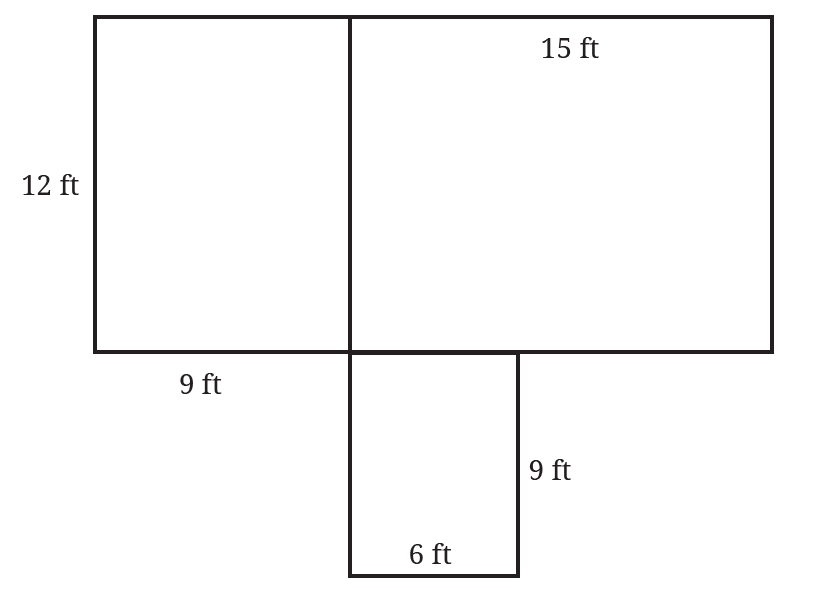
Question 2. A mason is building a house in the shape shown in the diagram. He needs to construct both the outer walls and the inner wall that separates two rooms. To build a wall of $10$ feet, he requires approximately $1450$ bricks. How many bricks would he need to build the house? Assume all walls are of the same height and thickness.
Answer:
Given:
Number of bricks required for a $10$ ft wall = $1450$ bricks.
The layout of the house involves outer walls and an inner wall separating the two upper rooms.
To Find:
Total number of bricks required to build the house according to the given dimensions.
Solution:
First, we calculate the total length of all the walls shown in the diagram by summing up the horizontal and vertical segments.
Horizontal Wall Lengths:
$\text{Top Wall} = 9\text{ ft} + 15\text{ ft} = 24\text{ ft}$
$\text{Middle Horizontal Wall} = 9\text{ ft} + 15\text{ ft} = 24\text{ ft}$
$\text{Bottom extension wall} = 6\text{ ft}$
Vertical Wall Lengths:
$\text{Three upper vertical walls} = 12\text{ ft} + 12\text{ ft} + 12\text{ ft} = 36\text{ ft}$
$\text{Two lower extension walls} = 9\text{ ft} + 9\text{ ft} = 18\text{ ft}$
Total Wall Length:
$\text{Total Length} = 24 + 24 + 6 + 36 + 18$
$\text{Total Length} = 108\text{ ft}$
[Sum of all segments]
Since the number of bricks is directly proportional to the length of the wall, we can set up a proportion.
Let $x$ be the total number of bricks required for a $108$ ft wall.
$\frac{10}{1450} = \frac{108}{x}$
Simplifying the first fraction:
$\frac{\cancel{10}^1}{\cancel{1450}_{145}} = \frac{108}{x}$
$\frac{1}{145} = \frac{108}{x}$
By cross-multiplication:
$x = 108 \times 145$
$x = 15,660$
Final Answer:
The mason would need $15,660$ bricks to build the entire house as per the diagram.
Figure It Out (Page No. 175)
Question 1. Divide $\textsf{₹}4,500$ into two parts in the ratio $2 : 3$.
Answer:
Given:
Total amount = $\textsf{₹} 4,500$
Ratio = $2 : 3$
To Find:
The value of each of the two parts.
Solution:
First, we find the sum of the ratio parts.
$\text{Sum of parts} = 2 + 3 = 5$
Now, we divide the total amount by the sum of parts to find the value of one part.
$\text{Value of one part} = \frac{4500}{5} = \textsf{₹} 900$
Now, we multiply this value by each term of the ratio:
$\text{First part} = 2 \times 900 = \textsf{₹} 1,800$
$\text{Second part} = 3 \times 900 = \textsf{₹} 2,700$
Final Answer: The two parts are $\textsf{₹} 1,800$ and $\textsf{₹} 2,700$.
Question 2. In a science lab, acid and water are mixed in the ratio of $1 : 5$ to make a solution. In a bottle that has $240$ mL of the solution, how much acid and water does the solution contain?
Answer:
Given:
Ratio of Acid to Water = $1 : 5$
Total volume of solution = $240$ mL
To Find:
The quantity of acid and the quantity of water in the mixture.
Solution:
The total number of parts in the mixture is obtained by adding the terms of the ratio.
$\text{Total parts} = 1 + 5 = 6$
Now, we find the volume of each component:
$\text{Quantity of Acid} = \frac{1}{6} \times 240$
$\text{Quantity of Acid} = \mathbf{40 \text{ mL}}$
$\text{Quantity of Water} = \frac{5}{6} \times 240$
$\text{Quantity of Water} = 5 \times 40 = \mathbf{200 \text{ mL}}$
Final Answer: The solution contains $40$ mL of acid and $200$ mL of water.
Question 3. Blue and yellow paints are mixed in the ratio of $3 : 5$ to produce green paint. To produce $40$ mL of green paint, how much of these two colours are needed?
To make the paint a lighter shade of green, I added $20$ mL of yellow to the mixture. What is the new ratio of blue and yellow in the paint?
Answer:
Given:
Initial Ratio of Blue to Yellow = $3 : 5$
Total initial volume of Green paint = $40$ mL
Part 1: Initial Quantities
Total parts = $3 + 5 = 8$
$\text{Amount of Blue paint} = \frac{3}{8} \times 40 = 15$ mL
$\text{Amount of Yellow paint} = \frac{5}{8} \times 40 = 25$ mL
Part 2: New Ratio Calculation
We add $20$ mL of yellow paint to the existing mixture.
$\text{New amount of Yellow paint} = 25 \text{ mL} + 20 \text{ mL} = 45 \text{ mL}$
The amount of blue paint remains unchanged at $15$ mL.
$\text{New Ratio (Blue : Yellow)} = 15 : 45$
To simplify, divide both terms by their Highest Common Factor ($15$):
$\text{Simplified New Ratio} = \frac{15}{15} : \frac{45}{15} = 1 : 3$
Final Answer: Initially, $15$ mL of blue and $25$ mL of yellow were needed. The new ratio after adding more yellow is $1 : 3$.
Question 4. To make soft idlis, you need to mix rice and urad dal in the ratio of $2 : 1$. If you need $6$ cups of this mixture to make idlis tomorrow morning, how many cups of rice and urad dal will you need?
Answer:
Given:
The ratio of rice to urad dal required for soft idlis is $2 : 1$.
The total volume of the mixture needed is $6$ cups.
To Find:
The number of cups of rice and urad dal required to make the mixture.
Solution:
The total number of parts in the ratio is the sum of the individual parts.
$\text{Total parts} = 2 + 1 = 3$
Now, we divide the total quantity by the total number of parts to find the value of one part.
$\text{Value of one part} = \frac{6 \text{ cups}}{3} = 2 \text{ cups}$
Using this, we calculate the required amount for each ingredient:
$\text{Quantity of Rice} = 2 \text{ parts} \times 2 \text{ cups/part} = \mathbf{4 \text{ cups}}$
$\text{Quantity of Urad Dal} = 1 \text{ part} \times 2 \text{ cups/part} = \mathbf{2 \text{ cups}}$
Final Answer: You will need $4$ cups of rice and $2$ cups of urad dal.
Question 5. I have one bucket of orange paint that I made by mixing red and yellow paints in the ratio of $3 : 5$. I added another bucket of yellow paint to this mixture. What is the ratio of red paint to yellow paint in the new mixture?
Answer:
Given:
Bucket 1 contains orange paint with red and yellow in the ratio $3 : 5$.
Bucket 2 contains only yellow paint. We assume the buckets are of equal size.
To Find:
The new ratio of red paint to yellow paint after mixing the two buckets.
Solution:
Let the total volume of one bucket be $8$ units (since the ratio $3 : 5$ adds up to $3 + 5 = 8$).
Contents of Bucket 1:
$\text{Red paint} = 3 \text{ units}$
$\text{Yellow paint} = 5 \text{ units}$
Contents of Bucket 2:
Since this bucket is entirely filled with yellow paint and is of the same size as Bucket 1:
$\text{Yellow paint} = 8 \text{ units}$
$\text{Red paint} = 0 \text{ units}$
Contents of the New Mixture:
We add the quantities of the same colours from both buckets together.
$\text{Total Red paint} = 3 \text{ units} + 0 \text{ units} = 3 \text{ units}$
$\text{Total Yellow paint} = 5 \text{ units} + 8 \text{ units} = 13 \text{ units}$
The new ratio of red paint to yellow paint is the ratio of these totals.
$\text{New Ratio (Red : Yellow)} = \mathbf{3 : 13}$
Final Answer: The ratio of red paint to yellow paint in the new mixture is $3 : 13$.
Figure It Out (Page No. 176 - 177)
Question 1. Anagh mixes $600$ mL of orange juice with $900$ mL of apple juice to make a fruit drink. Write the ratio of orange juice to apple juice in its simplest form.
Answer:
Given:
Volume of orange juice = $600$ mL
Volume of apple juice = $900$ mL
To Find:
The ratio of orange juice to apple juice in its simplest form.
Solution:
The ratio of orange juice to apple juice is written as:
$600 : 900$
To simplify the ratio, we can write it as a fraction and divide both terms by their Highest Common Factor (HCF). The HCF of $600$ and $900$ is $300$.
$\text{Ratio} = \frac{\cancel{600}^{2}}{\cancel{900}_{3}}$
$\text{Ratio} = 2 : 3$
Final Answer: The simplest form of the ratio of orange juice to apple juice is $2 : 3$.
Question 2. Last year, we hired $3$ buses for the school trip. We had a total of $162$ students and teachers who went on that trip and all the buses were full. This year we have $204$ students. How many buses will we need? Will all the buses be full?
Answer:
Given:
Total people last year = $162$
Buses hired last year = $3$ (Full capacity)
Total students this year = $204$
To Find:
The number of buses required this year and whether they will be full.
Solution:
First, we find the seating capacity of one bus using the unitary method.
$\text{Capacity of 1 bus} = \frac{162}{3} = 54 \text{ people}$
Now, we find the number of buses needed for $204$ people this year:
$\text{Number of buses} = \frac{204}{54}$
When we divide $204$ by $54$, we get $3$ with a remainder of $42$.
$204 = (54 \times 3) + 42$
This means $3$ buses will be completely full, and $42$ more students will still need a bus. Therefore, we will need $4$ buses in total.
To check if all buses will be full:
$\text{Total capacity of 4 buses} = 54 \times 4 = 216 \text{ seats}$
$\text{Number of empty seats} = 216 - 204 = 12$
Since there are $12$ empty seats, the buses will not all be full.
Final Answer: We will need $4$ buses, and they will not all be full.
Question 3. The area of Delhi is $1,484$ sq. km and the area of Mumbai is $550$ sq. km. The population of Delhi is approximately $30$ million and that of Mumbai is $20$ million people.
Which city is more crowded? Why do you say so?
Answer:
Given:
Delhi: $\text{Area} = 1,484 \text{ sq. km}$, $\text{Population} = 30 \text{ million}$
Mumbai: $\text{Area} = 550 \text{ sq. km}$, $\text{Population} = 20 \text{ million}$
To Find:
Which city is more crowded by comparing their population density (people per sq. km).
Solution:
$\text{Population Density} = \frac{\text{Population}}{\text{Area}}$
For Delhi:
$\text{Density} = \frac{30,000,000}{1484} \approx 20,215 \text{ people per sq. km}$
For Mumbai:
$\text{Density} = \frac{20,000,000}{550} \approx 36,363 \text{ people per sq. km}$
Comparing the two values, $36,363 > 20,215$. This means that for every square kilometre of land, there are significantly more people living in Mumbai than in Delhi.
Final Answer: Mumbai is more crowded because its population density is much higher than that of Delhi.
Question 4. A crane of height $155$ cm has its neck and the rest of its body in the ratio $4 : 6$. For your height, if your neck and the rest of the body also had this ratio, how tall would your neck be?
Answer:
Given:
Ratio of Neck : Body = $4 : 6$
Total height of the crane = $155$ cm
To Find:
The height of the neck for a human height based on the same ratio. Let us assume a sample student height of $150$ cm.
Solution:
Total parts in the ratio = $4 + 6 = 10$
The neck accounts for $4$ parts out of the total $10$ parts of the height.
$\text{Height of neck} = \frac{4}{10} \times \text{Total Height}$
$\text{Height of neck} = 0.4 \times 150 \text{ cm}$
$\text{Height of neck} = 60 \text{ cm}$
If we apply this to the crane's height of $155$ cm:
$\text{Crane's neck height} = \frac{4}{10} \times 155 = 62 \text{ cm}$
Final Answer: If your height is $150$ cm, your neck would be $60$ cm tall. (Note: The student should use their actual measured height in the formula $\frac{4}{10} \times \text{Height}$ to get their specific answer).
Question 5. Let us try an ancient problem from Lilavati. At that time weights were measured in a unit named palas and niskas was a unit of money.
“If $2 \frac{1}{2}$ palas of saffron costs $\frac{3}{7}$ niskas, O expert businessman! tell me quickly what quantity of saffron can be bought for $9$ niskas?”
Answer:
Given:
Weight of saffron ($Q_1$) = $2 \frac{1}{2}$ palas
$Q_1 = \frac{5}{2}$ palas
(Converting mixed fraction to improper)
Cost of saffron ($C_1$) = $\frac{3}{7}$ niskas
New available money ($C_2$) = $9$ niskas
To Find:
The quantity of saffron ($x$) that can be bought for $9$ niskas.
Solution:
The relationship between the weight of saffron and its cost is a direct proportion (more money buys more weight). Thus, the ratio of quantity to cost must remain constant.
$\frac{Q_1}{C_1} = \frac{Q_2}{C_2}$
Substituting the given values into the proportion:
$\frac{5/2}{3/7} = \frac{x}{9}$
To simplify the complex fraction on the left, we multiply the numerator by the reciprocal of the denominator:
$\frac{5}{2} \times \frac{7}{3} = \frac{x}{9}$
$\frac{35}{6} = \frac{x}{9}$
Now, we solve for $x$ by multiplying both sides by $9$:
$x = \frac{35 \times 9}{6}$
Cancelling common factors in the numerator and denominator:
$x = \frac{35 \times \cancel{9}^3}{\cancel{6}_2}$
[Dividing by 3]
$x = \frac{105}{2}$
$x = 52.5$
Final Answer:
The quantity of saffron that can be bought for $9$ niskas is $52.5$ palas (or $52 \frac{1}{2}$ palas).
Question 6. Harmain is a $1$-year-old girl. Her elder brother is $5$ years old. What will be Harmain’s age when the ratio of her age to her brother’s age is $1 : 2$?
Answer:
Given:
Current age of Harmain = $1$ year
Current age of her brother = $5$ years
The age difference between them is $5 - 1 = 4$ years. This difference will always remain constant.
To Find:
Harmain's age when the ratio of their ages is $1 : 2$.
Solution:
Let Harmain's age be $x$ when the ratio is $1 : 2$.
Since the brother is $4$ years older, his age will be $(x + 4)$.
According to the given ratio:
$\frac{x}{x + 4} = \frac{1}{2}$
By cross-multiplying, we get:
$2x = x + 4$
To isolate the variable, we subtract $x$ from both sides of the equation:
$2x - x = x - x + 4$
$x = 4$
Final Answer: Harmain will be $4$ years old when the ratio of her age to her brother's age is $1 : 2$. (At that time, her brother will be $8$ years old).
Question 7. The mass of equal volumes of gold and water are in the ratio $37 : 2$. If $1$ litre of water is $1$ kg in mass, what is the mass of $1$ litre of gold?
Answer:
Given:
Ratio of Gold mass to Water mass (for equal volume) = $37 : 2$
Mass of $1$ litre of water = $1$ kg
To Find:
The mass of $1$ litre of gold.
Solution:
Since the volumes are equal ($1$ litre each), we can use the ratio of their masses directly.
$\frac{\text{Mass of Gold}}{\text{Mass of Water}} = \frac{37}{2}$
Substituting the mass of water as $1$ kg:
$\frac{\text{Mass of Gold}}{1 \text{ kg}} = \frac{37}{2}$
$\text{Mass of Gold} = 18.5 \text{ kg}$
Final Answer: The mass of $1$ litre of gold is $18.5$ kg.
Question 8. It is good farming practice to apply $10$ tonnes of cow manure for $1$ acre of land. A farmer is planning to grow tomatoes in a plot of size $200$ ft by $500$ ft. How much manure should he buy? (Please refer to the section on Unit Conversions earlier in this chapter).
Answer:
Given:
Manure requirement = $10$ tonnes per $1$ acre
Plot dimensions = $200 \text{ ft} \times 500 \text{ ft}$
Standard unit conversion: $1 \text{ acre} \approx 43,560 \text{ sq. ft.}$
To Find:
The total amount of manure required for the plot.
Solution:
First, we calculate the area of the farmer's plot in square feet:
$\text{Area} = 200 \times 500 = 100,000 \text{ sq. ft.}$
Now, we convert this area into acres:
$\text{Area in acres} = \frac{100,000}{43,560} \approx 2.2956 \text{ acres}$
Finally, we calculate the amount of manure needed based on the $10$ tonnes/acre rate:
$\text{Manure needed} = 2.2956 \text{ acres} \times 10 \text{ tonnes/acre}$
$\text{Manure needed} \approx 22.96 \text{ tonnes}$
Final Answer: The farmer should buy approximately $22.96$ tonnes of cow manure.
Question 9. A tap takes $15$ seconds to fill a mug of water. The volume of the mug is $500$ mL. How much time does the same tap take to fill a bucket of water if the bucket has a $10$-litre capacity?
Answer:
Given:
Time taken to fill $500$ mL = $15$ seconds.
Capacity of the bucket = $10$ litres.
Conversion factor: $1$ litre = $1000$ mL. So, $10$ litres = $10,000$ mL.
To Find:
The time taken to fill the $10$-litre bucket.
Solution:
We can solve this using the Unitary Method. First, find the time required to fill $1$ mL of water.
Time for $1$ mL $= \frac{15}{500}$ seconds.
Now, calculate the time required for $10,000$ mL:
$\text{Total Time} = \frac{15}{\cancel{500}_{1}} \times \cancel{10000}^{20}$ seconds.
$\text{Total Time} = 15 \times 20$ seconds.
$\text{Total Time} = 300$ seconds.
To convert this into minutes:
$\text{Time in minutes} = \frac{300}{60} = 5 \text{ minutes}$.
Final Answer: The tap will take $300$ seconds (or $5$ minutes) to fill the bucket.
Question 10. One acre of land costs $\textsf{₹}15,00,000$. What is the cost of $2,400$ square feet of the same land?
Answer:
Given:
Cost of $1$ acre of land = $\textsf{₹} 15,00,000$.
Area of land to be purchased = $2,400$ sq. ft.
Standard Conversion: $1$ acre = $43,560$ sq. ft.
To Find:
The cost of $2,400$ sq. ft. of land.
Solution:
First, we find the cost of $1$ square foot of land by dividing the total cost of an acre by its area in square feet.
$\text{Cost per sq. ft.} = \frac{\textsf{₹} 15,00,000}{43,560}$
Now, multiply the cost per sq. ft. by the required area ($2,400$ sq. ft.):
$\text{Total Cost} = \left( \frac{15,00,000}{43,560} \right) \times 2,400$
$\text{Total Cost} \approx 34.435 \times 2,400$
$\text{Total Cost} \approx \textsf{₹} 82,644.62$
Final Answer: The cost of $2,400$ square feet of land is approximately $\textsf{₹} 82,645$.
Question 11. A tractor can plough the same area of a field $4$ times faster than a pair of oxen. A farmer wants to plough his $20$-acre field. A pair of oxen takes $6$ hours to plough an acre of land.
How much time would it take if the farmer used a pair of oxen to plough the field? How much time would it take him if he decides to use a tractor instead?
Answer:
Given:
Total area of the field = $20$ acres.
Time taken by oxen for $1$ acre = $6$ hours.
Tractor speed = $4 \times$ Oxen speed (meaning it takes $\frac{1}{4}$ of the time).
To Find:
1. Total time taken by oxen.
2. Total time taken by the tractor.
Solution:
Step 1: Calculate time for oxen.
$\text{Total time (oxen)} = \text{Area} \times \text{Time per acre}$
$\text{Total time (oxen)} = 20 \times 6 = 120 \text{ hours}$.
Step 2: Calculate time for tractor.
Since the tractor is $4$ times faster, it will complete the work in one-fourth of the time taken by the oxen.
$\text{Total time (tractor)} = \frac{\text{Total time (oxen)}}{4}$
$\text{Total time (tractor)} = \frac{120}{4} = 30 \text{ hours}$.
Final Answer: It would take the oxen $120$ hours and the tractor $30$ hours to plough the field.
Question 12. The $\textsf{₹}10$ coin is an alloy of copper and nickel called ‘cupro-nickel’. Copper and nickel are mixed in a $3 : 1$ ratio to get this alloy. The mass of the coin is $7.74$ grams. If the cost of copper is $\textsf{₹}906$ per kg and the cost of nickel is $\textsf{₹}1,341$ per kg, what is the cost of these metals in a $\textsf{₹}10$ coin?
Answer:
Given:
Ratio of Copper : Nickel = $3 : 1$
Mass of the coin = $7.74$ g
Cost of Copper = $\textsf{₹} 906$ per kg ($0.906$ per gram)
Cost of Nickel = $\textsf{₹} 1,341$ per kg ($1.341$ per gram)
To Find:
The total cost of the metal components in a single coin.
Solution:
Step 1: Find the mass of each metal in the coin.
$\text{Total parts} = 3 + 1 = 4$
$\text{Mass of Copper} = \frac{3}{4} \times 7.74 = 5.805 \text{ g}$
$\text{Mass of Nickel} = \frac{1}{4} \times 7.74 = 1.935 \text{ g}$
Step 2: Calculate the cost of each metal.
$\text{Cost of Copper} = 5.805 \text{ g} \times \textsf{₹} 0.906/\text{g} \approx \textsf{₹} 5.259$
$\text{Cost of Nickel} = 1.935 \text{ g} \times \textsf{₹} 1.341/\text{g} \approx \textsf{₹} 2.595$
Step 3: Total cost of metals.
$\text{Total Cost} = 5.259 + 2.595 = 7.854$
Final Answer: The cost of the metals in a $\textsf{₹}10$ coin is approximately $\textsf{₹} 7.85$.