

Chapter 1 Fractions in Disguise (Class 8 - Latest Maths NCERT (Ganita Prakash II) Solutions)
Looking for the most accurate and easy-to-follow NCERT Solutions for Chapter 1: Fractions in Disguise? You’ve come to the right place! This page provides step-by-step guidance to help you unmask the Percentage, showing exactly how it functions as a fraction with a denominator of 100. Our solutions simplify the conversion process within the FDP Trio (Fractions, Decimals, and Percentages), ensuring you can compare proportions and marks with mathematical confidence.
Our solutions dive deep into the world of Commercial Mathematics and Financial Literacy as presented in the Ganita Prakash II textbook. We provide detailed walkthroughs for calculating Cost Price (CP), Selling Price (SP), and Profit/Loss margins, along with clear explanations for modern concepts like GST. Whether you are distinguishing between the linear growth of Simple Interest and the "Power Play" of Compound Interest, or calculating the Depreciation of assets, our methods break down the math into manageable steps. We also solve the mystery of "Tricky Percentages," explaining the logic behind successive discounts.
To ensure you build a deep intuitive sense of scale, this page offers interactive bar models, logical problem-solving strategies, and historical context—referencing the 4th-century BCE wisdom of Kautilya’s Arthaśhāstra. These resources, curated by learningspot.co, are designed to transform abstract finance into practical skills, helping you achieve top results in your Class 8 Maths assessments.
| Content On This Page | ||
|---|---|---|
| Figure It Out (Page No. 3 - 4) | Figure It Out (Page No. 12 - 14) | Figure It Out (Page No. 19 - 20) |
| Figure It Out (Page No. 22 - 24) | Figure It Out (Page No. 28 - 30) | |
Figure It Out (Page No. 3 - 4)
Question 1. Express the following fractions as percentages.
(i) $\frac{3}{5}$
(ii) $\frac{7}{14}$
(iii) $\frac{9}{20}$
(iv) $\frac{72}{150}$
(v) $\frac{1}{3}$
(vi) $\frac{5}{11}$
Answer:
Question 2. Nandini has $25$ marbles, of which $15$ are white. What percentage of her marbles are white?
(i) $10\%$
(ii) $15\%$
(iii) $25\%$
(iv) $60\%$
(v) $40\%$
(vi) None of these
Answer:
Question 3. In a school, $15$ of the $80$ students come to school by walking. What percentage of the students come by walking?
Answer:
Question 4. A group of friends is participating in a long-distance run. The positions of each of them after $15$ minutes are shown in the following picture. Match (among the given options) what percentage of the race each of them has approximately completed.
Answer:
Question 5. Pairs of quantities are shown below. Identify and write appropriate symbols ‘$>$’, ‘$<$’, ‘$=$’ in the blanks. Try to do it without calculations.
(i) $50\%$ ____ $5\%$
(ii) $\frac{5}{10}$ ____ $50\%$
(iii) $\frac{3}{11}$ _____ $61\%$
(iv) $30\%$ ____ $\frac{1}{3}$
Answer:
Figure It Out (Page No. 12 - 14)
Question 1. Estimate first before making any computations to solve the following questions. Try different methods including mental computations. Find the missing numbers. The first problem has been worked out.
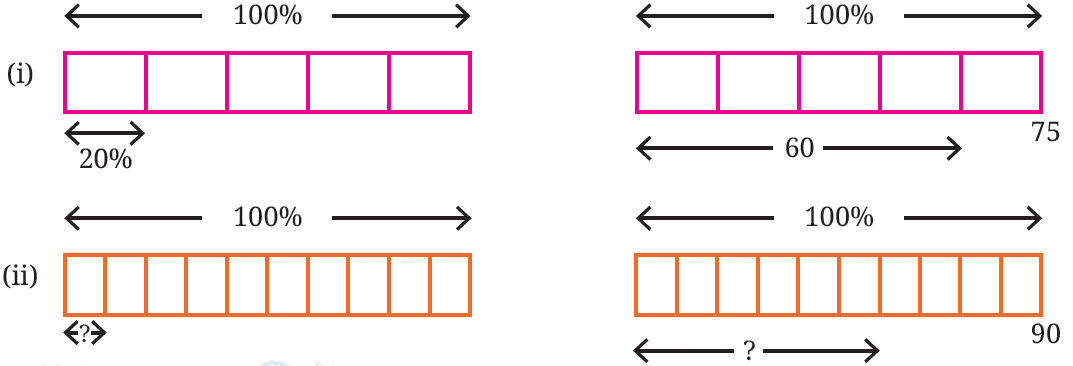

Answer:
Question 2. Find the value of the following and also draw their bar models.
(i) $25\%$ of $160$
(ii) $16\%$ of $250$
(iii) $62\%$ of $360$
(iv) $140\%$ of $40$
(v) $1\%$ of $1$ hour
(vi) $7\%$ of $10$ kg
Answer:
Question 3. Surya made $60$ ml of deep orange paint, how much red paint did he use if red paint made up $\frac{3}{4}$ of the deep orange paint?
Answer:
Question 4. Pairs of quantities are shown below. Identify and write appropriate symbols ‘$>$’, ‘$<$’, ‘$=$’ in the boxes. Visualising or estimating can help. Compute only if necessary or for verification.
(i) $50\%$ of $510$ _____ $50\%$ of $515$
(ii) $37\%$ of $148$ _____ $73\%$ of $148$
(iii) $29\%$ of $43$ _____ $92\%$ of $110$
(iv) $30\%$ of $40$ _____ $40\%$ of $50$
(v) $45\%$ of $200$ _____ $10\%$ of $490$
(vi) $30\%$ of $80$ _____ $24\%$ of $64$
Answer:
Question 5. Fill in the blanks appropriately:
(i) $30\%$ of $k$ is $70$, $60\%$ of $k$ is _____, $90\%$ of $k$ is _____, $120\%$ of $k$ is ______.
(ii) $100\%$ of $m$ is $215$, $10\%$ of $m$ is _____, $1\%$ of $m$ is ______, $6\%$ of $m$ is ______.
(iii) $90\%$ of $n$ is $270$, $9\%$ of $n$ is ______, $18\%$ of $n$ is _____, $100\%$ of $n$ is ______.
(iv) Make $2$ more such questions and challenge your peers.
Answer:
Question 6. Fill in the blanks:
(i) $3$ is ____ $\%$ of $300$.
(ii) _____ is $40\%$ of $4$.
(iii) $40$ is $80\%$ of _____.
Answer:
Question 7. Is $10\%$ of a day longer than $1\%$ of a week? Create such questions and challenge your peers.
Answer:
Question 8. Mariam’s farm has a peculiar bull. One day she gave the bull $2$ units of fodder and the bull ate $1$ unit. The next day, she gave the bull $3$ units of fodder and the bull ate $2$ units. The day after, she gave the bull $4$ units and the bull ate $3$ units. This continued, and on the $99$th day she gave the bull $100$ units and the bull ate $99$ units.
Represent these quantities as percentages. This task can be distributed among the class. What do you observe?
Answer:
Question 9. Workers in a coffee plantation take $18$ days to pick coffee berries in $20\%$ of the plantation. How many days will they take to complete the picking work for the entire plantation, assuming the rate of work stays the same? Why is this assumption necessary?
Answer:
Question 10. The badminton coach has planned the training sessions such that the ratio of warm up : play : cool down is $10\% : 80\% : 10\%$. If he wants to conduct a training of $90$ minutes. How long should each activity be done?
Answer:
Question 11. An estimated $90\%$ of the world’s population lives in the Northern Hemisphere. Find the (approximate) number of people living in the Northern Hemisphere based on this year’s worldwide population.
Answer:
Question 12. A recipe for the dish, halwa, for $4$ people has the following ingredients in the given proportions — Rava: $40\%$, Sugar: $40\%$, and Ghee: $20\%$.
(i) If you want to make halwa for $8$ people, what is the proportion of each of the above ingredients?
(ii) If the total weight of the ingredients is $2$ kg, how much rava, sugar and ghee are present?
Answer:
Figure It Out (Page No. 19 - 20)
Question 1. If a shopkeeper buys a geometry box for $\textsf{₹}75$ and sells it for $\textsf{₹}110$, what is his profit margin with respect to the cost?
Answer:
Question 2. I am a carpenter and I make chairs. The cost of materials for a chair is $\textsf{₹}475$ and I want to have a profit margin of $50\%$. At what price should I sell a chair?
Answer:
Question 3. The total sales of a company (also called revenue) was $\textsf{₹}2.5$ crore last year. They had a healthy profit margin of $25\%$. What was the total expenditure (costs) of the company last year?
Answer:
Question 4. A clothing shop offers a $25\%$ discount on all shirts. If the original price of a shirt is $\textsf{₹}300$, how much will Anwar have to pay to buy this shirt?
Answer:
Question 5. The petrol price in $2015$ was $\textsf{₹}60$ and $\textsf{₹}100$ in $2025$. What is the percentage increase in the price of petrol?
(i) $50\%$
(ii) $40\%$
(iii) $60\%$
(iv) $66.66\%$
(v) $140\%$
(vi) $160.66\%$
Answer:
Question 3. Samson bought a car for $\textsf{₹}4,40,000$ after getting a $15\%$ discount from the car dealer. What was the original price of the car?
Answer:
Question 4. $1600$ people voted in an election and the winner got $500$ votes. What percent of the total votes did the winner get? Can you guess the minimum number of candidates who stood for the election?
Answer:
Question 5. The price of $1$ kg of rice was $\textsf{₹}38$ in $2024$. It is $\textsf{₹}42$ in $2025$. What is the rate of inflation? (Inflation is the percentage increase in prices.)
Answer:
Question 6. A number increased by $20\%$ becomes $90$. What is the number?
Answer:
Question 7. A milkman sold two buffaloes for $\textsf{₹}80,000$ each. On one of them, he made a profit of $5\%$ and on the other a loss of $10\%$. Find his overall profit or loss.
Answer:
Question 8. The population of elephants in a national park increased by $5\%$ in the last decade. If the population of the elephants last decade is $p$, the population now is
(i) $p \times 0.5$
(ii) $p \times 0.05$
(iii) $p \times 1.5$
(iv) $p \times 1.05$
(v) $p + 1.50$
Answer:
Question 9. Which of the following statement(s) mean the same as — “The demand for cameras has fallen by $85\%$ in the last decade”?
(i) The demand now is $85\%$ of the demand a decade ago.
(ii) The demand a decade ago was $85\%$ of the demand now.
(iii) The demand now is $15\%$ of the demand a decade ago.
(iv) The demand a decade ago was $15\%$ of the demand now.
(v) The demand a decade ago was $185\%$ of the demand now.
(vi) The demand now is $185\%$ of the demand a decade ago.
Answer:
Figure It Out (Page No. 22 - 24)
Question 1. Bank of Yahapur offers an interest of $10\%$ p.a. Compare how much one gets if they deposit $\textsf{₹}20,000$ for a period of $2$ years with compounding and without compounding annually.
Answer:
Question 2. Bank of Wahapur offers an interest of $5\%$ p.a. Compare how much one gets if one deposits $\textsf{₹}20,000$ for a period of $4$ years with compounding and without compounding annually.
Answer:
Question 3. Do you observe anything interesting in the solutions of the two questions above? Share and discuss.
Answer:
Question 4. Jasmine invests amount ‘$p$’ for $4$ years at an interest of $6\%$ p.a. Which of the following expression(s) describe the total amount she will get after $4$ years when compounding is not done?
(i) $p \times 6 \times 4$
(ii) $p \times 0.6 \times 4$
(iii) $p \times \frac{0.6}{100} \times 4$
(iv) $p \times \frac{0.06}{100} \times 4$
(v) $p \times 1.6 \times 4$
(vi) $p \times 1.06 \times 4$
(vii) $p + (p \times 0.06 \times 4)$
Answer:
Question 5. The post office offers an interest of $7\%$ p.a. How much interest would one get if one invests $\textsf{₹}50,000$ for $3$ years without compounding? How much more would one get if it was compounded?
Answer:
Question 6. Giridhar borrows a loan of $\textsf{₹}12,500$ at $12\%$ per annum for $3$ years without compounding and Raghava borrows the same amount for the same time period at $10\%$ per annum, compounded annually. Who pays more interest and by how much?
Answer:
Question 7. Consider an amount $\textsf{₹}1000$. If this grows at $10\%$ p.a., how long will it take to double when compounding is done vs. when compounding is not done? Is compounding an example of exponential growth and not-compounding an example of linear growth?
Answer:
Question 8. The population of a city is rising by about $3\%$ every year. If the current population is $1.5$ crore, what is the expected population after $3$ years?
Answer:
Question 9. In a laboratory, the number of bacteria in a certain experiment increases at the rate of $2.5\%$ per hour. Find the number of bacteria at the end of $2$ hours if the initial count is $5,06,000$.
Answer:
Figure It Out (Page No. 28 - 30)
Question 1. The population of Bengaluru in $2025$ is about $250\%$ of its population in $2000$. If the population in $2000$ was $50$ lakhs, what is the population in $2025$?
Answer:
Question 2. The population of the world in $2025$ is about $8.2$ billion. The populations of some countries in $2025$ are given. Match them with their approximate percentage share of the worldwide population. [Hint: Writing these numbers in the standard form and estimating can help].

Answer:
Question 3. The price of a mobile phone is $\textsf{₹}8,250$. A GST of $18\%$ is added to the price. Which of the following gives the final price of the phone including the GST?
(i) $8250 + 18$
(ii) $8250 + 1800$
(iii) $8250 + \frac{18}{100}$
(iv) $8250 \times 18$
(v) $8250 \times 1.18$
(vi) $8250 + 8250 \times 0.18$
(vii) $1.8 \times 8250$
Answer:
Question 4. The monthly percentage change in population (compared to the previous month) of mice in a lab is given: Month 1 change was $+5\%$, Month 2 change was $-2\%$, and Month 3 change was $-3\%$. Which of the following statement(s) are true? The initial population is $p$.
(i) The population after three months was $p \times 0.05 \times 0.02 \times 0.03$.
(ii) The population after three months was $p \times 1.05 \times 0.98 \times 0.97$.
(iii) The population after three months was $p + 0.05 – 0.02 – 0.03$.
(iv) The population after three months was $p$.
(v) The population after three months was more than $p$.
(vi) The population after three months was less than $p$.
Answer:
Question 5. A shopkeeper initially set the price of a product with a $35\%$ profit margin. Due to poor sales, he decided to offer a $30\%$ discount on the selling price. Will he make a profit or a loss? Give reasons for your answer.
Answer:
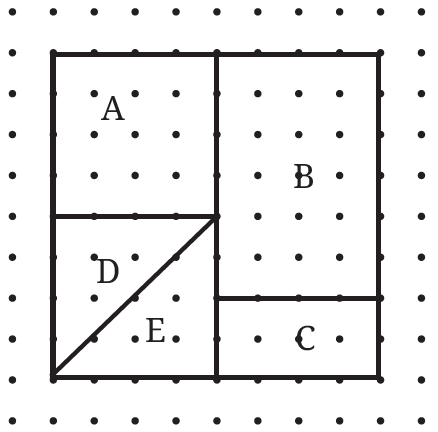
Question 6. What percentage of area is occupied by the region marked ‘E’ in the figure?
Answer:
Question 7. What is $5\%$ of $40$? What is $40\%$ of $5$?
What is $25\%$ of $12$? What is $12\%$ of $25$?
What is $15\%$ of $60$? What is $60\%$ of $15$?
What do you notice? Can you make a general statement and justify it using algebra, comparing $x\%$ of $y$ and $y\%$ of $x$?
Answer:
Question 8. A school is organising an excursion for its students. $40\%$ of them are Grade 8 students and the rest are Grade 9 students. Among these Grade 8 students, $60\%$ are girls.
(i) What percentage of the students going to the excursion are Grade 8 girls?
(ii) If the total number of students going to the excursion is $160$, how many of them are Grade 8 girls?
Answer:
Question 9. A shopkeeper sells pencils at a price such that the selling price of $3$ pencils is equal to the cost of $5$ pencils. Does he make a profit or a loss? What is his profit or loss percentage?
Answer:
Question 10. The bus fares were increased by $3\%$ last year and by $4\%$ this year. What is the overall percentage price increase in the last $2$ years?
Answer:
Question 11. If the length of a rectangle is increased by $10\%$ and the area is unchanged, by what percentage (exactly) does the breadth decrease by?
Answer:
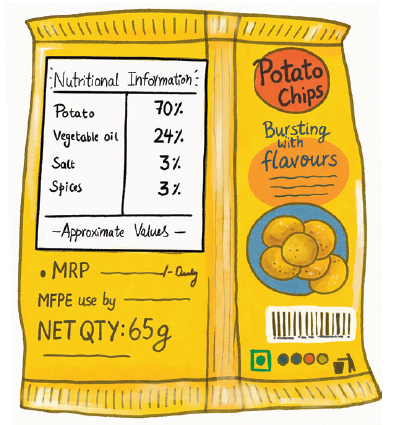
Question 12. The percentage of ingredients in a $65$ g chips packet is shown in the picture. Find out the weight each ingredient makes up in this packet.
Answer:
Question 13. Three shops sell the same items at the same price. The shops offer deals as follows:
Shop A: “Buy 1 and get 1 free”
Shop B: “Buy 2 and get 1 free”
Shop C: “Buy 3 and get 1 free”
(i) If the price of one item is $\textsf{₹}100$, what is the effective price per item in each shop? Arrange the shops from cheapest to costliest.
(ii) For each shop, calculate the percentage discount on the items. [Hint: Compare the free items to the total items you receive.]
(iii) Suppose you need $4$ items. Which shop would you choose? Why?
Answer:
Question 14. In a room of $100$ people, $99\%$ are left-handed. How many left-handed people have to leave the room to bring that percentage down to $98\%$?
Answer:
Question 15. Look at the following graph regarding the ability to use computers by age and gender ($2023$). Based on the graph, which of the following statement(s) are valid?
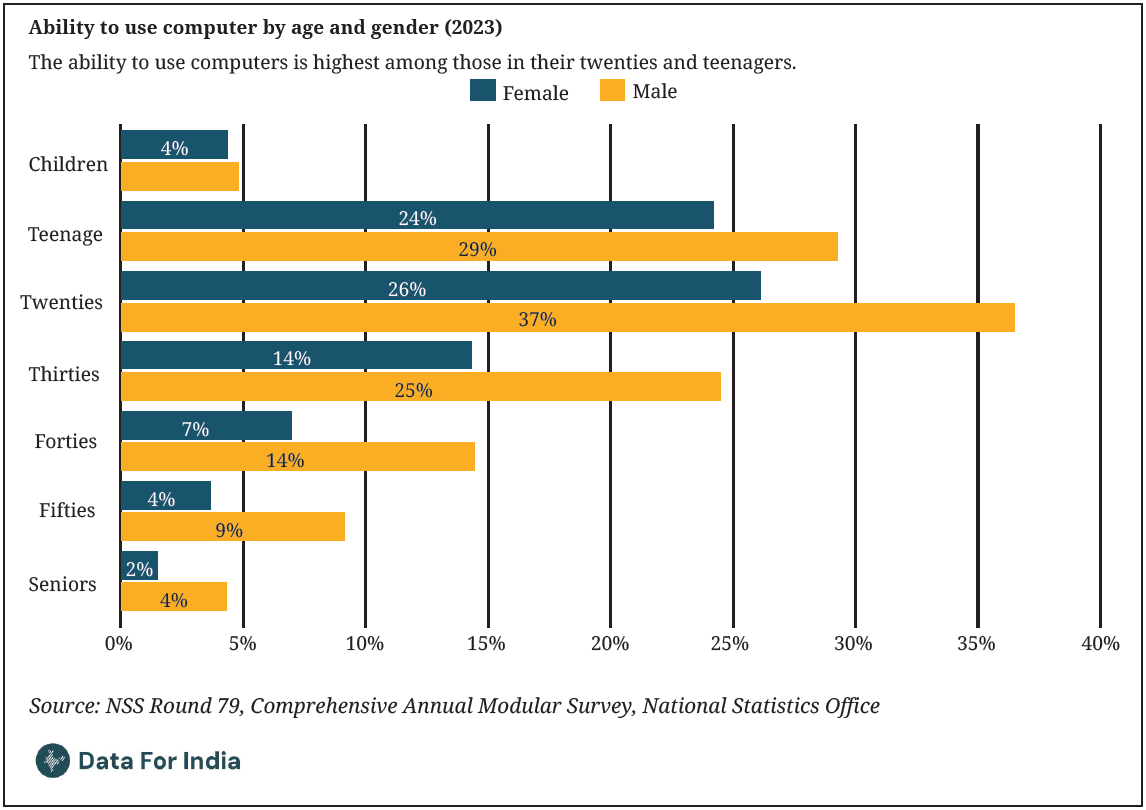
(i) People in their twenties are the most computer-literate among all age groups.
(ii) Women lag behind in the ability to use computers across age groups.
(iii) There are more people in their twenties than teenagers.
(iv) More than a quarter of people in their thirties can use computers.
(v) Less than 1 in 10 aged 60 and above can use computers.
(vi) Half of the people in their twenties can use computers.
Answer: