

Chapter 2 The Baudhāyana-Pythagoras Theorem (Class 8 - Latest Maths NCERT (Ganita Prakash II) Solutions)
Looking for the most accurate and easy-to-follow NCERT Solutions for Chapter 2: The Baudhāyana-Pythagoras Theorem? You’ve arrived at the perfect destination! This page provides clear, step-by-step guidance for the latest Class 8 Maths curriculum, exploring the fundamental relationship between the sides of a right-angled triangle. We help you bridge the gap between ancient wisdom from the Baudhāyana’s Śulba-Sūtras and modern geometry, ensuring you master the elegant relationship $a^2 + b^2 = c^2$ with complete clarity.
Our solutions offer detailed breakdowns for the Geometry of Right Triangles, identifying the hypotenuse and legs with precision. We provide thorough explanations for Irrational Numbers like $\sqrt{2}$, helping you understand why these values cannot be written as simple fractions. Whether you are identifying Baudhāyana Triples (like 3, 4, 5) or distinguishing between Primitive and Scaled versions, our guides break down every calculation. We even provide context for higher mathematical puzzles like Fermat’s Last Theorem, making complex concepts accessible.
From solving ancient problems found in Bhāskarāchārya’s Līlāvatī to mastering algebraic derivations, these resources are designed to help you excel. Curated by learningspot.co, these Ganita Prakash II solutions include visual proofs, step-by-step problem-solving methods, and historical insights. Designed for the latest CBSE syllabus, our materials ensure you build the geometric mastery needed to solve real-world problems—from architectural construction to depth calculations—with absolute confidence.
| Content On This Page | ||
|---|---|---|
| Figure It Out (Page No. 39 - 40) | Figure It Out (Page No. 47) | Figure It Out (Page No. 50) |
| Figure It Out (Page No. 52 - 54) | ||
Figure It Out (Page No. 39 - 40)
Question 1. Earlier, we saw a method to create a square with double the area of a given square paper. There is another method to do this in which two identical square papers are cut in the following way.
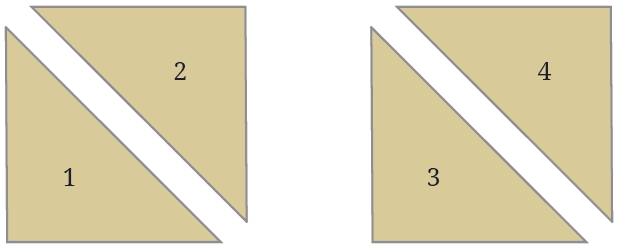
Can you arrange these pieces to create a square with double the area of either square?
Answer:
Solution:
Given: Two identical square papers.
Each of the two squares is cut along its diagonal into two right-angled triangles, resulting in a total of four identical triangles (labeled $1$, $2$, $3$, and $4$) as shown in the figure.
Since each square is divided into two identical triangles:
Area of two triangles = Area of one given square
When all four triangles are joined together along their sides (using the right-angle vertices to form the corners of a new square), they form a larger square.
Area of four triangles = Double the area of one original square.
Question 2. The length of the two equal sides of an isosceles right triangle is given. Find the length of the hypotenuse. Find bounds on the length of the hypotenuse such that they have at least one digit after the decimal point.
(i) $3$
(ii) $4$
(iii) $6$
(iv) $8$
(v) $9$
Answer:
Solution:
In an isosceles right-angled triangle, if the length of the two equal sides is $a$, then by the Baudhayana-Pythagoras theorem, the length of the hypotenuse ($h$) is given by:
$h = \sqrt{a^2 + a^2} = \sqrt{2a^2} = a\sqrt{2}$
(i) For side $a = 3$:
$h = 3\sqrt{2}$
Since $\sqrt{2} \approx 1.414$, $h = 3 \times 1.414 = 4.242$.
Bounds with at least one digit after the decimal point: $4.2 < 3\sqrt{2} < 4.3$.
(ii) For side $a = 4$:
$h = 4\sqrt{2} = 4 \times 1.414 = 5.656$.
Bounds with at least one digit after the decimal point: $5.6 < 4\sqrt{2} < 5.7$.
(iii) For side $a = 6$:
$h = 6\sqrt{2} = 6 \times 1.414 = 8.484$.
Bounds with at least one digit after the decimal point: $8.4 < 6\sqrt{2} < 8.5$.
(iv) For side $a = 8$:
$h = 8\sqrt{2} = 8 \times 1.414 = 11.312$.
Bounds with at least one digit after the decimal point: $11.3 < 8\sqrt{2} < 11.4$.
(v) For side $a = 9$:
$h = 9\sqrt{2} = 9 \times 1.414 = 12.726$.
Bounds with at least one digit after the decimal point: $12.7 < 9\sqrt{2} < 12.8$.
Question 3. The hypotenuse of an isosceles right triangle is $10$. What are its other two sidelengths?
[Hint: Find the area of the square composed of two such right triangles.]
Answer:
Given:
Hypotenuse $h = 10$ units.
The triangle is an isosceles right-angled triangle.
To Find:
The length of the other two equal sides (legs), let's call them $x$.
Solution:
Let the length of each of the two equal sides be $x$.
By the Baudhayana-Pythagoras Theorem:
$x^2 + x^2 = 10^2$
(Property of right triangles)
$2x^2 = 100$
$x^2 = \frac{100}{2} = 50$
$x = \sqrt{50}$
To find the value of $\sqrt{50}$:
We know $7^2 = 49$ and $8^2 = 64$. So $\sqrt{50}$ is slightly more than $7$.
Approximating to two decimal places: $x \approx 7.07$ units.
Figure It Out (Page No. 47)
Question 1. If a right-angled triangle has shorter sides of lengths $5$ cm and $12$ cm, then what is the length of its hypotenuse? First draw the right-angled triangle with these sidelengths and measure the hypotenuse, then check your answer using Baudhāyana’s Theorem.
Answer:
Step 1: Drawing and Measurement
Draw a base line of length $12\text{ cm}$ and a perpendicular of length $5\text{ cm}$ at one end. Join the ends to form a right-angled triangle. Measuring the hypotenuse with a scale gives approximately $13\text{ cm}$.
Step 2: Verification using Baudhāyana’s Theorem
According to Baudhāyana’s (Pythagoras) theorem:
$\text{Hypotenuse}^2 = \text{Base}^2 + \text{Perpendicular}^2$
$\text{Hypotenuse}^2 = 12^2 + 5^2$
[Given sides]
$\text{Hypotenuse}^2 = 144 + 25 = 169$
[Simplification]
$\text{Hypotenuse} = \sqrt{169} = 13\text{ cm}$
Thus, the length of the hypotenuse is $13\text{ cm}$.
Question 2. If a right-angled triangle has a short side of length $8$ cm and hypotenuse of length $17$ cm, what is the length of the third side? Again, try drawing the triangle and measuring, and then check your answer using Baudhāyana’s Theorem.
Answer:
Step 1: Drawing and Measurement
Draw a base line of length $8\text{ cm}$. Using a compass or ruler, construct a right-angled triangle such that the hypotenuse measures $17\text{ cm}$. Measuring the third side gives approximately $15\text{ cm}$.
Step 2: Verification using Baudhāyana’s Theorem
According to Baudhāyana’s theorem:
$\text{Hypotenuse}^2 = \text{Base}^2 + \text{Perpendicular}^2$
$17^2 = 8^2 + \text{Third Side}^2$
[Given values]
$289 = 64 + \text{Third Side}^2$
[Square values]
$\text{Third Side}^2 = 289 - 64 = 225$
[Subtraction]
$\text{Third Side} = \sqrt{225} = 15\text{ cm}$
Thus, the length of the third side is $15\text{ cm}$.
Question 3. Using the constructions you have now seen, how would you construct a square whose area is triple the area of a given square? Five times the area of a given square? (Baudhāyana’s Śulba-Sūtra, Verse $1.10$)
Answer:
Solution:
According to Baudhāyana’s Śulba-Sūtra, to construct a square with a multiple ($n$ times) of the area of a given square of side length $a$, we can construct right-angled triangles using previously constructed square sides as legs.
1. Constructing a square with triple ($3$ times) the area:
• Start with a square of side $a$ (area = $a^2$).
• Construct a right-angled triangle taking side $a$ and side $a\sqrt{2}$ (the diagonal/side of a double-area square) as its perpendicular legs.
• By Baudhāyana’s theorem, the hypotenuse squared is $a^2 + (a\sqrt{2})^2 = 3a^2$.
2. Constructing a square with five times ($5$ times) the area:
• Start with a square of side $a$ (area = $a^2$).
• Construct a right-angled triangle taking side $a$ and side $2a$ as its perpendicular legs.
• By Baudhāyana’s theorem, the hypotenuse squared is $a^2 + (2a)^2 = 5a^2$.
Question 4. Let $a, b$ and $c$ denote the length of the sides of a right triangle, with $c$ being the length of the hypotenuse. Find the missing sidelength in each of the following cases:
(i) $a = 5, b = 7$
(ii) $a = 8, b = 12$
(iii) $a = 9, c = 15$
(iv) $a = 7, b = 12$
(v) $a = 1.5, b = 3.5$
Answer:
To Find:
The missing side length in various right-angled triangles using the given side lengths.
Methodology (Indian Perspective):
In India, the relationship between the sides of a right-angled triangle was first described in the Baudhāyana Śulba Sūtras. The theorem states that in a right-angled triangle, the square of the hypotenuse ($c$) is equal to the sum of the squares of the other two sides ($a$ and $b$).
$a^2 + b^2 = c^2$
[Baudhāyana-Pythagoras Theorem]
(i) Given: $a = 5, b = 7$
To find the missing hypotenuse $c$:
$c^2 = 5^2 + 7^2$
$c^2 = 25 + 49$
$c^2 = 74$
$c = \sqrt{74}$
Since $74$ is not a perfect square, we can approximate it: $\mathbf{c \approx 8.60}$ units.
(ii) Given: $a = 8, b = 12$
To find the hypotenuse $c$:
$c^2 = 8^2 + 12^2$
$c^2 = 64 + 144$
$c^2 = 208$
$c = \sqrt{208} = \sqrt{16 \times 13}$
$\mathbf{c = 4\sqrt{13} \approx 14.42}$ units.
(iii) Given: $a = 9, c = 15$
To find the missing side $b$:
$9^2 + b^2 = 15^2$
$81 + b^2 = 225$
$b^2 = 225 - 81$
[By Transposition]
$b^2 = 144$
$b = \sqrt{144}$
$\mathbf{b = 12}$ units.
Note: $(9, 12, 15)$ is a Baudhāyana Triple, as it is a multiple of the basic $(3, 4, 5)$ triple.
(iv) Given: $a = 7, b = 12$
To find the hypotenuse $c$:
$c^2 = 7^2 + 12^2$
$c^2 = 49 + 144$
$c^2 = 193$
$c = \sqrt{193}$
Approximating the value: $\mathbf{c \approx 13.89}$ units.
(v) Given: $a = 1.5, b = 3.5$
To find the hypotenuse $c$:
$c^2 = (1.5)^2 + (3.5)^2$
$c^2 = 2.25 + 12.25$
$c^2 = 14.5$
$c = \sqrt{14.5}$
$\mathbf{c \approx 3.81}$ units.
Summary Table:
| Case | Missing Side | Value |
| (i) | $c$ | $\sqrt{74} \approx 8.60$ |
| (ii) | $c$ | $4\sqrt{13} \approx 14.42$ |
| (iii) | $b$ | $12$ |
| (iv) | $c$ | $\sqrt{193} \approx 13.89$ |
| (v) | $c$ | $\sqrt{14.5} \approx 3.81$ |
Figure It Out (Page No. 50)
Question 1. Find $5$ more Baudhāyana triples using this idea.
Answer:
Solution:
We can generate Baudhāyana triples (Pythagorean triples) using the algebraic identity provided in Baudhāyana's Śulba-Sūtra:
$(n - 1)^2 + (2n - 1) = n^2$
Letting $2n - 1 = m^2$ (where $m$ is an odd integer), we can derive triples for different integer values of $n$:
1. For $n = 2$:
• First term: $(n - 1)^2 = (2 - 1)^2 = 1^2 = 1$
• Second term: $2n - 1 = 2(2) - 1 = 3$
• Third term: $n^2 = 2^2 = 4$ (Note: Here $3^2 + 1^2 \neq 4^2$, but using the standard identity $(m^2-1)/2, m, (m^2+1)/2$ or substituting consecutive integers into $n$ yields the standard sequence:)
Let us use integer values for $n$ starting from $2$:
• For $n = 2$: Sides are $2^2 - 1 = 3$, $2(2) = 4$, $2^2 + 1 = 5$. Triplet: $(3, 4, 5)$
2. For $n = 3$:
• Sides are $3^2 - 1 = 8$, $2(3) = 6$, $3^2 + 1 = 10$. Triplet: $(6, 8, 10)$
3. For $n = 4$:
• Sides are $4^2 - 1 = 15$, $2(4) = 8$, $4^2 + 1 = 17$. Triplet: $(8, 15, 17)$
4. For $n = 5$:
• Sides are $5^2 - 1 = 24$, $2(5) = 10$, $5^2 + 1 = 26$. Triplet: $(10, 24, 26)$
5. For $n = 6$:
• Sides are $6^2 - 1 = 35$, $2(6) = 12$, $6^2 + 1 = 37$. Triplet: $(12, 35, 37)$
Thus, $5$ more Baudhāyana triples are $(3, 4, 5)$, $(6, 8, 10)$, $(8, 15, 17)$, $(10, 24, 26)$, and $(12, 35, 37)$.
Question 2. Does this method yield non-primitive Baudhāyana triples?
[Hint: Observe that among the triples generated, one of the smaller sidelengths is one less than the hypotenuse.]
Answer:
Solution:
No, this method does not yield non-primitive Baudhāyana triples; instead, it produces exclusively primitive triples.
To understand why, let us examine the structure of the triples generated by the identity:
$(n - 1)^2 + (2n - 1) = n^2$
In this formulation, the two shorter sides are $(n - 1)$ and $\sqrt{2n - 1}$ (or represented through the generated legs), and the hypotenuse is $n$.
Notice the relationship between the shorter side $(n - 1)$ and the hypotenuse $n$:
One of the smaller sides is exactly one less than the hypotenuse.
Since $(n - 1)$ and $n$ are consecutive integers, they share no common factors other than $1$.
Because the numbers are mutually coprime and share no common divisor across the entire set, it is impossible for the entire triple to be reducible by any common factor.
Therefore, all triples produced by Baudhāyana's method using consecutive integer relationships are strictly primitive Pythagorean triples.
Question 3. Are there primitive triples that cannot be obtained through this method? If yes, give examples.
Answer:
Solution:
Yes, there are many primitive Baudhāyana (Pythagorean) triples that cannot be obtained through this specific method.
The given method exclusively generates primitive triples in which one of the smaller sides is exactly one less than the hypotenuse (satisfying the form where the difference between the hypotenuse and one leg is $1$).
Primitive triples that do not satisfy this strict difference condition cannot be generated using this formula.
Examples:
• $(8, 15, 17)$: Here, the hypotenuse is $17$ and the smaller sides are $8$ and $15$. Neither of the smaller sides is one less than $17$ (since $17 - 8 = 9$ and $17 - 15 = 2$). Yet, $\text{HCF}(8, 15, 17) = 1$, making it a primitive triple.
• $(12, 35, 37)$: Here, the hypotenuse is $37$ and the smaller sides are $12$ and $35$. Neither side equals $36$ ($37 - 1$). Since $\text{HCF}(12, 35, 37) = 1$, it is also a primitive triple that falls outside this method's scope.
Figure It Out (Page No. 52 - 54)
Question 1. Find the diagonal of a square with sidelength $5$ cm.
Answer:
Solution:
Let the sidelength of the square be $a = 5\text{ cm}$.
The diagonal ($d$) of a square divides it into two identical right-angled isosceles triangles, where the two sides of length $a$ form the perpendicular and base, and the diagonal forms the hypotenuse.
Using Baudhāyana’s (Pythagoras) Theorem:
$d^2 = a^2 + a^2$
$d^2 = 5^2 + 5^2$
$d^2 = 25 + 25 = 50$
$d = \sqrt{50} = \sqrt{25 \times 2} = 5\sqrt{2}\text{ cm}$
Substituting the approximate value of $\sqrt{2} \approx 1.414$:
$d = 5 \times 1.414 = 7.07\text{ cm}$
Thus, the length of the diagonal is $5\sqrt{2}\text{ cm}$ (or approximately $7.07\text{ cm}$).
Question 2. Find the missing sidelengths in the following right triangles:
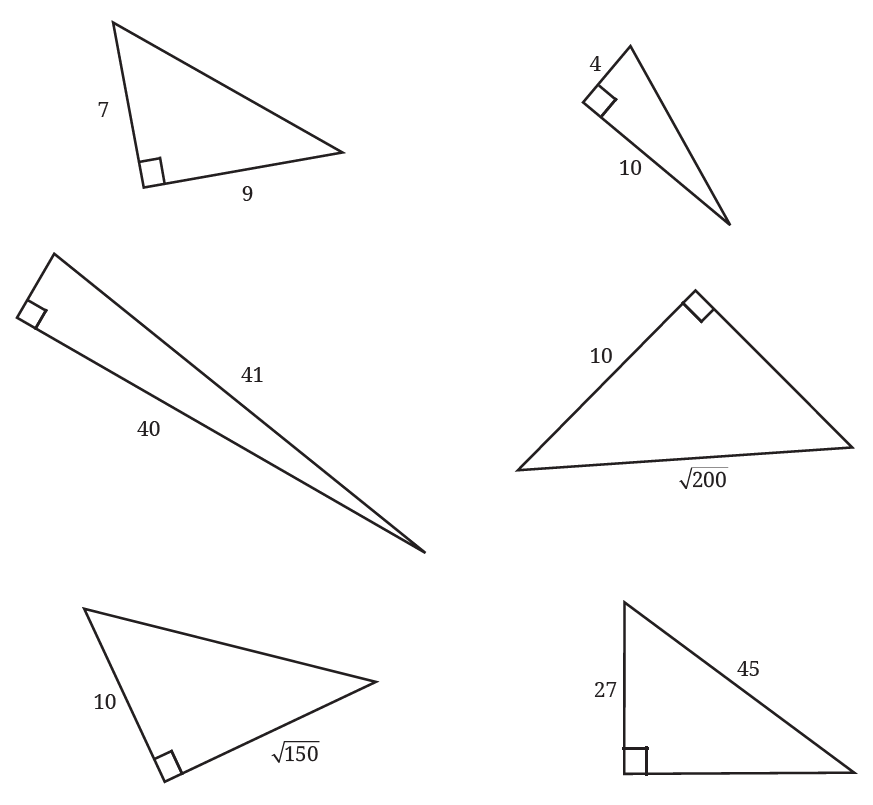
Answer:
Solution:
Using Baudhāyana’s (Pythagoras) Theorem, $\text{Hypotenuse}^2 = \text{Base}^2 + \text{Perpendicular}^2$, we calculate the missing sidelengths for each triangle:
(a) Triangle with legs $7$ and $9$:
$a^2 = 7^2 + 9^2$
[Formula setup]
$a^2 = 49 + 81 = 130$
[Addition]
$a = \sqrt{130}$
(b) Triangle with legs $4$ and $10$:
$b^2 = 4^2 + 10^2$
[Formula setup]
$b^2 = 16 + 100 = 116$
[Addition]
$b = \sqrt{116} = \sqrt{2 \times 2 \times 29} = 2\sqrt{29}$
(c) Triangle with leg $40$ and hypotenuse $41$:
$40^2 + c^2 = 41^2$
[Formula setup]
$1600 + c^2 = 1681$
[Squaring values]
$c^2 = 1681 - 1600 = 81$
[Subtraction]
$c = \sqrt{81} = 9$
(d) Triangle with leg $10$ and hypotenuse $\sqrt{200}$:
$10^2 + d^2 = (\sqrt{200})^2$
[Formula setup]
$100 + d^2 = 200$
[Simplification]
$d^2 = 200 - 100 = 100$
[Subtraction]
$d = \sqrt{100} = 10$
(e) Triangle with legs $10$ and $\sqrt{150}$:
$e^2 = 10^2 + (\sqrt{150})^2$
[Formula setup]
$e^2 = 100 + 150 = 250$
[Addition]
$e = \sqrt{250} = \sqrt{5 \times 5 \times 5 \times 2} = 5\sqrt{10}$
(f) Triangle with leg $27$ and hypotenuse $45$:
$27^2 + f^2 = 45^2$
[Formula setup]
$729 + f^2 = 2025$
[Squaring values]
$f^2 = 2025 - 729 = 1296$
[Subtraction]
$f = \sqrt{1296} = \sqrt{2^4 \times 3^4} = 2 \times 2 \times 3 \times 3 = 36$
Question 3. Find the sidelength of a rhombus whose diagonals are of length $24$ units and $70$ units.
Answer:
Solution:
Let the diagonals of the rhombus be $d_1 = 24$ units and $d_2 = 70$ units.
We know that the diagonals of a rhombus bisect each other perpendicularly at $90^\circ$, forming four congruent right-angled triangles.
The lengths of the two perpendicular legs of each right-angled triangle are half of the diagonals:
$\text{Leg}_1 = \frac{d_1}{2} = \frac{24}{2} = 12$ units
[Half of first diagonal]
$\text{Leg}_2 = \frac{d_2}{2} = \frac{70}{2} = 35$ units
[Half of second diagonal]
The hypotenuse of this right-angled triangle corresponds to the side length ($s$) of the rhombus.
Applying Baudhāyana’s (Pythagoras) Theorem:
$s^2 = (\text{Leg}_1)^2 + (\text{Leg}_2)^2$
[Theorem formula]
$s^2 = 12^2 + 35^2$
[Substitute values]
$s^2 = 144 + 1225 = 1369$
[Addition]
$s = \sqrt{1369} = 37$ units
Thus, the side length of the rhombus is $37$ units.
Question 4. Is the hypotenuse the longest side of a right triangle? Justify your answer.
Answer:
Solution:
Yes, the hypotenuse is always the longest side of a right-angled triangle.
Justification:
1. Geometric Reason: In any triangle, the side opposite the largest angle is always the longest side. In a right-angled triangle, one angle is $90^\circ$, and the sum of the other two angles is $90^\circ$ (since the total sum is $180^\circ$). Therefore, the $90^\circ$ angle is the largest angle, and the side opposite to it, the hypotenuse, is the longest.
2. Algebraic Reason (Baudhāyana's Theorem): Let the sides be $a$ and $b$, and the hypotenuse be $c$.
$c^2 = a^2 + b^2$
Since $a^2$ and $b^2$ are positive quantities, $c^2$ must be greater than $a^2$ and also greater than $b^2$.
$c^2 > a^2 \implies c > a$
$c^2 > b^2 \implies c > b$
This mathematically proves that $c$ is longer than both $a$ and $b$.
Question 5. True or False — Every Baudhāyana triple is either a primitive triple or a scaled version of a primitive triple.
Answer:
Solution:
True
Explanation:
A Baudhāyana triple (or Pythagorean triple) consists of three positive integers $(a, b, c)$ that satisfy the relation $a^2 + b^2 = c^2$.
If the greatest common divisor of $a$, $b$, and $c$ is $1$ ($\text{HCF}(a, b, c) = 1$), the triple is defined as a primitive triple.
If the greatest common divisor is some integer $k > 1$, then dividing each number in the triple by $k$ yields a set of integers that forms a primitive triple $(a/k, b/k, c/k)$.
Consequently, any non-primitive Baudhāyana triple is simply a scalar multiple (scaled version) of a primitive triple.
Question 6. Give $5$ examples of rectangles whose sidelengths and diagonals are all integers.
Answer:
Solution:
A rectangle with integer sidelengths ($a$ and $b$) will have an integer diagonal ($d$) if and only if its sidelengths and diagonal form a Baudhāyana (Pythagoras) triple, such that $a^2 + b^2 = d^2$.

Using known Baudhāyana triples, here are $5$ examples of such rectangles:
1. Example 1:
• Length ($a$) = $3$ units
• Breadth ($b$) = $4$ units
• Diagonal ($d$) = $\sqrt{3^2 + 4^2} = \sqrt{9 + 16} = \sqrt{25} = 5$ units
2. Example 2:
• Length ($a$) = $5$ units
• Breadth ($b$) = $12$ units
• Diagonal ($d$) = $\sqrt{5^2 + 12^2} = \sqrt{25 + 144} = \sqrt{169} = 13$ units
3. Example 3:
• Length ($a$) = $8$ units
• Breadth ($b$) = $15$ units
• Diagonal ($d$) = $\sqrt{8^2 + 15^2} = \sqrt{64 + 225} = \sqrt{289} = 17$ units
4. Example 4:
• Length ($a$) = $7$ units
• Breadth ($b$) = $24$ units
• Diagonal ($d$) = $\sqrt{7^2 + 24^2} = \sqrt{49 + 576} = \sqrt{625} = 25$ units
5. Example 5:
• Length ($a$) = $9$ units
• Breadth ($b$) = $40$ units
• Diagonal ($d$) = $\sqrt{9^2 + 40^2} = \sqrt{81 + 1600} = \sqrt{1681} = 41$ units
Question 7. Construct a square whose area is equal to the difference of the areas of squares of sidelengths $5$ units and $7$ units.
Answer:
Solution:
Step 1: Mathematical Analysis
• Area of the larger square = $7^2 = 49$ square units.
• Area of the smaller square = $5^2 = 25$ square units.
• Required area = $7^2 - 5^2 = 49 - 25 = 24$ square units.
Using Baudhāyana’s theorem in reverse: $x^2 + 5^2 = 7^2$, where $7$ is the hypotenuse and $5$ is one of the legs. The unknown side length of the new square is $x = \sqrt{7^2 - 5^2} = \sqrt{24}$ units.
Step 2: Geometric Construction
• Construct a right-angled triangle where the hypotenuse is $7$ units and one leg is $5$ units.
• The other leg of this right triangle will automatically have a length of $\sqrt{24}$ units.
• Construct a square using this leg ($\sqrt{24}$ units) as its side.
The constructed square will have an area of $24$ square units, which equals the difference of the areas of the two given squares.
Question 8. (i) Using the dots of a grid as the vertices, can you create a square that has an area of (a) $2$ sq. units, (b) $3$ sq. units, (c) $4$ sq. units, and (d) $5$ sq. unit?
(ii) Suppose the grid extends indefinitely. What are the possible integer-valued areas of squares you can create in this manner?
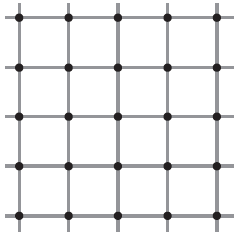
Answer:
Solution:
(i) Creating squares of given areas on the grid:
(a) Area of $2$ sq. units:
$2 = 1^2 + 1^2$
Mark dots $A, B, C,$ and $D$ diagonally across grid units as shown. Join $AB, BC, CD,$ and $DA$. Then $ABCD$ is a square with $\text{Area} = 2$ sq. units.
(b) Area of $3$ sq. units:
A square with an area of $3$ units is not possible using the dots of a grid as vertices, because $3$ cannot be expressed as the sum of two squares of integers ($a^2 + b^2 \neq 3$ for any integers $a$ and $b$).
(c) Area of $4$ sq. units:
$4 = 2 \times 2$ (or $2^2 + 0^2$)
Mark dots $A, B, C,$ and $D$ forming a $2 \times 2$ grid layout. Join $AB, BC, CD,$ and $DA$. Then $ABCD$ is a square with $\text{Area} = 2 \times 2 = 4$ sq. units.
(d) Area of $5$ sq. units:
$5 = 2^2 + 1^2$
Mark dots $A, B, C,$ and $D$ such that the side length squared is $AB^2 = 2^2 + 1^2 = 5$, meaning side $AB = \sqrt{5}$ units. Joining these dots forms a square with an area of $5$ sq. units.
(ii) Possible integer-valued areas:
If the grid extends indefinitely, the possible integer-valued areas of squares that can be created are any integer that can be expressed as the sum of two integer squares ($x = a^2 + b^2$, where $a$ and $b$ are integers), which includes all perfect squares and numbers that can be written as the sum of two squares (such as $1, 2, 4, 5, 8, 9, 10, 13$, etc.).
Question 9. Find the area of an equilateral triangle with sidelength $6$ units.
[Hint: Show that an altitude bisects the opposite side. Use this to find the height.]
Answer:
Solution:
Let $\triangle ABC$ be an equilateral triangle with sidelengths:
$AB = BC = CA = 6$ units
Draw an altitude $AD$ perpendicular to $BC$.
In right-angled triangles $\triangle ADB$ and $\triangle ADC$:
• $\angle ADB = \angle ADC = 90^\circ$
• Hypotenuse $AB = AC = 6$ units (given)
• Common side $AD = AD$
Therefore, by RHS congruence criterion, $\triangle ADB \cong \triangle ADC$.
This implies $BD = DC$ (by CPCT), meaning the altitude $AD$ bisects the base $BC$:
$BD = DC = \frac{1}{2} \times 6 = 3$ units
Now, consider the right-angled triangle $\triangle ADC$ to find the height ($h$):
$h^2 + 3^2 = 6^2$
[Baudhayana’s Theorem]
$h^2 + 9 = 36$
[Square values]
$h^2 = 36 - 9 = 27$
[Subtraction]
$h = \sqrt{27} = \sqrt{3 \times 3 \times 3} = 3\sqrt{3}$ units
Finally, calculate the area of the equilateral triangle:
$\text{Area} = \frac{1}{2} \times \text{Base} \times \text{Height}$
$\text{Area} = \frac{1}{2} \times 6 \times 3\sqrt{3}$
$\text{Area} = 3 \times 3\sqrt{3} = 9\sqrt{3}$ sq. units
Thus, the area of the equilateral triangle is $9\sqrt{3}$ sq. units.