

Chapter 5 Tales by Dots and Lines (Class 8 - Latest Maths NCERT (Ganita Prakash II) Solutions)
Seeking expert-verified NCERT Solutions for Chapter 5: Tales by Dots and Lines? You’ve come to the right place! This page provides clear, step-by-step guidance for the latest Class 8 Maths curriculum, helping you interpret the "story" behind every dataset. We move beyond basic calculations to help you solve problems where the Mean and Median are treated as a Balancing Act. Our solutions demonstrate exactly how the mean serves as a mathematical pivot point, ensuring you understand the internal equilibrium of any set of numbers.
Our solutions offer comprehensive walkthroughs for the dynamic side of statistics. We use Algebraic Proofs to show how a collection's average shifts when values are added, removed, or scaled. To prepare you for the modern world, we also provide clear explanations for using Spreadsheets. You will find detailed guides on how to apply digital formulas like =SUM() and =AVERAGE() to solve textbook exercises efficiently, turning manual data entry into automated mathematical insights.
In the final section, we help you master Advanced Data Visualization. Whether you are plotting monthly temperature trends using Line Graphs or analyzing geographical patterns through Infographics, our step-by-step methods make data interpretation simple. From creating Activity Strips for daily schedules to analyzing space launch history, these resources from learningspot.co are designed to help you excel in your Ganita Prakash II assessments and become a master of statistical storytelling.
| Content On This Page | ||
|---|---|---|
| Figure It Out (Page No. 113 - 116) | Figure It Out (Page No. 122 - 123) | Figure It Out (Page No. 127 - 132) |
Figure It Out (Page No. 113 - 116)
Question 1. Find the mean of the following data and share your observations:
(i) The first $50$ natural numbers.
(ii) The first $50$ odd numbers.
(iii) The first $50$ multiples of $4$.
Answer:
(i) Mean of the first $50$ natural numbers
Given: The data consists of natural numbers $1, 2, 3, \dots, 50$.
To Find: Mean of these numbers.
Solution:
The sum of the first $n$ natural numbers is given by the formula $\frac{n(n+1)}{2}$.
$\text{Sum} = \frac{50(50+1)}{2}$
$\text{Sum} = 25 \times 51 = 1275$
$\text{Mean} = \frac{\text{Sum of observations}}{\text{Total number of observations}}$
$\text{Mean} = \frac{1275}{50} = 25.5$
(ii) Mean of the first $50$ odd numbers
Given: The first $50$ odd numbers are $1, 3, 5, \dots, 99$.
To Find: Mean of these numbers.
Solution:
The sum of the first $n$ odd numbers is given by the formula $n^2$.
$\text{Sum} = 50^2 = 2500$
$\text{Mean} = \frac{2500}{50} = 50$
(iii) Mean of the first $50$ multiples of $4$
Given: The multiples of $4$ are $4, 8, 12, \dots, 200$.
To Find: Mean of these numbers.
Solution:
The sum can be found by taking $4$ common: $4(1 + 2 + 3 + \dots + 50)$.
$\text{Sum} = 4 \times \frac{50 \times 51}{2}$
$\text{Sum} = 2 \times 50 \times 51 = 5100$
$\text{Mean} = \frac{5100}{50} = 102$
Question 2. The dot plot below shows a collection of data and its average; but one dot is missing. Mark the missing value so that the mean is $9$ (as shown below).
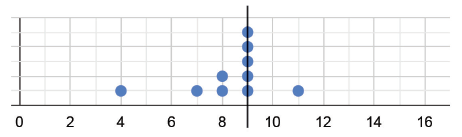
Answer:
Given:
The dot plot shows the following existing data points:
Value $4$: $1$ dot
Value $7$: $1$ dot
Value $8$: $2$ dots
Value $9$: $5$ dots
Value $11$: $1$ dot
Target Mean = $9$.
To Find: The position of the missing dot ($x$).
Solution:
First, let's calculate the number of existing dots: $1 + 1 + 2 + 5 + 1 = 10$ dots.
With the missing dot, the total number of observations will be $11$.
$\text{Sum of existing dots} = (4 \times 1) + (7 \times 1) + (8 \times 2) + (9 \times 5) + (11 \times 1)$
$\text{Sum} = 4 + 7 + 16 + 45 + 11 = 83$
Let the value of the missing dot be $x$.
$\text{Mean} = \frac{\text{Total Sum}}{\text{Total Observations}}$
$9 = \frac{83 + x}{11}$
$99 = 83 + x$
$x = 16$
Final Answer: The missing dot should be marked at the value $16$ on the number line.
Question 3. Sudhakar, the class teacher, asks Shreyas to measure the heights of all $24$ students in his class and calculate the average height. Shreyas informs the teacher that the average height is $150.2$ cm. Sudhakar discovers that the students were wearing uniform shoes when the measurements were taken and the shoes add $1$ cm to the height.
(i) Should the teacher get all the heights measured again without the shoes to find the correct average height? Or is there a simpler way?
(ii) What is the correct average height of the class?
(a) $174.2$ cm
(b) $126.2$ cm
(c) $150.2$ cm
(d) $149.2$ cm
(e) $151.2$ cm
(f) None of the above
(g) Insufficient information
Answer:
Given:
Total students = $24$
Initial average height (with shoes) = $150.2$ cm
Height added by shoes = $1$ cm
Solution (i):
No, the teacher does not need to measure all the heights again. There is a much simpler way based on the properties of the mean. If a constant value is subtracted from every observation in a data set, the mean of the data set also decreases by that same constant value.
Solution (ii):
Since every student's height was recorded as $1$ cm more than their actual height, we can find the correct average by subtracting $1$ cm from the calculated average.
$\text{Correct Average} = \text{Measured Average} - \text{Shoe Height}$
$\text{Correct Average} = 150.2 - 1 = 149.2 \text{ cm}$
Thus, the correct option is (d) $149.2$ cm.
Question 4. The three dot plots below show the lengths, in minutes, of songs of different albums. Which of these has a mean of $5.57$ minutes? Explain how you arrived at the answer.
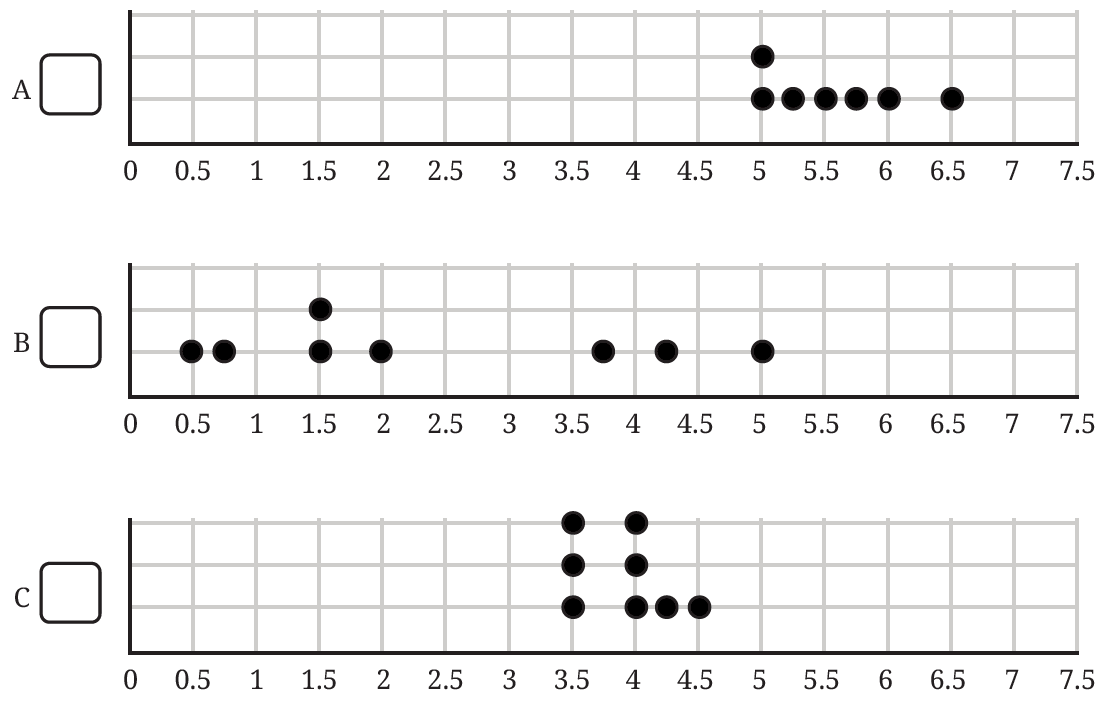
Answer:
Given:
Three dot plots labeled A, B, and C representing the lengths of songs (in minutes) from different albums.
Target Mean = $5.57$ minutes.
To Find:
Which of the dot plots has a mean of $5.57$ minutes and the explanation for the answer.
Solution:
We can determine the correct plot by examining the dot plots. In dot plot A, most song lengths are between $5$ and $6.5$ minutes, so the mean is likely around $5.57$ minutes. In dot plots B and C, all song lengths are well below $5.57$ minutes, so their means cannot reach $5.57$. Therefore, dot plot A is the one with a mean of $5.57$ minutes.
Detailed Check:
1. For Album A:
Data values = $5, 5, 5.25, 5.5, 5.75, 6, 6.5$
$\text{Mean} = \frac{5 + 5 + 5.25 + 5.5 + 5.75 + 6 + 6.5}{7}$
$\text{Mean} = \frac{39}{7} = 5.57\text{ minutes}$
2. For Album B:
Data values = $0.5, 0.75, 1.5, 1.5, 2, 3.75, 4.25, 5$
$\text{Mean} = \frac{0.5 + 0.75 + 1.5 + 1.5 + 2 + 3.75 + 4.25 + 5}{8}$
$\text{Mean} = \frac{19.25}{8} = 2.41\text{ minutes}$
3. For Album C:
Data values = $3.5, 3.5, 3.5, 4, 4, 4, 4.25, 4.5$
$\text{Mean} = \frac{3.5 + 3.5 + 3.5 + 4 + 4 + 4 + 4.25 + 4.5}{8}$
$\text{Mean} = \frac{30.75}{8} = 3.84\text{ minutes} \approx 3.9\text{ minutes}$
Final Answer:
Album (A) has a mean of $5.57$ minutes.
Question 5. Find the median of $8, 10, 19, 23, 26, $$ \ 34, 40, 41, $$ \ 41, 48, 51, $$ \ 55, 70, 84, 91, 92$.
(i) If we include one value to the data (in the given list) without affecting the median, what could that value be?
(ii) If we include two values to the data without affecting the median what could the two values be?
(iii) If we remove one value from the data without affecting the median what could the value be?
Answer:
Solution:
1. Finding the median of the given data:
The given data in ascending order is:
$8, 10, 19, 23, 26, 34, 40, \mathbf{41}, \mathbf{41}, 48, 51, 55, 70, 84, 91, 92$
Total number of observations ($n$) = $16$ (which is even).
The median of an even number of observations is the mean of the $\left(\frac{n}{2}\right)^{\text{th}}$ and $\left(\frac{n}{2} + 1\right)^{\text{th}}$ terms.
Here, $n = 16$, so we need the average of the $8^{\text{th}}$ and $9^{\text{th}}$ terms.
$8^{\text{th}}$ term = $41$
$9^{\text{th}}$ term = $41$
$\text{Median} = \frac{41 + 41}{2} = 41$
(i) If we include one value without affecting the median:
When we add one value to the data, the total number of observations becomes $17$ (odd).
The median of $17$ observations will be the middle value, which is the $9^{\text{th}}$ term.
To keep the median unchanged at $41$, the newly added value must be equal to $41$ (or any value that keeps the $9^{\text{th}}$ term equal to $41$).
Therefore, the included value could be $41$.
(ii) If we include two values without affecting the median:
When we add two values, the total number of observations becomes $18$ (even).
The median will be the average of the $9^{\text{th}}$ and $10^{\text{th}}$ terms.
To keep the median at $41$, we can include two values that are equal to $41$, or one value less than or equal to $41$ and one value greater than or equal to $41$ such that their average with the surrounding terms results in $41$ (for instance, adding two $41$s).
Therefore, the two values could be $41$ and $41$ (or any pair whose average preserves the middle values as $41$).
(iii) If we remove one value without affecting the median:
When we remove one value from the $16$ observations, the total number of observations becomes $15$ (odd).
The median of $15$ observations is the $8^{\text{th}}$ term.
To keep the median as $41$, we must remove a value that does not shift the position of $41$ as the middle term. We can remove one of the duplicate $41$s, or any number that is not part of the central calculation in a way that alters the $8^{\text{th}}$ position.
Therefore, the removed value could be one of the $41$s (or any value outside the central range whose removal leaves the $8^{\text{th}}$ term as $41$).
Question 6. Examine the statements below and justify if the statement is always true, sometimes true, or never true.
(i) Removing a value less than the median will decrease the median.
(ii) Including a value less than the mean will decrease the mean.
(iii) Including any $4$ values will not affect the median.
(iv) Including $4$ values less than the median will increase the median.
Answer:
(i) Removing a value less than the median:
Statement: Never True.
Justification: Removing a smaller value from the left side of the data set shifts the center towards the right (larger values). This will either keep the median same or increase it, but never decrease it.
(ii) Including a value less than the mean:
Statement: Always True.
Justification: The mean is the balance point. Adding a value smaller than the current average "pulls" the balance point down towards the smaller value.
(iii) Including any $4$ values will not affect the median:
Statement: Sometimes True.
Justification: If we include $2$ values less than the median and $2$ values greater than the median, the middle position stays the same. However, if all $4$ values are very large or very small, the median will shift.
(iv) Including $4$ values less than the median:
Statement: Never True.
Justification: Adding values to the left side of the data set shifts the center towards the smaller values. This will either decrease the median or keep it the same, but it can never increase it.
Question 7. The mean of the numbers $8, 13, 10, 4, 5, 20, y, 10$ is $10.375$. Find the value of $y$.
Answer:
Given:
Observations: $8, 13, 10, 4, 5, 20, y, 10$
Total number of observations ($n$) = $8$
Mean = $10.375$
To Find:
The value of $y$.
Solution:
$\text{Mean} = \frac{\text{Sum of observations}}{n}$
$10.375 = \frac{8 + 13 + 10 + 4 + 5 + 20 + y + 10}{8}$
$10.375 \times 8 = 70 + y$
$83 = 70 + y$
$y = 83 - 70 = 13$
Final Answer: The value of $y$ is $13$.
Question 8. The mean of a set of data with $15$ values is $134$. Find the sum of the data.
Answer:
Solution:
Given:
Number of values ($n$) = $15$
Mean of the data = $134$
Formula:
$\text{Mean} = \frac{\text{Sum of the data}}{\text{Number of values } (n)}$
Calculation:
$\text{Sum of the data} = \text{Mean} \times n$
$\text{Sum of the data} = 134 \times 15 = 2010$
Therefore, the sum of the data is $2010$.
Question 9. Consider the data: $12, 47, 8, 73, 18, 35, 39, 8, 29, 25, p$. Which of the following number(s) could be $p$ if the median of this data is $29$?
(i) $10$
(ii) $25$
(iii) $40$
(iv) $100$
(v) $29$
(vi) $47$
(vii) $30$
Answer:
Given:
Data without $p$: $12, 47, 8, 73, 18, 35, 39, 8, 29, 25$
Total observations including $p$ ($n$) = $11$
Target Median = $29$
To Find:
Possible values of $p$ from the given options.
Solution:
First, let us arrange the existing $10$ numbers in ascending order:
$8, 8, 12, 18, 25, 29, 35, 39, 47, 73$
Since $n = 11$, the median is the $(\frac{11+1}{2})^{th} = 6^{th}$ observation.
Currently, the $6^{th}$ value in the sorted list is $29$.
1. If $p < 29$, then $p$ will be placed before $29$. The $6^{th}$ observation would then become $25$ (if $p \leq 25$) or $p$ itself. The median would not be $29$.
2. If $p \geq 29$, then $p$ will be placed at or after the $6^{th}$ position. In this case, $29$ will remain as the $6^{th}$ observation.
Therefore, for the median to be $29$, we must have $p \geq 29$.
Checking Options:
(i) $10$ (No), (ii) $25$ (No), (iii) $40$ (Yes), (iv) $100$ (Yes), (v) $29$ (Yes), (vi) $47$ (Yes), (vii) $30$ (Yes).
Final Answer: The possible values for $p$ are $29, 30, 40, 47, 100$.
Question 10. The number of times students rode their cycles in a week is shown in the dot plot below. Four students rode their cycles twice in that week.
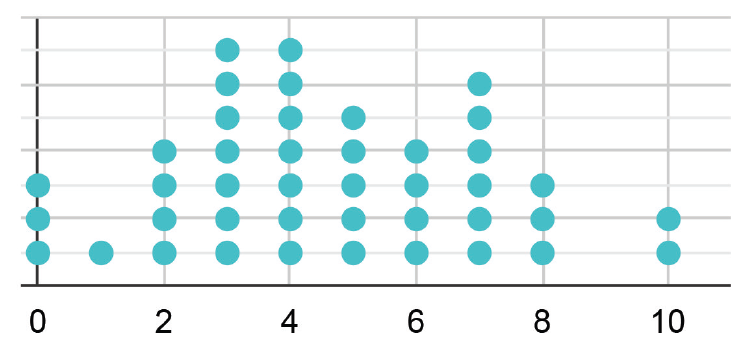
(i) Find the average number of times students rode their cycles.
(ii) Find the median number of times students rode their cycles.
(iii) Which of the following statements are valid? Why?
(a) Everyone used their cycle at least once.
(b) Almost everyone used their cycle a few times.
(c) There are some students who cycled more than once on some days.
(d) Exactly $5$ students have used their cycles more than once on some days.
(e) The following week, if all of them cycled $1$ more time than they did the previous week, what would be the average and median of the next week’s data?
Answer:
Solution:
1. Analyzing the dot plot data:
Let us list the frequencies from the dot plot at each value ($x$):
Value $0$: $3$ dots
Value $1$: $1$ dot
Value $2$: $4$ dots
Value $3$: $7$ dots
Value $4$: $7$ dots
Value $5$: $5$ dots
Value $6$: $4$ dots
Value $7$: $6$ dots
Value $8$: $3$ dots
Value $10$: $2$ dots
Total number of students ($N$) = $3 + 1 + 4 + 7 + 7 + 5 + 4 + 6 + 3 + 2 $$ = 42$
(i) Average number of times students rode their cycles:
Total sum = $(0 \times 3) + (1 \times 1) + (2 \times 4) + (3 \times 7) + (4 \times 7) + (5 \times 5) $$ + (6 \times 4) + (7 \times 6) + (8 \times 3) + (10 \times 2)$
Total sum = $0 + 1 + 8 + 21 + 28 + 25 + 24 + 42 + 24 + 20 = 193$
$\text{Average} = \frac{193}{42} \approx 4.6$
(ii) Median number of times students rode their cycles:
Total observations $N = 42$ (even).
The median is the average of the $21^{\text{st}}$ and $22^{\text{nd}}$ observations.
Cumulative frequencies:
Values $0$ to $3$: $3 + 1 + 4 + 7 = 15$
Value $4$: adds $7$ more, reaching $15 + 7 = 22$
Therefore, both the $21^{\text{st}}$ and $22^{\text{nd}}$ values lie at $4$.
$\text{Median} = \frac{4 + 4}{2} = 4$
(iii) Validity of statements:
(a) Everyone used their cycle at least once:
Invalid. The dot plot shows $3$ students at value $0$, meaning they did not use their cycle at all.
(b) Almost everyone used their cycle a few times:
Valid. The majority of students have non-zero ride counts (from $1$ up to $10$).
(c) There are some students who cycled more than once on some days:
Valid. The data shows ride counts of $2$ or more per week (and the problem description explicitly states $4$ students rode twice in that week).
(d) Exactly $5$ students have used their cycles more than once on some days:
Invalid. There are many students with cycle counts greater than $1$ (in fact, $42 - 4 = 38$ students had $0, 1$, or $>2$ counts).
(e) If the following week all of them cycled $1$ more time:
When every data value in a dataset is increased by a constant ($+1$), the average also increases by $1$, and the median also increases by $1$.
$\text{New Average} = 4.6 + 1 = 5.6$
$\text{New Median} = 4 + 1 = 5$
Question 11. A dart-throwing competition was organised in a school. The number of throws participants took to hit the bull’s eye (the centre circle) is given in the table below. Describe the data using its minimum, maximum, mean and median.
| No. of trials | No. of students |
|---|---|
| 1 | 1 |
| 2 | 0 |
| 3 | 0 |
| 4 | 1 |
| 5 | 4 |
| 6 | 9 |
| 7 | 12 |
| 8 | 15 |
| 9 | 10 |
| 10 | 10 |
Answer:
Solution:
1. Understanding the frequency table:
Let $x$ represent the number of trials and $f$ represent the number of students:
For $x = 1$, $f = 1$
For $x = 4$, $f = 1$
For $x = 5$, $f = 4$
For $x = 6$, $f = 9$
For $x = 7$, $f = 12$
For $x = 8$, $f = 15$
For $x = 9$, $f = 10$
For $x = 10$, $f = 10$
Total number of students ($N$) = $1 + 0 + 0 + 1 + 4 + 9 + 12 + 15 + $$ \ 10 + 10 = 62$
2. Minimum and Maximum:
Minimum number of trials: Looking at the lowest trial count with a student frequency greater than $0$, the minimum is $1$.
Maximum number of trials: Looking at the highest trial count in the table, the maximum is $10$.
3. Mean number of trials:
Total sum of trials ($fx$) = $(1 \times 1) + (4 \times 1) + (5 \times 4) + (6 \times 9) + $$ \ (7 \times 12) + (8 \times 15) + (9 \times 10) + (10 \times 10)$
Total sum = $1 + 4 + 20 + 54 + 84 + 120 + 90 + 100 = 473$
$\text{Mean} = \frac{473}{62} \approx 7.63$
4. Median number of trials:
Total observations $N = 62$ (even).
The median is the average of the $31^{\text{st}}$ and $32^{\text{nd}}$ observations.
Let us find the cumulative frequencies:
For $x = 1$: cumulative frequency = $1$
For $x = 4$: cumulative frequency = $1 + 1 = 2$
For $x = 5$: cumulative frequency = $2 + 4 = 6$
For $x = 6$: cumulative frequency = $6 + 9 = 15$
For $x = 7$: cumulative frequency = $15 + 12 = 27$
For $x = 8$: cumulative frequency = $27 + 15 = 42$
Since the cumulative frequency reaches $27$ at $x = 7$ and $42$ at $x = 8$, both the $31^{\text{st}}$ and $32^{\text{nd}}$ observations fall in the category $x = 8$.
$\text{Median} = \frac{8 + 8}{2} = 8$
Figure It Out (Page No. 122 - 123)
Question 1. The average number of customers visiting a shop and the average number of customers actually purchasing items over different days of the week is shown in the table below. Visualise this data on a line graph.
| Mon | Tue | Wed | Thu | Fri | Sat | Sun | |
|---|---|---|---|---|---|---|---|
| Visiting | $16$ | $19$ | $10$ | $14$ | $20$ | $22$ | $35$ |
| Purchasing | $10$ | $8$ | $7$ | $11$ | $12$ | $16$ | $26$ |
Answer:
Solution:
1. Understanding the data for the line graph:
To visualize this data on a line graph, we use two separate lines on the same set of axes:
Line 1 (Visiting): Represents the number of visiting customers across the days (Mon to Sun).
Line 2 (Purchasing): Represents the number of purchasing customers across the days (Mon to Sun).
2. Steps to draw the line graph:
Horizontal Axis (X-axis): Mark the days of the week from Monday to Sunday at equal intervals.
Vertical Axis (Y-axis): Mark the number of customers with a suitable scale (e.g., from $0$ to $40$ with intervals of $5$).
Plotting Points: For each day, plot the points for "Visiting" and "Purchasing" using the values from the table.
Joining Points: Connect the plotted points with straight line segments using distinct colors or styles (such as a solid line for visiting and a dashed line for purchasing) with a proper legend.
Question 2. The average number of days of rainfall in each month for a few cities is shown in the table below:
| City | Jan | Feb | Mar | Apr | May | Jun | Jul | Aug | Sep | Oct | Nov | Dec |
|---|---|---|---|---|---|---|---|---|---|---|---|---|
| Mangaluru | $0.1$ | $0$ | $0.1$ | $1.8$ | $6.2$ | $24.1$ | $27.7$ | $24.5$ | $14$ | $8.8$ | $3.9$ | $0.9$ |
| New Delhi | ||||||||||||
| Port Blair | $2.4$ | $1.3$ | $0.9$ | $3.3$ | $15.5$ | $18.7$ | $17.3$ | $18.8$ | $16.8$ | $14.1$ | $11.3$ | $5.4$ |
| Rameswaram | $2.6$ | $1.3$ | $1.9$ | $3.4$ | $2.5$ | $0.4$ | $1$ | $1$ | $1.9$ | $8.1$ | $10.4$ | $7.8$ |
(i) What could be the possible method to compile this data?
(ii) Mark the data for Mangaluru, Port Blair, and Rameswaram in the line graph shown below. You can round off the values to the nearest integer.
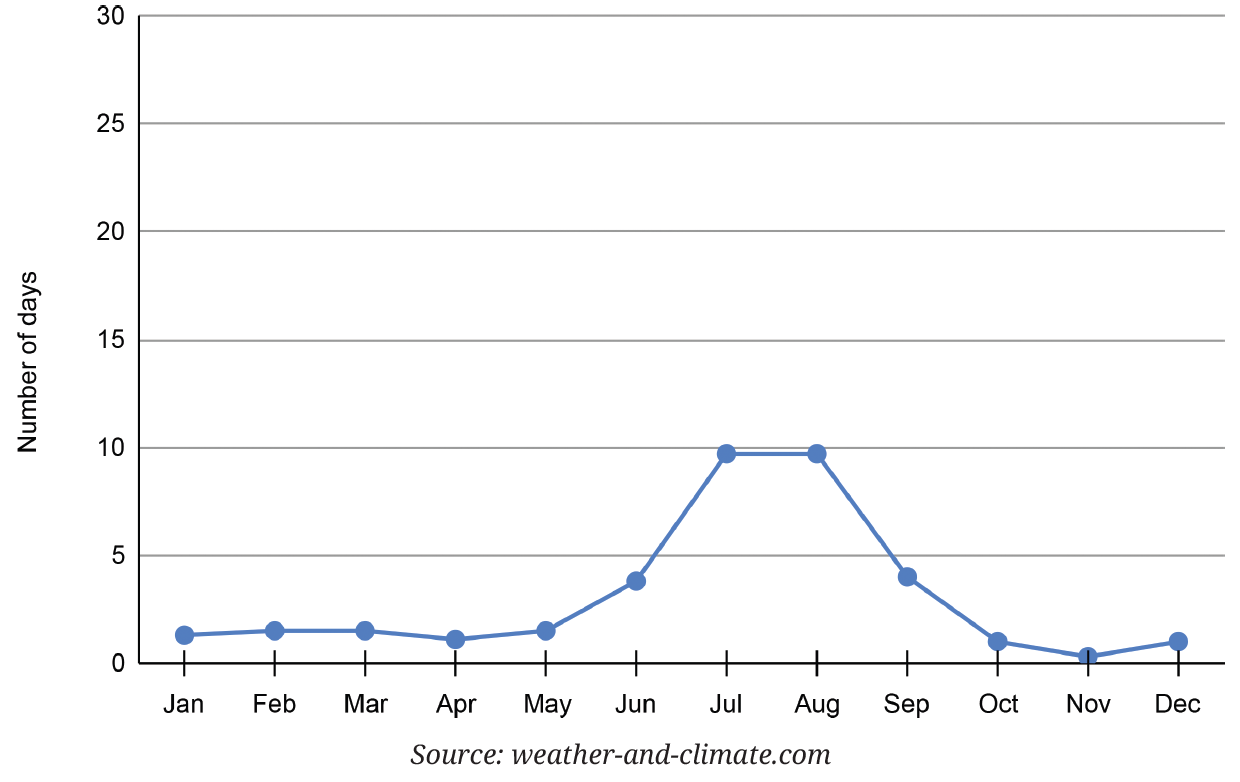
(iii) Based on the line for New Delhi in the graph fill the data in the table.
(iv) Which city among these receives the most number of days of rainfall per year? Which city gets the least number of days of rainfall per year?
(v) Looking at the table, when is the rainy season in New Delhi and Rameswaram?
Answer:
Solution:
(i) Possible method to compile this data:
Line graph
(ii) Marking the data in the line graph:
Rounding off the monthly average values to the nearest integer for plotting:
Mangaluru: $0, 0, 0, 2, 6, 24, 28, 25, 14, 9, 4, 1$
Port Blair: $2, 1, 1, 3, 16, 19, 17, 18, 17, 14, 11, 5$
Rameswaram: $3, 1, 2, 3, 3, 0, 1, 1, 2, 8, 10, 8$
(iii) Filling data for New Delhi based on the graph:
Jan: $1.6$, Feb: $1.7$, Mar: $1.7$, Apr: $1.1$, May: $2.0$, Jun: $4.1$, Jul: $9.8$, Aug: $9.8$, Sep: $4.5$, Oct: $0.9$, Nov: $0.1$, Dec: $1.2$
| City | Jan | Feb | Mar | Apr | May | Jun | Jul | Aug | Sep | Oct | Nov | Dec |
|---|---|---|---|---|---|---|---|---|---|---|---|---|
| New Delhi | $1.6$ | $1.7$ | $1.7$ | $1.1$ | $2.0$ | $4.1$ | $9.8$ | $9.8$ | $4.5$ | $0.9$ | $0.1$ | $1.2$ |
(iv) City with most and least days of rainfall per year:
Summing up the annual average rainy days for each city:
Mangaluru: $\approx 109.8$ days
Port Blair: $\approx 133.5$ days
New Delhi: $\approx 33.5$ days
Rameswaram: $\approx 41.3$ days
Most days of rainfall per year: Port Blair
Least days of rainfall per year: New Delhi
(v) Rainy season in New Delhi and Rameswaram:
New Delhi: The rainy season occurs during the monsoon months of July and August (where the highest number of rainy days are recorded).
Rameswaram: The rainy season occurs towards the end of the year, specifically in October, November, and December (due to the northeast monsoon).
Question 3. The following line graph shows the number of births in every month in India over a time period:
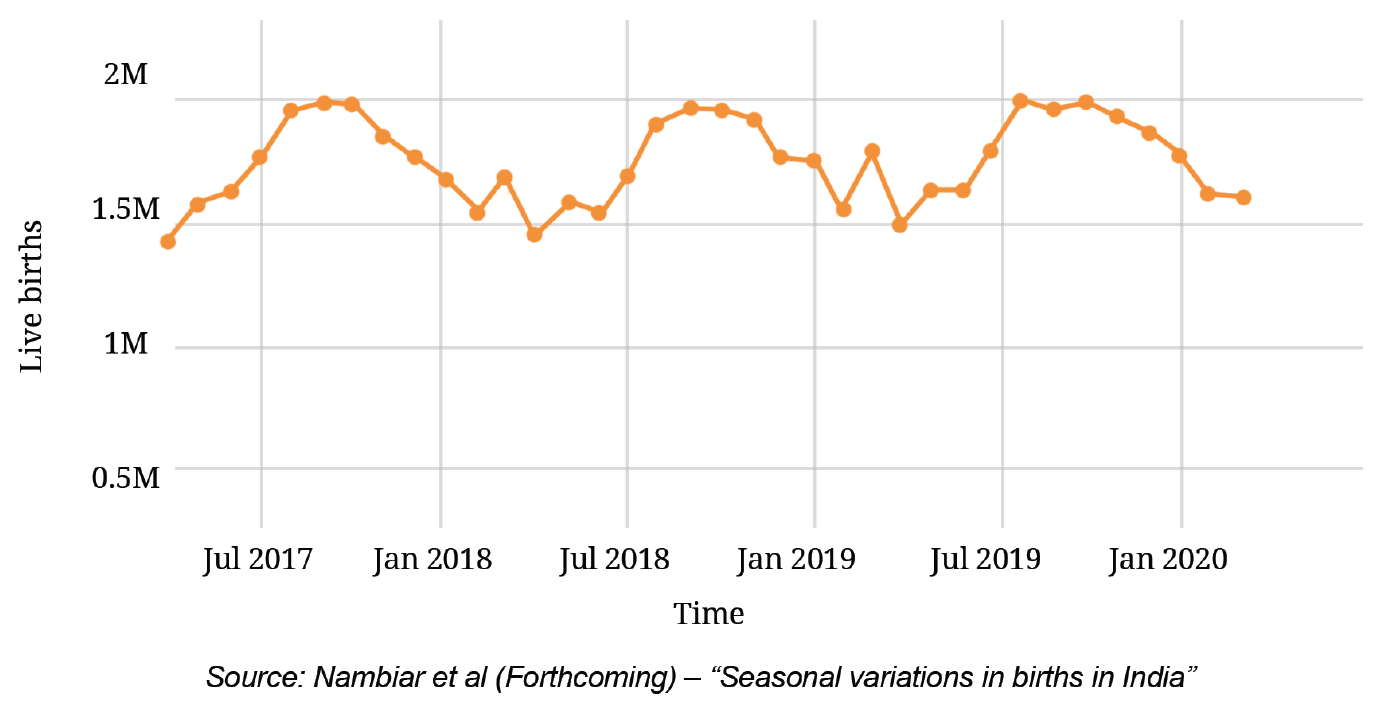
(i) What are your observations?
(ii) What was the approximate number of births in July $2017$?
(iii) What time period does the graph capture?
(iv) Compare the number of births in the month of January in the years $2018$, $2019$, and $2020$.
(v) Estimate the number of births in the year $2019$.
Answer:
Solution:
(i) Observations from the line graph:
The number of live births in India shows a repeating cyclical pattern every year (seasonal variation).
Births generally peak around the middle of the year (July–August) and drop towards the beginning or end of the years.
The monthly births mostly fluctuate between $1.4\text{ million}$ and $1.9\text{ million}$.
(ii) Approximate number of births in July $2017$:
Looking at the point corresponding to July $2017$ on the graph, it lies just below the $2\text{M}$ line, approximately at $1.9\text{ million}$.
(iii) Time period captured by the graph:
Apr 2017 to Mar 2020
(iv) Comparison of births in January for $2018$, $2019$, and $2020$:
January 2018: Approximately $1.7\text{ million}$ births.
January 2019: Approximately $1.8\text{ million}$ births.
January 2020: Approximately $1.85\text{ million}$ births.
Comparing these values, the number of births in January showed a steady upward trend from $2018$ through $2019$ to $2020$.
(v) Estimate the number of births in the year $2019$:
By averaging the monthly birth counts for $2019$ (which hover around $1.7\text{ million}$ per month) and multiplying by $12$ months:
$\text{Total births in } 2019 \approx 1.7\text{M} \times 12 \approx 20.4\text{ million}$
Figure It Out (Page No. 127 - 132)
Question 1. Mean Grids:
(i) Fill the grid with $9$ distinct numbers such that the average along each row, column, and diagonal is $10$.

(ii) Can we fill the grid by changing a few numbers and still get $10$ as the average in all directions?
Answer:
Given: A $3 \times 3$ grid and a target average of $10$ for each row, column, and diagonal.
To Find: Fill the grid with 9 distinct numbers.
Solution:
If the average of 3 numbers is $10$, their sum must be:
$\text{Sum} = 10 \times 3 = 30$
This is equivalent to creating a Magic Square with a magic constant of $30$. In a $3 \times 3$ magic square, the middle number is always $\frac{1}{3}$ of the magic constant. So, the center number must be $10$.
One such combination of 9 distinct numbers is:
| $8$ | $15$ | $7$ |
| $9$ | $10$ | $11$ |
| $13$ | $5$ | $12$ |
Check:
Row 1: $(8+15+7) \div 3 = 10$
Row 2: $(9+10+11) \div 3 = 10$
Diagonal 1: $(8+10+12) \div 3 = 10$
(ii) Answer:
Yes, we can fill the grid in different ways. By keeping $10$ at the center and choosing different pairs $(a, b)$ that sum to $20$ for the opposite cells, we can create multiple variations. For example, replacing $15$ and $5$ with $16$ and $4$ (and adjusting others) would still work.
Question 2. Give two examples of data that satisfy each of the following conditions:
(i) $3$ numbers whose mean is $8$.
(ii) $4$ numbers whose median is $15.5$.
(iii) $5$ numbers whose mean is $13.6$.
(iv) $6$ numbers whose mean $=$ median.
(v) $6$ numbers whose mean $>$ median.
Answer:
(i) 3 numbers whose mean is 8 (Sum must be 24):
Example 1: $\{7, 8, 9\}$
Example 2: $\{4, 9, 11\}$
(ii) 4 numbers whose median is 15.5 (Average of middle two must be 15.5):
Example 1: $\{10, 15, 16, 20\}$ (Median = $\frac{15+16}{2} = 15.5$)
Example 2: $\{5, 14, 17, 30\}$ (Median = $\frac{14+17}{2} = 15.5$)
(iii) 5 numbers whose mean is 13.6 (Sum must be 68):
Example 1: $\{10, 12, 13, 15, 20\}$
Example 2: $\{5, 10, 15, 20, 18\}$
(iv) 6 numbers whose mean $=$ median:
Example 1: $\{1, 2, 3, 4, 5, 6\}$ (Mean = $3.5$, Median = $3.5$)
Example 2: $\{5, 6, 7, 8, 9, 10\}$ (Mean = $7.5$, Median = $7.5$)
(v) 6 numbers whose mean $>$ median:
Example 1: $\{1, 2, 3, 4, 5, 100\}$ (Median = $3.5$, Mean $\approx 19.16$)
Example 2: $\{8, 9, 10, 11, 12, 70\}$ (Median = $10.5$, Mean = $20$)
Question 3. Fill in the blanks such that the median of the collection is $13$: $5, 21, 14, \_\_\_\_\_, \_\_\_\_\_\_, \_\_\_\_\_\_$. How many possibilities exist if only counting numbers are allowed?
Answer:
Solution:
1. Understanding the median for $6$ numbers:
We have a total of $6$ numbers ($3$ given numbers: $5, 14, 21$, and $3$ blanks).
Since the number of observations ($6$) is even, the median is the average of the $3^{\text{rd}}$ and $4^{\text{th}}$ terms when arranged in ascending order.
Given that the median is $13$:
$\text{3rd term} + \text{4th term} = 26$
2. Finding possible values:
We are given the numbers $5, 14, 21$.
To make the sum of the $3^{\text{rd}}$ and $4^{\text{th}}$ terms equal to $26$ (with $14$ being the $5^{\text{th}}$ term), the $3^{\text{rd}}$ term must be $12$ and the $4^{\text{th}}$ term must be $14$.
So the sorted numbers will be: $5, \text{(blank)}_1, 12, 14, \text{(blank)}_2, 21$ (plus one more blank).
3. Counting the possibilities:
Counting numbers are whole numbers starting from $1, 2, 3, \dots$
The first blank can be any number between $5$ and $12$ ($6$ choices: $6, 7, 8, 9, 10, 11$).
The second blank can be any number between $14$ and $21$ ($6$ choices: $15, 16, 17, 18, 19, 20$).
Multiplying the choices together ($6 \times 6$):
$\text{Total possibilities} = 36$
Therefore, there are $36$ possibilities if only counting numbers are allowed.
Question 4. Fill in the blanks such that the mean of the collection is $6.5$: $3, 11, \_\_\_\_, \_\_\_\_\_, 15, 6$. How many possibilities exist if only counting numbers are allowed?
Answer:
Solution:
1. Understanding the mean:
We are given $4$ numbers ($3, 11, 15, 6$) and $2$ blanks, making a total of $6$ numbers.
Given that the mean of the collection is $6.5$:
$\text{Mean} = \frac{\text{Sum of all 6 numbers}}{6} = 6.5$
$\text{Sum of all 6 numbers} = 6.5 \times 6 = 39$
2. Finding the sum of the two blanks:
Let us find the sum of the given numbers ($3, 11, 15, 6$):
$\text{Sum of given numbers} = 3 + 11 + 15 + 6 = 35$
Let the two missing numbers (blanks) be $x$ and $y$.
$\text{Sum of all 6 numbers} = 35 + x + y = 39$
$x + y = 39 - 35 = 4$
3. Counting the possibilities with counting numbers:
Counting numbers are positive integers ($1, 2, 3, \dots$).
We need to find pairs of positive integers $(x, y)$ such that $x + y = 4$:
If $x = 1$, then $y = 3$ ($1 + 3 = 4$)
If $x = 2$, then $y = 2$ ($2 + 2 = 4$)
If $x = 3$, then $y = 1$ ($3 + 1 = 4$)
Since the order of the two blanks matters (as they are two distinct positions in the collection), there are $3$ possible pairs: $(1, 3)$, $(2, 2)$, and $(3, 1)$.
Therefore, there are $3$ possibilities if only counting numbers are allowed.
Question 5. Check whether each of the statements below is true. Justify your reasoning. Use algebra, if necessary, to justify.
(i) The average of two even numbers is even.
(ii) The average of any two multiples of $5$ will be a multiple of $5$.
(iii) The average of any $5$ multiples of $5$ will also be a multiple of $5$.
Answer:
Solution:
(i) False
Let the two even numbers be $2n$ and $2m$, where $n$ and $m$ are integers.
The average of these two numbers is given by:
$\text{Average} = \frac{2n + 2m}{2} = \frac{2(n + m)}{2} = n + m$
The sum of two integers ($n + m$) is always an integer, but it is not necessarily an even integer.
Example: If the even numbers are $2$ and $4$:
$\text{Average} = \frac{2 + 4}{2} = \frac{6}{2} = 3$
Here, $3$ is odd. Thus, the statement is false.
(ii) False
Let the two multiples of $5$ be $5m$ and $5n$, where $m$ and $n$ are integers.
The average is given by:
$\text{Average} = \frac{5m + 5n}{2} = \frac{5(m + n)}{2}$
This result is a multiple of $5$ only if $\frac{m + n}{2}$ is an integer (i.e., $m + n$ is even).
Example: The average of $5$ and $10$ is:
$\text{Average} = \frac{5 + 10}{2} = \frac{15}{2} = 7.5$
Here, $7.5$ is not a multiple of $5$. Thus, the statement is false.
(iii) False
Let the five multiples of $5$ be $5m, 5n, 5p, 5q,$ and $5r$, where $m, n, p, q,$ and $r$ are integers.
The average is given by:
$\text{Average} = \frac{5m + 5n + 5p + 5q + 5r}{5} = \frac{5(m + n + p + q + r)}{5} = m + n + p + q + r$
The result is an integer but is not necessarily a multiple of $5$.
Example: The average of $5, 10, 10, 10,$ and $10$ is:
$\text{Average} = \frac{5 + 10 + 10 + 10 + 10}{5} = \frac{45}{5} = 9$
Here, $9$ is not a multiple of $5$. Thus, the statement is false.
Question 6. There were $2$ new admissions to Sudhakar’s class just a couple of days after the class average height was found to be $150.2$ cm.
(i) Which of the following statements are correct? Why?
(a) The average height of the class will increase as there are $2$ new values.
(b) The average height of the class will remain the same.
(c) The heights of the new students have to be measured to find out the new average height.
(d) The heights of everyone in the class has to be measured again to calculate the new average height.
(ii) The heights of the two new joinees are $149$ cm and $152$ cm. Which of the following statements about the class’ average height are correct? Why?
(a) The average will remain the same.
(b) The average will increase.
(c) The average will decrease.
(d) The information is not sufficient to make a claim about the average.
(iii) Which of the following statements about the new class average height are correct? Why?
(a) The median will remain the same.
(b) The median will increase.
(c) The median will decrease.
(d) The information is not sufficient to make a claim about median.
Answer:
Solution:
(i) Which of the following statements are correct? Why?
(c) The heights of the new students have to be measured to find out the new average height.
The average may increase, decrease, or stay the same depending on the heights of the two new students.
(ii) The heights of the two new joinees are $149\text{ cm}$ and $152\text{ cm}$. Which of the following statements about the class’s average height is correct? Why?
(b) The average will increase.
Old mean = $150.2\text{ cm}$
Let the number of students be $x$.
$\text{New mean} = \frac{\text{Sum of heights of } x \text{ students} + 149 + 152}{x + 2}$
Average of the new two heights = $\frac{149 + 152}{2} = \frac{301}{2} = 150.5\text{ cm}$
$150.5\text{ cm} > 150.2\text{ cm}$
As the average of the $2$ newly added heights is greater than the old average, the class average increases.
Option (b) is correct.
(iii) Which of the following statements about the new class average height are correct? Why?
(d) The information is not sufficient to make a claim about the median.
The median depends on the arrangement of all heights in the ordered list.
Adding two values changes the position of the middle value.
Option (d) is correct.
Question 7. Is $17$ the average of the data shown in the dot plot below? Share the method you used to answer this question.
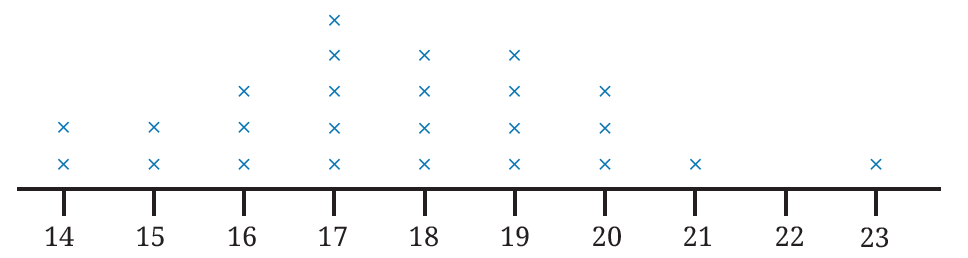
Answer:
Solution:
1. Analyzing the dot plot data:
Let us count the frequency ($\times$) for each value from the dot plot (with the frequency at value $17$ corrected to $5$):
Value $14$: $2$
Value $15$: $2$
Value $16$: $3$
Value $17$: $5$
Value $18$: $4$
Value $19$: $4$
Value $20$: $3$
Value $21$: $1$
Value $22$: $0$
Value $23$: $1$
Total number of data points ($N$) = $2 + 2 + 3 + 5 + 4 + 4 + 3 + 1 + 0 + 1 = 25$
2. Method to check if $17$ is the average:
We can check if $17$ is the average by calculating the deviation of each data point from the assumed average of $17$:
Value $14$: $(14 - 17) \times 2 = -3 \times 2 = -6$
Value $15$: $(15 - 17) \times 2 = -2 \times 2 = -4$
Value $16$: $(16 - 17) \times 3 = -1 \times 3 = -3$
Value $17$: $(17 - 17) \times 5 = 0 \times 5 = 0$
Value $18$: $(18 - 17) \times 4 = 1 \times 4 = 4$
Value $19$: $(19 - 17) \times 4 = 2 \times 4 = 8$
Value $20$: $(20 - 17) \times 3 = 3 \times 3 = 9$
Value $21$: $(21 - 17) \times 1 = 4 \times 1 = 4$
Value $22$: $(22 - 17) \times 0 = 5 \times 0 = 0$
Value $23$: $(23 - 17) \times 1 = 6 \times 1 = 6$
Sum of deviations = $-6 - 4 - 3 + 0 + 4 + 8 + 9 + 4 + 0 + 6 = 18$
Since the sum of deviations from $17$ is positive ($+18$), the true average is higher than $17$.
$\text{True Average} = 17 + \frac{18}{25} = 17 + 0.72 = 17.72$
3. Conclusion:
No, $17$ is not the average of the data. The actual average is $17.72$.
Question 8. The weights of people in a group were measured every month. The average weight for the previous month was $65.3$ kg and the median weight was $67$ kg. The data for this month showed that one person has lost $2$ kg and two have gained $1$ kg. What can we say about the change in mean weight and median weight this month?
Answer:
Solution:
Original average weight = $65.3\text{ kg}$
Let there be $n$ people in the group.
Total weight = $n \times 65.3\text{ kg}$
After one person loses $2\text{ kg}$ and two people each gain $1\text{ kg}$, the net change in total weight is:
$\text{Total weight} = 65.3n + 1 + 1 - 2 = 65.3n$
$\text{New mean} = \frac{65.3n}{n} = 65.3\text{ kg}$
The new mean weight will remain unchanged.
The effect on the median depends on the original position of these three people whose weights changed.
So the new median weight cannot be determined exactly without knowing more data.
Question 9. The following table shows the retail price (in $\textsf{₹}$) of iodised salt in the month of January in a few states over $10$ years. For your calculations and plotting you may round off values to the nearest counting number.
| Year | Andaman and Nicobar Islands | Assam | Gujarat | Mizoram | Uttar Pradesh | West Bengal |
|---|---|---|---|---|---|---|
| 2016 | 16 | 6 | 16.5 | 20 | 16.15 | 9.47 |
| 2017 | 12 | 12 | 14.75 | 20 | 16.97 | 11.65 |
| 2018 | 12 | 12 | 14.75 | 22 | 16.18 | 11.63 |
| 2019 | 12 | 12 | 14.75 | 22 | 18.24 | 11.43 |
| 2020 | 13.88 | 12 | 13 | 20 | 18.96 | 11.11 |
| 2021 | 18.22 | 15 | 14.45 | 22 | 20.63 | 12.79 |
| 2022 | 18.73 | 14 | 14.28 | 25 | 21.3 | 16.14 |
| 2023 | 20.63 | 12.02 | 14.54 | 27.65 | 25.39 | 18.43 |
| 2024 | 19.73 | 13.72 | 14.8 | 29.03 | 26.9 | 21.66 |
| 2025 | 20.99 | 12.35 | 19.2 | 29.8 | 24.81 | 23.99 |
(i) Choose data from any $3$ states you find interesting and present it through a line graph using an appropriate scale.
(ii) What do you find interesting in this data? Share your observations.
(iii) Compare the price variation in Gujarat and Uttar Pradesh.
(iv) In which state has the price increased the most from $2016$ to $2025$?
(v) What are you curious to explore further?
Answer:
Solution:
(i) Line graph for $3$ selected states (Assam, Gujarat, and Mizoram):
Rounding off the values to the nearest counting number for plotting:
Assam: $6, 12, 12, 12, 12, 15, 14, 12, 14, 12$
Gujarat: $17, 15, 15, 15, 13, 14, 14, 15, 15, 19$
Mizoram: $20, 20, 22, 22, 20, 22, 25, 28, 29, 30$
(ii) Interesting observations in the data:
Prices vary significantly across different states; for instance, Mizoram consistently has some of the highest salt prices ($\textsf{₹}20$ to $\textsf{₹}30$), whereas Assam and Gujarat have relatively lower prices.
While most states show a steady upward trend in prices over the $10$-year period, Gujarat's prices remained remarkably stable and flat for many years before rising slightly in 2025.
(iii) Compare the price variation in Gujarat and Uttar Pradesh:
Gujarat: The price of salt remained very stable, hovering around $\textsf{₹}14$–$\textsf{₹}15$ for most of the decade, with a slight increase to $\textsf{₹}19$ in $2025$.
Uttar Pradesh: The price showed a steady and consistent upward trend, starting from around $\textsf{₹}16$ in $2016$ and rising progressively to nearly $\textsf{₹}25$–$\textsf{₹}27$ by $2024$–$2025$.
(iv) State where the price increased the most from $2016$ to $2025$:
Let us check the price increase (2025 price minus 2016 price):
Andaman and Nicobar Islands: $20.99 - 16 = 4.99$
Assam: $12.35 - 6 = 6.35$
Gujarat: $19.2 - 16.5 = 2.7$
Mizoram: $29.8 - 20 = 9.8$
Uttar Pradesh: $24.81 - 16.15 = 8.66$
West Bengal: $23.99 - 9.47 = 14.52$
Therefore, the price has increased the most in West Bengal (an increase of about $\textsf{₹}14.52$).
(v) What are you curious to explore further?
Why is iodised salt significantly more expensive in hilly or remote states like Mizoram compared to coastal or producing states like Gujarat?
What factors caused West Bengal's salt price to nearly triple from $2016$ to $2025$?
Question 10. Referring to the graph below, which of the following statements are valid? Why?
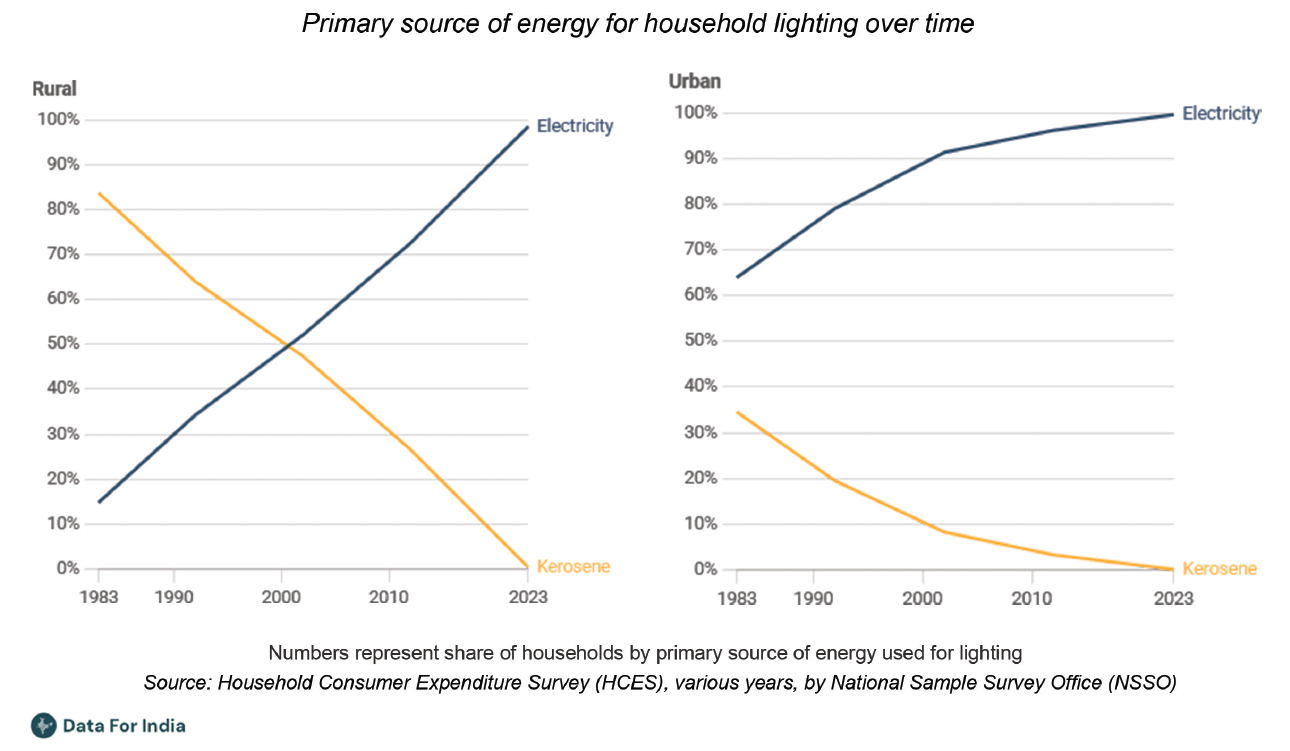
(i) In $1983$, the majority in rural areas used kerosene as a primary lighting source while the majority in urban areas used electricity.
(ii) The use of kerosene as a primary lighting source has decreased over time in both rural and urban areas.
(iii) In the year $2000$, $10\%$ of the urban households used electricity as a primary lighting source.
(iv) In $2023$, there were no power cuts.
Answer:
(i) Statement: In $1983$, the majority in rural areas used kerosene while the majority in urban areas used electricity.
Validity: Valid. By observing the graphs for $1983$: In Rural areas, Kerosene was at $\approx 84\%$, which is a clear majority. In Urban areas, Electricity was at $\approx 64\%$, which is also a majority (greater than $50\%$).
(ii) Statement: The use of kerosene as a primary lighting source has decreased over time in both rural and urban areas.
Validity: Valid. In both graphs, the orange lines (Kerosene) show a continuous downward slope from $1983$ to $2023$, indicating a consistent decline in usage.
(iii) Statement: In the year $2000$, $10\%$ of the urban households used electricity as a primary lighting source.
Validity: Invalid. In the Urban graph for the year $2000$, the Electricity line (blue) is near the $90\%$ mark. It was Kerosene usage that had dropped to nearly $10\%$.
(iv) Statement: In $2023$, there were no power cuts.
Validity: Invalid. The graph only shows the "Primary source of energy used for lighting". Even if a household uses electricity as its primary source, the graph does not provide data on the reliability of the power supply or the frequency of power cuts.
Question 11. Answer the following questions based on the line graph.
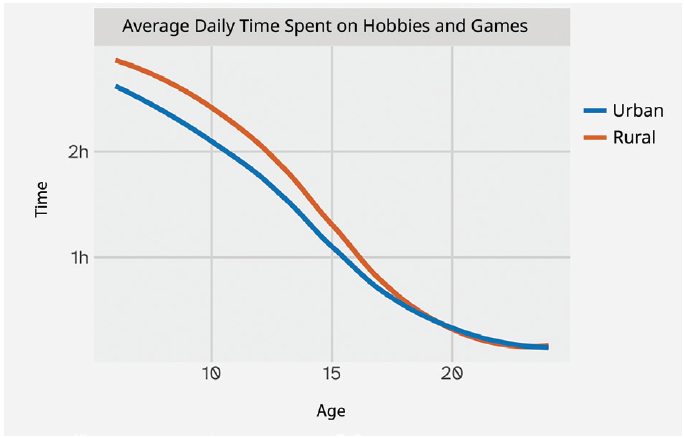
(i) How long do children aged $10$ in urban areas spend each day on hobbies and games?
(ii) At what age is the average time spent daily on hobbies and games by rural kids $1.5$ hours?
(a) $8$ years
(b) $10$ years
(c) $12$ years
(d) $14$ years
(e) $18$ years
(iii) Are the following statements correct?
(a) The average time spent daily on hobbies and games by kids aged $15$ is twice that of kids aged $10$.
(b) All rural kids aged $15$ spend at least $1$ hour on hobbies and games everyday.
Answer:
(i) Time spent by Urban children aged 10:
By observing the blue line (Urban) at the point corresponding to Age 10 on the x-axis, the y-axis value is exactly $2$ hours ($2$h).
(ii) Age for Rural kids spending 1.5 hours:
We look for the $1.5$h mark on the y-axis (midway between $1$h and $2$h) and see where the orange line (Rural) crosses it. This happens at approximately Age $14$.
The correct option is (d) $14$ years.
(iii) Analysis of Statements:
(a) The average time spent by kids aged 15 is twice that of kids aged 10:
Incorrect. At age 10, the time is $\approx 2$h. At age 15, the time is $\approx 1$h. The time spent by 15-year-olds is actually half that of 10-year-olds, not twice.
(b) All rural kids aged 15 spend at least 1 hour on hobbies and games everyday:
Incorrect. The graph shows the average daily time. An average of $1$ hour means some children might spend $3$ hours while others spend $0$ hours. We cannot conclude that "all" children spend at least $1$ hour based only on the mean.
Question 12. Individual project: Make your own activity strip for different days of the week.
(i) Do you eat and sleep at regular times every day? Typically how long do you spend outdoors?
(ii) Calculate the average time spent per activity. Represent this average day using a strip.
(iii) Similarly, track the activities of any adult at home. Compare your data with theirs.
Answer:
Solution:
(i) Reflection on personal routine:
Observe your daily schedule and note down whether your meal times and bedtime stay consistent throughout the week.
Estimate the total hours you spend playing, walking, or engaging in sports outside your home each day.
(ii) Steps to calculate average time and make an activity strip:
Track how many hours you spend on major activities (sleeping, school, studying, eating, playing, hobbies, and screen time) for a few days.
Add the hours spent on each activity across the days and divide by the number of days to find the daily average.
Draw a rectangular strip (e.g., $24\text{ cm}$ long, where each centimeter represents $1$ hour) and color-code different sections to show how you spend your $24$-hour day.
(iii) Tracking an adult's routine and comparing:
Ask an adult at home (like a parent or guardian) about their daily schedule and record the hours they spend on work, household chores, commuting, sleeping, and leisure.
Create an activity strip for them using the same method.
Compare both strips to find differences—such as how work time replaces school/study time, and how free time or sleep durations vary between you and the adult.
Question 13. Small group project: Make a group of $3$ – $4$ members. Do at least one of the following:
(i) Track daily sleep time of all your family members for a week. Daily sleep time includes night sleep, naps, and any sleep during the day.
(a) Represent this on strips.
(b) Put together the data of all your group members. Calculate the average and median sleep time of children, adults, elderly.
(c) Share your findings and observations.
(ii) When do schools start and end? On a weekday, Manoj’s school starts at $9:30$ am and ends at $4:30$ pm, i.e., $7$ hours which include class time and breaks. Collect information on the daily timings of different schools for Grade $8$, including class time and break time.
Answer:
Solution:
(i) Tracking family sleep time:
(a) Representing on strips:
Create a paper strip for each family member where each day of the week is represented by a bar proportional in length to their total sleep time (night sleep plus any daytime naps).
(b) Calculating average and median:
Combine the sleep data collected by all group members and group them into categories: children, adults, and elderly.
Calculate the mean (average) sleep time by summing all sleep hours in a category and dividing by the count of individuals in that category.
Arrange the sleep hours in ascending order for each group to find the median sleep time.
(c) Sharing findings and observations:
Compare the sleep patterns across age groups (e.g., children usually need and get more sleep than adults or elderly family members).
Observe if sleep times vary significantly between weekdays and weekends.
(ii) Collecting school timing information:
Contact friends, relatives, or classmates who study in different schools.
Note down the starting and ending times for Grade $8$ in each school.
Calculate the total duration and find out how much time is dedicated to actual classes versus recess/break times.
Compare the different school schedules to see which one has the longest or shortest school day.
Question 14. The following graphs show the sunrise and sunset times across the year at $4$ locations in India. Observe how the graphs are organised. Are you able to identify which lines indicate the sunrise and which indicate the sunset?
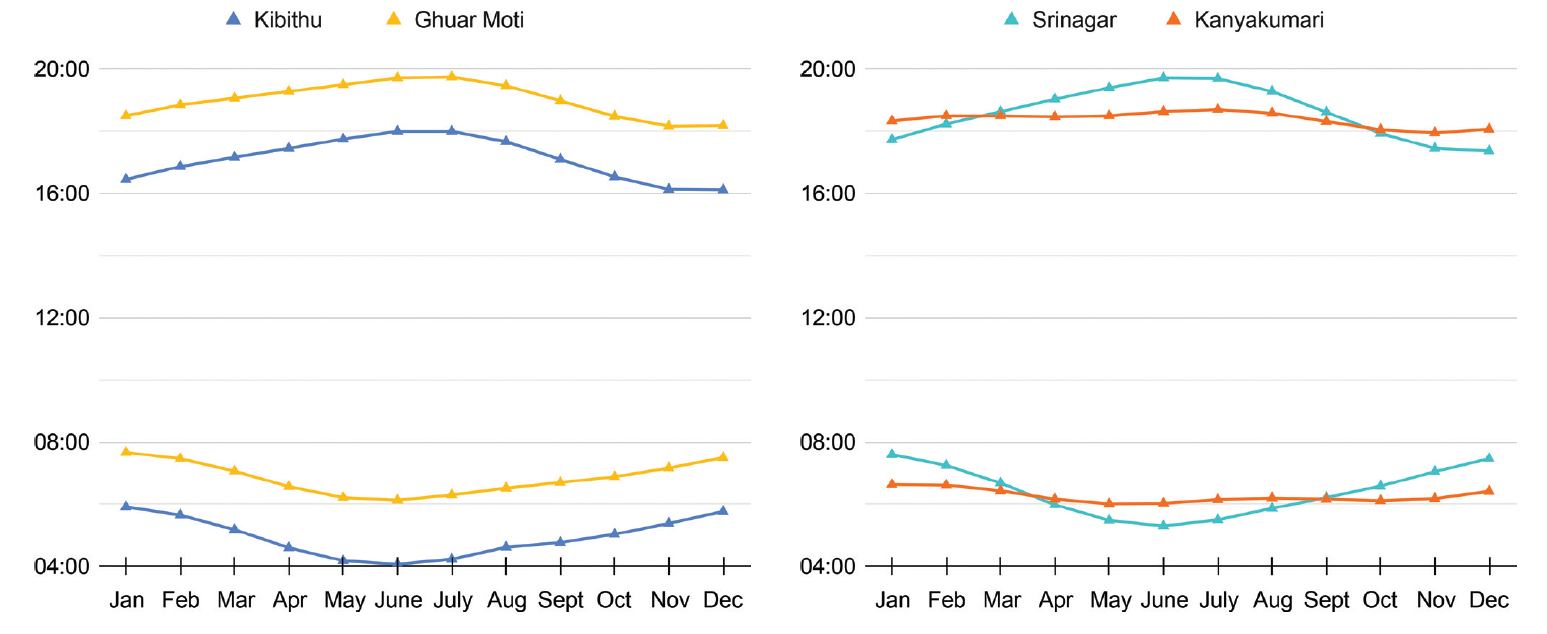
Answer the following questions based on the graphs:
(i) At which place does the sun rise the earliest in January? What is the approximate day length at this place in January?
(ii) Which place has the longest day length over the year?
(iii) Share your observations — what do you find interesting? What are you curious to find out?
Answer:
Solution:
Yes, we can identify the lines.
(i) In January, the sunrise was earliest in Kibithu (approx $6:00$).
$\text{The day length is } (16:00 - 6:00) = 10 \text{ hours}$
(ii) The place with the longest day length over the year is Ghuar Moti.
(iii) Observations are:
Longest day length – Ghuar Moti
Shortest day length – Kanyakumari
Earliest sunrise in Jan – Kibithu
Latest sunset in Jan – Ghuar Moti
I am curious to find out the seasonal variation of sunrise and sunset, or day length, for any particular location.
Question 15. We all know the typical sunrise and sunset timings. Do you know when the moon rises and sets? Does it follow a regular pattern like the sun? Let’s find out. The following graph shows the moonrise and moonset time over a month:
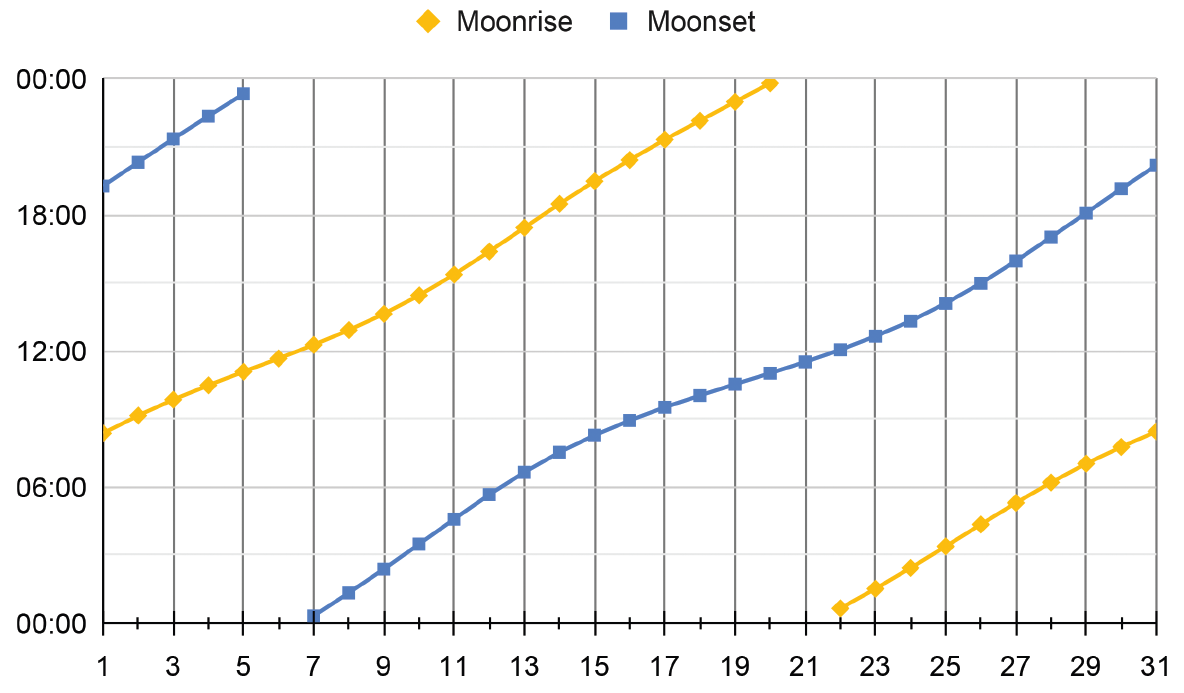
(i) Find out on what dates amavasya (new moon) and purnima (full moon) were in this month.
(ii) What do you notice? What do you wonder?
Answer:
Solution:
(i)
Amavasya – Day $21$
Purnima – Day $7\text{–}8$
(ii)
Observation: The difference between moonrise and moonset changes throughout the month.
Around the middle of the month, the gap between moonrise and moonset is the maximum.
I wonder:
Why do the moonrise and moonset times change every day?
Why is the time gap between moonrise and moonset maximum on some days and minimum on others?