

Chapter 6 Algebra Play (Class 8 - Latest Maths NCERT (Ganita Prakash II) Solutions)
Searching for the logic behind the "magic" in Chapter 6: Algebra Play? You’ve come to the right place! This page offers comprehensive NCERT Solutions that turn algebraic tricks into clear, understandable lessons. We help you use "letter-numbers" as secret keys to explain why numerical puzzles—like guessing a friend’s birthday or predicting a final result—work every single time. Our step-by-step guides show you how algebra provides the proof for the most entertaining mathematical mysteries.
Our solutions provide detailed walkthroughs for Algebraic Modeling across various formats. You will find clear instructions for solving Number Pyramids, where we use equations to reveal the values hidden within the blocks. We also dive into Fun with Grids, providing the mathematical breakdown for Calendar Magic and optimization puzzles like finding the Largest Product. Whether you are decoding Divisibility Tricks involving digit reversals or exploring the behavior of the Virahāṅka-Fibonacci sequence, our solutions make the logic accessible and fun.
To help you master these mathematical "magic" tricks, this page offers step-by-step algebraic breakdowns, visual pyramid-solving strategies, and logical explanations for classic word problems like "Karim and the Genie." These resources, meticulously prepared by learningspot.co based on the Ganita Prakash II textbook, are designed to show you that algebra is a powerful, playful language. Use our solutions to verify your work and build the confidence to solve any algebraic puzzle with ease.
| Content On This Page | ||
|---|---|---|
| Intext Questions (Page No. 136 - 139) | Figure It Out (Page No. 140) | Figure It Out (Page No. 144) |
| Figure It Out (Page No. 145 - 146) | ||
Intext Questions (Page No. 136 - 139)
In Grade 7, we learned about ‘Think of a Number’ tricks, like this one.
1. Think of a number.
2. Double it.
3. Add four.
4. Divide by two.
5. Subtract the original number you thought of.
I predict you get $2$. Am I right? Try it out with different starting numbers. Do you always end up with the same value, $2$? Why?
We saw that we can understand such tricks through algebra.
1. Think of a number: $x$
2. Double it: $2x$
3. Add four: $2x + 4$
4. Divide by $2$: $x + 2$
5. Subtract the original number you thought of: $x + 2 – x = 2$
Therefore, no matter what the starting number is, the end result will always be $2$!
Question. How would you change this game to make the final answer $3$? What about $5$?
Answer:
Solution:
1. To make the final answer $3$:
Let us modify step $3$ (adding $6$ instead of $4$) or adjust the steps using algebra:
1. Think of a number: $x$
2. Double it: $2x$
3. Add six: $2x + 6$
4. Divide by $2$: $x + 3$
5. Subtract the original number: $x + 3 - x = 3$
2. To make the final answer $5$:
Let us modify step $3$ by adding $10$:
1. Think of a number: $x$
2. Double it: $2x$
3. Add ten: $2x + 10$
4. Divide by $2$: $x + 5$
5. Subtract the original number: $x + 5 - x = 5$
Question. Can you come up with more complicated steps that always lead to the same final value?
Answer:
Solution:
1. Designing a more complicated number trick:
Let us create a new set of steps using algebra to ensure the variable $x$ cancels out and leaves a constant final value (say, $7$).
1. Think of a number: $x$
2. Multiply by $3$: $3x$
3. Add $14$: $3x + 14$
4. Add your original number: $3x + 14 + x = 4x + 14$
5. Divide by $2$: $\frac{4x + 14}{2} = 2x + 7$
6. Subtract twice your original number: $2x + 7 - 2x = 7$
No matter what number you start with, following these steps will always result in $7$!
Question. How did Shubham figure out the date chosen by Mukta?
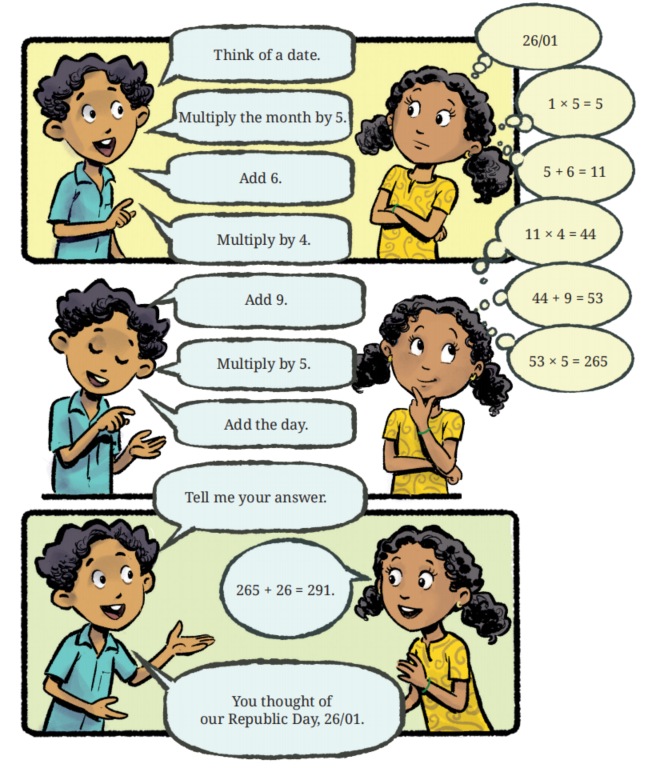
Answer:
Solution:
1. Using algebra to decode the trick:
Let the month be $m$ and the day be $d$.
Step 1: Think of a date: Month $m$, Day $d$
Step 2: Multiply the month by $5$: $5m$
Step 3: Add $6$: $5m + 6$
Step 4: Multiply by $4$: $4(5m + 6) = 20m + 24$
Step 5: Add $9$: $20m + 24 + 9 = 20m + 33$
Step 6: Multiply by $5$: $5(20m + 33) = 100m + 165$
Step 7: Add the day: $100m + 165 + d$
2. How Shubham finds the answer:
The final expression Mukta gets is $100m + 165 + d$.
When Mukta tells Shubham her final answer (e.g., $291$), Shubham simply subtracts $165$ from that number:
$291 - 165 = 126$
In the resulting number $126$, the hundreds digit ($1$) represents the month ($m$), and the remaining digits ($26$) represent the day ($d$).
Thus, Shubham easily figures out the date as $26/01$ (January $26^{\text{th}}$).
Question. Mukta thinks of another date, follows the same steps, and reports her answer as $1390$. What date did Mukta start with this time?
Answer:
Solution:
1. Decoding the final answer:
From the algebraic derivation of the date trick, the final reported number is given by:
$\text{Final Answer} = 100m + 165 + d$
Where $m$ is the month and $d$ is the day.
2. Calculating the month and day:
First, subtract the fixed constant $165$ from the reported answer ($1390$):
$1390 - 165 = 1225$
Now, separate the result into the month and the day:
The hundreds digit ($12$) represents the month: $m = 12$ (December)
The remaining digits ($25$) represent the day: $d = 25$
Therefore, Mukta started with the date $25/12$ (December $25^{\text{th}}$).
Question. Find the dates if the final answers are the following:
(i) $1269$
(ii) $394$
(iii) $296$
Answer:
Solution:
(i) For the final answer $1269$:
Subtract $165$ from $1269$:
$1269 - 165 = 1104$
Month ($m$) = $11$ (November)
Day ($d$) = $04$ ($4^{\text{th}}$)
Date: $04/11$ (November $4^{\text{th}}$)
(ii) For the final answer $394$:
Subtract $165$ from $394$:
$394 - 165 = 229$
Month ($m$) = $2$ (February)
Day ($d$) = $29$ ($29^{\text{th}}$)
Date: $29/02$ (February $29^{\text{th}}$)
(iii) For the final answer $296$:
Subtract $165$ from $296$:
$296 - 165 = 131$
Month ($m$) = $1$ (January)
Day ($d$) = $31$ ($31^{\text{st}}$)
Date: $31/01$ (January $31^{\text{st}}$)
Question. Can you change the steps in this trick and still find the original date? Instead of subtracting $165$ from the final answer, you might have to subtract some other number.
Answer:
Solution:
1. Modifying the steps:
Yes, we can change the numbers added in the intermediate steps, as long as the sequence of multiplications still results in multiplying the month by $100$ overall.
Let us try a modified version using algebra where month is $m$ and day is $d$:
Step 1: Think of a month: $m$
Step 2: Multiply by $5$: $5m$
Step 3: Add $4$ (instead of $6$): $5m + 4$
Step 4: Multiply by $4$: $4(5m + 4) = 20m + 16$
Step 5: Add $5$ (instead of $9$): $20m + 16 + 5 = 20m + 21$
Step 6: Multiply by $5$: $5(20m + 21) = 100m + 105$
Step 7: Add the day: $100m + 105 + d$
2. Finding the original date:
In this modified trick, the final algebraic expression is $100m + d + 105$.
To find the original date, instead of subtracting $165$, you would now subtract $105$ from the final answer.
The remaining number will easily reveal the month (in the hundreds or thousands place) and the day (in the tens and ones place).
Question. Try to devise your own ‘Think of a Number’ trick.
Answer:
Solution:
1. My 'Think of a Number' trick:
Here is a trick where the final answer will always end up being $10$.
Step 1: Think of a number.
Step 2: Multiply the number by $2$.
Step 3: Add $20$ to the result.
Step 4: Divide the new number by $2$.
Step 5: Subtract the original number you thought of.
Your final answer is $10$!
2. How it works algebraically:
Let the starting number be $x$.
Step 1: $x$
Step 2: $2x$
Step 3: $2x + 20$
Step 4: $\frac{2x + 20}{2} = x + 10$
Step 5: $x + 10 - x = 10$
By using algebra, we can see that subtracting the original number ($x$) causes the variable to cancel out completely, leaving a constant value of exactly $10$ every single time.
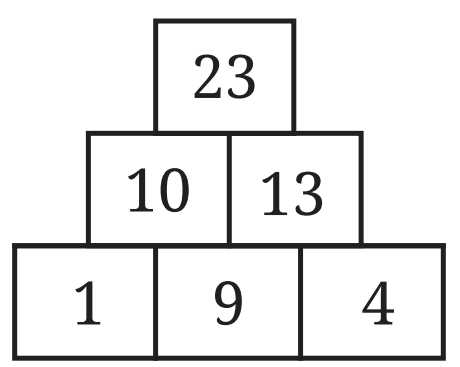
In a number pyramid, each number is the sum of the two numbers directly below it (see the figure).
Question. Use the same rule to fill these pyramids:
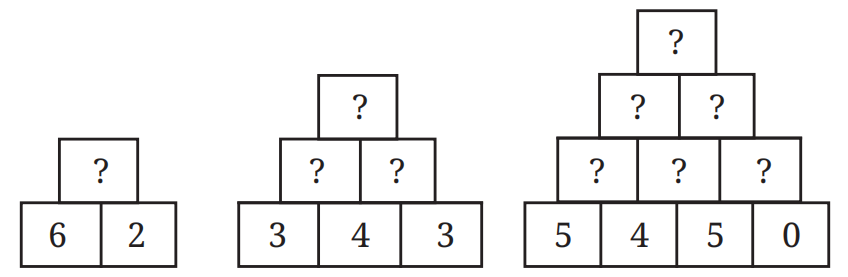
Answer:
Solution:
1. First Pyramid (2 tiers):
Bottom row numbers: $6$ and $2$.
Top box = $6 + 2 = 8$.
2. Second Pyramid (3 tiers):
Bottom row numbers: $3, 4, 3$.
Middle row left box = $3 + 4 = 7$.
Middle row right box = $4 + 3 = 7$.
Top box = $7 + 7 = 14$.
3. Third Pyramid (4 tiers):
Bottom row numbers: $5, 4, 5, 0$.
Second row from bottom (left to right):
Box $1 = 5 + 4 = 9$
Box $2 = 4 + 5 = 9$
Box $3 = 5 + 0 = 5$
Third row from bottom (left to right):
Box $1 = 9 + 9 = 18$
Box $2 = 9 + 5 = 14$
Top box = $18 + 14 = 32$.
Question. Fill the following pyramids:
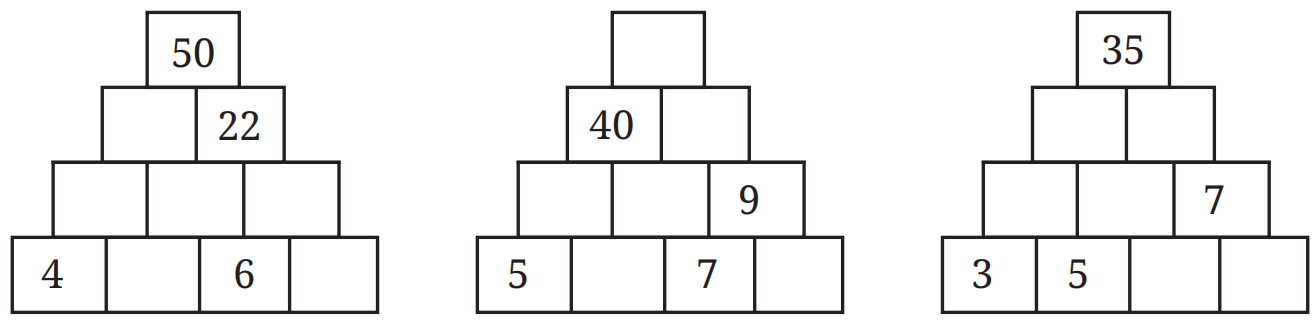
Answer:
Solution:
1. First Pyramid:
Let us assign a variable to each of the empty boxes in the first pyramid.
Let the bottom row be $4, a, 6, b$.
Let the second row from the bottom be $c, d, e$.
Let the third row from the bottom be $f, 22$.
The top row is $50$.
In a number pyramid, each box is the sum of the two boxes directly below it.
From the top row, we have:
$f + 22 = 50$
$f = 50 - 22 = 28$
From the second and third rows, since $f = 28$, we have the following relationships:
$c + d = 28$
... (i)
$d + e = 22$
... (ii)
From the bottom and second rows, we have:
$c = 4 + a$
$d = a + 6$
$e = 6 + b$
Substitute the expressions for $c$ and $d$ into equation (i):
$(4 + a) + (a + 6) = 28$
$2a + 10 = 28$
$2a = 18$
$a = 9$
Now, substitute the expressions for $d$ and $e$ into equation (ii):
$(a + 6) + (6 + b) = 22$
$a + b + 12 = 22$
Since $a = 9$:
$9 + b + 12 = 22$
$b + 21 = 22$
$b = 1$
Now we can find the remaining values:
$c = 4 + 9 = 13$
$d = 9 + 6 = 15$
$e = 6 + 1 = 7$
2. Second Pyramid:
Let us assign variables to the empty boxes in the second pyramid.
Let the bottom row be $5, a, 7, b$.
Let the second row from the bottom be $c, d, 9$.
Let the third row from the bottom be $40, e$.
Let the top box be $f$.
Using the sum rule from the bottom right:
$7 + b = 9$
$b = 2$
Now, express $c$ and $d$ in terms of $a$:
$c = 5 + a$
$d = a + 7$
We know that the sum of $c$ and $d$ gives the box above them ($40$):
$c + d = 40$
... (iii)
Substitute the expressions for $c$ and $d$ into equation (iii):
$(5 + a) + (a + 7) = 40$
$2a + 12 = 40$
$2a = 28$
$a = 14$
Now we can find $c$ and $d$:
$c = 5 + 14 = 19$
$d = 14 + 7 = 21$
Next, find $e$ using the second row:
$e = d + 9$
$e = 21 + 9 = 30$
Finally, find the top box $f$:
$f = 40 + e$
$f = 40 + 30 = 70$
3. Third Pyramid:
Let us assign variables to the empty boxes in the third pyramid.
Let the bottom row be $3, 5, a, b$.
Let the second row from the bottom be $c, d, 7$.
Let the third row from the bottom be $e, f$.
The top row is $35$.
First, find $c$ from the bottom row:
$c = 3 + 5 = 8$
Express $d$ and the relationship for $7$ in terms of $a$ and $b$:
$d = 5 + a$
$a + b = 7$
... (iv)
Express $e$ and $f$ using the second row:
$e = c + d = 8 + (5 + a) = 13 + a$
$f = d + 7 = (5 + a) + 7 = 12 + a$
We know the top box is $35$, so:
$e + f = 35$
... (v)
Substitute the expressions for $e$ and $f$ into equation (v):
$(13 + a) + (12 + a) = 35$
$2a + 25 = 35$
$2a = 10$
$a = 5$
Now substitute the value of $a$ into equation (iv):
$5 + b = 7$
$b = 2$
Finally, find the remaining boxes:
$d = 5 + 5 = 10$
$e = 13 + 5 = 18$
$f = 12 + 5 = 17$
Figure It Out (Page No. 140)
Question 1. Without building the entire pyramid, find the number in the topmost row given the bottom row in each of these cases:

Answer:
Solution:
1. General Algebraic Formulation:
Let us presume the numbers at the bottom row are $a$, $b$, and $c$.
In a number pyramid, each box is the sum of the two boxes directly below it.
Therefore, the middle row boxes will be $(a + b)$ and $(b + c)$.
The topmost box will be the sum of the middle row boxes: $(a + b) + (b + c) = a + 2b + c$.
So, the number in the topmost row is always given by the formula: $a + 2b + c$, where $b$ is the middle number.
2. Case 1: Bottom row is $4, 13, 8$
Here, $a = 4$, $b = 13$, and $c = 8$.
Using the formula for the topmost number:
$\text{Topmost number} = a + 2b + c$
$\text{Topmost number} = 4 + 2(13) + 8$
$\text{Topmost number} = 4 + 26 + 8 = 38$
The number in the topmost row is $38$.
3. Case 2: Bottom row is $7, 11, 3$
Here, $a = 7$, $b = 11$, and $c = 3$.
Using the formula for the topmost number:
$\text{Topmost number} = a + 2b + c$
$\text{Topmost number} = 7 + 2(11) + 3$
$\text{Topmost number} = 7 + 22 + 3 = 32$
The number in the topmost row is $32$.
4. Case 3: Bottom row is $10, 14, 25$
Here, $a = 10$, $b = 14$, and $c = 25$.
Using the formula for the topmost number:
$\text{Topmost number} = a + 2b + c$
$\text{Topmost number} = 10 + 2(14) + 25$
$\text{Topmost number} = 10 + 28 + 25 = 63$
The number in the topmost row is $63$.
Question 2. Write an expression for the topmost row of a pyramid with $4$ rows in terms of the values in the bottom row.
Answer:
Solution:
1. Setting up the base variables:
Let the $4$ values in the bottom row be $a, b, c,$ and $d$.
2. Building the pyramid row by row:
In a number pyramid, each box is the sum of the two boxes directly below it.
Row 1 (Bottom):
$a \quad b \quad c \quad d$
Row 2 (3 boxes):
Box 1 = $a + b$
Box 2 = $b + c$
Box 3 = $c + d$
Row 3 (2 boxes):
Box 1 = $(a + b) + (b + c) = a + 2b + c$
Box 2 = $(b + c) + (c + d) = b + 2c + d$
Row 4 (Topmost row, 1 box):
Top box = $(a + 2b + c) + (b + 2c + d)$
Top box = $a + 2b + b + c + 2c + d$
Top box = $a + 3b + 3c + d$
3. Conclusion:
The expression for the topmost row of a pyramid with $4$ rows, given the bottom row values $a, b, c, d$, is $a + 3b + 3c + d$.
Question 3. Without building the entire pyramid, find the number in the topmost row given the bottom row in each of these cases:

Recall the Virahāṅka-Fibonacci number sequence $1, 2, 3, 5, \dots$ where each number is the sum of the two numbers before it.
Answer:
Solution:
1. General Algebraic Formula:
From the previous question, we know that for a $4$-row number pyramid with bottom row values $a, b, c,$ and $d$, the topmost number can be directly calculated using the expression:
$\text{Topmost number} = a + 3b + 3c + d$
2. Case 1: Bottom row is $8, 19, 21, 13$
Here, $a = 8$, $b = 19$, $c = 21$, and $d = 13$.
Using the formula:
$\text{Topmost number} = a + 3b + 3c + d$
$\text{Topmost number} = 8 + 3(19) + 3(21) + 13$
$\text{Topmost number} = 8 + 57 + 63 + 13 = 141$
The number in the topmost row is $141$.
3. Case 2: Bottom row is $7, 18, 19, 6$
Here, $a = 7$, $b = 18$, $c = 19$, and $d = 6$.
Using the formula:
$\text{Topmost number} = a + 3b + 3c + d$
$\text{Topmost number} = 7 + 3(18) + 3(19) + 6$
$\text{Topmost number} = 7 + 54 + 57 + 6 = 124$
The number in the topmost row is $124$.
4. Case 3: Bottom row is $9, 7, 5, 11$
Here, $a = 9$, $b = 7$, $c = 5$, and $d = 11$.
Using the formula:
$\text{Topmost number} = a + 3b + 3c + d$
$\text{Topmost number} = 9 + 3(7) + 3(5) + 11$
$\text{Topmost number} = 9 + 21 + 15 + 11 = 56$
The number in the topmost row is $56$.
Question 4. If the first three Virahāṅka-Fibonacci numbers are written in the bottom row of a number pyramid with three rows, fill in the rest of the pyramid. What numbers appear in the grid? What is the number at the top? Are they all Virahāṅka-Fibonacci numbers?
Answer:
Solution:
1. Setting up the base:
The first three numbers of the Virahāṅka-Fibonacci sequence (as given in the prompt context) are $1, 2,$ and $3$.
Place these numbers in the bottom row of a $3$-row pyramid: $1 \quad 2 \quad 3$.
2. Filling in the rest of the pyramid:
In the second row (middle row):
Left box = $1 + 2 = 3$
Right box = $2 + 3 = 5$
In the top row:
Top box = $3 + 5 = 8$
3. Analyzing the numbers in the grid:
The numbers that appear in the grid are: $1, 2, 3$ (bottom row), $3, 5$ (middle row), and $8$ (top box).
The number at the top is $8$.
Yes, all the numbers that appear in this specific pyramid ($1, 2, 3, 5, 8$) belong exactly to the sequence of Virahāṅka-Fibonacci numbers.
Question 5. What can you say about the numbers in the pyramid and the number at the top in the following cases?
(i) The first four Virahāṅka-Fibonacci numbers are written in the bottom row of a four row pyramid.
(ii) The first $29$ Virahāṅka-Fibonacci numbers are written in the bottom row of a $29$ row pyramid.
Answer:
Solution:
(i) Four row pyramid with the first four Virahāṅka-Fibonacci numbers:
The first four numbers of the Virahāṅka-Fibonacci sequence are $1, 2, 3,$ and $5$.
Bottom row: $1, 2, 3, 5$
Second row: $1+2=3$, $2+3=5$, $3+5=8$
Third row: $3+5=8$, $5+8=13$
Top row: $8+13=21$
Observation: All the numbers that appear anywhere in the pyramid ($1, 2, 3, 5, 8, 13, 21$) are Virahāṅka-Fibonacci numbers. The number at the top is $21$, which is the $7^{\text{th}}$ Virahāṅka-Fibonacci number.
(ii) $29$ row pyramid with the first $29$ Virahāṅka-Fibonacci numbers:
Based on the pattern observed in the $3$-row and $4$-row pyramids, placing consecutive Virahāṅka-Fibonacci numbers at the base always generates subsequent Virahāṅka-Fibonacci numbers in the rows above because the fundamental rule of the pyramid (adding two adjacent numbers) exactly mirrors the fundamental rule of the Fibonacci sequence.
Observation: We can conclude that every single number appearing in any cell of this $29$-row pyramid will be a Virahāṅka-Fibonacci number.
To find which Fibonacci number is at the top:
For a $3$-row pyramid (base ends at $3^{\text{rd}}$ Fibonacci number), top is the $5^{\text{th}}$ Fibonacci number ($3 \times 2 - 1 = 5$).
For a $4$-row pyramid (base ends at $4^{\text{th}}$ Fibonacci number), top is the $7^{\text{th}}$ Fibonacci number ($4 \times 2 - 1 = 7$).
Following this linear pattern, for an $n$-row pyramid, the top number is the $(2n - 1)^{\text{th}}$ Virahāṅka-Fibonacci number.
For a $29$-row pyramid, the number at the top will be the $(2 \times 29 - 1) = 57^{\text{th}}$ Virahāṅka-Fibonacci number.
Question 6. If the bottom row of an $n$ row pyramid contains the first $n$ Virahāṅka-Fibonacci numbers, what can we say about the numbers in the pyramid? What can we say about the number at the top?
Answer:
Solution:
Let us analyze the structure of an $n$-row pyramid whose bottom row consists of the first $n$ Virahāṅka-Fibonacci numbers.
1. Numbers in the pyramid:
Every number that appears in any cell of the $n$-row pyramid is a Virahāṅka-Fibonacci number. This occurs because the construction rule of the pyramid—where each entry is the sum of the two numbers directly beneath it—precisely mirrors the recurrence relation of the Virahāṅka-Fibonacci sequence:
$F_k = F_{k-1} + F_{k-2}$
[Fibonacci Recurrence Relation]
2. Number at the top of the pyramid:
By generalizing the patterns established in smaller pyramids (such as $3$-row and $4$-row pyramids), the position index of the Fibonacci number at the apex of the pyramid increases by $2$ for each additional row added to the base.
Thus, for an $n$-row pyramid, the number located at the top will always be the $(2n - 1)^{\text{th}}$ Virahāṅka-Fibonacci number.
Figure It Out (Page No. 144)
Question 1. Fill the digits $1, 3,$ and $7$ in $\square \ \square \times \square$ to make the largest product possible.
Answer:
Given:
The available digits are $1, 3,$ and $7$. The required format is a two-digit number multiplied by a one-digit number: $\square \ \square \times \square$.
To Find:
The arrangement of these digits that results in the largest product.
Solution:
To obtain the largest product in the form $(10A + B) \times C$, the most significant positions (the multiplier $C$ and the tens digit $A$) should be filled with the largest available digits. Let's compare the most promising arrangements:
1. Arrangement 1: Use $7$ as the multiplier and $3$ as the tens digit ($31 \times 7$):
$\begin{array}{cc}& 3 & 1 \\ \times & & 7 \\ \hline 2 & 1 & 7 \\ \hline \end{array}$
2. Arrangement 2: Use $3$ as the multiplier and $7$ as the tens digit ($71 \times 3$):
$\begin{array}{cc}& 7 & 1 \\ \times & & 3 \\ \hline 2 & 1 & 3 \\ \hline \end{array}$
Comparing the two results:
$217 > 213$
[Comparing products]
Final Answer:
The digits should be filled as $3 \ 1 \times 7$ to get the largest product, which is $217$.
Question 2. Fill the digits $3, 5,$ and $9$ in $\square \ \square \times \square$ to make the largest product possible.
Answer:
Given:
The available digits are $3, 5,$ and $9$. The format is $\square \ \square \times \square$.
To Find:
The arrangement that yields the maximum product.
Solution:
Applying the logic that the largest digit should generally act as the multiplier to scale the entire multiplicand, we test the following primary arrangements:
1. Case A: Largest digit $9$ as the multiplier and $5$ in the tens place ($53 \times 9$):
$\begin{array}{cc}& 5 & 3 \\ \times & & 9 \\ \hline 4 & 7 & 7 \\ \hline \end{array}$
2. Case B: Second largest digit $5$ as the multiplier and $9$ in the tens place ($93 \times 5$):
$\begin{array}{cc}& 9 & 3 \\ \times & & 5 \\ \hline 4 & 6 & 5 \\ \hline \end{array}$
Comparing these two products:
$477 > 465$
Final Answer:
The digits should be filled as $5 \ 3 \times 9$ to result in the largest product, $477$.
Figure It Out (Page No. 145 - 146)
Suppose the two-digit number is $ab$. When it is reversed, the new number is $ba$.
If $b > a$, then $ba > ab$. So, the difference is
$(10b + a) – (10a + b)$
$= 10b – b – 10a + a$
$= 9b – 9a = 9 (b – a)$.
The difference is divisible by 9.
Question 1. In the trick given above, what is the quotient when you divide by $9$? Is there a relationship between the two numbers and the quotient?
Answer:
To Find:
The quotient when the difference between a two-digit number and its reversed number is divided by $9$, and the relationship between the two digits and the quotient.
Solution:
From the given problem, the difference between the reversed number $ba$ and the original number $ab$ (where $b > a$) is given by:
$\text{Difference} = 9(b - a)$
[Derived from the trick]
When this difference is divided by $9$, we get:
$\text{Quotient} = \frac{9(b - a)}{9} = b - a$
[Dividing by $9$]
Relationship:
The quotient obtained after dividing the difference by $9$ is precisely equal to the difference between the two digits ($b$ and $a$) of the original number.
Question 2. In the trick given above, instead of finding the difference of the two $2$-digit numbers, find their sum. What will happen? For example:
• We start with $31$. After reversing we get $13$. Adding $31$ and $13$, we get $44$.
• We start with $28$. After reversing we get $82$. Adding $28$ and $82$, we get $110$.
• We start with $12$. After reversing we get $21$. Adding $12$ and $21$, we get $33$.
Observe that all these numbers are divisible by $11$. Is this always true? Can we justify this claim using algebra?
Answer:
Given:
A $2$-digit number is added to its reverse.
To Prove:
The sum of a $2$-digit number and its reverse is always divisible by $11$.
Proof:
Let the $2$-digit number be $ab$, which can be written as $10a + b$.
$\text{Original Number} = 10a + b$
…(i)
When we reverse the digits, the new number is $ba$, which is $10b + a$.
$\text{Reversed Number} = 10b + a$
…(ii)
Now, finding the sum of the two numbers:
$\text{Sum} = (10a + b) + (10b + a)$
$\text{Sum} = 11a + 11b$
$\text{Sum} = 11(a + b)$
Conclusion:
Since the sum is expressed as $11 \times (a + b)$, where $(a + b)$ is an integer (the sum of the digits), it is always divisible by $11$. The quotient will be the sum of the digits.
Question 3. Consider any $3$-digit number, say $abc$ ($100a + 10b + c$). Make two other $3$-digit numbers from these digits by cycling these digits around, yielding $bca$ and $cab$. Now add the three numbers. Using algebra, justify that the sum is always divisible by $37$. Will it also always be divisible by $3$? [Hint: Look at some multiples of $37$.]
Answer:
Given:
Three $3$-digit numbers formed by cyclic permutations of digits: $abc$, $bca$, and $cab$.
To Prove:
The sum of these three numbers is divisible by both $37$ and $3$.
Solution:
Let's write the expanded form of the three numbers:
$abc = 100a + 10b + c$
…(i)
$bca = 100b + 10c + a$
…(ii)
$cab = 100c + 10a + b$
…(iii)
Adding the three expressions:
$\text{Sum} = (100a + 10b + c) + (100b + 10c + a) + (100c + 10a + b)$
$\text{Sum} = 111a + 111b + 111c$
$\text{Sum} = 111(a + b + c)$
We can factor $111$ as follows:
$111 = 3 \times 37$
Therefore, we can rewrite the sum as:
$\text{Sum} = 3 \times 37 \times (a + b + c)$
Conclusion:
Since the sum has factors of both $3$ and $37$, it is always divisible by $37$ and also always divisible by $3$. This mathematical beauty is often used in Vedic Math puzzles in India to quickly find factors of repeated digit sums.
Question 4. Consider any $3$-digit number, say $abc$. Make it a $6$-digit number by repeating the digits, that is $abcabc$. Divide this number by $7$, then by $11$, and finally by $13$. What do you get? Try this with other numbers. Figure out why it works. [Hint: Multiply $7, 11$ and $13$.]
Answer:
Solution:
Let us take any $3$-digit number, say $abc$. By repeating its digits, we form the $6$-digit number $abcabc$.
We can express the $6$-digit number $abcabc$ in expanded form based on its place values as follows:
$abcabc = a \times 100000 + b \times 10000 + c \times 1000 + a \times 100 + b \times 10 + c \times 1$
$abcabc = 100000a + 10000b + 1000c + 100a + 10b + c$
Grouping the terms containing $a$, $b$, and $c$ together:
$abcabc = (100000a + 100a) + (10000b + 10b) + (1000c + c)$
$abcabc = 100100a + 10010b + 1001c$
Factoring out $1001$ from the expression:
$abcabc = 1001 \times (100a + 10b + c)$
Since $(100a + 10b + c)$ is simply the original $3$-digit number $abc$, we can write:
$abcabc = 1001 \times abc$
Applying the Hint:
Let us find the product of the given divisors $7$, $11$, and $13$:
$7 \times 11 \times 13 = 77 \times 13 = 1001$
Conclusion:
When the $6$-digit number $abcabc$ is divided successively by $7$, $11$, and $13$, it is equivalent to dividing the number by their product, which is $1001$:
$\frac{abcabc}{7 \times 11 \times 13} = \frac{1001 \times abc}{1001} = abc$
Therefore, when you divide the $6$-digit number $abcabc$ by $7$, then by $11$, and finally by $13$, you get back the original $3$-digit number $abc$.
Question 5. There are $3$ shrines, each with a magical pond in the front. If anyone dips flowers into these magical ponds, the number of flowers doubles.
A person has some flowers. He dips them all in the first pond and then places some flowers in shrine $1$. Next, he dips the remaining flowers in the second pond and places some flowers in shrine $2$. Finally, he dips the remaining flowers in the third pond and then places them all in shrine $3$.
If he placed an equal number of flowers in each shrine, how many flowers did he start with? How many flowers did he place in each shrine?
Answer:
To Find:
The initial number of flowers the person started with and the number of flowers placed in each shrine.
Solution:
Let the initial number of flowers the person started with be $x$.
Let the number of flowers placed in each of the three shrines be $E$ (since an equal number of flowers, say $E$, is placed in each shrine).
Let us work backwards from the final shrine or use a step-by-step algebraic approach.
Step 1: After the third shrine
Let the number of flowers remaining after placing flowers in the second shrine be $R_2$.
These remaining flowers are dipped into the third pond, so they double:
$2 \times R_2$
He places all of these remaining flowers in the third shrine. Since he places an equal number of flowers $E$ in each shrine:
$2 R_2 = E \implies R_2 = \frac{E}{2}$
Step 2: After the second shrine
Let the number of flowers remaining after placing flowers in the first shrine be $R_1$.
These flowers are dipped into the second pond, so they double: $2 R_1$.
From this doubled amount, he places $E$ flowers in shrine $2$, leaving $R_2$ flowers:
$2 R_1 - E = R_2$
Substituting $R_2 = \frac{E}{2}$ into the equation:
$2 R_1 - E = \frac{E}{2}$
$2 R_1 = E + \frac{E}{2} = \frac{3E}{2}$
$R_1 = \frac{3E}{4}$
Step 3: After the first shrine
The initial number of flowers $x$ is dipped into the first pond, so they double: $2x$.
From this doubled amount, he places $E$ flowers in shrine $1$, leaving $R_1$ flowers:
$2x - E = R_1$
Substituting $R_1 = \frac{3E}{4}$ into the equation:
$2x - E = \frac{3E}{4}$
$2x = E + \frac{3E}{4} = \frac{7E}{4}$
$x = \frac{7E}{8}$
Since the number of flowers $x$ and $E$ must be whole numbers, $7E$ must be divisible by $8$. The smallest positive integer value for $E$ that makes $\frac{7E}{8}$ a whole number is $8$.
If $E = 8$ (flowers placed in each shrine):
Initial flowers $x = \frac{7 \times 8}{8} = 7$
Verification:
Initial flowers: $7$
1. Dip in first pond: $7 \times 2 = 14$ flowers.
Place $8$ flowers in shrine $1$: Remaining = $14 - 8 = 6$ flowers.
2. Dip in second pond: $6 \times 2 = 12$ flowers.
Place $8$ flowers in shrine $2$: Remaining = $12 - 8 = 4$ flowers.
3. Dip in third pond: $4 \times 2 = 8$ flowers.
Place all $8$ flowers in shrine $3$: Remaining = $8 - 8 = 0$ flowers.
Conclusion:
The person started with $7$ flowers and placed $8$ flowers in each shrine.
Question 6. A farm has some horses and hens. The total number of heads of these animals is $55$ and the total number of legs is $150$. How many horses and how many hens are on the farm?
Can you solve this without letter-numbers?
[Hint: If all the $55$ animals were hens, then how many legs would there be? Using the difference between this number and $150$, can you find the number of horses?]
Answer:
To Find:
The number of horses and hens on the farm.
Solution (Using Arithmetic / Without Letter-Numbers):
Total number of heads (animals) = $55$
Total number of legs = $150$
We know that a hen has $2$ legs and a horse has $4$ legs.
Step 1: Calculate legs assuming all animals are hens
If all $55$ animals were hens, the total number of legs would be:
$55 \times 2 = 110 \text{ legs}$
Step 2: Find the difference in legs
The actual number of legs given in the problem is $150$. The difference between the actual legs and our assumed legs is:
$150 - 110 = 40 \text{ extra legs}$
Step 3: Calculate the number of horses
Each time we replace a hen with a horse, the number of legs increases by $2$ ($4 - 2 = 2$). To account for the $40$ extra legs, the number of horses must be:
$\frac{40}{2} = 20 \text{ horses}$
Step 4: Calculate the number of hens
Since the total number of animals (heads) is $55$, the number of hens is:
$55 - 20 = 35 \text{ hens}$
Alternate Solution (Using Algebraic Method):
Let the number of hens be $h$ and the number of horses be $H$.
According to the given condition for total heads:
$h + H = 55$
[Total number of heads] ... (i)
According to the given condition for total legs ($2$ legs for each hen and $4$ legs for each horse):
$2h + 4H = 150$
[Total number of legs] ... (ii)
Multiplying equation (i) by $2$:
$2h + 2H = 110$
[Multiplying (i) by $2$] ... (iii)
Subtracting equation (iii) from equation (ii):
$(2h + 4H) - (2h + 2H) = 150 - 110$
$2H = 40$
$H = 20$
Substituting $H = 20$ into equation (i):
$h + 20 = 55$
$h = 55 - 20 = 35$
Conclusion:
There are $20$ horses and $35$ hens on the farm.
Question 7. A mother is $5$ times her daughter’s age. In $6$ years’ time, the mother will be $3$ times her daughter’s age. How old is the daughter now?
Answer:
Given:
$\text{Mother's age} = 5 \times \text{Daughter's age}$
(Now)
In $6$ years, the mother will be $3$ times the daughter's age.
To Find:
The current age of the daughter.
Solution:
Let the current age of the daughter be $d$ years.
$\text{Mother's age} = 5d$
After $6$ years:
$\text{Daughter's age} = d + 6$
$\text{Mother's age} = 5d + 6$
According to the problem:
$5d + 6 = 3(d + 6)$
$5d + 6 = 3d + 18$
$5d - 3d = 18 - 6$
$2d = 12$
$d = 6$
Final Answer:
The daughter is currently 6 years old. (The mother's age is $30$ years).
Question 8. Two friends, Gauri and Naina, are cowherds. One day, they pass each other on the road with their cows. Gauri says to Naina, “You have twice as many cows as I do”. Naina says, “That’s true, but if I gave you three of my cows, we would each have the same number of cows”. How many cows do Gauri and Naina have?
Answer:
Given:
1. Naina has twice as many cows as Gauri.
2. If Naina gives $3$ cows to Gauri, they will both have an equal number of cows.
To Find:
The number of cows Gauri and Naina each possess.
Solution:
Let the number of cows Gauri has be $x$.
Then, according to the first statement, the number of cows Naina has is $2x$.
$Naina = 2x$
[Twice Gauri's cows] ... (i)
Now, if Naina gives $3$ cows to Gauri:
Number of cows Gauri will have = $x + 3$
Number of cows Naina will have = $2x - 3$
According to the second condition, these quantities are equal:
$2x - 3 = x + 3$
... (ii)
Transposing $x$ to the Left Hand Side (LHS) and $-3$ to the Right Hand Side (RHS):
$2x - x = 3 + 3$
$x = 6$
Now, finding Naina's cows using equation (i):
$2x = 2 \times 6 = 12$
Final Answer:
Gauri has $6$ cows and Naina has $12$ cows.
Verification: If Naina (12) gives 3 to Gauri (6), Naina has 9 and Gauri has 9. They are equal.
Question 9. I run a small dosa cart and my expenses are as follows:
• Rent for the dosa cart is $\textsf{₹}5000$ per day.
• The cost of making one dosa (including all the ingredients and fuel) is $\textsf{₹}10$.
(i) If I can sell $100$ dosas a day, what should be the selling price of my dosa to make a profit of $\textsf{₹}2000$?
(ii) If my customers are willing to pay only $\textsf{₹}50$ for a dosa, how many dosas should I aim to sell in a day to make a profit of $\textsf{₹}2000$?
Answer:
Given:
Fixed Cost (Rent) = $\textsf{₹}5000$ per day.
Variable Cost per dosa = $\textsf{₹}10$.
(i) To Find: Selling price for $100$ dosas to earn $\textsf{₹}2000$ profit.
Let $S$ be the selling price per dosa.
$\text{Total Cost} = \text{Rent} + (\text{Cost per dosa} \times 100)$
$\text{Total Cost} = 5000 + (10 \times 100) = \textsf{₹}6000$
$\text{Total Sales (Revenue)} = \text{Total Cost} + \text{Profit}$
$100 \times S = 6000 + 2000$
$100S = 8000$
$S = \frac{\cancel{8000}^{80}}{\cancel{100}_{1}} = \textsf{₹}80$
The selling price should be $\textsf{₹}80$ per dosa.
(ii) To Find: Number of dosas ($n$) to sell at $\textsf{₹}50$ each for $\textsf{₹}2000$ profit.
$\text{Profit} = (\text{Selling Price} - \text{Cost Price}) \times n - \text{Rent}$
$2000 = (50 - 10)n - 5000$
$2000 + 5000 = 40n$
$7000 = 40n$
$n = \frac{\cancel{7000}^{175}}{\cancel{40}_{1}}$
$n = 175$
I should aim to sell $175$ dosas per day.
Question 10. Evaluate the following sequence of fractions:
$\frac{1}{3}, \frac{(1+3)}{(5+7)}, \frac{(1+3+5)}{(7+9+11)}$
What do you observe? Can you explain why this happens?
[Hint: Recall what you know about the sum of the first $n$ odd numbers.]
Answer:
To Find:
Evaluation of the given sequence of fractions, observation of any pattern, and explanation of why it happens.
Solution:
Let us evaluate each fraction in the given sequence one by one:
1. First fraction:
$\frac{1}{3} = \frac{1}{3}$
2. Second fraction:
$\frac{1+3}{5+7} = \frac{4}{12} = \frac{\cancel{4}^1}{\cancel{12}_3} = \frac{1}{3}$
3. Third fraction:
$\frac{1+3+5}{7+9+11} = \frac{9}{27} = \frac{\cancel{9}^1}{\cancel{27}_3} = \frac{1}{3}$
Observation:
Every single fraction in the given sequence simplifies to $\frac{1}{3}$.
Explanation (Why this happens):
Let us use the hint regarding the sum of the first $n$ odd numbers. We know that the sum of the first $n$ odd natural numbers is always equal to $n^2$, i.e.,
$1 + 3 + 5 + \dots + (2n-1) = n^2$
[Sum of first $n$ odd numbers]
Now, let us examine the $n^{\text{th}}$ term in this sequence of fractions:
• The numerator consists of the sum of the first $n$ odd numbers, which is $n^2$.
• The denominator consists of the sum of $n$ consecutive odd numbers starting from $(2n + 1)$.
• This sum represents the difference between the sum of the first $2n$ odd numbers and the first $n$ odd numbers.
• Using the property of the sum of odd numbers, this can be written as $(2n)^2 - n^2$.
• Simplifying this expression gives $4n^2 - n^2 = 3n^2$.
Thus, any general term in the sequence can be written as:
$\frac{\text{Sum of first } n \text{ odd numbers}}{\text{Sum of } n \text{ odd numbers starting from } 2n+1} = \frac{n^2}{3n^2}$
Canceling $n^2$ from both the numerator and the denominator:
$\frac{n^2}{3n^2} = \frac{\cancel{n^2}^1}{\cancel{3n^2}_3} = \frac{1}{3}$
This algebraic consistency ensures that regardless of how far the sequence extends, every fraction will always evaluate to $\frac{1}{3}$.