

Chapter 7 Area (Class 8 - Latest Maths NCERT (Ganita Prakash II) Solutions)
Looking for the most accurate and easy-to-follow NCERT Solutions for Chapter 7: Area? You’ve come to the right place! This page provides clear, step-by-step guidance for the exercises in your Ganita Prakash II textbook. We begin by helping you solve problems that clarify the common misconception between perimeter and area, ensuring you understand why regions with identical boundaries can contain different amounts of space through the logic of dimension products.
Our solutions focus on the "Dissection Method"—the elegant process of cutting and rearranging shapes to prove their area formulas. We provide detailed, solved examples for calculating the Area of a Parallelogram, the Area of a Rhombus, and the Area of a Trapezium. Drawing from the historical context of the Śulba-Sūtras, our explanations show you how these ancient transformation methods are applied to modern geometric problems, making complex derivations easy to master.
To help you apply geometry to the real world, this page offers comprehensive unit conversion guides for land measures like Acres, Bigha, and Gaj. Whether you are calculating the area of an A4 sheet or a large plot of land, our step-by-step visual proofs and "shortest path" logic ensure you build the precision needed for engineering and architecture. These resources, curated by learningspot.co, are designed to help you excel in your Class 8 Maths assessments and beyond.
| Content On This Page | ||
|---|---|---|
| Figure It Out (Page No. 150 - 152) | Figure It Out (Page No. 157 - 159) | Figure It Out (Page No. 160) |
| Figure It Out (Page No. 162 - 164) | Figure It Out (Page No. 169 - 170) | |
Figure It Out (Page No. 150 - 152)
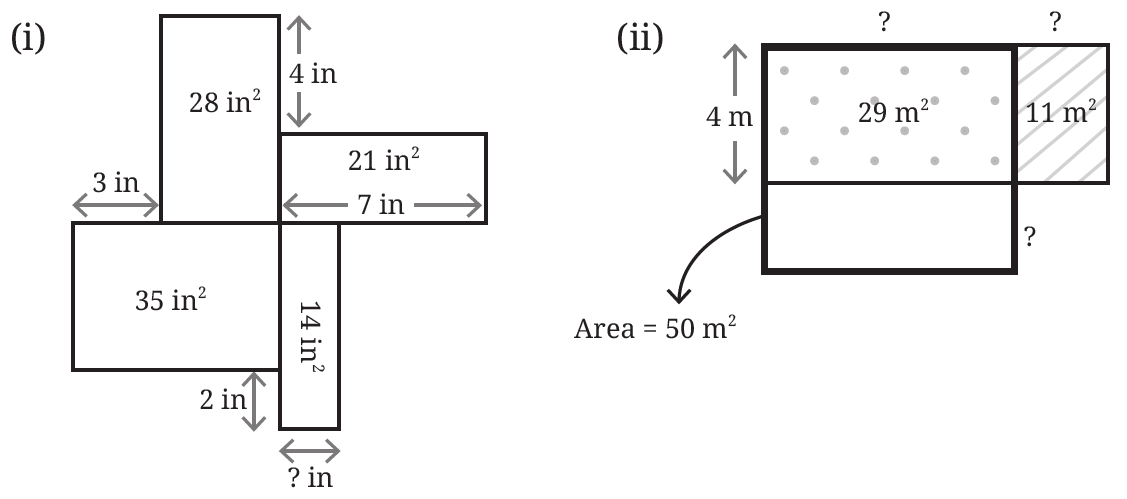
Question 1. Identify the missing sidelengths.
Answer:
Solution:
(i) Finding the missing side length in the first figure:
Let us label the relevant rectangles and vertices to find the missing side length.
In rectangle ABCD (area = $21\text{ in}^2$):
$\text{Area} = \text{Length} \times \text{Breadth}$
$7 \times \text{BC} = 21$
$\text{BC} = 3\text{ in}$
Now, considering the vertical dimension involving AF:
$\text{AF} = \text{AD} + \text{DF}$
$\text{AF} = 3\text{ in} + 4\text{ in} = 7\text{ in}$
In the rectangle EFAG (area = $28\text{ in}^2$):
$\text{EF} \times \text{AF} = 28\text{ in}^2$
$\text{EF} \times 7\text{ in} = 28\text{ in}^2$
$\text{EF} = 4\text{ in}$
Now, considering the horizontal dimension involving HA:
$\text{HA} = \text{HG} + \text{GA}$
$\text{HA} = 3\text{ in} + 4\text{ in} = 7\text{ in}$
In rectangle HIJA (area = $35\text{ in}^2$):
$\text{Area} = \text{HA} \times \text{AJ}$
$35\text{ in}^2 = 7\text{ in} \times \text{AJ}$
$\text{AJ} = 5\text{ in}$
Now, considering the vertical dimension involving AK:
$\text{AK} = \text{AJ} + \text{JK}$
$\text{AK} = 5\text{ in} + 2\text{ in} = 7\text{ in}$
In rectangle KLMA (area = $14\text{ in}^2$):
$\text{Area} = \text{KL} \times \text{LM}$
$x\text{ in} \times 7\text{ in} = 14\text{ in}^2$
$x = 2\text{ in}$
Thus, the missing side length = $2\text{ in}$.
(ii) Finding the missing side lengths in the second figure:
Let us label the relevant rectangles and regions to find the missing side lengths.
In rectangle ABGH (area = $29\text{ m}^2$):
$\text{Area} = \text{AB} \times \text{AH}$
$\text{AB} \times 4\text{ m} = 29\text{ m}^2$
$\text{AB} = \frac{29}{4}\text{ m} = 7.25\text{ m}$
Area of rectangle HGDC = Area of total lower-left structure ($\text{Area} = 50\text{ m}^2$) – Area of rectangle ABGH ($29\text{ m}^2$)
$\text{Area of HGDC} = 50\text{ m}^2 - 29\text{ m}^2 = 21\text{ m}^2$
In rectangle HGDC:
$\text{CD} \times \text{GD} = 21\text{ m}^2$
Since $\text{CD} = \text{AB} = \frac{29}{4}\text{ m}$:
$\frac{29}{4}\text{ m} \times \text{GD} = 21\text{ m}^2$
$\text{GD} = \frac{84}{29}\text{ m} \approx 2.9\text{ m}$
In rectangle BEFG (area = $11\text{ m}^2$):
$\text{BG} \times \text{BE} = 11\text{ m}^2$
$4\text{ m} \times \text{BE} = 11\text{ m}^2$
$\text{BE} = \frac{11}{4}\text{ m} = 2.75\text{ m}$
Thus, the missing side lengths are $\text{AB} = \frac{29}{4}\text{ m}$, $\text{BE} = \frac{11}{4}\text{ m}$, and $\text{GD} = \frac{84}{29}\text{ m}$.
Question 2. The figure shows a path (the shaded portion) laid around a rectangular park $EFGH$.
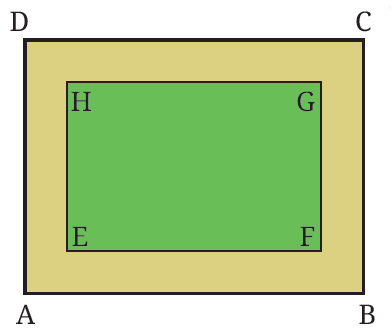
(i) What measurements do you need to find the area of the path? Once you identify the lengths to be measured, assign possible values of your choice to these measurements and find the area of the path. Give a formula for the area.
An example of a formula — Area of a rectangle $=$ length $\times$ width.
[Hint: There is a relation between the areas of $EFGH$, the path, and $ABCD$.]
(ii) If the width of the path along each side is given, can you find its area? If not, what other measurements do you need? Assign values of your choice to these measurements and find the area of the path. Give a formula for the area using these measurements.
[Hint: Break the path into rectangles.]
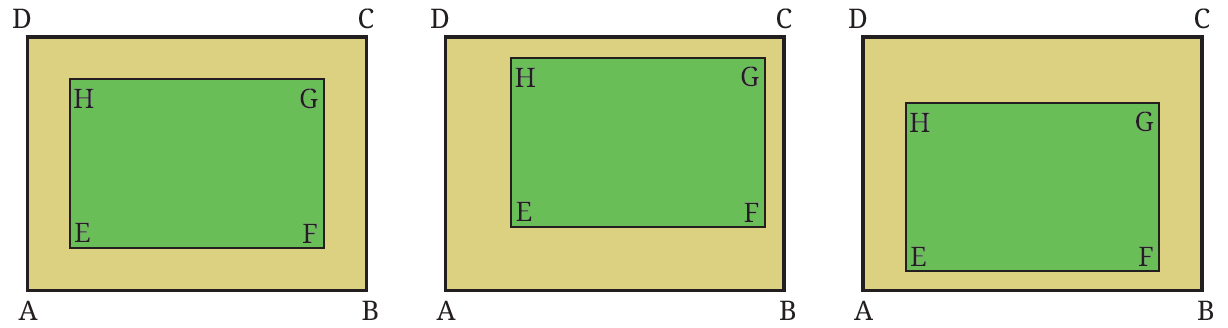
(iii) Does the area of the path change when the outer rectangle is moved while keeping the inner rectangular park $EFGH$ inside it, as shown?
Answer:
Solution:
(i) Measurements needed:
Length of outer rectangle ABCD = $A$
Width of outer rectangle ABCD = $B$
Length of inner rectangle EFGH = $a$
Width of inner rectangle EFGH = $b$
Let $A = 10\text{ m}$, $B = 8\text{ m}$, $a = 6\text{ m}$, $b = 4\text{ m}$.
Calculation:
$\text{Area of path} = \text{Area of ABCD} - \text{Area of EFGH}$
$= 10 \times 8 - 6 \times 4$
$= 80 - 24$
$= 56\text{ m}^2$
Formula:
$\text{Area of path} = (A \times B) - (a \times b)$
(ii) Finding area when path width is given:
Yes, if the width of the path is uniform along each side, we can find its area, but we also need the dimensions of either the outer or inner rectangle.
Let the width of the path $d = 2\text{ m}$ (uniform on all sides).
Length of inner park EFGH = $l = 16\text{ m}$
Width of inner park EFGH = $w = 11\text{ m}$
Length of outer rectangle = $l + 2d$
$= 16 + 2(2) = 20\text{ m}$
Width of outer rectangle = $w + 2d$
$= 11 + 2(2) = 15\text{ m}$
Breaking the path into rectangles:
Now there are $4$ rectangular sections:
Left rectangle area = $w \times d = 11 \times 2 = 22\text{ m}^2$
Right rectangle area = $w \times d = 11 \times 2 = 22\text{ m}^2$
Top rectangle area = $(l + 2d) \times d = 20 \times 2 = 40\text{ m}^2$
Bottom rectangle area = $(l + 2d) \times d = 20 \times 2 = 40\text{ m}^2$
Total area of path = $22 + 22 + 40 + 40 = 124\text{ m}^2$
Formula:
$\text{Area of path} = 2d(l + w) + 4d^2$
where $d$ = width of path, $l$ = length of inner park, and $w$ = width of inner park.
(iii) Does the area change when the outer rectangle is shifted?
No, the area of the path does not change.
Reason: The area of the path depends only on the total area of the outer rectangle ABCD and the area of the inner rectangle EFGH. Shifting the position of the inner rectangle inside the outer rectangle alters the widths of the surrounding path on opposite sides, but the sum of their areas remains exactly the same.
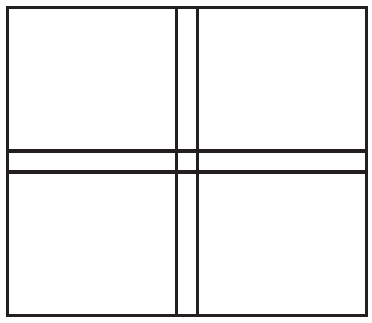
Question 3. The figure shows a plot with sides $14$ m and $12$ m, and with a crosspath. What other measurements do you need to find the area of the crosspath? Once you identify the lengths to be measured, assign some possible values of your choice and find the area of the path. Give a formula for the area based on the measurements you choose.
Answer:
Solution:
Measurements needed:
Length of plot = $14\text{ m}$
Width of plot = $12\text{ m}$
Width of horizontal path = $x_1$
Width of vertical path = $x_2$
Assign values:
Let $x_1 = 2\text{ m}$
$x_2 = 2\text{ m}$
Calculation:
Area of horizontal path = $14 \times 2 = 28\text{ m}^2$
Area of vertical path = $12 \times 2 = 24\text{ m}^2$
Area of overlapping square in the center = $2 \times 2 = 4\text{ m}^2$
$\therefore \text{Area of crosspath} = 28 + 24 - 4 = 48\text{ m}^2$
Formula:
$\text{Area of crosspath} = (L \times w_1) + (W \times w_2) - (w_1 \times w_2)$
where $L$ = length of plot, $W$ = width of plot, $w_1$ = width of horizontal path, and $w_2$ = width of vertical path.
Question 4. Find the area of the spiral tube shown in the figure. The tube has the same width throughout.
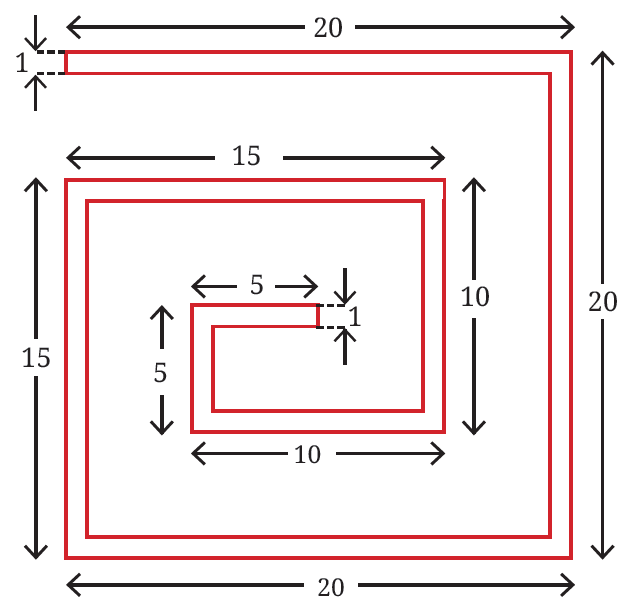
[Hint: There are different ways of finding the area. Here is one method.]
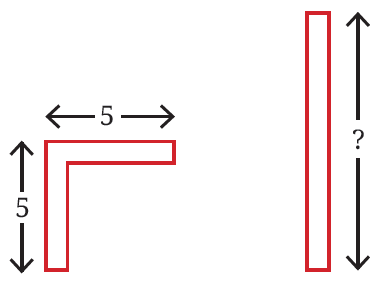
What should be the length of the straight tube if it is to have the same area as the bent tube on the left?
Answer:
Solution:
After naming the figure,
The area of the spiral tube = Area of rectangle ABEC + Area of rectangle DEGF + Area of rectangle GHIJ + Area of rectangle JKML + Area of rectangle NOPL + Area of rectangle PQRS + Area of rectangle STUV + Area of rectangle VWYX + Area of rectangle XZA1B1
$= \text{AC} \times \text{AB} + \text{EG} \times \text{DE} + \text{IH} \times \text{JI} + \text{LJ} \times \text{LM} + \text{NO} \times \text{NL} + $$ \ \text{PQ} \times \text{PS} + \text{UT} \times \text{ST} + \text{VX} \times \text{VW} + \text{ZA}_1 \times \text{A}_1\text{B}_1$
$= 20 \times 1 + 18 \times 1 + 20 \times 1 + 13 \times 1 + 15 \times 1 + 8 \times 1 + 10 \times 1 + $$ \ 3 \times 1 + 5 \times 1$
$= 20 + 18 + 20 + 13 + 15 + 8 + 10 + 3 + 5$
$= 112\text{ sq. units}$
Thus, the area of the spiral tube is $112\text{ sq. units}$.
Let the length of the straight tube be $x$.
The area of the bent tube on the left = Area of rectangle BACD + Area of rectangle BGFE
$= \text{AC} \times \text{CD} + \text{BG} \times \text{BE}$
$= 5 \times 1 + 4 \times 1$
$= 9\text{ sq. units}$
Area of straight tube = $x \times 1$
Area of bent tube = $9\text{ sq. units}$
According to the question, both have the same area.
So $x \times 1 = 9$
$\Rightarrow x = 9\text{ units}$.
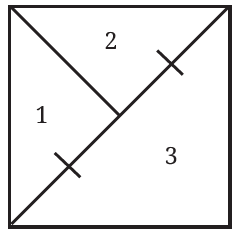
Question 5. In this figure, if the sidelength of the square is doubled, what is the increase in the areas of the regions $1, 2$ and $3$? Give reasons.
Answer:
Solution:
Let '$a$' be the side of the square.
Area of triangle DCB (region 3):
$= \frac{1}{2} \times \text{base} \times \text{height} = \frac{1}{2} \times \text{DC} \times \text{BC}$
$= \frac{1}{2} \times a \times a = \frac{a^2}{2}\text{ sq. units}$
In right-angled triangle DCB, by Pythagoras theorem:
$\text{DB} = \sqrt{\text{DC}^2 + \text{BC}^2} = \sqrt{a^2 + a^2} = \sqrt{2}a\text{ units}$
$\therefore \text{AE} = \text{DE} = \text{EB} = \frac{\text{DB}}{2} = \frac{\sqrt{2}a}{2} = \frac{\sqrt{2} \times \sqrt{2}}{2 \times \sqrt{2}}a = \frac{2}{2\sqrt{2}}a = \frac{a}{\sqrt{2}}\text{ units}$
Area of triangle AED (region 1):
$= \frac{1}{2} \times \text{DE} \times \text{AE} = \frac{1}{2} \times \frac{a}{\sqrt{2}} \times \frac{a}{\sqrt{2}}$
$= \frac{a^2}{4}\text{ sq. units}$
Area of triangle AEB (region 2):
$= \frac{1}{2} \times \text{EB} \times \text{AE} = \frac{1}{2} \times \frac{a}{\sqrt{2}} \times \frac{a}{\sqrt{2}} = \frac{a^2}{2} \times \frac{1}{2}$
$= \frac{a^2}{4}\text{ sq. units}$
If the side of the square is doubled $= 2a$
Area of triangle BCD (region 3):
$= \frac{1}{2} \times \text{DC} \times \text{BC}$
$= \frac{1}{2} \times 2a \times 2a = 2a^2\text{ sq. units}$
In right-angled triangle BCD, by Pythagoras theorem:
$\text{BD} = \sqrt{\text{DC}^2 + \text{BC}^2}$
$= \sqrt{(2a)^2 + (2a)^2}$
$= \sqrt{4a^2 + 4a^2} = 2\sqrt{2}a\text{ units}$
$\therefore \text{AE} = \text{ED} = \text{EB} = \frac{\text{BD}}{2} = \frac{2\sqrt{2}a}{2} = \sqrt{2}a\text{ units}$
Area of triangle AED (region 1):
$= \frac{1}{2} \times \text{DE} \times \text{AE}$
$= \frac{1}{2} \times \sqrt{2}a \times \sqrt{2}a = \frac{1}{2} \times 2a^2 = a^2\text{ sq. units}$
Area of triangle AEB (region 2):
$= \frac{1}{2} \times \text{EB} \times \text{AE} = \frac{1}{2} \times \sqrt{2}a \times \sqrt{2}a$
$= a^2\text{ sq. units}$
The increase in area of region 1:
$= \frac{a^2}{\frac{a^2}{4}} = 4\text{ times}$
The increase in area of region 2:
$= \frac{a^2}{\frac{a^2}{4}} = 4\text{ times}$
The increase in area of region 3:
$= \frac{2a^2}{\frac{a^2}{2}} = \frac{2a^2}{a^2} \times 2 = 4\text{ times}$
Thus, the increase in the areas of regions 1, 2, and 3 is $4$ times.
Reason: If the sidelength of the square is doubled, then the area becomes $4$ times.
Question 6. Divide a square into $4$ parts by drawing two perpendicular lines inside the square as shown in the figure.
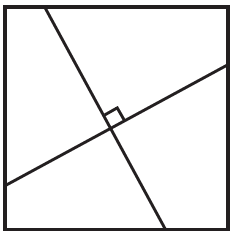
Rearrange the pieces to get a larger square, with a hole inside.
You can try this activity by constructing the square using cardboard, thick chart paper, or similar materials.
Answer:
Solution:
This is a geometric dissection and rearrangement puzzle. Follow the step-by-step instructions below to perform this activity:
Step 1: Dissection of the Square
• Draw a square on a piece of thick chart paper or cardboard.
• Draw two perpendicular intersecting line segments inside the square from the edges such that they divide the square into $4$ distinct polygonal pieces (two trapezoids and two right-angled or asymmetric four-sided pieces meeting at the perpendicular intersection point).
• Carefully cut along these lines using a pair of scissors or a craft knife to obtain the $4$ pieces.
Step 2: Rearrangement into a Larger Square with a Hole
• Take the $4$ cut-out pieces and flip or rotate them outward.
• Align the straight outer boundaries of the pieces along the new extended perimeter.
• By fitting the angled edges together, the pieces form a larger outer square frame.
• Because the pieces expand outward during this specific rearrangement, a symmetrical square-shaped "hole" or open space is automatically created right in the center.
Conclusion:
By dissecting a square using two perpendicular lines and sliding the resulting pieces outward, we successfully rearrange them into a larger square enclosing a central hole.
Figure It Out (Page No. 157 - 159)
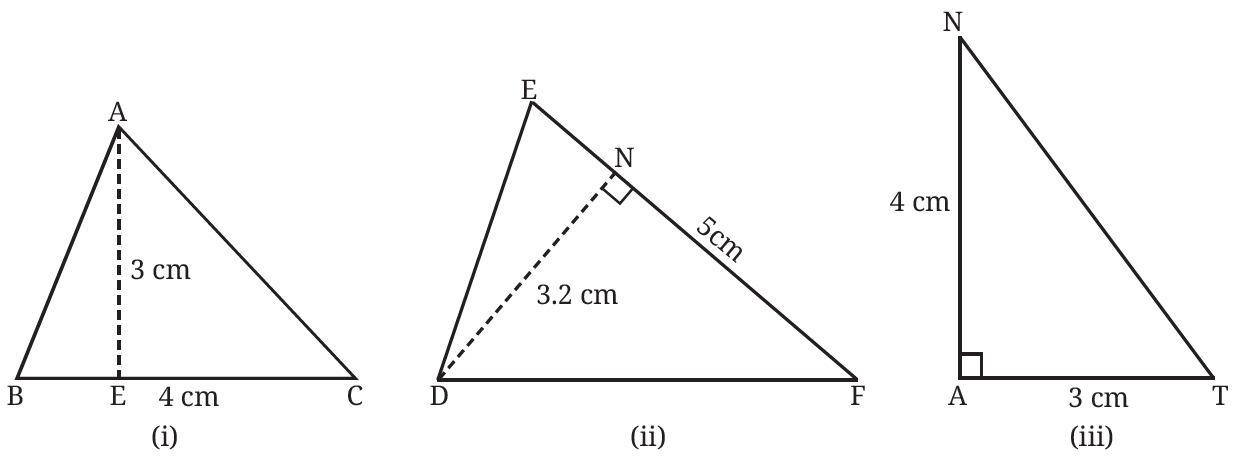
Question 1. Find the areas of the following triangles:
Answer:
Formula Used:
$\text{Area of a Triangle} = \frac{1}{2} \times \text{Base} \times \text{Height}$
(i) For Triangle $ABC$:
Base ($BC$) $= 4\text{ cm}$ and Height ($AE$) $= 3\text{ cm}$.
$\text{Area} = \frac{1}{2} \times 4 \times 3$
$\text{Area} = 2 \times 3$
$\text{Area} = 6\text{ cm}^2$
(ii) For Triangle $DEF$:
Base ($EF$) $= 5\text{ cm}$ and Height ($DN$) $= 3.2\text{ cm}$.
$\text{Area} = \frac{1}{2} \times 5 \times 3.2$
$\text{Area} = 5 \times 1.6$
$\text{Area} = 8\text{ cm}^2$
(iii) For Triangle $NAT$:
It is a right-angled triangle where Base ($AT$) $= 3\text{ cm}$ and Height ($NA$) $= 4\text{ cm}$.
$\text{Area} = \frac{1}{2} \times 3 \times 4$
$\text{Area} = 3 \times 2$
$\text{Area} = 6\text{ cm}^2$
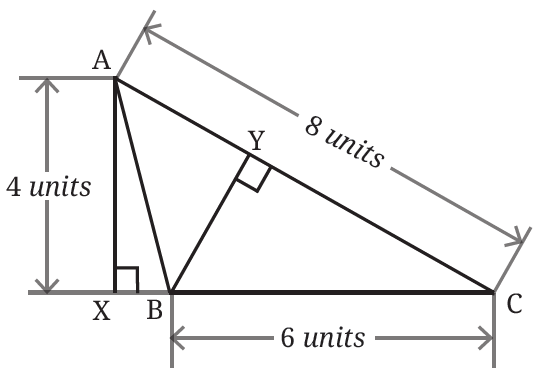
Question 2. Find the length of the altitude $BY$.
Answer:
Given:
In $\Delta ABC$:
Case 1: Base ($BC$) $= 6\text{ units}$ and corresponding Height ($AX$) $= 4\text{ units}$.
Case 2: Base ($AC$) $= 8\text{ units}$ and corresponding Height ($BY$) $= ?$.
To Find:
The length of the altitude $BY$.
Solution:
The area of a triangle remains the same regardless of which side is taken as the base.
First, calculate the area using base $BC$ and altitude $AX$:
$\text{Area of } \Delta ABC = \frac{1}{2} \times BC \times AX$
$\text{Area} = \frac{1}{2} \times 6 \times 4 = 12\text{ sq. units}$
Now, we use the same area to find altitude $BY$ using base $AC$:
$\text{Area} = \frac{1}{2} \times AC \times BY$
$12 = \frac{1}{2} \times 8 \times BY$
$12 = 4 \times BY$
$BY = \frac{12}{4}$
$BY = 3\text{ units}$
(Final Answer)
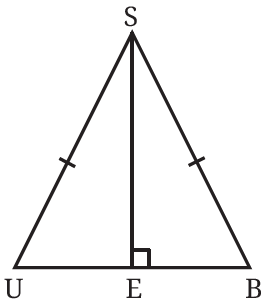
Question 3. Find the area of $\Delta SUB$, given that it is isosceles, $SE$ is perpendicular to $UB$, and the area of $\Delta SEB$ is $24$ sq. units.
Answer:
Given:
1. $\Delta SUB$ is an isosceles triangle with $SU = SB$.
2. $SE \perp UB$ (Altitude from the vertex to the base).
3. Area of $\Delta SEB = 24\text{ sq. units}$.
To Find:
Area of $\Delta SUB$.
Solution:
In an isosceles triangle, the altitude drawn from the vertex connecting the equal sides to the base ($SE$) acts as a line of symmetry. This means it bisects the base $UB$ and divides the triangle into two congruent triangles of equal area.
$\text{Area of } \Delta SEU = \text{Area of } \Delta SEB$
(Property of Isosceles $\Delta$)
$\text{Area of } \Delta SEU = 24\text{ sq. units}$
The total area of $\Delta SUB$ is the sum of the areas of these two smaller triangles:
$\text{Area of } \Delta SUB = \text{Area}(\Delta SEU) + \text{Area}(\Delta SEB)$
$\text{Area of } \Delta SUB = 24 + 24$
$\text{Area of } \Delta SUB = 48\text{ sq. units}$
(Final Answer)
Question 4. [Śulba-Sūtras] Give a method to transform a rectangle into a triangle of equal area.
Answer:
Solution:
According to the ancient geometric methods given in the Śulba-Sūtras, a rectangle can be transformed into a triangle of equal area through the following steps:
1. Let us take a rectangle ABCD, with length $a$ and breadth $b$.
2. Now mark the midpoint $E$ of side CD.
Draw a line perpendicular to CD passing through $E$.
Mark a point $M$ on it such that $\text{ME} = b$.
3. Draw a triangle using base = AB (same as the rectangle’s length) and join $M$ to $A$ and $B$ to form $\triangle MAB$.
Verification of Area:
• Area of the rectangle ABCD = $\text{length} \times \text{breadth} = a \times b$
• Area of the constructed triangle MAB = $\frac{1}{2} \times \text{base} \times \text{height} $$ \ = \frac{1}{2} \times a \times b = \frac{1}{2}ab$
Wait, to ensure the triangle has the equal area (same area $ab$), the height of the triangle must be $2b$ (or the base must be $2a$). Following the classical Śulba-Sūtra construction where the height is taken as twice the breadth (i.e., $\text{ME} = 2b$), the area becomes:
$\text{Area of } \triangle MAB = \frac{1}{2} \times a \times (2b) = a \times b$
Thus, the triangle has an area exactly equal to the area of the given rectangle.
Question 5. [Śulba-Sūtras] Give a method to transform a triangle into a rectangle of equal area.
Answer:
Solution:
According to the ancient geometric methods given in the Śulba-Sūtras, a triangle can be transformed into a rectangle of equal area through the following steps:
1. Take a triangle ABC with base $b$ and height $h$.
2. Find the midpoint $M$ of the height.
3. Draw a line parallel to the base through $M$.
This line intersects the sides of the triangle.
4. Create a rectangle using:
Length = Same as the triangle’s base = $b$
Width = Half of the triangle’s height = $\frac{h}{2}$
Verification of Area:
• Area of the triangle ABC = $\frac{1}{2} \times \text{base} \times \text{height} = \frac{1}{2} \times b \times h$
• Area of the constructed rectangle = $\text{length} \times \text{width} = b \times \frac{h}{2} = \frac{1}{2}bh$
Thus, the rectangle has an area exactly equal to the area of the given triangle.
Question 6. $ABCD, BCEF,$ and $BFGH$ are identical squares.
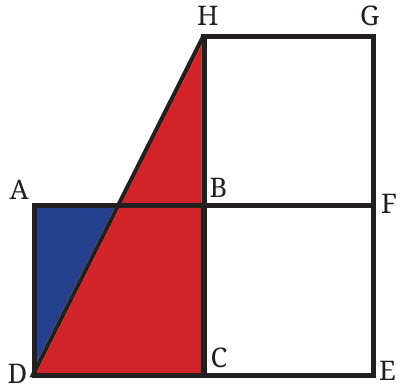
(i) If the area of the red region is $49$ sq. units, then what is the area of the blue region?
(ii) In another version of this figure, if the total area enclosed by the blue and red regions is $180$ sq. units, then what is the area of each square?
Answer:
Solution:
Given that $ABCD$, $BCEF$, and $BFGH$ are identical squares.
Let us assume that the intersection of line segments $AB$ and $DH$ is point $I$.
Let the side of each square be $a$.
(i) Finding the area of the blue region when the red region is $49$ sq. units:
Area of the red region ($\triangle HDC$) = $\frac{1}{2} \times \text{DC} \times \text{HC}$
(Since $\text{HC} = \text{HB} + \text{BC} = a + a = 2a$)
$= \frac{1}{2} \times a \times 2a = a^2 = 49$
$\Rightarrow a = 7\text{ units}$
Now, the area of the blue region ($\triangle IAD$):
$\text{Area} = \frac{1}{2} \times \text{AI} \times \text{AD}$
$= \frac{1}{2} \times \left(\frac{a}{2}\right) \times a$
$= \frac{1}{2} \times \left(\frac{7}{2}\right) \times 7 = \frac{49}{4}\text{ sq. units} = 12.25\text{ sq. units}$
Thus, the area of the blue region is $12.25\text{ square units}$.
(ii) Finding the area of each square when the total enclosed area is $180$ sq. units:
Given, the total area enclosed by the blue and red regions = $\text{Area of } \triangle HDC + \text{Area of } \triangle AID = 180\text{ sq. units}$
$\text{Area of } \triangle HDC = a^2$
$\text{Area of } \triangle AID = \frac{a^2}{4}$
Total combined area:
$a^2 + \frac{a^2}{4} = 180$
$\frac{5a^2}{4} = 180$
$5a^2 = 180 \times 4 = 720$
$a^2 = \frac{720}{5} = 144$
Since the area of each square is $a^2$:
$\text{Area of each square} = 144\text{ sq. units}$
Thus, the area of each square is $144\text{ sq. units}$.
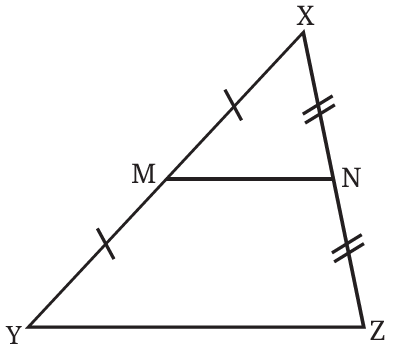
Question 7. If $M$ and $N$ are the midpoints of $XY$ and $XZ$, what fraction of the area of $\Delta XYZ$ is the area of $\Delta XMN$? [Hint: Join $NY$]
Answer:
Solution:
Let us follow the hint and join the vertex $N$ to $Y$ with a line segment $NY$.
Step 1: Analyzing triangles $\triangle XMN$ and $\triangle YMN$
• Since $M$ is the midpoint of $XY$, the segment $XM = MY$.
• Triangles $\triangle XMN$ and $\triangle YMN$ share the same vertex $N$ and their bases $XM$ and $MY$ lie along the same line $XY$ and are equal in length.
• Therefore, the areas of $\triangle XMN$ and $\triangle YMN$ are equal:
$\text{Area}(\triangle XMN) = \text{Area}(\triangle YMN)$
Step 2: Analyzing triangles $\triangle XMN$ and $\triangle ZMN$
• Since $N$ is the midpoint of $XZ$, the segment $XN = NZ$.
• Triangles $\triangle XMN$ and $\triangle ZMN$ share the same vertex $M$ and their bases $XN$ and $NZ$ lie along the same line $XZ$ and are equal in length.
• Therefore, the areas of $\triangle XMN$ and $\triangle ZMN$ are equal:
$\text{Area}(\triangle XMN) = \text{Area}(\triangle ZMN)$
Step 3: Relating triangles to the total area of $\triangle XYZ$
From the geometric relationships above, the entire triangle $\triangle XYZ$ is divided into four smaller triangles of equal area:
$\text{Area}(\triangle XYZ) = \text{Area}(\triangle XMN) + \text{Area}(\triangle YMN) + \text{Area}(\triangle ZMN) $$ \ + \text{Area}(\text{lower triangle formed by NY and base})$
Specifically, because $MN$ connects the midpoints of two sides of $\triangle XYZ$, $MN$ is parallel to $YZ$ and half its length, dividing $\triangle XYZ$ into four congruent smaller triangles ($\triangle XMN$, $\triangle AMN$, etc. or equivalently $4$ triangles of equal area).
Thus, the area of $\triangle XMN$ is $\frac{1}{4}$ of the total area of $\triangle XYZ$:
$\text{Area}(\triangle XMN) = \frac{1}{4} \times \text{Area}(\triangle XYZ)$
Conclusion:
The area of $\Delta XMN$ is $\frac{1}{4}$ of the area of $\Delta XYZ$.
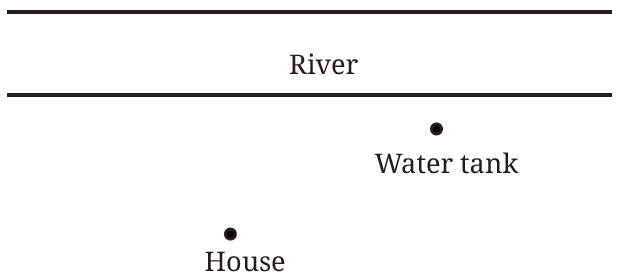
Question 8. Gopal needs to carry water from the river to his water tank. He starts from his house. What is the shortest path he can take from his house to the river and then to the water tank? Roughly recreate the map in your notebook and trace the shortest path.
Answer:
Solution:
Let $P$ be the point on the bank of the river, then the shortest path from $H$ to $P$ to $T$ is created by the point $P$ such that $\triangle HPT$ has minimum area.
Shortest path:
House ($H$) $\to P$ (Point on river) $\to$ Water tank ($T$)
Figure It Out (Page No. 160)
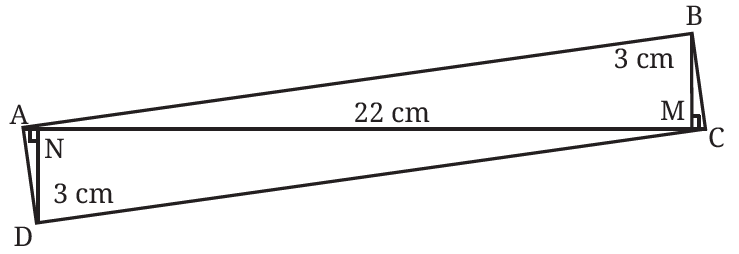
Question 1. Find the area of the quadrilateral $ABCD$ given that $AC = 22$ cm, $BM = 3$ cm, $DN = 3$ cm, $BM$ is perpendicular to $AC$, and $DN$ is perpendicular to $AC$.
Answer:
Given:
1. Length of diagonal $AC = 22\text{ cm}$.
2. Length of perpendicular (altitude) from $B$ to $AC$, $BM = 3\text{ cm}$.
3. Length of perpendicular (altitude) from $D$ to $AC$, $DN = 3\text{ cm}$.
To Find:
Area of quadrilateral $ABCD$.
Solution:
A quadrilateral can be divided into two triangles by its diagonal. Here, diagonal $AC$ divides quadrilateral $ABCD$ into $\Delta ABC$ and $\Delta ADC$.
$\text{Area of quadrilateral } ABCD = \text{Area}(\Delta ABC) + \text{Area}(\Delta ADC)$
We use the formula for the area of a triangle, which is $\frac{1}{2} \times \text{base} \times \text{height}$.
$\text{Area}(\Delta ABC) = \frac{1}{2} \times AC \times BM$
$\text{Area}(\Delta ABC) = \frac{1}{2} \times 22 \times 3 = 33\text{ cm}^2$
$\text{Area}(\Delta ADC) = \frac{1}{2} \times AC \times DN$
$\text{Area}(\Delta ADC) = \frac{1}{2} \times 22 \times 3 = 33\text{ cm}^2$
Now, adding the areas of the two triangles:
$\text{Total Area} = 33 + 33$
$\text{Total Area} = 66\text{ cm}^2$
Alternate Formula:
$\text{Area} = \frac{1}{2} \times d \times (h_1 + h_2)$
$\text{Area} = \frac{1}{2} \times 22 \times (3 + 3) = 11 \times 6 = 66\text{ cm}^2$
Thus, the area of quadrilateral $ABCD$ is $66\text{ cm}^2$.
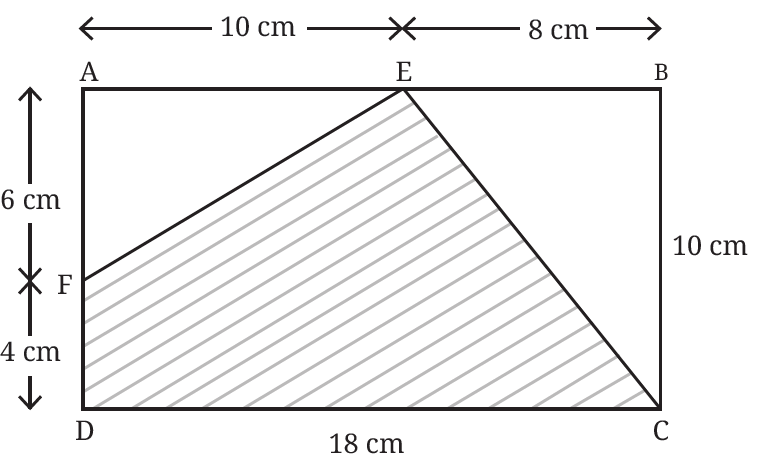
Question 2. Find the area of the shaded region given that $ABCD$ is a rectangle.
Answer:
Given:
1. Rectangle $ABCD$ with length $DC = 18\text{ cm}$ and breadth $BC = 10\text{ cm}$.
2. Points $E$ and $F$ on sides $AB$ and $AD$ respectively, with dimensions:
- $AE = 10\text{ cm}$ and $EB = 8\text{ cm}$ (Total $AB = 18\text{ cm}$).
- $AF = 6\text{ cm}$ and $FD = 4\text{ cm}$ (Total $AD = 10\text{ cm}$).
To Find:
Area of the shaded region (Quadrilateral $FECD$).
Solution:
The area of the shaded region can be found by subtracting the areas of the unshaded triangles from the total area of the rectangle $ABCD$.
Step 1: Calculate the area of rectangle $ABCD$.
$\text{Area}(ABCD) = \text{Length} \times \text{Breadth}$
$\text{Area}(ABCD) = 18 \times 10 = 180\text{ cm}^2$
Step 2: Calculate the area of unshaded $\Delta AFE$.
$\text{Area}(\Delta AFE) = \frac{1}{2} \times AE \times AF$
$\text{Area}(\Delta AFE) = \frac{1}{2} \times 10 \times 6 = 30\text{ cm}^2$
Step 3: Calculate the area of unshaded $\Delta EBC$.
$\text{Area}(\Delta EBC) = \frac{1}{2} \times EB \times BC$
$\text{Area}(\Delta EBC) = \frac{1}{2} \times 8 \times 10 = 40\text{ cm}^2$
Step 4: Find the area of the shaded region.
$\text{Shaded Area} = \text{Area}(ABCD) - [\text{Area}(\Delta AFE) + \text{Area}(\Delta EBC)]$
$\text{Shaded Area} = 180 - [30 + 40]$
$\text{Shaded Area} = 180 - 70 = 110\text{ cm}^2$
The area of the shaded region is $110\text{ cm}^2$.
Question 3. What measurements would you need to find the area of a regular hexagon?
Answer:
Solution:
To find the area of a regular hexagon, we need specific geometric measurements depending on the method used:
1. Length of a Side ($s$):
A regular hexagon is composed of $6$ congruent equilateral triangles. Therefore, knowing just the length of any side ($s$) is sufficient, because the distance from each vertex to the center is also equal to $s$.
2. Apothem ($a$) or Perpendicular Height:
Alternatively, if the side length is not directly known, we need the apothem (the perpendicular distance from the center of the hexagon to the midpoint of any side) along with either the side length or the perimeter.
Formulas for Area:
• Using side length ($s$):
$\text{Area} = \frac{3\sqrt{3}}{2} s^2$
• Using perimeter ($P$) and apothem ($a$):
$\text{Area} = \frac{1}{2} \times \text{Perimeter} \times \text{Apothem} = 3sa$
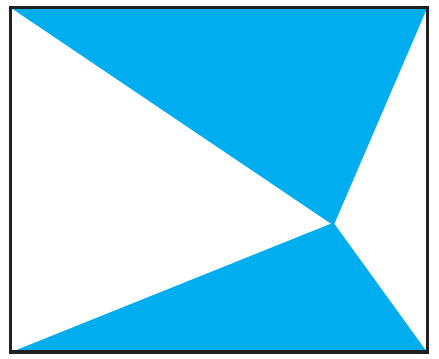
Question 4. What fraction of the total area of the rectangle is the area of the blue region?
Answer:
Solution:
Let $l$ be the length and $b$ be the breadth of the rectangle $ABCD$.
Total area of rectangle $ABCD = \text{DC} \times \text{BC} = l \times b\text{ sq. units}$
Area of $\Delta AOB = \frac{1}{2} \times \text{AB} \times \text{OE} = \frac{1}{2} \times l \times x\text{ sq. units}$
Area of $\Delta DOC = \frac{1}{2} \times \text{DC} \times \text{OF} = \frac{1}{2} \times l \times y\text{ sq. units}$
$\therefore$ The area of the shaded region = Area of $\Delta AOB + \text{Area of } \Delta DOC$
$= \frac{1}{2} \times l \times x + \frac{1}{2} \times l \times y$
$= \frac{1}{2} \times l \times (x + y)\text{ sq. units}$
$= \frac{1}{2} \times l \times b\text{ sq. units } [\because x + y = b]$
$\therefore \text{Area of shaded region} = \frac{1}{2} \times \text{Area of rectangle}$
Thus, the required fraction is $\frac{1}{2}$.
Question 5. Give a method to obtain a quadrilateral whose area is half that of a given quadrilateral?
Answer:
Solution:
Let $ABCD$ be a given quadrilateral.
Mark midpoints of $AB$, $BC$, $CD$, and $DA$ as $P$, $Q$, $R$, and $S$.
Join the midpoints, then $PQRS$ is the required quadrilateral with half the area of the given quadrilateral $ABCD$.
Figure It Out (Page No. 162 - 164)
Question 1. Observe the parallelograms in the figure below.
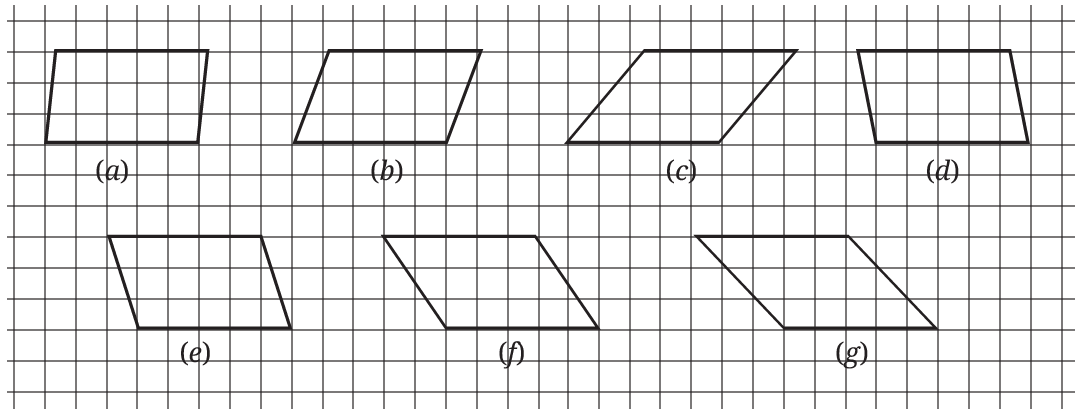
(i) What can we say about the areas of all these parallelograms?
(ii) What can we say about their perimeters? Which figure appears to have the maximum perimeter, and which has the minimum perimeter?
Answer:
Solution:
(i) Regarding the areas of the parallelograms:
All the given parallelograms are drawn on the same base and between the same parallel lines.
By counting the grid units, the base of each parallelogram is $5$ units and the height (distance between parallels) is $3$ units.
Therefore, the area of each parallelogram is $5 \times 3 = 15\text{ sq. units}$.
Thus, the areas of all these parallelograms are equal ($15\text{ sq. units}$).
(ii) Regarding their perimeters:
The perimeter of a parallelogram depends on the sum of the lengths of its adjacent sides. While the base and height remain constant across all figures, the slanted sides vary in length due to the tilt of the parallelogram.
• The figure with the minimum slant has the shortest side lengths. Hence, figure (d) has the minimum perimeter.
• The figure with the maximum slant has the longest slanted side lengths. Hence, figure (g) has the maximum perimeter.
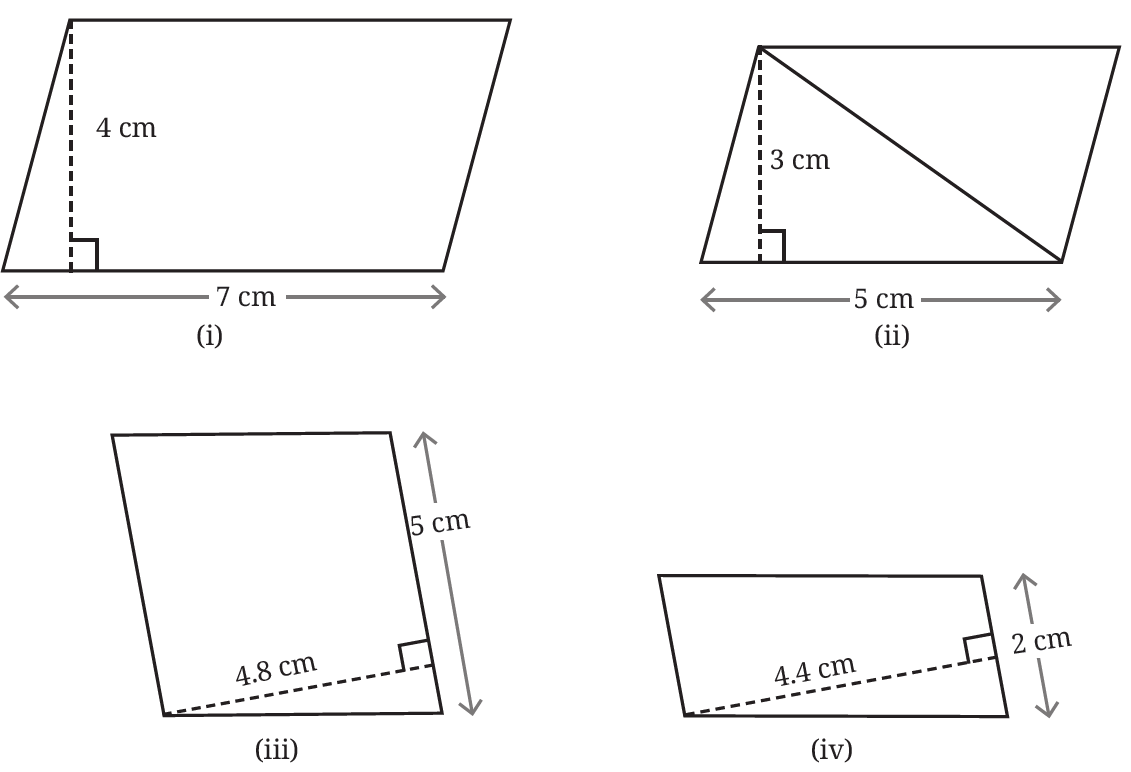
Question 2. Find the areas of the following parallelograms:
Answer:
Formula Used:
$\text{Area of a Parallelogram} = \text{Base} \times \text{Height}$
(i) Given: Base $= 7\text{ cm}$, Height $= 4\text{ cm}$
$\text{Area} = 7 \times 4$
$\text{Area} = 28\text{ cm}^2$
(ii) Given: Base $= 5\text{ cm}$, Height $= 3\text{ cm}$
$\text{Area} = 5 \times 3$
$\text{Area} = 15\text{ cm}^2$
(iii) Given: Base $= 5\text{ cm}$, Height $= 4.8\text{ cm}$
$\text{Area} = 5 \times 4.8$
$\text{Area} = 24.0\text{ cm}^2$
(iv) Given: Base $= 2\text{ cm}$, Height $= 4.4\text{ cm}$
$\text{Area} = 2 \times 4.4$
$\text{Area} = 8.8\text{ cm}^2$
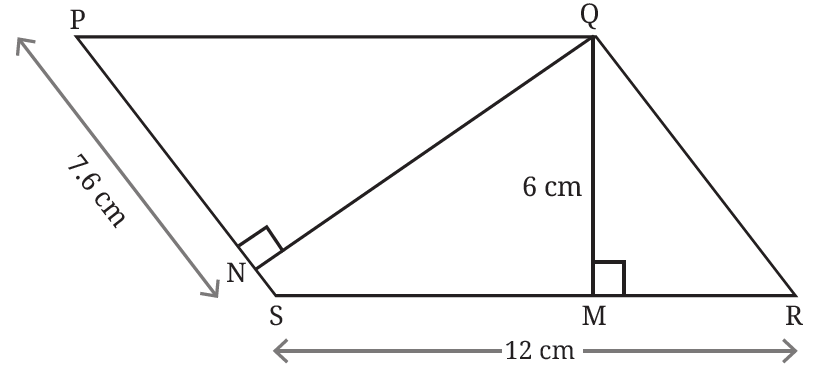
Question 3. Find $QN$.
Answer:
Given:
In parallelogram $PQRS$:
- Base $SR = 12\text{ cm}$
- Corresponding height $QM = 6\text{ cm}$
- Other side $PS = 7.6\text{ cm}$ (acts as base for height $QN$)
To Find:
The length of altitude $QN$.
Solution:
We know that the area of a parallelogram is the same regardless of which base and height are chosen.
Step 1: Calculate the area using base $SR$ and height $QM$.
$\text{Area} = SR \times QM = 12 \times 6$
$\text{Area} = 72\text{ cm}^2$
Step 2: Use the calculated area to find $QN$ using base $PS$.
$\text{Area} = PS \times QN$
$72 = 7.6 \times QN$
$QN = \frac{72}{7.6} = \frac{720}{76}$
$QN \approx 9.47\text{ cm}$
(Approximate Value)
The length of $QN$ is $9.47\text{ cm}$.
Question 4. Consider a rectangle and a parallelogram of the same sidelengths: $5$ cm and $4$ cm. Which has the greater area? [Hint: Imagine constructing them on the same base.]
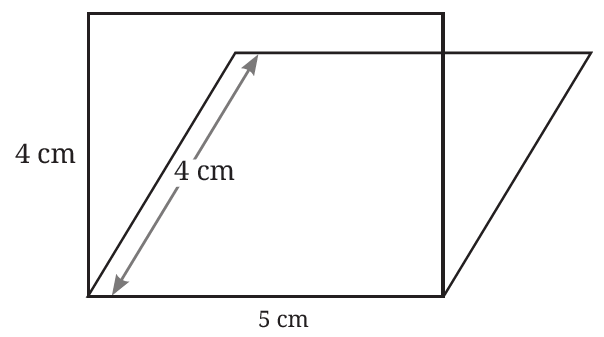
Answer:
Given:
A rectangle with side lengths $5\text{ cm}$ and $4\text{ cm}$.
A parallelogram with the same side lengths $5\text{ cm}$ and $4\text{ cm}$.
To Find:
Which figure has the greater area?
Solution:
1. Area of the Rectangle: Since the sides are perpendicular, the height is equal to the breadth.
$\text{Area}_{\text{rect}} = \text{Length} \times \text{Breadth} = 5 \times 4 = 20\text{ cm}^2$
2. Area of the Parallelogram: Let the base be $5\text{ cm}$. The slant side is $4\text{ cm}$.
The height ($h$) of a parallelogram is the perpendicular distance between the bases. In any right-angled triangle formed inside the parallelogram, the slant side ($4\text{ cm}$) acts as the hypotenuse, and the height ($h$) acts as a leg. Since the hypotenuse is always the longest side:
$h < 4\text{ cm}$
(Reason: Altitude < Hypotenuse)
Therefore, for the parallelogram:
$\text{Area}_{\text{para}} = 5 \times h < 5 \times 4$
$\text{Area}_{\text{para}} < 20\text{ cm}^2$
Conclusion:
The rectangle has a greater area than the parallelogram with the same side lengths.
Question 5. Give a method to obtain a rectangle whose area is twice that of a given triangle. What are the different methods that you can think of?
Answer:
Given:
A triangle with base $b$ and height $h$.
$\text{Area of Triangle} = \frac{1}{2} \times b \times h$
To Find:
A method to obtain a rectangle with area twice that of the triangle ($Area = b \times h$).
Solution:
Since the area of the rectangle needs to be $b \times h$, we can consider the following different methods:
Method 1: Same Base and Same Height
Construct a rectangle with the same base ($b$) and the same height ($h$) as the triangle. The area of this rectangle will be $b \times h$, which is exactly twice the area of the triangle.
Method 2: Double Base and Half Height
Construct a rectangle with twice the base ($2b$) and half the height ($\frac{h}{2}$) of the triangle.
$\text{Area} = (2b) \times (\frac{h}{2}) = b \times h$
Method 3: Half Base and Double Height
Construct a rectangle with half the base ($\frac{b}{2}$) and twice the height ($2h$) of the triangle.
$\text{Area} = (\frac{b}{2}) \times (2h) = b \times h$
Question 6. [Śulba-Sūtras] Give a method to obtain a rectangle of the same area as a given triangle.
Answer:
Given:
A triangle with base $b$ and height $h$. The area is $\frac{1}{2}bh$.
Solution:
According to the Śulba-Sūtras (ancient Indian geometric texts), a triangle can be converted into a rectangle of the same area using the following method:
Method:
1. Take the base of the triangle as the base of the rectangle.
2. Take half the altitude (height) of the triangle as the height of the rectangle.
$\text{Area of Rectangle} = \text{Base} \times \text{Half-Height}$
$\text{Area} = b \times \frac{h}{2} = \frac{1}{2}bh$
By keeping the base the same and halving the height, the rectangle occupies the same total area as the original triangle.
Question 7. [Śulba-Sūtras] An isosceles triangle can be converted into a rectangle by dissection in a simpler way. Can you find out how to do it?
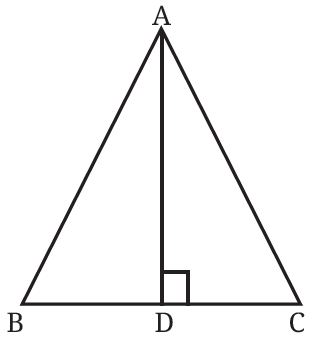
[Hint: Show that triangles $\Delta ADB$ and $\Delta ADC$ can be made into halves of a rectangle. Figure out how they should be assembled to get a rectangle. Use cut-outs if necessary.]
Answer:
Solution:
Given: An isosceles triangle $ABC$ in which $AB = AC$, and $AD \perp BC$ is the altitude drawn from vertex $A$ to the base $BC$.
To Find: To convert the given isosceles triangle into a rectangle by dissection.
Method & Construction:
1. In the isosceles triangle $ABC$, the altitude $AD$ divides the triangle into two congruent right-angled triangles, namely $\Delta ADB$ and $\Delta ADC$.
2. Each of these right-angled triangles represents half of a rectangle.
3. Assembly Process:
- Take the right-angled triangle $\Delta ADB$.
- Take the congruent right-angled triangle $\Delta ADC$.
- Rotate one of the triangles by $180^\circ$.
- Place them adjacent to each other such that their corresponding sides fit perfectly to form a complete rectangle.
4. The newly formed shape is a rectangle whose dimensions are determined by the base and the altitude of the original isosceles triangle.
Illustration of the Newly Formed Rectangle:
Question 8. [Śulba-Sūtras] Give a method to convert a rectangle into an isosceles triangle by dissection.
Answer:
Solution:
This is the reverse of Question 7.
Method:
Given: Rectangle $PQRS$ with length $l$ and width $w$.
Required: Isosceles triangle with the same area.
Dissection Steps:
Step 1: Take a rectangle $PQRS$ with $PQ = l$ and $PS = w$.
Step 2: Mark the midpoint $M$ of side $PQ$.
Step 3: From $M$, draw lines to the bottom corners $R$ and $S$.
Step 4: Cut the rectangle into pieces along the lines.
Step 5: Rearrange:
Flip the side triangles and attach them appropriately to form a single large isosceles triangle with a base equal to $PQ$ and height equal to the width of the rectangle.
Illustration of the Newly Formed Isosceles Triangle:
Question 9. Which has greater area — an equilateral triangle or a square of the same sidelength as the triangle? Which has greater area — two identical equilateral triangles together or a square of the same sidelength as the triangle? Give reasons.
Answer:
Solution:
Let the side length of both the equilateral triangle and the square be $a$.
Part 1: Equilateral triangle vs. Square of the same sidelength
1. Area of an equilateral triangle with side $a$ is given by:
$\text{Area}_{\text{triangle}} = \frac{\sqrt{3}}{4}a^2$
2. Area of a square with side $a$ is given by:
$\text{Area}_{\text{square}} = a^2$
3. Comparing both areas:
$\frac{\sqrt{3}}{4}a^2 < a^2 \quad \left[\text{Since } \frac{\sqrt{3}}{4} \approx 0.433 < 1\right]$
Conclusion for Part 1: A square has a greater area than an equilateral triangle of the same side length.
Part 2: Two identical equilateral triangles vs. Square of the same sidelength
1. Area of two identical equilateral triangles combined together with side $a$ is:
$\text{Area}_{\text{two triangles}} = 2 \times \frac{\sqrt{3}}{4}a^2 = \frac{\sqrt{3}}{2}a^2$
2. Area of the square with side $a$ remains:
$\text{Area}_{\text{square}} = a^2$
3. Comparing both areas:
$\frac{\sqrt{3}}{2}a^2 < a^2 \quad \left[\text{Since } \frac{\sqrt{3}}{2} \approx 0.866 < 1\right]$
Conclusion for Part 2: A square still has a greater area than two identical equilateral triangles of the same side length.
Visual Representation:
Figure It Out (Page No. 169 - 170)
Question 1. Find the area of a rhombus whose diagonals are $20$ cm and $15$ cm.
Answer:
Given:
Length of the first diagonal ($d_1$) $= 20\text{ cm}$
Length of the second diagonal ($d_2$) $= 15\text{ cm}$
To Find:
Area of the rhombus.
Solution:
We know that the area of a rhombus is half the product of its diagonals.
$\text{Area} = \frac{1}{2} \times d_1 \times d_2$
Substituting the given values:
$\text{Area} = \frac{1}{2} \times 20 \times 15$
$\text{Area} = 10 \times 15$
$\text{Area} = 150\text{ cm}^2$
(Final Answer)
Thus, the area of the rhombus is $150\text{ cm}^2$.
Question 2. Give a method to convert a rectangle into a rhombus of equal area using dissection.
Answer:
Solution:
This is the reverse of the rhombus to rectangle dissection.
Method:
Given: Rectangle $PQRS$ with length $l$ and width $W$.
Required: Rhombus with the same area = $l \times W$.
Illustration of the Dissection:
Dissection Process:
Step 1: The rhombus will have diagonals $d_1$ and $d_2$ such that: $\frac{1}{2} \times d_1 \times d_2 = l \times W$
So, $d_1 \times d_2 = 2lW$.
Step 2: Choose convenient diagonal lengths:
Let $d_1 = 2l$ (twice the rectangle length)
Then $d_2 = W$ (same as rectangle width)
Check: $\frac{1}{2} \times 2l \times W = lW$
Or
Let $d_1 = 2W$ (twice the rectangle width)
Then $d_2 = l$ (same as rectangle length)
Step 3: Dissection process (reverse of textbook method):
Divide the rectangle into two halves.
Mark the center point $O$.
Cut and rotate pieces to form two isosceles triangles.
Arrange these triangles to share a common diagonal.
This creates a rhombus.
Question 3. Find the areas of the following figures:
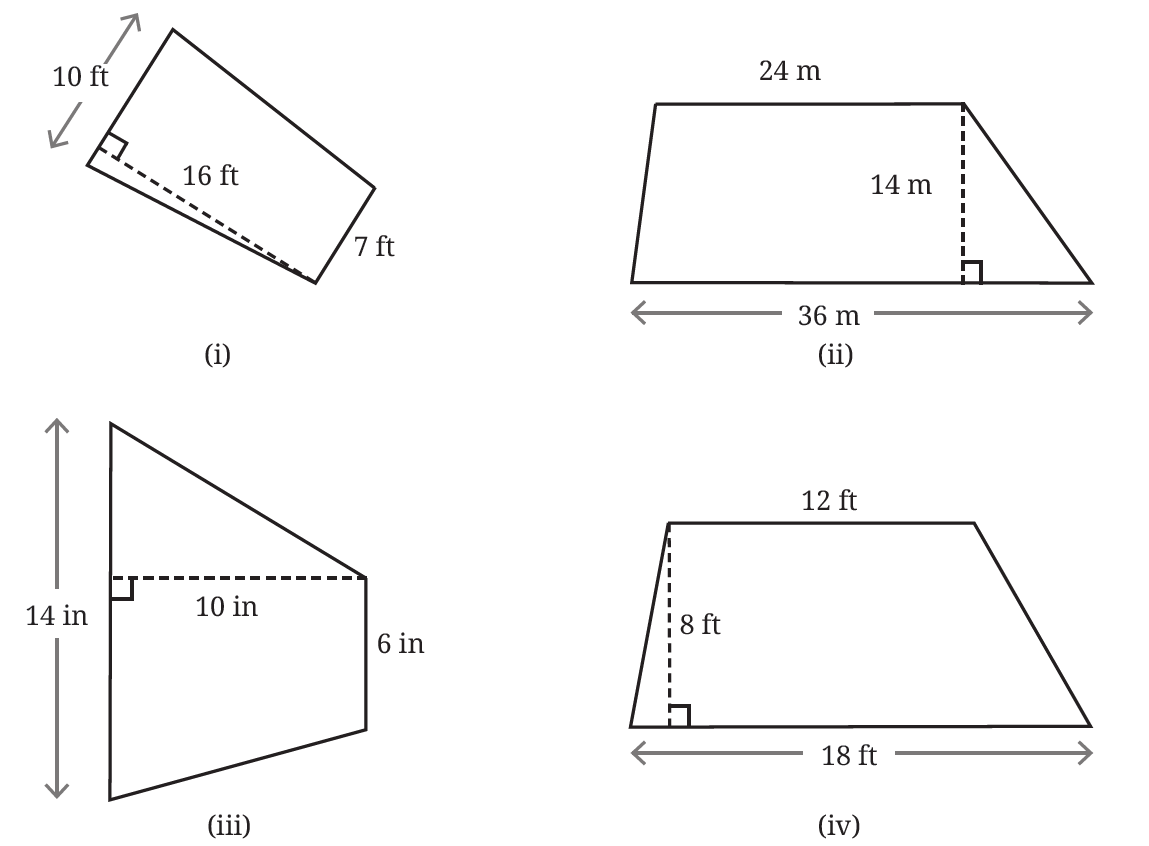
Answer:
General Formula for Area of a Trapezium:
$\text{Area} = \frac{1}{2} \times (\text{sum of parallel sides}) \times \text{height}$
(i) Solution:
Given: Parallel sides $a = 10\text{ ft}$ and $b = 7\text{ ft}$, Height $h = 16\text{ ft}$.
$\text{Area} = \frac{1}{2} \times (10 + 7) \times 16$
$\text{Area} = 17 \times 8 = 136\text{ ft}^2$
(ii) Solution:
Given: Parallel sides $a = 24\text{ m}$ and $b = 36\text{ m}$, Height $h = 14\text{ m}$.
$\text{Area} = \frac{1}{2} \times (24 + 36) \times 14$
$\text{Area} = 60 \times 7 = 420\text{ m}^2$
(iii) Solution:
Given: Parallel sides $a = 14\text{ in}$ and $b = 6\text{ in}$, Height $h = 10\text{ in}$.
$\text{Area} = \frac{1}{2} \times (14 + 6) \times 10$
$\text{Area} = 20 \times 5 = 100\text{ in}^2$
(iv) Solution:
Given: Parallel sides $a = 12\text{ ft}$ and $b = 18\text{ ft}$, Height $h = 8\text{ ft}$.
$\text{Area} = \frac{1}{2} \times (12 + 18) \times 8$
$\text{Area} = 30 \times 4 = 120\text{ ft}^2$
Question 4. [Śulba-Sūtras] Give a method to convert an isosceles trapezium to a rectangle using dissection.
Answer:
Solution:
An isosceles trapezium has special properties that make dissection simpler.
Properties of Isosceles Trapezium ABCD:
$AB \parallel CD$ (parallel sides)
$AD = BC$ (non-parallel sides are equal)
$\angle A = \angle B$ and $\angle D = \angle C$ (base angles are equal)
Illustration of the Dissection:
Dissection Method:
Step 1: Draw perpendiculars from $C$ and $D$ to $AB$, meeting at points $P$ and $Q$, respectively.
This creates rectangle $PQDC$ in the middle.
Two congruent right triangles: $\Delta APD$ and $\Delta BQC$.
Step 2: Since the trapezium is isosceles:
$\Delta APD \cong \Delta BQC$ (congruent triangles)
$AP = BQ$
Step 3: Rearrangement:
Cut triangle $\Delta APD$.
Rotate it and attach it to the right side (next to $\Delta BQC$).
The two triangles together form a rectangle with a width = height of the trapezium.
Step 4: Combine: The central rectangle $PQDC$.
The rectangle formed from the two triangles.
These can be joined to form one large rectangle.
Resulting Rectangle:
Length = $CD + AP$
= $CD + \frac{AB - CD}{2}$
= $\frac{AB + CD}{2}$
Width = $h$ (height of trapezium)
Area = $\frac{AB + CD}{2} \times h = \frac{1}{2}h(AB + CD)$
This matches the trapezium area formula!
Question 5. Here is one of the ways to convert trapezium $ABCD$ into a rectangle $EFGH$ of equal area —
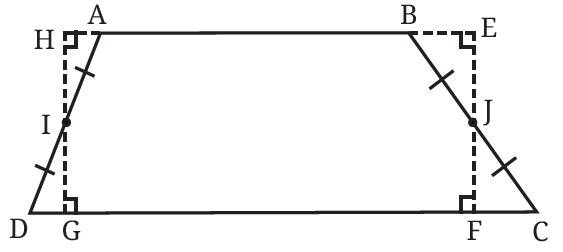
Given the trapezium $ABCD$, how do we find the vertices of the rectangle $EFGH$?
[Hint: If $\Delta AHI \cong \Delta DGI$ and $\Delta BEJ \cong \Delta CFJ$, then the trapezium and rectangle have equal areas.]
Answer:
Solution:
Given: Trapezium $ABCD$ with $AB \parallel CD$.
Required: Find the positions of the vertices $E$, $F$, $G$, and $H$ to form a rectangle $EFGH$ with equal area.
Using the Hint: If $\Delta AHI \cong \Delta DGI$ and $\Delta BEJ \cong \Delta CFJ$, then areas are equal.
Illustration of the Dissection and Conversion:
Method:
Step 1: The rectangle $EFGH$ should have:
$EF$ as one side (top side)
$GH$ is the opposite parallel side (bottom side)
$EH$ and $FG$ are the other pair of sides.
Step 2: Position the rectangle such that:
Points $I$ and $J$ are strategically chosen on the trapezium.
$\Delta AHI$ (part outside rectangle on left) is cut and moved to fill $\Delta DGI$.
$\Delta BEJ$ (part outside rectangle on right) is cut and moved to fill $\Delta CFJ$.
Step 3: For congruency:
Mark $I$ on side $AD$
Mark $J$ on side $BC$
Choose positions such that:
$HI = GI$ (making $\Delta AHI \cong \Delta DGI$ possible)
$EJ = FJ$ (making $\Delta BEJ \cong \Delta CFJ$ possible)
Step 4: The height of the rectangle = $h$ (height of the trapezium).
Step 5: The length of rectangle = $\frac{a + b}{2}$
where $a$ and $b$ are parallel sides.
This ensures: Area of rectangle = $h \times \frac{a + b}{2} =$ Area of trapezium.
Practical Construction:
Draw the trapezium $ABCD$.
Calculate required rectangle length = $\frac{AB + CD}{2}$.
Mark points $H$ and $E$ on $AB$ such that the central portion has this length.
Draw perpendiculars to get rectangle $EFGH$.
Verify that the triangular pieces outside match those inside.
Question 6. Using the idea of converting a trapezium into a rectangle of equal area, and vice versa, construct a trapezium of area $144$ cm$^2$.
Answer:
Solution:
To Find: Construction of a trapezium having an area of $144\text{ cm}^2$ using the rectangle conversion method.
Method & Construction:
1. We know that the area of a trapezium is equal to the area of a rectangle whose length is equal to the average of its parallel sides and whose breadth is equal to its height ($h$).
$$\text{Area} = \left(\frac{a + b}{2}\right) \times h = 144\text{ cm}^2$$
2. Choose suitable dimensions for a rectangle with an area of $144\text{ cm}^2$:
Let the length of the rectangle be $16\text{ cm}$ and the breadth (height) be $9\text{ cm}$.
$$\text{Area of rectangle} = 16\text{ cm} \times 9\text{ cm} = 144\text{ cm}^2$$
3. To convert this rectangle into a trapezium of the same area:
- The height of the trapezium will be equal to the breadth of the rectangle, i.e., $h = 9\text{ cm}$.
- The sum of the parallel sides ($a + b$) of the trapezium must be twice the length of the rectangle:
$$a + b = 2 \times 16\text{ cm} = 32\text{ cm}$$
4. Choose convenient values for the parallel sides $a$ and $b$ such that their sum is $32\text{ cm}$:
Let $a = 20\text{ cm}$ and $b = 12\text{ cm}$.
5. Final Trapezium Dimensions:
- Parallel sides: $20\text{ cm}$ and $12\text{ cm}$
- Height (altitude): $9\text{ cm}$
6. Verify the area of the constructed trapezium:
$$\text{Area} = \frac{1}{2} \times (20 + 12) \times 9 = \frac{1}{2} \times 32 \times 9 = 16 \times 9 = 144\text{ cm}^2$$
Illustration of the Constructed Trapezium:
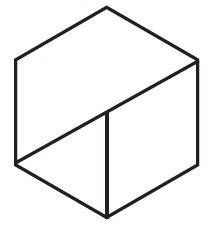
Question 7. A regular hexagon is divided into a trapezium, an equilateral triangle, and a rhombus, as shown. Find the ratio of their areas.
Answer:
Given:
A regular hexagon is divided into three regions: an equilateral triangle, a rhombus, and a trapezium.
Solution:
A regular hexagon can be divided into 6 identical equilateral triangles by joining its center to each of its six vertices. Let the area of one such small equilateral triangle be $x$.
Based on the geometric properties of a regular hexagon, we can observe the following:
1. Equilateral Triangle: The smallest triangular part shown in the figure is exactly one of the 6 small triangles.
$\text{Area of Triangle} = 1x$
2. Rhombus: A rhombus in a regular hexagon (formed by joining two adjacent triangles) consists of 2 small equilateral triangles.
$\text{Area of Rhombus} = 2x$
3. Trapezium: The remaining part is a large trapezium. Since the total area of the hexagon is $6x$, the area of the trapezium is:
$\text{Area of Trapezium} = 6x - (1x + 2x)$
$\text{Area of Trapezium} = 3x$
To Find:
The ratio of their areas (Trapezium : Triangle : Rhombus).
$\text{Ratio} = 3x : 1x : 2x$
$\text{Ratio} = 3 : 1 : 2$
Therefore, the ratio of the areas of the trapezium, equilateral triangle, and rhombus is $3 : 1 : 2$.
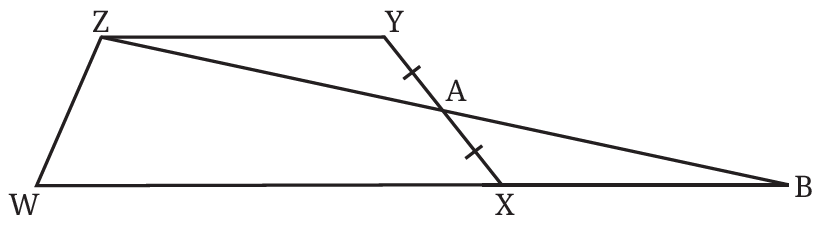
Question 8. $ZYXW$ is a trapezium with $ZY \parallel WX$. $A$ is the midpoint of $XY$. Show that the area of the trapezium $ZYXW$ is equal to the area of $\Delta ZWB$.
Answer:
Given:
1. Trapezium $ZYXW$ with $ZY \parallel WX$.
2. $A$ is the midpoint of $XY$, so $YA = AX$.
3. $\Delta ZWB$ is formed by extending base $WX$ to $B$ and connecting $Z$ to $B$ through $A$.
To Prove:
$\text{Area}(\text{Trapezium } ZYXW) = \text{Area}(\Delta ZWB)$
Proof:
Consider $\Delta ZYA$ and $\Delta BXA$. In these two triangles:
$\angle ZAY = \angle BAX$
(Vertically opposite angles)
$YA = AX$
(Given, $A$ is the midpoint)
$\angle ZYA = \angle BXA$
(Alternate interior angles as $ZY \parallel WB$)
Therefore, by ASA (Angle-Side-Angle) congruence criterion:
$\Delta ZYA \cong \Delta BXA$
Since congruent triangles have equal areas:
$\text{Area}(\Delta ZYA) = \text{Area}(\Delta BXA)$
... (i)
Now, let's look at the areas of the figures:
$\text{Area}(ZYXW) = \text{Area}(ZWXA) + \text{Area}(\Delta ZYA)$
Substituting equation (i) into this:
$\text{Area}(ZYXW) = \text{Area}(ZWXA) + \text{Area}(\Delta BXA)$
From the figure, the sum of Area(Quad $ZWXA$) and Area($\Delta BXA$) is exactly the area of $\Delta ZWB$:
$\text{Area}(ZYXW) = \text{Area}(\Delta ZWB)$
Hence Proved.