

Chapter 1 Orienting Yourself: The Use of Coordinates (Class 9 - Latest Maths NCERT (Ganita Manjari I) Solutions)
Looking for clear and accurate NCERT Solutions for Chapter 1: Orienting Yourself: The Use of Coordinates? You’ve come to the right place! This page provides comprehensive, step-by-step answers for the latest Class 9 Maths curriculum, helping you master the framework of coordinate geometry. We bridge the gap between historical "grid-based thinking"—from the streets of the Sindhu-Sarasvatī Civilisation to the celestial maps of Āryabhaṭa—and modern mathematical applications, ensuring you can describe physical locations with pinpoint accuracy.
Our solutions offer detailed walkthroughs for navigating the 2-D Cartesian Coordinate System. We provide clear explanations for identifying the Origin (0,0), the horizontal x-axis, and the vertical y-axis. Whether you are plotting points in the four quadrants or creating architectural floor plans, our step-by-step methods make the xy-plane easy to understand. A major focus is the Distance Formula; we show you exactly how to apply the Baudhāyana–Pythagoras Theorem to calculate the length between any two points in the plane with ease.
From the historical insights of Brahmagupta and Ömar Khayyām to technical distance derivations, these resources are designed to help you excel. Curated by learningspot.co based on the Ganita Manjari I textbook, our materials include visual quadrant guides and logical breakdowns of geometric shapes. These solutions are tailored for the latest CBSE syllabus, ensuring you build the foundation needed to visualize algebra as geometry and achieve top marks in your Class 9 examinations.
| Content On This Page | ||
|---|---|---|
| Exercise Set 1.1 | Exercise Set 1.2 | End-Of-Chapter Exercises |
Exercise Set 1.1
Question. Fig. $1.3$ shows Reiaan’s room with points $OABC$ marking its corners. The $x$- and $y$-axes are marked in the figure. Point $O$ is the origin.
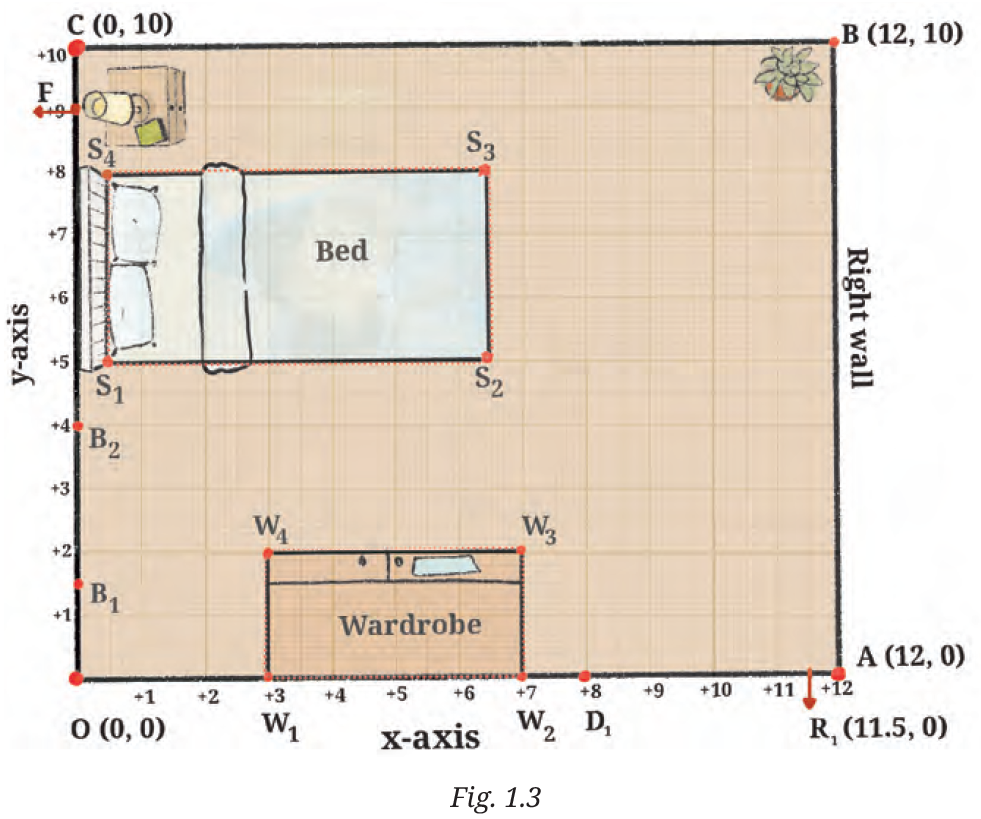
Referring to Fig. $1.3$, answer the following questions:
(i) If $D_1R_1$ represents the door to Reiaan’s room, how far is the door from the left wall (the $y$-axis) of the room? How far is the door from the $x$-axis?
(ii) What are the coordinates of $D_1$?
(iii) If $R_1$ is the point $(11.5, 0)$, how wide is the door? Do you think this is a comfortable width for the room door? If a person in a wheelchair wants to enter the room, will he/she be able to do so easily?
(iv) If $B_1 (0, 1.5)$ and $B_2 (0, 4)$ represent the ends of the bathroom door, is the bathroom door narrower or wider than the room door?
Answer:
Given:
From the provided coordinate map (Fig. $1.3$) of the room:
1. The left wall of the room lies along the $y$-axis (where $x = 0$).
2. The bottom wall of the room lies along the $x$-axis (where $y = 0$).
3. The coordinates of the corner points are $O(0, 0)$, $A(12, 0)$, $B(12, 10)$, and $C(0, 10)$.
4. The room door is represented by the segment $D_1R_1$ on the $x$-axis.
5. The coordinates of $R_1$ are $(11.5, 0)$.
6. The bathroom door is represented by the segment $B_1B_2$ on the $y$-axis, where $B_1(0, 1.5)$ and $B_2(0, 4)$.
(i) To find: Distance of the door from the left wall and the $x$-axis.
Solution:
By observing the grid on the $x$-axis in Fig. $1.3$, the point $D_1$ is located at the marking $8$. Therefore, the $x$-coordinate of $D_1$ is $8$.
The distance of any point from the $y$-axis (left wall) is given by its $x$-coordinate.
$\text{Distance from left wall} = 8 - 0 = 8\text{ units}$
[As $D_1$ is at $x=8$]
Since the door $D_1R_1$ lies exactly on the $x$-axis, its distance from the $x$-axis is zero.
$\text{Distance from } x\text{-axis} = 0\text{ units}$
[Points lie on the axis]
(ii) To find: Coordinates of $D_1$.
Solution:
The point $D_1$ lies on the $x$-axis, which means its $y$-coordinate is $0$. As determined from the grid in the previous step, its $x$-coordinate is $8$.
Therefore, the coordinates of $D_1$ are $(8, 0)$.
(iii) To find: Width of the door and its accessibility.
Solution:
The width of the door is the distance between points $D_1(8, 0)$ and $R_1(11.5, 0)$.
$\text{Width} = |x_{R1} - x_{D1}|$
$\text{Width} = 11.5 - 8 = 3.5\text{ units}$
In Indian residential standards, $1\text{ unit}$ often corresponds to $1\text{ foot}$. A width of $3.5\text{ units}$ is very comfortable for a room door.
(iv) To compare: Width of the bathroom door versus the room door.
Solution:
The bathroom door is represented by points $B_1(0, 1.5)$ and $B_2(0, 4)$ on the $y$-axis.
$\text{Width of bathroom door} = |y_{B2} - y_{B1}|$
$\text{Width} = 4 - 1.5 = 2.5\text{ units}$
Comparing the two widths:
Width of room door $= 3.5\text{ units}$
Width of bathroom door $= 2.5\text{ units}$
Since $2.5 < 3.5$, the bathroom door is narrower than the room door.
Exercise Set 1.2
On a graph sheet, mark the $x$-axis and $y$-axis and the origin $O$. Mark points from $(-7, 0)$ to $(13, 0)$ on the $x$-axis and from $(0, -15)$ to $(0, 12)$ on the $y$-axis. (Use the scale $1\text{ cm} = 1\text{ unit}$.) Using Fig. $1.5$, answer the given questions.
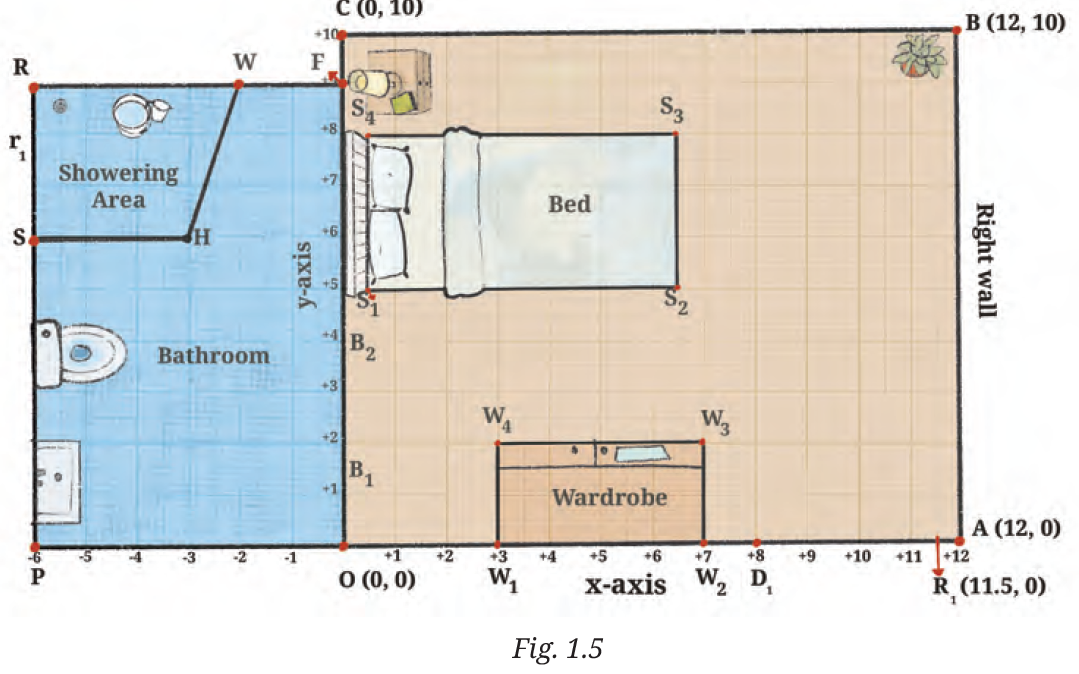
Question 1. Place Reiaan’s rectangular study table with three of its feet at the points $(8, 9)$, $(11, 9)$ and $(11, 7)$.
(i) Where will the fourth foot of the table be?
(ii) Is this a good spot for the table?
(iii) What is the width of the table? The length? Can you make out the height of the table?
Answer:
Given:
Three feet of a rectangular table are located at coordinates $A(8, 9)$, $B(11, 9)$, and $C(11, 7)$.
To Find:
(i) Coordinates of the fourth foot $D$.
(ii) Suitability of the location in the bedroom.
(iii) Dimensions of the table (Width, Length, and Height).
Solution:
(i) In a rectangle, opposite sides are equal and parallel. The vertices are usually given in cyclic order.
Looking at the coordinates of $A(8, 9)$ and $B(11, 9)$, we see they have the same $y$-coordinate, forming a horizontal side.
Looking at $B(11, 9)$ and $C(11, 7)$, they have the same $x$-coordinate, forming a vertical side.
The fourth foot $D$ must have the same $x$-coordinate as $A$ and the same $y$-coordinate as $C$ to complete the rectangle.
$D = (8, 7)$
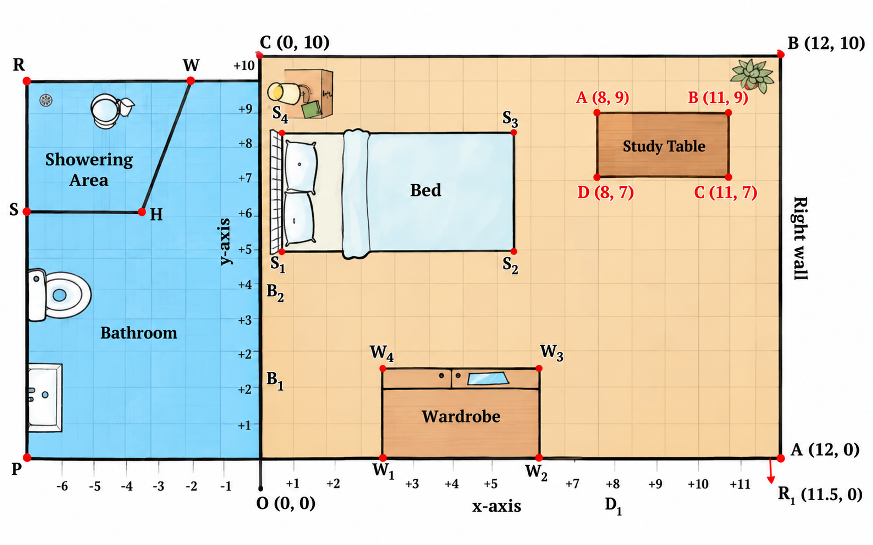
Visual Representation:
The following diagram illustrates the placement of the four feet of the study table within the bedroom coordinate system.
(ii) Is this a good spot?
According to the floor plan (Fig 1.5), the bedroom floor extends up to $x = 12$ and $y = 10$. The table coordinates $(8, 7)$ to $(11, 9)$ place it in the top-right corner of the room. Since it does not block the wardrobe (located at $y = 0$ to $2$), the bed (located at $y = 5$ to $8$), or the entrance, it is a very good and efficient spot for the table.
(iii) Dimensions:
The Width is the horizontal distance between the feet:
$\text{Width} = |11 - 8| = 3 \text{ units}$
The Length is the vertical distance between the feet:
$\text{Length} = |9 - 7| = 2 \text{ units}$
Height: From a two-dimensional (2D) plan view, we only see the floor coordinates ($x$ and $y$). We cannot determine the height of the table from this graph as the vertical dimension ($z$-axis) is not shown.
Question 2. If the bathroom door has a hinge at $B_1$ and opens into the bedroom, will it hit the wardrobe? Are there any changes you would suggest if the door is made wider?
Answer:
Given:
$\text{Coordinate of } B_1 = (0, 1.5)$
[Hinge point on $y$-axis]
$\text{Coordinate of } B_2 = (0, 4)$
[Top point of door]
The wardrobe is placed between $x = 3$ and $x = 7$. Its left vertical edge (represented by $W_1 W_4$) lies on the line $x = 3$.
To Find:
Whether the door hits the wardrobe during its swing and suggestions for a wider door design.
Solution:
First, we determine the width of the bathroom door based on the given coordinates:
$\text{Door Width} = 4 - 1.5 = 2.5 \text{ units}$
[Distance between $B_1$ and $B_2$]
When the door is hinged at $B_1(0, 1.5)$ and opens into the bedroom, it creates a circular swing path with a radius equal to the door width.
The maximum horizontal distance the door can reach into the bedroom is its radius ($2.5 \text{ units}$).
$\text{Maximum reach of door swing} = 2.5 \text{ units}$
$\text{Distance to Wardrobe} = 3 \text{ units}$
(From $x$-axis coordinates)
Comparing the values from (ii) and the wardrobe position, we see that $2.5 < 3$.
Therefore, the door will not hit the wardrobe as there is a clearance of $0.5 \text{ units}$ between the fully opened door and the wardrobe's edge.
Suggestions for a Wider Door:
If the door is made wider (for example, $3.5 \text{ units}$), the swing radius would exceed the distance to the wardrobe ($3.5 > 3$), causing a collision. In such a case, the following changes are suggested:
1. Inward Opening: Modify the design so the door opens inward into the bathroom. This is standard in most Indian flats to keep the bedroom area unobstructed.
2. Sliding Mechanism: Install a sliding door that moves along the wall (the $y$-axis). This saves the entire space required for a "swing" and allows for a much wider entrance if needed.
3. Relocate Wardrobe: Shift the wardrobe further to the right, starting from $x = 4$ or $x = 5$, to provide enough clearance for a larger door swing.
4. Hinge Reversal: Move the hinge to $B_2(0, 4)$. The door would then swing towards the bed area instead of the wardrobe area, though this might interfere with access to the bed.
Question 3. Look at Reiaan’s bathroom.
(i) What are the coordinates of the four corners $O$, $F$, $R$, and $P$ of the bathroom?
(ii) What is the shape of the showering area $SHWR$ in Reiaan’s bathroom? Write the coordinates of the four corners.
(iii) Mark off a $3\text{ ft} \times 2\text{ ft}$ space for the washbasin and a $2\text{ ft} \times 3\text{ ft}$ space for the toilet. Write the coordinates of the corners of these spaces.
Answer:
To Find:
(i) Coordinates of points $O$, $F$, $R$, and $P$.
(ii) Shape and coordinates of the showering area $SHWR$.
(iii) Coordinates for the washbasin and toilet areas.
Solution:
(i) Coordinates of the Bathroom Corners:
By observing Fig 1.5 and using the updated coordinates provided:
Point $O$ is the origin: $O(0, 0)$
Point $F$ lies on the $y$-axis: $F(0, 9)$
Point $R$ is the top-left corner: $R(-6, 9)$
Point $P$ lies on the $x$-axis at the same distance as $R$: $P(-6, 0)$
(ii) Showering Area $SHWR$:
The showering area is defined by the corners $S, H, W, \text{ and } R$. From the graph:
The coordinates are:
$R = (-6, 9)$
$W = (-2, 9)$
$H = (-2, 6)$
$S = (-6, 6)$
Now, let's calculate the dimensions:
$\text{Length } (RS) = 9 - 6 = 3 \text{ units}$
[Vertical distance]
$\text{Width } (RW) = -2 - (-6) = 4 \text{ units}$
[Horizontal distance]
Since the adjacent sides are perpendicular and unequal (3 units and 4 units), the shape of the showering area $SHWR$ is a Rectangle.
(iii) Washbasin and Toilet Spaces:
Washbasin ($3\text{ ft} \times 2\text{ ft}$):
Corners: $(-6, 0.5)$, $(-5, 0.5)$, $(-5, 2)$, and $(-6, 2)$.
Toilet ($2\text{ ft} \times 3\text{ ft}$):
Placing it between the washbasin and the showering area:
Corners: $(-6, 3)$, $(-4.5, 3)$, $(-4.5, 4)$, and $(-6, 4)$.
Question 4. Other rooms in the house:
(i) Reiaan’s room door leads from the dining room which has the length $18\text{ ft}$ and width $15\text{ ft}$. The length of the dining room extends from point $P$ to point $A$. Sketch the dining room and mark the coordinates of its corners.
(ii) Place a rectangular $5\text{ ft} \times 3\text{ ft}$ dining table precisely in the centre of the dining room. Write down the coordinates of the feet of the table.
Answer:
Given:
Dining room length = $18 \text{ units}$ (from $P(-6, 0)$ to $A(12, 0)$).
Dining room width = $15 \text{ units}$ extending downwards (negative $y$ direction).
Solution:
(i) The dining room corners are determined by extending $15 \text{ units}$ down from the $x$-axis.
$P = (-6, 0)$
$A = (12, 0)$
$A' = (12, -15)$
$P' = (-6, -15)$
(ii) Centre of the dining room:
$x_{\text{centre}} = \frac{-6 + 12}{2} = \frac{6}{2} = 3$
$y_{\text{centre}} = \frac{0 + (-15)}{2} = -7.5$
The table is $5 \text{ ft} \times 3 \text{ ft}$. For it to be centered:
Half-length = $2.5 \text{ units}$; Half-width = $1.5 \text{ units}$.
$x \text{-coordinates} = 3 \pm 2.5 \Rightarrow (0.5, 5.5)$
$y \text{-coordinates} = -7.5 \pm 1.5 \Rightarrow (-6, -9)$
The coordinates of the feet of the table are:
$(0.5, -6)$, $(5.5, -6)$, $(5.5, -9)$, and $(0.5, -9)$.
End-Of-Chapter Exercises
Question 1. What are the $x$-coordinate and $y$-coordinate of the point of intersection of the two axes?
Answer:
To Find:
The $x$-coordinate and $y$-coordinate of the point of intersection of the $x$-axis and $y$-axis.
Solution:
The point where the horizontal axis ($x$-axis) and the vertical axis ($y$-axis) intersect is called the Origin.
At this point, the distance from both the axes is zero.
$x = 0$
($x$-coordinate)
$y = 0$
($y$-coordinate)
Therefore, the coordinates of the point of intersection are $(0, 0)$.
Question 2. Point $W$ has $x$-coordinate equal to $-5$. Can you predict the coordinates of point $H$ which is on the line through $W$ parallel to the $y$-axis? Which quadrants can $H$ lie in?
Answer:
Given:
Point $W$ has an $x$-coordinate of $-5$. A line passes through $W$ and is parallel to the $y$-axis.
Solution:
Any line parallel to the $y$-axis has a constant $x$-coordinate for all points lying on it. Since the line passes through $W$ where $x = -5$, the equation of the line is:
$x = -5$
... (i)
(i) Coordinates of $H$:
Since $H$ lies on this line, its $x$-coordinate must be $-5$. The $y$-coordinate can be any real number $y$.
Therefore, the coordinates of $H$ are $(-5, y)$.
(ii) Quadrants for $H$:
The $x$-coordinate is negative ($x < 0$).
If $y > 0$, the point $H$ lies in the Second Quadrant (II).
If $y < 0$, the point $H$ lies in the Third Quadrant (III).
If $y = 0$, the point $H$ lies on the negative $x$-axis.
Question 3. Consider the points $R (3, 0)$, $A (0, -2)$, $M (-5, -2)$ and $P (-5, 2)$. If they are joined in the same order, predict:
(i) Two sides of $RAMP$ that are perpendicular to each other.
(ii) One side of $RAMP$ that is parallel to one of the axes.
(iii) Two points that are mirror images of each other in one axis. Which axis will this be?
Now plot the points and verify your predictions.
Answer:
Given:
Points $R(3, 0)$, $A(0, -2)$, $M(-5, -2)$, and $P(-5, 2)$.
To Predict and Verify:
(i) Perpendicular sides of quadrilateral $RAMP$.
(ii) Sides parallel to the coordinate axes.
(iii) Points that are mirror images across an axis.
Solution:
(i) Perpendicular Sides:
We analyze the coordinates of the segments formed by joining the points in order: $RA$, $AM$, $MP$, and $PR$.
$A(0, -2)$ and $M(-5, -2)$
[Same $y$-coordinate: Horizontal side]
$M(-5, -2)$ and $P(-5, 2)$
[Same $x$-coordinate: Vertical side]
Since a horizontal line and a vertical line are always perpendicular, the sides $AM$ and $MP$ are perpendicular to each other.
(ii) Side parallel to an axis:
From the observations in (i):
1. Side $AM$ is parallel to the $x$-axis (as it is a horizontal line where $y = -2$).
2. Side $MP$ is parallel to the $y$-axis (as it is a vertical line where $x = -5$).
(iii) Mirror Images:
Consider the points $M(-5, -2)$ and $P(-5, 2)$.
The $x$-coordinates are the same, while the $y$-coordinates are equal in magnitude but opposite in sign ($2$ and $-2$).
$P(-5, 2) \xrightarrow{\text{Reflection in } x\text{-axis}} M(-5, -2)$
Therefore, $M$ and $P$ are mirror images of each other in the $x$-axis.
Verification through Plotting:
The points are plotted on the Cartesian plane below. Joining them in order shows the shape of the quadrilateral and confirms the geometric properties predicted above.
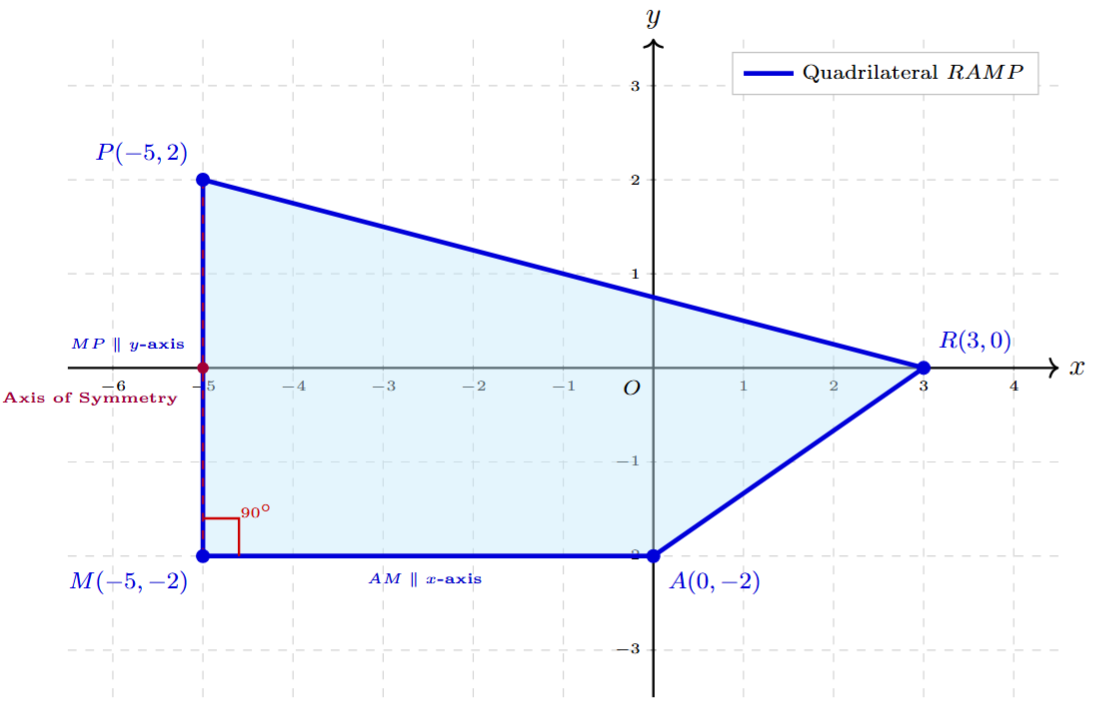
By looking at the graph, it is verified that $\angle AMP = 90^\circ$, side $AM$ is horizontal, side $MP$ is vertical, and point $P$ is the reflection of $M$ across the $x$-axis.
Question 4. Plot point $Z (5, -6)$ on the Cartesian plane. Construct a right-angled triangle $IZN$ and find the lengths of the three sides.
(Comment: Answers may differ from person to person.)
Answer:
Given:
A point $Z$ with coordinates $(5, -6)$ in the Fourth Quadrant of the Cartesian plane.
To Construct:
A right-angled triangle $IZN$ using $Z$ as one of the vertices and determining the lengths of its sides.
Construction and Solution:
To construct a right-angled triangle easily, we can choose the other two vertices such that the sides $IZ$ and $ZN$ are parallel to the coordinate axes. This ensures that the angle between them is exactly $90^\circ$.
1. Let us choose Point $I$ on the $x$-axis directly above $Z$. Since it is on the $x$-axis, its $y$-coordinate is $0$.
$\text{Coordinates of } I = (5, 0)$
2. Let us choose Point $N$ on the $y$-axis directly to the left of $Z$. Since it is on the $y$-axis, its $x$-coordinate is $0$.
$\text{Coordinates of } N = (0, -6)$
3. Now, we calculate the lengths of the three sides using the distance formula or simple subtraction for lines parallel to the axes.
Lengths of the Sides:
Side $IZ$ (Vertical side):
$IZ = |0 - (-6)|$
[Distance along $y$-axis]
$IZ = 6 \text{ units}$
Side $ZN$ (Horizontal side):
$ZN = |5 - 0|$
[Distance along $x$-axis]
$ZN = 5 \text{ units}$
Side $IN$ (Hypotenuse):
By Pythagoras' Theorem:
$IN = \sqrt{IZ^2 + ZN^2}$
$IN = \sqrt{6^2 + 5^2}$
$IN = \sqrt{36 + 25}$
$IN = \sqrt{61} \approx 7.81 \text{ units}$
Graphical Verification:
The points $I(5,0)$, $Z(5,-6)$, and $N(0,-6)$ form a right-angled triangle with the right angle at vertex $Z$.
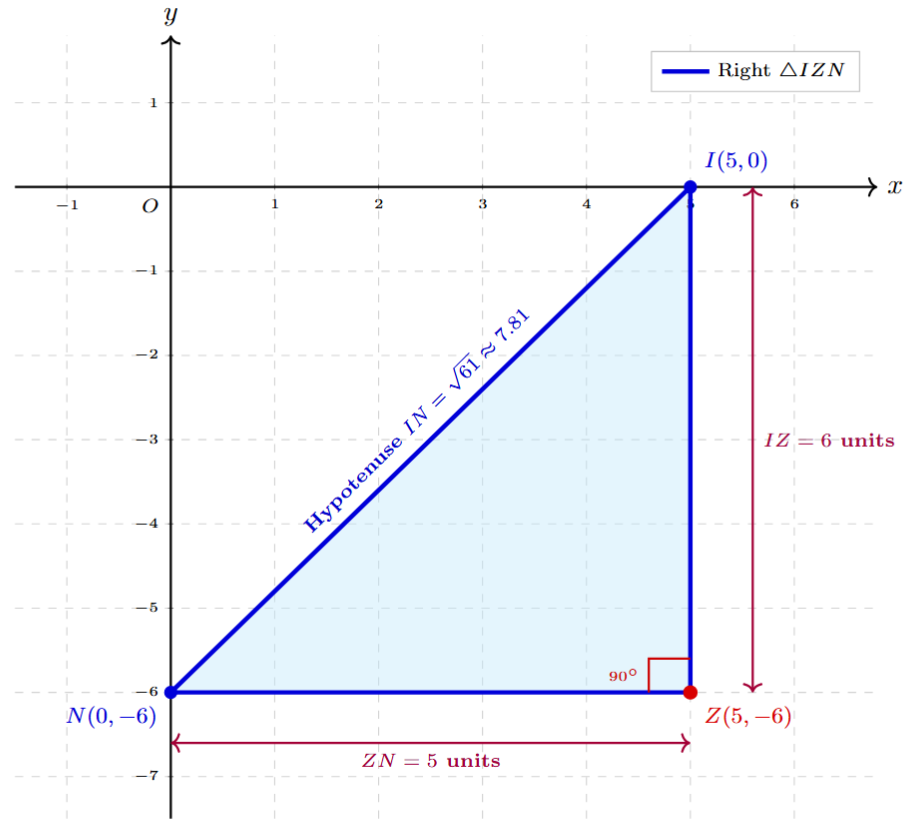
Therefore, the lengths of the three sides of $\triangle IZN$ are $6 \text{ units}$, $5 \text{ units}$, and $\sqrt{61} \text{ units}$.
Question 5. What would a system of coordinates be like if we did not have negative numbers? Would this system allow us to locate all the points on a $2$-D plane?
Answer:
Solution:
If a coordinate system did not have negative numbers, it would consist only of the First Quadrant ($x \geq 0$ and $y \geq 0$). Both the $x$-axis and $y$-axis would be rays starting from the origin $(0, 0)$ rather than infinite lines.
Would it allow us to locate all points?
No, this system would not allow us to locate all points on a 2-D plane. A complete 2-D Cartesian plane extends infinitely in all directions. Without negative numbers, we would be unable to represent:
1. Points to the left of the $y$-axis (where $x < 0$).
2. Points below the $x$-axis (where $y < 0$).
In other words, we would lose the ability to describe positions in the Second, Third, and Fourth Quadrants.
Question 6. Are the points $M (-3, -4)$, $A (0, 0)$ and $G (6, 8)$ on the same straight line? Suggest a method to check this without plotting and joining the points.
Answer:
Given:
Three points $M(-3, -4)$, $A(0, 0)$, and $G(6, 8)$.
To Find:
Determine if the points are collinear (lie on the same straight line) using the Distance Formula.
Solution:
The distance formula between two points $(x_1, y_1)$ and $(x_2, y_2)$ is given by:
$\text{Distance} = \sqrt{(x_2 - x_1)^2 + (y_2 - y_1)^2}$
For three points to be collinear, the sum of the distances between the two shorter segments must be equal to the distance of the longest segment.
1. Calculating distance $MA$ (between $M(-3, -4)$ and $A(0, 0)$):
$MA = \sqrt{(0 - (-3))^2 + (0 - (-4))^2}$
$MA = \sqrt{3^2 + 4^2} = \sqrt{9 + 16} = \sqrt{25}$
$MA = 5 \text{ units}$
2. Calculating distance $AG$ (between $A(0, 0)$ and $G(6, 8)$):
$AG = \sqrt{(6 - 0)^2 + (8 - 0)^2}$
$AG = \sqrt{6^2 + 8^2} = \sqrt{36 + 64} = \sqrt{100}$
$AG = 10 \text{ units}$
3. Calculating distance $MG$ (between $M(-3, -4)$ and $G(6, 8)$):
$MG = \sqrt{(6 - (-3))^2 + (8 - (-4))^2}$
$MG = \sqrt{9^2 + 12^2} = \sqrt{81 + 144} = \sqrt{225}$
$MG = 15 \text{ units}$
Conclusion:
Now, let us check if the sum of the two shorter distances ($MA$ and $AG$) equals the longest distance ($MG$):
$MA + AG = 5 + 10 = 15$
$MA + AG = MG$
[As $15 = 15$]
Since the sum of the lengths of two segments is equal to the length of the third segment, the points $M$, $A$, and $G$ are collinear and lie on the same straight line.
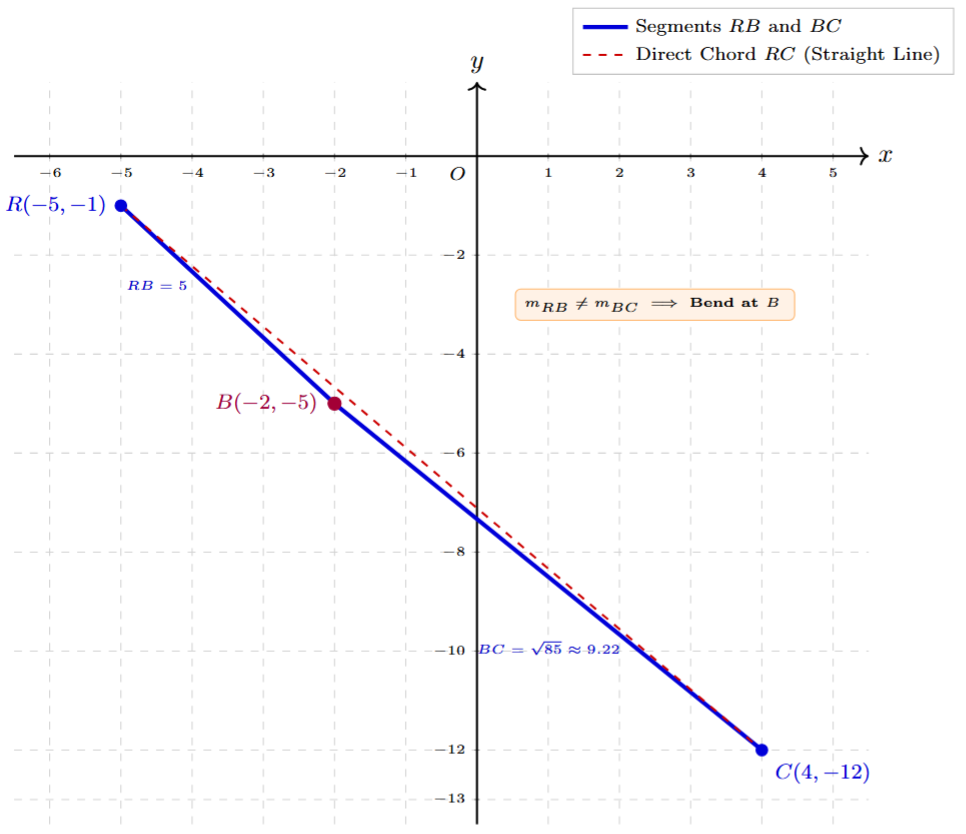
Question 7. Use your method (from Problem $6$) to check if the points $R (-5, -1)$, $B (-2, -5)$ and $C (4, -12)$ are on the same straight line. Now plot both sets of points and check your answers.
Answer:
Given:
Three points $R(-5, -1)$, $B(-2, -5)$, and $C(4, -12)$.
To Find:
Determine if the points are collinear using the Distance Formula.
Solution:
The distance between two points $(x_1, y_1)$ and $(x_2, y_2)$ is given by the formula:
$\text{Distance} = \sqrt{(x_2 - x_1)^2 + (y_2 - y_1)^2}$
We calculate the lengths of the segments $RB$, $BC$, and $RC$.
1. Distance $RB$ (between $R(-5, -1)$ and $B(-2, -5)$):
$RB = \sqrt{(-2 - (-5))^2 + (-5 - (-1))^2}$
$RB = \sqrt{(3)^2 + (-4)^2} = \sqrt{9 + 16}$
$RB = 5 \text{ units}$
2. Distance $BC$ (between $B(-2, -5)$ and $C(4, -12)$):
$BC = \sqrt{(4 - (-2))^2 + (-12 - (-5))^2}$
$BC = \sqrt{(6)^2 + (-7)^2} = \sqrt{36 + 49}$
$BC = \sqrt{85} \approx 9.22 \text{ units}$
3. Distance $RC$ (between $R(-5, -1)$ and $C(4, -12)$):
$RC = \sqrt{(4 - (-5))^2 + (-12 - (-1))^2}$
$RC = \sqrt{(9)^2 + (-11)^2} = \sqrt{81 + 121}$
$RC = \sqrt{202} \approx 14.21 \text{ units}$
Conclusion:
For the points to be on the same straight line, the sum of the two shorter segments must be equal to the longest segment.
Shortest distances: $RB = 5$ and $BC \approx 9.22$.
$RB + BC = 5 + 9.22 = 14.22$
Longest distance: $RC = 14.21$
$RB + BC \neq RC$
[As $14.22 \neq 14.21$]
Since the sum of the segments is not exactly equal to the third segment (even if very close), the points $R$, $B$, and $C$ are not collinear. Plotting the points will show a very slight bend at point $B$, forming a triangle rather than a single line.
Verification through Plotting:
Question 8. Using the origin as one vertex, plot the vertices of:
(i) A right-angled isosceles triangle.
(ii) An isosceles triangle with one vertex in Quadrant $III$ and the other in Quadrant $IV$.
Answer:
To Plot:
(i) A right-angled isosceles triangle with one vertex at the origin.
(ii) An isosceles triangle with the origin as a vertex and other vertices in Quadrant $III$ and Quadrant $IV$.
Solution:
(i) Right-angled isosceles triangle:
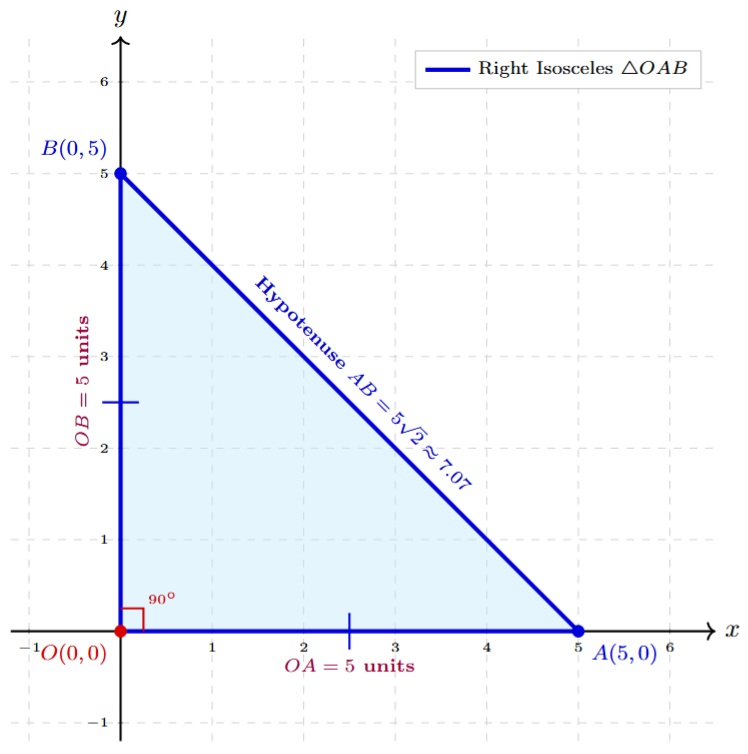
To form a right-angled isosceles triangle using the origin $O(0, 0)$ as the vertex where the right angle is formed, we can choose two points on the coordinate axes that are at an equal distance from the origin.
Let the distance be $a = 5$ units.
The vertices are:
1. $O (0, 0)$ (The origin)
2. $A (5, 0)$ (On the positive $x$-axis)
3. $B (0, 5)$ (On the positive $y$-axis)
Since $OA$ lies on the $x$-axis and $OB$ lies on the $y$-axis, the angle between them is $90^\circ$.
$OA = OB = 5 \text{ units}$
(Sides of isosceles triangle)
(ii) Isosceles triangle with vertices in Quadrant $III$ and $IV$:
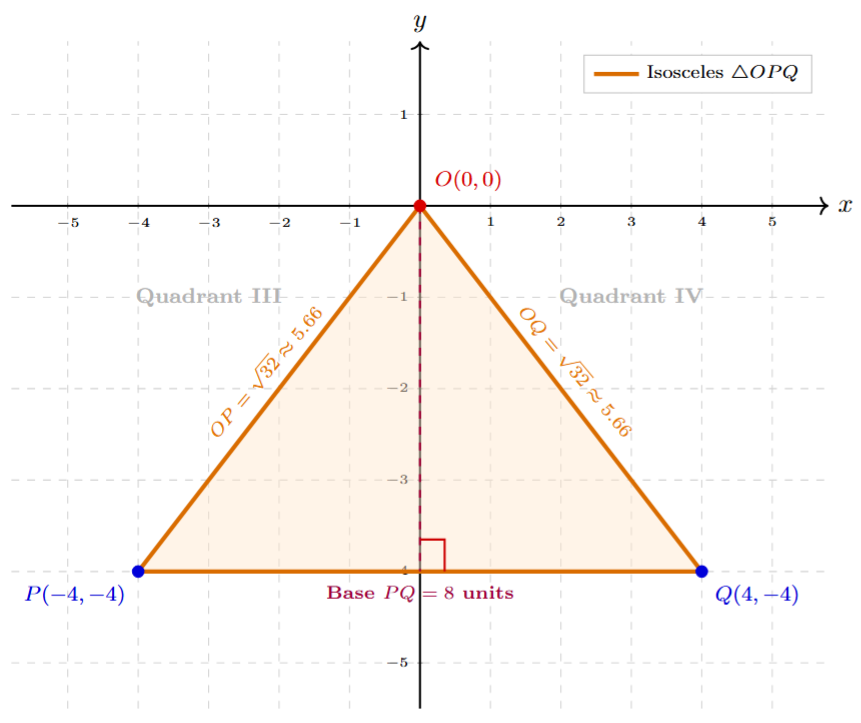
Let the origin $O(0, 0)$ be the first vertex. For the triangle to be isosceles with vertices in Quadrant $III$ (where both $x$ and $y$ are negative) and Quadrant $IV$ (where $x$ is positive and $y$ is negative), we can choose points that are symmetric about the $y$-axis.
Let the vertices be:
1. $O (0, 0)$
2. $P (-4, -4)$ (Located in Quadrant $III$)
3. $Q (4, -4)$ (Located in Quadrant $IV$)
To verify if the triangle is isosceles, we find the lengths of $OP$ and $OQ$ using the distance formula:
$OP = \sqrt{(-4 - 0)^2 + (-4 - 0)^2} = \sqrt{(-4)^2 + (-4)^2} = \sqrt{16 + 16} $$ = \sqrt{32} \text{ units}$
$OQ = \sqrt{(4 - 0)^2 + (-4 - 0)^2} = \sqrt{4^2 + (-4)^2} = \sqrt{16 + 16} $$ = \sqrt{32} \text{ units}$
$OP = OQ$
(Property of Isosceles Triangle)
Question 9. The following table shows the coordinates of points $S$, $M$ and $T$. In each case, state whether $M$ is the midpoint of segment $ST$. Justify your answer.
| $S$ | $M$ | $T$ | Is $M$ the midpoint of $ST$? Yes or No | Reason for your answer |
|---|---|---|---|---|
| $(-3, 0)$ | $(0, 0)$ | $(3, 0)$ | ||
| $(2, 3)$ | $(3, 4)$ | $(4, 5)$ | ||
| $(0, 0)$ | $(0, 5)$ | $(0, -10)$ | ||
| $(-8, 7)$ | $(0, -2)$ | $(6, -3)$ |
When $M$ is the mid-point of $ST$, can you find any connection between the coordinates of $M$, $S$ and $T$?
Answer:
Given:
The coordinates of points $S$, $M$, and $T$ for four different scenarios as provided in the table.
To Find:
Determine whether $M$ is the midpoint of segment $ST$ using the Distance Formula and establish the connection between the coordinates of $S, M,$ and $T$.
Solution:
To verify if $M$ is the midpoint of segment $ST$ using the distance formula, we must check two conditions:
1. The distance $SM$ must be equal to the distance $MT$.
2. The points must be collinear such that $SM + MT = ST$.
The distance between two points $(x_1, y_1)$ and $(x_2, y_2)$ is given by:
$d = \sqrt{(x_2 - x_1)^2 + (y_2 - y_1)^2}$
[Distance Formula]
Case (i): $S(-3, 0), M(0, 0), T(3, 0)$
$SM = \sqrt{(0 - (-3))^2 + (0 - 0)^2} = \sqrt{3^2 + 0} = 3 \text{ units}$
$MT = \sqrt{(3 - 0)^2 + (0 - 0)^2} = \sqrt{3^2 + 0} = 3 \text{ units}$
$ST = \sqrt{(3 - (-3))^2 + (0 - 0)^2} = \sqrt{6^2 + 0} = 6 \text{ units}$
$SM = MT = 3 \text{ and } SM + MT = ST$
(Condition satisfied)
Conclusion: Yes, $M$ is the midpoint of $ST$.
Case (ii): $S(2, 3), M(3, 4), T(4, 5)$
$SM = \sqrt{(3 - 2)^2 + (4 - 3)^2} = \sqrt{1^2 + 1^2} = \sqrt{2} \text{ units}$
$MT = \sqrt{(4 - 3)^2 + (5 - 4)^2} = \sqrt{1^2 + 1^2} = \sqrt{2} \text{ units}$
$ST = \sqrt{(4 - 2)^2 + (5 - 3)^2} = \sqrt{2^2 + 2^2} = \sqrt{8} = 2\sqrt{2} \text{ units}$
$SM = MT = \sqrt{2} \text{ and } SM + MT = ST$
(Condition satisfied)
Conclusion: Yes, $M$ is the midpoint of $ST$.
Case (iii): $S(0, 0), M(0, 5), T(0, -10)$
$SM = \sqrt{(0 - 0)^2 + (5 - 0)^2} = \sqrt{0 + 25} = 5 \text{ units}$
$MT = \sqrt{(0 - 0)^2 + (-10 - 5)^2} = \sqrt{0 + (-15)^2} = 15 \text{ units}$
$SM \neq MT$
($5 \neq 15$)
Conclusion: No, $M$ is not the midpoint of $ST$.
Case (iv): $S(-8, 7), M(0, -2), T(6, -3)$
$SM = \sqrt{(0 - (-8))^2 + (-2 - 7)^2} = \sqrt{8^2 + (-9)^2} = \sqrt{64 + 81} $$ = \sqrt{145} \text{ units}$
$MT = \sqrt{(6 - 0)^2 + (-3 - (-2))^2} = \sqrt{6^2 + (-1)^2} = \sqrt{36 + 1} $$ = \sqrt{37} \text{ units}$
$SM \neq MT$
($\sqrt{145} \neq \sqrt{37}$)
Conclusion: No, $M$ is not the midpoint of $ST$.
Final Table Results:
| Endpoints $S$ and $T$ | Point $M$ | Is $M$ Midpoint? | Reason (Distances) |
| $(-3, 0), (3, 0)$ | $(0, 0)$ | Yes | $SM = 3, MT = 3$ |
| $(2, 3), (4, 5)$ | $(3, 4)$ | Yes | $SM = \sqrt{2}, MT = \sqrt{2}$ |
| $(0, 0), (0, -10)$ | $(0, 5)$ | No | $SM = 5, MT = 15$ |
| $(-8, 7), (6, -3)$ | $(0, -2)$ | No | $SM = \sqrt{145}, MT = \sqrt{37}$ |
Question 10. Use the connection you found to find the coordinates of $B$ given that $M (-7, 1)$ is the midpoint of $A (3, -4)$ and $B (x, y)$.
Answer:
Given:
Coordinates of point $A = (3, -4)$
Coordinates of the midpoint $M = (-7, 1)$
Coordinates of point $B = (x, y)$
To Find:
The values of $x$ and $y$ using the Distance Formula.
Solution:
If $M$ is the midpoint of segment $AB$, then it must satisfy two conditions based on distances:
1. The distance $AM$ is equal to the distance $MB$.
2. The distance $AB$ is equal to twice the distance $AM$ (since $A, M, B$ are collinear).
The distance formula is:
$d = \sqrt{(x_2 - x_1)^2 + (y_2 - y_1)^2}$
Step 1: Calculate the distance $AM$:
$AM = \sqrt{(-7 - 3)^2 + (1 - (-4))^2}$
$AM = \sqrt{(-10)^2 + (5)^2}$
$AM = \sqrt{100 + 25} = \sqrt{125}$
Step 2: Set $AM^2 = MB^2$:
$(\sqrt{125})^2 = (x - (-7))^2 + (y - 1)^2$
$125 = (x + 7)^2 + (y - 1)^2$
[Equidistant Property]
$125 = x^2 + 14x + 49 + y^2 - 2y + 1$
$x^2 + y^2 + 14x - 2y = 75$
... (i)
Step 3: Set $AB^2 = (2 \times AM)^2$:
$AB = 2\sqrt{125} = \sqrt{4 \times 125} = \sqrt{500}$
$(x - 3)^2 + (y - (-4))^2 = 500$
$x^2 - 6x + 9 + y^2 + 8y + 16 = 500$
[Collinearity Property]
$x^2 + y^2 - 6x + 8y = 475$
... (ii)
Step 4: Solve the equations:
Subtracting equation (iii) from equation (v):
$(x^2 + y^2 - 6x + 8y) - (x^2 + y^2 + 14x - 2y) = 475 - 75$
$-20x + 10y = 400$
Dividing the entire equation by 10:
$-2x + y = 40 \implies y = 2x + 40$
... (iii)
Substituting $y = 2x + 40$ back into equation (i):
$x^2 + (2x + 40)^2 + 14x - 2(2x + 40) = 75$
$x^2 + 4x^2 + 160x + 1600 + 14x - 4x - 80 = 75$
$5x^2 + 170x + 1520 = 75$
$5x^2 + 170x + 1445 = 0$
Dividing by 5:
$x^2 + 34x + 289 = 0$
This is a perfect square: $(x + 17)^2 = 0$
Therefore, $x = -17$.
Step 5: Find the value of $y$:
Substitute $x = -17$ in equation (iii):
$y = 2(-17) + 40$
$y = -34 + 40$
Therefore, $y = 6$.
Final Answer:
Using the distance formula, the coordinates of point $B$ are calculated to be $(-17, 6)$.
Question 11. Let $P$, $Q$ be points of trisection of $AB$, with $P$ closer to $A$, and $Q$ closer to $B$. Using your knowledge of how to find the coordinates of the midpoint of a segment, how would you find the coordinates of $P$ and $Q$? Do this for the case when the points are $A (4, 7)$ and $B (16, -2)$.
Answer:
Given:
Endpoints of the line segment: $A(4, 7)$ and $B(16, -2)$.
Points of trisection: $P$ and $Q$, where $P$ is closer to $A$ and $Q$ is closer to $B$.
To Find:
The coordinates of points $P(x_1, y_1)$ and $Q(x_2, y_2)$ using midpoint logic.
Solution:
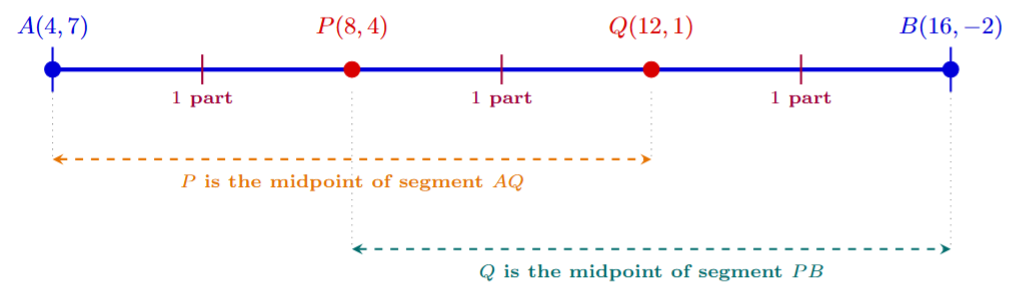
Points of trisection divide the line segment $AB$ into three equal parts. Therefore, $AP = PQ = QB$.
Based on this property, we can derive two midpoint relationships:
1. Since $AP = PQ$, point $P$ is the midpoint of the segment $AQ$.
2. Since $PQ = QB$, point $Q$ is the midpoint of the segment $PB$.
Step 1: Finding $x$-coordinates:
Using the midpoint formula for $P$ being the midpoint of $AQ$:
$x_1 = \frac{4 + x_2}{2}$
[From $P$ is midpoint of $AQ$] ... (i)
$\Rightarrow 2x_1 - x_2 = 4$
Using the midpoint formula for $Q$ being the midpoint of $PB$:
$x_2 = \frac{x_1 + 16}{2}$
[From $Q$ is midpoint of $PB$] ... (ii)
$\Rightarrow -x_1 + 2x_2 = 16$
Multiplying equation (ii) by 2, we get:
$-2x_1 + 4x_2 = 32$
Adding this to equation (i):
$(2x_1 - x_2) + (-2x_1 + 4x_2) = 4 + 32$
$3x_2 = 36$
$x_2 = \frac{36}{3} = 12$
Substituting $x_2 = 12$ in equation (i):
$2x_1 - 12 = 4$
$2x_1 = 16 \implies x_1 = 8$
Step 2: Finding $y$-coordinates:
Using the midpoint formula for $P$ being the midpoint of $AQ$:
$y_1 = \frac{7 + y_2}{2}$
... (iii)
$\Rightarrow 2y_1 - y_2 = 7$
Using the midpoint formula for $Q$ being the midpoint of $PB$:
$y_2 = \frac{y_1 - 2}{2}$
... (iv)
$\Rightarrow -y_1 + 2y_2 = -2$
Multiplying equation (iv) by 2, we get:
$-2y_1 + 4y_2 = -4$
Adding this to equation (iii):
$(2y_1 - y_2) + (-2y_1 + 4y_2) = 7 - 4$
$3y_2 = 3 \implies y_2 = 1$
Substituting $y_2 = 1$ in equation (iii):
$2y_1 - 1 = 7$
$2y_1 = 8 \implies y_1 = 4$
Final Answer:
The coordinates of the points of trisection are $P(8, 4)$ and $Q(12, 1)$.
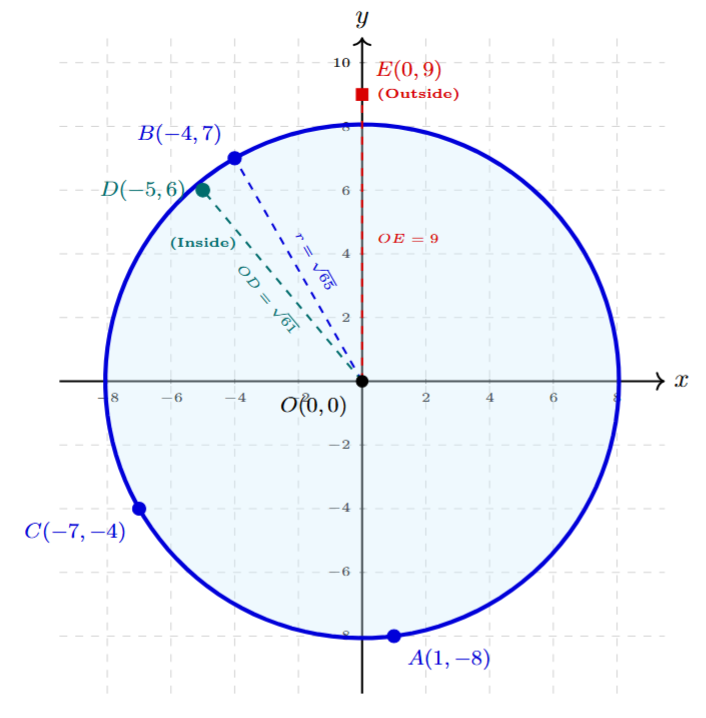
Question 12. (i) Given the points $A (1, -8)$, $B (-4, 7)$ and $C (-7, -4)$, show that they lie on a circle $K$ whose center is the origin $O (0, 0)$. What is the radius of circle $K$?
(ii) Given the points $D (-5, 6)$ and $E (0, 9)$, check whether $D$ and $E$ lie within the circle, on the circle, or outside the circle $K$.
Answer:
Given:
1. Center of the circle $K$ is the origin, $O(0, 0)$.
2. Points to be verified on the circle: $A(1, -8)$, $B(-4, 7)$, and $C(-7, -4)$.
3. Points to be checked for position: $D(-5, 6)$ and $E(0, 9)$.
To Find/Verify:
(i) Show that $A$, $B$, and $C$ lie on circle $K$ and find the radius.
(ii) Determine if $D$ and $E$ lie inside, on, or outside circle $K$.
Solution:
(i) Verification of points $A$, $B$, and $C$
A point $(x, y)$ lies on a circle if its distance from the center $(h, k)$ is equal to the radius $r$. For a circle centered at the origin $O(0, 0)$, the distance $d$ is given by:
$d = \sqrt{x^2 + y^2}$
Calculating distance $OA$:
$OA = \sqrt{(1)^2 + (-8)^2} = \sqrt{1 + 64} = \sqrt{65}$
Calculating distance $OB$:
$OB = \sqrt{(-4)^2 + (7)^2} = \sqrt{16 + 49} = \sqrt{65}$
Calculating distance $OC$:
$OC = \sqrt{(-7)^2 + (-4)^2} = \sqrt{49 + 16} = \sqrt{65}$
Since $OA = OB = OC = \sqrt{65}$, all three points are equidistant from the origin. Thus, they lie on the same circle $K$.
The radius of the circle $K$ is $r = \sqrt{65}$ units.
(ii) Position of points $D$ and $E$
We compare the distance of each point from the origin with the radius $r = \sqrt{65}$.
For Point $D(-5, 6)$:
$OD = \sqrt{(-5)^2 + (6)^2} = \sqrt{25 + 36} = \sqrt{61}$
$OD = \sqrt{61} < \sqrt{65}$
Since $OD < r$, point $D$ lies within (inside) the circle $K$.
For Point $E(0, 9)$:
$OE = \sqrt{(0)^2 + (9)^2} = \sqrt{0 + 81} = \sqrt{81} = 9$
$OE = \sqrt{81} > \sqrt{65}$
Since $OE > r$, point $E$ lies outside the circle $K$.
Summary Table:
| Point | Distance from $O(0,0)$ | Comparison with $r = \sqrt{65}$ | Position |
| $A(1, -8)$ | $\sqrt{65}$ | $Equal$ | On the circle |
| $B(-4, 7)$ | $\sqrt{65}$ | $Equal$ | On the circle |
| $C(-7, -4)$ | $\sqrt{65}$ | $Equal$ | On the circle |
| $D(-5, 6)$ | $\sqrt{61}$ | $Less$ $than$ | Inside the circle |
| $E(0, 9)$ | $9$ ($\sqrt{81}$) | $Greater$ $than$ | Outside the circle |
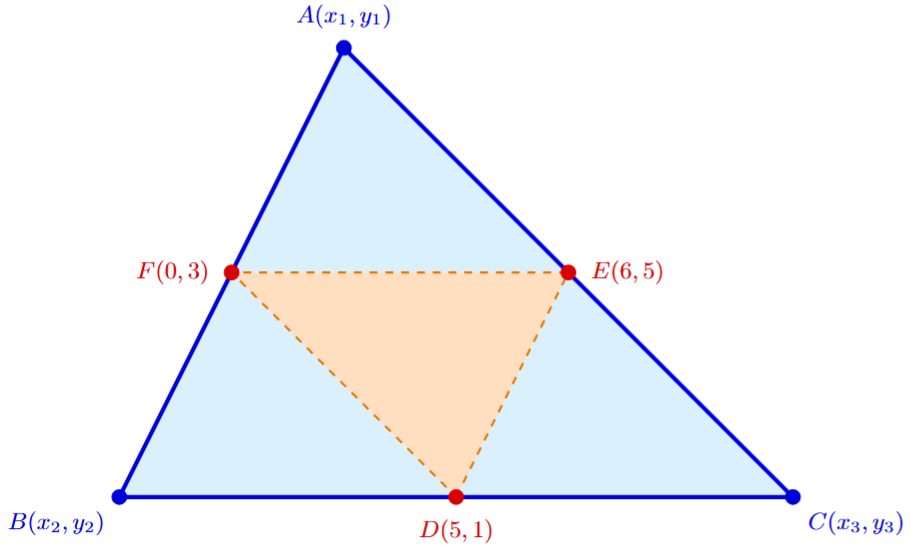
Question 13. The midpoints of the sides of triangle $ABC$ are the points $D$, $E$, and $F$. Given that the coordinates of $D$, $E$, and $F$ are $(5, 1)$, $(6, 5)$, and $(0, 3)$, respectively, find the coordinates of $A$, $B$ and $C$.
Answer:
Given:
Midpoints of the sides of $\triangle ABC$ are:
1. $D(5, 1)$ (Midpoint of $BC$)
2. $E(6, 5)$ (Midpoint of $AC$)
3. $F(0, 3)$ (Midpoint of $AB$)
To Find:
The coordinates of the vertices $A(x_1, y_1)$, $B(x_2, y_2)$, and $C(x_3, y_3)$.
Solution:
According to the midpoint formula, the coordinates of the midpoint of a line segment joining $(x_1, y_1)$ and $(x_2, y_2)$ are $\left(\frac{x_1+x_2}{2}, \frac{y_1+y_2}{2}\right)$.
For the $x$-coordinates:
$x_1 + x_2 = 2 \times 0 = 0$
[From midpoint $F$] ... (i)
$x_2 + x_3 = 2 \times 5 = 10$
[From midpoint $D$] ... (ii)
$x_1 + x_3 = 2 \times 6 = 12$
[From midpoint $E$] ... (iii)
Adding equations (i), (ii), and (iii):
$2(x_1 + x_2 + x_3) = 0 + 10 + 12$
$2(x_1 + x_2 + x_3) = 22$
$x_1 + x_2 + x_3 = 11$
... (iv)
Now, we find individual $x$-coordinates by subtracting (i), (ii), and (iii) from (iv):
$x_1 = (x_1 + x_2 + x_3) - (x_2 + x_3) = 11 - 10 = 1$
$x_2 = (x_1 + x_2 + x_3) - (x_1 + x_3) = 11 - 12 = -1$
$x_3 = (x_1 + x_2 + x_3) - (x_1 + x_2) = 11 - 0 = 11$
For the $y$-coordinates:
$y_1 + y_2 = 2 \times 3 = 6$
[From midpoint $F$] ... (v)
$y_2 + y_3 = 2 \times 1 = 2$
[From midpoint $D$] ... (vi)
$y_1 + y_3 = 2 \times 5 = 10$
[From midpoint $E$] ... (vii)
Adding equations (v), (vi), and (vii):
$2(y_1 + y_2 + y_3) = 6 + 2 + 10$
$2(y_1 + y_2 + y_3) = 18$
$y_1 + y_2 + y_3 = 9$
... (viii)
Now, we find individual $y$-coordinates by subtracting (v), (vi), and (vii) from (viii):
$y_1 = (y_1 + y_2 + y_3) - (y_2 + y_3) = 9 - 2 = 7$
$y_2 = (y_1 + y_2 + y_3) - (y_1 + y_3) = 9 - 10 = -1$
$y_3 = (y_1 + y_2 + y_3) - (y_1 + y_2) = 9 - 6 = 3$
Final Result:
The coordinates of the vertices of the triangle are:
$A = (1, 7)$
$B = (-1, -1)$
$C = (11, 3)$
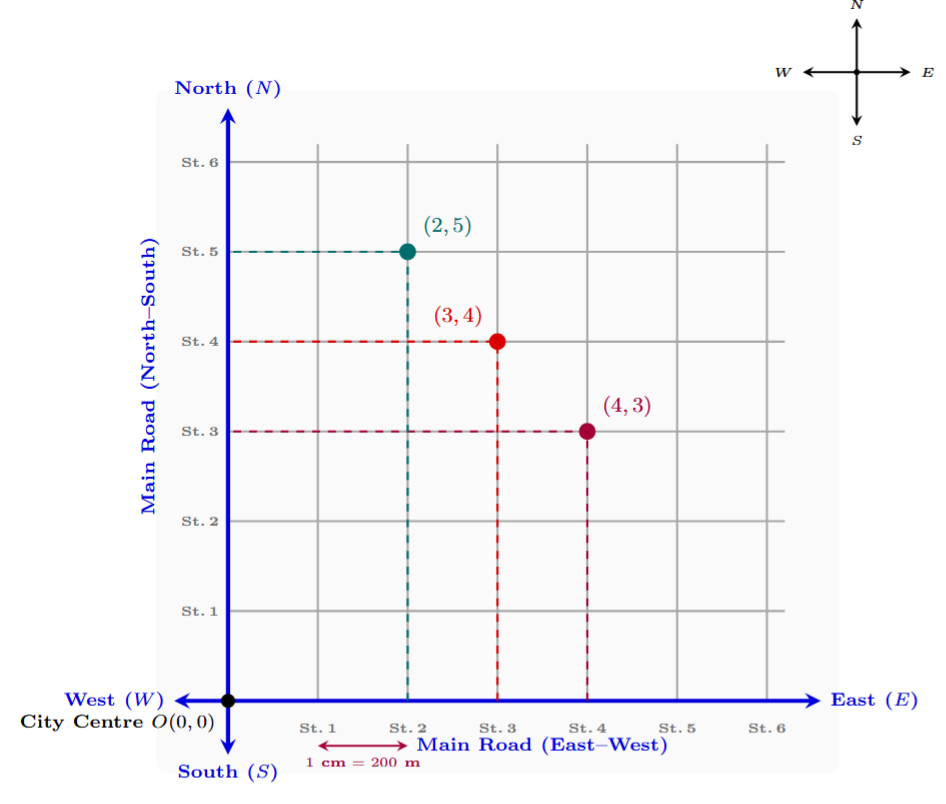
Question 14. A city has two main roads which cross each other at the centre of the city. These two roads are along the North–South ($N$–$S$) direction and East–West ($E$–$W$) direction. All the other streets of the city run parallel to these roads and are $200\text{ m}$ apart. There are $10$ streets in each direction.
(i) Using $1\text{ cm} = 200\text{ m}$, draw a model of the city in your notebook. Represent the roads/streets by single lines.
(ii) There are street intersections in the model. Each street intersection is formed by two streets — one running in the $N$–$S$ direction and another in the $E$–$W$ direction. Each street intersection is referred to in the following manner: If the second street running in the $N$–$S$ direction and $5$th street in the $E$–$W$ direction meet at some crossing, then we call this street intersection $(2, 5)$. Using this convention, find:
(a) how many street intersections can be referred to as $(4, 3)$.
(b) how many street intersections can be referred to as $(3, 4)$.
Answer:
Given:
Two main roads cross at the city centre: North–South ($N$–$S$) and East–West ($E$–$W$).
Total streets in each direction = 10.
Distance between parallel streets = $200\text{ m}$.
Scale for model = $1\text{ cm} = 200\text{ m}$.
To Find:
(i) Draw a city model using the given scale.
(ii) Determine how many street intersections are referred to as $(4, 3)$ and $(3, 4)$.
Solution:
(i) City Model Construction:
In our model, the $N$–$S$ roads can be represented as vertical lines (parallel to the $y$-axis) and the $E$–$W$ roads as horizontal lines (parallel to the $x$-axis). Since the distance between each street is $200\text{ m}$ and our scale is $1\text{ cm} = 200\text{ m}$, each street will be drawn at a distance of $1\text{ cm}$ from the previous one.
(ii) Identification of Intersections:
The city layout is based on a coordinate system where each intersection is a unique point defined by the crossing of a specific $N$–$S$ street and an $E$–$W$ street.
(a) For the intersection $(4, 3)$:
This refers to the intersection of the $4^{\text{th}}$ street in the $N$–$S$ direction and the $3^{\text{rd}}$ street in the $E$–$W$ direction. In any coordinate plane, a specific pair of coordinates $(x, y)$ identifies exactly one point.
Therefore, there is only one street intersection that can be referred to as $(4, 3)$.
(b) For the intersection $(3, 4)$:
This refers to the intersection of the $3^{\text{rd}}$ street in the $N$–$S$ direction and the $4^{\text{th}}$ street in the $E$–$W$ direction. This point is distinct from $(4, 3)$.
Therefore, there is only one street intersection that can be referred to as $(3, 4)$.
Conclusion:
Both $(4, 3)$ and $(3, 4)$ are unique intersections in the city grid. Their coordinates are distinct, and each pair points to a single, specific location where two streets cross.
Question 15. A computer graphics program displays images on a rectangular screen whose coordinate system has the origin at the bottom-left corner. The screen is $800$ pixels wide and $600$ pixels high. A circular icon of radius $80$ pixels is drawn with its centre at the point $A (100, 150)$. Another circular icon of radius $100$ pixels is drawn with its centre at the point $B (250, 230)$. Determine:
(i) whether any part of either circle lies outside the screen.
(ii) whether the two circles intersect each other.
Answer:
Given:
Screen Dimensions: Width = $800$ pixels, Height = $600$ pixels.
The screen boundaries are from $x = 0$ to $x = 800$ and from $y = 0$ to $y = 600$.
Circle A: Centre at $(100, 150)$ and Radius $r_1 = 80$ pixels.
Circle B: Centre at $(250, 230)$ and Radius $r_2 = 100$ pixels.
To Find:
(i) Check if any part of either circle lies outside the screen boundary.
(ii) Check if the two circles intersect each other.
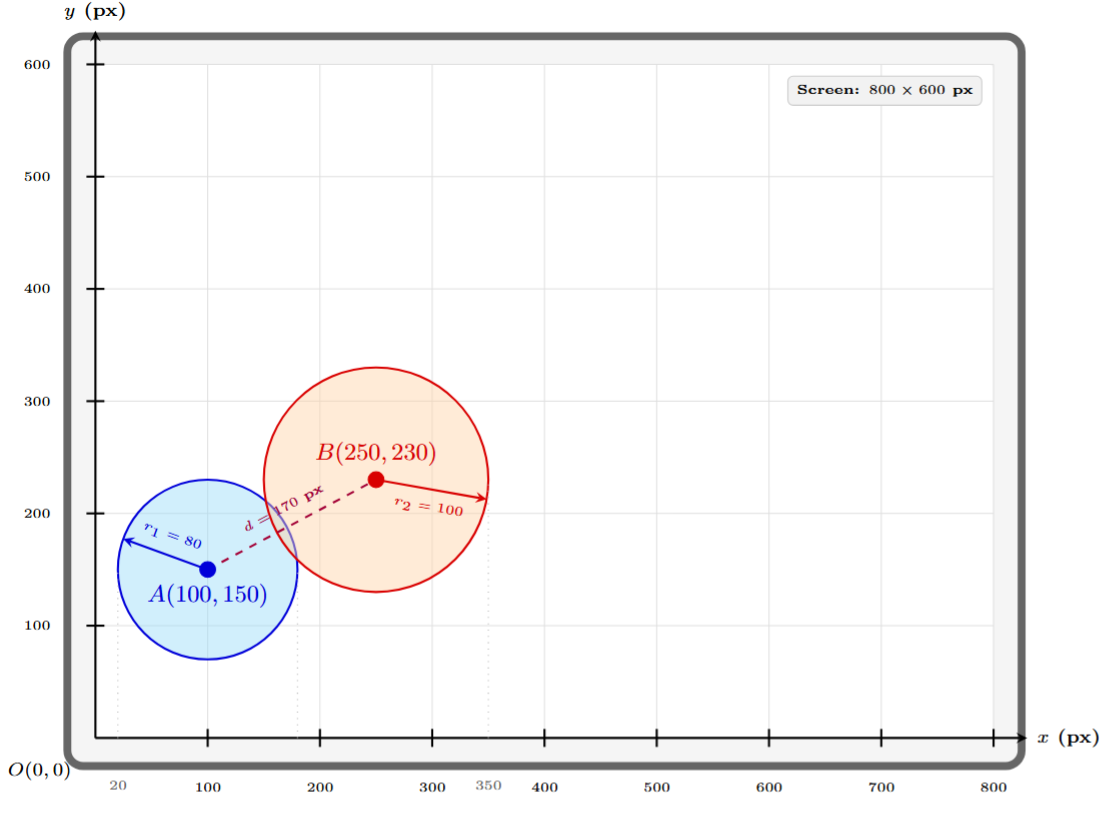
Solution:
(i) Checking if circles are within the screen:
A circle stays inside the screen if its leftmost, rightmost, topmost, and bottom-most points are within the screen limits ($0 \le x \le 800$ and $0 \le y \le 600$).
For Circle A:
Horizontal range: From $100 - 80 = 20$ to $100 + 80 = 180$.
Vertical range: From $150 - 80 = 70$ to $150 + 80 = 230$.
Since 20 and 180 are between 0 and 800, and 70 and 230 are between 0 and 600, Circle A is completely inside the screen.
For Circle B:
Horizontal range: From $250 - 100 = 150$ to $250 + 100 = 350$.
Vertical range: From $230 - 100 = 130$ to $230 + 100 = 330$.
Since 150 and 350 are between 0 and 800, and 130 and 330 are between 0 and 600, Circle B is also completely inside the screen.
Conclusion: No part of either circle lies outside the screen.
(ii) Checking if the circles intersect:
To check if two circles intersect, we compare the distance between their centres ($d$) with the sum of their radii ($r_1 + r_2$).
The distance $d$ between two points $(x_1, y_1)$ and $(x_2, y_2)$ is:
$d = \sqrt{(x_2 - x_1)^2 + (y_2 - y_1)^2}$
Calculating the distance $d$:
$d = \sqrt{(250 - 100)^2 + (230 - 150)^2}$
$d = \sqrt{(150)^2 + (80)^2}$
$d = \sqrt{22500 + 6400}$
$d = \sqrt{28900}$
$d = 170 \text{ pixels}$
[Distance between centres]
Now, finding the sum of the radii:
$r_1 + r_2 = 180 \text{ pixels}$
We observe that $d < r_1 + r_2$ ($170 < 180$).
Conclusion: Since the distance between the centres is less than the sum of their radii, the two circles intersect each other.
Question 16. Plot the points $A (2, 1)$, $B (-1, 2)$, $C (-2, -1)$, and $D (1, -2)$ in the coordinate plane. Is $ABCD$ a square? Can you explain why? What is the area of this square?
Answer:
Given:
The coordinates of the points are $A (2, 1)$, $B (-1, 2)$, $C (-2, -1)$, and $D (1, -2)$.
To Find:
(i) Plot the points in the coordinate plane.
(ii) Verify if $ABCD$ is a square.
(iii) Calculate the area of the figure.
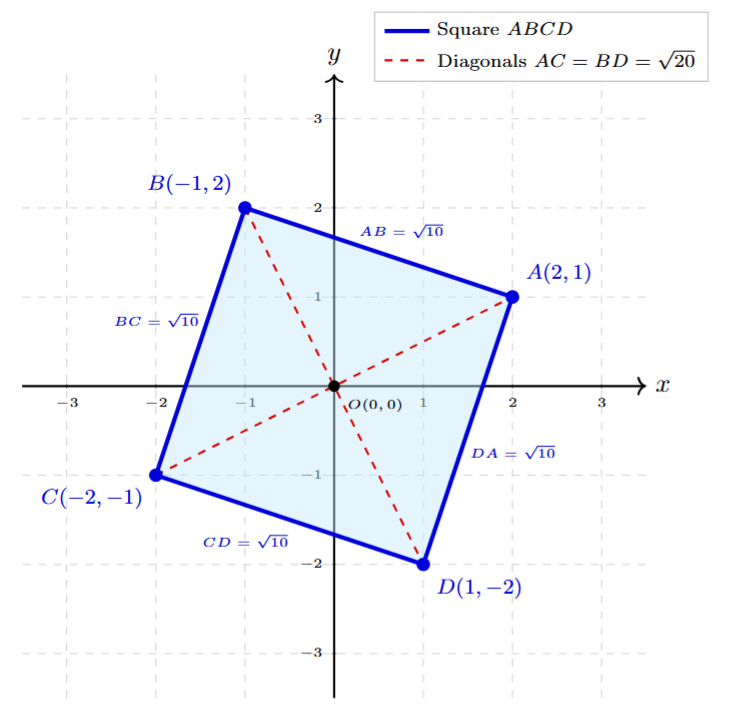
Solution:
To determine if $ABCD$ is a square, we need to check two properties using the distance formula:
1. All four sides must be of equal length ($AB = BC = CD = DA$).
2. The diagonals must be of equal length ($AC = BD$).
The distance between two points $(x_1, y_1)$ and $(x_2, y_2)$ is given by $d = \sqrt{(x_2 - x_1)^2 + (y_2 - y_1)^2}$.
Step 1: Calculating the lengths of the four sides:
$AB = \sqrt{(-1 - 2)^2 + (2 - 1)^2} = \sqrt{9 + 1} = \sqrt{10}$
$BC = \sqrt{(-2 - (-1))^2 + (-1 - 2)^2} = \sqrt{1 + 9} = \sqrt{10}$
$CD = \sqrt{(1 - (-2))^2 + (-2 - (-1))^2} = \sqrt{9 + 1} = \sqrt{10}$
$DA = \sqrt{(2 - 1)^2 + (1 - (-2))^2} = \sqrt{1 + 9} = \sqrt{10}$
Since $AB = BC = CD = DA = \sqrt{10}$, the quadrilateral is a rhombus.
Step 2: Calculating the lengths of the diagonals:
$AC = \sqrt{(-2 - 2)^2 + (-1 - 1)^2} = \sqrt{16 + 4} = \sqrt{20}$
$BD = \sqrt{(1 - (-1))^2 + (-2 - 2)^2} = \sqrt{4 + 16} = \sqrt{20}$
Since the diagonals are equal ($AC = BD$), the quadrilateral $ABCD$ is a square.
Step 3: Calculating the Area:
The area of a square is calculated as $\text{Side} \times \text{Side}$.
$\text{Area} = (\sqrt{10})^2$
$\text{Area} = 10 \text{ sq. units}$
Alternate Solution:
We can also find the area using the length of the diagonals. The area of a square is given by:
$\text{Area} = \frac{1}{2} \times (\text{diagonal})^2$
$\text{Area} = \frac{1}{2} \times (\sqrt{20})^2$
$\text{Area} = \frac{1}{2} \times 20$
Area = $10 \text{ sq. units}$
This matches our previous result, confirming the calculation.