

Chapter 2 Introduction to Linear Polynomials (Class 9 - Latest Maths NCERT (Ganita Manjari I) Solutions)
Looking for clear, expert-verified NCERT Solutions for Chapter 2: Introduction to Linear Polynomials? This page provides detailed, step-by-step answers for the latest Class 9 Maths curriculum. We help you deconstruct the "anatomy" of algebraic expressions, providing comprehensive solutions for Univariate Polynomials. Whether you are identifying terms and coefficients or determining the Degree of a polynomial, our guides ensure you grasp the logic behind every problem in your Ganita Manjari I textbook.
Our solutions focus on modeling real-world patterns using Linear Polynomials (degree 1). We provide solved examples for tracking fixed-rate changes, helping you distinguish between Linear Growth and Linear Decay in scenarios ranging from plant growth to the depreciation of a mobile phone. We also break down the concept of a Function, showing you exactly how to treat polynomials as input-output machines to find the unique value of $y$ for any given $x$.
To help you master the connection between equations and geometry, this page offers step-by-step graphing guides for y = ax + b and clear calculations for slope and y-intercept. These resources, curated by learningspot.co, are designed to turn abstract formulas into intuitive straight-line graphs. By following our detailed walkthroughs, you will build the algebraic confidence necessary to excel in your Class 9 CBSE assessments and prepare for advanced mathematics.
| Content On This Page | ||
|---|---|---|
| Exercise Set 2.1 | Exercise Set 2.2 | Exercise Set 2.3 |
| Exercise Set 2.4 | Exercise Set 2.5 | Exercise Set 2.6 |
| End-Of-Chapter Exercises | ||
Exercise Set 2.1
Question 1. Find the degrees of the following polynomials:
(i) $2x^2 – 5x + 3$
(ii) $y^3 + 2y – 1$
(iii) $– 9$
(iv) $4z – 3$
Answer:
To Find: The degree of the given polynomials.
The degree of a polynomial is the highest power of the variable present in the expression.
Solution:
(i) In $2x^2 - 5x + 3$, the variable is $x$. The powers of $x$ are $2$ and $1$. The highest power is $2$.
$\text{Degree} = 2$
(Quadratic Polynomial)
(ii) In $y^3 + 2y - 1$, the variable is $y$. The powers of $y$ are $3$ and $1$. The highest power is $3$.
$\text{Degree} = 3$
(Cubic Polynomial)
(iii) The given expression is $-9$. This is a constant. It can be written as $-9x^0$.
$\text{Degree} = 0$
(Constant Polynomial)
(iv) In $4z - 3$, the variable is $z$. The highest power of $z$ is $1$.
$\text{Degree} = 1$
(Linear Polynomial)
Question 2. Write polynomials of degrees $1$, $2$ and $3$.
Answer:
Solution:
The following are examples of polynomials with the requested degrees:
(i) Polynomial of Degree 1 (Linear Polynomial):
$P(x) = 3x + 5$
(ii) Polynomial of Degree 2 (Quadratic Polynomial):
$P(y) = y^2 - 4y + 7$
(iii) Polynomial of Degree 3 (Cubic Polynomial):
$P(z) = 2z^3 + 5z^2 - z + 10$
Question 3. What are the coefficients of $x^2$ and $x^3$ in the polynomial $x^4 – 3x^3 + 6x^2 – 2x + 7$?
Answer:
Given: Polynomial $P(x) = x^4 – 3x^3 + 6x^2 – 2x + 7$.
Solution:
A coefficient is the numerical factor of a term.
1. In the term $-3x^3$, the numerical factor multiplied by $x^3$ is $-3$.
$\text{Coefficient of } x^3 = -3$
2. In the term $6x^2$, the numerical factor multiplied by $x^2$ is $6$.
$\text{Coefficient of } x^2 = 6$
Question 4. What is the coefficient of $z$ in the polynomial $4z^3 + 5z^2 – 11$?
Answer:
Given: Polynomial $P(z) = 4z^3 + 5z^2 – 11$.
Solution:
We need to find the coefficient of the term containing $z$. Observing the polynomial, we see there is no term with $z$.
We can rewrite the polynomial including the missing term as:
$P(z) = 4z^3 + 5z^2 + 0 \cdot z - 11$
Therefore, the coefficient of $z$ is $0$.
Question 5. What is the constant term of the polynomial $9x^3 + 5x^2 – 8x –10$?
Recall that polynomials of degree $1$ are called linear polynomials. In this chapter, we shall study linear polynomials.
Answer:
Solution:
A constant term in a polynomial is the term that does not contain any variable (or contains the variable with power $0$).
In the given polynomial $9x^3 + 5x^2 – 8x – 10$:
The terms are $9x^3$, $5x^2$, $-8x$, and $-10$.
The term without the variable $x$ is $-10$.
$\text{Constant term} = -10$
(Answer)
Exercise Set 2.2
Question 1. Find the value of the linear polynomial $5x – 3$ if:
(i) $x = 0$
(ii) $x = -1$
(iii) $x = 2$
Answer:
Given:
Linear polynomial $P(x) = 5x - 3$.
Solution:
(i) For $x = 0$:
$P(0) = 5(0) - 3$
$P(0) = 0 - 3$
$P(0) = -3$
(ii) For $x = -1$:
$P(-1) = 5(-1) - 3$
$P(-1) = -5 - 3$
$P(-1) = -8$
(iii) For $x = 2$:
$P(2) = 5(2) - 3$
$P(2) = 10 - 3$
$P(2) = 7$
Question 2. Find the value of the quadratic polynomial $7s^2 – 4s + 6$ if:
(i) $s = 0$
(ii) $s = -3$
(iii) $s = 4$
Answer:
Given:
Quadratic polynomial $P(s) = 7s^2 - 4s + 6$.
Solution:
(i) For $s = 0$:
$P(0) = 7(0)^2 - 4(0) + 6$
$P(0) = 0 - 0 + 6$
$P(0) = 6$
(ii) For $s = -3$:
$P(-3) = 7(-3)^2 - 4(-3) + 6$
$P(-3) = 7(9) + 12 + 6$
$P(-3) = 63 + 18$
$P(-3) = 81$
(iii) For $s = 4$:
$P(4) = 7(4)^2 - 4(4) + 6$
$P(4) = 7(16) - 16 + 6$
$P(4) = 112 - 16 + 6$
$P(4) = 102$
Question 3. The present age of Salil’s mother is $3$ times Salil’s present age. After $5$ years, their ages will add up to $70$ years. Find their present ages.
Answer:
Given:
1. Salil's mother's age is 3 times Salil's age.
2. Sum of their ages after 5 years = 70.
To Find:
Their present ages.
Solution:
Let the present age of Salil be $x$ years.
$\text{Mother's age} = 3x \text{ years}$
(Given)
After 5 years:
Salil's age = $(x + 5)$ years
Mother's age = $(3x + 5)$ years
According to the problem:
$(x + 5) + (3x + 5) = 70$
$4x + 10 = 70$
$4x = 70 - 10$
$4x = 60$
$x = \frac{60}{4} = 15$
Present Ages:
Salil's present age = $x = \mathbf{15 \text{ years}}$
Mother's present age = $3x = 3 \times 15 = \mathbf{45 \text{ years}}$
Question 4. The difference between two positive integers is $63$. The ratio of the two integers is $2:5$. Find the two integers.
Answer:
Given:
Ratio of two integers = $2:5$
Difference between them = 63
Solution:
Let the two positive integers be $2x$ and $5x$.
According to the condition:
$5x - 2x = 63$
$3x = 63$
$x = \frac{63}{3} = 21$
The Integers are:
First integer = $2x = 2 \times 21 = \mathbf{42}$
Second integer = $5x = 5 \times 21 = \mathbf{105}$
Verification:
$105 - 42 = 63$
Question 5. Ruby has $3$ times as many two-rupee coins as she has five-rupee coins. If she has a total of $88$ rupees, how many coins does she have of each type?
Answer:
To Find:
Number of $\textsf{₹}2$ and $\textsf{₹}5$ coins.
Solution:
Let the number of five-rupee coins be $x$.
$\text{Number of two-rupee coins} = 3x$
(Given)
Total amount Ruby has = $\textsf{₹}88$
$\text{Value of } \textsf{₹}5 \text{ coins} = 5 \times x = 5x$
$\text{Value of } \textsf{₹}2 \text{ coins} = 2 \times 3x = 6x$
Total value equation:
$5x + 6x = 88$
$11x = 88$
$x = 8$
[Number of $\textsf{₹}5$ coins]
Number of Coins:
Number of five-rupee coins = $x = \mathbf{8}$
Number of two-rupee coins = $3x = 3 \times 8 = \mathbf{24}$
Question 6. A farmer cuts a $300$ feet fence into two pieces of different sizes. The longer piece is four times as long as the shorter piece. How long are the two pieces?
Answer:
Given:
Total length of fence = 300 ft
Longer piece = $4 \times$ Shorter piece
Solution:
Let the length of the shorter piece be $x$ feet.
Then, the length of the longer piece = $4x$ feet.
Since the total length is 300 feet:
$x + 4x = 300$
$5x = 300$
$x = \frac{300}{5} = 60$
Lengths:
Shorter piece = $\mathbf{60 \text{ feet}}$
Longer piece = $4 \times 60 = \mathbf{240 \text{ feet}}$
Question 7. If the length of a rectangle is $3$ more than twice its width and its perimeter is $24\text{ cm}$, what are the dimensions of the rectangle?
Answer:
Given:
1. Perimeter of the rectangle = $24\text{ cm}$
2. The length of the rectangle is $3$ more than twice its width.
To Find:
The dimensions (Length and Width) of the rectangle.
Solution:
Let the width of the rectangle be $x$ cm.
According to the problem, the length ($L$) is $3$ more than twice the width ($x$).
$L = 2x + 3$
... (i)
We know that the formula for the perimeter ($P$) of a rectangle is:
$P = 2(\text{Length} + \text{Width})$
... (ii)
Substituting the given perimeter and the expressions for length and width in equation (ii):
$24 = 2((2x + 3) + x)$
Dividing both sides by 2:
$12 = 3x + 3$
Now, we solve for $x$ by subtracting 3 from both sides:
$3x = 12 - 3$
$3x = 9$
[Subtracting 3 from 12]
$x = \frac{\cancel{9}^{3}}{\cancel{3}_{1}}$
$x = 3 \text{ cm}$
Now, we find the length by substituting the value of $x$ back into equation (i):
$L = 2(3) + 3$
$L = 6 + 3$
$L = 9 \text{ cm}$
Final Dimensions:
The width of the rectangle is $3\text{ cm}$ and the length is $9\text{ cm}$.
Exercise Set 2.3
Solve the following:
Question 1. A student has $500$ in her savings bank account. She gets $150$ every month as pocket money. How much money will she have at the end of every month from the second month onwards? Find a linear expression to represent the amount she will have in the $n^{th}$ month.
Answer:
Given:
Initial savings = $\textsf{₹} 500$
Monthly addition (pocket money) = $\textsf{₹} 150$
To Find:
1. Money at the end of every month from the second month onwards.
2. Linear expression for the amount in the $n^{th}$ month.
Solution:
Let $n$ represent the number of months passed.
Amount at the end of $1^{\text{st}}$ month = $500 + 150 = \textsf{₹} 650$
Amount at the end of $2^{\text{nd}}$ month = $650 + 150 = \textsf{₹} 800$
Amount at the end of $3^{\text{rd}}$ month = $800 + 150 = \textsf{₹} 950$
Following this pattern, the money at the end of every month from the second month onwards is $\textsf{₹} 800$, $\textsf{₹} 950$, $\textsf{₹} 1100, \dots$
Linear Expression:
The total amount $A$ after $n$ months is the initial balance plus the product of the number of months and the monthly addition.
$A = 500 + 150n$
Where $A$ is the amount in $\textsf{₹}$ and $n$ is the number of months.
Question 2. A rally starts with $120$ members. Each hour, $9$ members drop out of the group. How many members will remain after $1, 2, 3, \dots$ hours? Find a linear expression to represent the number of members at the end of the $n^{th}$ hour.
Answer:
Given:
Initial members = $120$
Drop out rate per hour = $9$
To Find:
1. Remaining members after $1, 2, 3, \dots$ hours.
2. Linear expression for the $n^{th}$ hour.
Solution:
Let $n$ be the number of hours.
Members after 1 hour = $120 - 9 = 111$
Members after 2 hours = $111 - 9 = 102$
Members after 3 hours = $102 - 9 = 93$
The number of members remaining after $1, 2, 3 \dots$ hours will be $111, 102, 93, \dots$
Linear Expression:
Let $M$ be the number of remaining members.
$M = 120 - 9n$
Here, $120$ is the starting value and $9n$ represents the total members dropped after $n$ hours.
Question 3. Suppose the length of a rectangle is $13\text{ cm}$. Find the area if the breadth is:
(i) $12\text{ cm}$
(ii) $10\text{ cm}$
(iii) $8\text{ cm}$
Find the linear pattern representing the area of the rectangle.
Answer:
Given:
Length ($l$) = $13 \text{ cm}$
Solution:
The formula for the area of a rectangle is $\text{Area} = \text{Length} \times \text{Breadth}$.
(i) If breadth ($b$) = $12 \text{ cm}$:
$\text{Area} = 13 \times 12 = \mathbf{156 \text{ cm}^2}$
(ii) If breadth ($b$) = $10 \text{ cm}$:
$\text{Area} = 13 \times 10 = \mathbf{130 \text{ cm}^2}$
(iii) If breadth ($b$) = $8 \text{ cm}$:
$\text{Area} = 13 \times 8 = \mathbf{104 \text{ cm}^2}$
Linear Pattern:
Since the length is fixed at $13 \text{ cm}$, the area ($A$) varies linearly with the breadth ($b$).
$A = 13b$
This linear pattern shows that for every $1 \text{ cm}$ increase in breadth, the area increases by $13 \text{ cm}^2$.
Question 4. Suppose the length of a rectangular box is $7\text{ cm}$ and breadth is $11\text{ cm}$. Find the volume if the height is:
(i) $5\text{ cm}$
(ii) $9\text{ cm}$
(iii) $13\text{ cm}$
Find the linear pattern representing the volume of the rectangular box.
Answer:
Given:
Length ($l$) = $7 \text{ cm}$
Breadth ($b$) = $11 \text{ cm}$
Solution:
The formula for the volume of a rectangular box (cuboid) is $\text{Volume} = \text{Length} \times \text{Breadth} \times \text{Height}$.
The area of the base is $7 \times 11 = 77 \text{ cm}^2$.
(i) If height ($h$) = $5 \text{ cm}$:
$\text{Volume} = 77 \times 5 = \mathbf{385 \text{ cm}^3}$
(ii) If height ($h$) = $9 \text{ cm}$:
$\text{Volume} = 77 \times 9 = \mathbf{693 \text{ cm}^3}$
(iii) If height ($h$) = $13 \text{ cm}$:
$\text{Volume} = 77 \times 13 = \mathbf{1001 \text{ cm}^3}$
Linear Pattern:
Let $V$ represent the volume and $h$ represent the height.
$V = 77h$
This linear expression represents the volume as a function of height.
Question 5. Sarita is reading a book of $500$ pages. She reads $20$ pages every day. How many pages will be left after $15$ days? Express this as a linear pattern.
Answer:
Given:
Total pages in book = $500$
Reading rate = $20$ pages/day
Time passed = $15$ days
Solution:
Pages read in 15 days = $20 \times 15 = 300$ pages
Pages left = Total pages $-$ Pages read
$\text{Pages left} = 500 - 300 = 200$
Therefore, 200 pages will be left after 15 days.
Linear Pattern:
Let $P$ be the number of pages left and $d$ be the number of days elapsed.
$P = 500 - 20d$
Where $500$ is the initial count and $20d$ is the total pages read after $d$ days.
Exercise Set 2.4
Question 1. Suppose a plant has height $1.75\text{ feet}$ and it grows by $0.5\text{ feet}$ each month.
(i) Find the height after $7\text{ months}$.
(ii) Make a table of values for $t$ varying from $0$ to $10\text{ months}$ and show how the height, $h$, increases every month.
(iii) Find an expression that relates $h$ and $t$, and explain why it represents linear growth.
Answer:
Given:
Initial height of the plant ($h_0$) = $1.75\text{ feet}$
Growth rate per month ($r$) = $0.5\text{ feet/month}$
To Find:
(i) Height ($h$) after $t = 7\text{ months}$.
(ii) Table of values for $t = 0$ to $10$.
(iii) Linear expression relating $h$ and $t$.
Solution:
(i) To find the height after $7$ months, we add the total growth to the initial height.
$\text{Total growth} = \text{Growth rate} \times \text{Time}$
$\text{Total growth} = 0.5 \times 7 = 3.5\text{ feet}$
$h = 1.75 + 3.5 = 5.25\text{ feet}$
[Height after 7 months]
(ii) Table of values:
| Time $t$ (months) | Height $h$ (feet) ($h = 1.75 + 0.5t$) |
| 0 | 1.75 |
| 1 | 2.25 |
| 2 | 2.75 |
| 3 | 3.25 |
| 4 | 3.75 |
| 5 | 4.25 |
| 6 | 4.75 |
| 7 | 5.25 |
| 8 | 5.75 |
| 9 | 6.25 |
| 10 | 6.75 |
(iii) Expression and Explanation:
The relationship between height $h$ and time $t$ can be expressed as:
$h = 0.5t + 1.75$
This represents linear growth because the height increases by a constant amount ($0.5\text{ feet}$) for every unit increase in time (each month). In a graph, this would form a straight line with a constant slope.
Question 2. A mobile phone is bought for $\textsf{₹}10,000$. Its value decreases by $\textsf{₹}800$ every year.
(i) Find the value of the phone after $3\text{ years}$.
(ii) Make a table of values for $t$ varying from $0$ to $8\text{ years}$ and show how the value of the phone, $v$, depreciates with time.
(iii) Find an expression that relates $v$ and $t$, and explain why it represents linear decay.
Answer:
Given:
Initial value of the phone ($v_0$) = $\textsf{₹}10,000$
Depreciation rate per year ($d$) = $\textsf{₹}800$
To Find:
(i) Value ($v$) after $t = 3\text{ years}$.
(ii) Table of values for $t = 0$ to $8$.
(iii) Expression relating $v$ and $t$.
Solution:
(i) To find the value after $3$ years, we subtract the total depreciation from the initial price.
$\text{Total depreciation} = 800 \times 3 = \textsf{₹}2,400$
$v = 10,000 - 2,400 = \textsf{₹}7,600$
[Value after 3 years]
(ii) Table of values:
| Time $t$ (years) | Value $v$ ($\textsf{₹}$) ($v = 10000 - 800t$) |
| 0 | 10,000 |
| 1 | 9,200 |
| 2 | 8,400 |
| 3 | 7,600 |
| 4 | 6,800 |
| 5 | 6,000 |
| 6 | 5,200 |
| 7 | 4,400 |
| 8 | 3,600 |
(iii) Expression and Explanation:
The relationship between value $v$ and time $t$ is:
$v = 10,000 - 800t$
This represents linear decay (or depreciation) because the value of the phone decreases by a fixed constant amount ($\textsf{₹}800$) every year. The rate of change is constant and negative.
Question 3. The initial population of a village is $750$. Every year, $50$ people move from a nearby city to the village.
(i) Find the population of the village after $6\text{ years}$.
(ii) Make a table of values for $t$ varying from $0$ to $10\text{ years}$ and show how the population, $P$, increases every year.
(iii) Find an expression that relates $P$ and $t$, and explain why it represents linear growth.
Answer:
Given:
Initial population ($P_0$) = $750$
Increase per year ($i$) = $50$ people
To Find:
(i) Population ($P$) after $t = 6\text{ years}$.
(ii) Table of values for $t = 0$ to $10$.
(iii) Expression relating $P$ and $t$.
Solution:
(i) To find the population after $6$ years:
$\text{Total increase} = 50 \times 6 = 300$
$P = 750 + 300 = 1050$
[Population after 6 years]
(ii) Table of values:
| Time $t$ (years) | Population $P$ ($P = 750 + 50t$) |
| 0 | 750 |
| 1 | 800 |
| 2 | 850 |
| 3 | 900 |
| 4 | 950 |
| 5 | 1000 |
| 6 | 1050 |
| 7 | 1100 |
| 8 | 1150 |
| 9 | 1200 |
| 10 | 1250 |
(iii) Expression and Explanation:
The relationship between population $P$ and time $t$ is:
$P = 50t + 750$
This represents linear growth because the population increases by a constant rate of $50$ individuals per year. The addition is independent of the current population size, leading to a constant slope.
Question 4. A telecom company charges $\textsf{₹}600$ for a certain recharge scheme. This prepaid balance is reduced by $\textsf{₹}15$ each day after the recharge.
(i) Write an equation that models the remaining balance $b(x)$ after using the scheme for $x$ days. Explain why it represents linear decay.
(ii) After how many days will the balance run out?
(iii) Make a table of values for $x$ varying from $1$ to $10\text{ days}$ and show how the balance $b(x)$, reduces with time.
Answer:
Given:
Initial balance = $\textsf{₹}600$
Daily reduction = $\textsf{₹}15$
To Find:
(i) Equation for $b(x)$ and reason for linear decay.
(ii) Number of days until balance becomes zero.
(iii) Table for $x = 1$ to $10$.
Solution:
(i) Equation:
The remaining balance $b(x)$ after $x$ days is calculated by subtracting the total reduction from the initial recharge amount.
$b(x) = 600 - 15x$
This represents linear decay because the balance reduces by a fixed amount ($\textsf{₹}15$) every day. This constant rate of reduction results in a linear relationship with a negative slope.
(ii) Balance running out:
The balance runs out when $b(x) = 0$.
$600 - 15x = 0$
(To Find)
$15x = 600$
$x = \frac{600}{15}$
$x = 40$
[Number of days]
Therefore, the balance will run out after $40$ days.
(iii) Table of values:
| Days $x$ | Balance $b(x)$ ($\textsf{₹}$) |
| 1 | 585 |
| 2 | 570 |
| 3 | 555 |
| 4 | 540 |
| 5 | 525 |
| 6 | 510 |
| 7 | 495 |
| 8 | 480 |
| 9 | 465 |
| 10 | 450 |
Exercise Set 2.5
Question 1. A learning platform charges a fixed monthly fee and an additional cost per digital learning module accessed. A student observes that when she accessed $10$ modules, her bill was $\textsf{₹}400$. When she accessed $14$ modules, her bill was $\textsf{₹}500$. If the monthly bill $y$ depends on the number of modules accessed, $x$, according to the relation $y = ax + b$, find the values of $a$ and $b$.
Answer:
Given:
Monthly bill relation: $y = ax + b$
Case 1: When $x = 10$, $y = \textsf{₹}400$
Case 2: When $x = 14$, $y = \textsf{₹}500$
To Find:
The values of $a$ (cost per module) and $b$ (fixed monthly fee).
Solution:
Substituting the given values into the equation $y = ax + b$:
$400 = 10a + b$
... (i)
$500 = 14a + b$
... (ii)
Subtracting equation (i) from equation (ii):
$(14a + b) - (10a + b) = 500 - 400$
$4a = 100$
$a = \frac{100}{4} = 25$
[Cost per module] ... (iii)
Now, substitute the value of $a = 25$ in equation (i):
$400 = 10(25) + b$
$400 = 250 + b$
$b = 400 - 250$
$b = 150$
[Fixed monthly fee] ... (iv)
Therefore, the values are $a = 25$ and $b = 150$.
Question 2. A gym charges a fixed monthly fee and an additional cost per hour for using the badminton court. A student using the gym observed that when she used the badminton court for $10$ hours, her bill was $\textsf{₹}800$. When she used it for $15$ hours, her bill was $\textsf{₹}1100$. If the monthly bill $y$ depends on the hours of the use of the badminton court, $x$, according to the relation $y = ax + b$, find the values of $a$ and $b$.
Answer:
Given:
Linear relation: $y = ax + b$
For $x = 10$ hours, $y = \textsf{₹}800$
For $x = 15$ hours, $y = \textsf{₹}1100$
To Find:
The values of $a$ (hourly rate) and $b$ (fixed fee).
Solution:
Forming equations based on the given data:
$800 = 10a + b$
... (i)
$1100 = 15a + b$
... (ii)
Subtracting equation (i) from equation (ii):
$(15a + b) - (10a + b) = 1100 - 800$
$5a = 300$
$a = 60$
(Hourly cost)
Substituting $a = 60$ into equation (i):
$800 = 10(60) + b$
$800 = 600 + b$
$b = 800 - 600$
$b = 200$
(Fixed fee)
Thus, the constants for the gym bill are $a = 60$ and $b = 200$.
Question 3. Consider the relationship between temperature measured in degrees Celsius $(^\circ\text{C})$ and degrees Fahrenheit $(^\circ\text{F})$, which is given by $^\circ\text{C} = a \cdot ^\circ\text{F} + b$. Find $a$ and $b$, given that ice melts at $0$ degrees Celsius and $32$ degrees Fahrenheit, and water boils at $100$ degrees Celsius and $212$ degrees Fahrenheit.
(Hint: When $^\circ\text{C} = 0$, $^\circ\text{F} = 32$ and when $^\circ\text{C} = 100$, $^\circ\text{F} = 212$. Use this information to find $a$ and $b$, and thus, the linear relationship between $^\circ\text{C} and ^\circ\text{F}$.)
Answer:
Given:
Linear equation: $C = aF + b$
Freezing point: $C = 0$ when $F = 32$
Boiling point: $C = 100$ when $F = 212$
To Find:
The values of coefficients $a$ and $b$.
Solution:
Using the melting point values in $C = aF + b$:
$0 = 32a + b$
... (i)
Using the boiling point values in $C = aF + b$:
$100 = 212a + b$
... (ii)
Subtracting equation (i) from equation (ii):
$100 - 0 = (212a + b) - (32a + b)$
$100 = 180a$
$a = \frac{100}{180} = \frac{5}{9}$
[Slope of the relation] ... (iii)
Now, substitute $a = \frac{5}{9}$ into equation (i):
$0 = 32 \left( \frac{5}{9} \right) + b$
$0 = \frac{160}{9} + b$
$b = -\frac{160}{9}$
[Y-intercept] ... (iv)
Therefore, the values are $a = \frac{5}{9}$ and $b = -\frac{160}{9}$.
Note: The final linear relationship can be written as $C = \frac{5}{9}F - \frac{160}{9}$ or $C = \frac{5}{9}(F - 32)$.
Exercise Set 2.6
Question 1. Draw the graphs of the following sets of lines. In each case, reflect on the role of ‘$a$’ and ‘$b$’.
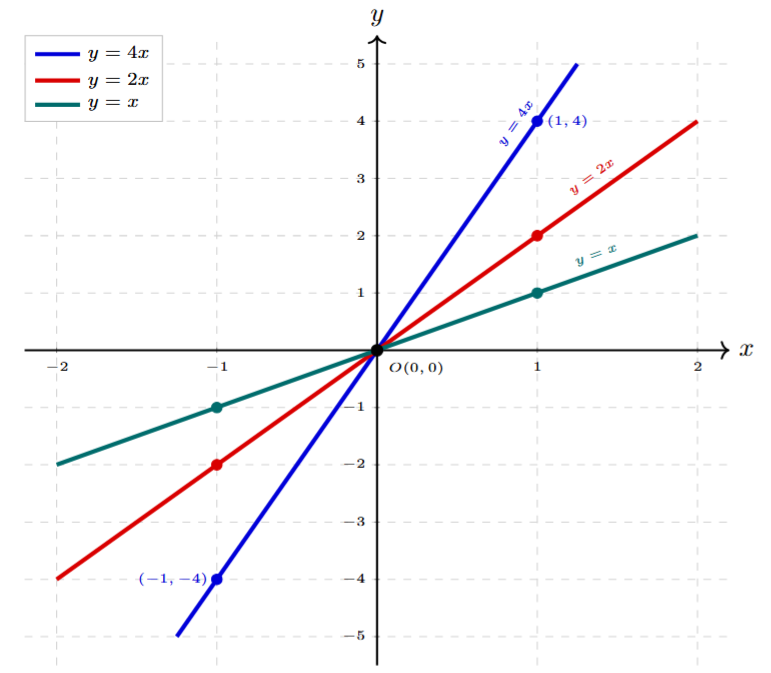
(i) $y = 4x, y = 2x, y = x$
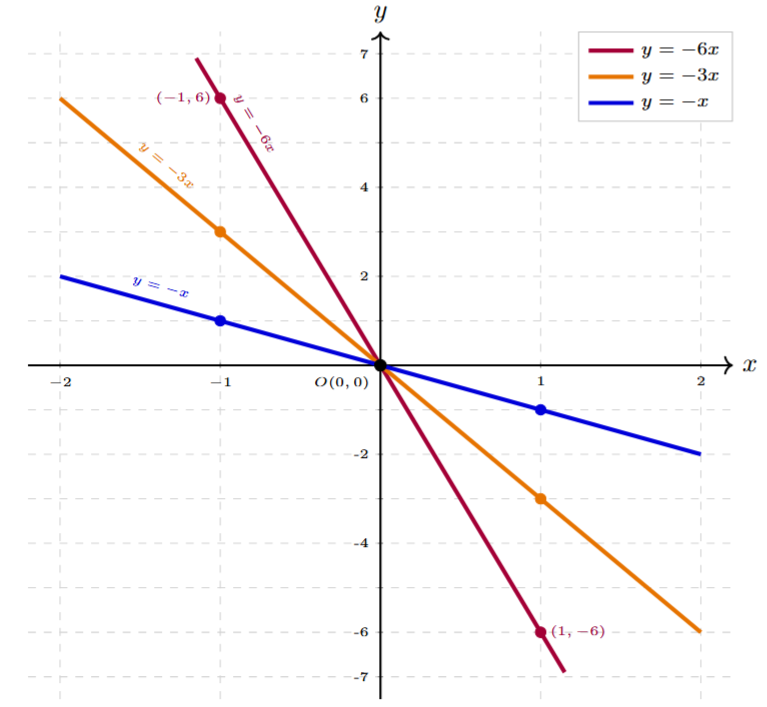
(ii) $y = -6x, y = -3x, y = -x$
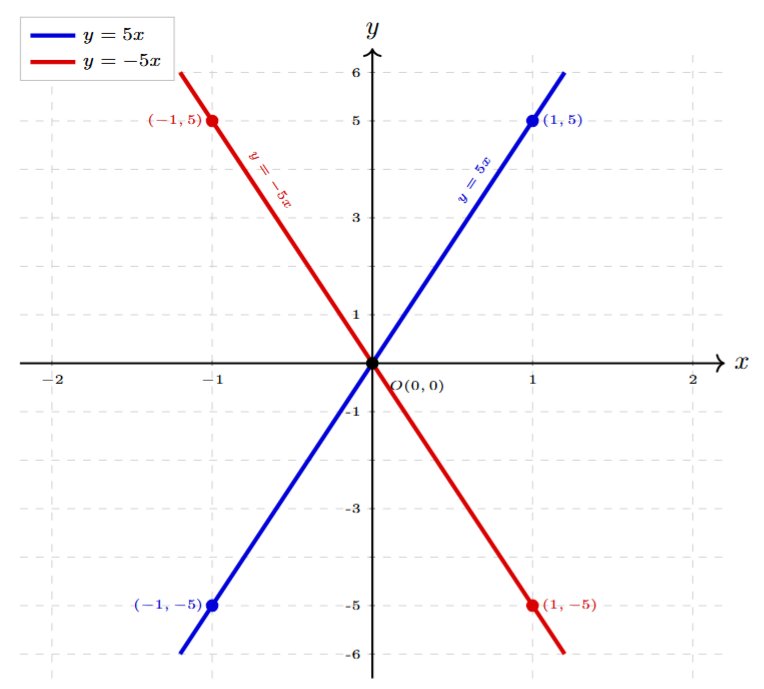
(iii) $y = 5x, y = -5x$
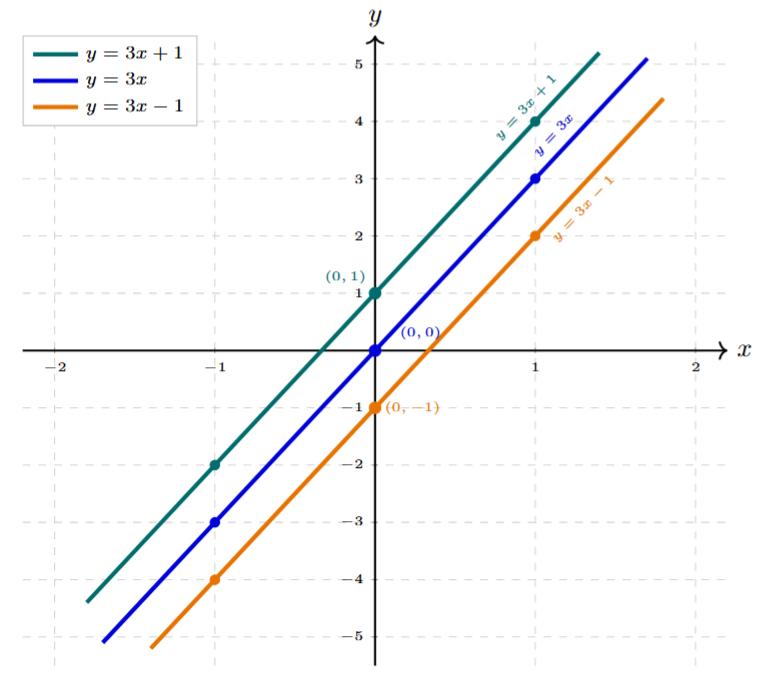
(iv) $y = 3x - 1, y = 3x, y = 3x + 1$
(v) $y = -2x - 3, y = -2x, y = 2x + 3$
Answer:
To Find:
The solutions (coordinates) for each set of equations and their respective graphical representations to understand the role of $a$ and $b$ in $y = ax + b$.
(i) Equations: $y = 4x, y = 2x, y = x$
For these equations, the $y$-intercept $b$ is $0$, meaning they all pass through the origin $(0, 0)$.
| $x$ | $y = 4x$ | $y = 2x$ | $y = x$ |
| -1 | -4 | -2 | -1 |
| 0 | 0 | 0 | 0 |
| 1 | 4 | 2 | 1 |
Reflection: As '$a$' (the coefficient of $x$) increases, the line becomes steeper and rotates towards the $y$-axis.
(ii) Equations: $y = -6x, y = -3x, y = -x$
In this set, the slope '$a$' is negative. These lines pass through the second and fourth quadrants.
| $x$ | $y = -6x$ | $y = -3x$ | $y = -x$ |
| -1 | 6 | 3 | 1 |
| 0 | 0 | 0 | 0 |
| 1 | -6 | -3 | -1 |
Reflection: A negative '$a$' results in a downward slope. As the absolute value of '$a$' increases, the line becomes steeper.
(iii) Equations: $y = 5x, y = -5x$
These lines have slopes of equal magnitude but opposite signs.
| $x$ | $y = 5x$ | $y = -5x$ |
| -1 | -5 | 5 |
| 0 | 0 | 0 |
| 1 | 5 | -5 |
Reflection: The line $y = -5x$ is a mirror image (reflection) of $y = 5x$ across the $y$-axis.
(iv) Equations: $y = 3x - 1, y = 3x, y = 3x + 1$
Here, the slope '$a$' is constant ($a = 3$), making the lines parallel. The intercept '$b$' varies.
| $x$ | $y = 3x - 1$ | $y = 3x$ | $y = 3x + 1$ |
| -1 | -4 | -3 | -2 |
| 0 | -1 | 0 | 1 |
| 1 | 2 | 3 | 4 |
Reflection: When '$a$' is constant, changing '$b$' shifts the line vertically. These are called parallel lines.
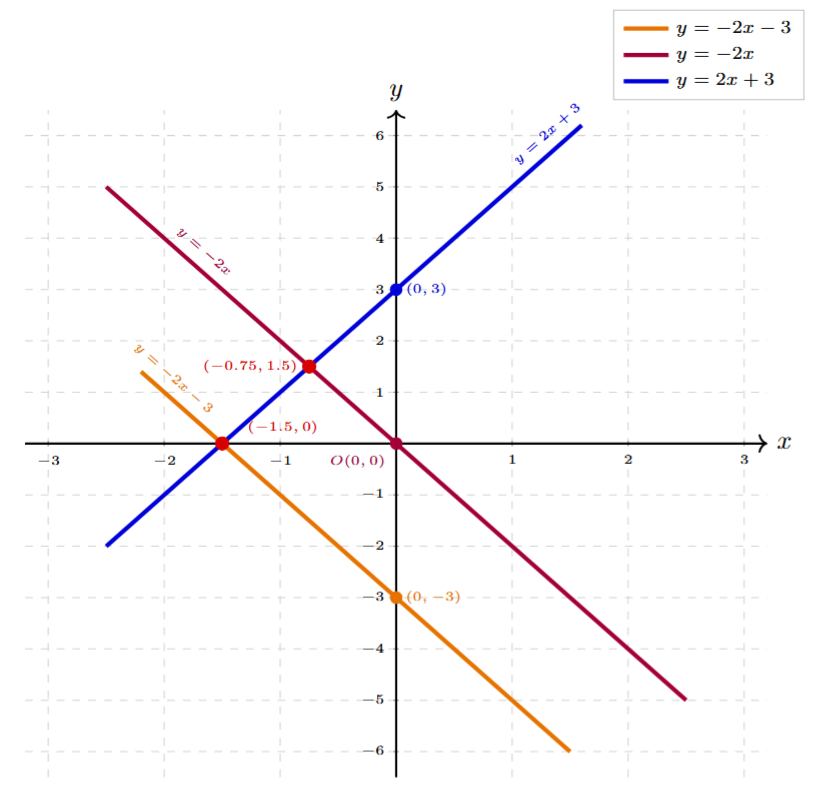
(v) Equations: $y = -2x - 3, y = -2x, y = 2x + 3$
This set compares parallel lines with negative slopes and a line with a positive slope.
| $x$ | $y = -2x - 3$ | $y = -2x$ | $y = 2x + 3$ |
| -1 | -1 | 2 | 1 |
| 0 | -3 | 0 | 3 |
| 1 | -5 | -2 | 5 |
Reflection: The first two lines are parallel. The third line intersects them. The point $(0, -3)$ is the $y$-intercept for the first line, while $(0, 3)$ is the intercept for the third.
Final Conclusion:
1. The coefficient '$a$': Represents the Slope. It controls the steepness and direction (increase/decrease) of the line.
2. The constant '$b$': Represents the $y$-intercept. It determines the point where the line crosses the vertical axis and indicates a vertical shift.
End-Of-Chapter Exercises
Question 1. Write a polynomial of degree $3$ in the variable $x$, in which the coefficient of the $x^2$ term is $-7$.
Answer:
To Find:
A polynomial of degree $3$ in $x$ with the coefficient of $x^2$ as $-7$.
Solution:
A general cubic polynomial (degree 3) in variable $x$ is given by:
$P(x) = ax^3 + bx^2 + cx + d$
According to the given conditions:
1. The degree must be $3$, so the highest power of $x$ is $3$. We can choose any non-zero value for $a$. Let $a = 1$.
2. The coefficient of $x^2$ must be $-7$. Thus, $b = -7$.
3. Other coefficients $c$ and $d$ can be any real numbers. Let $c = 5$ and $d = 10$.
One such polynomial is:
$P(x) = x^3 - 7x^2 + 5x + 10$
Question 2. Find the values of the following polynomials at the indicated values of the variables.
(i) $5x^2 – 3x + 7$ if $x = 1$
(ii) $4t^3 – t^2 + 6$ if $t = a$
Answer:
Given:
(i) $P(x) = 5x^2 – 3x + 7$
(ii) $Q(t) = 4t^3 – t^2 + 6$
Solution:
(i) For $x = 1$:
Substituting $x = 1$ in the polynomial:
$P(1) = 5(1)^2 - 3(1) + 7$
$P(1) = 5(1) - 3 + 7$
$P(1) = 5 - 3 + 7$
$P(1) = 9$
(ii) For $t = a$:
Substituting the variable $t$ with $a$:
$Q(a) = 4a^3 - a^2 + 6$
Question 3. If we multiply a number by $\frac{5}{2}$ and add $\frac{2}{3}$ to the product, we get $-\frac{7}{12}$. Find the number.
Answer:
To Find:
A number that satisfies the given algebraic condition.
Solution:
Let the required number be $x$.
According to the problem:
$\frac{5}{2}x + \frac{2}{3} = -\frac{7}{12}$
Transposing $\frac{2}{3}$ to the right side:
$\frac{5}{2}x = -\frac{7}{12} - \frac{2}{3}$
Taking the L.C.M. of 12 and 3, which is 12:
$\frac{5}{2}x = \frac{-7 - 8}{12}$
$\frac{5}{2}x = -\frac{15}{12}$
Solving for $x$:
$x = -\frac{15}{12} \times \frac{2}{5}$
$x = \frac{-\cancel{15}^{3} \times \cancel{2}^{1}}{\cancel{12}_{6} \times \cancel{5}_{1}}$
$x = -\frac{3}{6}$
$x = -\frac{1}{2}$
[Simplified value]
Therefore, the required number is $-\frac{1}{2}$.
Question 4. A positive number is $5$ times another number. If $21$ is added to both the numbers, then one of the new numbers becomes twice the other new number. What are the numbers?
Answer:
To Find:
The two initial positive numbers.
Solution:
Let the smaller number be $x$.
Then the other number is $5x$.
If $21$ is added to both:
New smaller number = $x + 21$
New larger number = $5x + 21$
According to the condition, the larger new number is twice the smaller new number:
$5x + 21 = 2(x + 21)$
$5x + 21 = 2x + 42$
[Opening the brackets]
$5x - 2x = 42 - 21$
$3x = 21$
$x = \frac{21}{3}$
$x = 7$
Finding the numbers:
Smaller number = $x = \mathbf{7}$
Larger number = $5x = 5 \times 7 = \mathbf{35}$
The numbers are $7$ and $35$.
Question 5. If you have $\textsf{₹}800$ and you save $\textsf{₹}250$ every month, find the amount you have after:
(i) $6$ months
(ii) $2$ years
Express this as a linear pattern.
Answer:
Given:
Initial balance = $\textsf{₹}800$
Monthly savings = $\textsf{₹}250$
Solution:
Let $n$ be the number of months.
The total amount ($A$) can be calculated using the pattern:
$A = 800 + 250n$
[Linear Pattern]
(i) After 6 months ($n = 6$):
$A = 800 + 250(6)$
$A = 800 + 1500$
$A = \textsf{₹} 2300$
(ii) After 2 years:
Since 1 year = 12 months, 2 years = $2 \times 12 = 24$ months.
$A = 800 + 250(24)$
$A = 800 + 6000$
$A = \textsf{₹} 6800$
Summary Table:
| Duration (n) | Calculation ($800 + 250n$) | Total Amount ($\textsf{₹}$) |
| 6 months | $800 + 1500$ | 2300 |
| 24 months | $800 + 6000$ | 6800 |
Question 6. The digits of a two-digit number differ by $3$. If the digits are interchanged, and the resulting number is added to the original number, we get $143$. Find both the numbers.
Answer:
To Find: The two-digit numbers satisfying the given conditions.
Solution:
Let the tens digit be $x$ and the units digit be $y$.
The original number can be expressed as $10x + y$.
According to the first condition:
$x - y = 3$
[Case 1] ... (i)
When digits are interchanged, the new number is $10y + x$.
According to the second condition:
$(10x + y) + (10y + x) = 143$
$11x + 11y = 143$
Dividing by $11$ on both sides:
$x + y = 13$
... (ii)
Adding equations (i) and (ii):
$(x - y) + (x + y) = 3 + 13$
$2x = 16$
$x = 8$
Substituting $x = 8$ in (ii):
$8 + y = 13 \implies y = 5$
The original number is $10(8) + 5 = 85$.
Case 2: If the difference is $y - x = 3$:
Adding $y - x = 3$ and $x + y = 13$:
$2y = 16 \implies y = 8$
Then $x = 5$.
The original number is $10(5) + 8 = 58$.
Therefore, the two possible numbers are $85$ and $58$.
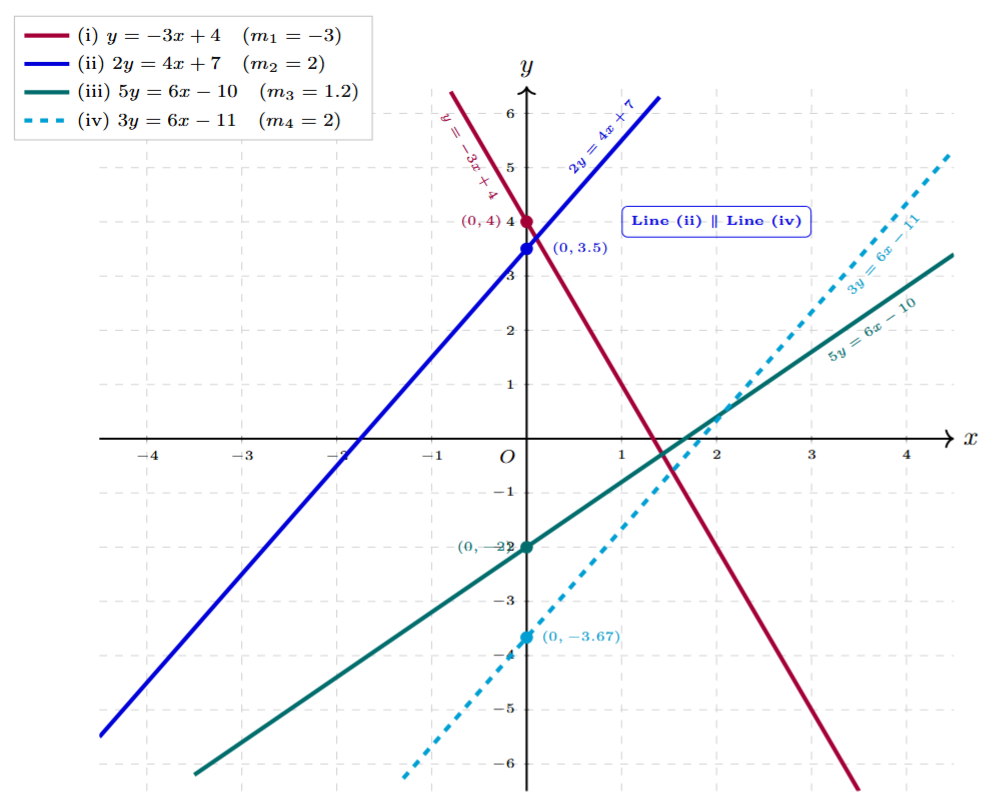
Question 7. Draw the graph of the following equations, and identify their slopes and $y$-intercepts. Also, find the coordinates of the points where these lines cut the $y$-axis.
(i) $y = –3x + 4$
(ii) $2y = 4x + 7$
(iii) $5y = 6x – 10$
(iv) $3y = 6x – 11$
Are any of the lines parallel?
Answer:
Given:
Four linear equations are provided:
(i) $y = –3x + 4$
(ii) $2y = 4x + 7$
(iii) $5y = 6x – 10$
(iv) $3y = 6x – 11$
To Find:
1. Slope ($m$) and $y$-intercept ($c$) for each equation.
2. Coordinates of the points where the lines cut the $y$-axis.
3. Identify if any of the lines are parallel.
4. Draw the graph of the equations.
Solution:
We use the Slope-Intercept form of a linear equation, which is given by:
$y = mx + c$
... (Standard Form)
Where $m$ is the slope and $c$ is the $y$-intercept. The point where the line cuts the $y$-axis is always $(0, c)$.
Analysis of Equation (i):
$y = -3x + 4$
Comparing with $y = mx + c$, we get:
Slope ($m_1$) = $-3$
$y$-intercept ($c_1$) = $4$
Point on $y$-axis = $(0, 4)$
Analysis of Equation (ii):
$2y = 4x + 7$
$y = 2x + 3.5$
[Dividing both sides by 2]
Comparing with $y = mx + c$, we get:
Slope ($m_2$) = $2$
$y$-intercept ($c_2$) = $3.5$
Point on $y$-axis = $(0, 3.5)$
Analysis of Equation (iii):
$5y = 6x - 10$
$y = 1.2x - 2$
[Dividing both sides by 5]
Comparing with $y = mx + c$, we get:
Slope ($m_3$) = $1.2$
$y$-intercept ($c_3$) = $-2$
Point on $y$-axis = $(0, -2)$
Analysis of Equation (iv):
$3y = 6x - 11$
$y = 2x - 3.67$
[Dividing both sides by 3]
Comparing with $y = mx + c$, we get:
Slope ($m_4$) = $2$
$y$-intercept ($c_4$) = $-3.67$ (approx)
Point on $y$-axis = $(0, -3.67)$
Table of Values for Graphing:
| Equation | Slope ($m$) | $y$-intercept ($c$) | Point on $y$-axis |
| $y = -3x + 4$ | $-3$ | $4$ | $(0, 4)$ |
| $2y = 4x + 7$ | $2$ | $3.5$ | $(0, 3.5)$ |
| $5y = 6x - 10$ | $1.2$ | $-2$ | $(0, -2)$ |
| $3y = 6x - 11$ | $2$ | $-3.67$ | $(0, -3.67)$ |
Conclusion on Parallel Lines:
Two lines are parallel if and only if their slopes are equal ($m_a = m_b$).
From our calculations:
Slope of line (ii) = $2$
Slope of line (iv) = $2$
Since $m_2 = m_4$, the lines (ii) and (iv) are parallel to each other.
Question 8. If the temperature of a liquid can be measured in Kelvin units as $x\text{ K}$ and in Fahrenheit units as $y\ ^\circ\text{F}$, the relation between the two systems of measurement of temperature is given by the linear equation $y = \frac{9}{5}(x – 273) + 32$.
(i) Find the temperature of the liquid in Fahrenheit if the temperature of the liquid is $313\text{ K}$.
(ii) If the temperature is $158\ ^\circ\text{F}$, then find the temperature in Kelvin.
Answer:
Given Equation:
$y = \frac{9}{5}(x - 273) + 32$
Solution:
(i) When $x = 313\text{ K}$:
$y = \frac{9}{5}(313 - 273) + 32$
$y = \frac{9}{5}(40) + 32$
$y = 9 \times 8 + 32$
$y = 72 + 32$
$y = 104\ ^\circ\text{F}$
(ii) When $y = 158\ ^\circ\text{F}$:
$158 = \frac{9}{5}(x - 273) + 32$
$158 - 32 = \frac{9}{5}(x - 273)$
$126 = \frac{9}{5}(x - 273)$
$x - 273 = 126 \times \frac{5}{9}$
$x - 273 = 14 \times 5$
$x - 273 = 70$
$x = 70 + 273$
$x = 343\text{ K}$
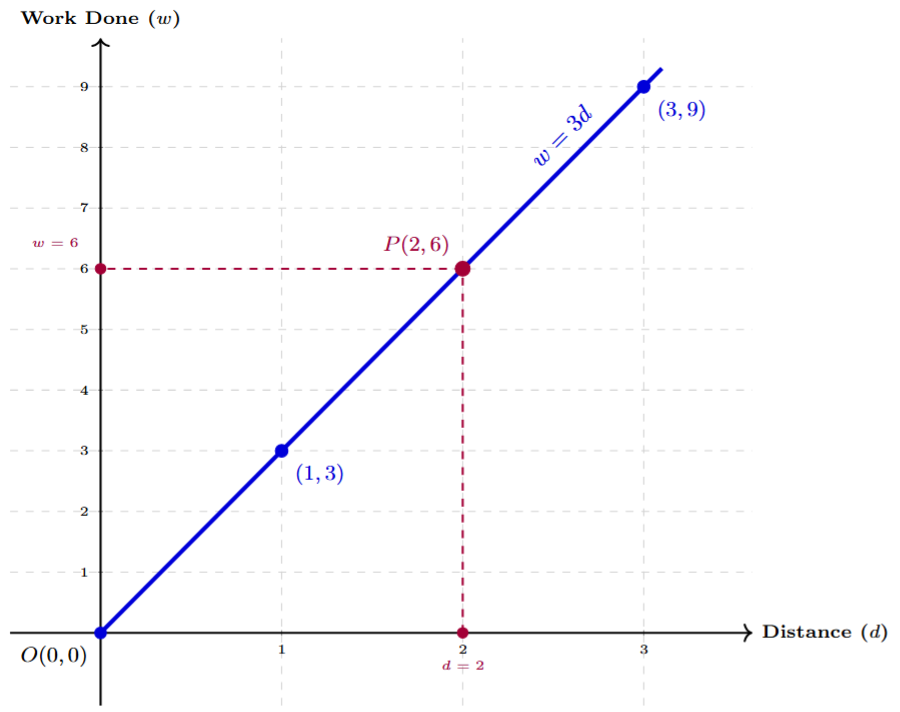
Question 9. The work done by a body on the application of a constant force is the product of the constant force and the distance travelled by the body in the direction of the force. Express this in the form of a linear equation in two variables (work $w$ and distance $d$), and draw its graph by taking the constant force as $3$ units. What is the work done when the distance travelled is $2$ units? Verify it by plotting it on the graph.
Answer:
Given:
Constant Force ($F$) = $3$ units.
Formula: $\text{Work } (w) = \text{Force } (F) \times \text{Distance } (d)$.
Solution:
The linear equation representing the situation is:
$w = 3d$
... (i)
Let's find some points for the graph:
| Distance (d) | Work (w) | Point (d, w) |
| 0 | 0 | (0, 0) |
| 1 | 3 | (1, 3) |
| 2 | 6 | (2, 6) |
Work done when $d = 2$ units:
Substituting $d = 2$ in equation (i):
$w = 3 \times 2 = 6 \text{ units}$.
This corresponds to the point $(2, 6)$ on the graph.
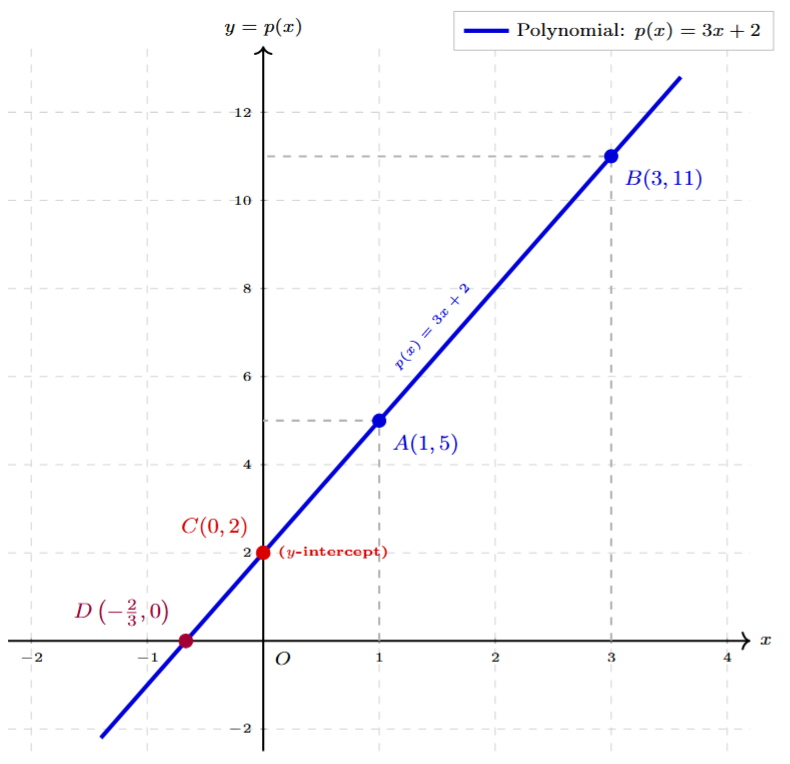
Question 10. The graph of a linear polynomial $p(x)$ passes through the points $(1, 5)$ and $(3, 11)$.
(i) Find the polynomial $p(x)$.
(ii) Find the coordinates where the graph of $p(x)$ cuts the axes.
(iii) Draw the graph of $p(x)$ and verify your answers.
Answer:
Given:
Points on the graph: $(1, 5)$ and $(3, 11)$.
Solution:
(i) A linear polynomial is of the form $p(x) = ax + b$.
Substituting $(1, 5)$: $5 = a(1) + b \implies a + b = 5$ ... (i)
Substituting $(3, 11)$: $11 = a(3) + b \implies 3a + b = 11$ ... (ii)
Subtracting (i) from (ii):
$(3a + b) - (a + b) = 11 - 5$
$2a = 6 \implies a = 3$
Substituting $a = 3$ in (i): $3 + b = 5 \implies b = 2$.
The polynomial is $p(x) = 3x + 2$.
(ii) Coordinates where it cuts the axes:
For the $y$-axis, set $x = 0$:
$y = 3(0) + 2 = 2$. Point is $(0, 2)$.
For the $x$-axis, set $y = 0$:
$0 = 3x + 2 \implies 3x = -2 \implies x = -\frac{2}{3}$. Point is $(-\frac{2}{3}, 0)$.
(iii) Verification:
Plotting the line through $(1, 5)$ and $(3, 11)$ shows that it crosses the vertical axis at exactly $2$ and the horizontal axis at $-\frac{2}{3}$ (approx $-0.67$).
Question 11. Let $p(x) = ax + b$ and $q(x) = cx + d$ be two linear polynomials such that:
(i) $p(0) = 5$.
(ii) The polynomial $p(x) – q(x)$ cuts the $x$-axis at $(3, 0)$.
(iii) The sum $p(x) + q(x)$ is equal to $6x + 4$ for all real $x$.
Find the polynomials $p(x)$ and $q(x)$.
Answer:
Given:
1. Two linear polynomials $p(x) = ax + b$ and $q(x) = cx + d$.
2. $p(0) = 5$.
3. $p(x) + q(x) = 6x + 4$ for all real $x$.
4. $p(x) - q(x)$ has an $x$-intercept at $(3, 0)$, which means at $x = 3$, $p(3) - q(3) = 0$.
To Find:
The explicit expressions for polynomials $p(x)$ and $q(x)$.
Solution:
Step 1: Finding $b$ and $d$ using constant terms.
From the definition of $p(x) = ax + b$:
$p(0) = a(0) + b = b$
$b = 5$
[Given $p(0) = 5$]
Now, we use the sum of the polynomials:
$p(x) + q(x) = (ax + b) + (cx + d) = (a + c)x + (b + d)$
Comparing this with the given $6x + 4$, we equate the constant terms:
$b + d = 4$
[Equating constant terms] ... (i)
Substituting $b = 5$ in equation (i):
$5 + d = 4$
$d = 4 - 5$
Therefore, $d = -1$.
Step 2: Relating $a$ and $c$ using the $x$-coefficient.
Equating the coefficients of $x$ from the sum $p(x) + q(x) = 6x + 4$:
$a + c = 6$
... (ii)
Step 3: Finding another relation for $a$ and $c$ using the $x$-intercept.
The polynomial $p(x) - q(x)$ passes through $(3, 0)$, so $p(3) - q(3) = 0$.
$(a(3) + b) - (c(3) + d) = 0$
$(3a + 5) - (3c - 1) = 0$
$3a - 3c + 5 + 1 = 0$
$3a - 3c + 6 = 0$
Dividing the whole equation by 3:
$a - c = -2$
... (iii)
Step 4: Solving for $a$ and $c$.
To find $a$, let's add equation (ii) and equation (iii):
$\begin{array}{cc} & a & + & c & = & 6 \\ + & a & - & c & = & -2 \\ \hline & 2a & & & = & 4 \\ \hline \end{array}$
$2a = 4 \implies a = 2$
Now, substitute $a = 2$ into equation (ii):
$2 + c = 6$
$c = 6 - 2 = 4$
Final Polynomials:
By substituting the values of $a, b, c,$ and $d$, we get:
$p(x) = 2x + 5$
$q(x) = 4x - 1$
Question 12. Look at the first three stages of a growing pattern of hexagons made using matchsticks. A new hexagon gets added at every stage which shares a side with the last hexagon of the previous stage.
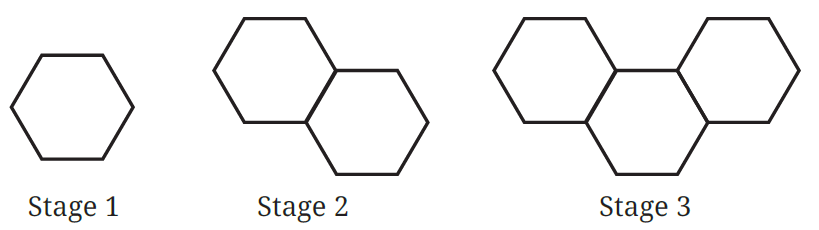
(i) Draw the next two stages of the pattern. How many matchsticks will be required at these stages?
(ii) Complete the following table.
| Stage Number | $1$ | $2$ | $3$ | $4$ | $5$ | $\dots$ | $n$ |
|---|---|---|---|---|---|---|---|
| Number of matchsticks |
(iii) Find a rule to determine the number of matchsticks required for the $n^{th}$ stage.
(iv) How many matchsticks will be required for the $15^{th}$ stage of the pattern?
(v) Can $200$ matchsticks form a stage in this pattern? Justify your answer.
Answer:
To Find:
1. The number of matchsticks required for the $4^{th}$ and $5^{th}$ stages.
2. A linear rule (expression) for the $n^{th}$ stage.
3. Matchsticks for the $15^{th}$ stage.
4. Check if $200$ matchsticks can form a complete stage.
Solution:
(i) Next Stages and Matchstick Count:
In the given pattern, Stage 1 has $1$ hexagon ($6$ sticks). Every subsequent stage adds $1$ hexagon that shares $1$ side with the previous one, thus adding only $5$ new sticks.
For Stage 4: $16 + 5 = \mathbf{21 \text{ matchsticks}}$.
For Stage 5: $21 + 5 = \mathbf{26 \text{ matchsticks}}$.
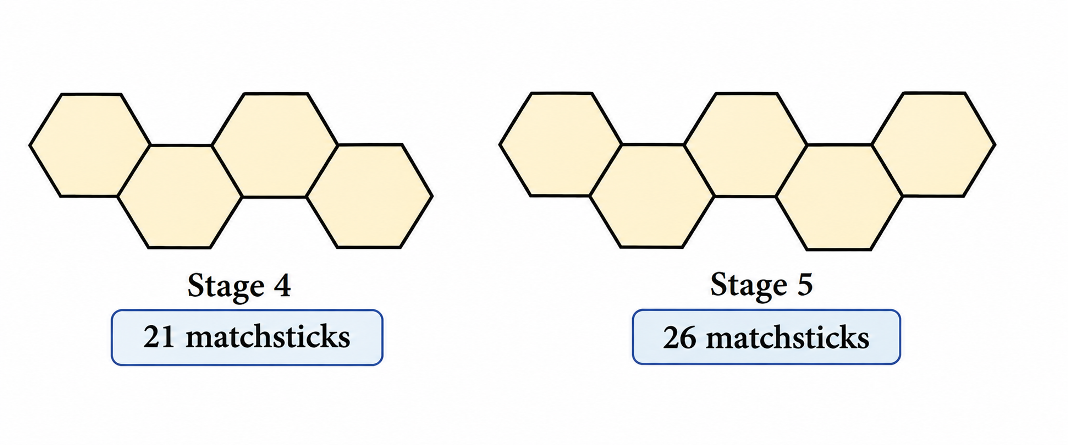
(ii) Table of Values:
| Stage Number ($n$) | 1 | 2 | 3 | 4 | 5 | $\dots$ | $n$ |
| Number of matchsticks | 6 | 11 | 16 | 21 | 26 | $\dots$ | $5n + 1$ |
(iii) Rule for the $n^{th}$ stage:
The first stage requires $6$ sticks. Each additional stage adds $5$ sticks. For $n$ stages, the number of additional hexagons is $(n-1)$.
$\text{Total sticks } (S) = 6 + (n - 1)5$
$S = 6 + 5n - 5$
$S = 5n + 1$
[Linear Expression] ... (i)
(iv) Matchsticks for the $15^{th}$ stage:
Substitute $n = 15$ in the rule derived in (i):
$S = 5(15) + 1$
$S = 75 + 1$
$S = 76 \text{ matchsticks}$
(v) Can $200$ matchsticks form a stage?
Let $S = 200$. We need to check if $n$ is a whole number (integer).
$5n + 1 = 200$
$5n = 200 - 1$
$5n = 199$
$n = \frac{199}{5}$
$n = 39.8$
Justification: Since the stage number $n$ must be a natural number ($1, 2, 3, \dots$), and $39.8$ is not an integer, $200$ matchsticks cannot form a complete stage in this pattern. A stage would require either $196$ sticks ($n=39$) or $201$ sticks ($n=40$).
Question 13. Let $p(x) = ax + b$ and $q(x) = cx + d$ be two linear polynomials such that:
(i) The graph of $p(x)$ passes through the points $(2, 3)$ and $(6, 11)$.
(ii) The graph of $q(x)$ passes through the point $(4, –1)$.
(iii) The graph of $q(x)$ is parallel to the graph of $p(x)$.
Find the polynomials $p(x)$ and $q(x)$. Also, find the coordinates of the point where these lines meet the $x$-axis.
Answer:
Given:
1. Polynomial $p(x) = ax + b$ passes through $(2, 3)$ and $(6, 11)$.
2. Polynomial $q(x) = cx + d$ passes through $(4, -1)$.
3. The graph of $q(x)$ is parallel to the graph of $p(x)$.
To Find:
Polynomials $p(x)$ and $q(x)$, and their $x$-intercepts.
Solution:
Step 1: Find the slope and equation of $p(x)$.
The slope $a$ is given by the formula $a = \frac{y_2 - y_1}{x_2 - x_1}$:
$a = \frac{11 - 3}{6 - 2} = \frac{8}{4}$
$a = 2$
Substituting $a = 2$ and the point $(2, 3)$ into $p(x) = ax + b$:
$3 = 2(2) + b$
$3 = 4 + b$
$b = -1$
Thus, the polynomial $p(x)$ is $p(x) = 2x - 1$.
Step 2: Find the equation of $q(x)$.
Since the graph of $q(x)$ is parallel to $p(x)$, their slopes must be equal.
$c = a = 2$
(Parallel lines condition)
Substituting $c = 2$ and the point $(4, -1)$ into $q(x) = cx + d$:
$-1 = 2(4) + d$
$-1 = 8 + d$
$d = -9$
Thus, the polynomial $q(x)$ is $q(x) = 2x - 9$.
Step 3: Find the $x$-intercepts.
To find where the lines meet the $x$-axis, we set $p(x) = 0$ and $q(x) = 0$.
For $p(x)$:
$2x - 1 = 0 \Rightarrow 2x = 1 \Rightarrow x = 0.5$
Point: $(0.5, 0)$.
For $q(x)$:
$2x - 9 = 0 \Rightarrow 2x = 9 \Rightarrow x = 4.5$
Point: $(4.5, 0)$.
Question 14. What do all linear functions of the form $f(x) = ax + a, a > 0$, have in common?
Answer:
To Find:
Identify common characteristics of the family of functions $f(x) = ax + a$ where $a > 0$.
Solution:
Let's analyze the given function $f(x) = ax + a$. We can factor out '$a$':
$f(x) = a(x + 1)$
We can check for key points on the graph:
1. The $x$-intercept:
Set $f(x) = 0$:
$a(x + 1) = 0$
Since it is given that $a > 0$, we can divide by $a$:
$x + 1 = 0$
$x = -1$
[Common $x$-intercept]
Conclusion:
All linear functions of the form $f(x) = ax + a$ share the following features:
1. They all pass through the fixed point $(-1, 0)$ on the $x$-axis.
2. Since $a > 0$, they all have a positive slope, meaning they are all increasing functions.
3. The $y$-intercept of each line is $(0, a)$, which varies depending on the value of $a$, but it will always be on the positive $y$-axis.