

Chapter 3 The World of Numbers (Class 9 - Latest Maths NCERT (Ganita Manjari I) Solutions)
Searching for comprehensive and clear NCERT Solutions for Chapter 3: The World of Numbers? You’ve come to the right place! This page provides detailed, step-by-step answers for the latest Class 9 Maths curriculum, helping you navigate the long evolution of numerical systems. We provide accurate solutions for exercises exploring the "Dawn of Mathematics," from the tally marks of the Lebombo and Ishango bones to the sophisticated representation of the Real Number Line.
Our solutions offer in-depth explanations of the revolutionary Indian contribution of Śhūnya (Zero) and the foundational rules of Negative Numbers (Dhana and Ṛiṇa) established by Brahmagupta. We provide logical walkthroughs for problems regarding the Density of Rational Numbers, showing you how to find infinite fractions between any two points. Additionally, we break down the complex concept of Irrational Numbers like $\sqrt{2}$ and $\pi$, ensuring you understand how they fill the final gaps on the number line to complete the Real Number System.
To help you master the most challenging parts of the Ganita Manjari I textbook, this page includes logical proofs for irrationality using the "Proof by Contradiction" method, step-by-step decimal to fraction conversions, and the history of Madhava’s infinite series. These resources, curated by learningspot.co, are designed to bridge the gap between ancient mathematical wisdom and modern exam requirements, helping you achieve excellence in your Class 9 assessments.
| Content On This Page | ||
|---|---|---|
| Exercise Set 3.1 | Exercise Set 3.2 | Exercise Set 3.3 |
| Exercise Set 3.4 | Exercise Set 3.5 | End-Of-Chapter Exercises |
Exercise Set 3.1
Question 1. A merchant in the port city of Lothal is exchanging bags of spices for copper ingots. He receives $15$ ingots for every $2$ bags of spices. If he brings $12$ bags of spices to the market, how many copper ingots will he leave with?
Answer:
Given:
Number of copper ingots received for $2$ bags = $15$
Total bags brought by the merchant = $12$
To Find:
The total number of copper ingots the merchant will receive.
Solution:
We can solve this using the unitary method by first calculating the number of ingots received for a single bag of spices.
$\text{Ingots per bag} = \frac{15}{2}$
[Rate of exchange]
Now, to find the total ingots for $12$ bags, we multiply the rate by the total quantity:
$\text{Total Ingots} = \frac{15}{2} \times 12$
$\text{Total Ingots} = 15 \times \frac{\cancel{12}^{6}}{\cancel{2}_{1}}$
$\text{Total Ingots} = 15 \times 6 = 90$
Therefore, the merchant will leave with 90 copper ingots.
Question 2. Look at the sequence of numbers on one column of the Ishango bone: $11, 13, 17, 19$. What do these numbers have in common? List the next three numbers that fit this pattern.
Answer:
Observation:
The given sequence is $11, 13, 17, 19$. These numbers are all prime numbers.
A prime number is a natural number greater than $1$ that has no positive divisors other than $1$ and itself.
Solution:
The sequence represents consecutive prime numbers starting from $11$. To find the next three numbers, we identify the prime numbers following $19$.
Therefore, the next three numbers in the pattern are 23, 29, and 31.
Question 3. We know that Natural Numbers are closed under addition (the sum of any two natural numbers is always a natural number). Are they closed under subtraction? Provide a couple of examples to justify your answer.
Answer:
Solution:
A set is "closed" under an operation if performing that operation on any two elements of the set always results in an element that is also in that set.
No, Natural Numbers ($\mathbb{N} = \{1, 2, 3, \dots\}$) are not closed under subtraction.
Justification:
To prove that a set is not closed, we only need to provide a single counter-example where the result of the operation falls outside the set.
Example 1:
Let $a = 5$ and $b = 8$. Both are natural numbers.
$a - b = 5 - 8 = -3$
Since $-3$ is an integer but not a Natural Number, the property of closure does not hold.
Example 2:
Let $a = 10$ and $b = 10$. Both are natural numbers.
$a - b = 10 - 10 = 0$
In the standard definition of Natural Numbers, $0$ is not considered a natural number (it is a Whole Number). Thus, the result is outside the set $\mathbb{N}$.
Question 4. Ancient Indians used the joints of their fingers to count, a practice still seen today. Each finger has $3$ joints, and the thumb is used to count them. How many can you count on one hand? How does this relate to the ancient base-$12$ counting systems?
Answer:
Indian Perspective:
Counting on finger joints (known as "Kar-ganana") is an ancient Indian tradition still used by many for chanting mantras or performing astrological calculations.
Solution:
When you look at your hand (excluding the thumb), there are four fingers: the index, middle, ring, and little finger. Each of these fingers has $3$ distinct sections or joints.
$\text{Total joints} = 4 \text{ fingers} \times 3 \text{ joints}$
Total joints = 12.
By using the thumb as a pointer to touch each joint, a person can count up to $12$ on just one hand.
Sexagesimal System: Ancient mathematicians took this further. If you use the five fingers of the other hand to track how many times you have counted to $12$, you can reach $12 \times 5 = 60$. This is the basis of the Base-60 system used globally for measuring time (minutes/seconds) and angles.
Exercise Set 3.2
Question 1. The temperature in the high-altitude desert of Ladakh is recorded as $4\ ^\circ\text{C}$ at noon. By midnight, it drops by $15\ ^\circ\text{C}$. What is the midnight temperature?
Answer:
Given:
Temperature at noon = $4\ ^\circ\text{C}$
Decrease in temperature = $15\ ^\circ\text{C}$
To Find:
The temperature at midnight.
Solution:
A drop or decrease in temperature is represented by a negative integer.
$\text{Midnight Temperature} = 4^\circ\text{C} - 15^\circ\text{C}$
$\text{Midnight Temperature} = -11\ ^\circ\text{C}$
Therefore, the midnight temperature in Ladakh is $-11\ ^\circ\text{C}$.
Question 2. A spice trader takes a loan (debt) of $\textsf{₹}850$. The next day, he makes a profit (fortune) of $\textsf{₹}1,200$. The following week, he incurs a loss of $\textsf{₹}450$. Write this sequence as an equation using integers and calculate his final financial standing.
Answer:
Given:
1. Loan (Debt) = $\textsf{₹}850$
2. Profit (Fortune) = $\textsf{₹}1,200$
3. Loss (Debt) = $\textsf{₹}450$
Solution:
Debts and losses are represented by negative integers and profits by positive integers.
The financial sequence can be written as:
$S = -850 + 1200 - 450$
[Final Standing]
$\text{Final Standing} = -1300 + 1200$
$\text{Final Standing} = -100$
Since the result is negative, the trader has a net loss of $\textsf{₹}100$.
Question 3. Calculate the following using Brahmagupta’s laws:
(i) $(-12) \times 5$
(ii) $(-8) \times (-7)$
(iii) $0 - (-14)$
(iv) $(-20) \div 4$
Answer:
Solution:
According to Brahmagupta’s Brahmasphutasiddhanta, the rules for integers are defined based on debt, fortune, and cipher (zero).
(i) $(-12) \times 5$
Law: "The product of a debt and a fortune is a debt."
$(-12) \times 5 = \mathbf{-60}$
(ii) $(-8) \times (-7)$
Law: "The product of two debts is a fortune."
$(-8) \times (-7) = \mathbf{56}$
(iii) $0 - (-14)$
Law: "Debt subtracted from cipher (zero) becomes a fortune."
$0 - (-14) = \mathbf{14}$
(iv) $(-20) \div 4$
Law: "Debt divided by fortune is a debt."
$(-20) \div 4 = \mathbf{-5}$
Question 4. Explain, using a real-world example of debt, why subtracting a negative number is the same as adding a positive number (e.g., $10 - (-5) = 15$).
Answer:
Solution:
Consider a situation where you have $\textsf{₹}10$ in your pocket (a fortune) but you owe a friend $\textsf{₹}5$ (a debt). Your net worth is $\textsf{₹}5$.
Now, if your friend decides to cancel or remove your debt, the "removal of a debt" is mathematically equivalent to subtracting a negative number.
$10 - (-5)$
[Removing the debt]
When the debt is removed, you no longer have to pay that $\textsf{₹}5$ back. This effectively increases your usable money. It is the same as if someone had given you an additional $\textsf{₹}5$ (adding a fortune).
$10 + 5 = 15$
Therefore, subtracting a debt is equivalent to gaining a fortune.
Exercise Set 3.3
Question 1. Prove that the following rational numbers are equal:
(i) $\frac{2}{3}$ and $\frac{4}{6}$
(ii) $\frac{5}{4}$ and $\frac{10}{8}$
(iii) $-\frac{3}{5}$ and $-\frac{6}{10}$
(iv) $\frac{9}{3}$ and $3$
Answer:
To Prove: The equality of the given rational numbers.
Rational numbers are equal if their simplest forms are identical or if their cross-products are equal.
Proof:
(i) Consider the second fraction $\frac{4}{6}$. To simplify, we divide the numerator and denominator by their greatest common divisor ($2$):
$\frac{4}{6} = \frac{\cancel{4}^2}{\cancel{6}_3} = \frac{2}{3}$
[Simplifying the fraction]
Since the simplified form is equal to the first fraction, $\frac{2}{3} = \frac{4}{6}$.
(ii) Consider $\frac{10}{8}$. Dividing by the common factor $2$:
$\frac{10}{8} = \frac{\cancel{10}^5}{\cancel{8}_4} = \frac{5}{4}$
Therefore, $\frac{5}{4} = \frac{10}{8}$.
(iii) Consider $-\frac{6}{10}$. Dividing by the common factor $2$:
$-\frac{6}{10} = -\frac{\cancel{6}^3}{\cancel{10}_5} = -\frac{3}{5}$
Therefore, $-\frac{3}{5} = -\frac{6}{10}$.
(iv) Consider $\frac{9}{3}$. Dividing the numerator by the denominator:
$\frac{9}{3} = \frac{\cancel{9}^3}{\cancel{3}_1} = 3$
Therefore, $\frac{9}{3} = 3$.
Question 2. Find the sum:
(i) $\frac{2}{5} + \frac{3}{10}$
(ii) $\frac{7}{12} + \frac{5}{8}$
(iii) $-\frac{4}{7} + \frac{3}{14}$
Answer:
To Find: The sum of the given rational numbers.
Solution:
(i) $\frac{2}{5} + \frac{3}{10}$
The L.C.M. of $5$ and $10$ is $10$. We convert $\frac{2}{5}$ to an equivalent fraction with denominator $10$:
$\frac{2 \times 2}{5 \times 2} + \frac{3}{10} = \frac{4}{10} + \frac{3}{10}$
$\text{Sum} = \frac{4 + 3}{10} = \frac{7}{10}$
(ii) $\frac{7}{12} + \frac{5}{8}$
L.C.M. of $12$ and $8$:
$$\begin{array}{c|cc} 2 & 12 \;, & 8 \\ \hline 2 & 6 \; , & 4 \\ \hline 2 & 3 \; , & 2 \\ \hline & 3 \; , & 1 \end{array}$$$\text{L.C.M.} = 2 \times 2 \times 2 \times 3 = 24$
$\frac{7 \times 2}{12 \times 2} + \frac{5 \times 3}{8 \times 3} = \frac{14}{24} + \frac{15}{24}$
$\text{Sum} = \frac{29}{24}$
(iii) $-\frac{4}{7} + \frac{3}{14}$
The L.C.M. of $7$ and $14$ is $14$.
$-\frac{4 \times 2}{7 \times 2} + \frac{3}{14} = -\frac{8}{14} + \frac{3}{14}$
$\text{Sum} = \frac{-8 + 3}{14} = -\frac{5}{14}$
Question 3. Find the difference:
(i) $\frac{5}{6} - \frac{1}{4}$
(ii) $\frac{11}{8} - \frac{3}{4}$
(iii) $-\frac{7}{9} - \left(-\frac{2}{3}\right)$
Answer:
To Find: The difference of the given rational numbers.
Solution:
(i) $\frac{5}{6} - \frac{1}{4}$
The L.C.M. of $6$ and $4$ is $12$.
$\frac{5 \times 2}{6 \times 2} - \frac{1 \times 3}{4 \times 3} = \frac{10}{12} - \frac{3}{12}$
$\text{Difference} = \frac{7}{12}$
(ii) $\frac{11}{8} - \frac{3}{4}$
The L.C.M. of $8$ and $4$ is $8$.
$\frac{11}{8} - \frac{3 \times 2}{4 \times 2} = \frac{11}{8} - \frac{6}{8}$
$\text{Difference} = \frac{5}{8}$
(iii) $-\frac{7}{9} - \left(-\frac{2}{3}\right)$
$-\frac{7}{9} + \frac{2}{3}$
[Subtracting a negative is adding]
The L.C.M. is $9$.
$-\frac{7}{9} + \frac{2 \times 3}{3 \times 3} = -\frac{7}{9} + \frac{6}{9}$
$\text{Difference} = \frac{-7 + 6}{9} = -\frac{1}{9}$
Question 4. Find the product:
(i) $\frac{2}{3} \times \frac{3}{10}$
(ii) $\frac{7}{11} \times \frac{5}{8}$
(iii) $-\frac{4}{7} \times \frac{5}{14}$
Answer:
To Find: The product of the given rational numbers.
Solution:
(i) $\frac{2}{3} \times \frac{3}{10}$
We multiply the numerators together and the denominators together, then simplify by cancellation:
$\text{Product} = \frac{\cancel{2}^1}{\cancel{3}_1} \times \frac{\cancel{3}^1}{\cancel{10}_5}$
[Using cancellation method]
$\text{Product} = \frac{1 \times 1}{1 \times 5} = \frac{1}{5}$
(ii) $\frac{7}{11} \times \frac{5}{8}$
Since there are no common factors between numerators and denominators:
$\text{Product} = \frac{7 \times 5}{11 \times 8} = \frac{35}{88}$
(iii) $-\frac{4}{7} \times \frac{5}{14}$
We can simplify the $4$ in the numerator and $14$ in the denominator by dividing both by $2$:
$\text{Product} = \frac{-\cancel{4}^2}{7} \times \frac{5}{\cancel{14}_7}$
$\text{Product} = -\frac{2 \times 5}{7 \times 7} = -\frac{10}{49}$
Question 5. Find the quotient:
(i) $\frac{2}{3} \div \frac{3}{10}$
(ii) $\frac{7}{11} \div \frac{5}{8}$
(iii) $-\frac{4}{7} \div \frac{5}{14}$
Answer:
To Find: The quotient of the given rational numbers.
To divide one rational number by another, we multiply the first number by the reciprocal of the second.
Solution:
(i) $\frac{2}{3} \div \frac{3}{10}$
$= \frac{2}{3} \times \frac{10}{3}$
[Multiplying by reciprocal]
$= \frac{2 \times 10}{3 \times 3} = \frac{20}{9}$
(ii) $\frac{7}{11} \div \frac{5}{8}$
$= \frac{7}{11} \times \frac{8}{5}$
$= \frac{7 \times 8}{11 \times 5} = \frac{56}{55}$
(iii) $-\frac{4}{7} \div \frac{5}{14}$
$= -\frac{4}{7} \times \frac{14}{5}$
$= -\frac{4 \times \cancel{14}^{2}}{\cancel{7}_{1} \times 5}$
$= -\frac{8}{5}$
Question 6. Show that: $\left( \frac{1}{2} + \frac{3}{4} \right) \times \frac{8}{3} = \frac{1}{2} \times \frac{8}{3} + \frac{3}{4} \times \frac{8}{3}$.
Answer:
To Prove: $\left( \frac{1}{2} + \frac{3}{4} \right) \times \frac{8}{3} = \frac{1}{2} \times \frac{8}{3} + \frac{3}{4} \times \frac{8}{3}$
Proof:
Step 1: Calculate the Left Hand Side (LHS)
$\text{LHS} = \left( \frac{1}{2} + \frac{3}{4} \right) \times \frac{8}{3}$
Taking L.C.M. of 2 and 4 inside the bracket, which is 4:
$\text{LHS} = \left( \frac{2}{4} + \frac{3}{4} \right) \times \frac{8}{3}$
$\text{LHS} = \frac{5}{4} \times \frac{8}{3}$
$\text{LHS} = \frac{5 \times \cancel{8}^{2}}{\cancel{4}_{1} \times 3} = \frac{10}{3}$
[Value of LHS] ... (i)
Step 2: Calculate the Right Hand Side (RHS)
$\text{RHS} = \frac{1}{2} \times \frac{8}{3} + \frac{3}{4} \times \frac{8}{3}$
$\text{RHS} = \frac{1 \times \cancel{8}^{4}}{\cancel{2}_{1} \times 3} + \frac{\cancel{3}^{1} \times \cancel{8}^{2}}{\cancel{4}_{1} \times \cancel{3}_{1}}$
$\text{RHS} = \frac{4}{3} + \frac{2}{1}$
$\text{RHS} = \frac{4 + 6}{3}$
$\text{RHS} = \frac{10}{3}$
[Value of RHS] ... (ii)
From (i) and (ii), we find that LHS = RHS.
Hence, the distributive property of multiplication over addition is verified.
Question 7. Simplify the following using the distributive property: $\frac{7}{9} \left(\frac{6}{7} - \frac{3}{4}\right)$.
Answer:
Given: $\frac{7}{9} \left(\frac{6}{7} - \frac{3}{4}\right)$
Solution:
Using the distributive property: $a(b - c) = ab - ac$
$= \left(\frac{7}{9} \times \frac{6}{7}\right) - \left(\frac{7}{9} \times \frac{3}{4}\right)$
Simplifying the first part:
$\frac{\cancel{7}^{1} \times \cancel{6}^{2}}{\cancel{9}_{3} \times \cancel{7}_{1}} = \frac{2}{3}$
Simplifying the second part:
$\frac{7 \times \cancel{3}^{1}}{\cancel{9}_{3} \times 4} = \frac{7}{12}$
Now, finding the difference:
$= \frac{2}{3} - \frac{7}{12}$
Taking L.C.M. as 12:
$= \frac{8 - 7}{12}$
$= \frac{1}{12}$
Question 8. Find the rational number $x$ such that: $\frac{5}{6} \left( x + \frac{3}{5} \right) = \frac{5}{6} x + \frac{1}{2}$.
Answer:
Given Equation:
$\frac{5}{6} \left( x + \frac{3}{5} \right) = \frac{5}{6} x + \frac{1}{2}$
Solution:
Applying the distributive property on the Left Hand Side (LHS):
$\frac{5}{6} \cdot x + \frac{5}{6} \cdot \frac{3}{5} = \frac{5}{6} x + \frac{1}{2}$
Simplifying the constant product on the LHS:
$\frac{\cancel{5}^{1}}{\cancel{6}_{2}} \times \frac{\cancel{3}^{1}}{\cancel{5}_{1}} = \frac{1}{2}$
Substituting this back into the equation:
$\frac{5}{6} x + \frac{1}{2} = \frac{5}{6} x + \frac{1}{2}$
Since the LHS and RHS are identical for all terms, this is an identity.
This means the equation holds true for any rational number $x$.
Example: If we take $x = 0$, both sides result in $\frac{1}{2}$. If $x = 1$, both sides result in $\frac{5}{6} + \frac{1}{2} = \frac{8}{6} = \frac{4}{3}$.
Therefore, $x$ can be any rational number.
Exercise Set 3.4
Question 1. Represent the rational numbers $\frac{2}{3}$, $-\frac{5}{4}$ and $1\frac{1}{2}$ on a single number line.
Answer:
Given:
Rational numbers: $\frac{2}{3}$, $-\frac{5}{4}$, and $1\frac{1}{2}$.
Solution:
First, we convert the mixed fraction and improper fractions to decimals or common denominators to understand their positions better:
1. $-\frac{5}{4} = -1.25$ (lies between $-1$ and $-2$)
2. $\frac{2}{3} \approx 0.67$ (lies between $0$ and $1$)
3. $1\frac{1}{2} = \frac{3}{2} = 1.5$ (lies between $1$ and $2$)
To plot these accurately, we can divide each unit on the number line into $12$ equal parts (since L.C.M. of $3, 4, 2$ is $12$).

On the number line, $-\frac{5}{4}$ is to the left of $0$, while $\frac{2}{3}$ and $1\frac{1}{2}$ are to the right of $0$.
Question 2. Find three distinct rational numbers that lie strictly between $-\frac{1}{2}$ and $\frac{1}{4}$.
Answer:
To Find:
Three rational numbers between $-\frac{1}{2}$ and $\frac{1}{4}$.
Solution:
We first convert the given numbers to equivalent fractions with a common denominator. The L.C.M. of $2$ and $4$ is $4$.
$-\frac{1}{2} = -\frac{2}{4}$
The numbers between $-\frac{2}{4}$ and $\frac{1}{4}$ with denominator $4$ are $-\frac{1}{4}$ and $0$. To find more numbers, we increase the denominator by multiplying both by $2$.
$-\frac{2 \times 2}{4 \times 2} = -\frac{4}{8}$
[New lower bound]
$\frac{1 \times 2}{4 \times 2} = \frac{2}{8}$
[New upper bound]
The integers between $-4$ and $2$ are $-3, -2, -1, 0, 1$.
Therefore, three rational numbers between the given limits are $-\frac{3}{8}$, $-\frac{2}{8}$ (or $-\frac{1}{4}$), and $\frac{1}{8}$.
Question 3. Simplify the expression: $\left( -\frac{1}{4} \right) + \left( \frac{5}{12} \right)$.
Answer:
To Find:
The sum of $-\frac{1}{4}$ and $\frac{5}{12}$.
Solution:
We need to find the L.C.M. of $4$ and $12$ to add the fractions.
$$\begin{array}{c|cc} 2 & 4 \;, & 12 \\ \hline 2 & 2 \; , & 6 \\ \hline & 1 \; , & 3 \end{array}$$$\text{L.C.M.} = 2 \times 2 \times 3 = 12$
Now, we convert $-\frac{1}{4}$ to an equivalent fraction with denominator $12$:
$-\frac{1 \times 3}{4 \times 3} + \frac{5}{12}$
$= -\frac{3}{12} + \frac{5}{12}$
$= \frac{-3 + 5}{12} = \frac{2}{12}$
Simplifying the fraction:
$\frac{\cancel{2}^1}{\cancel{12}_6} = \frac{1}{6}$
The simplified result is $\frac{1}{6}$.
Question 4. A tailor has $15\frac{3}{4}$ metres of fine silk. If making one kurta requires $2\frac{1}{4}$ metres of silk, exactly how many kurtas can he make?
Answer:
Given:
Total silk length = $15\frac{3}{4} \text{ metres}$
Silk required for one kurta = $2\frac{1}{4} \text{ metres}$
To Find:
Total number of kurtas that can be made.
Solution:
First, we convert the mixed fractions into improper fractions:
$\text{Total Silk} = \frac{(15 \times 4) + 3}{4} = \frac{63}{4} \text{ m}$
$\text{One Kurta} = \frac{(2 \times 4) + 1}{4} = \frac{9}{4} \text{ m}$
Number of kurtas = $\text{Total Silk} \div \text{Silk per Kurta}$
$\text{Number} = \frac{63}{4} \div \frac{9}{4}$
To divide, we multiply by the reciprocal of the divisor:
$\text{Number} = \frac{63}{4} \times \frac{4}{9}$
$\text{Number} = \frac{\cancel{63}^7 \times \cancel{4}^1}{\cancel{4}_1 \times \cancel{9}_1}$
$\text{Number} = 7$
Therefore, the tailor can make 7 kurtas.
Question 5. Find three rational numbers between $3.1415$ and $3.1416$.
Answer:
Solution:
The given numbers are $3.1415$ and $3.1416$. We can write these with an extra decimal place to find numbers between them easily.
$3.1415 = 3.14150$
... (i)
$3.1416 = 3.14160$
... (ii)
Now, we can clearly see the numbers between $3.14150$ and $3.14160$ by varying the last digit.
Three such rational numbers are:
1. $3.14151$ (which is $\frac{314151}{100000}$)
2. $3.14155$ (which is $\frac{314155}{100000}$)
3. $3.14159$ (which is $\frac{314159}{100000}$)
Question 6. Can you think of other way(s) to find a rational number between any two rational numbers?
Answer:
Solution:
Apart from the common denominator method, here are other ways to find rational numbers between any two given rational numbers $r_1$ and $r_2$:
1. Mean Method (Average Method):
A rational number between $r_1$ and $r_2$ can always be found by taking their average.
$x = \frac{r_1 + r_2}{2}$
[Midpoint Property]
This method ensures the resulting number $x$ is always exactly in the middle of $r_1$ and $r_2$.
2. Decimal Expansion Method:
Convert the rational numbers into decimal form. For example, between $\frac{1}{2} (0.5)$ and $\frac{2}{3} (0.66...)$, we can pick any terminating decimal like $0.51, 0.55,$ or $0.6$. Since these decimals are terminating, they are rational.
3. Large Denominator Method:
Multiply the numerator and denominator of both numbers by a very large number (e.g., $1000$). This creates a vast "gap" of integers between the new numerators, allowing you to pick many rational numbers easily.
Exercise Set 3.5
Question 1. Without performing long division, determine which of the following rational numbers will have terminating decimals and which will be repeating: $\frac{7}{20}$, $\frac{4}{15}$ and $\frac{13}{250}$.
Then check your answers by explicitly performing the long divisions and expressing these rational numbers as decimals.
Answer:
To Find: Determine without division if decimals are terminating or repeating, then verify with long division.
Rule: A rational number in its simplest form has a terminating decimal expansion if and only if the prime factorization of the denominator consists only of powers of $2$ and $5$.
1. $\frac{7}{20}$
Denominator $ = 20$. Prime factorization: $20 = 2^2 \times 5$. Since the factors are only $2$ and $5$, it is a terminating decimal.
2. $\frac{4}{15}$
Denominator $ = 15$. Prime factorization: $15 = 3 \times 5$. Since it contains a factor other than $2$ or $5$ (the number $3$), it is a non-terminating repeating decimal.
3. $\frac{13}{250}$
Denominator $ = 250$. Prime factorization: $250 = 2 \times 5^3$. Since the factors are only $2$ and $5$, it is a terminating decimal.
Verification via Long Division:
$\frac{7}{20} = 0.35$ (Terminating)
$\frac{4}{15} = 0.2666... = 0.2\overline{6}$ (Repeating)
$\frac{13}{250} = 0.052$ (Terminating)
Question 2. Perform the long division for $\frac{1}{13}$. Identify the repeating block of digits. Does it show cyclic properties if you evaluate $\frac{2}{13}$?
Now compute $\frac{3}{13}$, $\frac{4}{13}$, etc. What do you notice?
Answer:
Given:
A fraction $\frac{1}{13}$ to be converted into a decimal using long division. We are also required to compare it with $\frac{2}{13}$, $\frac{3}{13}$, $\frac{4}{13}$, etc., to identify cyclic patterns.
To Find:
1. The decimal expansion and repeating block of $\frac{1}{13}$.
2. The cyclic properties and patterns in the decimal expansions of multiples of $\frac{1}{13}$.
Solution:
First, we perform the long division for $1 \div 13$. Since $1$ is less than $13$, we add a decimal point and zeros to continue the division.
$$\begin{array}{r} 0.076923\phantom{)} \\ 13{\overline{\smash{\big)}\,1.000000\phantom{)}}} \\ \underline{-~\phantom{(}0.91\phantom{0000)}} \\ 90\phantom{000)} \\ \underline{-~\phantom{()}(78)\phantom{000)}} \\ 120\phantom{00)} \\ \underline{-~\phantom{()}(117)\phantom{00)}} \\ 30\phantom{0)} \\ \underline{-~\phantom{()}(26)\phantom{0)}} \\ 40\phantom{)} \\ \underline{-~\phantom{()}(39)\phantom{)}} \\ 1\phantom{)} \end{array}$$
As the remainder has become $1$ again, the digits will start repeating from this point.
$\frac{1}{13} = 0.\overline{076923}$
[Repeating block is $076923$]
Now, let us evaluate $\frac{2}{13}$ using the same method:
$$\begin{array}{r} 0.153846\phantom{)} \\ 13{\overline{\smash{\big)}\,2.000000\phantom{)}}} \\ \underline{-~\phantom{(}1.3\phantom{00000)}} \\ 70\phantom{000)} \\ \underline{-~\phantom{()}(65)\phantom{000)}} \\ 50\phantom{00)} \\ \underline{-~\phantom{()}(39)\phantom{00)}} \\ 110\phantom{0)} \\ \underline{-~\phantom{()}(104)\phantom{0)}} \\ 60\phantom{)} \\ \underline{-~\phantom{()}(52)\phantom{)}} \\ 80\phantom{)} \\ \underline{-~\phantom{()}(78)\phantom{)}} \\ 2\phantom{)} \end{array}$$
$\frac{2}{13} = 0.\overline{153846}$
[Repeating block is $153846$]
Observation: We notice that $\frac{2}{13}$ does not use the same digits as $\frac{1}{13}$. This indicates that for the denominator $13$, there is more than one cyclic group of digits.
Let us compute further values to observe the two distinct cycles:
| Fraction | Decimal Expansion | Digits Involved |
| $\frac{1}{13}$ | $0.\overline{076923}$ | $0, 7, 6, 9, 2, 3$ |
| $\frac{2}{13}$ | $0.\overline{153846}$ | $1, 5, 3, 8, 4, 6$ |
| $\frac{3}{13}$ | $0.\overline{230769}$ | $0, 7, 6, 9, 2, 3$ |
| $\frac{4}{13}$ | $0.\overline{307692}$ | $0, 7, 6, 9, 2, 3$ |
| $\frac{5}{13}$ | $0.\overline{384615}$ | $1, 5, 3, 8, 4, 6$ |
| $\frac{6}{13}$ | $0.\overline{461538}$ | $1, 5, 3, 8, 4, 6$ |
Conclusion:
From the computations, we notice that there are two distinct cycles of length $6$ for the denominator $13$.
1. The first group uses the digits $\{0, 7, 6, 9, 2, 3\}$. This cycle appears in $\frac{1}{13}, \frac{3}{13}, \frac{4}{13}, \frac{9}{13}, \frac{10}{13},$ and $\frac{12}{13}$.
2. The second group uses the digits $\{1, 5, 3, 8, 4, 6\}$. This cycle appears in $\frac{2}{13}, \frac{5}{13}, \frac{6}{13}, \frac{7}{13}, \frac{8}{13},$ and $\frac{11}{13}$.
In each group, the decimal expansion of a larger numerator is simply a cyclic permutation of the digits found in the base expansion of that group.
Question 3. Classify the following numbers as rational or irrational:
(i) $\sqrt{81}$
(ii) $\sqrt{12}$
(iii) $0.33333 \dots$
(iv) $0.123451234512345 \dots$
(v) $1.01001000100001 \dots$ (Notice the pattern: Is it repeating a single block?)
(vi) $23.560185612239874790120$
Find the explicit fractions in case they are rational.
Answer:
Given:
We are given a set of six numbers and asked to classify them as either rational or irrational. If they are rational, we must express them in their explicit fraction ($p/q$) form.
To Find:
1. Classification of each number as Rational or Irrational.
2. The $p/q$ form for all rational numbers.
Solution:
(i) $\sqrt{81}$
First, we evaluate the square root:
$\sqrt{81} = 9$
[Since $9 \times 9 = 81$]
Since $9$ can be written as $\frac{9}{1}$, it is a rational number.
Classification: Rational
Fraction Form: $\frac{9}{1}$
(ii) $\sqrt{12}$
Let us simplify the square root using prime factorisation:
So, $\sqrt{12} = \sqrt{2 \times 2 \times 3} = 2\sqrt{3}$.
Since $3$ is not a perfect square, $\sqrt{3}$ is an irrational number. The product of a non-zero rational number and an irrational number is always irrational.
Classification: Irrational
(iii) $0.33333 \dots$
This is a non-terminating repeating decimal, which can be expressed as $0.\overline{3}$. All such decimals are rational.
Let $x = 0.33333 \dots$
$x = 0.33333 \dots$
... (i)
Multiplying both sides by $10$:
$10x = 3.33333 \dots$
... (ii)
Subtracting (i) from (ii):
$9x = 3$
... (iii)
$x = \frac{\cancel{3}^1}{\cancel{9}_{3}}$
[Simplifying the fraction]
Classification: Rational
Fraction Form: $\frac{1}{3}$
(iv) $0.123451234512345 \dots$
This is a non-terminating decimal where the block of digits $12345$ repeats. It can be written as $0.\overline{12345}$. Since it is a periodic decimal, it is rational.
Let $x = 0.\overline{12345}$. Since the repeating block has $5$ digits, we multiply by $10^5 = 100000$.
$100000x = 12345.12345 \dots$
Subtracting $x = 0.12345 \dots$ from the above equation:
$99999x = 12345$
$x = \frac{\cancel{12345}^{4115}}{\cancel{99999}_{33333}}$
[Dividing numerator and denominator by $3$]
Classification: Rational
Fraction Form: $\frac{4115}{33333}$
(v) $1.01001000100001 \dots$
In this number, the pattern involves an increasing number of zeros between each $1$. This means no single block of digits repeats periodically.
Since the decimal is non-terminating and non-repeating, it is irrational.
Classification: Irrational
(vi) $23.560185612239874790120$
This number has a finite number of decimal places and does not have an ellipsis ($\dots$) at the end. It is a terminating decimal.
Every terminating decimal is rational and can be expressed by placing the number over a power of $10$.
$x = \frac{23560185612239874790120}{1000000000000000000000}$
Classification: Rational
Fraction Form: $\frac{2356018561223987479012}{100000000000000000000}$
Question 4. The number $0.99999 \dots$ is a rational number. Using algebra (let $x = 0.99999 \dots$, multiply by $10$, and subtract), explain why $0.99999 \dots$ is exactly equal to $1$.
Answer:
Proof:
$x = 0.99999 \dots$
…(i)
Multiply both sides by $10$:
$10x = 9.9999 \dots$
…(ii)
Subtracting (i) from (ii):
$10x - x = (9.9999 \dots) - (0.9999 \dots)$
$9x = 9$
[Subtracting like terms]
$x = \frac{9}{9}$
$x = 1$
This shows that $0.\overline{9}$ and $1$ are two different ways of representing the same real number. There is no number between them.
Question 5. We have seen that the repeating block of $\frac{1}{7}$ is a cyclic number. Try to find more numbers ($n$) whose reciprocals ($\frac{1}{n}$) produce decimals with repeating blocks that are cyclic.
Answer:
A "cyclic number" (or full-reptend prime) occurs when the repeating block of $\frac{1}{n}$ has the maximum possible length of $n - 1$ digits.
Beside $n = 7$ (length 6), some other numbers that produce cyclic repeating blocks are:
1. $n = 17$: The block has $16$ digits ($\frac{1}{17} = 0.\overline{0588235294117647}$).
2. $n = 19$: The block has $18$ digits ($\frac{1}{19} = 0.\overline{052631578947368421}$).
3. $n = 23$: The block has $22$ digits.
4. $n = 29$: The block has $28$ digits.
End-Of-Chapter Exercises
Question 1. Convert the following rational numbers in the form of a terminating decimal or non-terminating and repeating decimal, whichever the case may be, by the process of long division:
(i) $\frac{3}{50}$
(ii) $\frac{2}{9}$
Answer:
Given:
We are given two rational numbers:
(i) $\frac{3}{50}$
(ii) $\frac{2}{9}$
To Find:
The decimal expansion of these numbers using the long division process and identifying if they are terminating or non-terminating repeating decimals.
Solution:
(i) Conversion of $\frac{3}{50}$
To convert $\frac{3}{50}$ into a decimal, we divide $3$ by $50$. Since $3$ is smaller than $50$, we place a decimal point and add zeros to the dividend.
$$\begin{array}{r} 0.06\phantom{)} \\ 50{\overline{\smash{\big)}\,3.00\phantom{)}}} \\ \underline{-~\phantom{()}3.00} \\ 0\phantom{)} \end{array}$$
In this case, the remainder becomes zero after a finite number of steps.
$\frac{3}{50} = 0.06$
Since the division ends with a remainder of zero, it is a terminating decimal.
(ii) Conversion of $\frac{2}{9}$
To convert $\frac{2}{9}$ into a decimal, we divide $2$ by $9$. We add a decimal point and zeros to continue the division.
$$\begin{array}{r} 0.22...\phantom{)} \\ 9{\overline{\smash{\big)}\,2.00\phantom{)}}} \\ \underline{-~\phantom{()}1.8\phantom{)}} \\ 0.20\phantom{)} \\ \underline{-~\phantom{()}0.18} \\ 0.02\phantom{)} \end{array}$$
We observe that the remainder $2$ keeps repeating at every step. Consequently, the digit $2$ in the quotient will repeat indefinitely.
$\frac{2}{9} = 0.222... = 0.\overline{2}$
[Non-terminating repeating]
Since the remainder never becomes zero and a block of digits repeats, it is a non-terminating repeating (recurring) decimal.
Final Result:
(i) $\frac{3}{50} = 0.06$ (Terminating)
(ii) $\frac{2}{9} = 0.\overline{2}$ (Non-terminating repeating)
Question 2. Prove that $\sqrt{5}$ is an irrational number.
Answer:
To Prove: $\sqrt{5}$ is an irrational number.
Proof:
Let us assume, to the contrary, that $\sqrt{5}$ is a rational number.
Then, there exist co-prime integers $a$ and $b$ ($b \neq 0$) such that:
$\sqrt{5} = \frac{a}{b}$
... (i)
Squaring both sides, we get:
$5 = \frac{a^2}{b^2}$
$a^2 = 5b^2$
... (ii)
This means $a^2$ is divisible by $5$. According to the theorem, if $5$ divides $a^2$, then $5$ also divides $a$.
So, we can write $a = 5c$ for some integer $c$. Substituting this in (ii), we get:
$(5c)^2 = 5b^2$
$25c^2 = 5b^2$
$b^2 = 5c^2$
This means $b^2$ is divisible by $5$, which implies $b$ is also divisible by $5$.
Therefore, $a$ and $b$ have at least $5$ as a common factor. This contradicts our assumption that $a$ and $b$ are co-prime.
Hence, our assumption was wrong, and $\sqrt{5}$ is an irrational number.
Question 3. Convert the following decimal numbers in the form of $\frac{p}{q}$:
(i) $12.6$
(ii) $0.0120$
(iii) $3.0\overline{52}$
(iv) $1.2\overline{35}$
(v) $0.\overline{23}$
(vi) $2.0\overline{5}$
(vii) $2.12\overline{5}$
(viii) $3.12\overline{5}$
(ix) $2.\overline{1625}$
Answer:
To Find:
We need to convert each of the given decimal numbers into the rational form $\frac{p}{q}$, where $p$ and $q$ are integers and $q \neq 0$.
Solution:
(i) $12.6$
This is a terminating decimal. We can write it by removing the decimal point and dividing by $10$.
$x = \frac{126}{10}$
$x = \frac{\cancel{126}^{63}}{\cancel{10}_{5}}$
[Dividing by HCF $2$]
Final Answer: $\frac{63}{5}$
(ii) $0.0120$
First, we simplify the terminating decimal by noting that trailing zeros after a decimal do not change the value ($0.0120 = 0.012$).
$x = \frac{12}{1000}$
$x = \frac{\cancel{12}^{3}}{\cancel{1000}_{250}}$
[Dividing by HCF $4$]
Final Answer: $\frac{3}{250}$
(iii) $3.0\overline{52}$
Let $x$ be the given mixed recurring decimal:
$x = 3.0525252...$
…(i)
Multiplying equation (i) by $10$ to move the non-repeating digit:
$10x = 30.525252...$
…(ii)
Multiplying equation (i) by $1000$ to move the repeating block:
$1000x = 3052.525252...$
…(iii)
Subtracting equation (ii) from (iii):
$990x = 3022$
$x = \frac{\cancel{3022}^{1511}}{\cancel{990}_{495}}$
[Dividing by $2$]
Final Answer: $\frac{1511}{495}$
(iv) $1.2\overline{35}$
Let $x = 1.2353535...$
$10x = 12.353535...$
…(i)
$1000x = 1235.353535...$
…(ii)
Subtracting equation (i) from (ii):
$990x = 1223$
$x = \frac{1223}{990}$
Final Answer: $\frac{1223}{990}$
(v) $0.\overline{23}$
Let $x = 0.232323...$
$x = 0.232323...$
…(i)
Multiplying by $100$ as two digits are repeating:
$100x = 23.232323...$
…(ii)
Subtracting equation (i) from (ii):
$99x = 23$
Final Answer: $\frac{23}{99}$
(vi) $2.0\overline{5}$
Let $x = 2.0555...$
$10x = 20.555...$
…(i)
$100x = 205.555...$
…(ii)
Subtracting equation (i) from (ii):
$90x = 185$
$x = \frac{\cancel{185}^{37}}{\cancel{90}_{18}}$
[Dividing by $5$]
Final Answer: $\frac{37}{18}$
(vii) $2.12\overline{5}$
Let $x = 2.12555...$
$100x = 212.555...$
…(i)
$1000x = 2125.555...$
…(ii)
Subtracting equation (i) from (ii):
$900x = 1913$
[As $2125 - 212 = 1913$]
Final Answer: $\frac{1913}{900}$
(viii) $3.12\overline{5}$
Let $x = 3.12555...$
$100x = 312.555...$
…(i)
$1000x = 3125.555...$
…(ii)
Subtracting equation (i) from (ii):
$900x = 2813$
[As $3125 - 312 = 2813$]
Final Answer: $\frac{2813}{900}$
(ix) $2.\overline{1625}$
Let $x = 2.16251625...$
$x = 2.16251625...$
…(i)
Multiplying by $10000$ as four digits repeat:
$10000x = 21625.16251625...$
…(ii)
Subtracting equation (i) from (ii):
$9999x = 21623$
Final Answer: $\frac{21623}{9999}$
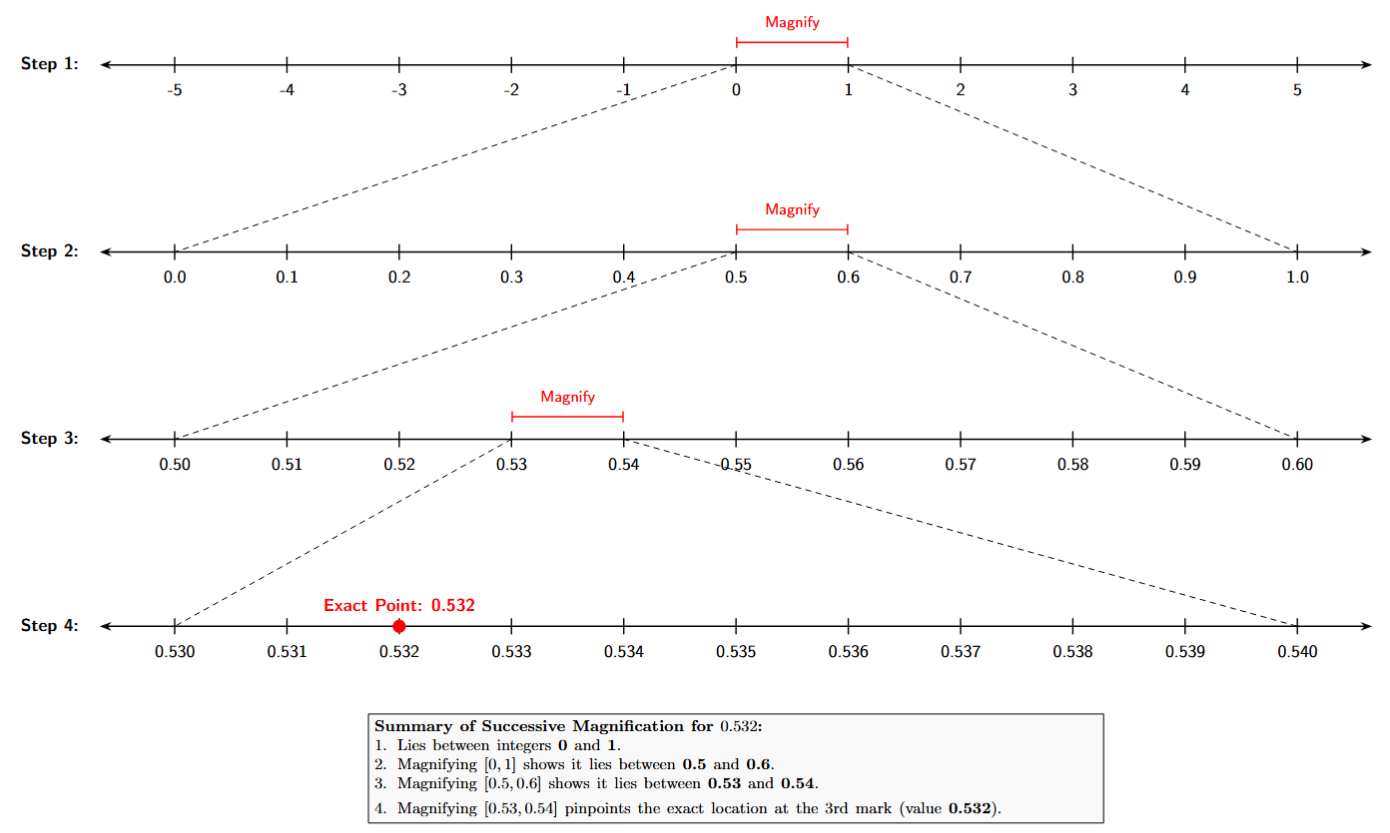
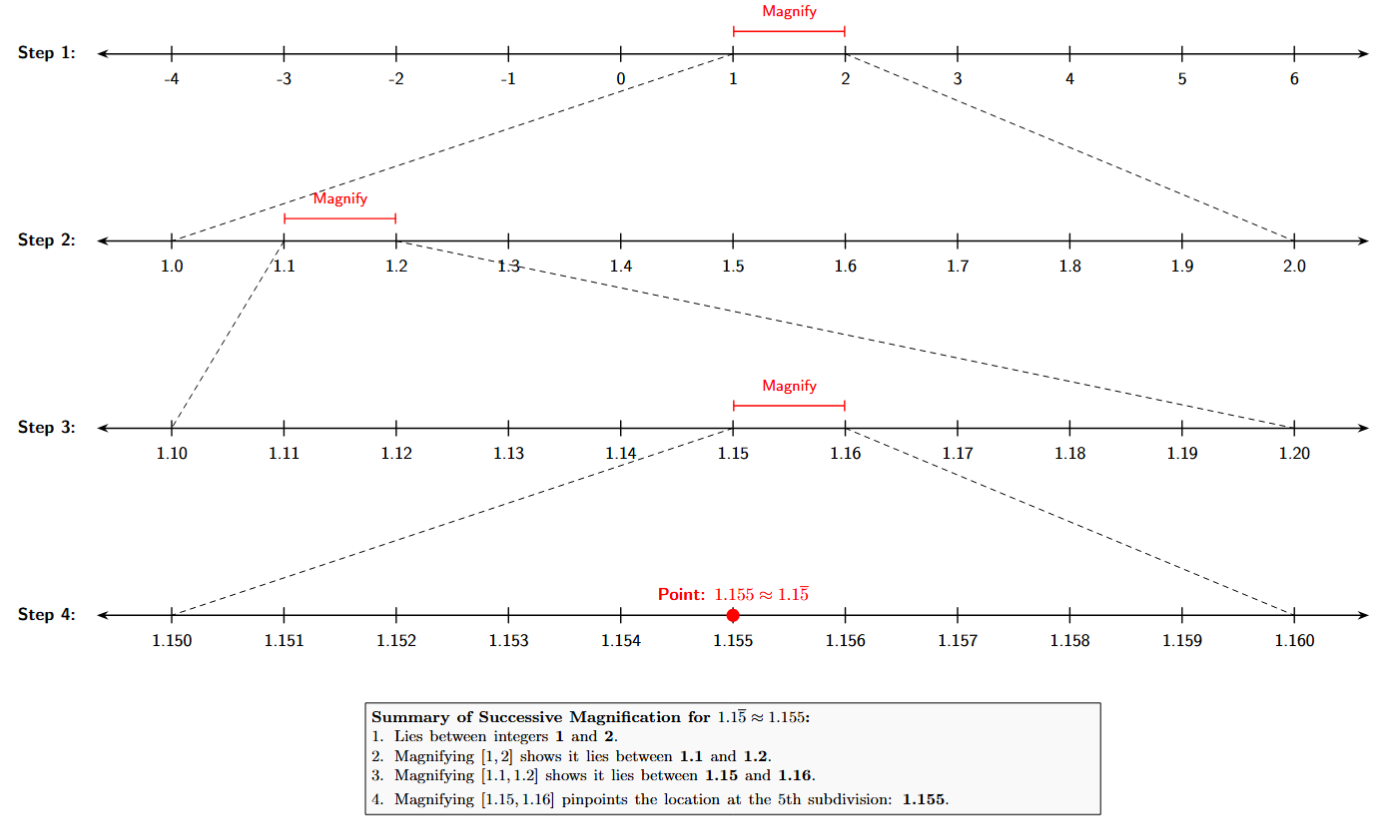
Question 4. Locate the following rational numbers on the number line.
(i) $0.532$
(ii) $1.1\overline{5}$
Answer:
To Find: The location of $0.532$ and $1.1\overline{5}$ on the number line using the method of successive magnification.
Solution:
(i) For $0.532$:
This number lies between $0$ and $1$. More specifically, it lies between $0.5$ and $0.6$.
1. First, we divide the segment between $0$ and $1$ into $10$ equal parts and focus on $[0.5, 0.6]$.
2. Next, we divide the segment $[0.5, 0.6]$ into $10$ equal parts to find $[0.53, 0.54]$.
3. Finally, we divide $[0.53, 0.54]$ into $10$ equal parts. The third mark represents $0.532$.
(ii) For $1.1\overline{5}$:
The number $1.1\overline{5}$ is $1.1555...$. Let us locate it up to $3$ decimal places, i.e., $1.155$.
1. This number lies between $1.1$ and $1.2$.
2. We divide the interval $[1.1, 1.2]$ into $10$ parts and locate the interval $[1.15, 1.16]$.
3. We further divide $[1.15, 1.16]$ into $10$ parts. The fifth mark represents $1.155$, which is the approximate position of $1.1\overline{5}$.
Question 5. Find $6$ rational numbers between $3$ and $4$.
Answer:
Given: Two integers $3$ and $4$.
To Find: Six rational numbers between them.
Solution:
To find $n$ rational numbers between two numbers, we can multiply the numerator and denominator of both numbers by $(n + 1)$. Here, $n = 6$, so we use $6 + 1 = 7$.
$3 = \frac{3 \times 7}{7} = \frac{21}{7}$
... (i)
$4 = \frac{4 \times 7}{7} = \frac{28}{7}$
... (ii)
The integers between the numerators $21$ and $28$ are $22, 23, 24, 25, 26, 27$.
Therefore, the six rational numbers are:
$\frac{22}{7}, \frac{23}{7}, \frac{24}{7}, \frac{25}{7}, \frac{26}{7}, \text{ and } \frac{27}{7}$.
Alternate Solution:
We can also use decimal representation. Any six decimals between $3.0$ and $4.0$ are rational.
Examples: $3.1, 3.2, 3.3, 3.4, 3.5, 3.6$.
Question 6. Find $5$ rational numbers between $\frac{2}{5}$ and $\frac{3}{5}$.
Answer:
To Find: Five rational numbers between $\frac{2}{5}$ and $\frac{3}{5}$.
Solution:
We want to find $5$ numbers, so we multiply the numerator and denominator of both fractions by $(5 + 1) = 6$.
$\frac{2}{5} = \frac{2 \times 6}{5 \times 6} = \frac{12}{30}$
[First equivalent fraction]
$\frac{3}{5} = \frac{3 \times 6}{5 \times 6} = \frac{18}{30}$
[Second equivalent fraction]
The numerators between $12$ and $18$ are $13, 14, 15, 16, 17$.
Thus, the five rational numbers are:
$\frac{13}{30}, \frac{14}{30}, \frac{15}{30}, \frac{16}{30}, \text{ and } \frac{17}{30}$.
We can simplify these fractions where possible:
$\frac{13}{30}, \frac{7}{15}, \frac{1}{2}, \frac{8}{15}, \frac{17}{30}$
Question 7. Find $5$ rational numbers between $\frac{1}{6}$ and $\frac{2}{5}$.
Answer:
To Find: Five rational numbers between $\frac{1}{6}$ and $\frac{2}{5}$.
Solution:
First, we find a common denominator for the two fractions. The L.C.M. of $6$ and $5$ is $30$.
$\frac{1}{6} = \frac{1 \times 5}{6 \times 5} = \frac{5}{30}$
... (i)
$\frac{2}{5} = \frac{2 \times 6}{5 \times 6} = \frac{12}{30}$
... (ii)
Now, we need to find five integers between the numerators $5$ and $12$. These are $6, 7, 8, 9, 10$.
The rational numbers are:
$\frac{6}{30}, \frac{7}{30}, \frac{8}{30}, \frac{9}{30}, \text{ and } \frac{10}{30}$.
Simplifying the fractions:
$\frac{1}{5}, \frac{7}{30}, \frac{4}{15}, \frac{3}{10}, \text{ and } \frac{1}{3}$.
Question 8. If $\frac{x}{3} + \frac{x}{5} = \frac{16}{15}$, find the rational number $x$.
Answer:
To Find:
The value of the rational number $x$.
Solution:
The given equation is:
$\frac{x}{3} + \frac{x}{5} = \frac{16}{15}$
To add the fractions on the left-hand side, we find the L.C.M. of the denominators $3$ and $5$, which is $15$.
$\frac{5x + 3x}{15} = \frac{16}{15}$
$\frac{8x}{15} = \frac{16}{15}$
[Combining like terms]
Multiplying both sides by $15$:
$8x = 16$
$x = \frac{16}{8}$
$x = 2$
Therefore, the rational number is $2$.
Question 9. Let $a$ and $b$ be two non-zero rational numbers such that $a + \frac{1}{b} = 0$. Without assigning any numerical values, determine whether $ab$ is positive or negative. Justify your answer.
Answer:
Given:
$a + \frac{1}{b} = 0$, where $a, b \neq 0$.
To Find:
Whether the product $ab$ is positive or negative.
Solution:
From the given equation:
$a = -\frac{1}{b}$
[Transposing $\frac{1}{b}$]
Since $b \neq 0$, we can multiply both sides of the equation by $b$:
$a \times b = \left(-\frac{1}{b}\right) \times b$
$ab = -1$
Justification:
The product of $a$ and $b$ is $-1$. Since $-1$ is a negative number, it implies that the two non-zero rational numbers $a$ and $b$ must have opposite signs.
Therefore, the product $ab$ is negative.
Question 10. A rational number has a terminating decimal expansion whose last non-zero digit occurs in the $4^{th}$ decimal place. Show that such a number can be written in the form $\frac{p}{10^4}$, where $p$ is an integer not divisible by $10$.
Is it necessary that the denominator of this rational number, when written in the lowest form, is divisible by $2^4$ or $5^4$? Give reasons.
Answer:
Given:
A rational number has a terminating decimal expansion. The last non-zero digit of this expansion occurs at the $4^{th}$ decimal place.
To Prove/Show:
1. The number can be written as $\frac{p}{10^4}$, where $p$ is an integer not divisible by $10$.
2. To determine if the denominator in the lowest form must be divisible by $2^4$ or $5^4$.
Proof / Solution:
Let the rational number be $x$. Since the decimal expansion terminates at the $4^{th}$ decimal place, we can represent it as:
$x = a.\text{bcde}$
[where $e \neq 0$]
Here, $a$ is the integral part, and $b, c, d, e$ are the digits at the $1^{st}, 2^{nd}, 3^{rd},$ and $4^{th}$ decimal places respectively. Since the last non-zero digit is at the $4^{th}$ place, $e \neq 0$.
By the definition of decimals, we can write:
$x = \frac{abcde}{10000}$
$x = \frac{p}{10^4}$
[Let $p = abcde$]
Since the last digit of the integer $p$ is $e$, and we are given that $e \neq 0$, the integer $p$ does not end with $0$. Therefore, $p$ is not divisible by $10$.
Now, let us consider the denominator in the lowest form. The expression can be written as:
$x = \frac{p}{2^4 \times 5^4}$
To write this in the lowest form, we must cancel out any common factors between $p$ and the denominator. The prime factors of the denominator are only $2$ and $5$.
As proved earlier, $p$ is not divisible by $10$. This means $p$ cannot be divisible by both $2$ and $5$ simultaneously. This leads to three possible cases:
Case 1: If $p$ is divisible by $2$, it cannot be divisible by $5$. Thus, the factor $5^4$ in the denominator will remain unchanged after simplification. Hence, the denominator will be divisible by $5^4$.
Case 2: If $p$ is divisible by $5$, it cannot be divisible by $2$. Thus, the factor $2^4$ in the denominator will remain unchanged after simplification. Hence, the denominator will be divisible by $2^4$.
Case 3: If $p$ is divisible by neither $2$ nor $5$, the denominator $10^4$ (which is $2^4 \times 5^4$) remains as it is. In this case, the denominator is divisible by both $2^4$ and $5^4$.
Conclusion:
Yes, it is necessary that the denominator of the rational number in its lowest form is divisible by either $2^4$ or $5^4$ (or both). This is because $p$ is not divisible by $10$, so it cannot eliminate all the powers of both $2$ and $5$ from the denominator simultaneously.
Question 11. Without performing division, determine whether the decimal expansion of $\frac{18}{125}$ is terminating or non-terminating. If it terminates, state the number of decimal places.
Answer:
Given:
Rational number $\frac{18}{125}$.
Solution:
A rational number $\frac{p}{q}$ has a terminating decimal expansion if the prime factorization of $q$ is of the form $2^n 5^m$, where $n, m$ are non-negative integers.
For the given fraction, the denominator is $q = 125$.
Prime factorization of $125$:
$125 = 5 \times 5 \times 5 = 5^3$
We can write this as $2^0 \times 5^3$. Since the denominator is in the form $2^n 5^m$, the decimal expansion is terminating.
Number of decimal places:
The number of decimal places is determined by the highest power of $2$ or $5$ in the denominator.
In $2^0 \times 5^3$, the highest exponent is $3$.
$\frac{18}{125} = \frac{18 \times 2^3}{5^3 \times 2^3} = \frac{18 \times 8}{10^3} = \frac{144}{1000} = 0.144$
Therefore, the expansion terminates after $3$ decimal places.
Question 12. A rational number in its lowest form has denominator $2^3 \times 5$. How many decimal places will its decimal expansion have? Explain your answer.
Answer:
To Find:
The number of decimal places in the expansion of a rational number with denominator $2^3 \times 5$.
Solution:
A rational number $\frac{p}{q}$ in its lowest form has a terminating decimal expansion if its denominator $q$ is of the form $2^n \times 5^m$. The number of decimal places after which it terminates is given by the maximum of $n$ and $m$.
Given the denominator $q = 2^3 \times 5^1$.
Comparing this with $2^n \times 5^m$:
$n = 3, m = 1$
The number of decimal places = $\max(3, 1) = 3$.
Explanation:
To convert the fraction into a decimal, we need to make the powers of $2$ and $5$ equal in the denominator to create a power of $10$.
$\frac{p}{2^3 \times 5} = \frac{p \times 5^2}{2^3 \times 5^1 \times 5^2}$
$\frac{p \times 25}{2^3 \times 5^3} = \frac{25p}{(10)^3}$
Since the denominator is $10^3$ ($1000$), the decimal will terminate after $3$ decimal places.
Question 13. Let $a = \frac{7}{12}$ and $b = \frac{5}{6}$. Express both $a$ and $b$ in the form $\frac{k_1}{m}$ and $\frac{k_2}{m}$ where $k_1$, $k_2$ and $m$ are integers and $k_2 – k_1 > 6$.
Using the same denominator $m$, write exactly five distinct rational numbers lying between $a$ and $b$ keeping an integer numerator. Explain why the condition $k_2 – k_1 > n + 1$ is necessary to find $n$ such rational numbers between the two rational numbers $a$ and $b$ using this method.
Answer:
Given:
Two rational numbers $a = \frac{7}{12}$ and $b = \frac{5}{6}$.
Solution:
To express both numbers with a common denominator $m$, we first find the Lowest Common Multiple (LCM) of the denominators $12$ and $6$, which is $12$.
$a = \frac{7}{12}$
$b = \frac{5 \times 2}{6 \times 2} = \frac{10}{12}$
Here, $k_1 = 7$ and $k_2 = 10$. The difference $k_2 - k_1 = 10 - 7 = 3$. Since we require a difference $k_2 - k_1 > 6$, we need to scale both fractions by a suitable integer. Multiplying both numerators and denominators by $3$:
$a = \frac{7 \times 3}{12 \times 3} = \frac{21}{36}$
…(i)
$b = \frac{10 \times 3}{12 \times 3} = \frac{30}{36}$
…(ii)
By comparing the scaled fractions in equations (i) and (ii) with the forms $\frac{k_1}{m}$ and $\frac{k_2}{m}$, we get:
$k_1 = 21, k_2 = 30, \text{and } m = 36$.
Now, we verify the difference condition:
$k_2 - k_1 = 30 - 21 = 9$
…(iii)
Since $9 > 6$, the given condition is satisfied.
Five Distinct Rational Numbers:
Using the common denominator $m = 36$, the rational numbers lying between $a$ and $b$ with integer numerators are of the form $\frac{x}{36}$, where $21 < x < 30$.
Exactly five distinct rational numbers from this range are:
$\mathbf{\frac{22}{36}, \frac{23}{36}, \frac{24}{36}, \frac{25}{36}, \text{ and } \frac{26}{36}}$
In their simplest form, these can be written as $\frac{11}{18}, \frac{23}{36}, \frac{2}{3}, \frac{25}{36}, \text{ and } \frac{13}{18}$.
Explanation:
When searching for $n$ rational numbers between $\frac{k_1}{m}$ and $\frac{k_2}{m}$ using this method, we look for integers strictly between $k_1$ and $k_2$. The set of available integer numerators is $\{k_1+1, k_1+2, \dots, k_2-1\}$.
$N = (k_2 - k_1) - 1$
[Number of available integers] ... (iv)
To ensure we can find $n$ distinct numbers, the count $N$ must be at least $n$. This gives the following inequality:
$(k_2 - k_1) - 1 \geq n$
$k_2 - k_1 \geq n + 1$
The strict condition $k_2 - k_1 > n + 1$ is necessary because it guarantees that there is at least one extra integer available, ensuring that the gap between the fractions is sufficiently wide to pick $n$ distinct rational numbers with ease. As seen in equation (iii), our difference was $9$. Since $9 > (5 + 1)$, we had more than enough space to identify five distinct numbers.
Question 14. Three rational numbers $x, y, z$ satisfy $x + y + z = 0$ and $xy + yz + zx = 0$. Show that all the rational numbers $x, y, z$ must be simultaneously zero.
Answer:
Given:
$x + y + z = 0$
... (i)
$xy + yz + zx = 0$
... (ii)
To Prove:
$x = y = z = 0$.
Proof:
We use the algebraic identity for the square of a trinomial:
$(x + y + z)^2 = x^2 + y^2 + z^2 + 2(xy + yz + zx)$
Substituting the values from equations (i) and (ii):
$(0)^2 = x^2 + y^2 + z^2 + 2(0)$
$x^2 + y^2 + z^2 = 0$
For any rational number, the square of the number is always non-negative (i.e., $x^2 \geq 0$, $y^2 \geq 0$, and $z^2 \geq 0$).
The only way the sum of non-negative rational numbers can be zero is if each individual term is zero.
$x^2 = 0, y^2 = 0, z^2 = 0$
[Property of squares]
This implies:
$x = 0, y = 0, \text{ and } z = 0$.
Thus, $x, y,$ and $z$ are simultaneously zero.
Question 15. Show that the rational number $\frac{(a + b)}{2}$ lies between the rational numbers $a$ and $b$.
Answer:
To Prove:
If $a$ and $b$ are two rational numbers such that $a < b$, then $a < \frac{a+b}{2} < b$.
Proof:
Let us assume $a < b$.
Step 1: Prove $a < \frac{a+b}{2}$
$a < b$
(Assumption)
Add $a$ to both sides:
$a + a < b + a$
$2a < a + b$
$a < \frac{a+b}{2}$
... (i)
Step 2: Prove $\frac{a+b}{2} < b$
$a < b$
(Assumption)
Add $b$ to both sides:
$a + b < b + b$
$a + b < 2b$
$\frac{a+b}{2} < b$
... (ii)
Combining (i) and (ii), we get:
$a < \frac{a+b}{2} < b$
Therefore, the average of two rational numbers always lies strictly between them.
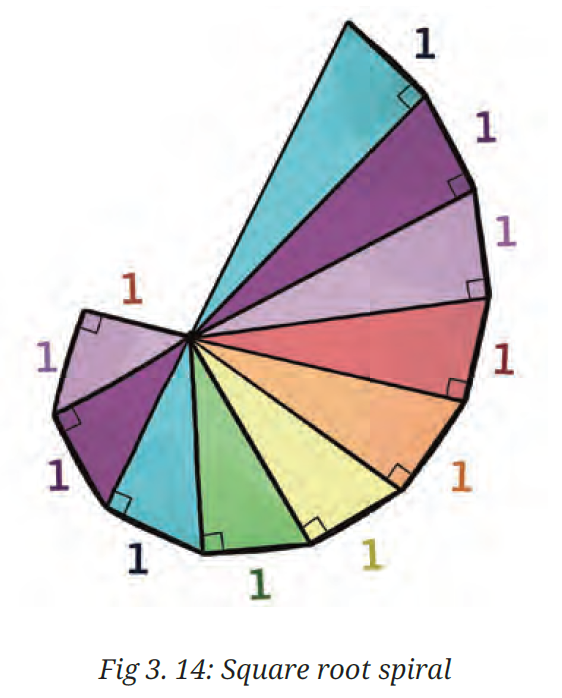
Question 16. Find the lengths of the hypotenuses of all the right triangles in Fig. $3.14$ which is referred to as the square root spiral.
Answer:
Given:
According to Fig 3.14, we are provided with a Square Root Spiral. This spiral is constructed by a sequence of right-angled triangles joined together.
The first triangle in the sequence has a base of $1$ unit and a perpendicular height of $1$ unit. Each subsequent triangle uses the hypotenuse of the previous triangle as its base and has a constant perpendicular height of $1$ unit.
To Find:
The lengths of the hypotenuses of all the right-angled triangles shown in the given figure.
Solution:
To find the hypotenuse ($H$) of a right-angled triangle, we use the Pythagoras Theorem:
$H^2 = B^2 + P^2$
[Pythagoras Theorem]
Taking the square root on both sides, we get:
$H = \sqrt{B^2 + P^2}$
Now, we calculate the length of the hypotenuse for each triangle in the spiral:
1. For the first triangle ($T_1$):
Base ($B_1$) = $1$ unit and Perpendicular ($P$) = $1$ unit.
$H_1 = \sqrt{1^2 + 1^2} = \sqrt{1 + 1} = \sqrt{2}$
[Length of first hypotenuse]
2. For the second triangle ($T_2$):
Base ($B_2$) = Hypotenuse of $T_1$ = $\sqrt{2}$ units and Perpendicular ($P$) = $1$ unit.
$H_2 = \sqrt{(\sqrt{2})^2 + 1^2} = \sqrt{2 + 1} = \sqrt{3}$
3. For the third triangle ($T_3$):
Base ($B_3$) = $H_2 = \sqrt{3}$ units and Perpendicular ($P$) = $1$ unit.
$H_3 = \sqrt{(\sqrt{3})^2 + 1^2} = \sqrt{3 + 1} = \sqrt{4} = 2$
4. For the fourth triangle ($T_4$):
Base ($B_4$) = $H_3 = 2$ units and Perpendicular ($P$) = $1$ unit.
$H_4 = \sqrt{2^2 + 1^2} = \sqrt{4 + 1} = \sqrt{5}$
By continuing this process recursively, we observe that the hypotenuse of the $n^{th}$ triangle is $\sqrt{n+1}$. By counting the segments labeled as $1$ in Fig 3.14, we identify 11 such triangles. The lengths of their hypotenuses are:
Length of Hypotenuse 1 = $\sqrt{2}$ units
Length of Hypotenuse 2 = $\sqrt{3}$ units
Length of Hypotenuse 3 = $2$ units (since $\sqrt{4} = 2$)
Length of Hypotenuse 4 = $\sqrt{5}$ units
Length of Hypotenuse 5 = $\sqrt{6}$ units
Length of Hypotenuse 6 = $\sqrt{7}$ units
Length of Hypotenuse 7 = $\sqrt{8}$ units (or $2\sqrt{2}$ units)
Length of Hypotenuse 8 = $3$ units (since $\sqrt{9} = 3$)
Length of Hypotenuse 9 = $\sqrt{10}$ units
Length of Hypotenuse 10 = $\sqrt{11}$ units
Length of Hypotenuse 11 = $\sqrt{12}$ units (or $2\sqrt{3}$ units)
Conclusion:
The lengths of the hypotenuses of the right triangles in the square root spiral shown are $\sqrt{2}, \sqrt{3}, 2, \sqrt{5}, \sqrt{6}, \sqrt{7}, 2\sqrt{2}, 3, \sqrt{10}, \sqrt{11}, \text{ and } 2\sqrt{3}$ units.