

Chapter 5 I’m Up and Down, and Round and Round (Class 9 - Latest Maths NCERT (Ganita Manjari I) Solutions)
Looking for comprehensive and clear NCERT Solutions for Chapter 5: I’m Up and Down, and Round and Round? You’ve come to the right place! This page provides step-by-step guidance for the latest Class 9 Maths curriculum, helping you master the perfect symmetry of the Circle. We provide accurate answers for exercises that define the circle as a locus of points, ensuring you understand why this shape is unique in its rotational symmetry and infinite lines of reflection.
Our solutions walk you through the intricate theorems governing Chords and Arcs. We offer detailed, logical proofs showing why equal chords are equidistant from the centre and how to correctly identify angles subtended by different arcs. A key feature of our resources is the step-by-step breakdown of Theorem 9, proving that the angle at the centre is double the angle at the circumference. We also provide precise construction methods for the Circumcircle of a triangle, helping you locate the circumcentre by finding the intersection of perpendicular bisectors with ease.
To ensure you excel in your geometry assessments, this page offers visual proofs and logical derivations for Cyclic Quadrilaterals and concyclic points based on the Ganita Manjari I textbook. Whether you are proving theorems or solving complex construction problems, our resources—curated by learningspot.co—are designed to turn the "round and round" logic of circles into intuitive mathematical skills for every CBSE student.
| Content On This Page | ||
|---|---|---|
| Exercise Set 5.1 | Exercise Set 5.2 | Exercise Set 5.3 |
| Exercise Set 5.4 | Exercise Set 5.5 | Exercise Set 5.6 |
| End-Of-Chapter Exercises | ||
Exercise Set 5.1
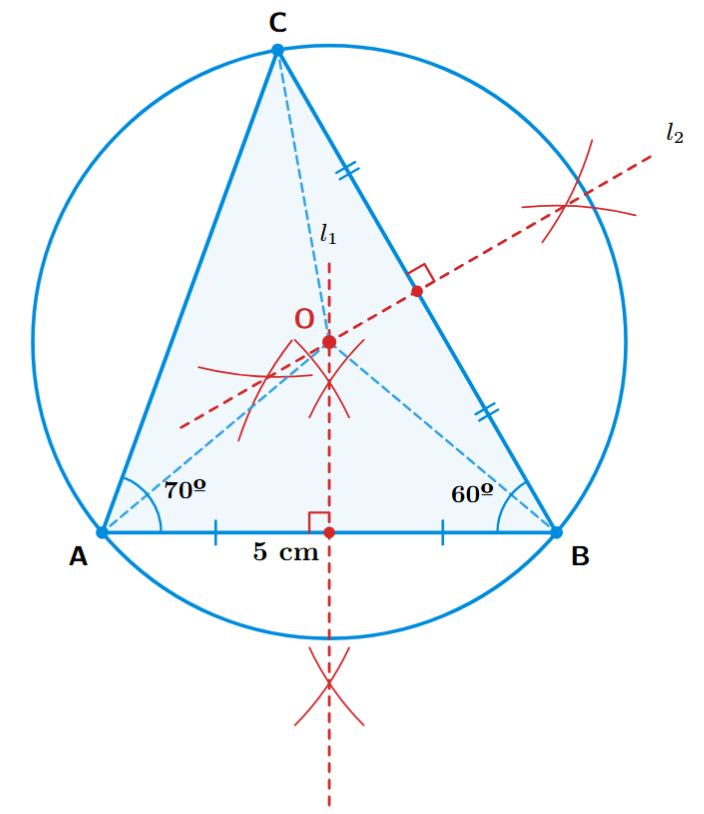
Question 1. Draw $\Delta ABC$ with $AB = 5\text{ cm}$, $\angle A = 70^\circ$ and $\angle B = 60^\circ$. Draw the circumcircle of $\Delta ABC$. Is the centre inside or outside the triangle?
Answer:
Given:
In $\Delta ABC$, side $AB = 5\text{ cm}$, $\angle A = 70^\circ$ and $\angle B = 60^\circ$.
Construction Required:
1. Draw a line segment $AB = 5\text{ cm}$ using a ruler.
2. At point $A$, draw a ray making an angle of $70^\circ$ with $AB$ using a protractor.
3. At point $B$, draw a ray making an angle of $60^\circ$ with $BA$ using a protractor.
4. Let the two rays intersect at point $C$. Thus, $\Delta ABC$ is formed.
5. Draw the perpendicular bisectors of any two sides, say $AB$ and $BC$.
6. Let the perpendicular bisectors intersect at point $O$. This point $O$ is the circumcentre.
7. With $O$ as the centre and $OA$ (or $OB$ or $OC$) as the radius, draw a circle. This is the circumcircle.
Solution:
To determine the position of the circumcentre, we first find the third angle of the triangle.
$\angle A + \angle B + \angle C = 180^\circ$
(Angle sum property of a triangle)
$70^\circ + 60^\circ + \angle C = 180^\circ$
$130^\circ + \angle C = 180^\circ$
$\angle C = 50^\circ$
Since all the angles ($\angle A = 70^\circ$, $\angle B = 60^\circ$, and $\angle C = 50^\circ$) are less than $90^\circ$, $\Delta ABC$ is an acute-angled triangle.
For an acute-angled triangle, the circumcentre always lies inside the triangle.
Therefore, the centre of the circumcircle is inside the triangle.
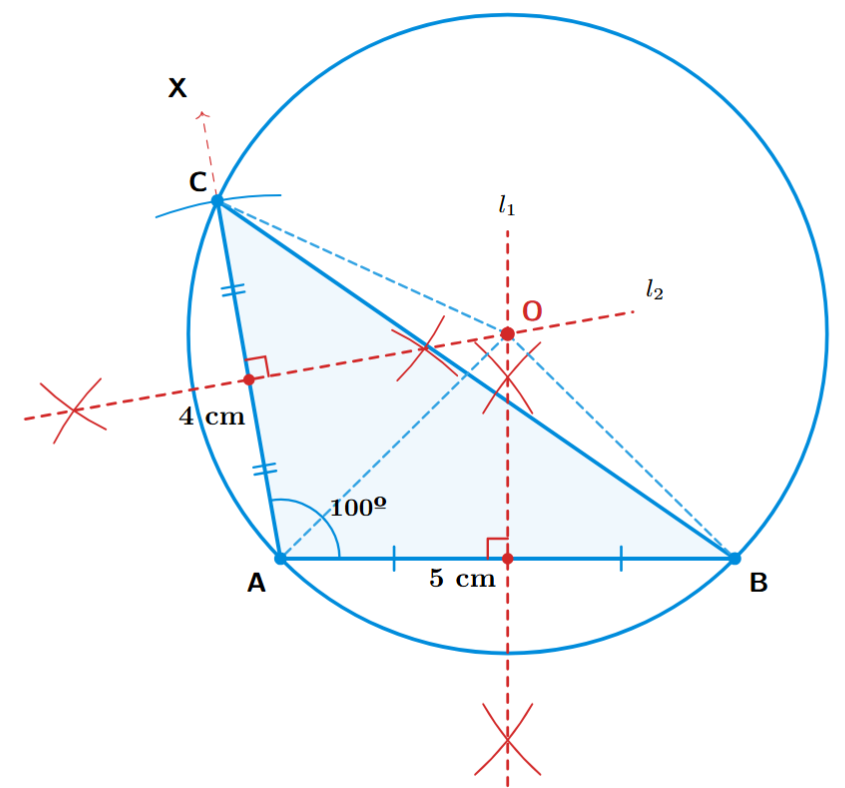
Question 2. Draw $\Delta ABC$ with $AB = 5\text{ cm}$, $\angle A = 100^\circ$, $AC = 4\text{ cm}$. Draw the circumcircle of $\Delta ABC$. Is the centre inside or outside the triangle?
Answer:
Given:
In $\Delta ABC$, $AB = 5\text{ cm}$, $AC = 4\text{ cm}$ and $\angle A = 100^\circ$.
Construction Required:
1. Draw a line segment $AB = 5\text{ cm}$.
2. At point $A$, construct an angle $\angle BAX = 100^\circ$ using a protractor.
3. With $A$ as the centre and a radius of $4\text{ cm}$, draw an arc on the ray $AX$ to mark point $C$.
4. Join $BC$ to complete $\Delta ABC$.
5. Construct the perpendicular bisectors of sides $AB$ and $AC$.
6. Extend the perpendicular bisectors until they meet at point $O$ (the circumcentre).
7. Draw a circle with centre $O$ and radius $OA$.
Solution:
In the given $\Delta ABC$, the angle $\angle A = 100^\circ$.
Since $100^\circ > 90^\circ$, $\Delta ABC$ is an obtuse-angled triangle.
For an obtuse-angled triangle, the circumcentre always lies in the exterior (outside) of the triangle.
Therefore, the centre of the circumcircle is outside the triangle.
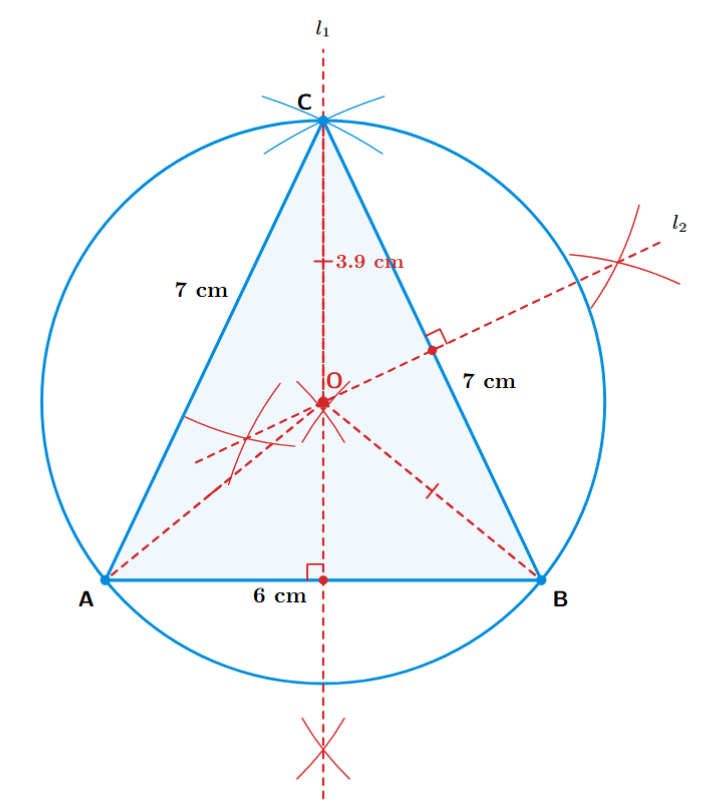
Question 3. Draw $\Delta ABC$, with $AB = 6\text{ cm}$, $BC = 7\text{ cm}$ and $CA = 7\text{ cm}$. Draw the circumcircle of $\Delta ABC$. Let the circumcentre be $O$. Measure $OA$, $OB$, $OC$.
Answer:
Given:
In $\Delta ABC$, the lengths of the sides are:
$AB = 6\text{ cm}$
$BC = 7\text{ cm}$
$CA = 7\text{ cm}$
To Find:
The measure of the segments $OA$, $OB$, and $OC$ where $O$ is the circumcentre of $\Delta ABC$.
Construction Required:
1. Draw a line segment $AB = 6\text{ cm}$.
2. Using a compass, take a radius of $7\text{ cm}$. With $A$ as the centre, draw an arc above $AB$.
3. With the same radius of $7\text{ cm}$ and $B$ as the centre, draw another arc intersecting the previous arc at point $C$.
4. Join $AC$ and $BC$ to complete $\Delta ABC$.
5. Draw the perpendicular bisectors of any two sides (e.g., $AB$ and $BC$).
6. The point where these perpendicular bisectors intersect is the circumcentre $O$.
7. With $O$ as the centre and $OA$ as the radius, draw a circle that passes through $A, B,$ and $C$.
Solution:
By definition, the circumcentre $O$ of a triangle is the point that is equidistant from all three vertices of the triangle ($A, B,$ and $C$).
The segments $OA$, $OB$, and $OC$ represent the circumradius ($R$) of the triangle.
$OA = OB = OC$
(Radii of the same circumcircle)
After performing the construction accurately using a ruler and compass, we measure the lengths from the circumcentre $O$ to any vertex.
$OA = OB = OC \approx 3.9 \text{ cm}$
[By actual measurement]
Final Answer: The lengths of $OA, OB,$ and $OC$ are equal as they are the radii of the circumcircle. Upon measurement, $OA = OB = OC \approx 3.9 \text{ cm}$.
Question 4. What is the least possible radius of a circle through two points $A$ and $B$?
Answer:
Given:
Two distinct points $A$ and $B$. Let the distance between them be $d$.
To Find:
The least possible radius of a circle passing through $A$ and $B$.
Solution:
Infinite circles can pass through two given points $A$ and $B$. The centres of all such circles lie on the perpendicular bisector of the line segment $AB$.
Let the distance between points $A$ and $B$ be $AB$.
For any circle passing through $A$ and $B$, the segment $AB$ acts as a chord of the circle.
We know that the diameter is the longest chord of a circle. Thus, the smallest possible circle containing $AB$ as a chord is the one where $AB$ itself is the diameter.
If $AB$ is the diameter, the radius $r$ is half of the diameter.
$r = \frac{1}{2} AB$
... (i)
In any other case, the chord $AB$ would be smaller than the diameter, meaning the diameter (and thus the radius) would be larger than in the case where $AB$ is the diameter.
Conclusion:
The least possible radius of a circle through two points $A$ and $B$ is half the length of the segment $AB$ (i.e., $\frac{AB}{2}$).
Exercise Set 5.2
Question 1. Show that the triangle formed by a chord and the centre of the circle is isosceles.
Answer:
Given:
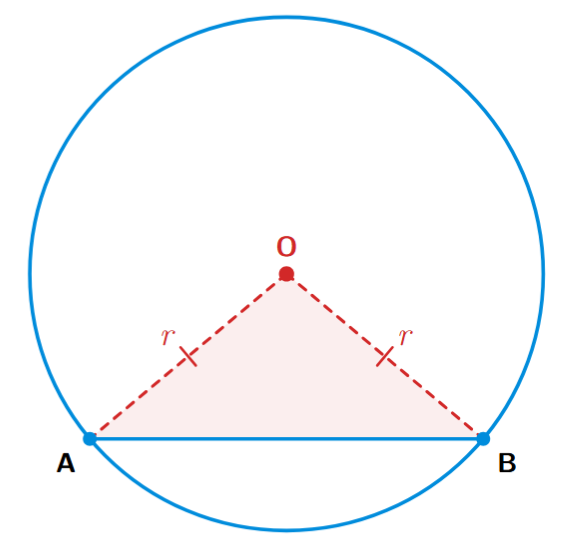
A circle with centre $O$ and a chord $AB$ which does not pass through the centre. Joining the endpoints of the chord $A$ and $B$ to the centre $O$ forms $\Delta OAB$.
To Prove:
$\Delta OAB$ is an isosceles triangle.
Construction Required:
Draw a circle with centre $O$ and mark a chord $AB$. Join $OA$ and $OB$.
Proof:
In $\Delta OAB$, we consider the sides $OA$ and $OB$.
$OA = OB$
(Radii of the same circle)
We know that a triangle in which at least two sides are equal is called an isosceles triangle.
Since $OA = OB$, two sides of $\Delta OAB$ (which are the radii of the circle) are equal.
$\angle OAB = \angle OBA$
[Angles opposite to equal sides are equal]
Thus, by the definition of an isosceles triangle, $\Delta OAB$ is an isosceles triangle.
Hence Proved.
Question 2. Show that if two such isosceles triangles (occurring in the previous question) have equal base length, they are congruent to each other.
Answer:
Given:
A circle with centre $O$. Let there be two chords $AB$ and $CD$ representing the bases of the two triangles $\Delta OAB$ and $\Delta OCD$, such that their lengths are equal, i.e., $AB = CD$.
To Prove:
$\Delta OAB \cong \Delta OCD$
Construction Required:
Draw a circle with centre $O$. Draw two chords $AB$ and $CD$ in the circle such that $AB = CD$. Join the centre $O$ to the endpoints $A, B, C,$ and $D$ to form the triangles $\Delta OAB$ and $\Delta OCD$.
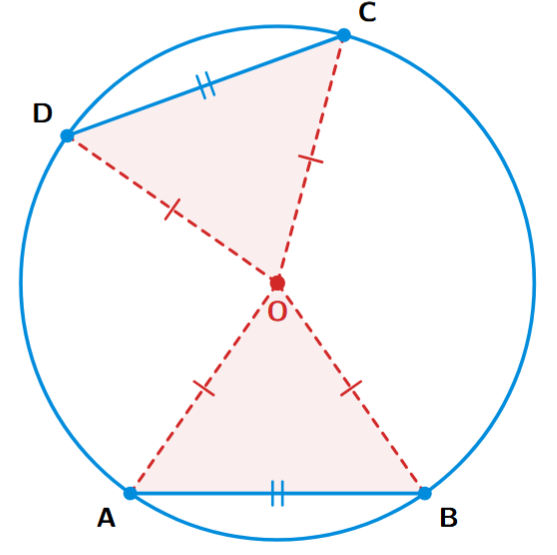
Proof:
Consider $\Delta OAB$ and $\Delta OCD$. In these two triangles:
$OA = OC$
(Radii of the same circle)
$OB = OD$
(Radii of the same circle)
$AB = CD$
(Given: equal base lengths)
Since all the three corresponding sides of $\Delta OAB$ are equal to the three corresponding sides of $\Delta OCD$, we apply the SSS (Side-Side-Side) congruence criterion.
$\Delta OAB \cong \Delta OCD$
[By SSS Congruence Rule]
Hence Proved.
Alternate Solution:
We can also prove this using the SAS (Side-Angle-Side) congruence criterion by utilizing a standard circle property.
In $\Delta OAB$ and $\Delta OCD$:
1. $OA = OC$ (Radii of the same circle)
$\angle AOB = \angle COD$
(Equal chords subtend equal angles at the centre)
2. $OB = OD$ (Radii of the same circle)
Therefore, by the SAS congruence criterion, the two triangles are congruent:
$\Delta OAB \cong \Delta OCD$
This confirms that equal chords (bases) within the same circle create congruent isosceles triangles.
Exercise Set 5.3
Question 1. Can you explain why the converse to Theorem $4$ is true, i.e., why does the perpendicular from the centre of a circle to a chord of the circle bisect the chord?
(Hint: Use Fig. $5.12$. You are told that $\angle CMA = \angle CMB = 90^\circ$. You need to show that $AM = BM$.)
Answer:
Given:
A circle with centre $O$ and a chord $AB$. $OM$ is the perpendicular drawn from the centre $O$ to the chord $AB$.
$\angle OMA = \angle OMB = 90^\circ$
(Given: $OM \perp AB$)
To Prove:
$M$ bisects the chord $AB$, i.e., $AM = BM$.
Construction Required:
Join the centre $O$ to the endpoints of the chord $A$ and $B$.
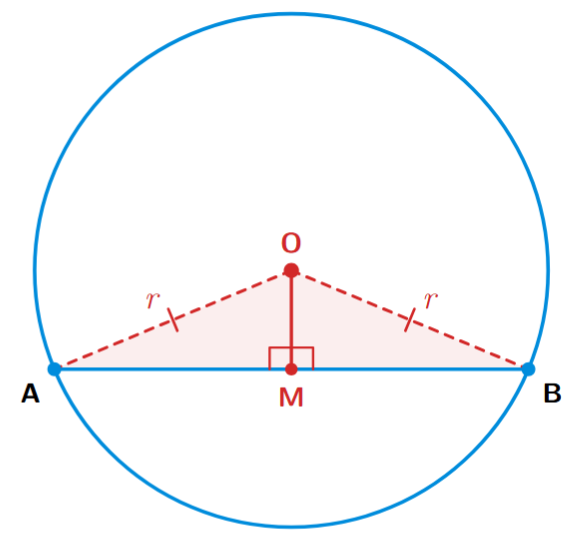
Proof:
In right-angled triangles $\Delta OMA$ and $\Delta OMB$:
$OA = OB$
(Radii of the same circle)
$\angle OMA = \angle OMB$
($90^\circ$ each, as $OM \perp AB$)
$OM = OM$
(Common side)
By applying the RHS (Right angle-Hypotenuse-Side) congruence criterion:
$\Delta OMA \cong \Delta OMB$
[By RHS Congruence Rule]
Since the triangles are congruent, their corresponding parts must be equal:
$AM = BM$
[By C.P.C.T.]
Hence, the perpendicular from the centre to a chord bisects the chord.
Question 2. An isosceles triangle $ABC$ is inscribed in a circle, with $AB = AC$. Show that the altitude from $A$ to $BC$ passes through the centre of the circle.
Answer:
Given:
$\Delta ABC$ is an isosceles triangle inscribed in a circle with centre $O$, where $AB = AC$. $AD$ is the altitude from $A$ to $BC$, so $AD \perp BC$.
To Prove:
The centre $O$ lies on the line $AD$.
Construction Required:
Join $OB$ and $OC$.
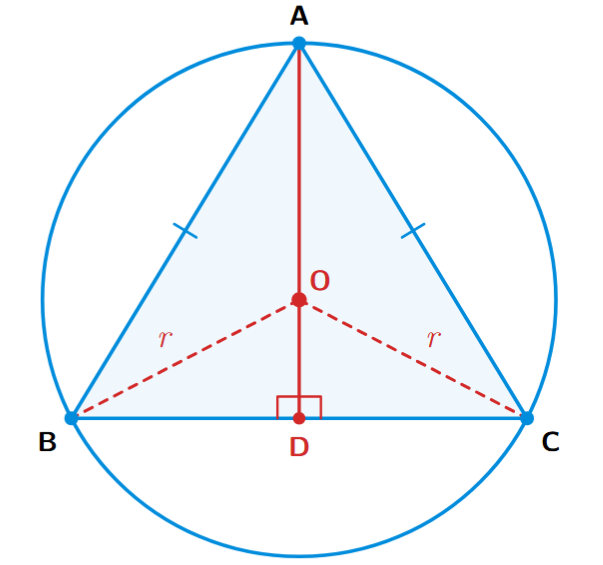
Proof:
In $\Delta ABD$ and $\Delta ACD$:
$AB = AC$
(Given)
$AD = AD$
(Common)
$\angle ADB = \angle ADC = 90^\circ$
(Given: $AD$ is altitude)
By RHS congruence criterion, $\Delta ABD \cong \Delta ACD$.
By CPCT, we get $BD = CD$.
Since $BD = CD$ and $AD \perp BC$, the line $AD$ is the perpendicular bisector of the chord $BC$.
We know that the perpendicular bisector of any chord of a circle passes through the centre of the circle.
Therefore, the centre $O$ must lie on the perpendicular bisector $AD$.
Hence Proved.
Question 3. Two parallel chords of lengths $6\text{ cm}$ and $8\text{ cm}$ are on opposite sides of the centre of a circle. If the radius of the circle is $5\text{ cm}$, find the distance between the midpoints of the chords.
Answer:
Given:
Let the circle have centre $O$ and radius $r = 5\text{ cm}$.
Chord $AB = 8\text{ cm}$ and chord $CD = 6\text{ cm}$.
$AB \parallel CD$ and they lie on opposite sides of the centre $O$.
To Find:
The distance between the midpoints of $AB$ and $CD$.
Construction Required:
Draw $OP \perp AB$ and $OQ \perp CD$. Since $AB \parallel CD$, $P, O,$ and $Q$ are collinear. The distance between the midpoints is $PQ = OP + OQ$. Join $OA$ and $OC$.
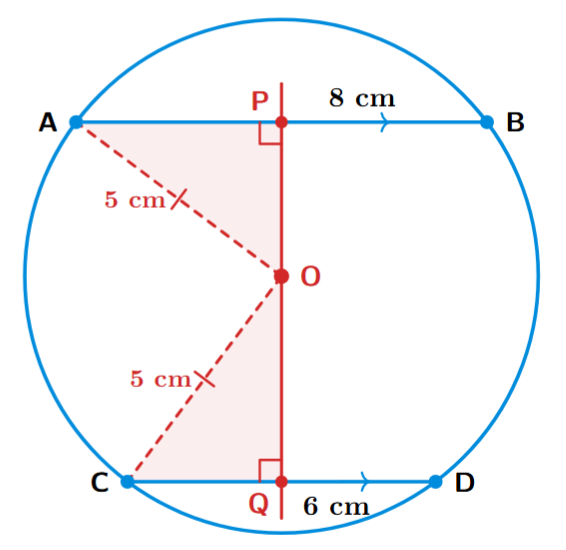
Solution:
As we know, the perpendicular from the centre bisects the chord.
$AP = \frac{1}{2} AB = \frac{8}{2} = 4\text{ cm}$
$CQ = \frac{1}{2} CD = \frac{6}{2} = 3\text{ cm}$
In right-angled $\Delta OPA$:
$OA^2 = OP^2 + AP^2$
(By Pythagoras Theorem)
$5^2 = OP^2 + 4^2$
$25 = OP^2 + 16$
$OP^2 = 25 - 16 = 9$
$OP = 3\text{ cm}$
... (i)
In right-angled $\Delta OQC$:
$OC^2 = OQ^2 + CQ^2$
(By Pythagoras Theorem)
$5^2 = OQ^2 + 3^2$
$25 = OQ^2 + 9$
$OQ^2 = 25 - 9 = 16$
$OQ = 4\text{ cm}$
... (ii)
The total distance between the midpoints $P$ and $Q$ is:
$PQ = OP + OQ$
$PQ = 3 + 4$
$PQ = 7\text{ cm}$
Therefore, the distance between the midpoints of the chords is $7\text{ cm}$.
Exercise Set 5.4
Question 1. Use the Baudhāyana–Pythagoras theorem to show why Theorem $6$ must be true.
Theorem 6: Chords of a circle having the same length are all at the same distance from the centre of the circle.
Answer:
Given:
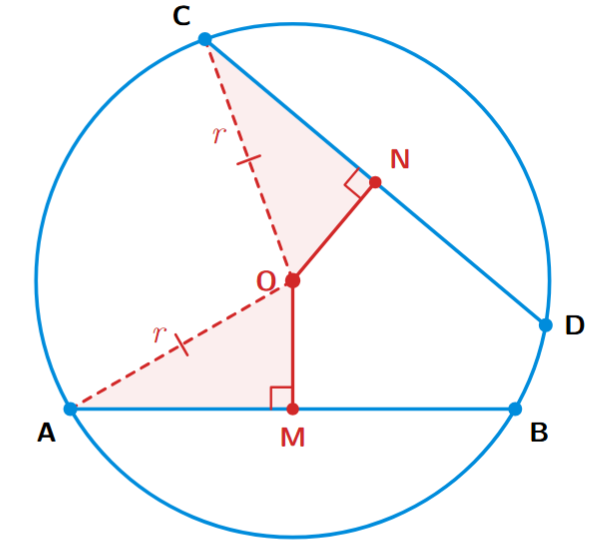
A circle with centre $O$ and radius $r$. Let $AB$ and $CD$ be two equal chords of the circle, i.e., $AB = CD$. Let $OM$ and $ON$ be the perpendiculars drawn from the centre $O$ to the chords $AB$ and $CD$ respectively.
To Prove:
The chords are equidistant from the centre, i.e., $OM = ON$.
Construction Required:
Join the centre $O$ to the endpoints $A$ and $C$ to form right-angled triangles $\triangle OMA$ and $\triangle ONC$.
Proof:
We know that the perpendicular from the centre of a circle to a chord bisects the chord.
$AM = \frac{1}{2} AB$
(As $OM \perp AB$)
$CN = \frac{1}{2} CD$
(As $ON \perp CD$)
Since the chords are equal ($AB = CD$), their halves must also be equal:
$AM = CN$
[Given $AB = CD$] ... (i)
Now, applying the Baudhāyana–Pythagoras theorem in right-angled $\triangle OMA$:
$OA^2 = OM^2 + AM^2$
[Hypotenuse$^2$ = Base$^2$ + Perpendicular$^2$] ... (ii)
Similarly, applying the Baudhāyana–Pythagoras theorem in right-angled $\triangle ONC$:
$OC^2 = ON^2 + CN^2$
[By Baudhāyana-Pythagoras theorem] ... (iii)
In a circle, all radii are equal:
$OA = OC = r$
(Radii of the same circle)
Therefore, $OA^2 = OC^2$. From equations (ii) and (iii), we get:
$OM^2 + AM^2 = ON^2 + CN^2$
Substituting $AM = CN$ from equation (i):
$OM^2 + CN^2 = ON^2 + CN^2$
Subtracting $CN^2$ from both sides:
$OM^2 = ON^2$
$OM = ON$
Hence, chords of equal length are at the same distance from the centre.
Alternate Solution:
We can also prove this using the RHS congruence criterion.
In right $\triangle OMA$ and right $\triangle ONC$:
1. $\angle OMA = \angle ONC = 90^\circ$ (By construction)
2. $OA = OC$ (Radii of the same circle)
3. $AM = CN$ (Halves of equal chords $AB$ and $CD$)
By RHS congruence rule, $\Delta OMA \cong \Delta ONC$.
By C.P.C.T., $OM = ON$.
This proves that the distance of equal chords from the centre is equal.
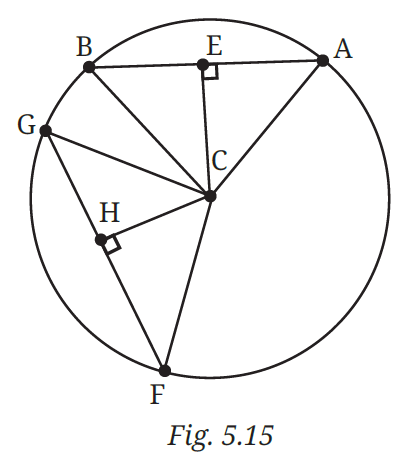
Question 2. Consider Fig. $5.15$. If $CE$ is perpendicular to $AB$, $CH$ is perpendicular to $GH$, and $CE = CH$, show that $AB = GF$.
Answer:
Given:
In a circle with centre $C$, $CE \perp AB$ and $CH \perp GF$. It is given that $CE = CH$.
To Prove:
$AB = GF$
Proof:
In right-angled $\Delta CEA$ and $\Delta CHG$:
$CA = CG$
(Radii of the same circle)
$CE = CH$
(Given)
$\angle CEA = \angle CHG = 90^\circ$
(Given: $CE \perp AB$ and $CH \perp GF$)
Therefore, by RHS congruence criterion:
$\Delta CEA \cong \Delta CHG$
By CPCT (Corresponding Parts of Congruent Triangles):
$AE = GH$
... (i)
We know that a perpendicular from the centre to a chord bisects the chord. Therefore:
$AB = 2 \times AE$
... (ii)
$GF = 2 \times GH$
... (iii)
From (i), (ii), and (iii), we conclude:
$AB = GF$
Hence Proved.
Question 3. Solve the previous question using the Baudhāyana–Pythagoras theorem.
Answer:
Given:
$CE \perp AB$, $CH \perp GF$, $CE = CH$, and $CA = CG = r$.
Proof:
In right-angled $\Delta CEA$, by the Baudhāyana–Pythagoras theorem:
$AE^2 + CE^2 = CA^2$
$AE^2 = CA^2 - CE^2$
... (i)
In right-angled $\Delta CHG$, by the Baudhāyana–Pythagoras theorem:
$GH^2 + CH^2 = CG^2$
$GH^2 = CG^2 - CH^2$
... (ii)
Since $CA = CG$ (Radii) and $CE = CH$ (Given):
$CA^2 = CG^2$ and $CE^2 = CH^2$
Substituting these into equations (i) and (ii), we see that the right-hand sides are equal:
$AE^2 = GH^2$
$AE = GH$
Since $E$ and $H$ are midpoints of chords $AB$ and $GF$ respectively (perpendicular from centre bisects the chord):
$AB = 2AE$ and $GF = 2GH$
Multiplying $AE = GH$ by 2:
$2AE = 2GH$
$AB = GF$
Hence Proved.
Exercise Set 5.5
Question 1. Find the length of the chord of a circle where the radius is $7\text{ cm}$ and perpendicular distance is $6\text{ cm}$.
Answer:
Given:
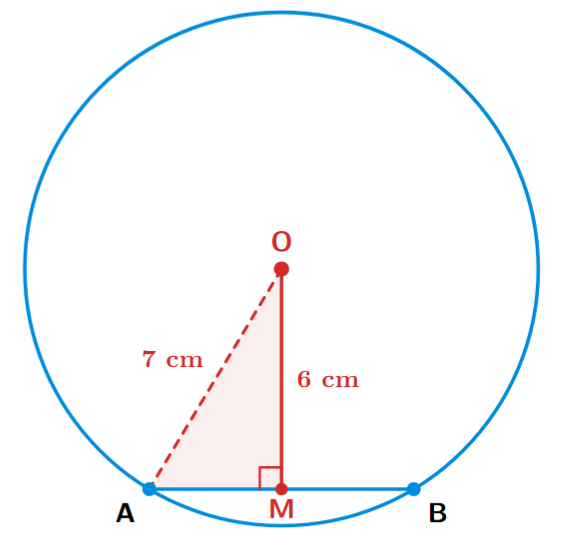
Radius of the circle $(r) = 7\text{ cm}$
Perpendicular distance of the chord from the centre $(d) = 6\text{ cm}$
To Find:
The length of the chord.
Construction Required:
Let $O$ be the centre of the circle and $AB$ be the chord. Draw $OM \perp AB$. Join $OA$.
Solution:
In right-angled $\Delta OMA$, using the Baudhāyana–Pythagoras theorem:
$OA^2 = OM^2 + AM^2$
Substituting the given values:
$7^2 = 6^2 + AM^2$
$49 = 36 + AM^2$
$AM^2 = 49 - 36$
$AM^2 = 13$
$AM = \sqrt{13}\text{ cm}$
We know that the perpendicular from the centre of a circle to a chord bisects the chord.
$AB = 2 \times AM$
$AB = 2\sqrt{13}\text{ cm}$
Using $\sqrt{13} \approx 3.605$:
$AB \approx 2 \times 3.605 = 7.21\text{ cm}$
Therefore, the length of the chord is $2\sqrt{13}\text{ cm}$ or approximately $7.21\text{ cm}$.
Question 2. Explain why the following statement is true: If the perpendicular distance of a chord from the centre is $d$ and the radius is $r$, then the chord length is $2\sqrt{r^2 - d^2}$.
Answer:
Given:
Radius of a circle $= r$. Perpendicular distance of a chord from the centre $= d$.
Proof:
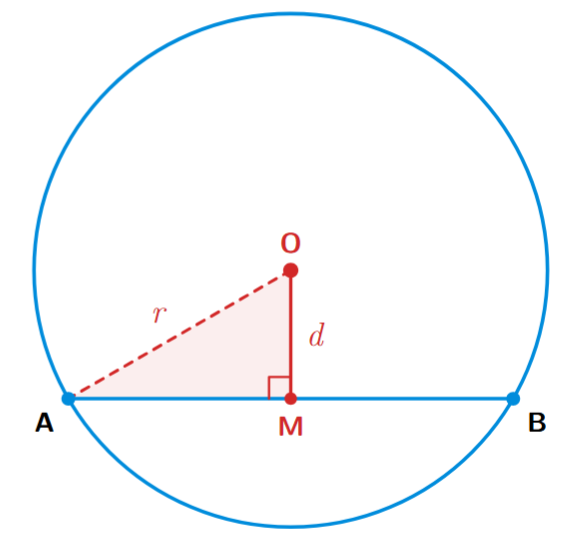
Let $O$ be the centre of the circle and $AB$ be a chord of length $L$. Let $OM$ be the perpendicular from $O$ to $AB$.
Thus, $OM = d$ and $OA = r$ (radius).
In the right-angled $\Delta OMA$, by the Baudhāyana–Pythagoras theorem:
$OA^2 = OM^2 + AM^2$
$r^2 = d^2 + AM^2$
Solving for $AM$:
$AM^2 = r^2 - d^2$
$AM = \sqrt{r^2 - d^2}$
Since the perpendicular from the centre bisects the chord:
$AB = 2 \times AM$
Substituting the value of $AM$:
$AB = 2\sqrt{r^2 - d^2}$
Thus, the chord length $L$ is $2\sqrt{r^2 - d^2}$. The statement is true.
Question 3. In a circle, if the distance of chord $AB$ from the centre is twice the distance of another chord $CD$ from the centre, then can we conclude that $CD = 2AB$? Give reasons for your answer.
Answer:
Given:
Two chords $AB$ and $CD$ in a circle of radius $r$. Let $d_1$ be the distance of $AB$ from centre and $d_2$ be the distance of $CD$ from centre.
Given that $d_1 = 2d_2$.
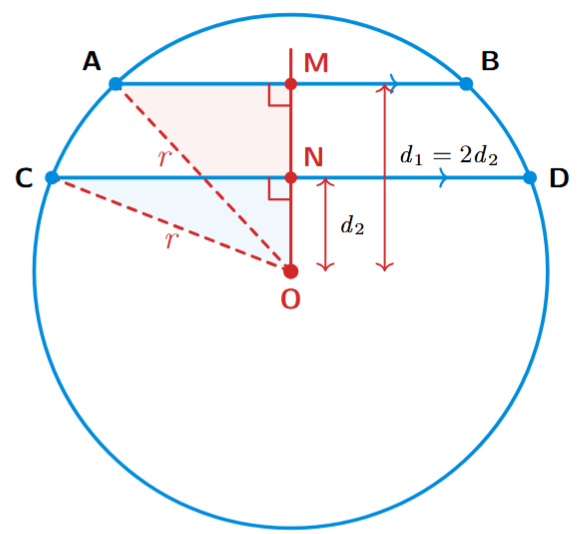
Solution:
No, we cannot conclude that $CD = 2AB$.
Reason:
Using the formula derived in the previous question, the length of the chords are:
$AB = 2\sqrt{r^2 - d_1^2}$
$CD = 2\sqrt{r^2 - d_2^2}$
Substituting $d_1 = 2d_2$ in the expression for $AB$:
$AB = 2\sqrt{r^2 - (2d_2)^2} = 2\sqrt{r^2 - 4d_2^2}$
Now, let us compare $CD$ and $2AB$:
$2AB = 4\sqrt{r^2 - 4d_2^2}$
Clearly, $2\sqrt{r^2 - d_2^2}$ is not equal to $4\sqrt{r^2 - 4d_2^2}$.
The relationship between chord length and its distance from the centre is non-linear. As the distance from the centre increases, the chord length decreases, but not in a direct proportional ratio.
Example:
Let radius $r = 5$. Let $d_2 = 1.5$ and $d_1 = 3$ (so $d_1 = 2d_2$).
$CD = 2\sqrt{25 - 1.5^2} = 2\sqrt{25 - 2.25} = 2\sqrt{22.75} \approx 9.54$
$AB = 2\sqrt{25 - 3^2} = 2\sqrt{25 - 9} = 2\sqrt{16} = 8$
Here, $2AB = 16$, but $CD = 9.54$. Thus $CD \neq 2AB$.
Exercise Set 5.6
Question 1. In a circle with centre $O$, the central angle $\angle AOB$ is $60^\circ$. If the radius of the circle is $12\text{ cm}$, what is the length of the chord $AB$?
Answer:
Given:
A circle with centre $O$ and radius $OA = OB = 12\text{ cm}$.
Central angle subtended by chord $AB$, $\angle AOB = 60^\circ$.
To Find:
Length of the chord $AB$.
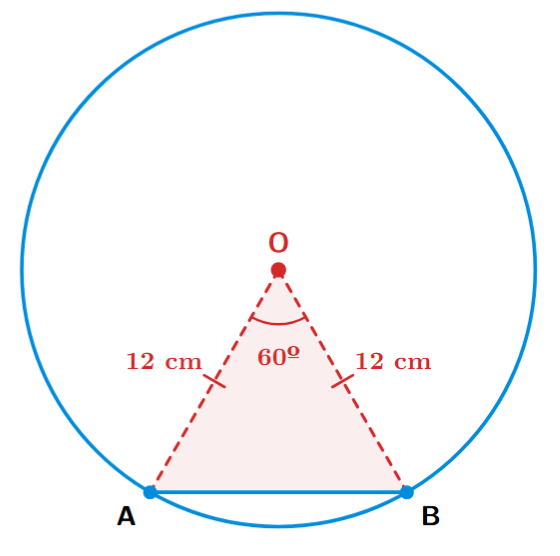
Solution:
In $\Delta OAB$, we have $OA = OB$.
$OA = OB = 12\text{ cm}$
(Radii of the same circle)
Since the sides opposite to equal angles in a triangle are equal:
$\angle OAB = \angle OBA$
... (i)
In $\Delta OAB$, by the angle sum property of a triangle:
$\angle AOB + \angle OAB + \angle OBA = 180^\circ$
Substituting $\angle AOB = 60^\circ$ and using equation (i):
$60^\circ + 2\angle OAB = 180^\circ$
$2\angle OAB = 180^\circ - 60^\circ$
$2\angle OAB = 120^\circ$
$\angle OAB = 60^\circ$
Since $\angle OAB = \angle OBA = 60^\circ$ and $\angle AOB = 60^\circ$, all angles of $\Delta OAB$ are $60^\circ$.
Therefore, $\Delta OAB$ is an equilateral triangle.
In an equilateral triangle, all sides are equal:
$AB = OA = OB$
$AB = 12\text{ cm}$
The length of the chord $AB$ is $12\text{ cm}$.
Question 2. Let $A$ and $B$ be two points on a circle with centre $O$.
(i) Are there points $X, Y$ on the circle, on the same side of $AB$, such that $\angle AXB$ is different from $\angle AYB$?
(ii) Is it true that if $\angle AXB = \angle AYB$, then $X$ and $Y$ lie on the same side of the circle?
(iii) If $\angle AXB = \angle AYB$, and $X$ and $Y$ do not lie on the circle, does the circle through $A$, $B$ and $X$ also pass through $Y$?
Answer:
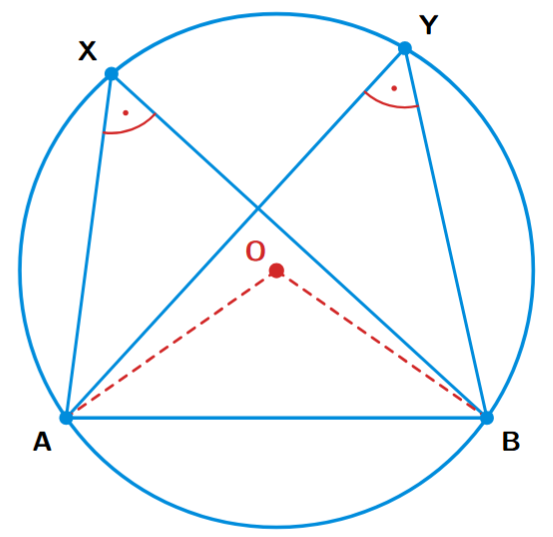
(i) Are there points $X, Y$ on the circle, on the same side of $AB$, such that $\angle AXB$ is different from $\angle AYB$?
Solution:
No, there are no such points. According to the geometric theorem of circles, "Angles subtended by an arc at any points on the remaining part of the circle (in the same segment) are equal."
Since points $X$ and $Y$ lie on the circle on the same side of chord $AB$, they are in the same segment of the circle. Therefore:
$\angle AXB = \angle AYB$
[Angles in the same segment] ... (i)
Hence, the angle subtended by the chord $AB$ at any point on the same side of the circle is always constant.
(ii) Is it true that if $\angle AXB = \angle AYB$, then $X$ and $Y$ lie on the same side of the circle?
Solution:
Not necessarily. If the chord $AB$ happens to be the diameter of the circle, then any point $X$ or $Y$ on the circle will subtend an angle of $90^\circ$ at the circumference.
$\angle AXB = \angle AYB = 90^\circ$
(Angle in a semi-circle)
In this specific case, $X$ and $Y$ could be on opposite sides of the diameter $AB$ and still have equal angles. However, for any chord other than the diameter, if $X$ and $Y$ are on opposite sides, the angles would be supplementary ($\angle AXB + \angle AYB = 180^\circ$) because $AXBY$ would form a cyclic quadrilateral. In that case, they would only be equal if both are $90^\circ$.
(iii) If $\angle AXB = \angle AYB$, and $X$ and $Y$ do not lie on the circle, does the circle through $A$, $B$ and $X$ also pass through $Y$?
Solution:
Yes, provided that $X$ and $Y$ lie on the same side of the line segment $AB$. This is based on the Converse of the Theorem of Angles in the Same Segment.
Theorem: If a line segment joining two points subtends equal angles at two other points lying on the same side of the line containing the segment, then the four points are concyclic (they lie on the same circle).
So, if $\angle AXB = \angle AYB$ and both points are on the same side of $AB$, the circle passing through $A, B,$ and $X$ must also pass through $Y$.
Final Answer:
(i) No, angles in the same segment are always equal.
(ii) False (in the case of a diameter); otherwise True.
(iii) Yes, the four points are concyclic if the angles are equal and the points are on the same side of $AB$.
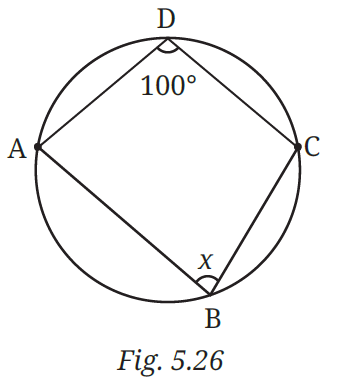
Question 3. Find $x$ in Fig. $5.26$.
Answer:
Given:
A circle with points $A, D, C, B$ on its circumference. These points form a cyclic quadrilateral $ABCD$.
The angle $\angle ADC = 100^\circ$.
The angle $\angle ABC = x$.
To Find:
The value of $x$.
Solution:
We know that a quadrilateral is called cyclic if all its vertices lie on a circle.
A key property of a cyclic quadrilateral is that the sum of its opposite angles is $180^\circ$ (they are supplementary).
In cyclic quadrilateral $ABCD$, $\angle ADC$ and $\angle ABC$ are opposite angles.
$\angle ADC + \angle ABC = 180^\circ$
(Opposite angles of a cyclic quadrilateral)
Substituting the given values:
$100^\circ + x = 180^\circ$
Subtracting $100^\circ$ from both sides:
$x = 180^\circ - 100^\circ$
$x = 80^\circ$
Thus, the value of $x$ is $80^\circ$.
End-Of-Chapter Exercises
Question 1. In a circle, a chord is $5\text{ cm}$ away from the centre. If the radius of the circle is $13\text{ cm}$, what is the length of the chord?
Answer:
Given:
Distance of the chord from the centre ($d$) = $5\text{ cm}$
Radius of the circle ($r$) = $13\text{ cm}$
To Find:
The length of the chord.
Construction Required:
Let $O$ be the centre of the circle and $AB$ be the chord. Draw $OM \perp AB$. Join $OA$.
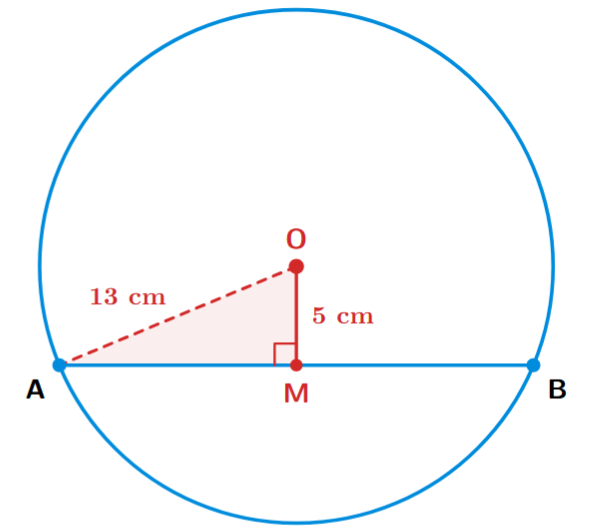
Solution:
In right-angled $\Delta OMA$, according to the Baudhāyana–Pythagoras theorem:
$OA^2 = OM^2 + AM^2$
Substituting the given values $OA = 13\text{ cm}$ and $OM = 5\text{ cm}$:
$13^2 = 5^2 + AM^2$
$169 = 25 + AM^2$
$AM^2 = 169 - 25$
$AM^2 = 144$
$AM = \sqrt{144} = 12\text{ cm}$
We know that the perpendicular from the centre to a chord bisects the chord.
$AB = 2 \times AM$
$AB = 2 \times 12$
$AB = 24\text{ cm}$
[Total length of the chord]
Therefore, the length of the chord is $24\text{ cm}$.
Question 2. An arc of a circle subtends an angle of $70^\circ$ at the centre. What is the measure of the angle subtended by the arc at a point on the circle?
Answer:
Given:
Angle subtended by an arc at the centre, $\angle AOB = 70^\circ$.
To Find:
The angle subtended by the same arc at a point on the remaining part of the circle ($\angle ACB$).
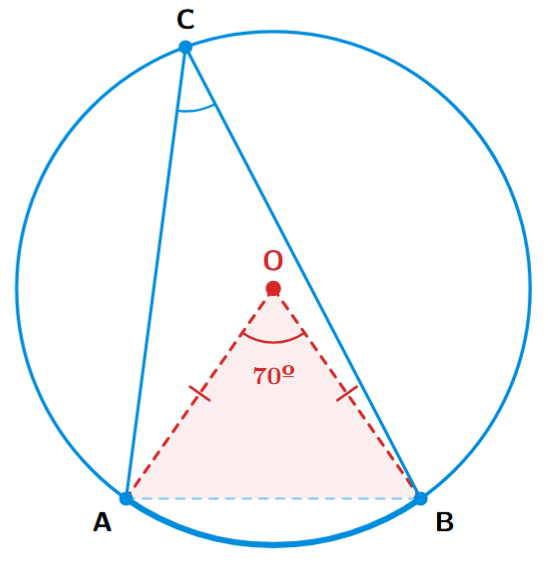
Solution:
According to the Central Angle Theorem, the angle subtended by an arc at the centre is double the angle subtended by it at any point on the remaining part of the circle.
$\angle AOB = 2 \angle ACB$
Substituting the given value $\angle AOB = 70^\circ$:
$70^\circ = 2 \angle ACB$
Dividing by $2$:
$\angle ACB = \frac{70^\circ}{2}$
$\angle ACB = 35^\circ$
[Angle at the circumference]
Therefore, the measure of the angle subtended at a point on the circle is $35^\circ$.
Question 3. The diameter of a circle is $26\text{ cm}$. A chord of length $24\text{ cm}$ is drawn in the circle. Find the distance from the centre of the circle to the chord?
Answer:
Given:
Diameter of the circle = $26\text{ cm}$
Length of the chord ($AB$) = $24\text{ cm}$
To Find:
The distance from the centre to the chord ($OM$).
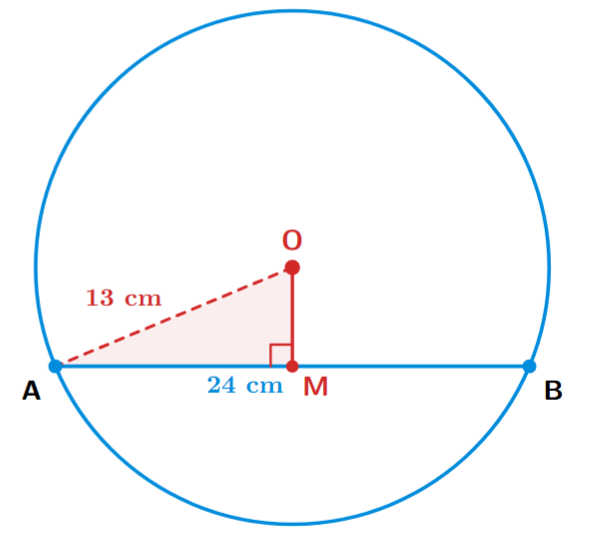
Solution:
First, we find the radius ($r$):
$r = \frac{\text{Diameter}}{2} = \frac{26}{2} = 13\text{ cm}$
Let $OM \perp AB$. Then $M$ is the midpoint of $AB$:
$AM = \frac{1}{2} AB = \frac{24}{2} = 12\text{ cm}$
In right-angled $\Delta OMA$, using the Baudhāyana–Pythagoras theorem:
$OA^2 = OM^2 + AM^2$
$13^2 = OM^2 + 12^2$
$169 = OM^2 + 144$
$OM^2 = 169 - 144$
$OM^2 = 25$
$OM = \sqrt{25} = 5\text{ cm}$
Therefore, the distance from the centre to the chord is $5\text{ cm}$.
Question 4. A circle has a radius of $15\text{ cm}$. A chord is drawn. The distance from the centre of the circle to the chord is $9\text{ cm}$. What is the length of the chord?
Answer:
Given:
Radius ($r$) = $15\text{ cm}$
Distance from the centre ($d$) = $9\text{ cm}$
To Find:
The length of the chord.
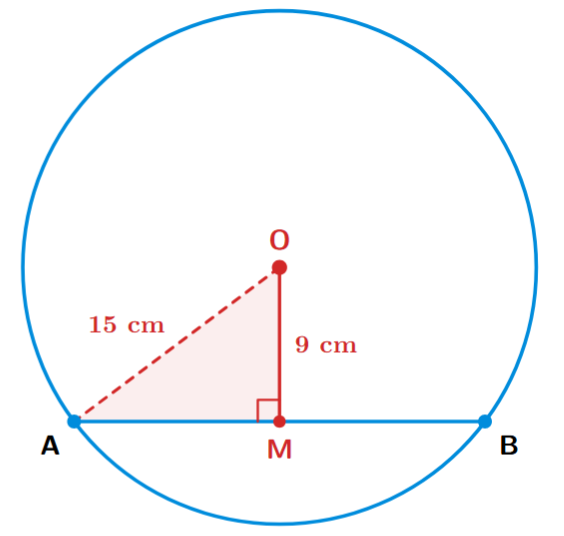
Solution:
Let the chord be $AB$ and $OM$ be the perpendicular from the centre to the chord. Thus $OM = 9\text{ cm}$ and $OA = 15\text{ cm}$.
In right-angled $\Delta OMA$:
$OA^2 = OM^2 + AM^2$
$15^2 = 9^2 + AM^2$
$225 = 81 + AM^2$
$AM^2 = 225 - 81 = 144$
$AM = \sqrt{144} = 12\text{ cm}$
Since the perpendicular from the centre bisects the chord:
$AB = 2 \times AM$
$AB = 2 \times 12$
$AB = 24\text{ cm}$
Therefore, the length of the chord is $24\text{ cm}$.
Question 5. Prove that the perpendicular bisector of a chord passes through the centre of the circle.
Answer:
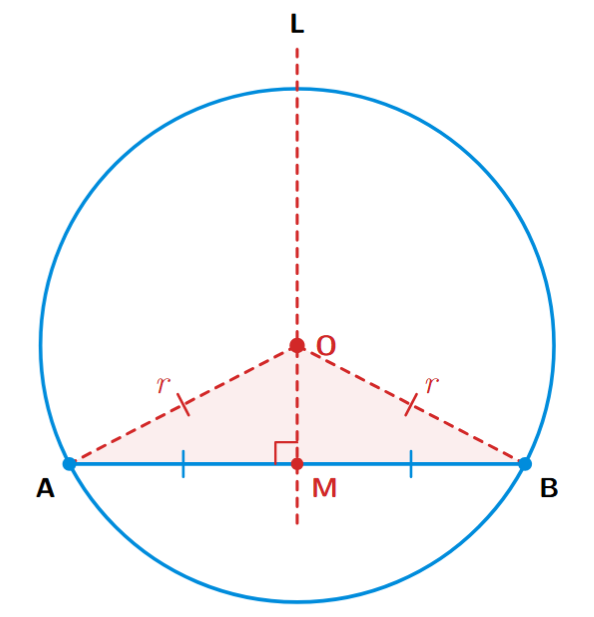
Given:
A circle with centre $O$ and a chord $AB$. $L$ is the perpendicular bisector of $AB$ intersecting it at $M$.
To Prove:
The line $L$ passes through the centre $O$.
Construction Required:
Join the centre $O$ to points $A, B,$ and the midpoint $M$.
Proof:
Let $M$ be the midpoint of $AB$. Join $OA$ and $OB$.
In $\Delta OMA$ and $\Delta OMB$:
$OA = OB$
(Radii of the same circle)
$AM = BM$
(Given: $M$ is midpoint)
$OM = OM$
(Common side)
By SSS congruence criterion, $\Delta OMA \cong \Delta OMB$.
Therefore, $\angle OMA = \angle OMB$ (by CPCT).
Since $\angle OMA$ and $\angle OMB$ form a linear pair:
$\angle OMA + \angle OMB = 180^\circ$
$2\angle OMA = 180^\circ$
$\angle OMA = 90^\circ$
Since $\angle OMA = 90^\circ$ and $AM = BM$, $OM$ is the perpendicular bisector of $AB$.
Since there is only one unique perpendicular bisector for any line segment, the line $L$ (which is the perpendicular bisector of $AB$) must contain the line segment $OM$.
Therefore, the line $L$ passes through the centre $O$.
Hence Proved.
Question 6. The diameter of a circle is $AB$. Point $C$ is on the circumference. What is the measure of the $\angle ACB$? Explain your reasoning.
Answer:
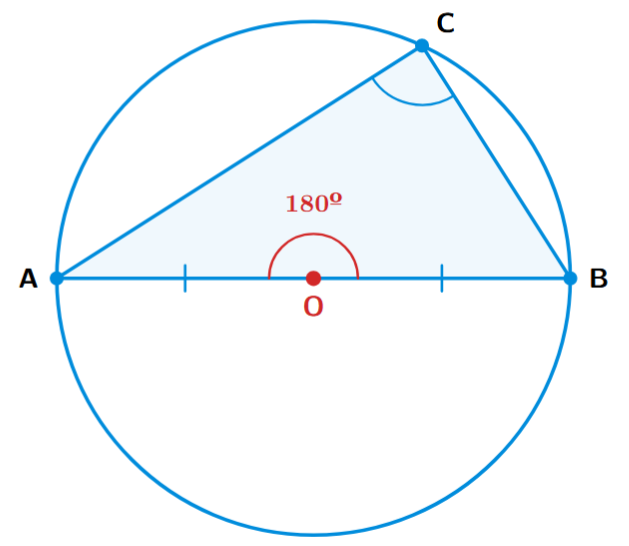
Given:
A circle with centre $O$ and diameter $AB$. Point $C$ lies on the circumference of the circle.
To Find:
The measure of $\angle ACB$.
Solution:
We know that $AB$ is a diameter, so it passes through the centre $O$. The angle subtended by the diameter at the centre is a straight angle.
$\angle AOB = 180^\circ$
(Straight angle)
According to the Central Angle Theorem (or Angle at the Centre Theorem), the angle subtended by an arc at the centre is double the angle subtended by it at any point on the remaining part of the circle.
$\angle AOB = 2 \angle ACB$
Substituting the value of $\angle AOB$:
$180^\circ = 2 \angle ACB$
$\angle ACB = \frac{180^\circ}{2}$
$\angle ACB = 90^\circ$
[Angle in a semicircle]
Therefore, the measure of $\angle ACB$ is $90^\circ$. This is also known as the Thales's Theorem property: the angle in a semicircle is a right angle.
Question 7. $ABCD$ is a cyclic quadrilateral inscribed in a circle. If $\angle A$ measures $75^\circ$, what is the measure of $\angle C$? If $\angle B$ measures $110^\circ$, what is the measure of $\angle D$?
Answer:
Given:
$ABCD$ is a cyclic quadrilateral.
$\angle A = 75^\circ$
$\angle B = 110^\circ$
To Find:
1. Measure of $\angle C$
2. Measure of $\angle D$
Solution:
In a cyclic quadrilateral, the sum of each pair of opposite angles is $180^\circ$.
For the first pair of opposite angles ($\angle A$ and $\angle C$):
$\angle A + \angle C = 180^\circ$
(Opposite angles of a cyclic quadrilateral)
$75^\circ + \angle C = 180^\circ$
$\angle C = 180^\circ - 75^\circ$
$\angle C = 105^\circ$
For the second pair of opposite angles ($\angle B$ and $\angle D$):
$\angle B + \angle D = 180^\circ$
(Opposite angles of a cyclic quadrilateral)
$110^\circ + \angle D = 180^\circ$
$\angle D = 180^\circ - 110^\circ$
$\angle D = 70^\circ$
Therefore, $\angle C = 105^\circ$ and $\angle D = 70^\circ$.
Question 8. Quadrilateral $PQRS$ is inscribed in a circle. If $\angle P = (2x + 10)^\circ$ and $\angle R = (3x - 20)^\circ$, find the value of $x$ and the measures of $\angle P$ and $\angle R$.
Answer:
Given:
$PQRS$ is a cyclic quadrilateral.
$\angle P = (2x + 10)^\circ$
$\angle R = (3x - 20)^\circ$
To Find:
Value of $x$, $\angle P$ and $\angle R$.
Solution:
In a cyclic quadrilateral, the sum of opposite angles is $180^\circ$. Here, $\angle P$ and $\angle R$ are opposite angles.
$\angle P + \angle R = 180^\circ$
Substituting the given algebraic expressions:
$(2x + 10) + (3x - 20) = 180$
Grouping the like terms:
$5x - 10 = 180$
$5x = 180 + 10$
$5x = 190$
$x = \frac{190}{5}$
$x = 38$
Now, finding the measures of the angles:
$\angle P = 2(38) + 10$
$\angle P = 76 + 10 = 86^\circ$
$\angle R = 3(38) - 20$
$\angle R = 114 - 20 = 94^\circ$
Therefore, $x = 38$, $\angle P = 86^\circ$ and $\angle R = 94^\circ$.
Question 9. The distance of a chord of length $16\text{ cm}$ from the centre of a circle is $6\text{ cm}$. Find the radius of the circle.
Answer:
Given:
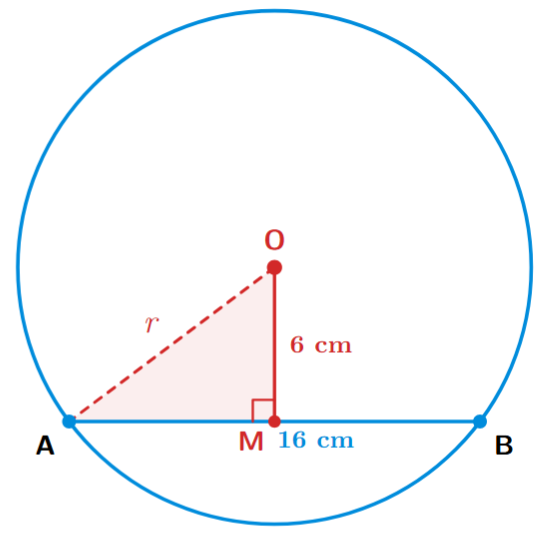
Length of the chord ($AB$) = $16\text{ cm}$
Distance from the centre ($OM$) = $6\text{ cm}$
To Find:
Radius of the circle ($r$).
Solution:
Let $O$ be the centre and $AB$ be the chord. $OM$ is the perpendicular from $O$ to $AB$.
We know that the perpendicular from the centre bisects the chord.
$AM = \frac{1}{2} AB = \frac{16}{2} = 8\text{ cm}$
In right-angled $\Delta OMA$, by the Baudhāyana–Pythagoras theorem:
$OA^2 = OM^2 + AM^2$
$r^2 = 6^2 + 8^2$
$r^2 = 36 + 64$
$r^2 = 100$
$r = \sqrt{100} = 10\text{ cm}$
Therefore, the radius of the circle is $10\text{ cm}$.
Question 10. A cyclic quadrilateral has sides $5, 5, 12, 12$ units. Find its area.
Answer:
Given:
A cyclic quadrilateral with sides $a = 5, b = 5, c = 12,$ and $d = 12$ units.
To Find:
The area of the cyclic quadrilateral.
Solution:
We can use Brahmagupta's Formula for the area of a cyclic quadrilateral:
$\text{Area} = \sqrt{(s-a)(s-b)(s-c)(s-d)}$
First, calculate the semi-perimeter ($s$):
$s = \frac{a+b+c+d}{2}$
$s = \frac{5+5+12+12}{2} = \frac{34}{2} = 17$ units
Now, calculate the area:
$\text{Area} = \sqrt{(17-5)(17-5)(17-12)(17-12)}$
$\text{Area} = \sqrt{12 \times 12 \times 5 \times 5}$
$\text{Area} = \sqrt{144 \times 25}$
$\text{Area} = 12 \times 5$
$\text{Area} = 60$ sq. units
Therefore, the area of the cyclic quadrilateral is $60$ sq. units.
Question 11. Consider a cyclic quadrilateral. Without drawing its circumcircle, how can we find out whether the centre of the circumcircle lies inside the quadrilateral or outside? What is the best way of finding out?
Answer:
Given:
A cyclic quadrilateral $ABCD$ where all four vertices $A, B, C,$ and $D$ lie on the circumference of a circle. We need to determine the position of the circumcentre $O$ relative to the quadrilateral without drawing the circle itself.
To Find:
Whether the circumcentre lies inside or outside the quadrilateral and the best method to find it.
Solution:
The circumcentre of a cyclic quadrilateral is the point that is equidistant from all its vertices. This point is also the circumcentre of any triangle formed by taking any three vertices of the quadrilateral (e.g., $\triangle ABC$ or $\triangle BCD$).
To find whether the centre lies inside or outside, we can analyze the nature of the triangles formed by the vertices:
1. Inside: If all the triangles formed by any three vertices (such as $\triangle ABC, \triangle BCD, \triangle CDA,$ and $\triangle DAB$) are acute-angled or right-angled, then the circumcentre lies inside or on the boundary of the quadrilateral.
2. Outside: If any one of the triangles formed by three vertices is obtuse-angled, the circumcentre of that triangle (and consequently the quadrilateral) will lie outside that specific triangle. If the obtuse angle is such that the centre falls "away" from the fourth vertex, the circumcentre lies outside the quadrilateral.
Question 12. When two chords intersect, each of them is divided into two line segments. Show that if the intersecting chords are of equal length, then the line segments of one chord are equal to the corresponding line segments of the other chord.
Answer:
Given:
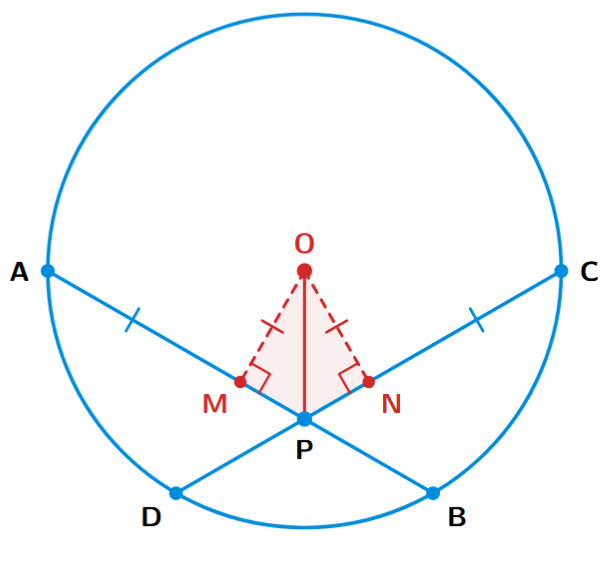
In a circle with centre $O$, two equal chords $AB$ and $CD$ intersect at point $P$. So, $AB = CD$.
To Prove:
1. $AP = CP$ (Larger segments are equal)
2. $BP = DP$ (Smaller segments are equal)
Construction Required:
Draw $OM \perp AB$ and $ON \perp CD$. Join $OP$.
Proof:
Since $AB = CD$, they are equidistant from the centre.
$OM = ON$
(Equal chords are equidistant from centre)
In right-angled $\Delta OMP$ and $\Delta ONP$:
$OM = ON$
(Proved above)
$OP = OP$
(Common hypotenuse)
$\angle OMP = \angle ONP = 90^\circ$
(By construction)
By RHS congruence criterion, $\Delta OMP \cong \Delta ONP$.
By CPCT:
$MP = NP$
... (i)
We know the perpendicular from the centre bisects the chord:
$AM = MB = \frac{1}{2}AB$
$CN = ND = \frac{1}{2}CD$
Since $AB = CD$, then $AM = CN$ and $MB = ND$. ... (ii)
For the larger segments:
Adding (i) and (ii): $AM + MP = CN + NP$
$AP = CP$
For the smaller segments:
Subtracting (i) from (ii): $MB - MP = ND - NP$
$BP = DP$
Hence Proved.
Question 13. Draw a circle in which a chord of $6\text{ cm}$ length stands at a distance of $3\text{ cm}$ from the centre.
(Hint: Is it a circumcircle of a suitable triangle?)
Answer:
Given:
Length of the chord $AB = 6\text{ cm}$
Distance of the chord from the centre $O$ is $OM = 3\text{ cm}$ (where $OM \perp AB$)
To Construct:
A circle with the given chord length and distance from the centre.
Construction Required:
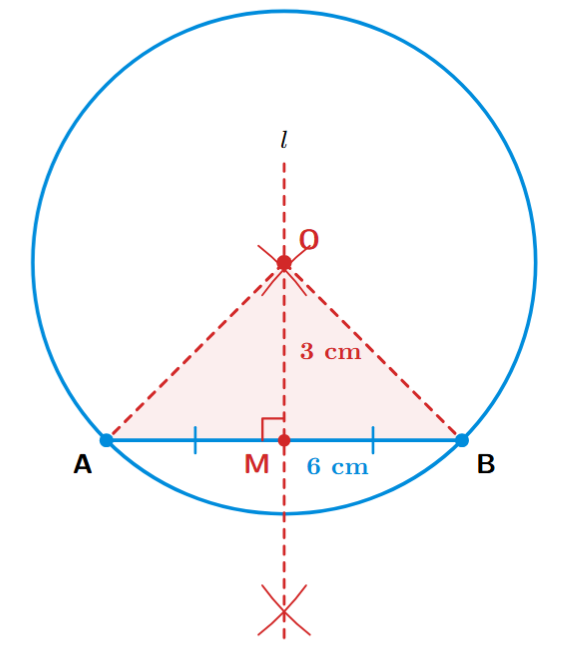
Step 1: Draw a line segment $AB = 6\text{ cm}$ using a ruler.
Step 2: Draw the perpendicular bisector of $AB$. Let it intersect $AB$ at point $M$.
Step 3: Since the distance from the centre is $3\text{ cm}$, mark a point $O$ on the perpendicular bisector such that $OM = 3\text{ cm}$.
Step 4: Join $OA$.
Step 5: With $O$ as the centre and $OA$ as the radius, draw a circle. This circle will pass through points $A$ and $B$.
Solution:
To understand the construction, we calculate the radius of the circle.
In a circle, the perpendicular from the centre to a chord bisects the chord.
$AM = \frac{1}{2} \times AB = 3\text{ cm}$
(Perpendicular bisector property)
Now, in the right-angled triangle $\triangle OMA$, by Pythagoras theorem:
$OA^2 = OM^2 + AM^2$
$OA^2 = 3^2 + 3^2$
$OA^2 = 9 + 9 = 18$
$OA = \sqrt{18} = 3\sqrt{2}\text{ cm}$
[Radius of the circle]
The value of $3\sqrt{2}$ is approximately $3 \times 1.414 = 4.24\text{ cm}$.
Answer to Hint:
Yes, the circle is the circumcircle of a suitable triangle.
In $\triangle OMA$, since $OM = 3\text{ cm}$ and $AM = 3\text{ cm}$, the triangle is a right-angled isosceles triangle.
Therefore, $\angle OAM = 45^\circ$. Similarly, $\angle OBM = 45^\circ$.
In $\triangle OAB$:
$\angle AOB = 180^\circ - (45^\circ + 45^\circ)$
$\angle AOB = 90^\circ$
Thus, the circle is the circumcircle of a right-angled isosceles triangle $OAB$ where the right angle is at the centre of the circle.
Question 14. Show that rectangle is the only parallelogram that can be inscribed in a circle.
Answer:
Given:
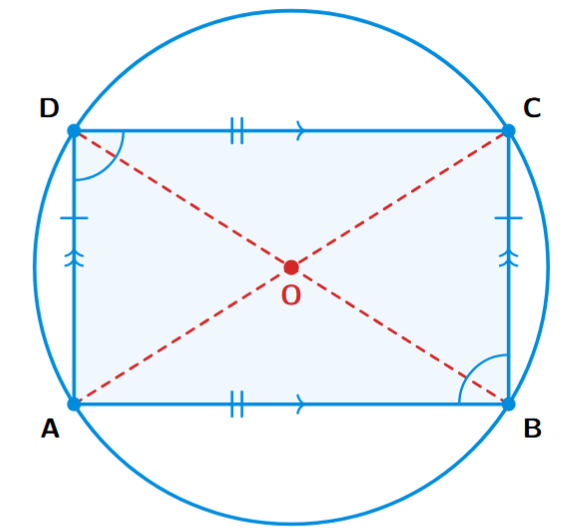
A parallelogram $ABCD$ is inscribed in a circle with centre $O$. Such a quadrilateral is also known as a cyclic parallelogram.
To Prove:
$ABCD$ is a rectangle.
Proof:
We know that $ABCD$ is a parallelogram.
$\angle ABC = \angle ADC$
(Opposite angles of a parallelogram are equal) ... (i)
Since the parallelogram $ABCD$ is inscribed in a circle, it is a cyclic quadrilateral.
In a cyclic quadrilateral, the sum of the opposite angles is $180^\circ$.
$\angle ABC + \angle ADC = 180^\circ$
... (ii)
Substituting the value of $\angle ADC$ from equation (i) into equation (ii):
$\angle ABC + \angle ABC = 180^\circ$
$2\angle ABC = 180^\circ$
$\angle ABC = \frac{180^\circ}{2}$
$\angle ABC = 90^\circ$
We know that a parallelogram with one angle equal to $90^\circ$ is a rectangle.
Since $\angle ABC = 90^\circ$, $ABCD$ must be a rectangle.
Hence, a rectangle is the only parallelogram that can be inscribed in a circle.
Question 15. Show that if a rectangle is inscribed in a circle, then the point of intersection of its diagonals must lie at the centre of the circle.
Answer:
Given:
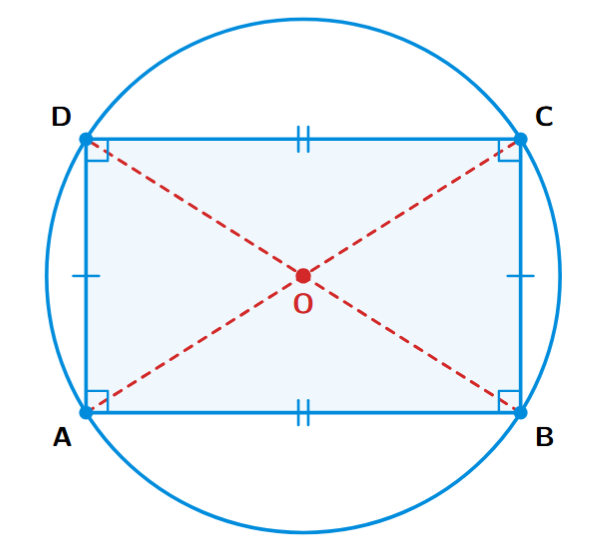
A rectangle $ABCD$ is inscribed in a circle.
To Prove:
The point of intersection of diagonals $AC$ and $BD$ is the centre of the circle.
Proof:
Since $ABCD$ is a rectangle, all its interior angles are equal to $90^\circ$.
$\angle ABC = 90^\circ$
(Angle of a rectangle)
We know that the angle subtended by a chord at the circumference of a circle is $90^\circ$ only if the chord is the diameter of the circle (Angle in a semi-circle is a right angle).
Since $\angle ABC = 90^\circ$, the chord $AC$ which subtends this angle must be a diameter of the circle.
$AC \text{ is a diameter}$
[Chord subtending $90^\circ$ at the circle] ... (i)
Similarly, consider the angle $\angle BCD$.
$\angle BCD = 90^\circ$
(Angle of a rectangle)
Since $\angle BCD = 90^\circ$, the chord $BD$ which subtends this angle must also be a diameter of the circle.
$BD \text{ is a diameter}$
[Chord subtending $90^\circ$ at the circle] ... (ii)
The diagonals of the rectangle $ABCD$ are $AC$ and $BD$. From equations (i) and (ii), we have established that these diagonals are also the diameters of the circle.
We know that the point of intersection of any two diameters of a circle is the centre of that circle.
Therefore, the point of intersection of the diagonals $AC$ and $BD$ must lie at the centre of the circle.
Hence Proved.
Question 16. Consider all chords of a circle of a fixed length. What is the shape formed by the midpoints of all these chords?
Answer:
Given:
A circle with centre $O$ and multiple chords of a fixed length $L$.
Solution:
We know from the properties of circles that chords of equal length are equidistant from the centre.
Let the fixed length of the chords be $L$ and the radius of the circle be $r$. The distance $d$ of any such chord from the centre $O$ is given by the formula:
$d = \sqrt{r^2 - \left(\frac{L}{2}\right)^2}$
Since $r$ and $L$ are constant, the distance $d$ is also constant for every such chord. The midpoint of each chord is the point on the chord that is at this minimum distance $d$ from the centre $O$.
The set of all points that are at a constant distance $d$ from a fixed point $O$ forms a circle.
Therefore, the shape formed by the midpoints of all these chords is a circle which is concentric with the original circle (having the same centre $O$) and has a radius equal to the distance $d$.
Question 17. In a circle with centre $O$, chords $AB$ and $AC$ are congruent. Explain why this statement is true: “The centre of the circle lies on the angle bisector of $\angle BAC$”.
Answer:
Given:
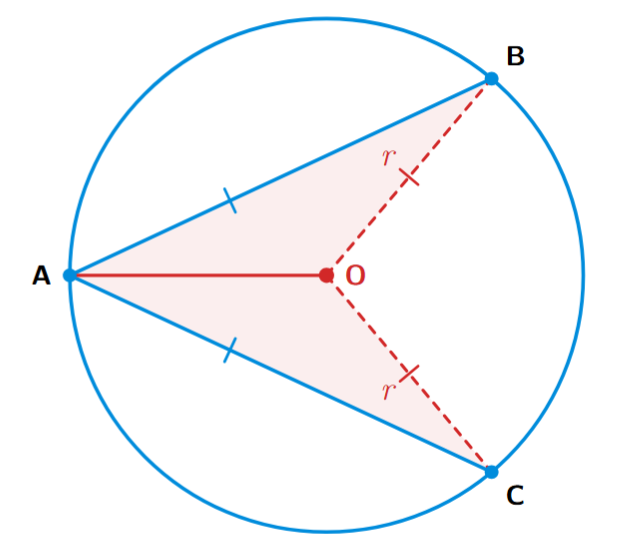
A circle with centre $O$. Two congruent chords $AB$ and $AC$ (i.e., $AB = AC$).
To Prove:
The centre $O$ lies on the angle bisector of $\angle BAC$.
Construction Required:
Join $OB$ and $OC$. Also, join $OA$.
Proof:
In $\Delta OAB$ and $\Delta OAC$:
$AB = AC$
(Given: Chords are congruent)
$OB = OC$
(Radii of the same circle)
$OA = OA$
(Common side)
By SSS (Side-Side-Side) congruence criterion:
$\Delta OAB \cong \Delta OAC$
By CPCT (Corresponding Parts of Congruent Triangles):
$\angle OAB = \angle OAC$
This equality shows that the line segment $AO$ divides $\angle BAC$ into two equal parts.
Therefore, $AO$ is the angle bisector of $\angle BAC$. Since $O$ is a point on this line, the centre $O$ lies on the angle bisector of $\angle BAC$.
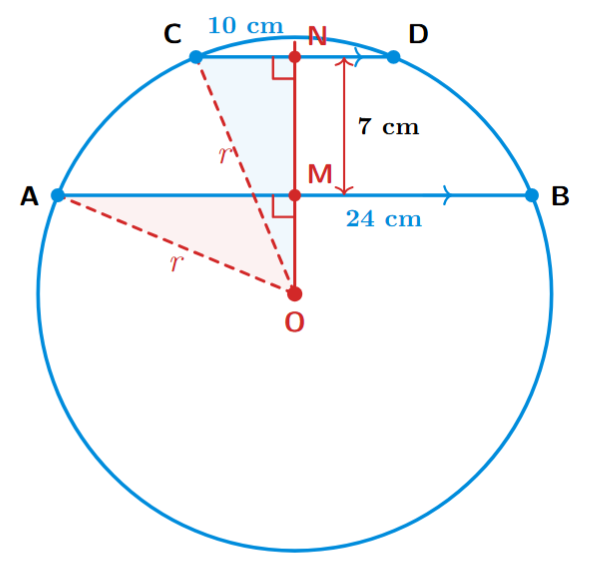
Question 18. Two parallel chords of lengths $10\text{ cm}$ and $24\text{ cm}$ are on the same side of the centre of a circle. The distance between the chords is $7\text{ cm}$. Find the radius of the circle.
Answer:
Given:
Length of chord $AB = 24\text{ cm}$
Length of chord $CD = 10\text{ cm}$
The distance between the chords $AB$ and $CD$ is $7\text{ cm}$.
Both chords are on the same side of the centre $O$.
To Find:
The radius of the circle ($r$).
Construction Required:
Draw $OM \perp AB$ and $ON \perp CD$. Since $AB \parallel CD$ and both are on the same side of the centre, the points $O$, $M$, and $N$ are collinear (lie on the same line).
Join $OA$ and $OC$.
Solution:
We know that the perpendicular from the centre of a circle to a chord bisects the chord.
$AM = \frac{1}{2} AB = \frac{24}{2} = 12\text{ cm}$
$CN = \frac{1}{2} CD = \frac{10}{2} = 5\text{ cm}$
Let $OM = x\text{ cm}$.
Given the distance between chords $MN = 7\text{ cm}$.
$ON = OM + MN = (x + 7)\text{ cm}$
In right-angled triangle $\triangle OMA$:
$OA^2 = OM^2 + AM^2$
$r^2 = x^2 + 12^2$
[By Pythagoras Theorem] ... (i)
In right-angled triangle $\triangle ONC$:
$OC^2 = ON^2 + CN^2$
$r^2 = (x + 7)^2 + 5^2$
[By Pythagoras Theorem] ... (ii)
From equations (i) and (ii), equating the values of $r^2$:
$x^2 + 12^2 = (x + 7)^2 + 5^2$
$x^2 + 144 = x^2 + 14x + 49 + 25$
$144 = 14x + 74$
$14x = 144 - 74$
$14x = 70$
$x = \frac{70}{14} = 5\text{ cm}$
Now, substitute the value of $x$ in equation (i):
$r^2 = 5^2 + 144$
$r^2 = 25 + 144$
$r^2 = 169$
$r = \sqrt{169} = 13\text{ cm}$
Therefore, the radius of the circle is $13\text{ cm}$.
Question 19. A regular hexagon is inscribed in a circle of radius $r$. Find the length of the sides of the hexagon and the distance of each side from the centre of the circle.
Answer:
Given:
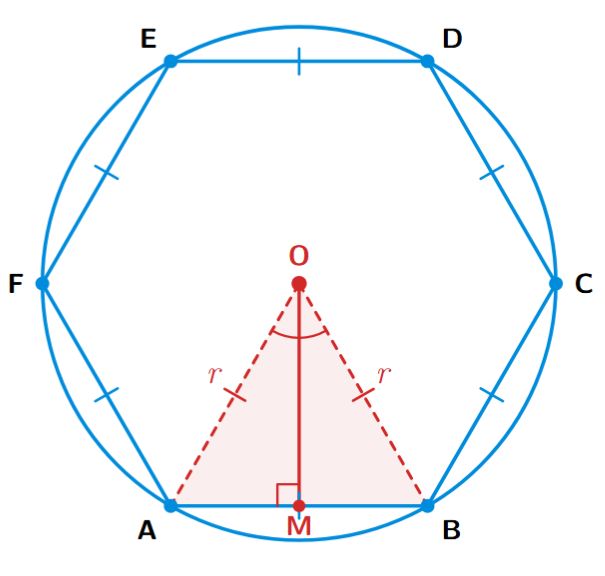
A regular hexagon $ABCDEF$ is inscribed in a circle with centre $O$ and radius $r$.
To Find:
1. The length of the sides of the regular hexagon.
2. The distance of each side from the centre of the circle.
Solution:
Let $AB$ be one of the sides of the regular hexagon inscribed in the circle with centre $O$.
In a regular hexagon, the side subtends an angle at the centre which is calculated as:
$\angle AOB = \frac{360^\circ}{6}$
$\angle AOB = 60^\circ$
In $\triangle OAB$, we have $OA = OB = r$ (radii of the same circle).
Since $OA = OB$, the angles opposite to these sides must be equal.
$\angle OAB = \angle OBA$
In $\triangle OAB$:
$\angle OAB + \angle OBA + \angle AOB = 180^\circ$
$2\angle OAB + 60^\circ = 180^\circ$
$2\angle OAB = 120^\circ$
$\angle OAB = 60^\circ$
Since all angles of $\triangle OAB$ are $60^\circ$, it is an equilateral triangle.
$AB = OA = OB = r$
Thus, the length of each side of the regular hexagon is $r$.
Now, let $OM$ be the distance of the side $AB$ from the centre $O$, such that $OM \perp AB$.
In an equilateral triangle, the perpendicular from the vertex to the opposite side bisects the side.
$AM = \frac{1}{2} AB = \frac{r}{2}$
In right-angled triangle $\triangle OMA$, by Pythagoras theorem:
$OA^2 = OM^2 + AM^2$
$r^2 = OM^2 + \left(\frac{r}{2}\right)^2$
$OM^2 = r^2 - \frac{r^2}{4}$
$OM^2 = \frac{4r^2 - r^2}{4}$
$OM^2 = \frac{3r^2}{4}$
$OM = \sqrt{\frac{3r^2}{4}}$
$OM = \frac{\sqrt{3}}{2}r$
Therefore, the distance of each side from the centre is $\frac{\sqrt{3}}{2}r$.
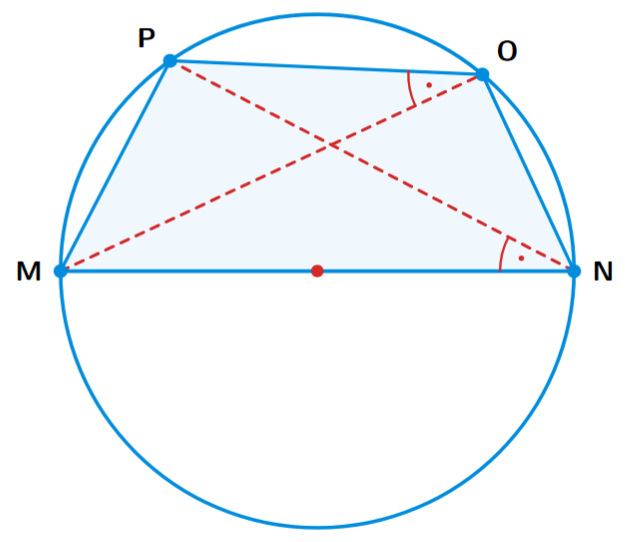
Question 20. A quadrilateral $MNOP$ is inscribed in a circle. If $MN$ is a diameter, what can you say about $\angle MOP$ and $\angle MNP$? Explain your reasoning.
Answer:
Given:
1. $MNOP$ is a cyclic quadrilateral (inscribed in a circle).
2. $MN$ is the diameter of the circle.
To Find:
The relationship between $\angle MOP$ and $\angle MNP$.
Solution:
In a cyclic quadrilateral $MNOP$, all four vertices $M, N, O,$ and $P$ lie on the circumference of the circle.
Since $MN$ is the diameter of the circle, it divides the circle into two semi-circles. We know that the angle subtended by a diameter at any point on the circumference is a right angle (Angle in a semi-circle is $90^\circ$).
Therefore, we can say:
$\angle MON = 90^\circ$
[Angle in a semi-circle] ... (i)
$\angle MPN = 90^\circ$
[Angle in a semi-circle] ... (ii)
Now, let us consider the angles $\angle MOP$ and $\angle MNP$.
Both these angles are subtended by the same arc $MP$ at the remaining part of the circle's circumference.
According to the circle theorems, angles subtended by the same arc in the same segment of a circle are equal.
Thus, we can conclude that:
$\angle MOP = \angle MNP$
(Angles in the same segment)
Reasoning:
1. Equality of Angles: $\angle MOP$ and $\angle MNP$ are equal because they stand on the same arc $MP$.
2. Right Angle Property: Since $MN$ is the diameter, the triangle $MON$ is a right-angled triangle with $\angle MON = 90^\circ$. This implies that $O$ is a point on the semi-circle. This confirms that $MNOP$ is a special cyclic quadrilateral where one side is the diameter.
3. Conclusion: We can say that $\angle MOP$ is equal to $\angle MNP$ and both are acute angles (since they are parts of the right angles $\angle MON$ and $\angle MPN$ respectively, assuming $O$ and $P$ are distinct points on the same side of the diameter or otherwise forming the quadrilateral).
Question 21. Let $ABCD$ be a cyclic quadrilateral. Explain why the exterior angle at any vertex is equal to the interior opposite angle (e.g., $\angle CDE = \angle ABC$, where $E$ is a point on the extension of side $CD$).
Answer:
Given:
A cyclic quadrilateral $ABCD$ where side $AD$ is extended to a point $E$, forming an exterior angle $\angle CDE$.
To Prove:
$\angle CDE = \angle ABC$
Proof:
We know that $ABCD$ is a cyclic quadrilateral. The sum of the opposite interior angles of a cyclic quadrilateral is $180^\circ$.
$\angle ABC + \angle ADC = 180^\circ$
... (i)
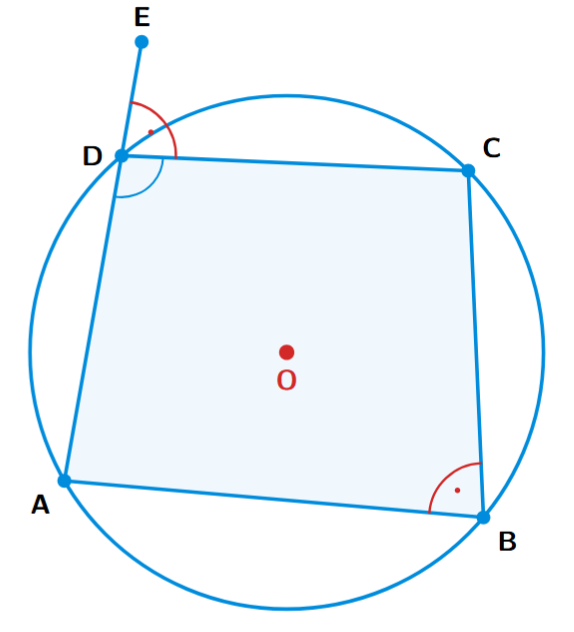
Now, observe the line segment $ADE$. Since it is a straight line, the angles forming a linear pair must sum up to $180^\circ$.
$\angle ADC + \angle CDE = 180^\circ$
... (ii)
From equations (i) and (ii), both sums are equal to $180^\circ$. Therefore, we can equate them:
$\angle ABC + \angle ADC = \angle ADC + \angle CDE$
By subtracting $\angle ADC$ from both sides, we get:
$\angle ABC = \angle CDE$
Hence, the exterior angle of a cyclic quadrilateral is equal to the interior opposite angle.
Question 22. “There is no chord of a circle that is longer than its diameter.” How do you justify this statement?
Answer:
Justification:
Let us consider a circle with centre $O$ and radius $r$. Let $AB$ be a diameter and $CD$ be any chord of the circle that is not a diameter.
To justify the statement, we join the ends of the chord $CD$ to the centre $O$ to form a triangle $\triangle OCD$.
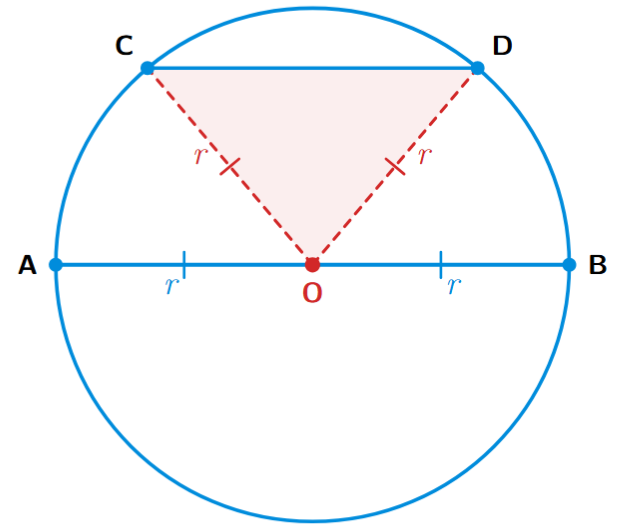
In $\triangle OCD$, we have:
$OC = OD = r$
(Radii of the same circle)
According to the Triangle Inequality Theorem, the sum of any two sides of a triangle must be greater than the third side.
$OC + OD > CD$
Substituting the radius $r$:
$r + r > CD$
$2r > CD$
Since $2r$ is the length of the diameter ($d$), we can write:
$Diameter > CD$
If the chord passes through the centre, it becomes the diameter, in which case its length is exactly $2r$. In all other cases, the chord is strictly shorter than the diameter. Thus, the diameter is the longest chord of a circle.
Question 23. Let $A$ be any point within a given circle with centre $O$. Show that the shortest chord of the circle that passes through point $A$ is the one that is perpendicular to $OA$.
Answer:
Given:
A circle with centre $O$ and a point $A$ inside it. $PQ$ is a chord passing through $A$ such that $OA \perp PQ$. $RS$ is any other chord passing through $A$.
To Prove:
Chord $PQ$ is the shortest chord passing through point $A$.
Proof:
To compare the lengths of chords, we find their distances from the centre $O$. Let us draw $OM \perp RS$.
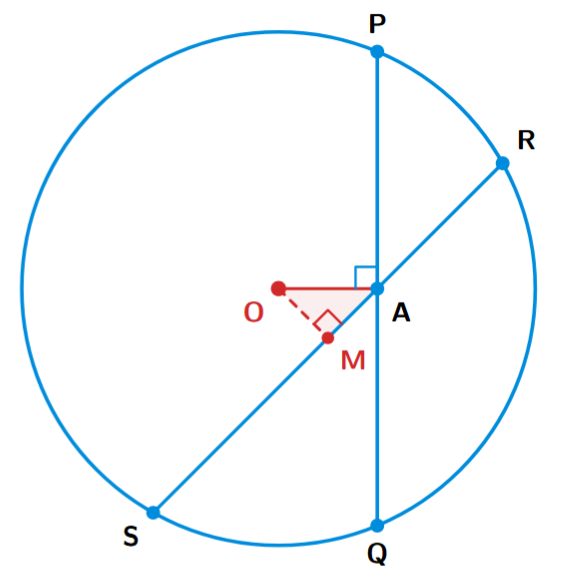
In the right-angled triangle $\triangle OMA$:
$OA$ is the hypotenuse.
In any right-angled triangle, the hypotenuse is the longest side.
$OA > OM$
... (i)
We know that in a circle, chords that are farther from the centre are shorter than chords that are closer to the centre.
From equation (i), the distance of chord $PQ$ (which is $OA$) is greater than the distance of chord $RS$ (which is $OM$).
$Chord\ PQ < Chord\ RS$
[Distance $OA > OM$] ... (ii)
Since $RS$ was any arbitrary chord passing through $A$, and $PQ$ is shorter than $RS$, it follows that $PQ$ is the shortest chord passing through $A$.
Hence, the chord perpendicular to the radius at a given point is the shortest chord passing through that point.
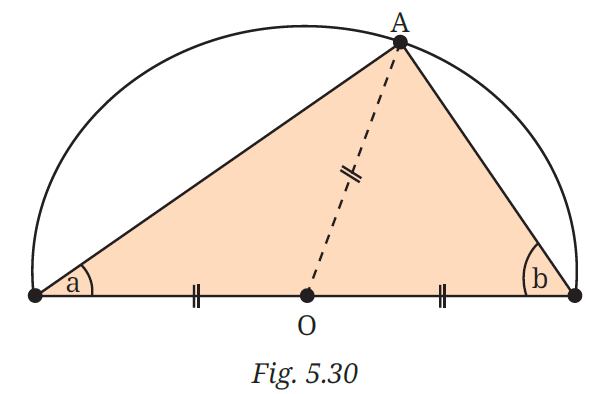
Question 24. How would you use the following figure to justify the statement that the angle in a semicircle is $90^\circ$?
Answer:
Justification using Fig 5.30:
In Fig 5.30, let the diameter be $BC$ with centre $O$. Let $A$ be a point on the circumference. Join $OA$.
1. In $\Delta OBA$, $OB = OA$ (radii). Thus, it is an isosceles triangle. Let $\angle OBA = \angle OAB = a$.
2. In $\Delta OCA$, $OC = OA$ (radii). Thus, it is also an isosceles triangle. Let $\angle OCA = \angle OAC = b$.
Now, consider the large triangle $ABC$. The sum of its interior angles must be $180^\circ$.
$\angle ABC + \angle BAC + \angle ACB = 180^\circ$
From the figure, $\angle BAC = \angle OAB + \angle OAC = a + b$. Substituting the values:
$a + (a + b) + b = 180^\circ$
$2a + 2b = 180^\circ$
Dividing the entire equation by $2$:
$a + b = 90^\circ$
Since $\angle BAC = a + b$, we conclude that $\angle BAC = 90^\circ$.
Question 25. In a circle, two chords $CC'$ and $DD'$ are drawn perpendicular to a diameter $AB$. Prove that the segment $MM'$ joining the midpoints of the chords $CD$ and $C'D'$ is perpendicular to $AB$.
Answer:
Given:
1. A circle with diameter $AB$.
2. Two chords $CC'$ and $DD'$ such that $CC' \perp AB$ and $DD' \perp AB$.
3. $M$ is the midpoint of $CD$ and $M'$ is the midpoint of $C'D'$.
To Prove:
$MM' \perp AB$
Proof:
Let the diameter $AB$ lie along the $x$-axis of a coordinate system, with the centre of the circle $O$ at the origin $(0, 0)$.
Since $CC' \perp AB$, the chord $CC'$ is a vertical line. By the property of circles, a diameter perpendicular to a chord bisects the chord. Thus, if $C$ has coordinates $(x_1, y_1)$, then $C'$ must have coordinates $(x_1, -y_1)$.
Similarly, since $DD' \perp AB$, the chord $DD'$ is also a vertical line. If $D$ has coordinates $(x_2, y_2)$, then $D'$ must have coordinates $(x_2, -y_2)$.
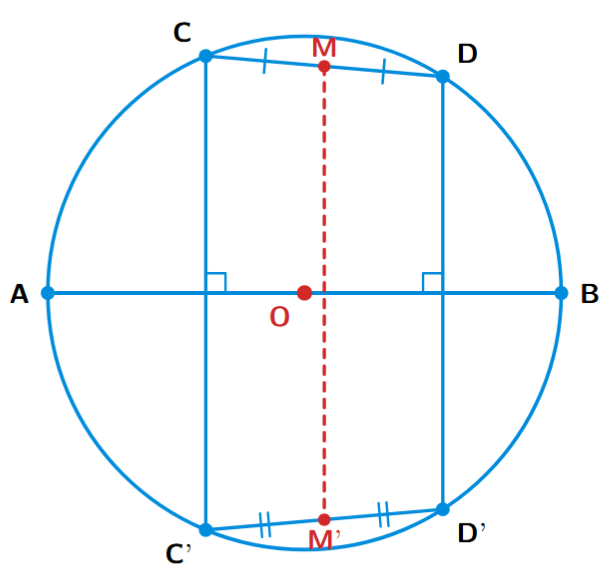
Now, we find the coordinates of the midpoint $M$ of the segment $CD$ using the midpoint formula:
$M = \left( \frac{x_1 + x_2}{2}, \frac{y_1 + y_2}{2} \right)$
Next, we find the coordinates of the midpoint $M'$ of the segment $C'D'$:
$M' = \left( \frac{x_1 + x_2}{2}, \frac{-y_1 + (-y_2)}{2} \right)$
$M' = \left( \frac{x_1 + x_2}{2}, -\frac{y_1 + y_2}{2} \right)$
Observe the $x$-coordinates of points $M$ and $M'$. Both points have the same $x$-coordinate, which is $\frac{x_1 + x_2}{2}$.
A line segment joining two points with the same $x$-coordinate is a vertical line (perpendicular to the $x$-axis).
Since the diameter $AB$ lies on the $x$-axis and the segment $MM'$ is vertical, it follows that:
$MM' \perp AB$
Hence, the segment joining the midpoints of the chords $CD$ and $C'D'$ is perpendicular to the diameter $AB$.
Hence Proved.
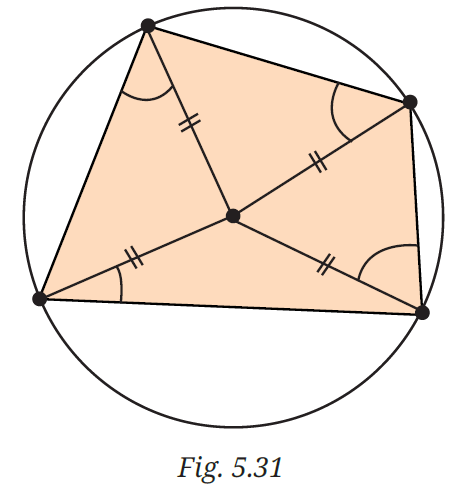
Question 26. How would you use the following figure to justify the statement that the sum of the opposite angles of a cyclic quadrilateral is $180^\circ$?
Answer:
Given:
A cyclic quadrilateral with its vertices joined to the centre of the circle. Let the vertices be $A, B, C,$ and $D$ in order, and the centre of the circle be $O$.
To Justify:
The sum of opposite angles is $180^\circ$, i.e., $\angle DAB + \angle BCD = 180^\circ$ and $\angle ABC + \angle CDA = 180^\circ$.
Solution and Explanation:
In the given figure, the vertices of the quadrilateral are connected to the centre $O$. This forms four triangles: $\triangle OAB, \triangle OBC, \triangle OCD,$ and $\triangle ODA$.
Since the distance from the centre to any point on the circle is the radius ($r$), we have:
$OA = OB = OC = OD = r$
(Radii of the same circle)
This means each of the four triangles formed at the centre is an isosceles triangle. In an isosceles triangle, the angles opposite to the equal sides are also equal.
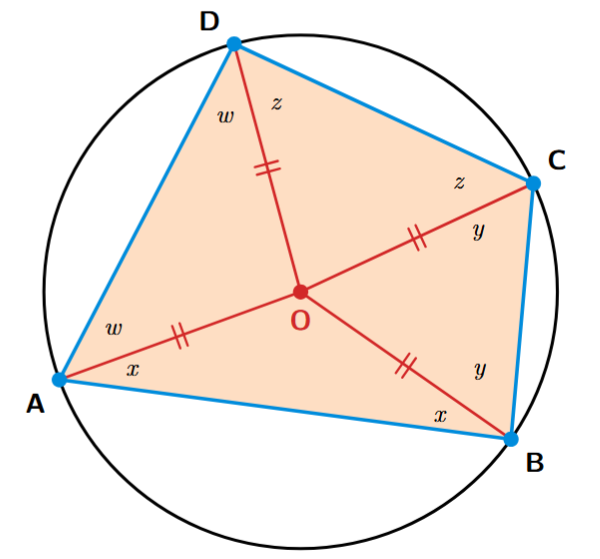
Let us denote the equal angles in each triangle as follows:
1. In $\triangle OAB$, let $\angle OAB = \angle OBA = x$
2. In $\triangle OBC$, let $\angle OBC = \angle OCB = y$
3. In $\triangle OCD$, let $\angle OCD = \angle ODC = z$
4. In $\triangle ODA$, let $\angle ODA = \angle OAD = w$
Now, let's write the interior angles of the quadrilateral $ABCD$ in terms of $x, y, z,$ and $w$:
$\angle A = x + w$
$\angle B = x + y$
$\angle C = y + z$
$\angle D = z + w$
We know that the sum of the interior angles of any quadrilateral is $360^\circ$.
$\angle A + \angle B + \angle C + \angle D = 360^\circ$
Substituting the values of the angles:
$(x + w) + (x + y) + (y + z) + (z + w) = 360^\circ$
$2x + 2y + 2z + 2w = 360^\circ$
$2(x + y + z + w) = 360^\circ$
$x + y + z + w = 180^\circ$
Now, let's look at the sum of the opposite angles:
Sum of $\angle A$ and $\angle C$:
$\angle A + \angle C = (x + w) + (y + z)$
$\angle A + \angle C = x + y + z + w$
From equation (i), we know that $x + y + z + w = 180^\circ$. Therefore:
$\angle A + \angle C = 180^\circ$
Sum of $\angle B$ and $\angle D$:
$\angle B + \angle D = (x + y) + (z + w)$
$\angle B + \angle D = x + y + z + w$
$\angle B + \angle D = 180^\circ$
Thus, by using the property of isosceles triangles formed by the radii, we have justified that the sum of the opposite angles of a cyclic quadrilateral is $180^\circ$.