

Chapter 6 Measuring Space: Perimeter and Area (Class 9 - Latest Maths NCERT (Ganita Manjari I) Solutions)
Looking for the most accurate and detailed NCERT Solutions for Chapter 6: Measuring Space: Perimeter and Area? You have come to the right place! This page provides clear, step-by-step answers for the latest Class 9 Maths curriculum, helping you solve practical measurement problems from the "stagger" of an athletics track to the complex area of irregular polygons. We bridge the gap between simple straight-edged boundaries and the infinite curves of circles, ensuring you master the geometric logic needed to measure any region.
Our solutions offer comprehensive walkthroughs for calculating Arc Length and the Area of a Sector, while providing detailed guidance on using Heron’s Formula for triangular regions. We dive into the properties of $\pi$ (Pi), helping you solve exercises related to its historical evolution—from ancient Mesopotamian polygons to the infinite series of Mādhava of Sangamagrāma. You will also find clear explanations for predicting decimal expansions, teaching you to identify terminating or repeating patterns based on prime factors of the denominator.
To ensure you build a deep understanding of spatial measurement, this page includes visual derivations for the area of a circle and step-by-step guides for Brahmagupta’s Formula for cyclic quadrilaterals. Drawing from the wisdom of the Śhulbasūtras, our solutions show you how to transform shapes and calculate the "amount of space" with absolute confidence. These resources, curated by learningspot.co based on the Ganita Manjari I textbook, are designed to help you excel in your Class 9 CBSE assessments.
| Content On This Page | ||
|---|---|---|
| Exercise Set 6.1 | Exercise Set 6.2 | Exercise Set 6.3 |
| End-Of-Chapter Exercises | ||
Exercise Set 6.1
Unless stated otherwise, use the approximation $\frac{22}{7}$ for $\pi$.
Question 1. The perimeter of a circle is $44\text{ cm}$. What is its radius?
Answer:
Given:
Perimeter (Circumference) of the circle $= 44\text{ cm}$
To Find:
The radius ($r$) of the circle.
Solution:
We know that the perimeter (circumference) of a circle is given by the formula:
$Circumference = 2\pi r$
Substituting the given values and using $\pi = \frac{22}{7}$:
$44 = 2 \times \frac{22}{7} \times r$
$44 = \frac{44}{7} \times r$
Rearranging the equation to solve for $r$:
$r = \frac{44 \times 7}{44}$
$r = \frac{\cancel{44}^{1} \times 7}{\cancel{44}_{1}}$
$r = 7\text{ cm}$
Therefore, the radius of the circle is $7\text{ cm}$.
Question 2. Calculate, correct to $3$ significant figures, the circumference of a circle with:
(i) radius $7\text{ cm}$
(ii) radius $10\text{ cm}$
(iii) radius $12\text{ cm}$
Answer:
To Find:
Circumference of the circle for different radii, rounded to 3 significant figures.
Solution:
The formula for the circumference ($C$) is $C = 2\pi r$.
(i) For radius $r = 7\text{ cm}$
$C = 2 \times \frac{22}{7} \times 7$
$C = 2 \times 22 = 44\text{ cm}$
Correct to 3 significant figures, $C = \mathbf{44.0\text{ cm}}$.
(ii) For radius $r = 10\text{ cm}$
$C = 2 \times \frac{22}{7} \times 10$
$C = \frac{440}{7} \approx 62.857...\text{ cm}$
Correct to 3 significant figures, $C = \mathbf{62.9\text{ cm}}$.
(iii) For radius $r = 12\text{ cm}$
$C = 2 \times \frac{22}{7} \times 12$
$C = \frac{528}{7} \approx 75.428...\text{ cm}$
Correct to 3 significant figures, $C = \mathbf{75.4\text{ cm}}$.
Question 3. Calculate the length of the arc of a circle if:
(i) the radius is $3.5\text{ cm}$ and the angle at the centre is $60^\circ$
(ii) the radius is $6.3\text{ m}$ and the angle at the centre is $120^\circ$
Answer:
Formula:
Length of an arc ($l$) $= \frac{\theta}{360^\circ} \times 2\pi r$
Solution:
(i) Given: $r = 3.5\text{ cm}$ and $\theta = 60^\circ$
$l = \frac{60^\circ}{360^\circ} \times 2 \times \frac{22}{7} \times 3.5$
$l = \frac{1}{6} \times 44 \times 0.5$
$l = \frac{22}{6} = \frac{11}{3} \approx 3.67\text{ cm}$
(ii) Given: $r = 6.3\text{ m}$ and $\theta = 120^\circ$
$l = \frac{120^\circ}{360^\circ} \times 2 \times \frac{22}{7} \times 6.3$
$l = \frac{1}{3} \times 44 \times 0.9$
$l = 44 \times 0.3 = 13.2\text{ m}$
Question 4. Find the perimeter of a sector (i.e., the curved portion as well as the two straight portions) of a circle of radius $14\text{ cm}$ and sector angle $75^\circ$.
Answer:
Given:
Radius of the circle ($r$) $= 14\text{ cm}$
Sector angle ($\theta$) $= 75^\circ$
To Find:
The perimeter of the sector.
Solution:
The perimeter of a sector consists of the length of the arc ($l$) plus the length of two radii ($2r$).
Step 1: Calculate the length of the arc ($l$)
$l = \frac{\theta}{360^\circ} \times 2\pi r$
$l = \frac{75^\circ}{360^\circ} \times 2 \times \frac{22}{7} \times 14$
$l = \frac{5}{24} \times 44 \times 2$
$l = \frac{5}{24} \times 88$
$l = \frac{5 \times 11}{3} = \frac{55}{3} \approx 18.33\text{ cm}$
Step 2: Calculate the Perimeter
$Perimeter = l + 2r$
$Perimeter = 18.33 + 2(14)$
$Perimeter = 18.33 + 28 = 46.33\text{ cm}$
Therefore, the perimeter of the sector is approximately $46.33\text{ cm}$.
Question 5. Find the perimeters of the following shapes (taking the arcs to be quarter or half or three-quarters of a circle, as appropriate) (Fig. 6.14i to 6.14ix):
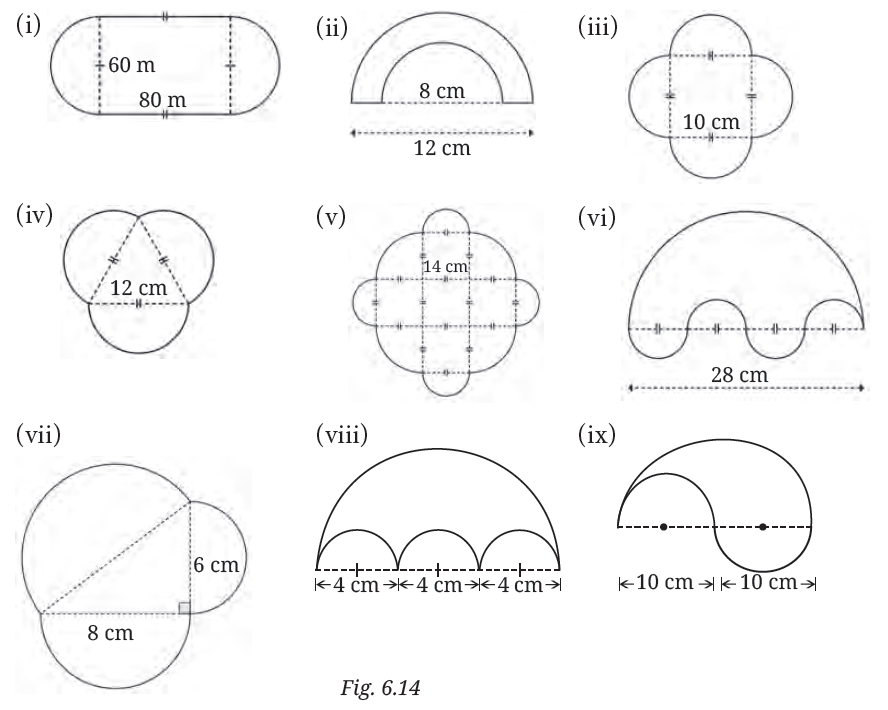
Answer:
General Formula:
The perimeter of a shape is the total length of its boundary. For circular arcs, we use the formula for circumference $C = 2\pi r$ or $C = \pi d$. For a semicircle, the arc length is $\frac{1}{2}\pi d$. We use $\pi = \frac{22}{7}$.
(i) Perimeter of Athletics Track Shape:
The boundary consists of two straight parallel segments and two semicircular arcs.
Length of two straight segments $= 80 + 80 = 160\text{ m}$
Length of two semicircular arcs (with diameter $d = 60\text{ m}$):
$Arc\ Length = 2 \times \left( \frac{1}{2} \times \pi \times 60 \right)$
$Arc\ Length = \frac{22}{7} \times 60 = \frac{1320}{7} \approx 188.57\text{ m}$
Total Perimeter $= 160 + 188.57 = \mathbf{348.57\text{ m}}$
(ii) Perimeter of the Arch:
The boundary consists of one large outer semicircle, one small inner semicircle, and two small straight edges at the bottom.
Outer arc ($d = 12\text{ cm}$) $= \frac{1}{2} \times \pi \times 12 = 6\pi$
Inner arc ($d = 8\text{ cm}$) $= \frac{1}{2} \times \pi \times 8 = 4\pi$
Two straight edges $= \frac{12 - 8}{2} + \frac{12 - 8}{2} = 2 + 2 = 4\text{ cm}$
$Perimeter = 6\pi + 4\pi + 4 = 10\pi + 4$
$Perimeter = 10 \times \frac{22}{7} + 4 = 31.43 + 4 = \mathbf{35.43\text{ cm}}$
(iii) Perimeter of Flower-like Shape:
The boundary consists of four semicircular arcs, each with a diameter of $10\text{ cm}$.
$Perimeter = 4 \times \left( \frac{1}{2} \times \pi \times 10 \right)$
$Perimeter = 2 \times \pi \times 10 = 20\pi$
$Perimeter = 20 \times \frac{22}{7} = \frac{440}{7} \approx \mathbf{62.86\text{ cm}}$
(iv) Perimeter of the Trefoil Shape:
The boundary consists of three semicircular arcs arranged around an equilateral triangle of side $12\text{ cm}$.
$Perimeter = 3 \times \left( \frac{1}{2} \times \pi \times 12 \right)$
$Perimeter = 18\pi = 18 \times \frac{22}{7} = \frac{396}{7} \approx \mathbf{56.57\text{ cm}}$
(v) Perimeter of the Complex Cross Shape:
Based on the structure, the boundary is constituted of 4 semicircles and 4 quarter circles.
Given: Radius of semicircles ($r_1$) $= 7\text{ cm}$ and Radius of quarter circles ($r_2$) $= 14\text{ cm}$.
Length of 4 semicircle arcs:
$L_1 = 4 \times (\pi \times 7)$
[Arc length $= \pi r$]
$L_1 = 4 \times \frac{22}{7} \times 7 = 88\text{ cm}$
Length of 4 quarter circle arcs:
$L_2 = 4 \times (\frac{1}{2} \times \pi \times 14)$
[Arc length $= \frac{1}{2} \pi r$]
$L_2 = 2 \times \frac{22}{7} \times 14 = 88\text{ cm}$
$Total\ Perimeter = L_1 + L_2 = 88 + 88 = \mathbf{176\text{ cm}}$
(vi) Perimeter of the Wave Arch:
The boundary consists of one large top semicircular arc ($d = 28\text{ cm}$) and four smaller semicircular arcs at the bottom. Since the total bottom length is $28\text{ cm}$, each small semicircle has a diameter of $\frac{28}{4}\text{ cm}$.
Large arc $= \frac{1}{2} \times \pi \times 28 = 14\pi$
Four small arcs $= 4 \times \left( \frac{1}{2} \times \pi \times \frac{28}{4} \right) = \frac{1}{2} \times \pi \times 28 = 14\pi$
$Total\ Perimeter = 14\pi + 14\pi = 28\pi = \mathbf{88\text{ cm}}$
(vii) Perimeter of Triangle-Circle Composite:
The boundary consists of three semicircles drawn on the sides of a right-angled triangle. The sides are $6\text{ cm}$ and $8\text{ cm}$. The hypotenuse is $\sqrt{6^2 + 8^2} = 10\text{ cm}$.
Arc 1 ($d=6$) $+ $ Arc 2 ($d=8$) $+ $ Arc 3 ($d=10$):
$Perimeter = \frac{1}{2}\pi(6) + \frac{1}{2}\pi(8) + \frac{1}{2}\pi(10)$
$Perimeter = 3\pi + 4\pi + 5\pi = 12\pi$
$Perimeter = 12 \times \frac{22}{7} = \frac{264}{7} \approx \mathbf{37.71\text{ cm}}$
(viii) Perimeter of the Triple-Dome Arch:
The boundary consists of one large top arc ($d = 12\text{ cm}$) and three small bottom arcs ($d = 4\text{ cm}$ each).
Large top arc $= \frac{1}{2} \times \pi \times 12 = 6\pi$
Three small bottom arcs $= 3 \times \left( \frac{1}{2} \times \pi \times 4 \right) = 6\pi$
$Total\ Perimeter = 6\pi + 6\pi = 12\pi = \mathbf{37.71\text{ cm}}$
(ix) Perimeter of the Yin-Yang Style Shape:
The boundary consists of one large outer semicircular arc ($d = 20\text{ cm}$) and two internal semicircular arcs ($d = 10\text{ cm}$ each).
Outer large arc $= \frac{1}{2} \times \pi \times 20 = 10\pi$
Two small internal arcs $= 2 \times \left( \frac{1}{2} \times \pi \times 10 \right) = 10\pi$
$Total\ Perimeter = 10\pi + 10\pi = 20\pi$
$Perimeter = 20 \times \frac{22}{7} = \frac{440}{7} \approx \mathbf{62.86\text{ cm}}$
Question 6. If the diameter of a car tyre is $56\text{ cm}$, then:
(i) How far does the car need to travel for the tyre to complete one revolution?
(ii) How many revolutions does the tyre make if the car travels $10\text{ km}$?
Answer:
Given:
Diameter of the car tyre ($d$) $= 56\text{ cm}$
Total distance to travel $= 10\text{ km}$
(i) Distance for one revolution:
The distance travelled by a tyre in one complete revolution is equal to its circumference.
Using the formula for circumference ($C$):
$C = \pi d$
Substituting $\pi = \frac{22}{7}$ and $d = 56\text{ cm}$:
$C = \frac{22}{7} \times 56$
$C = 22 \times 8$
$C = 176\text{ cm}$
Therefore, the car needs to travel $176\text{ cm}$ for the tyre to complete one revolution.
(ii) Number of revolutions for $10\text{ km}$:
First, we convert the total distance from kilometres to centimetres.
$1\text{ km} = 1,00,000\text{ cm}$
$10\text{ km} = 10 \times 1,00,000 = 10,00,000\text{ cm}$
Let the number of revolutions be $n$.
$n = \frac{\text{Total Distance}}{\text{Distance in one revolution}}$
$n = \frac{10,00,000}{176}$
Dividing the numerator and denominator by $8$:
$n = \frac{\cancel{10,00,000}^{1,25,000}}{\cancel{176}_{22}}$
$n = \frac{62,500}{11}$
$n \approx 5681.82$
[Number of revolutions]
Rounding to the nearest whole number, the tyre makes approximately $5682$ revolutions.
Question 7. Find the total perimeter of all the petals in each of the given flowers.
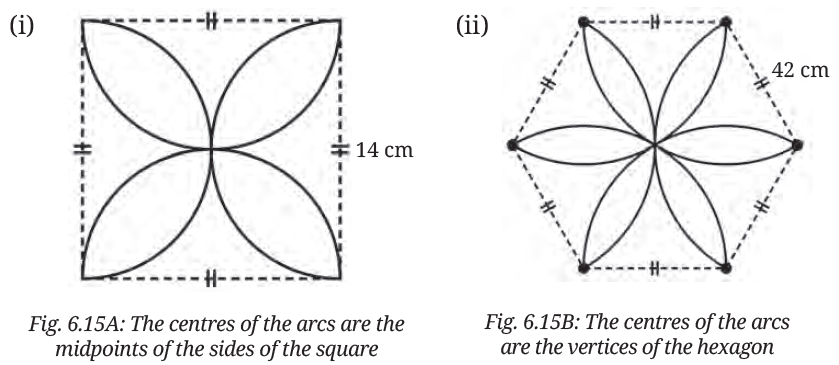
Answer:
(i) Flower in the Square (Fig. 6.15A)
Given: Side of the square $= 14\text{ cm}$. The centres of the arcs are the midpoints of the sides of the square.
Analysis: If the centre of an arc is the midpoint of a side, and the side length is $14\text{ cm}$, the radius ($r$) of each arc is half the side length.
$r = \frac{14}{2} = 7\text{ cm}$
The 4 petals are formed by 4 semicircles drawn on the four sides of the square as diameters. Each petal is composed of two arcs. In total, the boundary of all petals is made up of these 4 semicircles.
Total perimeter of all petals $= 4 \times (\text{Length of a semicircular arc})$
$Perimeter = 4 \times (\pi \times r)$
Substituting $\pi = \frac{22}{7}$ and $r = 7\text{ cm}$:
$Perimeter = 4 \times \frac{22}{7} \times 7$
$Perimeter = 4 \times 22 = 88\text{ cm}$
Thus, the total perimeter of all the petals in the square is $88\text{ cm}$.
(ii) Flower in the Hexagon (Fig. 6.15B)
Given: Side of the regular hexagon $= 42\text{ cm}$. The centres of the arcs are the vertices of the hexagon.
Analysis: In a regular hexagon, the distance from any vertex to the centre of the hexagon is equal to its side length. Here, radius ($r$) $= 42\text{ cm}$.
A regular hexagon can be divided into 6 equilateral triangles. The angle of each equilateral triangle at the centre (or vertex) is $60^\circ$. Each arc forming the petals is drawn from a vertex to the centre of the hexagon, which corresponds to a sector angle ($\theta$) of $60^\circ$.
There are 6 petals, and each petal consists of 2 arcs. Therefore, there are a total of 12 such arcs.
Step 1: Calculate the length of one arc ($l$)
$l = \frac{\theta}{360^\circ} \times 2\pi r$
$l = \frac{60^\circ}{360^\circ} \times 2 \times \frac{22}{7} \times 42$
$l = \frac{1}{6} \times 2 \times 22 \times 6$
$l = 2 \times 22 = 44\text{ cm}$
Step 2: Calculate the total perimeter
$Total\ Perimeter = 12 \times l$
$Total\ Perimeter = 12 \times 44 = 528\text{ cm}$
Thus, the total perimeter of all the petals in the hexagon is $528\text{ cm}$.
Question 8. The ratio of the perimeters of two circles is $5:4$. What is the ratio of their radii?
Answer:
Given:
Ratio of the perimeters of two circles $= 5 : 4$
To Find:
The ratio of their radii ($r_1 : r_2$).
Solution:
Let the radii of the first and second circles be $r_1$ and $r_2$ respectively.
Let their perimeters be $P_1$ and $P_2$.
We know that the perimeter (circumference) of a circle is calculated using the formula:
$P = 2\pi r$
Therefore, for the two circles, we have:
$P_1 = 2\pi r_1$
$P_2 = 2\pi r_2$
According to the question, the ratio of their perimeters is $5 : 4$:
$\frac{P_1}{P_2} = \frac{5}{4}$
Substituting the values of $P_1$ and $P_2$ in the ratio:
$\frac{2\pi r_1}{2\pi r_2} = \frac{5}{4}$
Cancelling the common terms $2$ and $\pi$ from the numerator and the denominator:
$\frac{\cancel{2\pi} r_1}{\cancel{2\pi} r_2} = \frac{5}{4}$
$\frac{r_1}{r_2} = \frac{5}{4}$
Thus, $r_1 : r_2 = 5 : 4$.
Therefore, the ratio of their radii is $5 : 4$.
Exercise Set 6.2
Question 1. Find the area of triangle $ADE$ in Fig. 6.31.
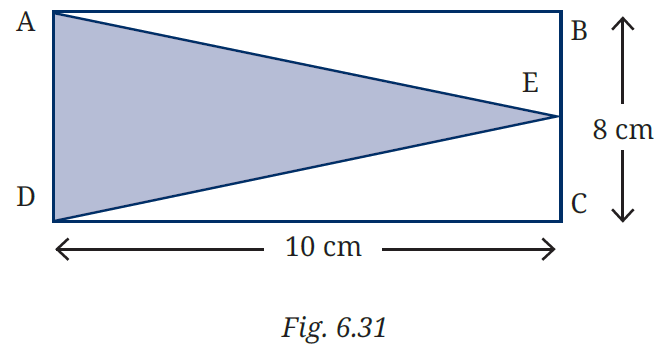
Answer:
Given:
Rectangle $ABCD$ with length $DC = 10\text{ cm}$ and width $AD = 8\text{ cm}$. Vertex $E$ of triangle $ADE$ lies on side $BC$.
To Find:
Area of $\triangle ADE$.
Solution:
In the given figure, $ABCD$ is a rectangle. The side $AD$ is perpendicular to $DC$ and $AB$.
For $\triangle ADE$, we consider $AD$ as the base.
$Base\ (b) = AD = 8\text{ cm}$
The height of the triangle is the perpendicular distance from vertex $E$ to the base $AD$ (or the line containing $AD$). Since $E$ lies on $BC$ and $BC \parallel AD$, the perpendicular distance is equal to the length of the rectangle.
$Height\ (h) = DC = 10\text{ cm}$
The formula for the area of a triangle is:
$Area = \frac{1}{2} \times b \times h$
Substituting the values:
$Area = \frac{1}{2} \times 8 \times 10$
$Area = 4 \times 10 = 40\text{ cm}^2$
Therefore, the area of $\triangle ADE$ is $40\text{ cm}^2$.
Alternate Solution:
The area of a triangle and a rectangle are related if they share the same base and lie between the same parallel lines. Here, $\triangle ADE$ and rectangle $ABCD$ share the same base height (width) and lie between parallels $AD$ and $BC$.
$Area\ of\ \triangle ADE = \frac{1}{2} \times Area\ of\ rectangle\ ABCD$
$Area = \frac{1}{2} \times (10 \times 8) = 40\text{ cm}^2$
Question 2. The parallel sides of a trapezium are $40\text{ cm}$ and $20\text{ cm}$. If its non-parallel sides are both equal, each being $26\text{ cm}$, find the area of the trapezium.
Answer:
Given:
Parallel sides of the trapezium: $a = 40\text{ cm}$, $b = 20\text{ cm}$.
Non-parallel sides: $c = 26\text{ cm}$ (Isosceles trapezium).
To Find:
Area of the trapezium.
Construction Required:
Let the trapezium be $ABCD$ with $AB \parallel CD$, $AB = 20\text{ cm}$, and $CD = 40\text{ cm}$. Draw perpendiculars $AM$ and $BN$ from $A$ and $B$ to $CD$.
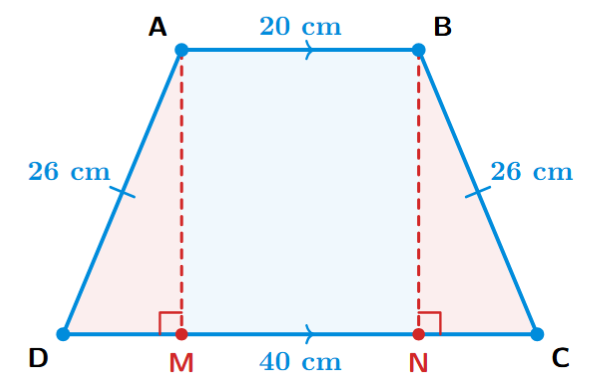
Solution:
In the rectangle $ABNM$, $MN = AB = 20\text{ cm}$.
Since the trapezium is isosceles ($AD = BC = 26\text{ cm}$), the triangles $\triangle ADM$ and $\triangle BCN$ are congruent.
$DM = NC = \frac{CD - MN}{2}$
$DM = \frac{40 - 20}{2} = 10\text{ cm}$
In right-angled triangle $\triangle ADM$, by Pythagoras theorem:
$AD^2 = AM^2 + DM^2$
$26^2 = h^2 + 10^2$
$676 = h^2 + 100$
$h^2 = 576 \Rightarrow h = 24\text{ cm}$
Now, the area of the trapezium is:
$Area = \frac{1}{2} \times (a + b) \times h$
$Area = \frac{1}{2} \times (40 + 20) \times 24$
$Area = \frac{1}{2} \times 60 \times 24 = 720\text{ cm}^2$
Therefore, the area of the trapezium is $720\text{ cm}^2$.
Question 3. Find the area of a triangle, given that its sides are $8\text{ cm}$ and $11\text{ cm}$ long, and its perimeter is $32\text{ cm}$.
Answer:
Given:
Two sides of the triangle: $a = 8\text{ cm}$, $b = 11\text{ cm}$.
Perimeter $= 32\text{ cm}$.
Solution:
Step 1: Find the third side ($c$)
$a + b + c = 32$
$8 + 11 + c = 32$
$c = 32 - 19 = 13\text{ cm}$
Step 2: Calculate the semi-perimeter ($s$)
$s = \frac{\text{Perimeter}}{2} = \frac{32}{2} = 16\text{ cm}$
Step 3: Use Heron's Formula for Area
$Area = \sqrt{s(s-a)(s-b)(s-c)}$
$Area = \sqrt{16(16-8)(16-11)(16-13)}$
$Area = \sqrt{16 \times 8 \times 5 \times 3}$
$Area = \sqrt{1920}$
$Area = \sqrt{64 \times 30} = 8\sqrt{30}\text{ cm}^2$
Therefore, the area of the triangle is $8\sqrt{30}\text{ cm}^2$.
Question 4. The sides of a triangular plot are in the ratio $3: 5: 7$; its perimeter is $300\text{ m}$. Find its area.
Answer:
Given:
Ratio of sides $= 3 : 5 : 7$.
Perimeter $= 300\text{ m}$.
Solution:
Let the sides be $3x, 5x,$ and $7x$.
$3x + 5x + 7x = 300$
$15x = 300 \Rightarrow x = 20$
The sides are:
$a = 3 \times 20 = 60\text{ m}$
$b = 5 \times 20 = 100\text{ m}$
$c = 7 \times 20 = 140\text{ m}$
Semi-perimeter ($s$):
$s = \frac{300}{2} = 150\text{ m}$
Using Heron's Formula:
$Area = \sqrt{150(150-60)(150-100)(150-140)}$
$Area = \sqrt{150 \times 90 \times 50 \times 10}$
$Area = \sqrt{6750000}$
$Area = 1500\sqrt{3}\text{ m}^2$
Therefore, the area of the plot is $1500\sqrt{3}\text{ m}^2$.
Question 5. One diagonal of a rhombus is twice as long as the other diagonal. If the rhombus has area $128\text{ cm}^2$, find the length of the shorter diagonal.
Answer:
Given:
Area of rhombus $= 128\text{ cm}^2$.
Relationship between diagonals: $d_2 = 2d_1$.
Solution:
The formula for the area of a rhombus is:
$Area = \frac{1}{2} \times d_1 \times d_2$
Substituting the given relationship $d_2 = 2d_1$:
$128 = \frac{1}{2} \times d_1 \times (2d_1)$
$128 = d_1^2$
Taking square root on both sides:
$d_1 = \sqrt{128}$
$d_1 = \sqrt{64 \times 2} = 8\sqrt{2}\text{ cm}$
The value of $8\sqrt{2}$ is approximately $8 \times 1.414 = 11.31\text{ cm}$.
Since $d_1$ is the shorter diagonal, its length is $8\sqrt{2}\text{ cm}$.
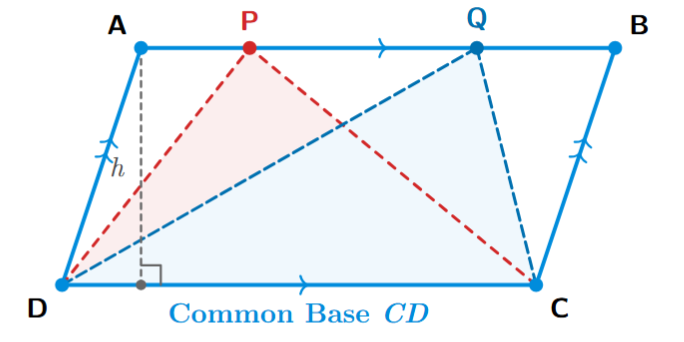
Question 6. $ABCD$ is a parallelogram. $P$ and $Q$ are any two points on side $AB$. What can you say about the ratio $\text{area } (\Delta PCD) : \text{area } (\Delta QCD)$?
Answer:
Given:
A parallelogram $ABCD$. Points $P$ and $Q$ lie on the side $AB$. Two triangles $\triangle PCD$ and $\triangle QCD$ are formed with the common base $CD$.
Solution:
We know that triangles on the same base and between the same parallel lines are equal in area.
In this case, both $\triangle PCD$ and $\triangle QCD$ stand on the same base $CD$.
Also, since $ABCD$ is a parallelogram, we have $AB \parallel CD$. Since points $P$ and $Q$ lie on $AB$, the vertices $P$ and $Q$ of the triangles lie on a line parallel to the base $CD$.
This means the height (perpendicular distance between the parallel lines) is the same for both triangles.
$\text{Area } (\triangle PCD) = \frac{1}{2} \times CD \times h$
$\text{Area } (\triangle QCD) = \frac{1}{2} \times CD \times h$
Since the bases and heights are equal:
$\text{Area } (\triangle PCD) = \text{Area } (\triangle QCD)$
Therefore, the ratio of their areas is:
$\text{Area } (\triangle PCD) : \text{Area } (\triangle QCD) = 1 : 1$
Thus, the areas are equal and the ratio is $1:1$.
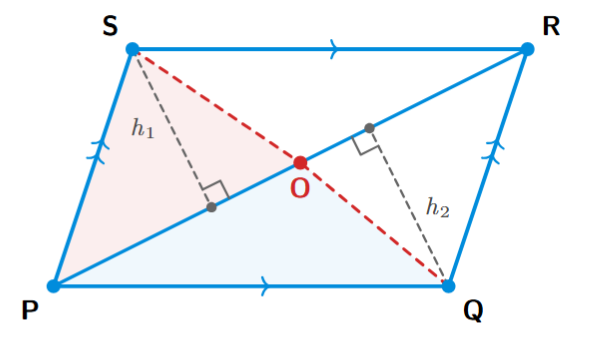
Question 7. $O$ is any point on the diagonal $PR$ of a parallelogram $PQRS$. Prove that the areas of triangles $PSO$ and $PQO$ are equal.
Answer:
Given:
$PQRS$ is a parallelogram. $O$ is a point on the diagonal $PR$.
To Prove:
$\text{Area } (\triangle PSO) = \text{Area } (\triangle PQO)$
Proof:
Consider the diagonal $PR$ of the parallelogram $PQRS$. We know that a diagonal of a parallelogram divides it into two triangles of equal area.
$\text{Area } (\triangle PSR) = \text{Area } (\triangle PQR)$
Now, consider $\triangle PSR$ and $\triangle PQR$. Let us draw perpendiculars from $S$ and $Q$ to the diagonal $PR$. Let these be $h_1$ and $h_2$. Since $PR$ is a diagonal of a parallelogram, $S$ and $Q$ are equidistant from $PR$, so $h_1 = h_2$.
The triangles $\triangle PSO$ and $\triangle PQO$ share the same base $PO$ along the diagonal.
$\text{Area } (\triangle PSO) = \frac{1}{2} \times PO \times h_1$
$\text{Area } (\triangle PQO) = \frac{1}{2} \times PO \times h_2$
Since $h_1 = h_2$ (altitudes of triangles from opposite vertices of a parallelogram to the diagonal):
$\text{Area } (\triangle PSO) = \text{Area } (\triangle PQO)$
Hence Proved.
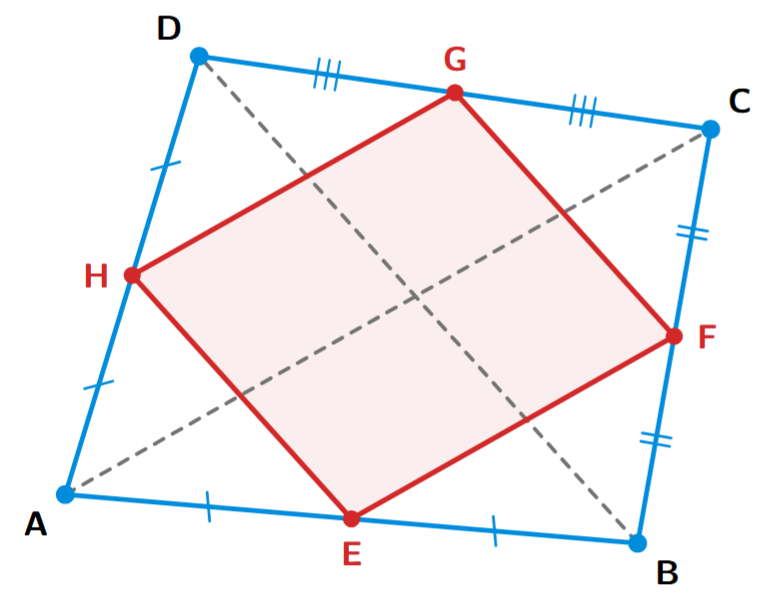
Question 8. If the mid-points of the sides of a $4$-gon (also known as a quadrilateral, but we prefer to call it a ‘$4$-gon’) are joined in order, prove that the area of the parallelogram thus formed will be half of the area of the given $4$-gon. (You may wonder whether the $4$-gon thus formed is always a parallelogram, and if so, why? These questions will be tackled and answered in the chapter on quadrilaterals.)
Answer:
Given:
A quadrilateral $ABCD$ ($4$-gon). $E, F, G,$ and $H$ are the mid-points of sides $AB, BC, CD,$ and $DA$ respectively.
To Prove:
$\text{Area } (EFGH) = \frac{1}{2} \times \text{Area } (ABCD)$
Construction:
Join the diagonals $AC$ and $BD$.
Proof:
In $\triangle ABC$, $E$ and $F$ are mid-points of $AB$ and $BC$. By the Mid-point Theorem:
$EF \parallel AC$ and $EF = \frac{1}{2} AC$
The area of $\triangle EBF$ is related to the area of $\triangle ABC$. Since $E$ and $F$ are mid-points, the height and base of $\triangle EBF$ are half of $\triangle ABC$.
$\text{Area } (\triangle EBF) = \frac{1}{4} \times \text{Area } (\triangle ABC)$
... (i)
Similarly, for the other corner triangles:
$\text{Area } (\triangle GDH) = \frac{1}{4} \times \text{Area } (\triangle ADC)$
... (ii)
Adding equations (i) and (ii):
$\text{Area } (\triangle EBF) + \text{Area } (\triangle GDH) = \frac{1}{4} [\text{Area } (\triangle ABC) $$ + \text{Area } (\triangle ADC)]$
$\text{Area } (\triangle EBF) + \text{Area } (\triangle GDH) = \frac{1}{4} \times \text{Area } (ABCD)$
... (iii)
Following the same logic using diagonal $BD$ for the other two corner triangles $\triangle FCG$ and $\triangle HAE$:
$\text{Area } (\triangle FCG) + \text{Area } (\triangle HAE) = \frac{1}{4} \times \text{Area } (ABCD)$
... (iv)
Total area of the four corner triangles $= (\text{Eq. iii}) + (\text{Eq. iv})$:
$\text{Sum of corner triangles} = \frac{1}{4} \text{Area } (ABCD) + \frac{1}{4} \text{Area } (ABCD) $$ = \frac{1}{2} \text{Area } (ABCD)$
Now, the area of the inner parallelogram $EFGH$ is:
$\text{Area } (EFGH) = \text{Area } (ABCD) - (\text{Sum of corner triangles})$
$\text{Area } (EFGH) = \text{Area } (ABCD) - \frac{1}{2} \text{Area } (ABCD)$
$\text{Area } (EFGH) = \frac{1}{2} \times \text{Area } (ABCD)$
Hence Proved.
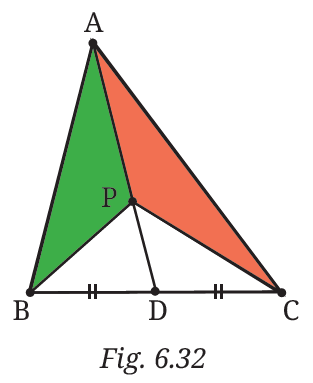
Question 9. In $\Delta ABC$, the midpoint of $BC$ is $D$ (Fig. 6.32). Median $AD$ is drawn. $P$ is any point on $AD$. Show that $\text{area } (\Delta ABP) = \text{area } (\Delta ACP)$.
Answer:
Given:
In $\Delta ABC$, $D$ is the midpoint of $BC$. $AD$ is the median of $\Delta ABC$ and $P$ is a point lying on the median $AD$.
To Prove:
$\text{area } (\Delta ABP) = \text{area } (\Delta ACP)$
Proof:
We know that a median of a triangle divides it into two triangles of equal area.
In $\Delta ABC$, $AD$ is the median.
$\text{area } (\Delta ABD) = \text{area } (\Delta ACD)$
[Median $AD$ divides $\Delta ABC$] ... (i)
Now, consider $\Delta BPC$. Since $D$ is the midpoint of $BC$, $PD$ is the median of $\Delta BPC$.
$\text{area } (\Delta BPD) = \text{area } (\Delta CPD)$
[Median $PD$ divides $\Delta BPC$] ... (ii)
Subtracting equation (ii) from equation (i):
$\text{area } (\Delta ABD) - \text{area } (\Delta BPD) = \text{area } (\Delta ACD) - \text{area } (\Delta CPD)$
From the figure, we can see that:
$\text{area } (\Delta ABD) - \text{area } (\Delta BPD) = \text{area } (\Delta ABP)$
$\text{area } (\Delta ACD) - \text{area } (\Delta CPD) = \text{area } (\Delta ACP)$
Therefore, we get:
$\text{area } (\Delta ABP) = \text{area } (\Delta ACP)$
Hence Proved.
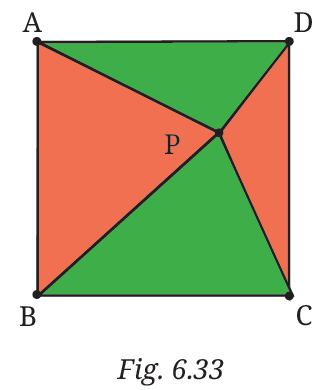
Question 10. Given a square $ABCD$, let $P$ be a point within it. Join $PA, PB, PC, PD$ (Fig. 6.33). What is the ratio of the areas of the red region ($\Delta PAB$ and $\Delta PCD$) and the green region ($\Delta PBC$ and $\Delta PDA$)?
Answer:
Given:
A square $ABCD$. $P$ is a point inside the square. $\Delta PAB$ and $\Delta PCD$ form the red region. $\Delta PBC$ and $\Delta PDA$ form the green region.
To Find:
The ratio of the area of the red region to the area of the green region.
Solution:
Let the side of the square $ABCD$ be $s$.
$\text{Area of square } ABCD = s^2$
Let the perpendicular distance from $P$ to the side $AB$ be $h_1$ and the perpendicular distance from $P$ to the side $CD$ be $h_2$.
Since $AB \parallel CD$, the total distance between them is the side of the square.
$h_1 + h_2 = s$
Step 1: Calculate the area of the red region
$\text{Area of red region} = \text{area } (\Delta PAB) + \text{area } (\Delta PCD)$
$\text{Area of red region} = \left( \frac{1}{2} \times s \times h_1 \right) + \left( \frac{1}{2} \times s \times h_2 \right)$
$\text{Area of red region} = \frac{1}{2} \times s \times (h_1 + h_2)$
$\text{Area of red region} = \frac{1}{2} \times s \times s = \frac{1}{2} s^2$
Step 2: Calculate the area of the green region
Similarly, let the perpendicular distances from $P$ to sides $BC$ and $AD$ be $h_3$ and $h_4$ respectively. Here, $h_3 + h_4 = s$.
$\text{Area of green region} = \text{area } (\Delta PBC) + \text{area } (\Delta PDA)$
$\text{Area of green region} = \left( \frac{1}{2} \times s \times h_3 \right) + \left( \frac{1}{2} \times s \times h_4 \right)$
$\text{Area of green region} = \frac{1}{2} \times s \times (h_3 + h_4)$
$\text{Area of green region} = \frac{1}{2} \times s \times s = \frac{1}{2} s^2$
Step 3: Find the ratio
$\text{Ratio} = \frac{\text{Area of red region}}{\text{Area of green region}} = \frac{\frac{1}{2} s^2}{\frac{1}{2} s^2}$
$\text{Ratio} = \frac{1}{1} = 1 : 1$
Therefore, the ratio of the areas of the red region and the green region is $1 : 1$.
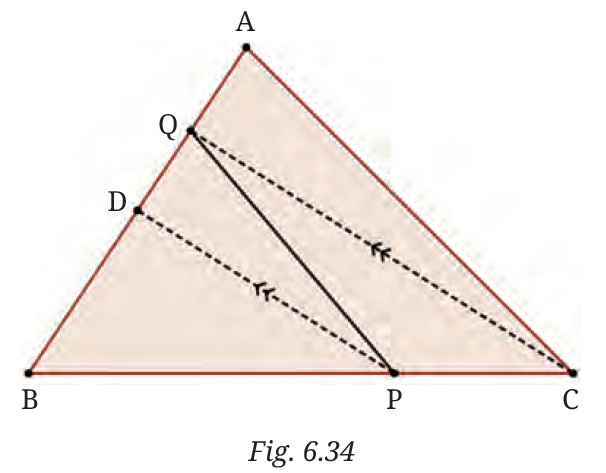
Question 11. In $\Delta ABC$, $D$ is the midpoint of $AB$. $P$ is any point on $BC$, and $Q$ is a point on $AB$ such that $CQ \parallel PD$. $PQ$ is joined (Fig. 6.34). Prove that $\text{Area } (\Delta BPQ) = \frac{1}{2} \text{Area } (\Delta ABC)$.
Answer:
Given:
1. In $\Delta ABC$, $D$ is the midpoint of the side $AB$.
2. $P$ is a point on side $BC$.
3. $Q$ is a point on side $AB$ such that $CQ \parallel PD$.
To Prove:
$\text{Area } (\Delta BPQ) = \frac{1}{2} \text{Area } (\Delta ABC)$
Proof:
Consider $\Delta BPQ$ and $\Delta BQC$. Both these triangles share the same vertex $Q$, and their bases $BP$ and $BC$ lie on the same straight line $BC$.
Therefore, the ratio of their areas is equal to the ratio of their bases.
$\frac{\text{Area } (\Delta BPQ)}{\text{Area } (\Delta BQC)} = \frac{BP}{BC}$
[Triangles with same altitude from $Q$] ... (i)
In $\Delta BQC$, it is given that $PD \parallel CQ$.
According to the Basic Proportionality Theorem (or the property of parallel lines in a triangle), the ratios of the corresponding segments are equal.
$\frac{BP}{BC} = \frac{BD}{BQ}$
[Since $PD \parallel CQ$] ... (ii)
Now, consider $\Delta BQC$ and $\Delta ABC$. Both these triangles share the same vertex $C$, and their bases $BQ$ and $AB$ lie on the same straight line $AB$.
Therefore, the ratio of their areas is equal to the ratio of their bases.
$\frac{\text{Area } (\Delta BQC)}{\text{Area } (\Delta ABC)} = \frac{BQ}{AB}$
[Triangles with same altitude from $C$] ... (iii)
To find the total ratio, we multiply the area ratios from equation (i) and equation (iii):
$\frac{\text{Area } (\Delta BPQ)}{\text{Area } (\Delta BQC)} \times \frac{\text{Area } (\Delta BQC)}{\text{Area } (\Delta ABC)} = \frac{BP}{BC} \times \frac{BQ}{AB}$
$\frac{\text{Area } (\Delta BPQ)}{\text{Area } (\Delta ABC)} = \frac{BP}{BC} \times \frac{BQ}{AB}$
Substituting the value of $\frac{BP}{BC}$ from equation (ii):
$\frac{\text{Area } (\Delta BPQ)}{\text{Area } (\Delta ABC)} = \frac{BD}{BQ} \times \frac{BQ}{AB}$
$\frac{\text{Area } (\Delta BPQ)}{\text{Area } (\Delta ABC)} = \frac{BD}{AB}$
It is given that $D$ is the midpoint of $AB$.
$BD = \frac{1}{2} AB$
Substituting this value into our area ratio:
$\frac{\text{Area } (\Delta BPQ)}{\text{Area } (\Delta ABC)} = \frac{\frac{1}{2} AB}{AB}$
$\frac{\text{Area } (\Delta BPQ)}{\text{Area } (\Delta ABC)} = \frac{1}{2}$
$\text{Area } (\Delta BPQ) = \frac{1}{2} \text{Area } (\Delta ABC)$
Hence Proved.
Exercise Set 6.3
Unless stated otherwise, use the approximation $\frac{22}{7}$ for $\pi$.
Question 1. Find the area of a sector of a circle with radius $7\text{ cm}$ if the angle of the sector is $60^\circ$.
Answer:
Given:
Radius of the circle ($r$) $= 7\text{ cm}$
Angle of the sector ($\theta$) $= 60^\circ$
To Find:
Area of the sector.
Solution:
The formula for the area of a sector is given by:
$Area = \frac{\theta}{360^\circ} \times \pi r^2$
Substituting the given values:
$Area = \frac{60^\circ}{360^\circ} \times \frac{22}{7} \times 7 \times 7$
Simplifying the expression:
$Area = \frac{\cancel{60}^{1}}{\cancel{360}_{6}} \times \frac{22}{\cancel{7}} \times \cancel{7} \times 7$
$Area = \frac{1}{6} \times 22 \times 7$
$Area = \frac{11 \times 7}{3} = \frac{77}{3}\text{ cm}^2$
Therefore, the area of the sector is $25.67\text{ cm}^2$ (approximately).
Question 2. Find the area of a quadrant of a circle whose circumference is $44\text{ cm}$.
Answer:
Given:
Circumference of the circle ($C$) $= 44\text{ cm}$
To Find:
Area of a quadrant of the circle.
Solution:
A quadrant is a sector with an angle $\theta = 90^\circ$. First, we need to find the radius ($r$).
$C = 2\pi r$
$44 = 2 \times \frac{22}{7} \times r$
$44 = \frac{44}{7} \times r$
$r = 7\text{ cm}$
[Radius of the circle]
Now, we find the area of the quadrant:
$Area = \frac{1}{4} \pi r^2$
$Area = \frac{1}{4} \times \frac{22}{7} \times 7 \times 7$
$Area = \frac{1}{4} \times 22 \times 7$
$Area = \frac{11 \times 7}{2} = \frac{77}{2}\text{ cm}^2$
Therefore, the area of the quadrant is $38.5\text{ cm}^2$.
Question 3. The length of the minute hand of a clock is $7\text{ cm}$. Find the area swept by the minute hand in $10$ minutes.
Answer:
Given:
Length of the minute hand ($r$) $= 7\text{ cm}$
Time duration $= 10\text{ minutes}$
Solution:
In a clock, the minute hand completes one full revolution ($360^\circ$) in $60$ minutes.
Angle swept in $60$ minutes $= 360^\circ$
Angle swept in $1$ minute $= \frac{360^\circ}{60} = 6^\circ$
Angle swept in $10$ minutes ($\theta$):
$\theta = 10 \times 6^\circ = 60^\circ$
The area swept is the area of a sector with radius $r = 7\text{ cm}$ and $\theta = 60^\circ$.
$Area = \frac{\theta}{360^\circ} \times \pi r^2$
$Area = \frac{60^\circ}{360^\circ} \times \frac{22}{7} \times 7 \times 7$
$Area = \frac{1}{6} \times 154 = \frac{77}{3}\text{ cm}^2$
Therefore, the area swept by the minute hand in $10$ minutes is $25.67\text{ cm}^2$.
Question 4. A chord of a circle of radius $10\text{ cm}$ subtends $90^\circ$ at the centre. Find the area of the corresponding:
(i) minor sector (that subtends $90^\circ$ at the centre)
(ii) major sector (that subtends $270^\circ$ at the centre).
(Use $\pi \approx 3.14$.)
Answer:
Given:
Radius of the circle ($r$) $= 10\text{ cm}$
Sector angle for minor sector $= 90^\circ$
Sector angle for major sector $= 270^\circ$
Value of $\pi = 3.14$
Solution:
(i) Area of minor sector:
$Area = \frac{90^\circ}{360^\circ} \times 3.14 \times 10 \times 10$
$Area = \frac{1}{4} \times 3.14 \times 100$
$Area = \frac{314}{4} = 78.5\text{ cm}^2$
(ii) Area of major sector:
$Area = \frac{270^\circ}{360^\circ} \times 3.14 \times 10 \times 10$
$Area = \frac{3}{4} \times 314$
$Area = 3 \times 78.5 = 235.5\text{ cm}^2$
Therefore, the area of the minor sector is $78.5\text{ cm}^2$ and the area of the major sector is $235.5\text{ cm}^2$.
Question 5. A chord of a circle of radius $15\text{ cm}$ subtends an angle of $60^\circ$ at the centre of the circle. Find the areas of the corresponding minor and major segments of the circle. (Use $\pi \approx 3.14$ and $\sqrt{3} \approx 1.73$.)
Answer:
Given:
Radius of the circle ($r$) $= 15\text{ cm}$
Angle subtended at the centre ($\theta$) $= 60^\circ$
Use $\pi = 3.14$ and $\sqrt{3} = 1.73$.
To Find:
Area of the minor segment and major segment.
Solution:
Step 1: Calculate the Area of the minor sector.
$Area_{sector} = \frac{\theta}{360^\circ} \times \pi r^2$
$Area_{sector} = \frac{60^\circ}{360^\circ} \times 3.14 \times (15)^2$
$Area_{sector} = \frac{1}{6} \times 3.14 \times 225 = 117.75\text{ cm}^2$
Step 2: Calculate the Area of $\triangle OAB$.
Since $OA = OB$ and $\angle AOB = 60^\circ$, the triangle is equilateral. All its angles are $60^\circ$.
$Area_{\triangle} = \frac{\sqrt{3}}{4} r^2$
$Area_{\triangle} = \frac{1.73}{4} \times 225 = 0.4325 \times 225$
$Area_{\triangle} = 97.3125\text{ cm}^2$
Step 3: Calculate the Area of minor segment.
$Area_{minor\ segment} = Area_{sector} - Area_{\triangle}$
$Area_{minor\ segment} = 117.75 - 97.3125 = \mathbf{20.4375\text{ cm}^2}$
Step 4: Calculate the Area of major segment.
$Area_{major\ segment} = \text{Total Area of circle} - Area_{minor\ segment}$
$Area_{circle} = 3.14 \times 15^2 = 706.5\text{ cm}^2$
$Area_{major\ segment} = 706.5 - 20.4375 = \mathbf{686.0625\text{ cm}^2}$
Question 6. A car has two wipers which do not overlap. Each wiper has a blade of length $28\text{ cm}$ and sweeps through an angle of $120^\circ$. Find the total area cleaned at each sweep of the blades.
Answer:
Given:
Length of the blade ($r$) $= 28\text{ cm}$
Angle of sweep ($\theta$) $= 120^\circ$
Number of wipers $= 2$
Solution:
Each wiper cleans an area in the shape of a sector of a circle.
Area cleaned by one wiper:
$A_1 = \frac{\theta}{360^\circ} \times \pi r^2$
$A_1 = \frac{120^\circ}{360^\circ} \times \frac{22}{7} \times 28 \times 28$
$A_1 = \frac{1}{3} \times 22 \times 4 \times 28 = \frac{2464}{3}\text{ cm}^2$
Total area cleaned by both wipers:
$Total\ Area = 2 \times A_1 = 2 \times \frac{2464}{3}$
$Total\ Area = \frac{4928}{3} \approx \mathbf{1642.67\text{ cm}^2}$
Question 7. A chord of a circle of radius $r$ subtends an angle of $60^\circ$ at the centre of the circle. Show that the area of the corresponding minor segment of the circle is equal to $\pi r^2 \left( \frac{1}{6} - \frac{\sqrt{3}}{4} \right)$.
Answer:
Given:
A circle with radius $r$. A chord subtending an angle $\theta = 60^\circ$ at the centre $O$.
To Prove:
Area of minor segment $= r^2 \left( \frac{\pi}{6} - \frac{\sqrt{3}}{4} \right)$
Proof:
The area of a minor segment is calculated as:
$Area_{segment} = Area_{sector} - Area_{\triangle OAB}$
1. Area of sector:
$Area_{sector} = \frac{60^\circ}{360^\circ} \times \pi r^2 = \frac{1}{6} \pi r^2$
2. Area of triangle OAB:
Since $OA = OB = r$ and $\angle AOB = 60^\circ$, the triangle is equilateral.
$Area_{\triangle} = \frac{\sqrt{3}}{4} r^2$
3. Area of segment:
$Area_{segment} = \frac{1}{6} \pi r^2 - \frac{\sqrt{3}}{4} r^2$
Factoring out $r^2$ from both terms:
$Area_{segment} = r^2 \left( \frac{\pi}{6} - \frac{\sqrt{3}}{4} \right)$
Hence Proved.
Question 8. An equilateral triangle is inscribed in a circle of radius $r$. Show that the ratio of the area of the triangle to the area of the circle is equal to $\frac{3\sqrt{3}}{4\pi} \approx 0.413$.
Answer:
Given:
An equilateral triangle with side $s$ inscribed in a circle of radius $r$.
Solution:
In an equilateral triangle, the centre $O$ of the circle (circumcentre) coincides with the centroid.
The height ($h$) of an equilateral triangle is $\frac{\sqrt{3}}{2}s$. The centroid divides the median in the ratio $2:1$.
$r = \frac{2}{3} h = \frac{2}{3} \times \frac{\sqrt{3}}{2} s = \frac{s}{\sqrt{3}}$
From this, we get the side $s$ in terms of $r$:
$s = r\sqrt{3}$
Step 1: Area of the equilateral triangle:
$Area_{\triangle} = \frac{\sqrt{3}}{4} s^2 = \frac{\sqrt{3}}{4} (r\sqrt{3})^2 = \frac{3\sqrt{3}}{4} r^2$
Step 2: Area of the circle:
$Area_{circle} = \pi r^2$
Step 3: Finding the ratio:
$Ratio = \frac{\text{Area of Triangle}}{\text{Area of Circle}} = \frac{\frac{3\sqrt{3}}{4} r^2}{\pi r^2}$
$Ratio = \frac{3\sqrt{3}}{4\pi}$
Using $\sqrt{3} \approx 1.732$ and $\pi \approx 3.141$:
$Ratio = \frac{5.196}{12.564} \approx \mathbf{0.413}$
Hence Proved.
Question 9. A square is inscribed in a circle of radius $r$. Show that the ratio of the area of the square to the area of the circle is equal to $\frac{2}{\pi} \approx 0.637$.
Answer:
Given:
A square is inscribed in a circle of radius $r$.
To Prove:
Ratio of Area of Square : Area of Circle $= \frac{2}{\pi} \approx 0.637$
Solution:
Let the side of the inscribed square be $s$.
When a square is inscribed in a circle, its diagonal is equal to the diameter of the circle.
$Diagonal\ of\ square = 2r$
In a square, the relationship between side $s$ and diagonal $d$ is given by $d = s\sqrt{2}$.
$s\sqrt{2} = 2r$
$s = \frac{2r}{\sqrt{2}} = r\sqrt{2}$
Step 1: Calculate Area of the Square
$Area_{square} = s^2 = (r\sqrt{2})^2 = 2r^2$
Step 2: Calculate Area of the Circle
$Area_{circle} = \pi r^2$
Step 3: Finding the Ratio
$Ratio = \frac{Area_{square}}{Area_{circle}} = \frac{2r^2}{\pi r^2}$
$Ratio = \frac{2}{\pi}$
Using the value of $\pi \approx 3.14159$:
$Ratio \approx \frac{2}{3.14159} \approx 0.6366$
Rounding to three decimal places, the ratio is $0.637$.
Hence Proved.
Question 10. A hexagon is inscribed in a circle of radius $r$. Show that the ratio of the area of the hexagon to the area of the circle is equal to $\frac{3\sqrt{3}}{2\pi} \approx 0.827$. Can you see why the answer is exactly twice the answer to Question 8?
Answer:
Given:
A regular hexagon inscribed in a circle of radius $r$.
To Prove:
Ratio of Area of Hexagon : Area of Circle $= \frac{3\sqrt{3}}{2\pi} \approx 0.827$
Solution:
A regular hexagon inscribed in a circle consists of 6 equilateral triangles, each having a side equal to the radius $r$ of the circle.
Step 1: Calculate Area of the Hexagon
$Area_{hexagon} = 6 \times Area\ of\ one\ equilateral\ triangle$
$Area_{hexagon} = 6 \times \left( \frac{\sqrt{3}}{4} r^2 \right)$
$Area_{hexagon} = \frac{3\sqrt{3}}{2} r^2$
Step 2: Calculate Area of the Circle
$Area_{circle} = \pi r^2$
Step 3: Finding the Ratio
$Ratio = \frac{\frac{3\sqrt{3}}{2} r^2}{\pi r^2} = \frac{3\sqrt{3}}{2\pi}$
Using $\sqrt{3} \approx 1.732$ and $\pi \approx 3.14159$:
$Ratio \approx \frac{3 \times 1.732}{2 \times 3.14159} \approx \frac{5.196}{6.28318} \approx 0.82697$
Rounding to three decimal places, the ratio is $0.827$.
Hence Proved.
Reasoning for relationship with Question 8:
The ratio obtained in Question 8 for an inscribed equilateral triangle was $\frac{3\sqrt{3}}{4\pi}$.
The ratio for the inscribed hexagon is $\frac{3\sqrt{3}}{2\pi}$.
Mathematically, we can see that:
$\frac{3\sqrt{3}}{2\pi} = 2 \times \left( \frac{3\sqrt{3}}{4\pi} \right)$
This is because the area of a regular hexagon inscribed in a circle is exactly twice the area of an equilateral triangle inscribed in the same circle.
A regular hexagon is composed of 6 equilateral triangles of side $r$. An equilateral triangle inscribed in the same circle is composed of 3 such equilateral triangles (if we consider the triangle formed by joining alternate vertices of the hexagon). Since the hexagon uses 6 triangles and the equilateral triangle uses 3, the area of the hexagon is double, and thus the ratio is also exactly twice.
End-Of-Chapter Exercises
Unless stated otherwise, use the approximation $\frac{22}{7}$ for $\pi$.
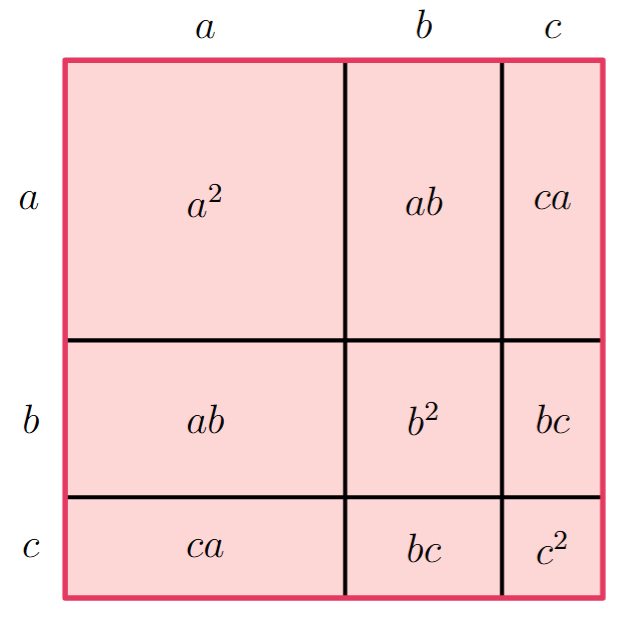
Question 1. Identities in algebra can sometimes be shown as area relationships. For example:
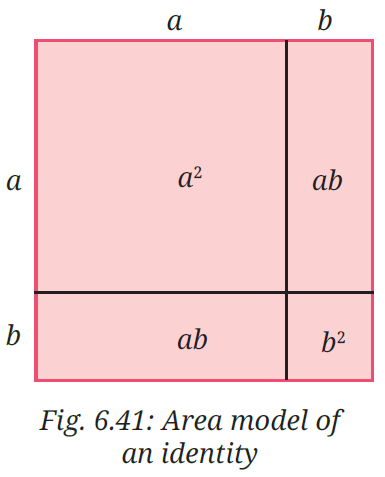
The figure shown corresponds to the identity $(a + b)^2 = a^2 + 2ab + b^2$. Do you see how?
Draw figures corresponding to the identities $(a + b)(a – b) = a^2 – b^2$ and $(a + b + c)^2 = a^2 + b^2 + c^2 + 2ab + 2bc + 2ca$.
Answer:
Explanation of Fig. 6.41:
The figure displays a large square whose side length is the sum of two segments, $a$ and $b$. Therefore, the total side length of the large square is $(a + b)$.
The total area of this square is given by the square of its side:
$\text{Total Area} = (a + b)^2$
As shown in the diagram, this large square is partitioned into four smaller rectangular regions:
1. A square with side $a$, having an area of $a^2$.
2. A rectangle with sides $a$ and $b$, having an area of $ab$.
3. Another rectangle with sides $b$ and $a$, also having an area of $ab$.
4. A square with side $b$, having an area of $b^2$.
By summing the areas of these four regions, we obtain the total area of the large square:
$(a + b)^2 = a^2 + ab + ab + b^2$
$(a + b)^2 = a^2 + 2ab + b^2$
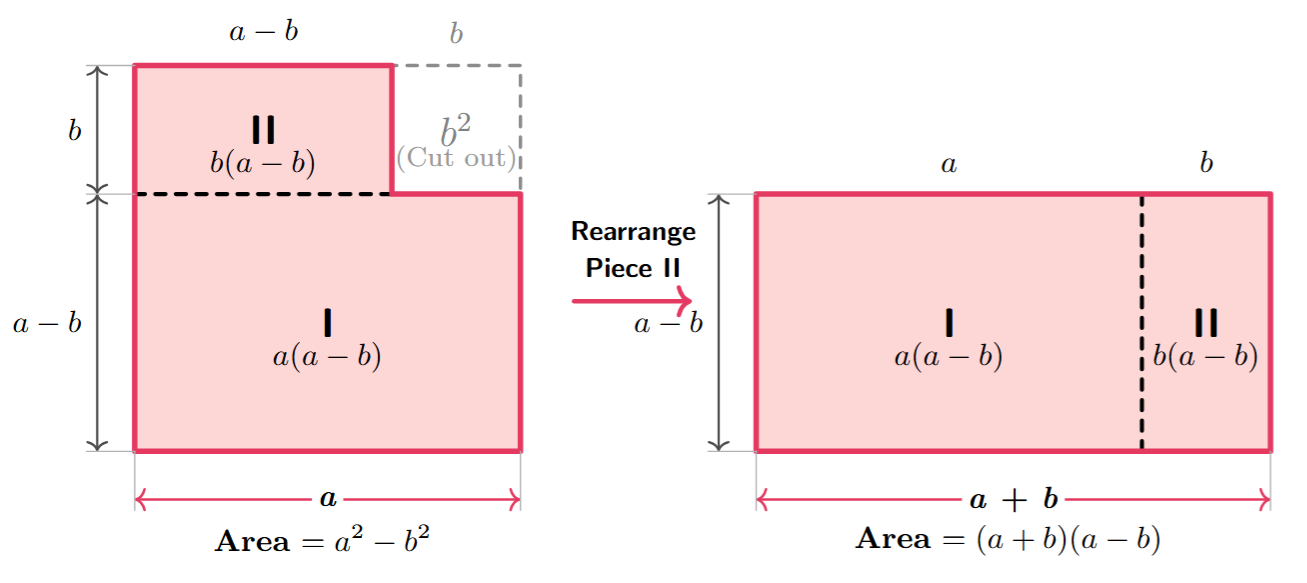
Visualizing $(a + b)(a - b) = a^2 - b^2$:
To show this identity using an area model, we start with a large square of side $a$, which has an area of $a^2$.
Next, we "remove" or subtract a smaller square of side $b$ from one of its corners. The remaining area is $a^2 - b^2$.
This remaining L-shaped region can be cut and rearranged into a single rectangle. One dimension of this rearranged rectangle will be $(a + b)$ and the other will be $(a - b)$.
Since the area remains the same after rearrangement, we conclude:
$\text{Area of Rectangle} = (a + b)(a - b)$
$(a + b)(a - b) = a^2 - b^2$
Visualizing $(a + b + c)^2 = a^2 + b^2 + c^2 + 2ab + 2bc + 2ca$:
To represent this identity, we draw a square where each side is divided into three parts of lengths $a$, $b$, and $c$. The total side length is $(a + b + c)$.
The total area is $(a + b + c)^2$. This square is divided into 9 sub-regions:
1. Three squares with sides $a, b,$ and $c$, giving areas $a^2, b^2,$ and $c^2$.
2. Six rectangles: two with area $ab$, two with area $bc$, and two with area $ca$.
Summing all these individual areas gives:
$(a + b + c)^2 = a^2 + b^2 + c^2 + ab + ab + bc + bc + ca + ca$
$(a + b + c)^2 = a^2 + b^2 + c^2 + 2ab + 2bc + 2ca$
Question 2. An isosceles triangle has perimeter $40\text{ cm}$; the equal sides are $15\text{ cm}$ each. Find the area of the triangle.
Answer:
Given:
In an isosceles triangle,
Length of equal sides ($a$ and $b$) $= 15\text{ cm}$
Perimeter of the triangle $= 40\text{ cm}$
To Find:
Area of the triangle.
Solution:
Let the sides of the triangle be $a, b,$ and $c$.
$a = 15\text{ cm}, b = 15\text{ cm}$
(Given)
We know that Perimeter $= a + b + c$
$40 = 15 + 15 + c$
$40 = 30 + c$
$c = 40 - 30 = 10\text{ cm}$
Now, calculate the semi-perimeter ($s$):
$s = \frac{\text{Perimeter}}{2} = \frac{40}{2} = 20\text{ cm}$
Using Heron's Formula to find the area:
$Area = \sqrt{s(s - a)(s - b)(s - c)}$
$Area = \sqrt{20(20 - 15)(20 - 15)(20 - 10)}$
$Area = \sqrt{20 \times 5 \times 5 \times 10}$
$Area = \sqrt{5000}$
$Area = \sqrt{2500 \times 2}$
$Area = 50\sqrt{2}\text{ cm}^2$
Therefore, the area of the triangle is $50\sqrt{2}\text{ cm}^2$.
Question 3. An isosceles triangle has base $10\text{ cm}$, and its area is $60\text{ cm}^2$. What are the lengths of the equal sides?
Answer:
Given:
Base of the isosceles triangle ($b$) $= 10\text{ cm}$
Area of the triangle $= 60\text{ cm}^2$
To Find:
Length of the equal sides.
Solution:
Let the length of the equal sides be $a$ and the height of the triangle be $h$.
$Area = \frac{1}{2} \times \text{base} \times \text{height}$
$60 = \frac{1}{2} \times 10 \times h$
$60 = 5h$
$h = \frac{60}{5} = 12\text{ cm}$
In an isosceles triangle, the altitude to the base bisects the base. This forms two right-angled triangles.
In one of these right triangles, the base is $\frac{10}{2} = 5\text{ cm}$ and the height is $12\text{ cm}$.
By Pythagoras Theorem:
$a^2 = h^2 + \left(\frac{b}{2}\right)^2$
$a^2 = 12^2 + 5^2$
$a^2 = 144 + 25 = 169$
$a = \sqrt{169} = 13\text{ cm}$
Therefore, the length of each of the equal sides is $13\text{ cm}$.
Question 4. The area of a right-angled triangle is $54\text{ sq. cm}$. One of its legs has length $12\text{ cm}$. Find its perimeter.
Answer:
Given:
Area of the right-angled triangle $= 54\text{ cm}^2$
Length of one leg (base) $= 12\text{ cm}$
To Find:
Perimeter of the triangle.
Solution:
Let the legs of the triangle be $b = 12\text{ cm}$ and $h$.
$Area = \frac{1}{2} \times b \times h$
$54 = \frac{1}{2} \times 12 \times h$
$54 = 6h \Rightarrow h = 9\text{ cm}$
Now, find the hypotenuse ($c$) using Pythagoras Theorem:
$c = \sqrt{b^2 + h^2}$
$c = \sqrt{12^2 + 9^2}$
$c = \sqrt{144 + 81} = \sqrt{225} = 15\text{ cm}$
The perimeter is the sum of all three sides:
$Perimeter = b + h + c$
$Perimeter = 12 + 9 + 15 = 36\text{ cm}$
Therefore, the perimeter of the triangle is $36\text{ cm}$.
Question 5. The sides of a triangle are in the ratio $2: 3: 4$, and its perimeter is $45\text{ cm}$. Find its area.
Answer:
Given:
Ratio of sides $= 2 : 3 : 4$
Perimeter $= 45\text{ cm}$
To Find:
Area of the triangle.
Solution:
Let the sides of the triangle be $2x, 3x,$ and $4x$.
$2x + 3x + 4x = 45$
$9x = 45 \Rightarrow x = 5\text{ cm}$
The lengths of the sides are:
$a = 2 \times 5 = 10\text{ cm}$
$b = 3 \times 5 = 15\text{ cm}$
$c = 4 \times 5 = 20\text{ cm}$
Semi-perimeter ($s$):
$s = \frac{45}{2} = 22.5\text{ cm}$
Using Heron's Formula:
$Area = \sqrt{s(s - a)(s - b)(s - c)}$
$Area = \sqrt{22.5(22.5 - 10)(22.5 - 15)(22.5 - 20)}$
$Area = \sqrt{22.5 \times 12.5 \times 7.5 \times 2.5}$
$Area = \sqrt{\frac{45}{2} \times \frac{25}{2} \times \frac{15}{2} \times \frac{5}{2}}$
$Area = \frac{1}{4} \sqrt{84375} = \frac{75\sqrt{15}}{4}\text{ cm}^2$
The area of the triangle is $\frac{75\sqrt{15}}{4}\text{ cm}^2$ (approx $72.62\text{ cm}^2$).
Question 6. The sides of a triangle have lengths $7\text{ cm}, 24\text{ cm}, 25\text{ cm}$. Find the area of the triangle in two different ways.
Answer:
Given:
Sides of the triangle are $a = 7\text{ cm}$, $b = 24\text{ cm}$, and $c = 25\text{ cm}$.
Method 1: Using Pythagoras Theorem property
Let us check if the triangle is a right-angled triangle by checking the squares of the sides:
$a^2 = 7^2 = 49$
$b^2 = 24^2 = 576$
$c^2 = 25^2 = 625$
Checking the sum of squares of smaller sides:
$a^2 + b^2 = 49 + 576 = 625 = c^2$
Since $a^2 + b^2 = c^2$, the triangle is right-angled at the vertex opposite to the side of $25\text{ cm}$.
$Area = \frac{1}{2} \times \text{Base} \times \text{Height}$
$Area = \frac{1}{2} \times 7 \times 24$
$Area = 7 \times 12 = 84\text{ cm}^2$
Alternate Solution (Method 2: Using Heron's Formula)
First, calculate the semi-perimeter ($s$):
$s = \frac{a + b + c}{2} = \frac{7 + 24 + 25}{2}$
$s = \frac{56}{2} = 28\text{ cm}$
Now, using Heron's formula:
$Area = \sqrt{s(s - a)(s - b)(s - c)}$
$Area = \sqrt{28(28 - 7)(28 - 24)(28 - 25)}$
$Area = \sqrt{28 \times 21 \times 4 \times 3}$
$Area = \sqrt{7 \times 4 \times 7 \times 3 \times 4 \times 3}$
$Area = 7 \times 4 \times 3 = 84\text{ cm}^2$
Therefore, the area of the triangle calculated by both methods is $84\text{ cm}^2$.
Question 7. If the wheel of a bicycle has a diameter of $60\text{ cm}$, find how far a cyclist will have travelled after the wheel has rotated $100$ times.
Answer:
Given:
Diameter of the bicycle wheel ($d$) $= 60\text{ cm}$
Number of rotations $= 100$
Solution:
The distance travelled in one rotation is equal to the circumference of the wheel.
$Circumference = \pi d$
$Circumference = \frac{22}{7} \times 60 \approx 188.57\text{ cm}$
Total distance travelled in $100$ rotations:
$Distance = \text{Number of rotations} \times \text{Circumference}$
$Distance = 100 \times 188.57$
$Distance = 18857\text{ cm}$
Converting the distance into metres ($1\text{ m} = 100\text{ cm}$):
$Distance = 188.57\text{ m}$
Therefore, the cyclist will have travelled approximately $188.57\text{ m}$.
Question 8. Find the area of a quadrant of a circle whose circumference is $66\text{ cm}$.
Answer:
Given:
Circumference of the circle ($C$) $= 66\text{ cm}$
Solution:
First, we find the radius ($r$) of the circle.
$C = 2\pi r = 66$
$2 \times \frac{22}{7} \times r = 66$
$r = \frac{66 \times 7}{44} = \frac{3 \times 7}{2}$
$r = 10.5\text{ cm}$
Now, calculate the area of a quadrant (which is one-fourth of a circle):
$Area = \frac{1}{4} \pi r^2$
$Area = \frac{1}{4} \times \frac{22}{7} \times 10.5 \times 10.5$
$Area = \frac{1}{4} \times \frac{22}{7} \times \frac{21}{2} \times \frac{21}{2}$
$Area = \frac{11 \times 3 \times 21}{8} = \frac{693}{8}$
$Area = 86.625\text{ cm}^2$
Therefore, the area of the quadrant is $86.625\text{ cm}^2$.
Question 9. The wheel of a car has an outer radius of $28\text{ cm}$. Calculate how far the car travels after one complete turn of the wheel, and how many times the wheel turns during a journey of $1\text{ km}$.
Answer:
Given:
Outer radius of the wheel ($r$) $= 28\text{ cm}$
Total journey distance $= 1\text{ km}$
Part 1: Distance travelled in one complete turn
The distance travelled in one turn is equal to the circumference of the wheel.
$C = 2\pi r$
$C = 2 \times \frac{22}{7} \times 28$
$C = 2 \times 22 \times \frac{\cancel{28}^4}{\cancel{7}_1} = 176\text{ cm}$
So, the distance travelled in one turn is $176\text{ cm}$.
Part 2: Number of turns in $1\text{ km}$
First, convert the journey distance into centimetres:
$1\text{ km} = 1000\text{ m} = 100,000\text{ cm}$
Now, calculate the number of turns ($n$):
$n = \frac{\text{Total Distance}}{\text{Circumference}}$
$n = \frac{100,000}{176}$
$n = 568.18$
Therefore, the wheel turns approximately $568$ times during the journey.
Question 10. Two rectangles have the same area and the same perimeter. Does this mean that they are congruent to each other?
Answer:
Answer:
Yes, they must be congruent to each other.
Explanation:
Let the lengths and widths of the two rectangles be ($l_1, w_1$) and ($l_2, w_2$) respectively.
Given they have the same perimeter ($P$):
$2(l_1 + w_1) = 2(l_2 + w_2) \Rightarrow l_1 + w_1 = l_2 + w_2$
Given they have the same area ($A$):
$l_1 w_1 = l_2 w_2$
Consider a quadratic equation where the roots are the length and width of such a rectangle. The sum of the roots is $\frac{P}{2}$ and the product of the roots is $A$. The equation is:
$x^2 - (\frac{P}{2})x + A = 0$
Since the perimeter and area are the same for both rectangles, they both correspond to the same quadratic equation. A quadratic equation has a unique set of roots. Thus, the dimensions ($l, w$) must be identical for both rectangles.
When two rectangles have the same dimensions, they are congruent.
Question 11. You know that the area of a parallelogram is $\text{base} \times \text{height}$. Using this and the figure, show that the area of a trapezium is half the sum of the parallel sides $\times$ height, i.e., $\frac{1}{2}(a + b)h$.
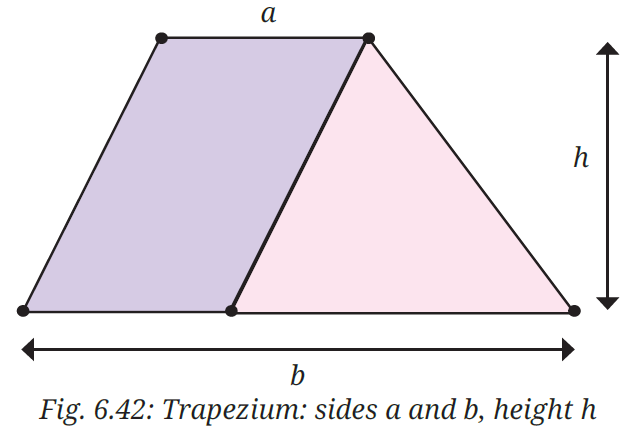
Answer:
Given:
A trapezium with parallel sides of lengths $a$ and $b$, and height $h$. From Fig. 6.42, the trapezium is divided into a parallelogram and a triangle.
To Show:
The area of the trapezium is $\frac{1}{2}(a + b)h$.
Solution:
From the figure, we can observe that the total base of the trapezium is $b$. It is composed of the base of the parallelogram and the base of the triangle.
Since the top side of the trapezium is $a$, the base of the parallelogram part is also $a$.
$\text{Base of the parallelogram} = a$
The remaining part of the bottom base belongs to the triangle. Therefore:
$\text{Base of the triangle} = b - a$
Both the parallelogram and the triangle share the same height $h$.
Now, we calculate the individual areas:
1. Area of the Parallelogram:
$Area_1 = \text{base} \times \text{height}$
$Area_1 = a \times h = ah$
2. Area of the Triangle:
$Area_2 = \frac{1}{2} \times \text{base} \times \text{height}$
$Area_2 = \frac{1}{2} \times (b - a) \times h$
Total Area of the Trapezium ($A$):
The total area is the sum of the areas of the parallelogram and the triangle.
$A = Area_1 + Area_2$
$A = ah + \frac{1}{2}(b - a)h$
Taking $h$ as common:
$A = h \left[ a + \frac{1}{2}(b - a) \right]$
Taking the LCM inside the brackets:
$A = h \left[ \frac{2a + b - a}{2} \right]$
$A = h \left[ \frac{a + b}{2} \right]$
$A = \frac{1}{2}(a + b)h$
Thus, it is proved that the area of a trapezium is half the sum of its parallel sides multiplied by the height.
Question 12. By dividing a trapezium into two triangles show that its area is, half the sum of the parallel sides multiplied by the height (the same formula as the one given above).
Answer:
Given:
A trapezium $ABCD$ with parallel sides $AB = a$ and $CD = b$, and height $h$.
To Prove:
$\text{Area of trapezium } ABCD = \frac{1}{2}(a + b)h$
Construction Required:
Join the diagonal $AC$. This divides the trapezium into two triangles: $\triangle ABC$ and $\triangle ADC$.
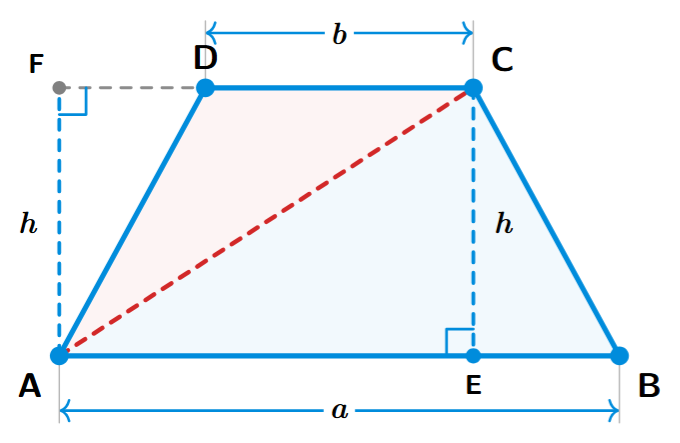
Proof:
The total area of the trapezium is the sum of the areas of the two triangles.
$Area(ABCD) = Area(\triangle ABC) + Area(\triangle ADC)$
For $\triangle ABC$, the base is $AB = a$ and the height (perpendicular distance from $C$ to $AB$) is $h$.
$Area(\triangle ABC) = \frac{1}{2} \times a \times h$
For $\triangle ADC$, the base is $CD = b$. The height (perpendicular distance from $A$ to the line containing $CD$) is also $h$, because $AB \parallel CD$.
$Area(\triangle ADC) = \frac{1}{2} \times b \times h$
Now, adding the areas:
$Area(ABCD) = \frac{1}{2}ah + \frac{1}{2}bh$
Factoring out $\frac{1}{2}$ and $h$:
$Area(ABCD) = \frac{1}{2}(a + b)h$
Hence Proved.
Question 13. Show how we can use two identical copies of a trapezium to make a parallelogram. How will this give us the formula for the area of a trapezium?
Answer:
Explanation:
Consider a trapezium with parallel sides $a$ and $b$ and height $h$. Take two identical (congruent) copies of this trapezium.
Invert the second copy and place it next to the first copy such that the side $b$ of the second copy is adjacent to side $a$ of the first copy, and side $a$ of the second copy is adjacent to side $b$ of the first copy.
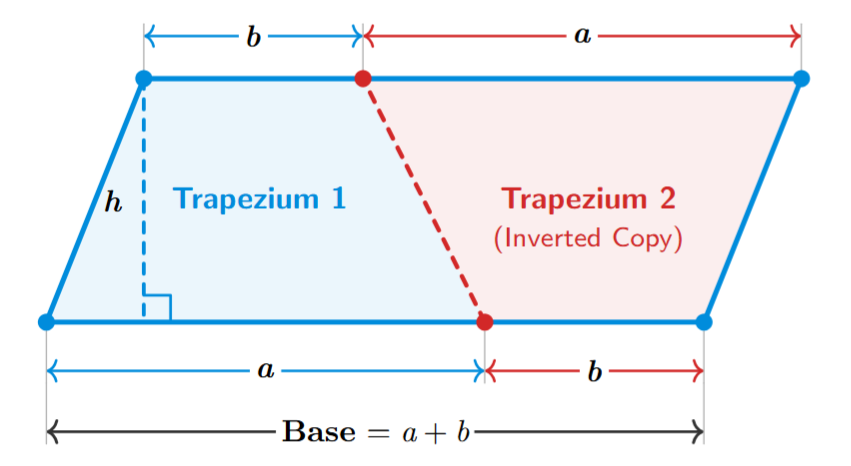
Analysis:
The resulting shape is a parallelogram. Let's analyze its dimensions:
1. The base of this new parallelogram is the sum of the two parallel sides of the original trapezium, which is $(a + b)$.
2. The height of the parallelogram remains the same as the height of the original trapezium, which is $h$.
We know that the area of a parallelogram is given by the formula:
$Area_{parallelogram} = \text{base} \times \text{height}$
$Area_{parallelogram} = (a + b) \times h$
Formula Derivation:
Since this parallelogram was made by using two identical copies of the trapezium, the area of one trapezium is exactly half of the area of the parallelogram.
$Area_{trapezium} = \frac{1}{2} \times Area_{parallelogram}$
$Area_{trapezium} = \frac{1}{2} (a + b) h$
This confirms the standard formula for the area of a trapezium.
Question 14. Show that the area of a kite is half the product of its diagonals. Show this: (i) using algebra, and (ii) using geometry.
Answer:
(i) Using Algebra:
Let the kite be $ABCD$. Let the diagonals be $AC = d_1$ and $BD = d_2$. The diagonals of a kite intersect each other at right angles ($90^\circ$).
The area of the kite is the sum of the areas of two triangles, $\triangle ABC$ and $\triangle ADC$.
$Area = Area(\triangle ABC) + Area(\triangle ADC)$
Both triangles have the same base $AC = d_1$. Let the heights of these triangles from the diagonal $BD$ be $h_1$ and $h_2$.
$Area = \frac{1}{2} \times d_1 \times h_1 + \frac{1}{2} \times d_1 \times h_2$
Factoring out $\frac{1}{2} d_1$:
$Area = \frac{1}{2} \times d_1 \times (h_1 + h_2)$
Since the sum of the heights $h_1 + h_2$ is equal to the total length of the other diagonal $BD = d_2$:
$Area = \frac{1}{2} \times d_1 \times d_2$
(ii) Using Geometry:
To show this geometrically, we can enclose the kite $ABCD$ within a rectangle whose sides pass through the vertices of the kite and are parallel to the diagonals.
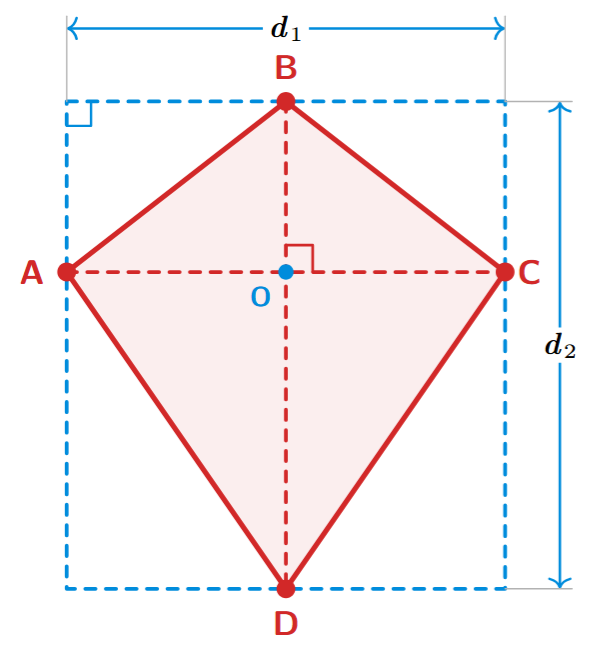
The length of the surrounding rectangle is equal to diagonal $d_1$ and its width is equal to diagonal $d_2$.
$Area\ of\ Rectangle = d_1 \times d_2$
As seen in the figure, the rectangle is divided into eight right-angled triangles. The kite is composed of four of these triangles, while the remaining four triangles (which are identical to the first four) lie outside the kite but inside the rectangle.
Therefore, the area of the kite is exactly half the area of the rectangle.
$Area\ of\ Kite = \frac{1}{2} (d_1 \times d_2)$
Question 15. Three problems about fitting congruent shapes together:
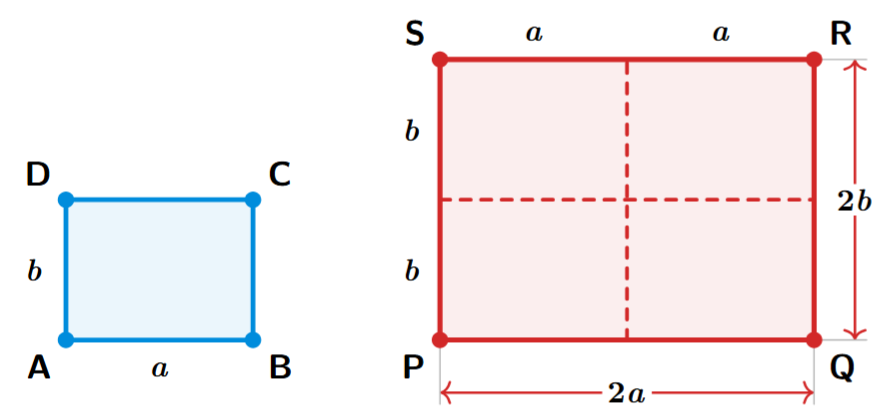
(i) Rectangle $ABCD$ has sides $a, b$, and rectangle $PQRS$ has sides $2a, 2b$. Show that $PQRS$ has $4$ times the area of $ABCD$. Does this mean that $4$ copies of rectangle $ABCD$ will fit into rectangle $PQRS$? Check and see!
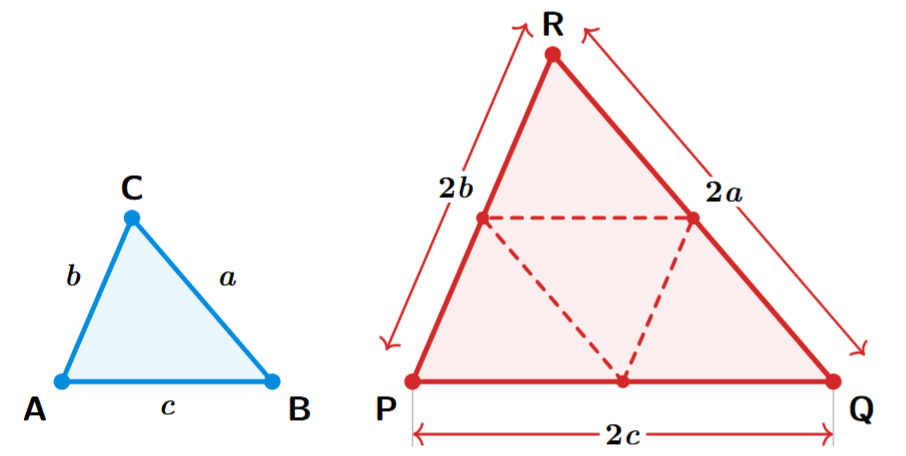
(ii) $\Delta ABC$ has sides $a, b, c$, and $\Delta PQR$ has sides $2a, 2b, 2c$. Show that $\Delta PQR$ has $4$ times the area of $\Delta ABC$. Does this mean that $4$ copies of $\Delta ABC$ will fit into $\Delta PQR$? Check and see!
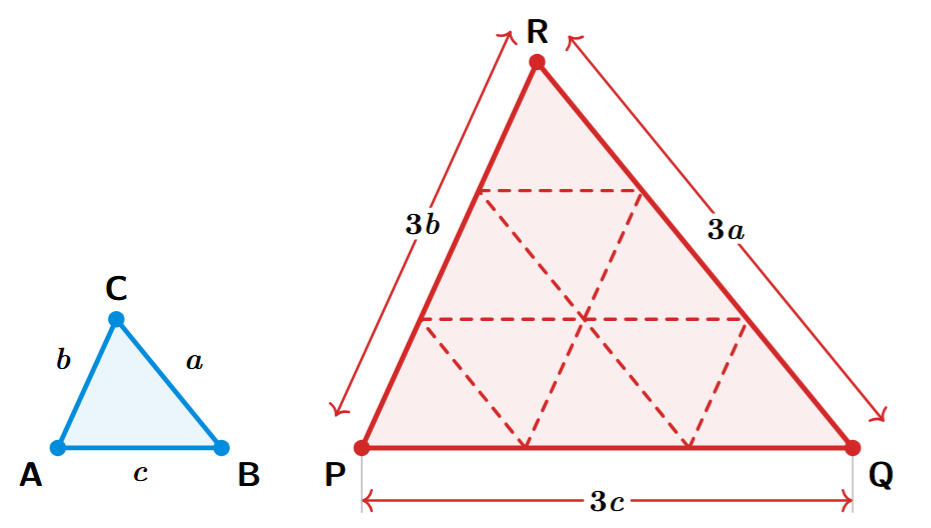
(iii) $\Delta ABC$ has sides $a, b, c$, and $\Delta PQR$ has sides $3a, 3b, 3c$. Show that $\Delta PQR$ has $9$ times the area of $\Delta ABC$. Does this mean that $9$ copies of $\Delta ABC$ will fit into $\Delta PQR$? Check and see!
Answer:
(i) Scaling Rectangles:
For rectangle $ABCD$:
$Area_1 = a \times b = ab$
For rectangle $PQRS$:
$Area_2 = 2a \times 2b = 4ab$
Clearly, $Area_2 = 4 \times Area_1$.
Verification: We can fit exactly 4 copies of $ABCD$ into $PQRS$ by arranging them in a $2 \times 2$ grid.
(ii) Scaling Triangles (Scale Factor 2):
If the sides are doubled ($2a, 2b, 2c$), the area becomes $2^2 = 4$ times the original area.
$Area(PQR) = 4 \times Area(ABC)$
Verification: By joining the midpoints of the sides of the larger triangle $\Delta PQR$, we divide it into four congruent triangles, each of which is identical to $\Delta ABC$.
(iii) Scaling Triangles (Scale Factor 3):
If the sides are tripled ($3a, 3b, 3c$), the area becomes $3^2 = 9$ times the original area.
$Area(PQR) = 9 \times Area(ABC)$
Verification: By dividing each side into three equal parts and drawing lines parallel to the sides, the larger triangle can be tiled with 9 copies of the smaller triangle $\Delta ABC$.
Conclusion: In general, if the linear dimensions of a shape are scaled by a factor $k$, its area is scaled by $k^2$.
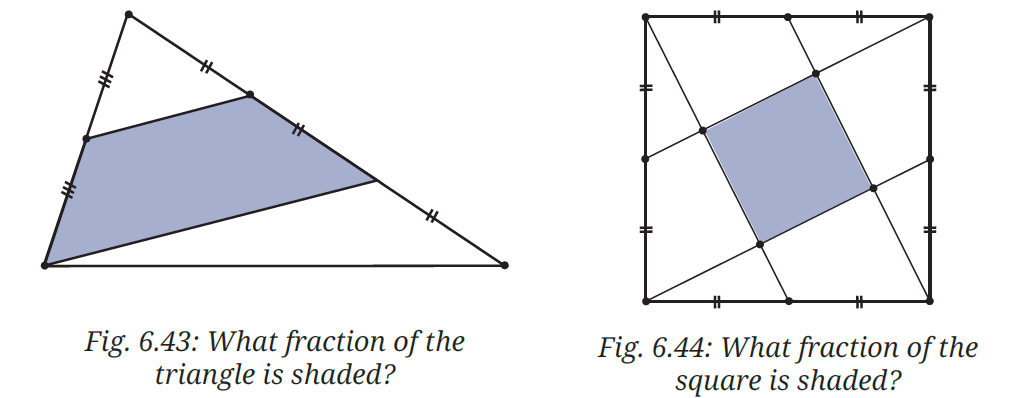
Question 16. What fraction of the triangle is shaded (Fig. 6.43)? What fraction of the square is shaded (Fig. 6.44)?
Answer:
(i) Analysis of Fig. 6.43 (Triangle):
Let the vertices of the triangle be $A$ (top), $B$ (bottom-left), and $C$ (bottom-right). Let the total area of $\triangle ABC$ be $1$ unit.
From the figure, the left side $AB$ is divided at its midpoint $M$. The right side $AC$ is trisected at points $E$ and $F$ (where $AE = EF = FC = \frac{1}{3} AC$). The shaded region is the quadrilateral $BMFE$.
Solution using a Median:
Step 1: Draw the median $CM$ from vertex $C$ to the midpoint $M$.
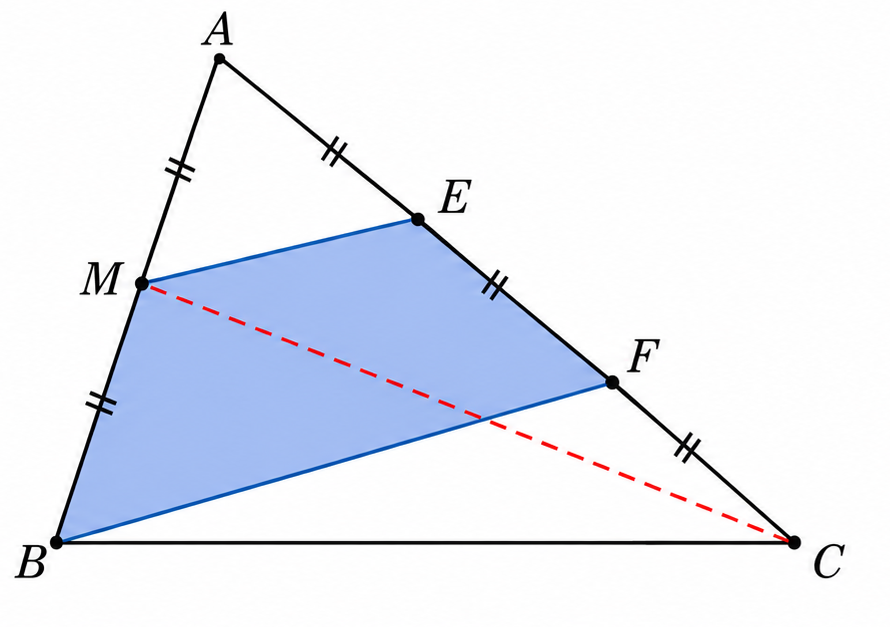
We know that a median divides the triangle into two equal areas.
$\text{Area } (\triangle AMC) = \text{Area } (\triangle BMC) = \frac{1}{2}$
Step 2: In $\triangle AMC$, the side $AC$ is trisected by $E$ and $F$. Since $\triangle AME, \triangle MEF,$ and $\triangle MFC$ share the same vertex $M$ and have equal bases on the line $AC$, their areas are equal.
$\text{Area } (\triangle AME) = \text{Area } (\triangle MEF) = \text{Area } (\triangle MFC) = \frac{1}{3} \times \frac{1}{2} = \frac{1}{6}$
Step 3: The shaded area $BMFE$ consists of $\triangle BMC$ and $\triangle MEF$. However, observing the shading in Fig. 6.43, the shaded part is bounded by $B, M, E$ and $F$.
$\text{Shaded Area} = \text{Area } (\triangle ABF) - \text{Area } (\triangle AME)$
$\text{Area } (\triangle ABF) = \frac{2}{3} \times \text{Area } (\triangle ABC) = \frac{2}{3}$
$\text{Shaded Area} = \frac{2}{3} - \frac{1}{6} = \frac{4-1}{6} = \frac{3}{6} = \frac{1}{2}$
Therefore, $\frac{1}{2}$ of the triangle is shaded.
(ii) Analysis of Fig. 6.44 (Square):
In this figure, each side of the square is trisected. Lines are drawn from each vertex to the first trisection point on the opposite side in a clockwise manner.
Solution using a Grid:
To find the shaded fraction, we can superimpose a specific grid on the square. By extending the lines and drawing parallel segments through all trisection points, we can dissect the square into congruent shapes.
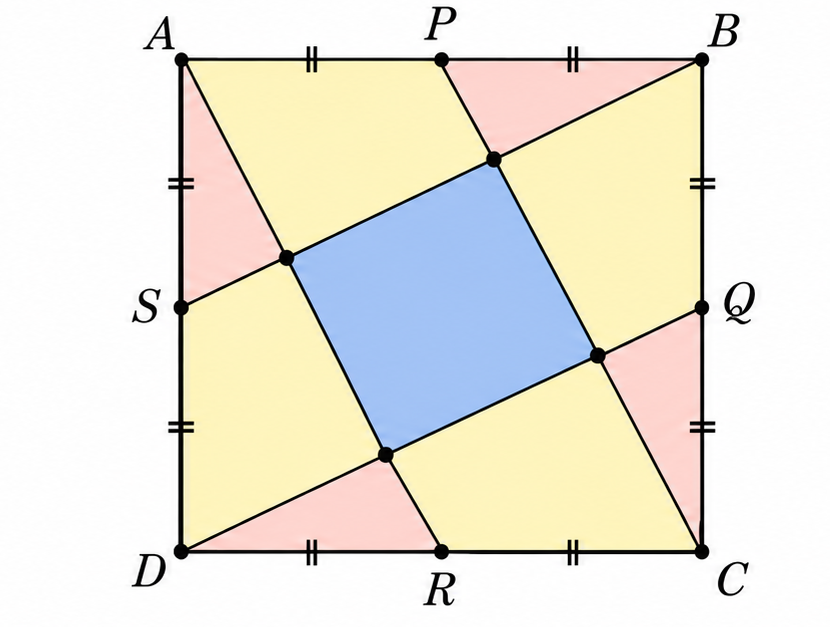
Through this geometric dissection, it can be shown that the central shaded square can be surrounded by 4 other regions of exactly the same area. These regions are composed of the right-angled triangles and trapezoids seen in the figure. When rearranged, they form 5 identical squares.
$\text{Total Area} = 5 \times \text{Area of shaded square}$
$\text{Shaded Fraction} = \frac{1}{5}$
Therefore, $\frac{1}{5}$ of the square is shaded.
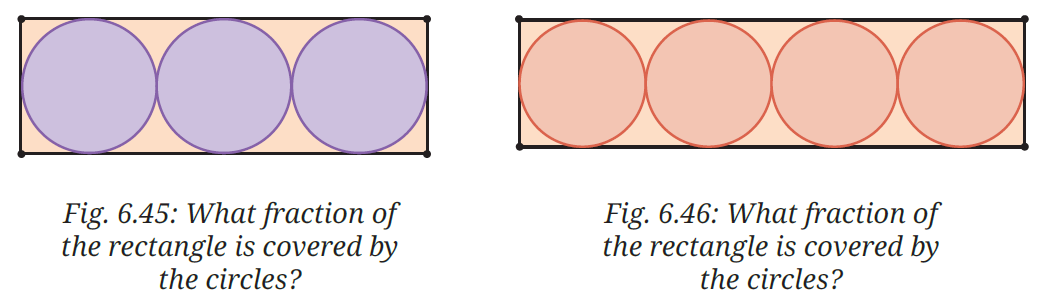
Question 17. What fraction of the rectangle is covered by the circles (Fig. 6.45 and Fig. 6.46)?
Answer:
Analysis of Fig. 6.45 (3 Circles):
Let the diameter of each circle be $d$. The radius is $r = \frac{d}{2}$.
Step 1: Dimensions of the rectangle.
The height of the rectangle is equal to one diameter ($d$).
The length of the rectangle is equal to three diameters ($3d$).
$Area_{rectangle} = d \times 3d = 3d^2$
Step 2: Area of the circles.
$Area_{3\ circles} = 3 \times \pi r^2 = 3 \times \pi \left( \frac{d}{2} \right)^2 = \frac{3\pi d^2}{4}$
Step 3: Calculate the fraction covered.
$Fraction = \frac{Area_{circles}}{Area_{rectangle}} = \frac{3\pi d^2 / 4}{3d^2} = \frac{\pi}{4}$
Analysis of Fig. 6.46 (4 Circles):
Using the same logic for $n = 4$ circles:
Length of rectangle $= 4d$; Height $= d$. $Area_{rectangle} = 4d^2$.
$Area_{4\ circles} = 4 \times \frac{\pi d^2}{4} = \pi d^2$
$Fraction = \frac{\pi d^2}{4d^2} = \frac{\pi}{4}$
Conclusion:
In both cases, the fraction covered is $\frac{\pi}{4}$.
$Fraction = \frac{22}{7 \times 4} = \frac{11}{14}$
As a decimal, this is approximately 0.785 or 78.5%.
Question 18. Use the above to make a conjecture about the area occupied by circles fitted into a rectangle in the manner shown. Test your conjecture for particular cases: $10$ circles; $20$ circles; $50$ circles. Then prove your conjecture!
Answer:
Conjecture:
The fraction of the area of a rectangle covered by $n$ identical circles fitted in a single row (where each circle is tangent to the sides of the rectangle and to the adjacent circles) is constant and equal to $\frac{\pi}{4}$, regardless of the number of circles $n$.
Testing the Conjecture:
Let the radius of each circle be $r$. Then the diameter of each circle is $d = 2r$.
For $n$ circles arranged in a row, the height of the rectangle is $d$ and the length is $nd$.
$\text{Area of Rectangle} = \text{Length} \times \text{Height} = (nd) \times d = nd^2$
$\text{Area of } n \text{ Circles} = n \times \pi r^2 = n \times \pi \left(\frac{d}{2}\right)^2 = \frac{n\pi d^2}{4}$
Case 1: $10$ circles ($n = 10$)
$\text{Fraction} = \frac{\frac{10\pi d^2}{4}}{10d^2} = \frac{\pi}{4}$
Case 2: $20$ circles ($n = 20$)
$\text{Fraction} = \frac{\frac{20\pi d^2}{4}}{20d^2} = \frac{\pi}{4}$
Case 3: $50$ circles ($n = 50$)
$\text{Fraction} = \frac{\frac{50\pi d^2}{4}}{50d^2} = \frac{\pi}{4}$
In all test cases, the fraction remains $\frac{\pi}{4}$.
Proof of the Conjecture:
Let $n$ be any positive integer representing the number of identical circles.
Let $r$ be the radius of each circle. Therefore, the diameter $d = 2r$.
When these circles are fitted into a rectangle in a single row:
1. The height of the rectangle ($H$) must be equal to the diameter of a circle.
$H = d$
2. The length of the rectangle ($L$) must be equal to the sum of the diameters of the $n$ circles.
$L = n \times d$
Now, we calculate the Area of the Rectangle ($A_R$):
$A_R = L \times H = (nd) \times d = nd^2$
Next, we calculate the total Area of the $n$ Circles ($A_C$):
$Area\ of\ one\ circle = \pi r^2 = \pi \left(\frac{d}{2}\right)^2 = \frac{\pi d^2}{4}$
$A_C = n \times \frac{\pi d^2}{4}$
The fraction of the rectangle covered by the circles is given by the ratio $\frac{A_C}{A_R}$:
$\text{Fraction} = \frac{\frac{n\pi d^2}{4}}{nd^2}$
Cancelling the common terms $n$ and $d^2$ from the numerator and the denominator:
$\text{Fraction} = \frac{\cancel{n}\pi \cancel{d^2}}{4 \times \cancel{n} \cancel{d^2}}$
$\text{Fraction} = \frac{\pi}{4}$
Using the Indian perspective approximation $\pi \approx \frac{22}{7}$:
$\text{Fraction} \approx \frac{22}{7 \times 4} = \frac{11}{14} \approx 0.7857$
Conclusion: The fraction of the area covered is always $\frac{\pi}{4}$, which is independent of the number of circles $n$.
Question 19. The figure shows nine identical rectangles fitted together to make a large rectangle whose area is $72\text{ cm}^2$. Find the perimeter of each small rectangle.
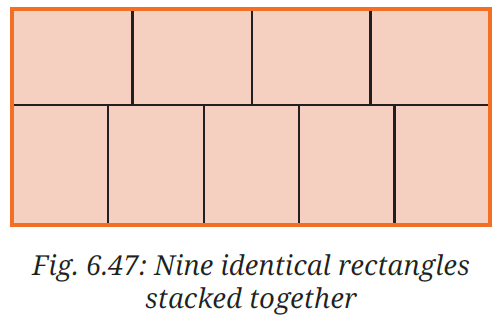
Answer:
Given:
1. Total area of the large rectangle $= 72\text{ cm}^2$.
2. Number of identical small rectangles $= 9$.
3. Arrangement: The top row has 4 rectangles and the bottom row has 5 rectangles.
To Find:
The perimeter of each small rectangle.
Solution:
First, we find the area of one small rectangle.
$\text{Area of one small rectangle} = \frac{\text{Total Area}}{\text{Number of rectangles}}$
$\text{Area} = \frac{72}{9} = 8\text{ cm}^2$
Let the length of each small rectangle be $L$ and the width be $W$.
$L \times W = 8$
... (i)
From Fig. 6.47, we can see that the total width of the large rectangle is the same for both rows.
In the top row, 4 rectangles are placed with their longer sides (lengths) horizontally. In the bottom row, 5 rectangles are placed with their shorter sides (widths) horizontally.
$4 \times L = 5 \times W$
$L = \frac{5}{4}W = 1.25W$
... (ii)
Now, substitute the value of $L$ from equation (ii) into equation (i):
$(1.25W) \times W = 8$
$1.25W^2 = 8$
$W^2 = \frac{8}{1.25} = 6.4$
$W = \sqrt{6.4} = \sqrt{\frac{64}{10}} = \frac{8}{\sqrt{10}}\text{ cm}$
Now, find the length $L$ using equation (ii):
$L = 1.25 \times \frac{8}{\sqrt{10}} = \frac{10}{\sqrt{10}} = \sqrt{10}\text{ cm}$
The perimeter of each small rectangle is given by $2(L + W)$:
$Perimeter = 2\left(\sqrt{10} + \frac{8}{\sqrt{10}}\right)$
$Perimeter = 2\left(\frac{10 + 8}{\sqrt{10}}\right) = \frac{36}{\sqrt{10}}\text{ cm}$
Rationalizing the denominator:
$Perimeter = \frac{36\sqrt{10}}{10} = 3.6\sqrt{10}\text{ cm}$
Using $\sqrt{10} \approx 3.162$:
$Perimeter \approx 3.6 \times 3.162 \approx 11.38\text{ cm}$
Therefore, the perimeter of each small rectangle is approximately $11.38\text{ cm}$.
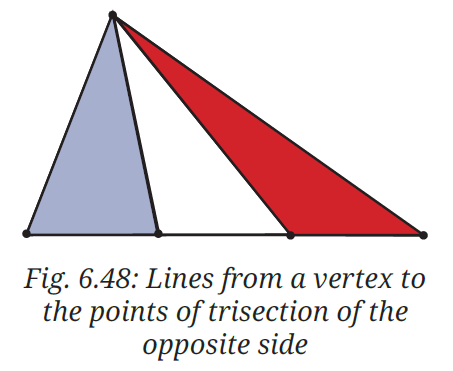
Question 20. Show that the areas of the shaded blue triangle and the shaded red triangle are equal. Find a way of cutting up the blue triangle into some number of pieces and rearranging the pieces to cover the red triangle.
Answer:
Given:
A triangle where the base is divided into three equal parts (trisection). A blue triangle is formed on the first segment and a red triangle is formed on the third segment, both sharing the same top vertex.
To Prove:
$\text{Area of blue triangle} = \text{Area of red triangle}$
Proof:
Let the total base of the large triangle be $B$ and the perpendicular height from the top vertex to the base be $H$.
Since the base is trisected, the base length of each of the three smaller triangles is:
$b = \frac{B}{3}$
We know that the area of a triangle is given by:
$Area = \frac{1}{2} \times \text{base} \times \text{height}$
For the blue triangle:
$Area_{blue} = \frac{1}{2} \times \left(\frac{B}{3}\right) \times H = \frac{BH}{6}$
For the red triangle:
$Area_{red} = \frac{1}{2} \times \left(\frac{B}{3}\right) \times H = \frac{BH}{6}$
Since both formulas yield the same result, the areas of the blue and red triangles are equal.
Rearrangement Method:
To cover the red triangle using pieces of the blue triangle:
1. Cut the blue triangle horizontally through the midpoints of its two non-base sides. This divides it into a smaller triangle and a trapezoid.
2. Rotate and shift the top triangle piece to the side of the trapezoid. This transforms the triangle into a parallelogram with base $\frac{B}{3}$ and height $\frac{H}{2}$.
3. Because the red triangle has the same base and height, it can also be transformed into an identical parallelogram. By dissecting the blue triangle's parallelogram into specific strips, they can be rearranged to form the shape of the red triangle.
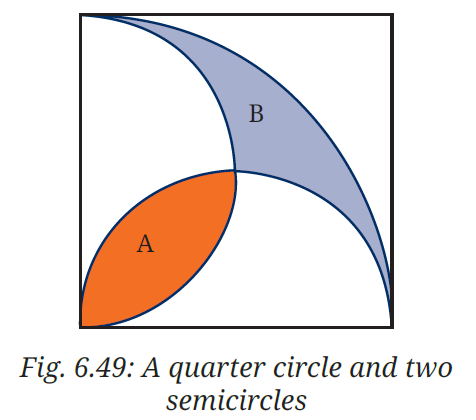
Question 21. The figure shows a quarter circle in a square. Its centre is at one vertex, and it passes through two adjacent vertices. There are two semicircles on two adjacent sides as diameters. They create the shaded regions $A$ and $B$. Show that $A$ and $B$ have equal area.
Answer:
Given:
1. A square of side length $s$.
2. A quarter circle with radius $s$, centered at a vertex.
3. Two semicircles with diameter $s$ (radius $r = \frac{s}{2}$) drawn on two adjacent sides.
4. Region $A$ is the intersection of the two semicircles.
5. Region $B$ is the part of the quarter circle that lies outside the union of the two semicircles.
To Prove:
Area of region $A$ = Area of region $B$.
Solution:
Let the side of the square be $s$. The area of the square is $s^2$.
Step 1: Calculate the Area of Region $A$.
Region $A$ is the overlap of two semicircles. This overlap is equivalent to a "leaf" shape within a smaller square of side $\frac{s}{2}$.
$Area(A) = 2 \times (\text{Area of quadrant of radius } \frac{s}{2}) - \text{Area of square of side } \frac{s}{2}$
$Area(A) = 2 \times \left( \frac{1}{4} \pi \left(\frac{s}{2}\right)^2 \right) $$ - \left(\frac{s}{2}\right)^2$
$Area(A) = \frac{\pi s^2}{8} - \frac{s^2}{4}$
... (i)
Step 2: Calculate the Area of the Union of the two semicircles.
$Union = Area(\text{Semicircle 1}) + Area(\text{Semicircle 2}) - Area(A)$
The area of one semicircle is $\frac{1}{2} \pi (\frac{s}{2})^2 = \frac{\pi s^2}{8}$.
$Union = \frac{\pi s^2}{8} + \frac{\pi s^2}{8} - \left( \frac{\pi s^2}{8} - \frac{s^2}{4} \right)$
$Union = \frac{\pi s^2}{8} + \frac{s^2}{4}$
Step 3: Calculate the Area of Region $B$.
Region $B$ is the area of the large quarter circle (radius $s$) minus the union of the two semicircles.
$Area(B) = Area(\text{Quarter circle of radius } s) - Area(Union)$
$Area(B) = \frac{1}{4} \pi s^2 - \left( \frac{\pi s^2}{8} + \frac{s^2}{4} \right)$
$Area(B) = \frac{2\pi s^2}{8} - \frac{\pi s^2}{8} - \frac{s^2}{4}$
$Area(B) = \frac{\pi s^2}{8} - \frac{s^2}{4}$
... (ii)
Comparing equations (i) and (ii), we see that the expressions for the areas of $A$ and $B$ are identical.
Hence, Area($A$) = Area($B$).
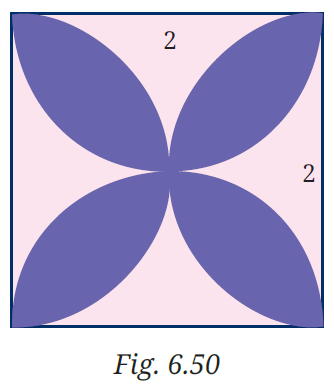
Question 22. In Fig. 6.50, four semicircles have been drawn within the given square whose side is $2$ units. The centres of these semicircles are the midpoints of the sides. They create a $4$-petalled flower (shown in blue). Find the perimeter and the area of this flower.
Answer:
Given:
1. A square with side $= 2\text{ units}$.
2. Four semicircles with diameters on the square's sides. The radius of each semicircle is $r = 1\text{ unit}$.
To Find:
1. Perimeter of the flower.
2. Area of the flower.
Solution:
1. Finding the Perimeter:
The boundary of the 4-petalled flower consists of 8 arcs. Each of these arcs is a quarter circle with a radius of $1\text{ unit}$ (since the centers are the midpoints of the sides).
$Perimeter = 8 \times (\text{Length of a quarter-circle arc})$
$Perimeter = 8 \times \left( \frac{1}{4} \times 2 \pi r \right) = 4 \pi r$
Using $\pi = \frac{22}{7}$ and $r = 1$:
$Perimeter = 4 \times \frac{22}{7} \times 1 = \frac{88}{7} \approx 12.57\text{ units}$
2. Finding the Area:
The area of the flower can be found by taking the sum of the areas of the 4 semicircles and subtracting the area of the square. This is because the overlapping parts (the flower petals) are counted multiple times while the whole square is covered.
$Area(Flower) = 4 \times Area(\text{Semicircle}) - Area(\text{Square})$
$Area(Flower) = 4 \times \left( \frac{1}{2} \pi r^2 \right) - (side)^2$
Substituting $r = 1$ and side $= 2$:
$Area(Flower) = 2 \pi (1)^2 - (2)^2$
$Area(Flower) = 2 \pi - 4$
Using $\pi = \frac{22}{7}$:
$Area = 2 \times \frac{22}{7} - 4 = \frac{44}{7} - 4$
$Area = \frac{44 - 28}{7} = \frac{16}{7} \approx 2.29\text{ sq units}$
Therefore, the perimeter of the flower is $12.57\text{ units}$ and the area is $2.29\text{ sq units}$.
Question 23. In Fig. 6.51 we see two concentric circles with a common centre $O$. A chord $BC$ of the larger circle is drawn, touching the smaller circle at $A$. The length of $BC$ is $l$. Show that the area of the green region enclosed between the two circles is $\frac{1}{4}\pi l^2$.
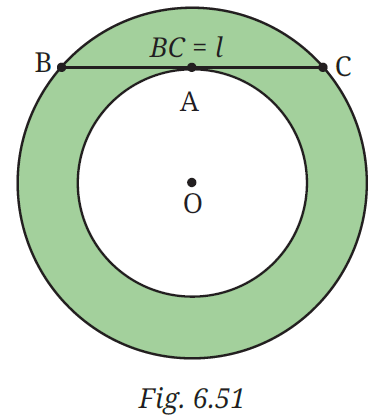
Answer:
Given:
Two concentric circles with centre $O$. A chord $BC$ of the larger circle has length $l$ and is tangent to the smaller circle at point $A$.
To Prove:
Area of the green region $= \frac{1}{4}\pi l^2$
Construction Required:
Join $OA$ and $OB$. Let the radius of the outer circle be $R$ ($OB = R$) and the radius of the inner circle be $r$ ($OA = r$).
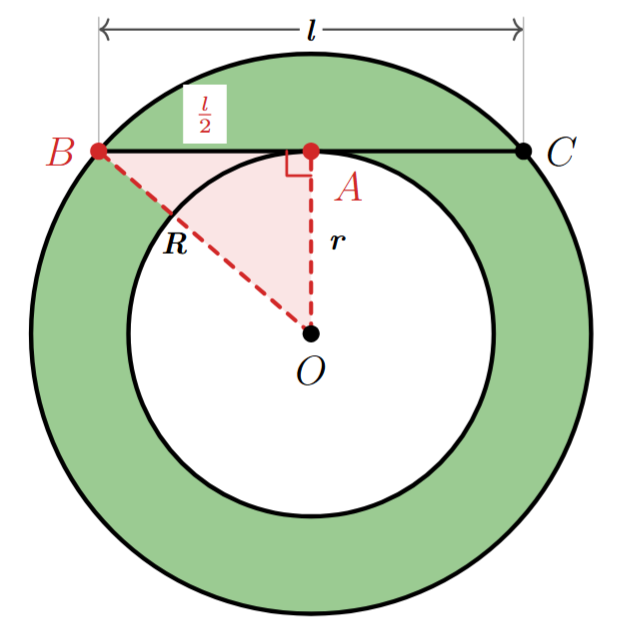
Proof:
Since $BC$ is a tangent to the inner circle at $A$ and $OA$ is the radius through the point of contact:
$OA \perp BC$
(Radius is perpendicular to the tangent)
In the outer circle, $OA$ is perpendicular to the chord $BC$. We know that the perpendicular from the centre to a chord bisects the chord.
$AB = AC = \frac{1}{2} BC = \frac{l}{2}$
Now, in the right-angled triangle $\triangle OAB$, by Pythagoras theorem:
$OB^2 = OA^2 + AB^2$
$R^2 = r^2 + \left( \frac{l}{2} \right)^2$
$R^2 - r^2 = \frac{l^2}{4}$
... (i)
The area of the green region (annulus) is the area of the outer circle minus the area of the inner circle.
$\text{Area} = \pi R^2 - \pi r^2$
$\text{Area} = \pi (R^2 - r^2)$
Substituting the value of $(R^2 - r^2)$ from equation (i):
$\text{Area} = \pi \left( \frac{l^2}{4} \right)$
$\text{Area} = \frac{1}{4} \pi l^2$
Hence Proved.
Question 24. In Fig. 6.52, semicircles have been drawn on all the sides of a right-angled triangle as shown. Show that $\text{Area } (A) + \text{Area } (B) = \text{Area } (C)$.
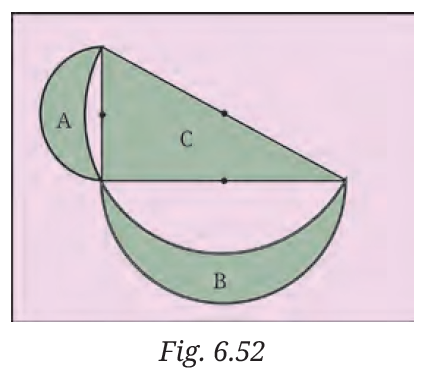
Answer:
Given:
A right-angled triangle with sides $x$ and $y$ (legs) and side $z$ (hypotenuse). Semicircles $A, B,$ and $C$ are drawn on these sides respectively.
To Prove:
$\text{Area } (A) + \text{Area } (B) = \text{Area } (C)$
Proof:
Let the lengths of the sides of the triangle be $x, y,$ and $z$. According to the Pythagoras theorem:
$x^2 + y^2 = z^2$
... (i)
The area of a semicircle with diameter $d$ is given by $\frac{1}{2} \pi \left(\frac{d}{2}\right)^2 = \frac{\pi d^2}{8}$.
Calculate the area of each semicircle:
$\text{Area } (A) = \frac{\pi x^2}{8}$
$\text{Area } (B) = \frac{\pi y^2}{8}$
$\text{Area } (C) = \frac{\pi z^2}{8}$
Now, consider the sum of areas $A$ and $B$:
$\text{Area } (A) + \text{Area } (B) = \frac{\pi x^2}{8} + \frac{\pi y^2}{8}$
Taking $\frac{\pi}{8}$ as common:
$\text{Area } (A) + \text{Area } (B) = \frac{\pi}{8} (x^2 + y^2)$
Substituting $x^2 + y^2 = z^2$ from equation (i):
$\text{Area } (A) + \text{Area } (B) = \frac{\pi z^2}{8}$
Since $\frac{\pi z^2}{8} = \text{Area } (C)$, we have:
$\text{Area } (A) + \text{Area } (B) = \text{Area } (C)$
Hence Proved.
Question 25. Fig. 6.53 shows two circles passing through each other’s centres. Find the area of the region enclosed by the two circles in terms of the common radius $r$.
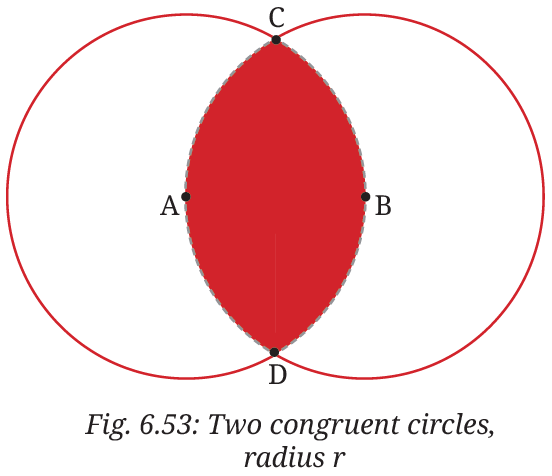
Answer:
Given:
Two congruent circles with radius $r$. Each circle passes through the centre of the other circle. Let the centres be $A$ and $B$, and the intersection points be $C$ and $D$.
To Find:
The area of the shaded region (enclosed by both circles).
Construction Required:
Join $AC, AD, BC, BD,$ and $AB$.
Solution:
In the figure, $AB = r$ (distance between centres). Since $C$ lies on both circles:
$AC = BC = AB = r$
(Radii of congruent circles)
Therefore, $\triangle ABC$ is an equilateral triangle. Similarly, $\triangle ABD$ is also an equilateral triangle.
$\angle CAB = 60^\circ$ and $\angle DAB = 60^\circ$
$\angle CAD = 60^\circ + 60^\circ = 120^\circ$
The shaded area is composed of two circular segments (one from each circle) or can be calculated as the sum of two sectors minus the area of the rhombus $ACBD$.
Step 1: Area of sector $CAD$ in circle $B$:
$Area_{sector} = \frac{120^\circ}{360^\circ} \times \pi r^2 = \frac{1}{3} \pi r^2$
Step 2: Area of rhombus $ACBD$:
The rhombus consists of two equilateral triangles $\triangle ABC$ and $\triangle ABD$.
$Area_{rhombus} = 2 \times \left( \frac{\sqrt{3}}{4} r^2 \right) = \frac{\sqrt{3}}{2} r^2$
Step 3: Total enclosed area:
The total area is twice the area of a circular segment, which is $2 \times (Area_{sector} - Area_{\triangle CAD})$.
$Area = 2 \times \left( \frac{1}{3} \pi r^2 - \frac{\sqrt{3}}{4} r^2 \right)$
$Area = \left( \frac{2\pi}{3} - \frac{\sqrt{3}}{2} \right) r^2$
Using $\pi \approx \frac{22}{7}$ and $\sqrt{3} \approx 1.732$:
$Area \approx (2.094 - 0.866) r^2 \approx 1.228 r^2$
The exact area in terms of $r$ is $\left( \frac{2\pi}{3} - \frac{\sqrt{3}}{2} \right) r^2$.
Question 26. In Fig. 6.54, we see three triangles within a rectangle. The areas of the triangles are $A, B, C$, as marked. Show that the area of the rectangle is $\frac{2(A+C)(B+C)}{C}$.
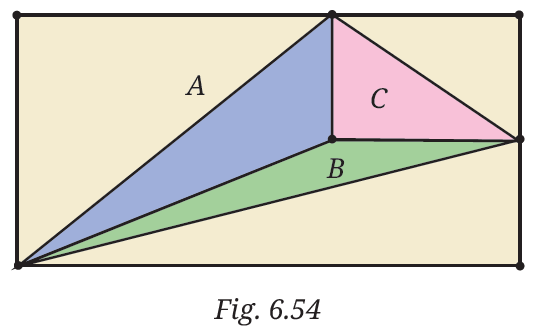
Answer:
Given:
A rectangle containing three triangles with areas $A$ (blue), $B$ (green), and $C$ (pink).
To Prove:
$\text{Area of Rectangle} = \frac{2(A+C)(B+C)}{C}$
Construction and Labeling:
Let the common vertex where the three triangles meet be $O$. Based on the provided figure:
1. Let the horizontal side of triangle $C$ be $b$ and its vertical side be $c$. Thus, its area is $C = \frac{1}{2} bc$.
2. Let the horizontal distance from the left edge of the rectangle to point $O$ be $a$. Triangle $A$ has base $c$ and altitude $a$. Thus, its area is $A = \frac{1}{2} ac$.
3. Let the vertical distance from the bottom edge of the rectangle to point $O$ be $d$. Triangle $B$ has base $b$ and altitude $d$. Thus, its area is $B = \frac{1}{2} bd$.
4. The total width of the rectangle is $(a + b)$ and the total height is $(c + d)$.
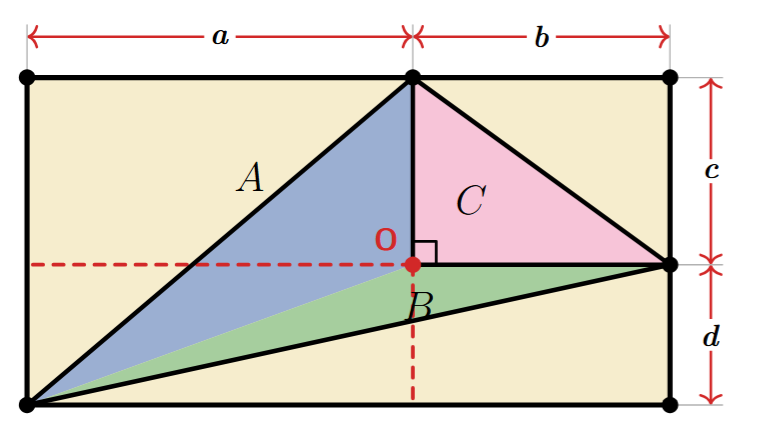
Proof:
From the given area formulas, we can write the following expressions:
$ac = 2A$
... (i)
$bd = 2B$
... (ii)
$bc = 2C$
... (iii)
The total area of the rectangle is given by the product of its length and height:
$\text{Area} = (a + b)(c + d)$
$\text{Area} = ac + ad + bc + bd$
Substituting values from (i), (ii), and (iii):
$\text{Area} = 2A + ad + 2C + 2B$
... (iv)
We need to find $ad$ in terms of $A, B,$ and $C$. From (i) and (ii), we know $a = \frac{2A}{c}$ and $d = \frac{2B}{b}$. Multiplying these gives:
$ad = \left( \frac{2A}{c} \right) \left( \frac{2B}{b} \right) = \frac{4AB}{bc}$
Using the value of $bc$ from (iii):
$ad = \frac{4AB}{2C} = \frac{2AB}{C}$
Now, substitute this value of $ad$ into equation (iv):
$\text{Area} = 2A + \frac{2AB}{C} + 2C + 2B$
Taking $2$ as common and arranging terms over the denominator $C$:
$\text{Area} = 2 \left( \frac{AC + AB + C^2 + BC}{C} \right)$
Now, let's factor the numerator:
$AB + AC + BC + C^2 = A(B + C) + C(B + C)$
$AB + AC + BC + C^2 = (A + C)(B + C)$
Substituting this back into the area expression:
$\text{Area of Rectangle} = \frac{2(A+C)(B+C)}{C}$
Hence Proved.
Question 27. In Fig. 6.55, we see two shaded regions formed by a quarter circle, a semicircle, and a triangle. Show that the areas of the two shaded regions are equal.
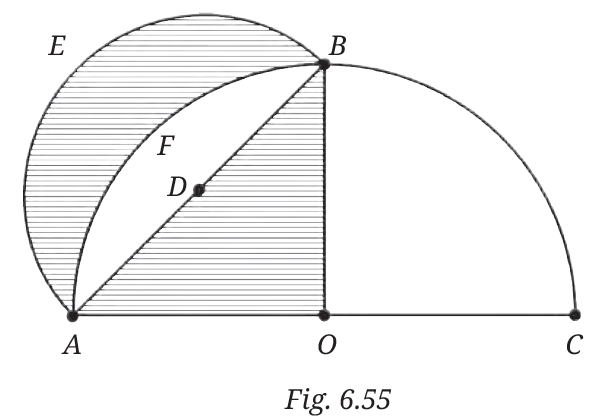
Answer:
Given:
1. A quarter circle $OAB$ with centre $O$ and radius $OA = OB = r$.
2. A triangle $\triangle AOB$ which is right-angled at $O$.
3. A semicircle with chord $AB$ as its diameter.
4. Shaded regions: The crescent (lune) labeled $E$ and the triangle $\triangle AOB$.
To Prove:
Area of shaded crescent $E$ = Area of shaded triangle $\triangle AOB$.
Proof:
Let the radius of the larger circle be $OA = OB = r$.
Step 1: Calculate the Area of the shaded triangle $\triangle AOB$
$\text{Area } (\triangle AOB) = \frac{1}{2} \times \text{base} \times \text{height}$
$\text{Area } (\triangle AOB) = \frac{1}{2} \times r \times r = \frac{1}{2} r^2$
... (i)
Step 2: Calculate the diameter of the semicircle ($AB$)
In the right-angled triangle $\triangle AOB$, using Pythagoras Theorem:
$AB^2 = OA^2 + OB^2$
$AB^2 = r^2 + r^2 = 2r^2$
$AB = \sqrt{2r^2} = r\sqrt{2}$
[Diameter of the semicircle] ... (ii)
Step 3: Calculate the Area of the semicircle
The radius of the semicircle is half of the diameter $AB$.
$Radius_{semi} = \frac{r\sqrt{2}}{2} = \frac{r}{\sqrt{2}}$
$\text{Area of semicircle} = \frac{1}{2} \pi (Radius_{semi})^2$
$\text{Area of semicircle} = \frac{1}{2} \pi \left(\frac{r}{\sqrt{2}}\right)^2 = \frac{1}{2} \pi \frac{r^2}{2}$
$\text{Area of semicircle} = \frac{1}{4} \pi r^2$
... (iii)
Step 4: Calculate the Area of the circular segment $AFB$
The circular segment $AFB$ is the unshaded part between the chord $AB$ and the arc of the quarter circle.
$\text{Area } (AFB) = \text{Area of quarter circle } OAB - \text{Area of } \triangle AOB$
$\text{Area } (AFB) = \frac{1}{4} \pi r^2 - \frac{1}{2} r^2$
... (iv)
Step 5: Calculate the Area of the shaded crescent $E$
The shaded region $E$ is obtained by subtracting the area of segment $AFB$ from the area of the semicircle.
$\text{Area } (E) = \text{Area of semicircle} - \text{Area } (AFB)$
Using values from equation (iii) and equation (iv):
$\text{Area } (E) = \frac{1}{4} \pi r^2 - \left( \frac{1}{4} \pi r^2 - \frac{1}{2} r^2 \right)$
$\text{Area } (E) = \frac{1}{4} \pi r^2 - \frac{1}{4} \pi r^2 + \frac{1}{2} r^2$
$\text{Area } (E) = \frac{1}{2} r^2$
... (v)
Conclusion:
Comparing equation (i) and equation (v):
Area of shaded crescent $E$ = $\frac{1}{2} r^2$
Area of shaded triangle $\triangle AOB$ = $\frac{1}{2} r^2$
Therefore, the areas of the two shaded regions are exactly equal.
Hence Proved.