

Chapter 8 Predicting What Comes Next: Exploring Sequences and Progressions (Class 9 - Latest Maths NCERT (Ganita Manjari I) Solutions)
Searching for accurate and easy-to-follow NCERT Solutions for Chapter 8: Predicting What Comes Next? You’ve come to the right place! This page provides comprehensive, step-by-step answers for the latest Class 9 Maths curriculum, helping you master the art of pattern recognition. We provide detailed explanations for creating Explicit Rules to find any term in an infinite sequence and Recursive Rules to understand how sequences grow, ensuring you can decode the mathematical rhythms found in nature, music, and finance.
Our solutions offer in-depth walkthroughs for the two pillar structures of the Ganita Manjari I textbook: Arithmetic Progressions (AP) and Geometric Progressions (GP). We provide clear derivations for the $n^{th}$ term formulas ($t_n = a + (n-1)d$ and $t_n = ar^{n-1}$) and explore the historical contributions of Indian mathematicians like Virahāṅka and Āryabhaṭa. You will also find solved examples for calculating the sum of the first $n$ natural numbers, connecting simple addition to the geometric beauty of Triangular Numbers.
To help you visualize these mathematical journeys, this page includes linear and exponential graphs, step-by-step formula applications, and analyses of fractal patterns like the Sierpiński Triangle. Whether you are solving for common differences or common ratios, our resources from learningspot.co are designed to help you verify your work and build the predictive power needed for your Class 9 CBSE assessments. Master the logic of progressions and excel in your exams with our expert-prepared solutions!
| Content On This Page | ||
|---|---|---|
| Exercise Set 8.1 | Exercise Set 8.2 | Exercise Set 8.3 |
| End-Of-Chapter Exercises | ||
Exercise Set 8.1
Question 1. Find the first five terms of the sequence in which the $n^{th}$ term is given by (i) $t_n = 3n - 4$, (ii) $t_n = 2 - 5n$, and (iii) $t_n = n^2 - 2n + 3$ for $n \geq 1$.
Answer:
To Find:
The first five terms ($t_1, t_2, t_3, t_4, t_5$) for the given sequences.
Solution:
(i) $t_n = 3n - 4$
Substituting $n = 1, 2, 3, 4, 5$:
For $n = 1$, $t_1 = 3(1) - 4 = 3 - 4 = -1$
For $n = 2$, $t_2 = 3(2) - 4 = 6 - 4 = 2$
For $n = 3$, $t_3 = 3(3) - 4 = 9 - 4 = 5$
For $n = 4$, $t_4 = 3(4) - 4 = 12 - 4 = 8$
For $n = 5$, $t_5 = 3(5) - 4 = 15 - 4 = 11$
The first five terms are $-1, 2, 5, 8, 11$.
(ii) $t_n = 2 - 5n$
Substituting $n = 1, 2, 3, 4, 5$:
For $n = 1$, $t_1 = 2 - 5(1) = 2 - 5 = -3$
For $n = 2$, $t_2 = 2 - 5(2) = 2 - 10 = -8$
For $n = 3$, $t_3 = 2 - 5(3) = 2 - 15 = -13$
For $n = 4$, $t_4 = 2 - 5(4) = 2 - 20 = -18$
For $n = 5$, $t_5 = 2 - 5(5) = 2 - 25 = -23$
The first five terms are $-3, -8, -13, -18, -23$.
(iii) $t_n = n^2 - 2n + 3$
Substituting $n = 1, 2, 3, 4, 5$:
For $n = 1$, $t_1 = (1)^2 - 2(1) + 3 = 1 - 2 + 3 = 2$
For $n = 2$, $t_2 = (2)^2 - 2(2) + 3 = 4 - 4 + 3 = 3$
For $n = 3$, $t_3 = (3)^2 - 2(3) + 3 = 9 - 6 + 3 = 6$
For $n = 4$, $t_4 = (4)^2 - 2(4) + 3 = 16 - 8 + 3 = 11$
For $n = 5$, $t_5 = (5)^2 - 2(5) + 3 = 25 - 10 + 3 = 18$
The first five terms are $2, 3, 6, 11, 18$.
Question 2. Find the $10^{th}$ and $15^{th}$ terms of the sequence $t_n = 5n - 3$ for $n \geq 1$.
Answer:
Given:
The general term of the sequence is $t_n = 5n - 3$.
To Find:
The $10^{th}$ term ($t_{10}$) and the $15^{th}$ term ($t_{15}$).
Solution:
To find the $10^{th}$ term, substitute $n = 10$ into the formula:
$t_{10} = 5(10) - 3$
$t_{10} = 50 - 3 = 47$
To find the $15^{th}$ term, substitute $n = 15$ into the formula:
$t_{15} = 5(15) - 3$
$t_{15} = 75 - 3 = 72$
Therefore, the $10^{th}$ term is $47$ and the $15^{th}$ term is $72$.
Question 3. Determine whether $97$ and $172$ are terms of the sequence $t_n = 5n - 3$ for $n \geq 1$.
Answer:
Given:
The sequence is defined by $t_n = 5n - 3$ where $n$ must be a natural number ($n = 1, 2, 3, ...$).
Solution for 97:
Let $t_n = 97$. We need to find if $n$ is an integer.
$5n - 3 = 97$
$5n = 97 + 3$
$5n = 100$
$n = \frac{100}{5} = 20$
Since $20$ is a natural number, $97$ is the $20^{th}$ term of the sequence.
Solution for 172:
Let $t_n = 172$.
$5n - 3 = 172$
$5n = 172 + 3$
$5n = 175$
$n = \frac{175}{5} = 35$
Since $35$ is a natural number, $172$ is the $35^{th}$ term of the sequence.
Conclusion: Both $97$ and $172$ are terms of the given sequence.
Question 4. Which term of the sequence $t_n = 5n - 3$ for $n \geq 1$ is $607$?
Answer:
Given:
The general term of the sequence is $t_n = 5n - 3$.
The value of the term is $t_n = 607$.
To Find:
The position of the term ($n$).
Solution:
We substitute the value of $t_n$ into the given formula:
$5n - 3 = 607$
Transposing $-3$ to the right-hand side:
$5n = 607 + 3$
$5n = 610$
Dividing both sides by $5$:
$n = \frac{610}{5}$
$n = 122$
Since $122$ is a natural number, the term $607$ exists in the sequence.
Therefore, $607$ is the $122^{nd}$ term of the sequence.
Question 5. A sequence is given by the recursive rule $t_1 = -5$, $t_{n+1} = t_n + 3$ for $n \geq 1$. Find the first five terms of the sequence. Is $52$ a term of this sequence? If so, which term is it?
Answer:
Given:
First term $t_1 = -5$
Recursive relation $t_{n+1} = t_n + 3$
Solution:
Step 1: Finding the first five terms.
We already have $t_1 = -5$.
For $n = 1$, $t_2 = t_1 + 3 = -5 + 3 = -2$
For $n = 2$, $t_3 = t_2 + 3 = -2 + 3 = 1$
For $n = 3$, $t_4 = t_3 + 3 = 1 + 3 = 4$
For $n = 4$, $t_5 = t_4 + 3 = 4 + 3 = 7$
The first five terms are $-5, -2, 1, 4, 7$.
Step 2: Checking if $52$ is a term.
This sequence is an Arithmetic Progression (AP) where the first term $a = -5$ and the common difference $d = 3$.
The general term ($n^{th}$ term) formula is:
$t_n = a + (n - 1)d$
Substitute $t_n = 52$, $a = -5$, and $d = 3$:
$52 = -5 + (n - 1)3$
$52 + 5 = 3(n - 1)$
$57 = 3(n - 1)$
$n - 1 = \frac{57}{3}$
$n - 1 = 19$
$n = 20$
Since $n$ is a whole number, $52$ is a term of the sequence and it is the $20^{th}$ term.
Question 6. Let $T_1 = 1$, $T_2 = 2$, $T_3 = 4$, and $T_n = T_{n-1} + T_{n-2} + T_{n-3}$ for $n \geq 4$. Find $T_4, T_5, T_6, T_7$, and $T_8$.
Answer:
Given:
$T_1 = 1$, $T_2 = 2$, $T_3 = 4$
Recursive rule: $T_n = T_{n-1} + T_{n-2} + T_{n-3}$
To Find:
Terms $T_4$ to $T_8$.
Solution:
For $n = 4$:
$T_4 = T_3 + T_2 + T_1$
$T_4 = 4 + 2 + 1 = 7$
For $n = 5$:
$T_5 = T_4 + T_3 + T_2$
$T_5 = 7 + 4 + 2 = 13$
For $n = 6$:
$T_6 = T_5 + T_4 + T_3$
$T_6 = 13 + 7 + 4 = 24$
For $n = 7$:
$T_7 = T_6 + T_5 + T_4$
$T_7 = 24 + 13 + 7 = 44$
For $n = 8$:
$T_8 = T_7 + T_6 + T_5$
$T_8 = 44 + 24 + 13 = 81$
The calculated terms are $T_4 = 7, T_5 = 13, T_6 = 24, T_7 = 44,$ and $T_8 = 81$.
Exercise Set 8.2
Question 1. Find the $10^{th}$ and $26^{th}$ terms of the $AP$: $3, 8, 13, 18, \dots$.
Answer:
Given:
Arithmetic Progression (AP): $3, 8, 13, 18, \dots$
First term ($a$) $= 3$
Common difference ($d$) $= 8 - 3 = 5$
To Find:
The $10^{th}$ term ($t_{10}$) and the $26^{th}$ term ($t_{26}$).
Solution:
We know that the general term of an AP is given by the formula:
$t_n = a + (n - 1)d$
1. Finding the $10^{th}$ term ($n = 10$):
$t_{10} = 3 + (10 - 1) \times 5$
$t_{10} = 3 + 9 \times 5$
$t_{10} = 3 + 45 = 48$
2. Finding the $26^{th}$ term ($n = 26$):
$t_{26} = 3 + (26 - 1) \times 5$
$t_{26} = 3 + 25 \times 5$
$t_{26} = 3 + 125 = 128$
Therefore, the $10^{th}$ term is $48$ and the $26^{th}$ term is $128$.
Question 2. Which term of the $AP$: $21, 18, 15, \dots$ is $-81$? Also, is $0$ a term of this $AP$? Give reasons for your answer.
Answer:
Given:
Arithmetic Progression (AP): $21, 18, 15, \dots$
First term ($a$) $= 21$
Common difference ($d$) $= 18 - 21 = -3$
Solution:
Part 1: Finding the position of $-81$.
Let $t_n = -81$. Using the formula $t_n = a + (n - 1)d$:
$-81 = 21 + (n - 1)(-3)$
$-81 - 21 = -3(n - 1)$
$-102 = -3(n - 1)$
$n - 1 = \frac{-102}{-3} = 34$
$n = 34 + 1 = 35$
So, $-81$ is the $35^{th}$ term of the AP.
Part 2: Checking if $0$ is a term.
Let $t_n = 0$.
$0 = 21 + (n - 1)(-3)$
$-21 = -3(n - 1)$
$n - 1 = \frac{-21}{-3} = 7$
$n = 8$
Reasoning: Since $n$ is a natural number ($8$), $0$ is indeed a term of the given AP. Specifically, it is the $8^{th}$ term.
Question 3. Find the $n^{th}$ term of the $AP$: $11, 8, 5, 2 \dots$ Write the recursive rule for this $AP$.
Answer:
Given:
AP: $11, 8, 5, 2, \dots$
First term ($a$) $= 11$
Common difference ($d$) $= 8 - 11 = -3$
Solution:
1. Finding the $n^{th}$ term:
$t_n = a + (n - 1)d$
$t_n = 11 + (n - 1)(-3)$
$t_n = 11 - 3n + 3$
$t_n = 14 - 3n$
The $n^{th}$ term of the AP is $14 - 3n$.
2. Writing the recursive rule:
A recursive rule defines a term based on the preceding term. In an AP, each term is obtained by adding the common difference to the previous term.
$t_1 = 11$
$t_n = t_{n-1} - 3$
(for $n > 1$)
Question 4. An $AP$ consists of $50$ terms in which the $3^{rd}$ term is $12$ and the last term is $106$. Find the $29^{th}$ term.
(Hint: If ‘$a$’ is the first term and ‘$d$’ the common difference, then we arrive at the equations $a + 2d = 12$ and $a + 49d = 106$. Solve this pair of linear equations for ‘$a$’ and ‘$d$’.)
Answer:
Given:
Total number of terms ($n$) $= 50$
$3^{rd}$ term ($t_3$) $= 12$
Last term ($t_{50}$) $= 106$
To Find:
The $29^{th}$ term ($t_{29}$).
Solution:
Let '$a$' be the first term and '$d$' be the common difference.
From the given information, we form two linear equations:
$a + 2d = 12$
... (i)
$a + 49d = 106$
... (ii)
Subtracting equation (i) from equation (ii):
$(a + 49d) - (a + 2d) = 106 - 12$
$47d = 94$
$d = \frac{94}{47} = 2$
Substituting $d = 2$ in equation (i):
$a + 2(2) = 12$
$a + 4 = 12 \Rightarrow a = 8$
Now, we find the $29^{th}$ term:
$t_{29} = a + (29 - 1)d$
$t_{29} = 8 + 28 \times 2$
$t_{29} = 8 + 56 = 64$
Therefore, the $29^{th}$ term of the AP is $64$.
Question 5. How many $2$-digit numbers are divisible by $3$? What is the sum of all these $2$-digit numbers?
Answer:
Given:
Two-digit numbers divisible by $3$. The smallest $2$-digit number divisible by $3$ is $12$ and the largest is $99$.
Solution:
The sequence of $2$-digit numbers divisible by $3$ forms an Arithmetic Progression (AP):
$12, 15, 18, \dots, 99$
Here, first term ($a$) $= 12$, common difference ($d$) $= 3$, and last term ($l$ or $t_n$) $= 99$.
Step 1: Find the number of terms ($n$).
Using the general term formula $t_n = a + (n - 1)d$:
$99 = 12 + (n - 1)3$
$99 - 12 = 3(n - 1)$
$87 = 3(n - 1)$
$n - 1 = \frac{87}{3} = 29$
$n = 29 + 1 = 30$
There are $30$ such numbers.
Step 2: Find the sum of these numbers.
Using the sum formula $S_n = \frac{n}{2}(a + l)$:
$S_{30} = \frac{30}{2}(12 + 99)$
$S_{30} = 15 \times 111$
$S_{30} = 1665$
Therefore, there are $30$ two-digit numbers divisible by $3$, and their sum is $1665$.
Question 6. Harish started work at an annual salary of $\textsf{₹}5,00,000$ and received an increment of $\textsf{₹}20,000$ each year. After how many years did his income reach $\textsf{₹}7,00,000$?
Answer:
Given:
Initial annual salary ($a$) $= \textsf{₹}5,00,000$
Annual increment ($d$) $= \textsf{₹}20,000$
Target income ($t_n$) $= \textsf{₹}7,00,000$
Solution:
The annual salaries form an AP: $5,00,000, 5,20,000, 5,40,000, \dots$
We need to find the value of $n$ using the formula $t_n = a + (n - 1)d$:
$7,00,000 = 5,00,000 + (n - 1)20,000$
$7,00,000 - 5,00,000 = 20,000(n - 1)$
$2,00,000 = 20,000(n - 1)$
$n - 1 = \frac{2,00,000}{20,000}$
$n - 1 = 10$
$n = 11$
Since $n = 11$, it corresponds to the $11^{th}$ year of his service.
Therefore, after $11$ years (or at the start of the $11^{th}$ year), his income reached $\textsf{₹}7,00,000$.
Question 7. A child arranges marbles in rows so that the first row has $1$ marble, the second has $2$ marbles, the third has $3$, and so on up to $25$ rows. How many marbles does the child use in all?
Answer:
Given:
Number of marbles in the $1^{st}$ row $= 1$
Number of marbles in the $2^{nd}$ row $= 2$
Number of marbles in the $3^{rd}$ row $= 3$
This continues up to $25$ rows ($n = 25$).
Solution:
This is a sum of the first $25$ natural numbers, which form an AP:
$1, 2, 3, \dots, 25$
Here, $a = 1$, $d = 1$, $n = 25$, and $l = 25$.
The total number of marbles ($S_n$) is given by:
$S_n = \frac{n(n + 1)}{2}$
Substituting $n = 25$:
$S_{25} = \frac{25(25 + 1)}{2}$
$S_{25} = \frac{25 \times 26}{2}$
$S_{25} = 25 \times 13$
$S_{25} = 325$
Therefore, the child uses $325$ marbles in all.
Exercise Set 8.3
Question 1. Find the $12^{th}$ term of a $GP$ with common ratio $2$, whose $8^{th}$ term is $192$.
Answer:
Given:
Common ratio ($r$) $= 2$
$8^{th}$ term ($t_8$) $= 192$
To Find:
The $12^{th}$ term ($t_{12}$).
Solution:
The general term of a Geometric Progression (GP) is given by the formula:
$t_n = ar^{n-1}$
First, we find the first term ($a$) using the $8^{th}$ term:
$t_8 = a \cdot (2)^{8-1} = 192$
$a \cdot 2^7 = 192$
$a \cdot 128 = 192$
$a = \frac{192}{128} = \frac{3}{2}$
Now, calculate the $12^{th}$ term ($t_{12}$):
$t_{12} = a \cdot r^{12-1}$
$t_{12} = \frac{3}{2} \cdot (2)^{11}$
$t_{12} = 3 \cdot 2^{10}$
$t_{12} = 3 \cdot 1024$
$t_{12} = 3072$
Therefore, the $12^{th}$ term of the GP is $3072$.
Question 2. Find the $10^{th}$ and $n^{th}$ terms of the $GP$: $5, 25, 125, \dots$.
Answer:
Given:
GP: $5, 25, 125, \dots$
First term ($a$) $= 5$
Common ratio ($r$) $= \frac{25}{5} = 5$
Solution:
1. Finding the $n^{th}$ term:
Using the formula $t_n = ar^{n-1}$:
$t_n = 5 \cdot (5)^{n-1}$
$t_n = 5^1 \cdot 5^{n-1} = 5^{1+n-1}$
$t_n = 5^n$
2. Finding the $10^{th}$ term:
Substitute $n = 10$ into the expression for $t_n$:
$t_{10} = 5^{10}$
$t_{10} = 9765625$
Therefore, the $n^{th}$ term is $5^n$ and the $10^{th}$ term is $9765625$.
Question 3. A sequence is given by the recursive rule $t_1 = 2$, $t_{n+1} = 3t_n - 2$ for $n \geq 1$. Which term of the sequence is $730$?
Answer:
Given:
$t_1 = 2$
$t_{n+1} = 3t_n - 2$
Solution:
Let's calculate the terms of the sequence until we reach $730$:
$t_1 = 2$
$t_2 = 3(t_1) - 2 = 3(2) - 2 = 4$
$t_3 = 3(t_2) - 2 = 3(4) - 2 = 10$
$t_4 = 3(t_3) - 2 = 3(10) - 2 = 28$
$t_5 = 3(t_4) - 2 = 3(28) - 2 = 84 - 2 = 82$
$t_6 = 3(t_5) - 2 = 3(82) - 2 = 246 - 2 = 244$
$t_7 = 3(t_6) - 2 = 3(244) - 2 = 732 - 2 = 730$
We see that the $7^{th}$ term is $730$.
Therefore, $730$ is the $7^{th}$ term of the sequence.
Question 4. Which term of the $GP$: $2, 6, 18, \dots$ is $4374$? Write the explicit formula as well as the recursive formula for the $n^{th}$ term.
Answer:
Given:
GP: $2, 6, 18, \dots$
First term ($a$) $= 2$
Common ratio ($r$) $= \frac{6}{2} = 3$
Solution:
1. Finding the position of $4374$:
Let $t_n = 4374$. Using $t_n = ar^{n-1}$:
$4374 = 2 \cdot (3)^{n-1}$
$3^{n-1} = \frac{4374}{2} = 2187$
Now we express $2187$ as a power of $3$:
$3^1=3, 3^2=9, 3^3=27, 3^4=81, 3^5=243, 3^6=729, 3^7=2187$
$3^{n-1} = 3^7$
$n - 1 = 7 \implies n = 8$
2. Explicit Formula:
The explicit formula is based on the general term formula $t_n = ar^{n-1}$.
$t_n = 2 \cdot 3^{n-1}$
3. Recursive Formula:
In a GP, each term is the previous term multiplied by the common ratio.
$t_1 = 2$
$t_n = 3 \cdot t_{n-1}$
(for $n > 1$)
Therefore, $4374$ is the $8^{th}$ term of the GP.
Question 5. A ball is dropped from a height of $80\text{ metres}$. After hitting the ground, it bounces back to $60\%$ of the height from which it fell. It continues bouncing in this way — each time rising to $60\%$ of the previous height.
(i) What height does the ball reach after the $5^{th}$ bounce?
(ii) What is the total vertical distance the ball has travelled by the time it hits the ground for the $6^{th}$ time?
Answer:
Given:
Initial height ($H$) $= 80\text{ m}$
Rebound ratio ($r$) $= 60\% = 0.6$
Solution:
The heights reached after each bounce form a Geometric Progression (GP) where the first rebound height is $t_1$.
Height after $1^{st}$ bounce $= 80 \times 0.6 = 48\text{ m}$
Height after $2^{nd}$ bounce $= 48 \times 0.6 = 80 \times (0.6)^2\text{ m}$
Height after $n^{th}$ bounce ($h_n$) $= 80 \times (0.6)^n$
(i) Height after the $5^{th}$ bounce:
$h_5 = 80 \times (0.6)^5$
$h_5 = 80 \times 0.07776$
$h_5 = 6.2208\text{ m}$
The ball reaches a height of $6.2208\text{ m}$ after the $5^{th}$ bounce.
(ii) Total vertical distance by the $6^{th}$ hit:
The total distance includes the initial drop and the double distance (up and down) for each subsequent bounce.
Distance $= \text{Initial Drop} + 2 \times (\text{Height 1} + \text{Height 2} + \text{Height 3} $$ + \text{Height 4} + \text{Height 5})$
The sum of heights $h_1$ to $h_5$ is a geometric series with $a = 48$, $r = 0.6$, and $n = 5$.
$S_5 = \frac{a(1 - r^n)}{1 - r}$
$S_5 = \frac{48(1 - 0.6^5)}{1 - 0.6} = \frac{48(1 - 0.07776)}{0.4}$
$S_5 = 120 \times 0.92224 = 110.6688\text{ m}$
Now, calculate total distance:
$Total\ Distance = 80 + 2(110.6688)$
$Total\ Distance = 80 + 221.3376 = 301.3376\text{ m}$
The total vertical distance travelled is $301.3376\text{ m}$.
Question 6. Which term of the sequence $2, 2\sqrt{2}, 4, \dots$ is $128$?
Answer:
Given:
Geometric sequence: $2, 2\sqrt{2}, 4, \dots$
First term ($a$) $= 2$
Common ratio ($r$) $= \frac{2\sqrt{2}}{2} = \sqrt{2}$
Target term ($t_n$) $= 128$
Solution:
Using the general term formula $t_n = ar^{n-1}$:
$128 = 2 \cdot (\sqrt{2})^{n-1}$
Dividing both sides by $2$:
$64 = (\sqrt{2})^{n-1}$
We know that $64 = 2^6$ and $\sqrt{2} = 2^{1/2}$:
$2^6 = (2^{1/2})^{n-1}$
$2^6 = 2^{\frac{n-1}{2}}$
Since the bases are the same, we equate the exponents:
$6 = \frac{n-1}{2}$
$12 = n - 1$
$n = 13$
Therefore, $128$ is the $13^{th}$ term of the sequence.
Question 7. Fig. 8.12 shows Stages $0$ to $3$ of the Sierpiński square carpet. Stage $0$ of this fractal is a square sheet of paper. To construct Stage $1$, each side of the square is trisected and the points of trisection of opposite sides are joined to obtain nine smaller squares. The centre square is then removed and the $8$ smaller squares are retained, leaving a square hole in the centre. The same process is repeated on the eight smaller shaded squares to obtain Stage $2$ and so on.
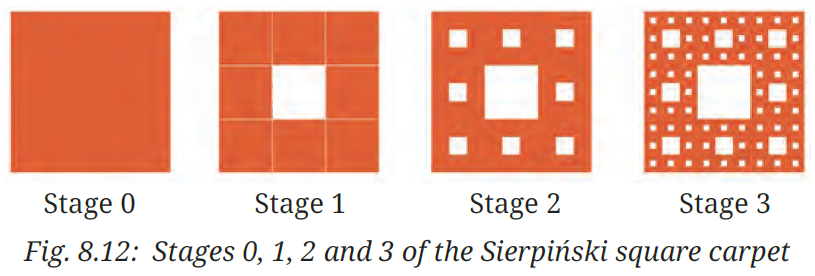
Look at Fig. 8.12 and try to answer the following questions.
(i) How many red squares are there in Stages $0$ to $3$?
(ii) Can you predict the number of red squares in Stages $4$ and $5$?
(iii) Can you find a rule for the number of red squares at the $n^{th}$ stage? Write the explicit formula as well as the recursive formula for the number of red squares at any stage.
(iv) Suppose the area of the square in Stage $0$ is $1$ square unit. What is the area of the red region in Stages $1, 2$ and $3$? What will be the area of the red region in Stages $4$ and $5$? Find the explicit as well as the recursive formula for the area of the red region at the $n^{th}$ stage. What happens to this area as $n$, the number of stages, goes on increasing?
Answer:
Given:
The construction of the Sierpiński carpet starts with a single square ($Stage\ 0$). In each subsequent stage, every existing square is divided into 9 smaller squares, and the middle one is removed, leaving 8 squares behind.
(i) Total number of red squares in Stages $0$ to $3$:
Let $S_n$ represent the number of red squares at a specific stage $n$.
At Stage 0: $S_0 = 1$
At Stage 1: $S_1 = 1 \times 8 = 8$
At Stage 2: $S_2 = 8 \times 8 = 64$
At Stage 3: $S_3 = 64 \times 8 = 512$
To find the total number of red squares across all these stages (Stages 0, 1, 2, and 3):
$Total = S_0 + S_1 + S_2 + S_3$
$Total = 1 + 8 + 64 + 512$
$Total = 585$
Therefore, there are $585$ red squares in Stages 0 to 3.
(ii) Prediction for Stages $4$ and $5$:
The number of squares at each stage follows a Geometric Progression (GP) with the first term $a = 1$ and common ratio $r = 8$.
For Stage 4: $S_4 = 512 \times 8 = 4096$
For Stage 5: $S_5 = 4096 \times 8 = 32768$
The number of red squares in Stage 4 is $4096$ and in Stage 5 is $32768$.
(iii) Rule for the number of red squares at the $n^{th}$ stage:
Explicit Formula:
The number of squares at stage $n$ is given by:
$S_n = 8^n$
Recursive Formula:
Each stage depends on the previous stage:
$S_0 = 1$
$S_n = 8 \times S_{n-1}$
[for $n \geq 1$]
(iv) Area of the red region:
Given the area of Stage 0 is $1$ square unit. In each stage, the middle square (which is $\frac{1}{9}$ of the area) is removed, so $\frac{8}{9}$ of the area remains.
Areas in Stages 1, 2, and 3:
Stage 1: $A_1 = 1 \times \frac{8}{9} = \frac{8}{9}$
Stage 2: $A_2 = \frac{8}{9} \times \frac{8}{9} = \frac{64}{81}$
Stage 3: $A_3 = \frac{64}{81} \times \frac{8}{9} = \frac{512}{729}$
Areas in Stages 4 and 5:
Stage 4: $A_4 = \frac{512}{729} \times \frac{8}{9} = \frac{4096}{6561}$
Stage 5: $A_5 = \frac{4096}{6561} \times \frac{8}{9} = \frac{32768}{59049}$
Formulas for Area at $n^{th}$ stage:
$Explicit: A_n = \left( \frac{8}{9} \right)^n$
$Recursive: A_n = \frac{8}{9} \times A_{n-1}$
(with $A_0 = 1$)
Conclusion: As $n$ increases, the area $\left( \frac{8}{9} \right)^n$ gets smaller and smaller because the common ratio is less than 1. As $n$ approaches infinity, the area approaches $0$.
End-Of-Chapter Exercises
Question 1. Find the $31^{st}$ term of an $AP$ whose $11^{th}$ term is $38$ and $16^{th}$ term is $73$.
Answer:
Given:
In an Arithmetic Progression (AP):
$11^{th}$ term ($t_{11}$) $= 38$
$16^{th}$ term ($t_{16}$) $= 73$
To Find:
The $31^{st}$ term ($t_{31}$).
Solution:
Let '$a$' be the first term and '$d$' be the common difference of the AP.
The general term of an AP is $t_n = a + (n - 1)d$.
According to the given conditions:
$a + 10d = 38$
…(i)
$a + 15d = 73$
…(ii)
Subtracting equation (i) from equation (ii):
$(a + 15d) - (a + 10d) = 73 - 38$
$5d = 35 \implies d = 7$
Substitute $d = 7$ in equation (i):
$a + 10(7) = 38$
$a + 70 = 38 \implies a = 38 - 70 = -32$
Now, find the $31^{st}$ term:
$t_{31} = a + 30d$
$t_{31} = -32 + 30(7)$
$t_{31} = -32 + 210 = 178$
Therefore, the $31^{st}$ term of the AP is $178$.
Question 2. Determine the $AP$ whose third term is $16$ and whose $7^{th}$ term exceeds the $5^{th}$ term by $12$.
Answer:
Given:
$3^{rd}$ term ($t_3$) $= 16$
$t_7 - t_5 = 12$
Solution:
Using the formula $t_n = a + (n - 1)d$:
$a + 2d = 16$
…(i)
Also, given $t_7 - t_5 = 12$:
$(a + 6d) - (a + 4d) = 12$
$2d = 12 \implies d = 6$
Substitute $d = 6$ in equation (i):
$a + 2(6) = 16$
$a + 12 = 16 \implies a = 4$
The AP is $a, a + d, a + 2d, \dots$ which is $4, 10, 16, 22, \dots$
Therefore, the required AP is $4, 10, 16, 22, \dots$
Question 3. How many three-digit numbers are divisible by $7$?
(Hint: All three-digit numbers divisible by $7$ form an $AP$. Find the smallest and largest such three-digit numbers.)
Answer:
Solution:
The smallest three-digit number divisible by $7$ is $105$. The largest three-digit number is $999$. When $999$ is divided by $7$, the remainder is $5$. So, the largest three-digit number divisible by $7$ is $999 - 5 = 994$.
The sequence is: $105, 112, 119, \dots, 994$. This forms an AP.
First term ($a$) $= 105$, Common difference ($d$) $= 7$, Last term ($l$) $= 994$.
$l = a + (n - 1)d$
$994 = 105 + (n - 1)7$
$889 = 7(n - 1)$
$n - 1 = \frac{889}{7} = 127 \implies n = 128$
Therefore, there are $128$ three-digit numbers divisible by $7$.
Question 4. How many multiples of $4$ lie between $10$ and $250$?
(Hint: All multiples of $4$ form an $AP$. Find the smallest and largest multiples of $4$ between $10$ and $250$.)
Answer:
Solution:
The multiples of $4$ after $10$ start at $12$. The largest multiple of $4$ before $250$ is $248$.
The sequence is: $12, 16, 20, \dots, 248$.
Here, $a = 12, d = 4, l = 248$.
$248 = 12 + (n - 1)4$
$236 = 4(n - 1)$
$n - 1 = 59 \implies n = 60$
Therefore, there are $60$ multiples of $4$ between $10$ and $250$.
Question 5. Find a $GP$ for which the sum of the first two terms is $-4$ and the fifth term is $4$ times the third term.
Answer:
Given:
Sum of first two terms of GP ($t_1 + t_2$) $= -4$
$5^{th}$ term ($t_5$) $= 4 \times t_3$
Solution:
Let the GP be $a, ar, ar^2, \dots$
From $t_5 = 4 t_3$:
$ar^4 = 4ar^2$
$r^2 = 4 \implies r = \pm 2$
Case 1: $r = 2$
Given $a + ar = -4$:
$a(1 + 2) = -4 \implies 3a = -4 \implies a = -4/3$
GP: $-4/3, -8/3, -16/3, \dots$
Case 2: $r = -2$
Given $a + ar = -4$:
$a(1 - 2) = -4 \implies -a = -4 \implies a = 4$
GP: $4, -8, 16, -32, \dots$
Question 6. Find all possible ways of expressing $100$ as the sum of consecutive natural numbers.
Answer:
To Find:
Sets of consecutive natural numbers whose sum is equal to $100$.
Solution:
Let the sum of $k$ consecutive natural numbers starting from $a$ be $100$. These numbers form an Arithmetic Progression where the first term is $a$, the number of terms is $k$, and the common difference $d = 1$.
The formula for the sum of an AP is $S_k = \frac{k}{2}[2a + (k-1)d]$.
$\frac{k}{2}[2a + (k-1)] = 100$
$k(2a + k - 1) = 200$
…(i)
Here, $k$ must be a factor of $200$. Also, since $a \geq 1$, we must have $2a = \frac{200}{k} - k + 1 \geq 2$.
Additionally, for $a$ to be a natural number, $\frac{200}{k} - k + 1$ must be an even number. This implies that $\frac{200}{k} - k$ must be odd. This only happens if one of $(\frac{200}{k})$ or $k$ is even and the other is odd.
Case 1: $k$ is an odd factor of $200$.
The odd factors of $200$ are $1, 5, 25$.
If $k = 1$, then $2a = 200 - 1 + 1 = 200 \implies a = 100$. (This is just one number, not a sum of "consecutive" numbers in the typical sense, though technically valid).
If $k = 5$:
$2a = \frac{200}{5} - 5 + 1 = 40 - 4 = 36$
$a = 18$
The numbers are: $18, 19, 20, 21, 22$.
If $k = 25$:
$2a = \frac{200}{25} - 25 + 1 = 8 - 24 = -16$
Since $a$ must be a natural number, this case is invalid.
Case 2: $\frac{200}{k}$ is an odd factor of $200$.
If $\frac{200}{k} = 25$, then $k = 8$:
$2a = 25 - 8 + 1 = 18$
$a = 9$
The numbers are: $9, 10, 11, 12, 13, 14, 15, 16$.
If $\frac{200}{k} = 5$, then $k = 40$. $2a = 5 - 40 + 1 = -34$ (Invalid).
Therefore, the two ways to express $100$ as a sum of consecutive natural numbers are:
1. $18 + 19 + 20 + 21 + 22$
2. $9 + 10 + 11 + 12 + 13 + 14 + 15 + 16$
Question 7. The number of bacteria in a certain culture doubles every hour. If there were $30$ bacteria present in the culture originally, how many bacteria will be present at the end of the $2^{nd}$ hour, $4^{th}$ hour and $n^{th}$ hour?
Answer:
Given:
Original number of bacteria (at $t=0$) $= 30$
Growth pattern: Doubles every hour.
Solution:
This forms a Geometric Progression (GP) where the original amount is $a = 30$ and the common ratio is $r = 2$.
The number of bacteria after $n$ hours is given by $t_{n+1} = a \cdot r^n$.
1. Bacteria at the end of the $2^{nd}$ hour:
$Bacteria = 30 \times 2^2$
$Bacteria = 30 \times 4 = 120$
2. Bacteria at the end of the $4^{th}$ hour:
$Bacteria = 30 \times 2^4$
$Bacteria = 30 \times 16 = 480$
3. Bacteria at the end of the $n^{th}$ hour:
$Bacteria = 30 \times 2^n$
Therefore, the counts are $120$, $480$, and $30 \times 2^n$ respectively.
Question 8. The sum of the $4^{th}$ and $8^{th}$ terms of an $AP$ is $24$ and the sum of the $6^{th}$ and $10^{th}$ terms is $44$. Find the first three terms of the $AP$.
Answer:
Given:
$t_4 + t_8 = 24$
$t_6 + t_{10} = 44$
To Find:
The first three terms ($a, a+d, a+2d$).
Solution:
Using the general term formula $t_n = a + (n-1)d$:
From the first condition:
$(a + 3d) + (a + 7d) = 24$
$2a + 10d = 24 \implies a + 5d = 12$
…(i)
From the second condition:
$(a + 5d) + (a + 9d) = 44$
$2a + 14d = 44 \implies a + 7d = 22$
…(ii)
Subtracting equation (i) from equation (ii):
$(a + 7d) - (a + 5d) = 22 - 12$
$2d = 10 \implies d = 5$
Substituting $d = 5$ in equation (i):
$a + 5(5) = 12$
$a + 25 = 12 \implies a = -13$
The first three terms are:
$t_1 = a = -13$
$t_2 = a + d = -13 + 5 = -8$
$t_3 = a + 2d = -13 + 10 = -3$
The first three terms of the AP are $-13, -8, -3$.
Question 9. Find the smallest value of $n$ such that the sum of the first $n$ natural numbers is greater than $1,000$.
Answer:
To Find:
Smallest natural number $n$ such that $\sum_{i=1}^{n} i > 1000$.
Solution:
The sum of the first $n$ natural numbers is given by the formula:
$S_n = \frac{n(n + 1)}{2}$
We need to solve for $n$ in the inequality:
$\frac{n(n + 1)}{2} > 1000$
$n^2 + n > 2000$
To estimate $n$, we look at the square root of $2000$. Since $\sqrt{2025} = 45$ and $\sqrt{1936} = 44$, let us test these values.
If $n = 44$:
$S_{44} = \frac{44 \times 45}{2} = 22 \times 45 = 990$
Since $990$ is not greater than $1000$, we check the next value.
If $n = 45$:
$S_{45} = \frac{45 \times 46}{2} = 45 \times 23 = 1035$
Since $1035 > 1000$, $n = 45$ satisfies the condition.
Therefore, the smallest value of $n$ is $45$.
Question 10. Which term of the $GP$: $2, 8, 32, \dots$ is $131072$? Write the explicit formula as well as the recursive formula for the $n^{th}$ term.
Answer:
Given:
Geometric Progression (GP): $2, 8, 32, \dots$
First term ($a$) $= 2$
Common ratio ($r$) $= \frac{8}{2} = 4$
Solution:
1. Finding the position of $131072$:
The general term of a GP is $t_n = ar^{n-1}$.
$131072 = 2 \cdot (4)^{n-1}$
$4^{n-1} = \frac{131072}{2} = 65536$
Now, we express $65536$ as a power of $4$:
$4^1=4, 4^2=16, 4^3=64, 4^4=256, 4^5=1024, 4^6=4096, 4^7=16384, $$ 4^8=65536$.
$4^{n-1} = 4^8$
$n - 1 = 8 \implies n = 9$
So, $131072$ is the $9^{th}$ term.
2. Explicit Formula:
$t_n = 2 \cdot 4^{n-1}$
3. Recursive Formula:
$t_1 = 2$
$t_n = 4 \cdot t_{n-1}$
(for $n > 1$)
Question 11. The sum of the first three terms of a $GP$ is $\frac{13}{12}$ and their product is $-1$. Find the common ratio and the terms.
Answer:
Given:
Let the three terms of the GP be $\frac{a}{r}, a, ar$.
Product of the terms $= -1$
Sum of the terms $= \frac{13}{12}$
Solution:
Step 1: Use the product to find '$a$'.
$\frac{a}{r} \cdot a \cdot ar = -1$
$a^3 = -1 \implies a = -1$
Step 2: Use the sum to find '$r$'.
$\frac{a}{r} + a + ar = \frac{13}{12}$
Substitute $a = -1$:
$-\frac{1}{r} - 1 - r = \frac{13}{12}$
$-\left( \frac{1 + r + r^2}{r} \right) = \frac{13}{12}$
$12 + 12r + 12r^2 = -13r$
$12r^2 + 25r + 12 = 0$
Solving the quadratic equation by splitting the middle term ($16 \times 9 = 144$):
$12r^2 + 16r + 9r + 12 = 0$
$4r(3r + 4) + 3(3r + 4) = 0$
$(4r + 3)(3r + 4) = 0$
$r = -\frac{3}{4} \text{ or } r = -\frac{4}{3}$
Step 3: Find the terms.
If $r = -\frac{3}{4}$ and $a = -1$, the terms are: $\frac{-1}{-3/4}, -1, -1(-\frac{3}{4}) \implies \mathbf{\frac{4}{3}, -1, \frac{3}{4}}$.
If $r = -\frac{4}{3}$ and $a = -1$, the terms are: $\frac{-1}{-4/3}, -1, -1(-\frac{4}{3}) \implies \mathbf{\frac{3}{4}, -1, \frac{4}{3}}$.
The common ratio is $-3/4$ or $-4/3$ and the terms are $4/3, -1, 3/4$.
Question 12. If the $4^{th}$, $10^{th}$ and $16^{th}$ terms of a $GP$ are $x$, $y$ and $z$ respectively, prove that $x, y, z$ are in $GP$.
Answer:
Given:
$t_4 = x$
$t_{10} = y$
$t_{16} = z$
To Prove:
$x, y, z$ are in GP.
Proof:
Let '$a$' be the first term and '$r$' be the common ratio of the given GP.
Using the formula $t_n = ar^{n-1}$:
$x = ar^3$
…(i)
$y = ar^9$
…(ii)
$z = ar^{15}$
…(iii)
To show that $x, y, z$ are in GP, we must show that $y^2 = xz$.
L.H.S:
$y^2 = (ar^9)^2 = a^2 r^{18}$
R.H.S:
$xz = (ar^3)(ar^{15})$
$xz = a^2 r^{3 + 15} = a^2 r^{18}$
Since L.H.S = R.H.S ($y^2 = xz$), the terms $x, y,$ and $z$ form a geometric progression.
Hence Proved.
Question 13. The sum of the first three terms of a geometric progression is $26$, and the sum of their squares is $364$. Find the terms of the $GP$.
Answer:
Given:
Let the first three terms of the GP be $a, ar, ar^2$.
$a + ar + ar^2 = 26$
…(i)
$a^2 + a^2r^2 + a^2r^4 = 364$
…(ii)
Solution:
From equation (i), we can write:
$a(1 + r + r^2) = 26$
…(iii)
From equation (ii), we can write:
$a^2(1 + r^2 + r^4) = 364$
Using the algebraic identity $1 + r^2 + r^4 = (1 + r + r^2)(1 - r + r^2)$:
$a^2(1 + r + r^2)(1 - r + r^2) = 364$
Multiplying equation (iii) by $a(1 - r + r^2)$ gives:
$a(1 + r + r^2) \cdot a(1 - r + r^2) = 26 \cdot a(1 - r + r^2)$
$364 = 26 \cdot a(1 - r + r^2)$
$a(1 - r + r^2) = \frac{364}{26} = 14$
…(iv)
Now, dividing equation (iii) by equation (iv):
$\frac{a(1 + r + r^2)}{a(1 - r + r^2)} = \frac{26}{14}$
$\frac{1 + r + r^2}{1 - r + r^2} = \frac{13}{7}$
Cross-multiplying:
$7 + 7r + 7r^2 = 13 - 13r + 13r^2$
$6r^2 - 20r + 6 = 0$
$3r^2 - 10r + 3 = 0$
Solving the quadratic equation: $(3r - 1)(r - 3) = 0 \implies r = 3$ or $r = \frac{1}{3}$.
Substituting $r = 3$ in equation (iii): $a(1 + 3 + 9) = 26 \implies 13a = 26 \implies a = 2$.
The terms are $2, 6, 18$. (If $r = 1/3$, the terms are $18, 6, 2$).
Question 14. Suppose $P_1 = 1$, $P_2 = 2$ and for $n > 2$, $P_n = P_1 + P_2 + \dots + P_{n-1} + 1$. Find the values of $P_1, P_2, \dots, P_8$.
Can you find a simpler recursive formula for $P_n$? Can you give an explicit formula?
Answer:
Solution:
Given $P_1 = 1, P_2 = 2$.
$P_3 = P_1 + P_2 + 1 = 1 + 2 + 1 = 4$
$P_4 = P_1 + P_2 + P_3 + 1 = 1 + 2 + 4 + 1 = 8$
$P_5 = 1 + 2 + 4 + 8 + 1 = 16$
Following this pattern, the values are: $1, 2, 4, 8, 16, 32, 64, 128$.
Recursive Formula:
Observe that $P_n = (P_1 + \dots + P_{n-2} + 1) + P_{n-1}$.
Since $(P_1 + \dots + P_{n-2} + 1) = P_{n-1}$:
$P_n = P_{n-1} + P_{n-1} = 2P_{n-1}$
Simpler recursive formula: $P_n = 2P_{n-1}$ (for $n > 2$).
Explicit Formula:
The sequence is $1, 2, 4, 8, \dots$, which is $2^0, 2^1, 2^2, 2^3, \dots$
Explicit formula: $P_n = 2^{n-1}$ (for $n \geq 1$).
Question 15. Suppose $W_1 = 1$, $W_2 = 2$ and for $n > 2$, $W_n = W_1 + W_2 + \dots + W_{n-2} + 2$. Find the values of $W_1, W_2, \dots, W_8$. Do you recognise this sequence?
Answer:
Solution:
Given $W_1 = 1, W_2 = 2$.
$W_3 = W_1 + 2 = 1 + 2 = 3$
$W_4 = W_1 + W_2 + 2 = 1 + 2 + 2 = 5$
$W_5 = W_1 + W_2 + W_3 + 2 = 1 + 2 + 3 + 2 = 8$
$W_6 = 1 + 2 + 3 + 5 + 2 = 13$
$W_7 = 1 + 2 + 3 + 5 + 8 + 2 = 21$
$W_8 = 1 + 2 + 3 + 5 + 8 + 13 + 2 = 34$
The values are: $1, 2, 3, 5, 8, 13, 21, 34$.
Recognition:
This sequence is the Fibonacci Sequence starting from the second term (or with $1, 2$ as the first two terms). Each term is the sum of the two preceding terms (e.g., $3+5=8, 5+8=13$).