

Chapter 12 Quadrilaterals (Class 9 - Latest Maths NCERT (Ganita Manjari II) Solutions)
Looking for clear and accurate NCERT Solutions for Chapter 12: Quadrilaterals? You’ve come to the right place! This page provides comprehensive, step-by-step answers to help you understand quadrilaterals and their geometric properties. From identifying sides, angles, vertices, and diagonals to examining the relationships between different four-sided figures, our solutions make the chapter easier to understand and revise.
Our solutions guide you through the properties and classification of quadrilaterals using clear reasoning and worked examples. You will learn how to approach questions involving figures such as parallelograms, rectangles, squares, and rhombuses, wherever covered in the exercise. Labelled diagrams and systematic explanations help you identify the relevant properties, organise your reasoning, and present mathematical answers clearly.
Whether you are solving textbook exercises or revising important geometric concepts, these resources are designed to strengthen your understanding and problem-solving skills. Curated by learningspot.co based on the Ganita Manjari II textbook, our solutions provide detailed explanations and step-by-step answers to help you prepare effectively for your Class 9 Mathematics examinations.
| Content On This Page | ||
|---|---|---|
| Exercise Set 12.1 | Exercise Set 12.2 | Exercise Set 12.3 |
| Exercise Set 12.4 | End-of-Chapter Exercises | |
Exercise Set 12.1
Question 1. Let $ABCD$ be a quadrilateral.
(i) List all sides of $ABCD$ adjacent to side $AB$. List all sides opposite to $AB$.
(ii) List all angles of $ABCD$ adjacent to $\angle A$. List all angles opposite to $\angle A$.
(iii) Define a pair of opposite sides and a pair of opposite angles without using the names of the vertices.
Answer:
Consider the quadrilateral $ABCD$ shown below:
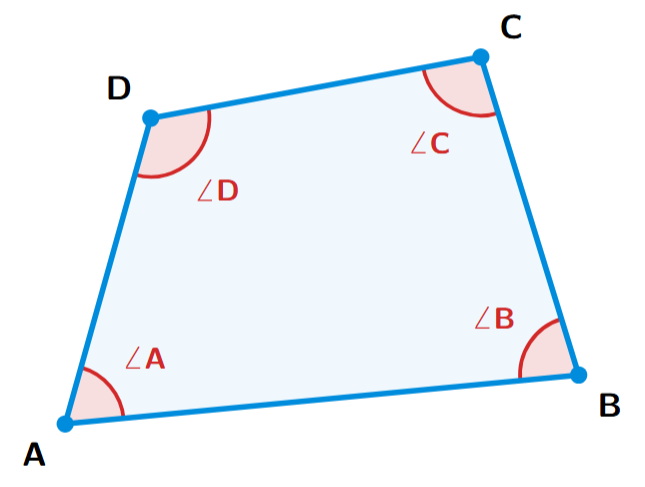
(i) Sides Adjacent and Opposite to $AB$:
Sides adjacent to $AB$: $AD$ (or $DA$) and $BC$, as they share a common vertex ($A$ or $B$) with side $AB$.
Side opposite to $AB$: $CD$ (or $DC$), as it has no common vertex with side $AB$.
(ii) Angles Adjacent and Opposite to $\angle A$:
Angles adjacent to $\angle A$: $\angle B$ and $\angle D$, as they share a common side ($AB$ or $AD$) with $\angle A$.
Angle opposite to $\angle A$: $\angle C$, as it does not share any side with $\angle A$.
(iii) Definitions (Without Using Vertex Names):
Pair of opposite sides: Two sides of a quadrilateral that do not have a common vertex (endpoint).
Pair of opposite angles: Two angles of a quadrilateral that do not share a common side (arm).
Question 2. You have used internal angles of quadrilaterals, but they too require an exact definition, just like how we gave one for a quadrilateral. Precisely define the internal angle of a quadrilateral at a given vertex. Your answer should work for a non-convex quadrilateral too. (Hint: use the opposite vertex as well.)
Answer:
Definition:
The angle formed at a vertex of a quadrilateral by a pair of adjacent sides and enclosing the opposite vertex is called an internal angle of a quadrilateral.
In all, there are four internal angles in a quadrilateral.
Explanation with Figures:
In the quadrilaterals $ABCD$ given in the figure, the internal angle $\angle CDA$ at vertex $D$ (formed by the pair of adjacent sides $DC$ and $DA$, and enclosing the opposite vertex $B$) is marked separately for a convex quadrilateral and a non-convex quadrilateral.
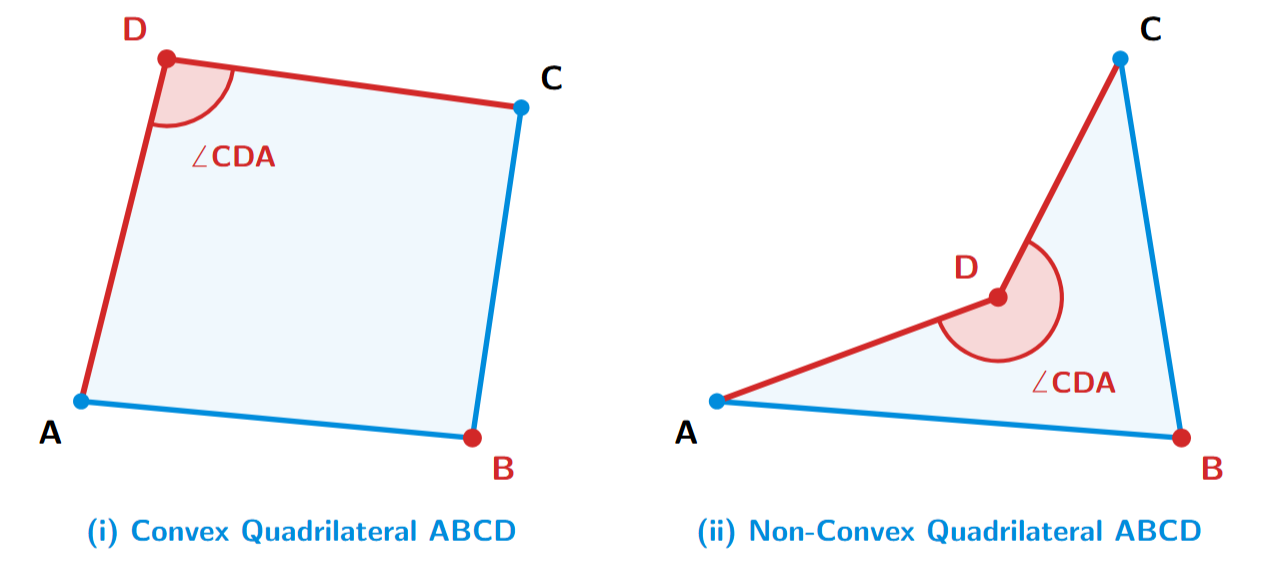
1. In a Convex Quadrilateral $ABCD$:
At vertex $D$, the internal angle $\angle CDA$ formed by the adjacent sides $DC$ and $DA$ encloses the opposite vertex $B$ and measures less than $180^\circ$.
2. In a Non-Convex Quadrilateral $ABCD$:
At the inward-pointing vertex $D$, the internal angle $\angle CDA$ formed by the adjacent sides $DC$ and $DA$ encloses the opposite vertex $B$ and is a reflex angle (measuring greater than $180^\circ$).
Question 3. In a quadrilateral $ABCD$, suppose $AB \parallel DC$. Can $ABCD$ be non-convex? What if we instead assume $AB = CD$? What if we instead assume $\angle A = \angle C$?
Answer:
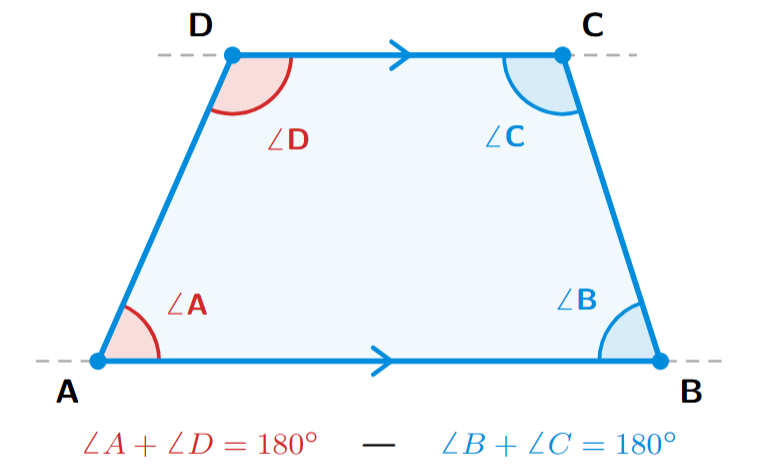
1. If $AB \parallel DC$:
No, $ABCD$ cannot be non-convex; it must be a convex quadrilateral.
Proof: Since $AB \parallel DC$ and $ABCD$ is a simple (non-self-intersecting) quadrilateral, the entire quadrilateral lies between the parallel lines $\overleftrightarrow{AB}$ and $\overleftrightarrow{DC}$, with sides $AD$ and $BC$ acting as transversals.
$\angle A + \angle D = 180^\circ$
(Co-interior angles, $AB \parallel DC$)
$\angle B + \angle C = 180^\circ$
(Co-interior angles, $AB \parallel DC$)
Since every internal angle is strictly greater than $0^\circ$, each of $\angle A, \angle B, \angle C, \angle D$ is strictly less than $180^\circ$. Hence, no angle is reflex, so $ABCD$ is always convex.
2. If $AB = CD$:
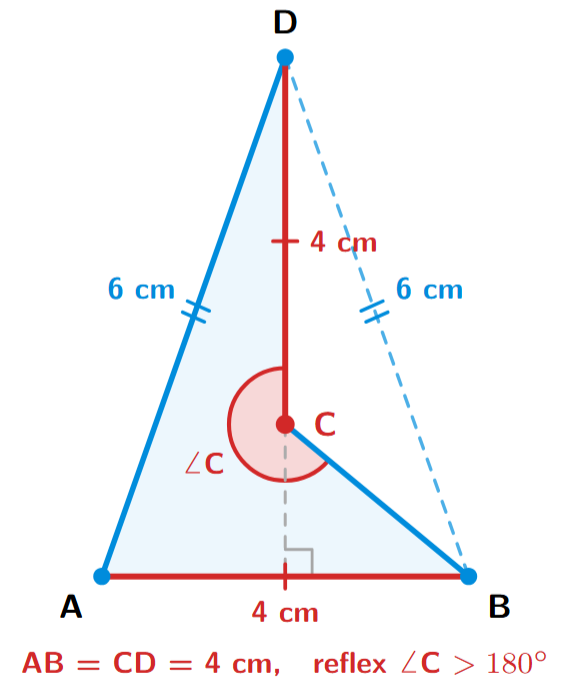
Yes, $ABCD$ can be non-convex.
Example: Construct an isosceles triangle $\triangle ABD$ with $DA = DB = 6\text{ cm}$ and $AB = 4\text{ cm}$ (its altitude from $D$ to $AB$ is $\sqrt{6^2 - 2^2} = \sqrt{32}\text{ cm} > 4\text{ cm}$).
Choose point $C$ on this altitude strictly inside $\triangle ABD$ such that $CD = 4\text{ cm}$.
In quadrilateral $ABCD$, $AB = CD = 4\text{ cm}$, and since $C$ lies inside $\triangle ABD$, the internal angle $\angle C$ is a reflex angle ($> 180^\circ$). Thus, $ABCD$ is non-convex.
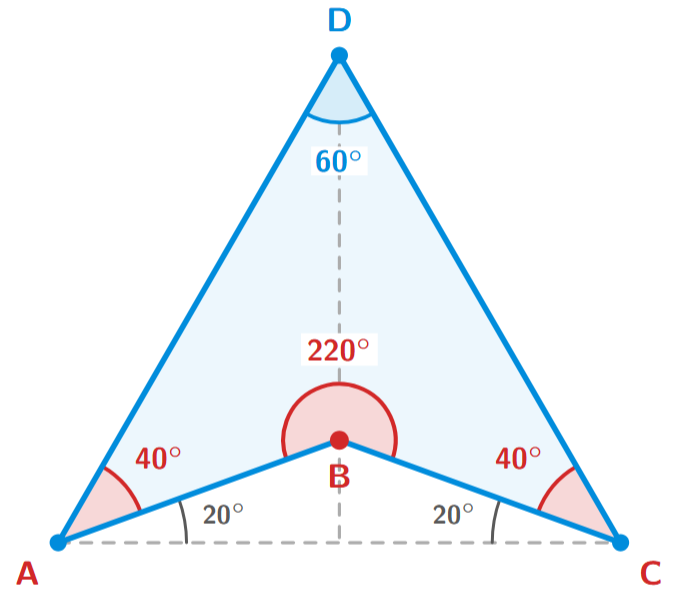
3. If $\angle A = \angle C$:
Yes, $ABCD$ can be non-convex (with the reflex angle at $B$ or $D$; it cannot be at $A$ or $C$ because $\angle A = \angle C > 180^\circ$ would give $\angle A + \angle C > 360^\circ$, which is impossible).
Example: Construct an equilateral triangle $\triangle ACD$ ($\angle DAC = \angle DCA = \angle ADC = 60^\circ$).
Choose point $B$ inside $\triangle ACD$ on the perpendicular bisector of $AC$ such that $\angle BAC = \angle BCA = 20^\circ$.
Then in quadrilateral $ABCD$:
• $\angle A = 60^\circ - 20^\circ = 40^\circ$ and $\angle C = 60^\circ - 20^\circ = 40^\circ$ (so $\angle A = \angle C$)
• $\angle D = 60^\circ$
• $\angle B = 360^\circ - (180^\circ - 20^\circ - 20^\circ) = 220^\circ > 180^\circ$ (reflex angle)
Thus, $ABCD$ is a non-convex quadrilateral satisfying $\angle A = \angle C$.
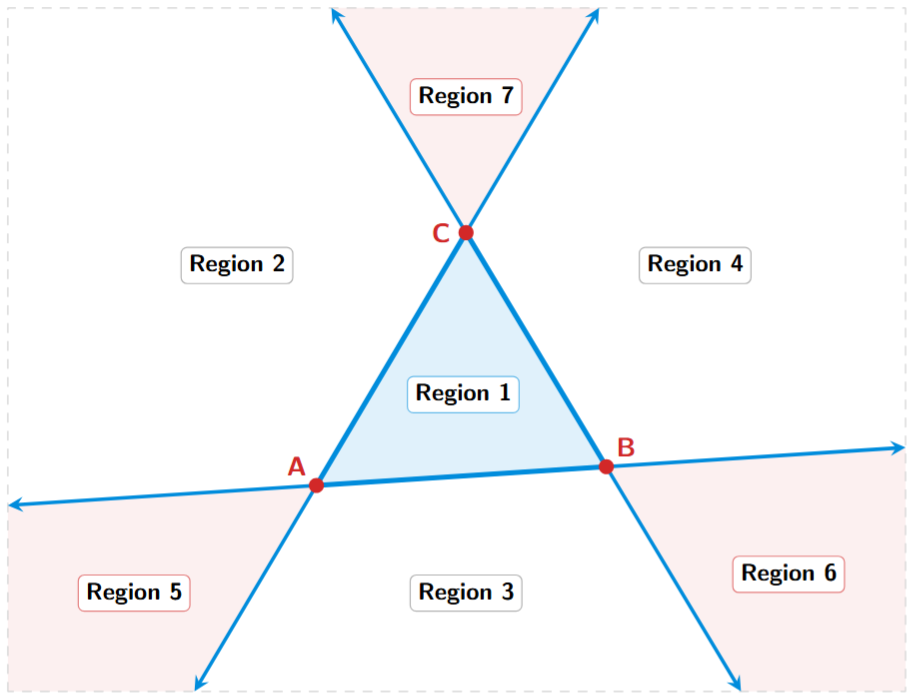
Question 4. Consider three non-collinear points $A$, $B$, $C$ and draw the lines $AB$, $BC$, $CA$. For every possible location of point $D$ in the plane outside these lines, decide if $ABCD$ is self-intersecting, non-convex, or convex. (Hint: the three lines divide the plane into $7$ regions.)
Answer:
Setup and Division of the Plane:
The three lines $\overleftrightarrow{AB}$, $\overleftrightarrow{BC}$, and $\overleftrightarrow{CA}$ divide the plane (outside the lines) into $7$ open regions:
• $1$ bounded triangular region (the interior of $\triangle ABC$).
• $3$ unbounded regions adjacent to the three sides $AC$, $AB$, and $BC$.
• $3$ unbounded vertical-angle (wedge) regions opposite the three vertices $A$, $B$, and $C$.
In quadrilateral $ABCD$, the sides $AB$ and $BC$ are fixed, while sides $CD$ and $DA$ depend on the position of $D$. Self-intersection occurs if and only if $CD$ crosses $AB$ or $DA$ crosses $BC$.
Region-by-Region Classification of $ABCD$:
1. Region $1$ — Interior of $\triangle ABC$:
Neither $CD$ nor $DA$ crosses any other side, so $ABCD$ is simple. Since $D$ lies strictly inside $\triangle ABC$, the internal angle at $D$ (enclosing $B$) is a reflex angle ($> 180^\circ$).
Result: $ABCD$ is non-convex (reflex angle at $D$).
2. Region $2$ — Adjacent to side $AC$ (opposite vertex $B$):
This is the region bounded by segment $AC$ and the rays $\overrightarrow{BA}$ and $\overrightarrow{BC}$ extended beyond $A$ and $C$. Here, $B$ and $D$ lie on opposite sides of line $\overleftrightarrow{AC}$, while $A$ and $C$ lie on opposite sides of line $\overleftrightarrow{BD}$. No sides cross, and all four internal angles are less than $180^\circ$.
Result: $ABCD$ is convex.
3. Region $3$ — Adjacent to side $AB$ (opposite vertex $C$):
This is the region bounded by segment $AB$ and the rays $\overrightarrow{CA}$ and $\overrightarrow{CB}$ extended beyond $A$ and $B$. Since $D$ lies on the side of $\overleftrightarrow{AB}$ opposite to $C$ and between the extensions of $CA$ and $CB$, the segment $CD$ must cross the segment $AB$.
Result: $ABCD$ is self-intersecting ($CD$ intersects $AB$).
4. Region $4$ — Adjacent to side $BC$ (opposite vertex $A$):
This is the region bounded by segment $BC$ and the rays $\overrightarrow{AB}$ and $\overrightarrow{AC}$ extended beyond $B$ and $C$. Since $D$ lies on the side of $\overleftrightarrow{BC}$ opposite to $A$ and between the extensions of $AB$ and $AC$, the segment $DA$ must cross the segment $BC$.
Result: $ABCD$ is self-intersecting ($DA$ intersects $BC$).
5. Region $5$ — Vertical-angle region opposite vertex $A$:
This is the region bounded by the rays $\overrightarrow{BA}$ and $\overrightarrow{CA}$ extended beyond $A$. No sides cross, and vertex $A$ lies strictly inside $\triangle BCD$, making the internal angle at $A$ a reflex angle ($> 180^\circ$).
Result: $ABCD$ is non-convex (reflex angle at $A$).
6. Region $6$ — Vertical-angle region opposite vertex $B$:
This is the region bounded by the rays $\overrightarrow{AB}$ and $\overrightarrow{CB}$ extended beyond $B$. No sides cross, and vertex $B$ lies strictly inside $\triangle ACD$, making the internal angle at $B$ a reflex angle ($> 180^\circ$).
Result: $ABCD$ is non-convex (reflex angle at $B$).
7. Region $7$ — Vertical-angle region opposite vertex $C$:
This is the region bounded by the rays $\overrightarrow{AC}$ and $\overrightarrow{BC}$ extended beyond $C$. No sides cross, and vertex $C$ lies strictly inside $\triangle ABD$, making the internal angle at $C$ a reflex angle ($> 180^\circ$).
Result: $ABCD$ is non-convex (reflex angle at $C$).
Summary Table:
| Region | Location of $D$ | Nature of $ABCD$ | Key Feature |
| Region $1$ | Interior of $\triangle ABC$ | Non-convex | Reflex angle at $D$ |
| Region $2$ | Adjacent to side $AC$ (opposite $B$) | Convex | All internal angles $< 180^\circ$ |
| Region $3$ | Adjacent to side $AB$ (opposite $C$) | Self-intersecting | Sides $CD$ and $AB$ cross |
| Region $4$ | Adjacent to side $BC$ (opposite $A$) | Self-intersecting | Sides $DA$ and $BC$ cross |
| Region $5$ | Opposite vertex $A$ (wedge beyond $A$) | Non-convex | Reflex angle at $A$ ($A$ inside $\triangle BCD$) |
| Region $6$ | Opposite vertex $B$ (wedge beyond $B$) | Non-convex | Reflex angle at $B$ ($B$ inside $\triangle ACD$) |
| Region $7$ | Opposite vertex $C$ (wedge beyond $C$) | Non-convex | Reflex angle at $C$ ($C$ inside $\triangle ABD$) |
Question 5. Can a quadrilateral be both self-intersecting and non-planar?
Answer:
Answer:
No, a quadrilateral cannot be both self-intersecting and non-planar. Every self-intersecting quadrilateral is necessarily planar (coplanar).
Proof:
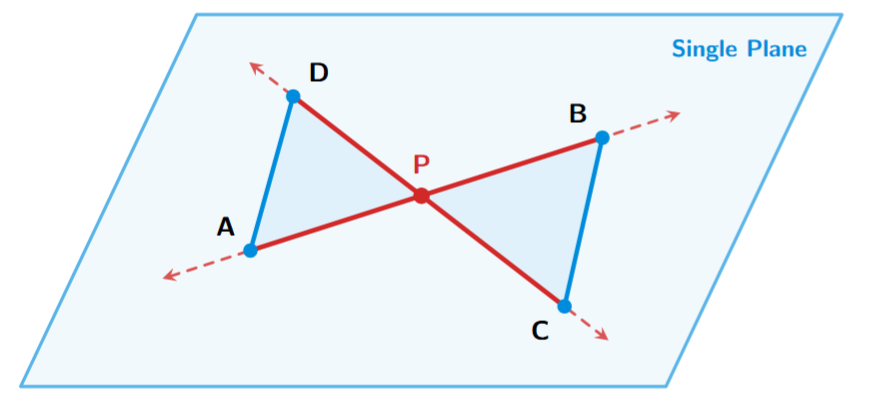
Suppose a quadrilateral $ABCD$ is self-intersecting. Then, a pair of its non-adjacent sides—either $AB$ and $CD$, or $BC$ and $DA$—must intersect at some point $P$.
Case 1: Suppose sides $AB$ and $CD$ intersect at point $P$.
Then the lines $\overleftrightarrow{AB}$ and $\overleftrightarrow{CD}$ intersect at $P$.
Since any two intersecting lines always lie in a single plane, there exists a plane containing both lines $\overleftrightarrow{AB}$ and $\overleftrightarrow{CD}$.
(Note: Even if the two lines coincide, all four vertices are collinear, and hence still lie in a plane.)
Because vertices $A$ and $B$ lie on line $\overleftrightarrow{AB}$, and vertices $C$ and $D$ lie on line $\overleftrightarrow{CD}$, all four vertices $A, B, C, D$ (and therefore all four sides $AB, BC, CD, DA$) lie in that same plane.
Case 2: Similarly, if sides $BC$ and $DA$ intersect at a point $P$, then the intersecting lines $\overleftrightarrow{BC}$ and $\overleftrightarrow{DA}$ lie in a single plane, which must contain all four vertices $A, B, C, D$.
Conclusion:
In every case, a self-intersecting quadrilateral must lie completely in a single plane. Hence, it cannot be non-planar.
Exercise Set 12.2
Question 1. True or false?
(i) A parallelogram with a right angle is a rectangle.
(ii) A rhombus with perpendicular diagonals is a square.
(iii) If the diagonals of a parallelogram are equal, then it is a rectangle.
Answer:
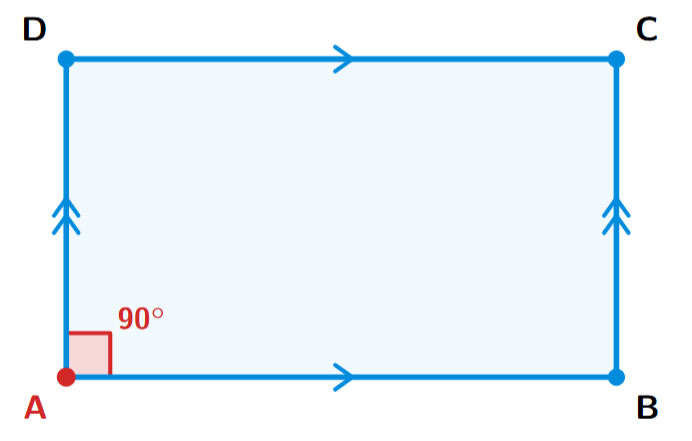
(i) A parallelogram with a right angle is a rectangle.
Answer: True
Reason: Let $ABCD$ be a parallelogram with $\angle A = 90^\circ$.
$\angle C = \angle A = 90^\circ$
(Opposite angles of a parallelogram are equal)
$\angle A + \angle B = 180^\circ$
(Co-interior angles, since $AD \parallel BC$)
$\implies \angle B = 180^\circ - 90^\circ = 90^\circ$
$\angle D = \angle B = 90^\circ$
(Opposite angles of a parallelogram are equal)
Thus, all four angles of parallelogram $ABCD$ are $90^\circ$, which makes it a rectangle.
(ii) A rhombus with perpendicular diagonals is a square.
Answer: False
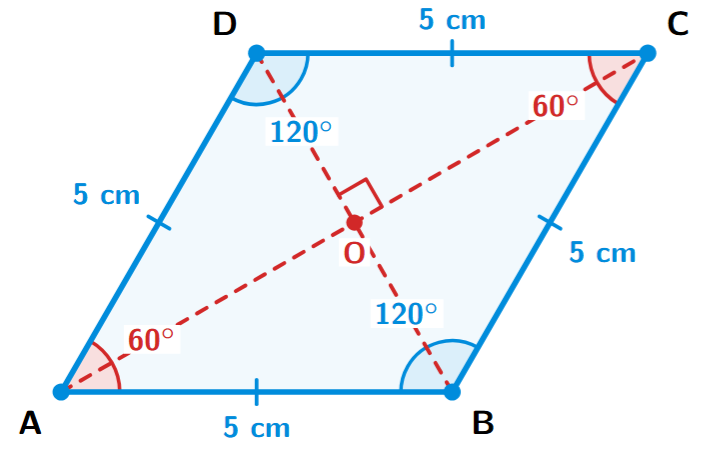
Reason: The diagonals of every rhombus are perpendicular to each other by property, regardless of whether its internal angles are $90^\circ$ or not. For a rhombus to be a square, its angles must be $90^\circ$ (or its diagonals must be equal).
Counterexample: A rhombus with all sides $5\text{ cm}$ and internal angles $60^\circ, 120^\circ, 60^\circ, 120^\circ$ has perpendicular diagonals, yet it is not a square.
(iii) If the diagonals of a parallelogram are equal, then it is a rectangle.
Answer: True
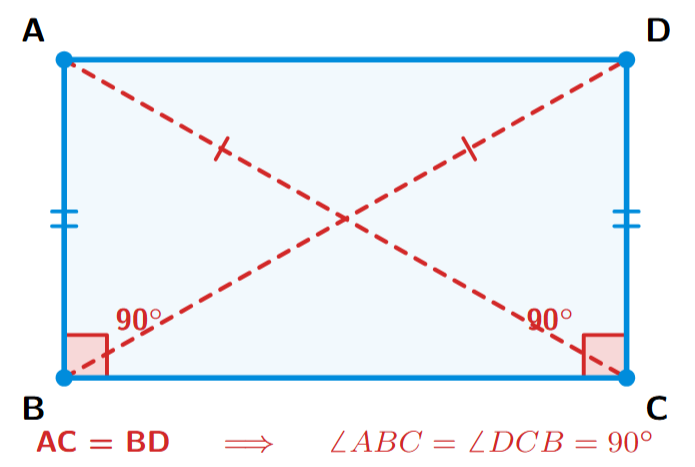
Reason: Let $ABCD$ be a parallelogram with equal diagonals, i.e., $AC = BD$.
In $\triangle ABC$ and $\triangle DCB$:
$AB = DC$
(Opposite sides of a parallelogram)
$BC = CB$
(Common side)
$AC = DB$
(Given)
Therefore, $\triangle ABC \cong \triangle DCB$ by the SSS congruence rule.
$\implies \angle ABC = \angle DCB$
(By CPCT)
Since $AB \parallel DC$ and $BC$ is a transversal:
$\angle ABC + \angle DCB = 180^\circ$
(Co-interior angles)
$\implies 2\angle ABC = 180^\circ \implies \angle ABC = 90^\circ$.
Since $ABCD$ is a parallelogram with a right angle, all its angles are $90^\circ$. Hence, $ABCD$ is a rectangle.
Question 2. The diagonal $AC$ of a parallelogram $ABCD$ bisects $\angle A$. Show that it also bisects $\angle C$ and that $ABCD$ is a rhombus.
Answer:
Given:
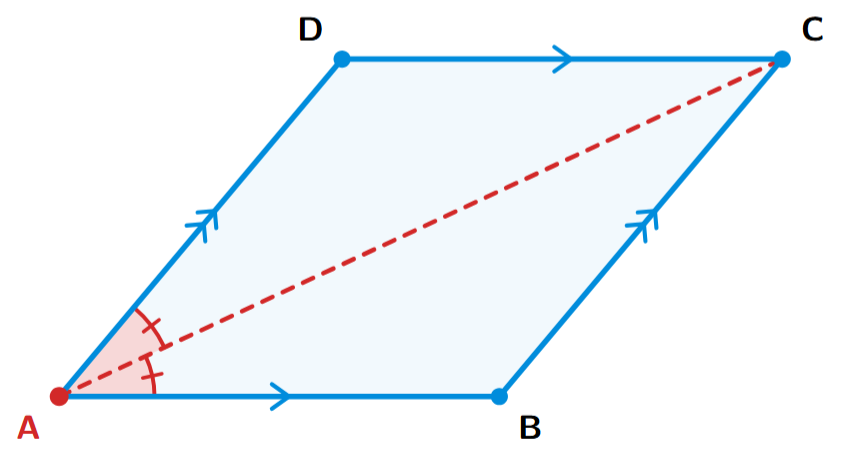
$ABCD$ is a parallelogram in which diagonal $AC$ bisects $\angle A$, i.e., $\angle DAC = \angle BAC$.
To Prove:
(i) Diagonal $AC$ bisects $\angle C$, i.e., $\angle DCA = \angle BCA$.
(ii) $ABCD$ is a rhombus, i.e., $AB = BC = CD = DA$.
Proof:
Part (i): Proving that $AC$ bisects $\angle C$
Since $ABCD$ is a parallelogram, its opposite sides are parallel, i.e., $AB \parallel DC$ and $AD \parallel BC$, and $AC$ acts as a transversal.
$\angle BAC = \angle DCA$
[Alternate interior angles, $AB \parallel DC$] ... (i)
$\angle DAC = \angle BCA$
[Alternate interior angles, $AD \parallel BC$] ... (ii)
$\angle DAC = \angle BAC$
[Given, since $AC$ bisects $\angle A$] ... (iii)
From equations (i), (ii), and (iii), we obtain:
$\angle DCA = \angle BCA$
…(iv)
Hence, diagonal $AC$ bisects $\angle C$.
Part (ii): Proving that $ABCD$ is a rhombus
From equations (ii) and (iii), we have:
$\angle BAC = \angle DAC = \angle BCA$
Now, in $\triangle ABC$, since $\angle BAC = \angle BCA$:
$BC = AB$
[Sides opposite to equal angles of a triangle are equal] ... (v)
Also, since $ABCD$ is a parallelogram, its opposite sides are equal:
$AB = CD$ and $BC = DA$
[Opposite sides of a parallelogram] ... (vi)
From equations (v) and (vi), we get:
$AB = BC = CD = DA$
Since $ABCD$ is a parallelogram with all four sides equal, $ABCD$ is a rhombus.
Hence proved.
Alternate Method for Part (ii) (Using Congruence of Triangles):
In $\triangle ADC$ and $\triangle ABC$:
$\angle DAC = \angle BAC$
(Given)
$AC = AC$
(Common side)
$\angle DCA = \angle BCA$
(From equation (iv))
Therefore, $\triangle ADC \cong \triangle ABC$ by the ASA congruence rule.
$AD = AB$ and $CD = CB$
(By CPCT)
Since $ABCD$ is a parallelogram, $AB = CD$ and $AD = BC$. Combining these with $AD = AB$, we get:
$AB = BC = CD = DA$
Hence, $ABCD$ is a rhombus.
Hence proved.
Question 3. The following questions examine converses of true properties. Answer them with Yes or No. If your answer is No, what extra condition can you add so that the answer becomes Yes?
(i) If the diagonals of a quadrilateral $ABCD$ bisect its angles, must $ABCD$ be a rhombus?
(ii) If the diagonals of a quadrilateral $ABCD$ bisect each other at right angles, must $ABCD$ be a rhombus?
(iii) If the diagonals of a quadrilateral $ABCD$ are of equal length, must $ABCD$ be a rectangle? (In the ancient Indian study of quadrilaterals, equality of diagonals was considered significant. Quadrilaterals were first classified according to whether their diagonals were equal or not, before considering equality of sides.)
Answer:
(i) If the diagonals of a quadrilateral $ABCD$ bisect its angles, must $ABCD$ be a rhombus?
Answer: Yes.
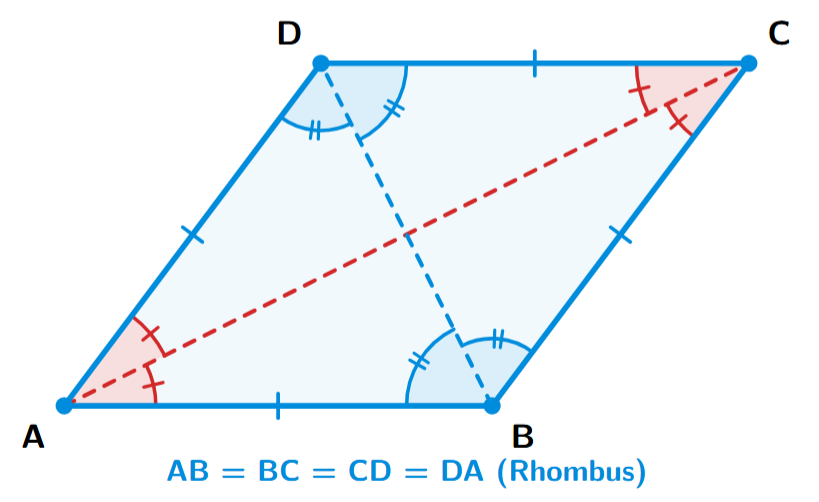
Justification: Suppose the diagonals $AC$ and $BD$ of quadrilateral $ABCD$ bisect all four of its internal angles (which also requires both diagonals to lie inside the quadrilateral, so $ABCD$ is convex).
Since diagonal $AC$ bisects $\angle A$ and $\angle C$, we have $\angle BAC = \angle DAC$ and $\angle BCA = \angle DCA$.
In $\triangle ABC$ and $\triangle ADC$:
$\angle BAC = \angle DAC$, $AC = AC$ (common side), and $\angle BCA = \angle DCA$.
Therefore, $\triangle ABC \cong \triangle ADC$ by the ASA congruence rule, which gives $AB = AD$ and $CB = CD$ (by CPCT).
Similarly, since diagonal $BD$ bisects $\angle B$ and $\angle D$, we have $\angle ABD = \angle CBD$ and $\angle ADB = \angle CDB$. Together with the common side $BD$, we get $\triangle ABD \cong \triangle CBD$ by the ASA congruence rule, which gives $AB = CB$ and $AD = CD$ (by CPCT).
Combining these results, we obtain $AB = BC = CD = DA$. Since all four sides are equal, $ABCD$ must be a rhombus.
(ii) If the diagonals of a quadrilateral $ABCD$ bisect each other at right angles, must $ABCD$ be a rhombus?
Answer: Yes.
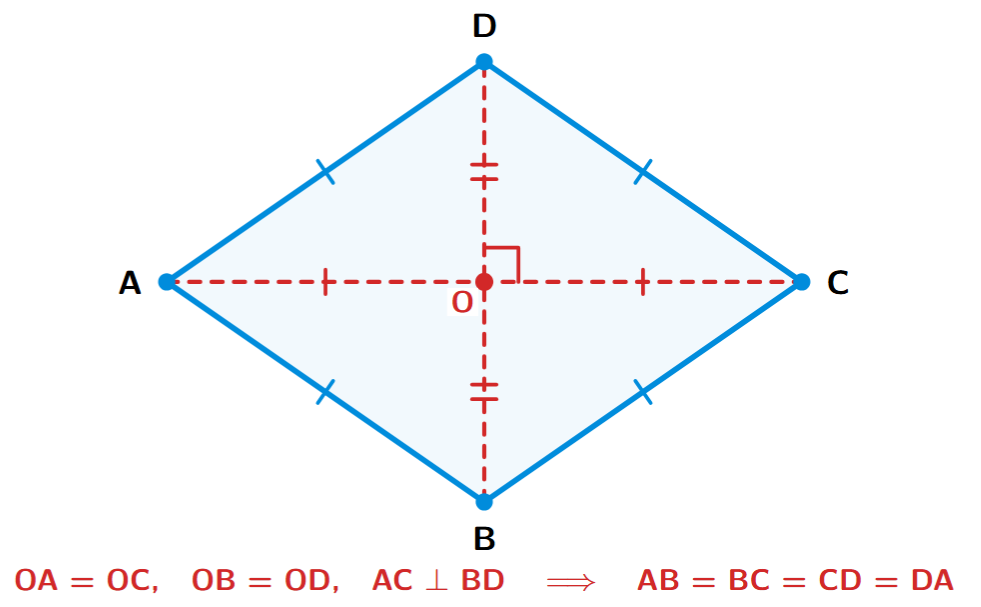
Justification: Let the diagonals $AC$ and $BD$ bisect each other at point $O$ at right angles. Then $OA = OC$, $OB = OD$, and $\angle AOB = \angle BOC = \angle COD = \angle DOA = 90^\circ$.
Consider $\triangle AOB$ and $\triangle COB$:
$OA = OC$, $\angle AOB = \angle COB = 90^\circ$, and $OB = OB$ (common side).
Therefore, $\triangle AOB \cong \triangle COB$ by the SAS congruence rule, so $AB = BC$ (by CPCT).
In the same way, $\triangle COB \cong \triangle COD$ gives $BC = CD$, and $\triangle COD \cong \triangle DOA$ gives $CD = DA$.
Hence, $AB = BC = CD = DA$. Because all four sides are equal, $ABCD$ must be a rhombus.
(iii) If the diagonals of a quadrilateral $ABCD$ are of equal length, must $ABCD$ be a rectangle?
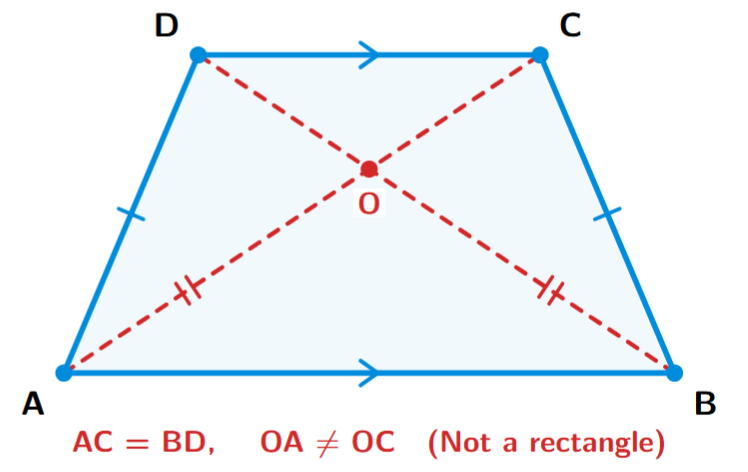
Answer: No.
Counterexample: An isosceles trapezium (with one pair of parallel sides and equal non-parallel sides) has equal diagonals ($AC = BD$), yet it is not a rectangle. More generally, any two equal line segments $AC$ and $BD$ that intersect without bisecting each other form a quadrilateral with equal diagonals that is not even a parallelogram.
Extra Condition Needed: To guarantee that $ABCD$ is a rectangle, we must add the condition that the diagonals also bisect each other (or equivalently, that $ABCD$ is a parallelogram).
When $AC = BD$ and the diagonals bisect each other at $O$, we get $OA = OB = OC = OD$, which makes $ABCD$ a parallelogram with equal diagonals—hence necessarily a rectangle.
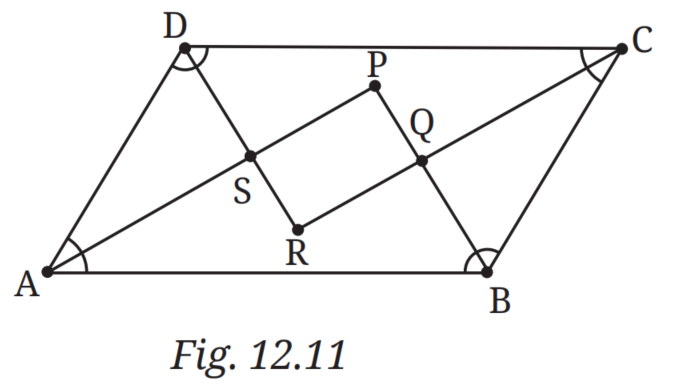
Question 4. Let $ABCD$ be a parallelogram with $AB \neq BC$. Show that the pairwise intersection points of the four angle bisectors form the vertices of a rectangle (see Fig. 12.11). Why did we assume $AB \neq BC$?
Answer:
Given:
$ABCD$ is a parallelogram with $AB \neq BC$.
As shown in Fig. 12.11, the angle bisectors of $\angle A, \angle B, \angle C,$ and $\angle D$ intersect pairwise at $P, Q, R,$ and $S$.
To Prove:
1. $PQRS$ is a rectangle.
2. Explain why $AB \neq BC$ is assumed.
Proof (Part 1 — $PQRS$ is a rectangle):
In parallelogram $ABCD$, $AB \parallel DC$ and $AD \parallel BC$.
Step 1: Find $\angle PSR$.
Since $AB \parallel DC$ with transversal $AD$, co-interior angles sum to $180^\circ$.
$\angle A + \angle D = 180^\circ$
Divide both sides by $2$:
$\dfrac{1}{2}\angle A + \dfrac{1}{2}\angle D = 90^\circ$
Since $AS$ bisects $\angle A$ and $DS$ bisects $\angle D$, we get:
$\angle SAD + \angle SDA = 90^\circ$
In $\triangle ASD$, by the angle sum property:
$\angle ASD + \angle SAD + \angle SDA = 180^\circ$
$\angle ASD + 90^\circ = 180^\circ \implies \angle ASD = 90^\circ$
By vertically opposite angles, $\angle PSR = \angle ASD = 90^\circ$.
Step 2: Find $\angle PQR$.
Similarly, $AB \parallel DC$ with transversal $BC$ gives $\angle B + \angle C = 180^\circ$.
Dividing by $2$ gives $\angle QBC + \angle QCB = 90^\circ$.
In $\triangle BQC$, $\angle BQC = 180^\circ - 90^\circ = 90^\circ$.
By vertically opposite angles, $\angle PQR = \angle BQC = 90^\circ$.
Step 3: Find $\angle SPQ$ and $\angle SRQ$.
Since $AD \parallel BC$ with transversal $AB$, we have $\angle A + \angle B = 180^\circ$.
Dividing by $2$ gives $\angle PAB + \angle PBA = 90^\circ$.
In $\triangle APB$, $\angle APB = 180^\circ - 90^\circ = 90^\circ$, so $\angle SPQ = 90^\circ$.
Similarly, in $\triangle DRC$, $\angle DRC = 90^\circ$, so $\angle SRQ = 90^\circ$.
All four interior angles of quadrilateral $PQRS$ are $90^\circ$.
Therefore, $PQRS$ is a rectangle.
Part 2 — Why we assumed $AB \neq BC$:
Suppose $AB = BC$ in parallelogram $ABCD$.
Then all four sides become equal ($AB = BC = CD = DA$), making $ABCD$ a rhombus.
In a rhombus, the diagonals themselves bisect the interior angles.
So, the bisectors of $\angle A$ and $\angle C$ coincide along diagonal $AC$.
Similarly, the bisectors of $\angle B$ and $\angle D$ coincide along diagonal $BD$.
As a result, all four bisectors meet at a single point instead of forming a rectangle $PQRS$.
Exercise Set 12.3
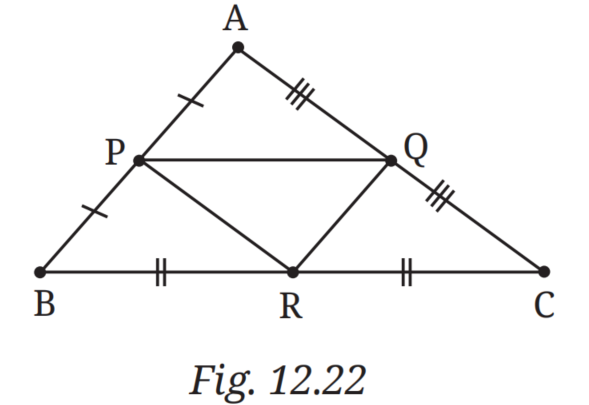
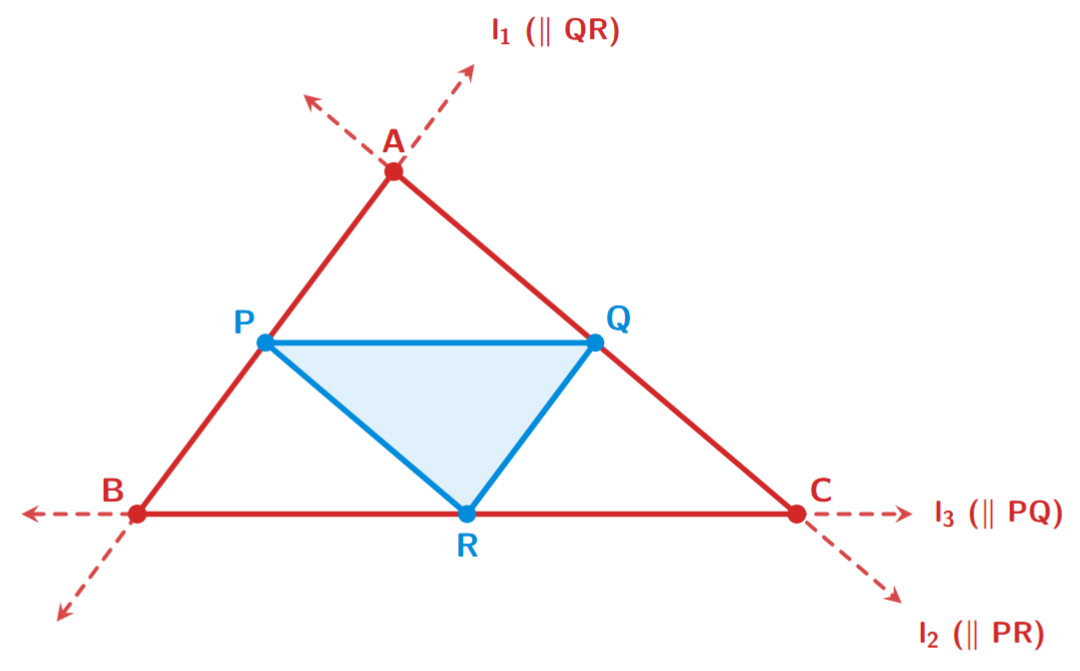
Question 1. (i) If $P$, $Q$, $R$ are the midpoints of sides $AB$, $AC$, $BC$ respectively of $\triangle ABC$, show that $\triangle PQR$ is congruent to $\triangle QPA$ and to two other triangles which you should identify.
(ii) Suppose someone erases $\triangle ABC$, leaving only $\triangle PQR$ on the paper. Can you reconstruct $\triangle ABC$ from $\triangle PQR$?
Answer:
Part (i):
Given:
In $\triangle ABC$, $P$, $Q$, and $R$ are the midpoints of sides $AB$, $AC$, and $BC$ respectively.
So, $AP = PB = \dfrac{1}{2}AB$, $AQ = QC = \dfrac{1}{2}AC$, and $BR = RC = \dfrac{1}{2}BC$.
To Prove:
$\triangle PQR \cong \triangle QPA$, and identify two more congruent triangles.
Proof:
By the Midpoint Theorem, the segment joining the midpoints of two sides of a triangle is half the third side.
1. Since $P$ and $Q$ are midpoints of $AB$ and $AC$: $PQ = \dfrac{1}{2}BC = BR = RC$.
2. Since $Q$ and $R$ are midpoints of $AC$ and $BC$: $QR = \dfrac{1}{2}AB = AP = PB$.
3. Since $P$ and $R$ are midpoints of $AB$ and $BC$: $PR = \dfrac{1}{2}AC = AQ = QC$.
(a) Compare $\triangle PQR$ and $\triangle QPA$:
$PQ = QP$
(Common side)
$QR = PA$
(Proved above)
$PR = QA$
(Proved above)
By SSS congruence, $\triangle PQR \cong \triangle QPA$.
(b) Compare $\triangle PQR$ and $\triangle RBP$:
$PQ = RB$
(Proved above)
$QR = BP$
(Proved above)
$PR = RP$
(Common side)
By SSS congruence, $\triangle PQR \cong \triangle RBP$.
(c) Compare $\triangle PQR$ and $\triangle CRQ$:
$PQ = CR$
(Proved above)
$QR = RQ$
(Common side)
$PR = CQ$
(Proved above)
By SSS congruence, $\triangle PQR \cong \triangle CRQ$.
Thus, the two other congruent triangles are $\triangle RBP$ and $\triangle CRQ$.
Part (ii):
Yes, we can reconstruct $\triangle ABC$ from $\triangle PQR$.
Why This Works:
By the Midpoint Theorem, $AB \parallel QR$, $AC \parallel PR$, and $BC \parallel PQ$.
Steps of Reconstruction:
1. Through vertex $P$, draw a line $l_1$ parallel to side $QR$.
2. Through vertex $Q$, draw a line $l_2$ parallel to side $PR$.
3. Through vertex $R$, draw a line $l_3$ parallel to side $PQ$.
4. Mark the intersection of $l_1$ and $l_2$ as $A$.
5. Mark the intersection of $l_1$ and $l_3$ as $B$.
6. Mark the intersection of $l_2$ and $l_3$ as $C$.
The resulting triangle is the exact original $\triangle ABC$.
Question 2. In $\triangle ABC$, let $M$ and $N$ be midpoints of $AB$ and $AC$ respectively. Let $D$ be any point on $BC$. Show that $MN$ bisects $AD$.
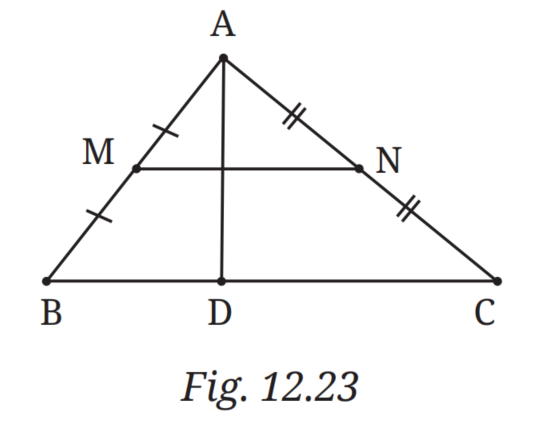
Answer:
Given:
In $\triangle ABC$, $M$ and $N$ are the midpoints of sides $AB$ and $AC$ respectively, and $D$ is any point on side $BC$. Let line segment $MN$ intersect $AD$ at point $P$.
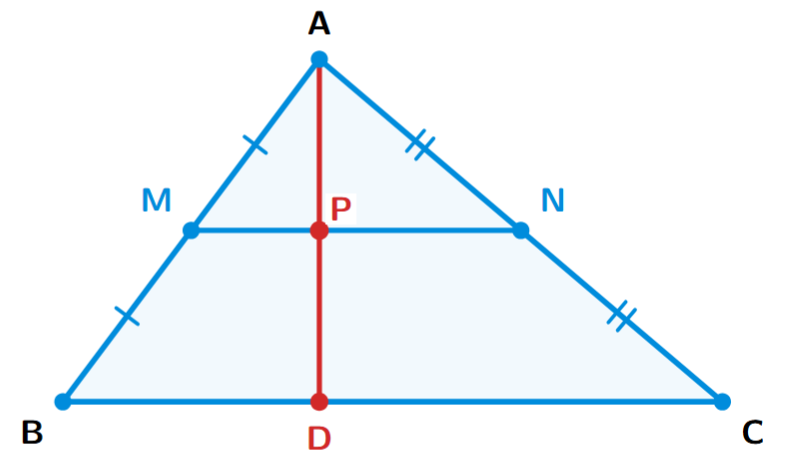
To Prove:
$MN$ bisects $AD$, i.e., $AP = PD$.
Proof:
In $\triangle ABC$, $M$ is the midpoint of $AB$ and $N$ is the midpoint of $AC$.
By the Midpoint Theorem, the line segment joining the midpoints of two sides of a triangle is parallel to the third side. Therefore:
$MN \parallel BC$
Since point $P$ lies on $MN$ and point $D$ lies on $BC$, we have:
$MP \parallel BD$
Now, in $\triangle ABD$:
$M$ is the midpoint of side $AB$
(Given)
$MP \parallel BD$
(Proved above)
By the Converse of the Midpoint Theorem, a line drawn through the midpoint of one side of a triangle and parallel to another side bisects the third side.
Therefore, $P$ is the midpoint of $AD$, which means:
$AP = PD$
Hence, $MN$ bisects $AD$.
Hence proved.
Question 3. In a quadrilateral $ABCD$, suppose $AB \parallel DC$ and $AB \neq CD$. Suppose $G$ and $H$ are the midpoints of $AC$ and $BD$ respectively. Prove that $GH \parallel AB$. (Why did we assume $AB \neq CD$?)
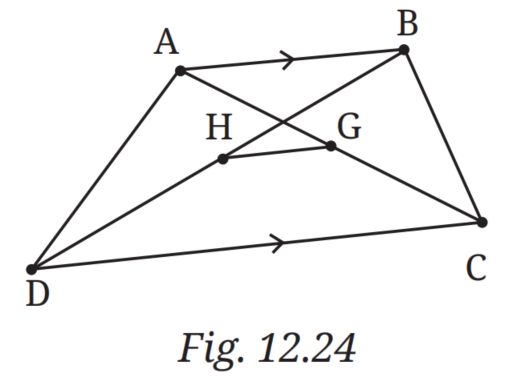
Answer:
Given:
In quadrilateral $ABCD$, $AB \parallel DC$ and $AB \neq CD$. $G$ and $H$ are the midpoints of diagonals $AC$ and $BD$ respectively.
To Prove:
$GH \parallel AB$, and explain why $AB \neq CD$ is assumed.
Construction Required:
Let $M$ be the midpoint of side $AD$. Join $M$ to $G$ and $M$ to $H$.
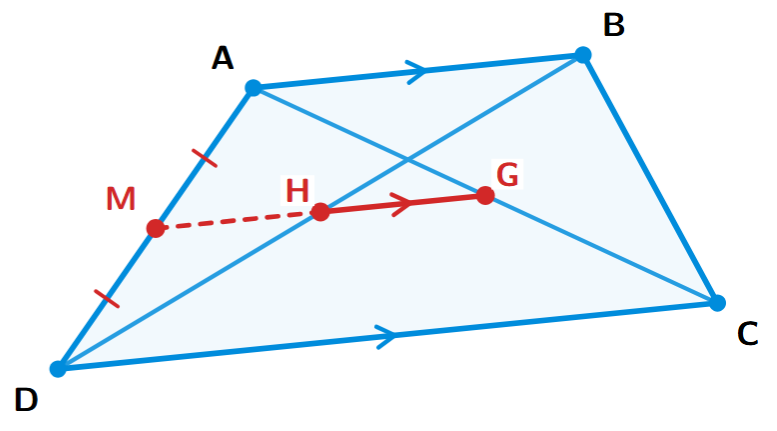
Proof (Using Midpoint Theorem Only):
1. In $\triangle ADC$:
$M$ is the midpoint of side $AD$ (by construction), and $G$ is the midpoint of side $AC$ (given).
By the Midpoint Theorem, the line segment joining the midpoints of two sides of a triangle is parallel to the third side and equal to half of it:
$MG \parallel DC$ and $MG = \frac{1}{2}CD$
Since $AB \parallel DC$ (given), it follows that:
$MG \parallel AB$
2. In $\triangle DAB$:
$M$ is the midpoint of side $AD$ (by construction), and $H$ is the midpoint of side $BD$ (given).
Again, by the Midpoint Theorem:
$MH \parallel AB$ and $MH = \frac{1}{2}AB$
3. Collinearity and Parallelism:
Through the same point $M$, both lines $MG$ and $MH$ are parallel to the same line $AB$.
Through a given point not on a line, there is a unique line parallel to the given line, the lines $MG$ and $MH$ must coincide—that is, points $M$, $H$, and $G$ are collinear and lie on the same straight line parallel to $AB$.
Moreover, since $AB \neq CD$, we have $MH = \frac{1}{2}AB \neq \frac{1}{2}CD = MG$, so $G$ and $H$ are two distinct points on this line.
Therefore, segment $GH$ lies on this line parallel to $AB$, which gives:
$GH \parallel AB$
Hence proved.
Why did we assume $AB \neq CD$?
Since $B$ and $C$ lie on the same side of $AD$, both $H$ and $G$ lie on the same ray starting from $M$ parallel to $AB$, at distances $MH = \frac{1}{2}AB$ and $MG = \frac{1}{2}CD$.
If $AB = CD$, then $MH = MG$, so the midpoints $G$ and $H$ would coincide at a single point ($G = H$)—which also happens because $ABCD$ would be a parallelogram whose diagonals bisect each other at one point.
In that case, $GH$ would reduce to a single point instead of a line segment, so we could not speak of $GH$ being parallel to $AB$.
Question 4. Suppose the midpoints of sides $AB$, $BC$, $CD$ and $DA$ of a quadrilateral $ABCD$ are $P$, $Q$, $R$ and $S$ respectively.
(i) Show that $PR$ and $QS$ bisect each other.
(ii) Show that if $AC = BD$, then $PR$ and $QS$ are perpendicular. Is the converse true?
Answer:
Given:
$ABCD$ is a quadrilateral in which $P$, $Q$, $R$, and $S$ are the midpoints of sides $AB$, $BC$, $CD$, and $DA$ respectively.
To Prove:
(i) $PR$ and $QS$ bisect each other.
(ii) If $AC = BD$, then $PR \perp QS$; and check whether the converse is true.
Construction Required:
Join $PQ$, $QR$, $RS$, and $SP$ to form quadrilateral $PQRS$. Join diagonals $AC$ and $BD$ of quadrilateral $ABCD$, and join $PR$ and $QS$ intersecting at $O$.
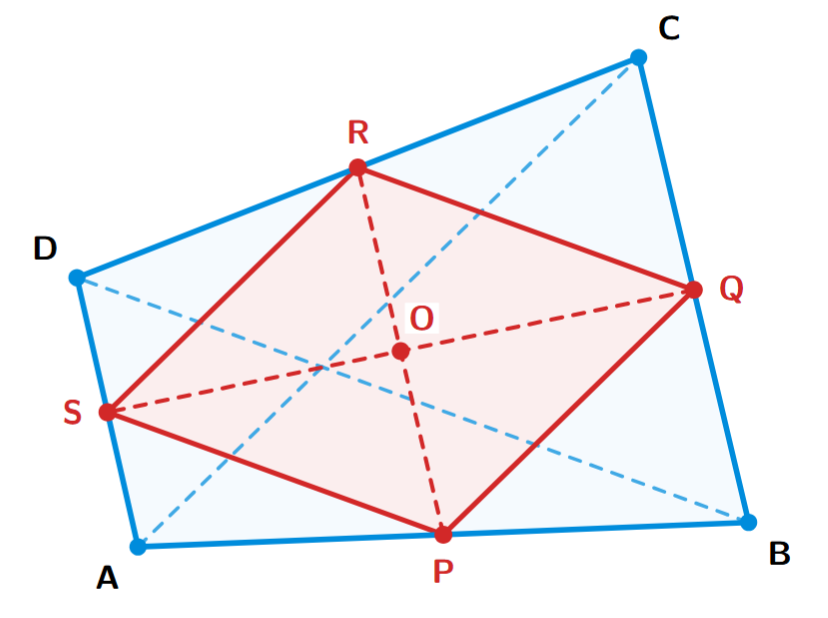
Proof of (i):
In $\triangle ABC$, $P$ and $Q$ are the midpoints of sides $AB$ and $BC$ respectively. By the Midpoint Theorem:
$PQ \parallel AC$ and $PQ = \frac{1}{2}AC$
…(i)
In $\triangle ADC$, $S$ and $R$ are the midpoints of sides $AD$ and $CD$ respectively. By the Midpoint Theorem:
$SR \parallel AC$ and $SR = \frac{1}{2}AC$
…(ii)
From (i) and (ii), we obtain $PQ \parallel SR$ and $PQ = SR$.
Since one pair of opposite sides of quadrilateral $PQRS$ is both equal and parallel, $PQRS$ is a parallelogram.
Because $PR$ and $QS$ are the diagonals of parallelogram $PQRS$, and the diagonals of a parallelogram bisect each other, it follows that $PR$ and $QS$ bisect each other.
Hence proved.
Proof of (ii):
Forward Part: Suppose $AC = BD$.
In $\triangle ABD$, $P$ and $S$ are the midpoints of sides $AB$ and $AD$ respectively. By the Midpoint Theorem:
$PS \parallel BD$ and $PS = \frac{1}{2}BD$
From equation (i), $PQ = \frac{1}{2}AC$. Since $AC = BD$, we have:
$PQ = \frac{1}{2}AC = \frac{1}{2}BD = PS$
In parallelogram $PQRS$, the opposite sides are equal ($PQ = SR$ and $PS = QR$). Since $PQ = PS$, all four sides are equal:
$PQ = QR = RS = SP$
Therefore, $PQRS$ is a rhombus.
Since the diagonals of a rhombus intersect at right angles, $PR \perp QS$.
Hence proved.
Converse of (ii):
Converse Statement: If $PR$ and $QS$ are perpendicular ($PR \perp QS$), must $AC = BD$?
Answer: Yes, the converse is true.
Proof of Converse: Suppose $PR \perp QS$.
From part (i), $PQRS$ is a parallelogram whose diagonals $PR$ and $QS$ bisect each other at $O$, so $PO = OR$ and $QO = OS$.
In $\triangle POQ$ and $\triangle POS$:
$QO = SO$ (diagonals of parallelogram $PQRS$ bisect each other), $\angle POQ = \angle POS = 90^\circ$ (given $PR \perp QS$), and $PO = PO$ (common side).
Thus, $\triangle POQ \cong \triangle POS$ by the SAS congruence rule, which gives $PQ = PS$ (by CPCT).
Since $PQ = \frac{1}{2}AC$ and $PS = \frac{1}{2}BD$ (by the Midpoint Theorem), we get:
$\frac{1}{2}AC = \frac{1}{2}BD \implies$ $AC = BD$
Hence, the converse is true.
Question 5. Suppose $PQRS$ is the Varignon parallelogram of $ABCD$.
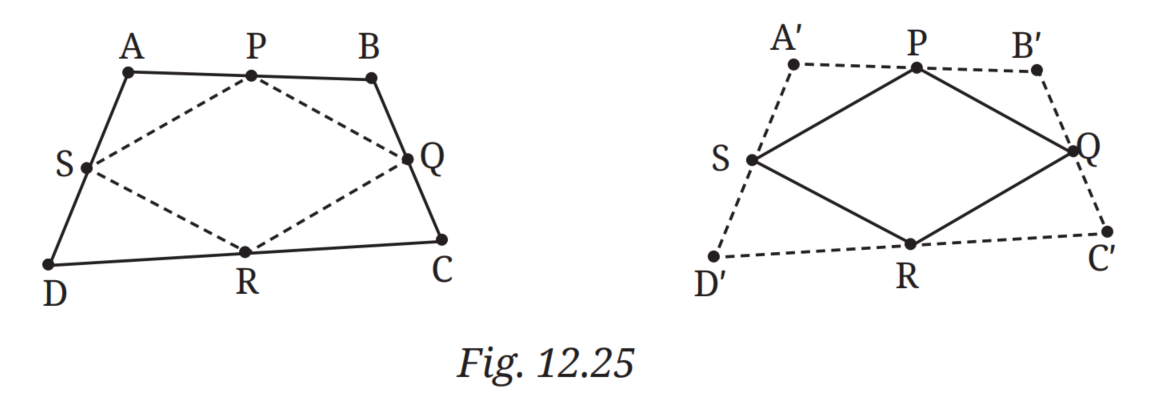
(i) Copy only $PQRS$ on another paper. Show how you will recreate a congruent copy $A'B'C'D'$ of $ABCD$ from $PQRS$. This will be relevant when we return to study tilings at the end of this chapter. (Hint: How will you place vertex $A'$? How will you place $B'$, $C'$ and $D'$?)
(ii) There are multiple ways to construct $A'B'C'D'$ in (i). Justify why the quadrilateral $A'B'C'D'$ you constructed is congruent to $ABCD$. You may need to show why $S$ is collinear with the points $A'$ and $D'$ that you constructed, and similarly for $P$, $Q$ and $R$. (Hint: Use congruence of triangles, for example $\triangle SDR \cong \triangle SD'R$.)
(iii) Show that if $PQRS$ is a square, then $AC$ and $BD$ are perpendicular and equal. Prove the converse
Answer:
(i) Reconstructing $A'B'C'D'$ from $PQRS$:
A copy of $PQRS$ is drawn below using a tracing paper.
We choose point $A'$ such that $A'P = AP$ and $A'S = AS$.
Draw $A'P$ and produce it to $B'$ such that $PB' = PA'$.
Draw $B'Q$ and produce it to $C'$ such that $QC' = QB'$.
Draw $C'R$ and produce it to $D'$ such that $RD' = RC'$.
Join $D'$ and $A'$. Here $P$, $Q$, and $R$ are midpoints of $A'B'$, $B'C'$, and $C'D'$ respectively.
In $\triangle A'B'C'$, by the Midpoint Theorem, we have:
$PQ \parallel A'C'$ and $PQ = \frac{1}{2}A'C'$
Let $S'$ be the midpoint of $D'A'$.
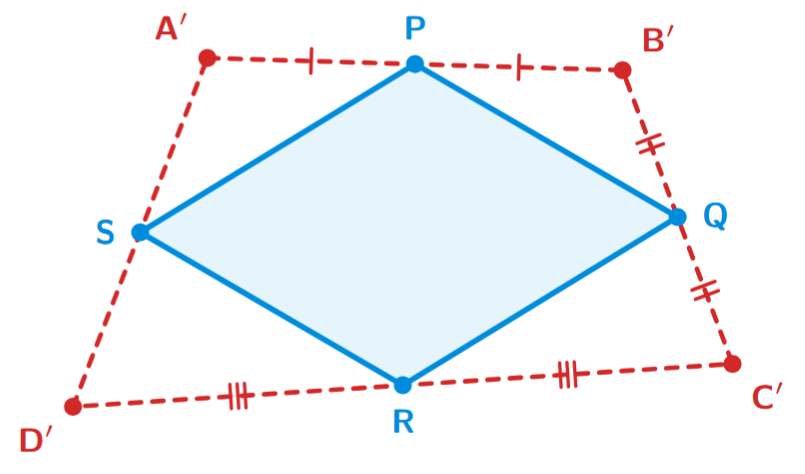
In $\triangle C'D'A'$, by the Midpoint Theorem, we have:
$S'R \parallel A'C'$ and $S'R = \frac{1}{2}A'C'$
$\therefore PQ \parallel S'R$ and $PQ = S'R$
Also, $PQ \parallel SR$ and $PQ = SR$ (since $PQRS$ is a parallelogram).
$\therefore S'$ must coincide with $S$.
$\therefore$ Point $S$ is collinear with points $A'$ and $D'$.
Thus, $PQRS$ is the Varignon parallelogram of the quadrilateral $A'B'C'D'$.
Also, $\triangle SA'P \cong \triangle SAP$, $\triangle PB'Q \cong \triangle PBQ$, $\triangle QC'R \cong \triangle QCR$, and $\triangle RD'S \cong \triangle RDS$.
$\therefore$ Quadrilateral $A'B'C'D'$ is a congruent copy of quadrilateral $ABCD$.
(ii) Justification:
In general, there are unlimited choices of $A'$ such that its distances from $P$ and $S$ are equal (or chosen freely, and in fact we could begin the reconstruction from any of the four vertices $A'$, $B'$, $C'$, or $D'$).
$\therefore$ There are multiple ways to construct $A'B'C'D'$ such that $PQRS$ is its Varignon parallelogram.
Since $P$, $Q$, $R$, and $S$ are collinear with and bisect $A'B'$, $B'C'$, $C'D'$, and $D'A'$ respectively, and $\triangle SA'P \cong \triangle SAP$, $\triangle PB'Q \cong \triangle PBQ$, $\triangle QC'R \cong \triangle QCR$, and $\triangle RD'S \cong \triangle RDS$ (so $\triangle SDR \cong \triangle SD'R$), all corresponding sides and corresponding angles of $A'B'C'D'$ and $ABCD$ are equal.
Hence, $A'B'C'D' \cong ABCD$.
(iii) $PQRS$ is a Square $\iff$ $AC \perp BD$ and $AC = BD$:
Let $ABCD$ be a quadrilateral whose Varignon parallelogram $PQRS$ is a square.
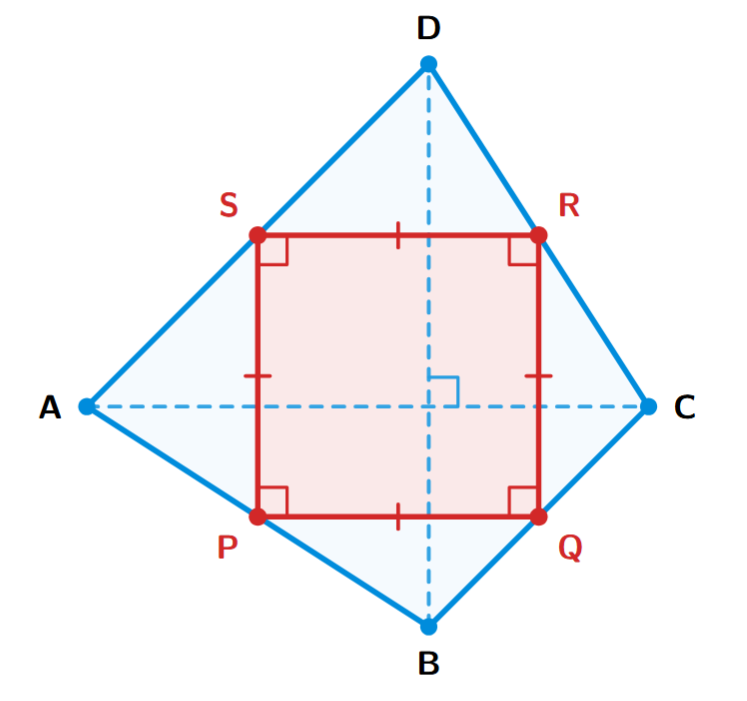
In $\triangle ABC$, by the Midpoint Theorem, we have:
$PQ \parallel AC$ and $PQ = \frac{1}{2}AC$
…(i)
In $\triangle BCD$, by the Midpoint Theorem, we have:
$QR \parallel BD$ and $QR = \frac{1}{2}BD$
…(ii)
Since $PQRS$ is a square, we have:
$PQ \perp QR$ and $PQ = QR$
From (i) and (ii), it follows that:
$\therefore$ $AC \perp BD$ and $AC = BD$
$\therefore$ Diagonals $AC$ and $BD$ of $ABCD$ are perpendicular and equal.
Converse:
Conversely, let $AC$ and $BD$ be perpendicular and equal, i.e.:
$AC \perp BD$ and $AC = BD$
$\therefore$ Equations (i) and (ii) imply:
$PQ \perp QR$ and $PQ = QR$
Thus, adjacent sides $PQ$ and $QR$ of the parallelogram $PQRS$ are perpendicular and equal.
$\therefore$ $PQRS$ is a square.
Hence proved.
Exercise Set 12.4
Question 1. Justify why the plane cannot be tiled with a regular pentagon.
(Hint: Read the first 3 sentences of ‘Think and Reflect’ in the section on tiling.) (There are many ways to tile the plane using a suitable irregular pentagon. The most recent method was found in 2015.)
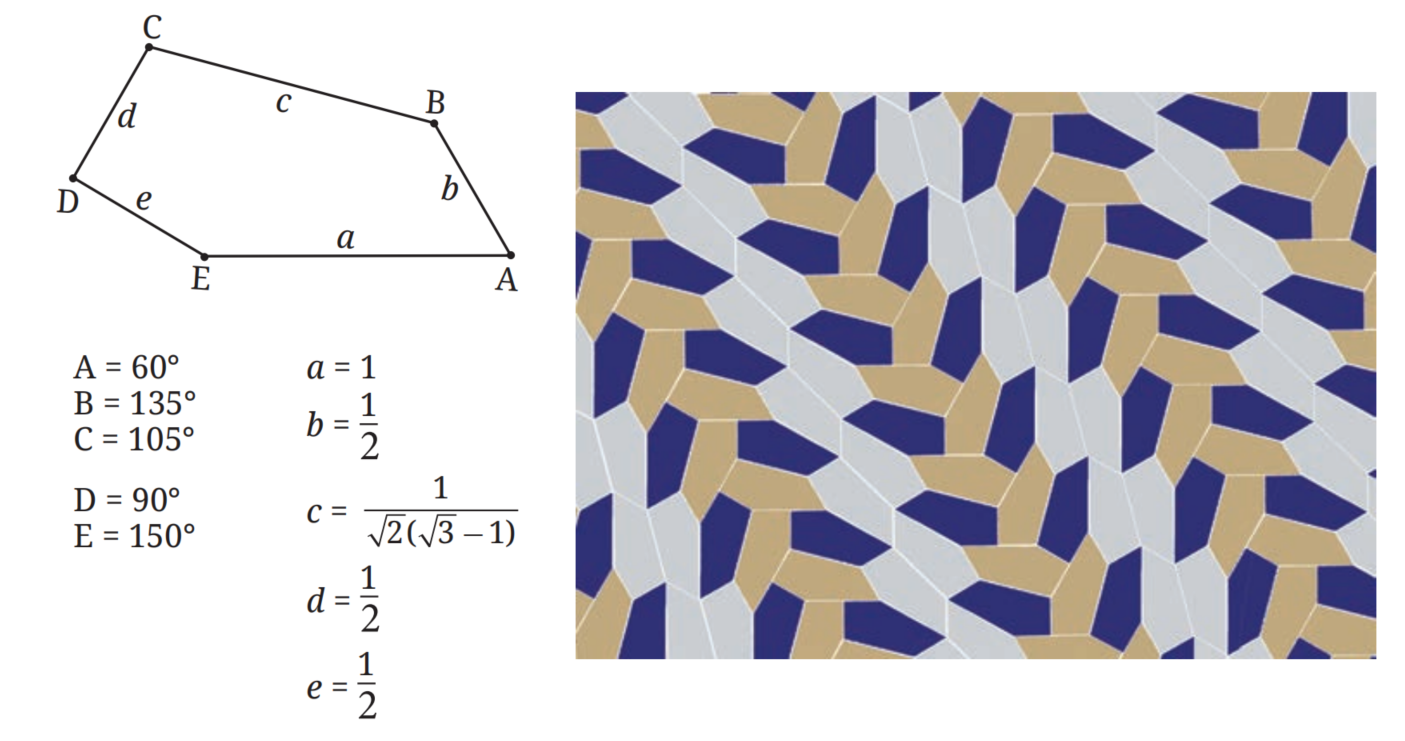
Answer:
Solution:
We know that the sum of all exterior angles of any convex polygon is $360^\circ$. Since a regular pentagon has $5$ equal sides and $5$ equal exterior angles, each exterior angle of a regular pentagon is:
$\frac{360^\circ}{5} = 72^\circ$
$\therefore$ Each interior angle of a regular pentagon is:
$180^\circ - 72^\circ = 108^\circ$
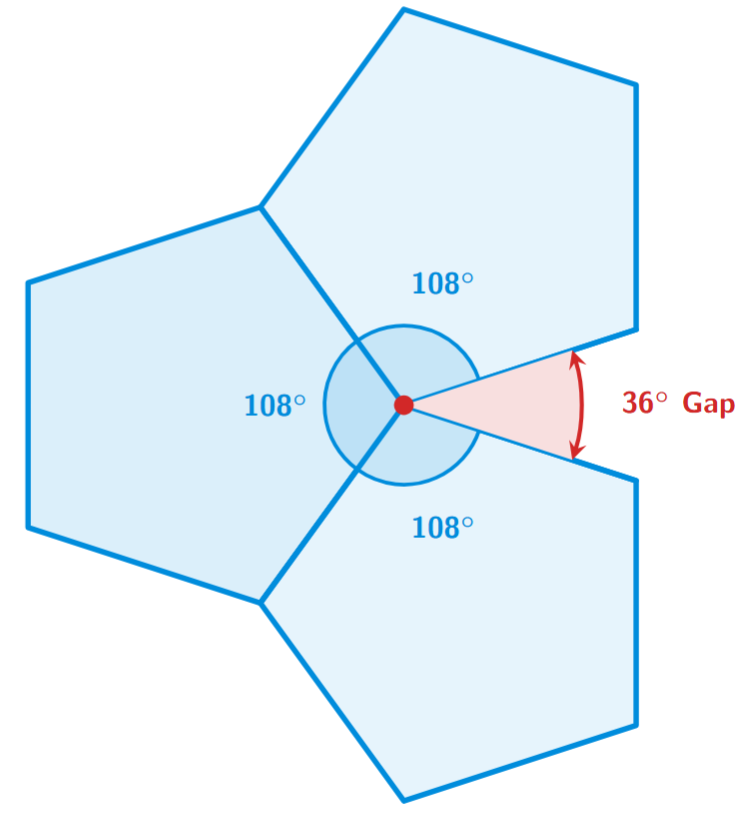
For copies of a regular polygon to tile the plane without gaps or overlaps, the interior angles meeting at any common vertex must sum to $360^\circ$ (i.e., $108^\circ$ must divide $360^\circ$ evenly).
Now, checking multiples of $108^\circ$:
$3(108^\circ) = 324^\circ < 360^\circ$
$4(108^\circ) = 432^\circ > 360^\circ$
$\therefore$ If we try to fit $3$ regular pentagons around a point, they will leave a gap of $360^\circ - 324^\circ = 36^\circ$, and if we try to fit $4$ regular pentagons around a point, two pentagons would overlap.
(Even if vertices meet along the side of another pentagon, two interior angles give $2(108^\circ) = 216^\circ > 180^\circ$, which also overlaps.)
$\therefore$ We cannot fit any number of regular pentagons around a point so that there are no gaps and no overlaps.
Conclusion:
$\therefore$ A plane cannot be tiled with copies of a regular pentagon.
Question 2. Draw a non-convex $4$-gon $DART$. Show how we can tile the plane with copies of $DART$. Both methods that we discussed earlier will work. Which do you prefer?
Answer:
Solution:
Let $DART$ be a non-convex $4$-gon (with a reflex internal angle, say at vertex $R$).
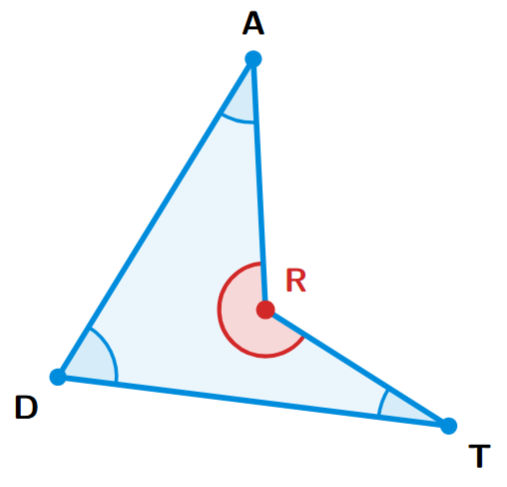
We shall tile the plane with copies of $DART$ using the $180^\circ$ midpoint-rotation method (which does not require constructing the Varignon parallelogram of the $4$-gon $DART$).
Step-by-Step Tiling Procedure:
Step 1: Cut out the $4$-gon $DART$ along its sides and prepare several congruent copies of it—say $4$ copies labelled I, II, III, and IV (as shown in Figure (i)).
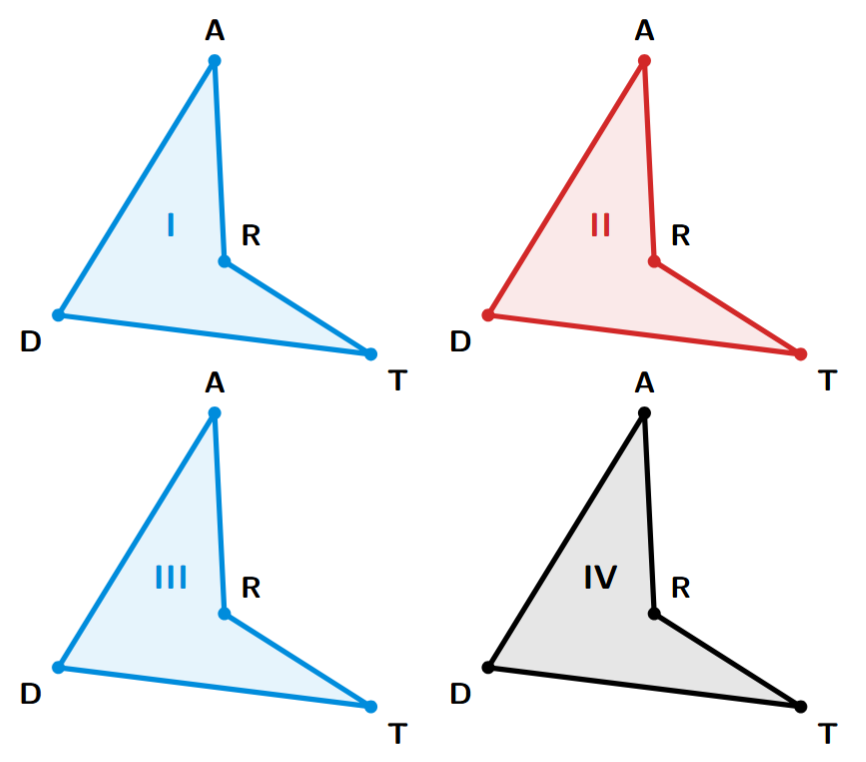
Step 2: Paste copy I onto a sheet of paper, and place copy II directly on top of copy I so that they coincide.
Step 3: Rotate copy II by $180^\circ$ around the midpoint of side $DA$ of copy I.
Because a $180^\circ$ rotation about the midpoint of $DA$ swaps vertices $D$ and $A$, the rotated copy II aligns perfectly with copy I along the shared edge $DA$ without any gap or overlap (as shown in the figure below). Paste copy II in this position.
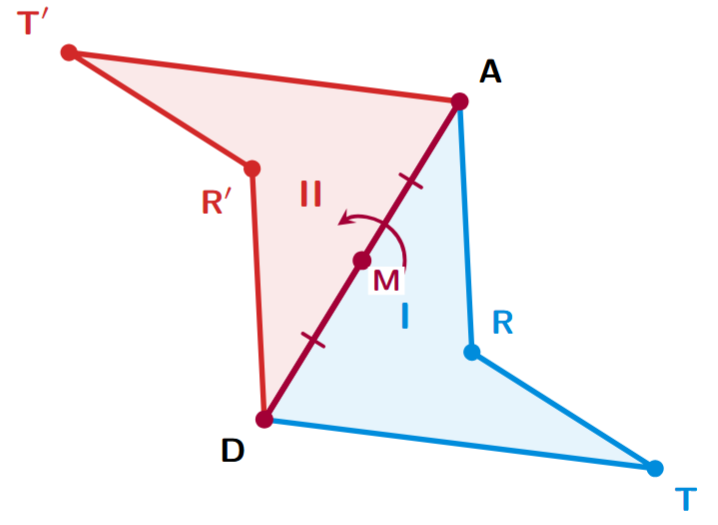
Step 4: Similarly, rotate and paste copy III and copy IV by $180^\circ$ about the midpoints of the remaining sides (such as $AR$, $RT$, and $TD$) so that their shared edges align seamlessly and the four angles $\angle D$, $\angle A$, $\angle R$, and $\angle T$ meet around a common vertex, summing to $360^\circ$ (as shown in the figure below).
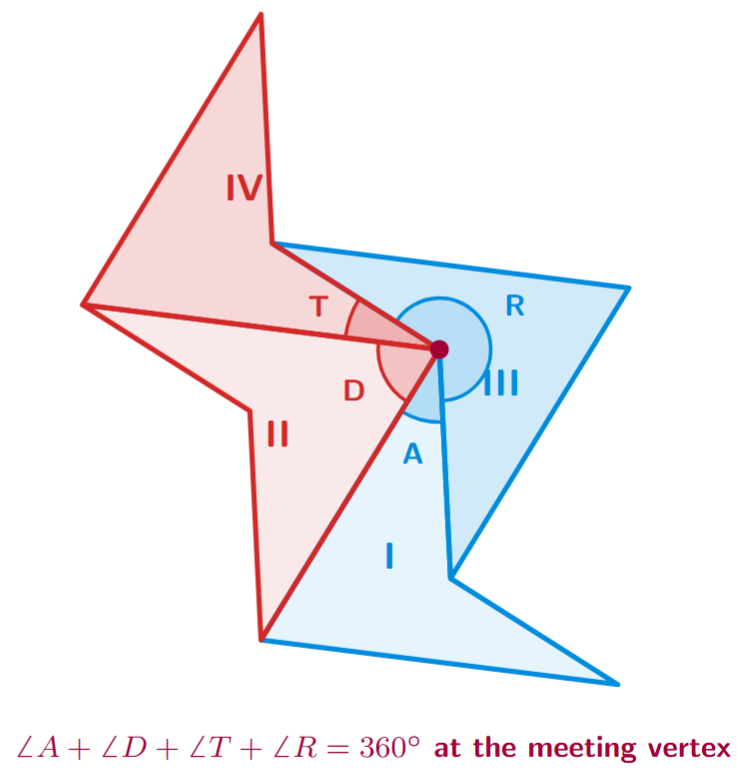
Step 5: Repeating this process along every outer edge, we can add any number of copies of the non-convex $4$-gon $DART$ to cover the entire plane without gaps or overlaps.
Which Method is Preferred?
While both the midpoint-rotation method and the Varignon parallelogram method work for tiling the plane with $DART$, the $180^\circ$ midpoint-rotation method is preferred because it is simpler and more direct—especially for a non-convex $4$-gon, where the Varignon parallelogram lies partly outside the quadrilateral.
End-of-Chapter Exercises
Question 1. Using a fact about parallelograms, show how to tile the plane using any given triangle. (Hint: Can you use the parallelogram tiling in the introduction?)
Answer:
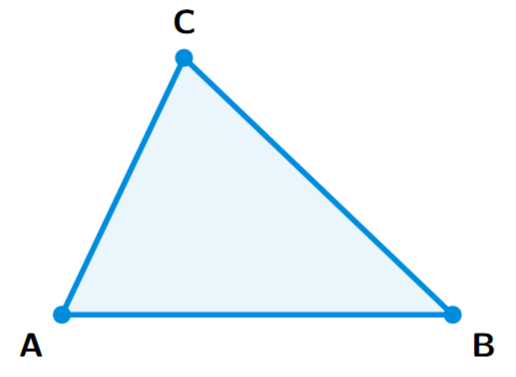
Given:
Any triangle $\triangle ABC$.
To Show:
How to tile the entire plane without any gaps or overlaps using congruent copies of the given triangle $\triangle ABC$, with the help of a property of parallelograms.
Fact About Parallelograms Used:
1. A diagonal of a parallelogram divides it into two congruent triangles.
2. Congruent copies of any parallelogram can tile the entire plane completely without any gaps or overlaps (by placing them side-by-side in rows and stacking the rows along the direction of the parallel sides).
Construction:
Starting from the given $\triangle ABC$, draw a line through $C$ parallel to $AB$ ($CP \parallel AB$) and a line through $B$ parallel to $AC$ ($BP \parallel AC$). Let these two lines intersect at point $P$ to complete the parallelogram $ABPC$.
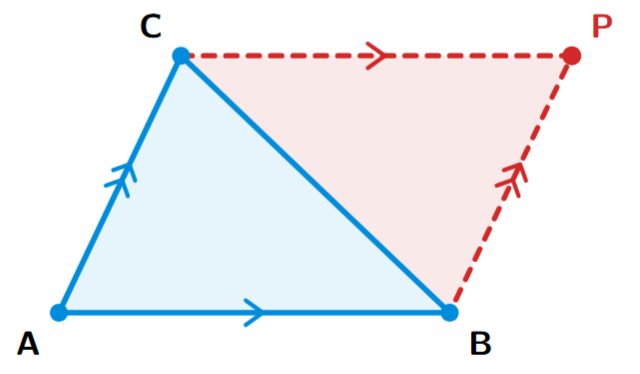
Solution:
In order to show that $\triangle ABC$ can tile the plane, let us first verify that $\triangle ABC$ and $\triangle PCB$ are congruent copies of each other.
In $\triangle ABC$ and $\triangle PCB$:
$\angle ABC = \angle PCB$
(Alternate interior angles, since $AB \parallel CP$ and $BC$ is a transversal)
$BC = CB$
(Common side)
$\angle ACB = \angle PBC$
(Alternate interior angles, since $AC \parallel BP$ and $BC$ is a transversal)
$\therefore \; \triangle ABC \cong \triangle PCB$
(By ASA congruence rule)
Thus, $\triangle PCB$ is an exact copy of $\triangle ABC$ (obtained by rotating $\triangle ABC$ by $180^\circ$ about the midpoint of side $BC$).
This means that two congruent copies of $\triangle ABC$ together form the parallelogram $ABPC$ completely without any gap or overlap.
Steps to Tile the Plane:
1. Make sufficient congruent copies of the given $\triangle ABC$ (for example, using tracing paper or paper cutouts).
2. Pair two copies of $\triangle ABC$ (one placed upright and the other rotated by $180^\circ$ along a common side such as $BC$) to form a parallelogram $ABPC$.
3. Since identical parallelograms can tile the plane completely, arrange these pairs of triangles side-by-side in straight strips along the direction of $AB$ (or $AC$), and then place more such strips adjacent to one another to cover the plane.
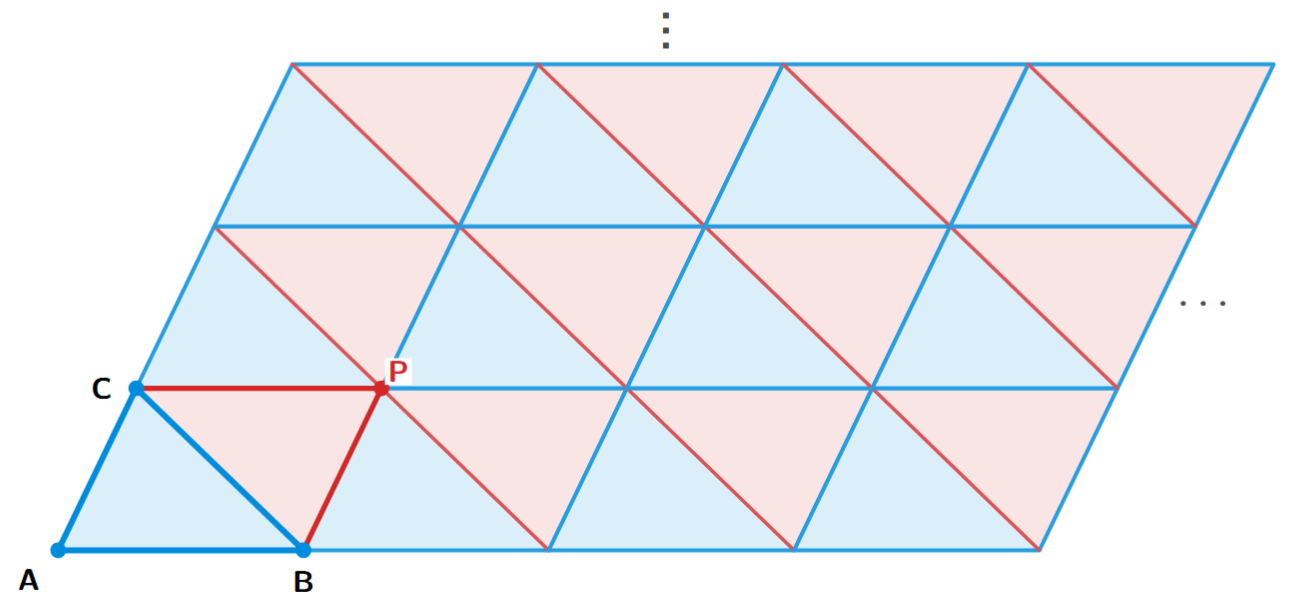
Since every parallelogram in the parallelogram tiling is composed of two congruent copies of $\triangle ABC$, the above arrangement forms a complete tiling pattern of the plane using the given triangle $\triangle ABC$ without any gaps or overlaps.
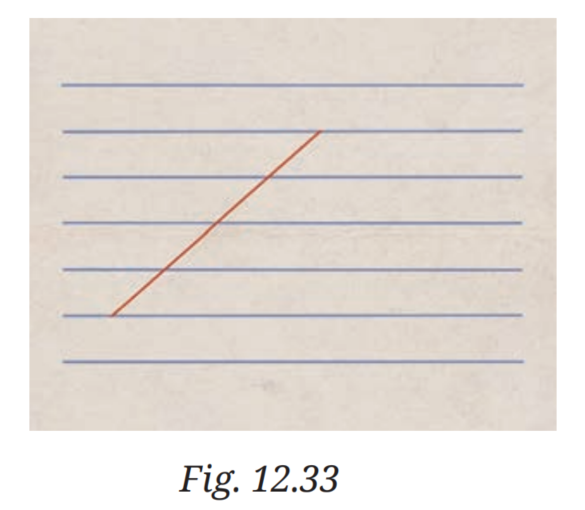
Question 2. Mark the midpoint of the line drawn on the paper (see Fig. 12.33), given that the horizontal lines are equally spaced. Justify your answer.
Answer:
Given:
A slanted line segment is drawn across equally spaced horizontal parallel lines as shown in Fig. 12.33, spanning across $4$ equal spaces (between the $2^{\text{nd}}$ and $6^{\text{th}}$ horizontal lines from the bottom).
To Find:
Mark the midpoint of the given line segment and justify the answer.
Construction Required:
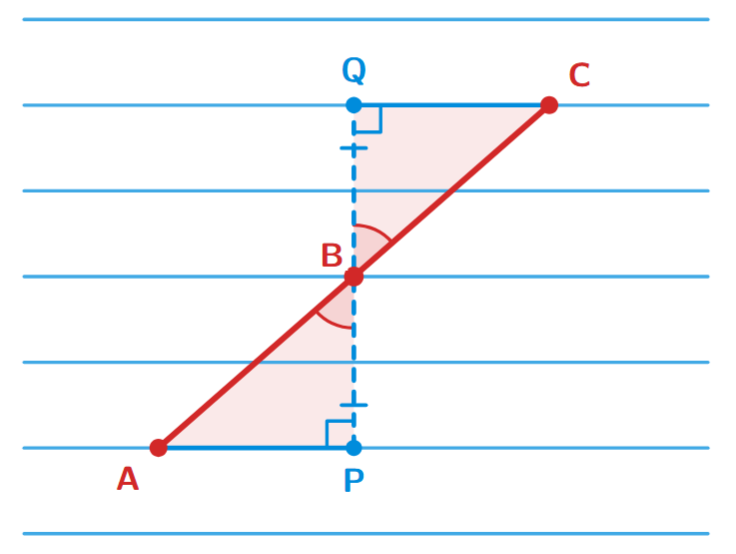
1. Mark the endpoints of the given line segment as $A$ (on the $2^{\text{nd}}$ horizontal line from the bottom) and $C$ (on the $6^{\text{th}}$ horizontal line from the bottom), and mark point $B$ where the segment intersects the middle horizontal line (the $4^{\text{th}}$ horizontal line from the bottom).
2. From $B$, draw a line segment $PQ$ perpendicular to the given parallel lines, such that $P$ lies on the horizontal line passing through $A$ and $Q$ lies on the horizontal line passing through $C$.
Solution / Justification:
The midpoint of the given line segment $AC$ is the point $B$ (lying on the $4^{\text{th}}$ horizontal line from the bottom).
To justify this, consider $\triangle ABP$ and $\triangle CBQ$:
$\angle ABP = \angle CBQ$
(Vertically opposite angles)
$BP = BQ$
(Each is twice the distance between two consecutive parallel lines)
$\angle APB = \angle CQB = 90^\circ$
(Since $PQ$ is perpendicular to the horizontal parallel lines)
$\therefore \; \triangle ABP \cong \triangle CBQ$
(By ASA congruence rule)
$\therefore \; AB = CB$
(CPCT)
$\therefore$ $B$ is the midpoint of $AC$.
Question 3. You know that the sum of angles of a quadrilateral is $360^\circ$, even for a non-convex quadrilateral. (Recall the proof.) Now consider a self-intersecting quadrilateral $ABCD$, where $AB$ and $CD$ intersect at point $E$. Show that $\angle A + \angle B + \angle C + \angle D < 360^\circ$. Can you construct $ABCD$ such that $\angle A + \angle B + \angle C + \angle D = 2^\circ$?
Answer:
Part 1: Proof that the sum of angles of a non-convex quadrilateral is $360^\circ$
Given:
Let $ABCD$ be a non-convex quadrilateral.
To Prove:
$\angle A + \angle B + \angle C + \angle D = 360^\circ$.
Construction Required:
Join the diagonal $BD$ (which lies inside the non-convex quadrilateral $ABCD$). Label the angles of $\triangle ABD$ as $\angle 1, \angle 2, \angle 3$ (at vertices $A, B, D$ respectively) and the angles of $\triangle BCD$ as $\angle 4, \angle 6, \angle 5$ (at vertices $B, C, D$ respectively).
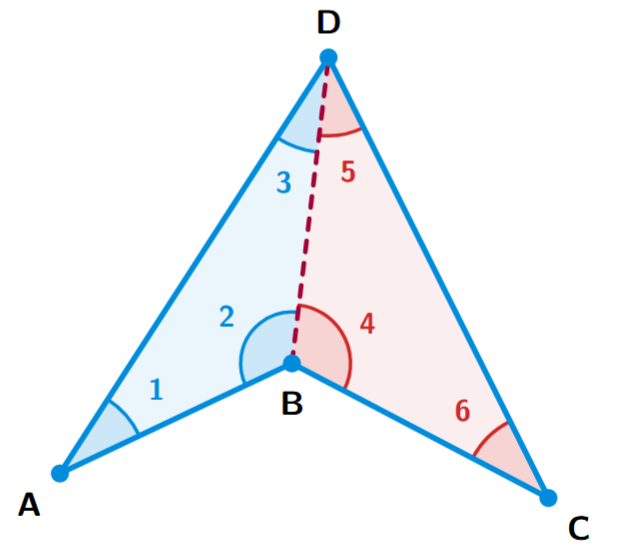
Proof:
In $\triangle ABD$, by the angle sum property of a triangle, we have:
$\angle 1 + \angle 2 + \angle 3 = 180^\circ$
[Angle sum property of a triangle] ... (i)
In $\triangle BCD$, by the angle sum property of a triangle, we have:
$\angle 4 + \angle 6 + \angle 5 = 180^\circ$
[Angle sum property of a triangle] ... (ii)
Adding equations (i) and (ii), we get:
$\therefore \; (\angle 1 + \angle 2 + \angle 3) + (\angle 4 + \angle 6 + \angle 5) = 180^\circ + 180^\circ$
$\therefore \; \angle 1 + (\angle 2 + \angle 4) + \angle 6 + (\angle 3 + \angle 5) = 360^\circ$
Here, $\angle 1 = \angle A$, $\angle 2 + \angle 4 = \angle B$, $\angle 6 = \angle C$, and $\angle 3 + \angle 5 = \angle D$.
$\therefore \; \angle A + \angle B + \angle C + \angle D = 360^\circ$
(Hence proved)
$\therefore$ The sum of all interior angles of the non-convex quadrilateral $ABCD$ is $360^\circ$.
Part 2: Proof that for a self-intersecting quadrilateral $ABCD$, $\angle A + \angle B + \angle C + \angle D < 360^\circ$
Given:
Let $ABCD$ be a self-intersecting quadrilateral whose sides $AB$ and $CD$ intersect each other at point $E$.
To Prove:
$\angle A + \angle B + \angle C + \angle D < 360^\circ$.
Construction Required:
Join $BD$ and $AC$ to form the non-self-intersecting quadrilateral $ADBC$. Label the angles formed at the vertices as follows: at $A$, let $\angle DAB = \angle 1$ and $\angle BAC = \angle 8$; at $D$, let $\angle ADC = \angle 2$ and $\angle CDB = \angle 3$; at $B$, let $\angle DBA = \angle 4$ and $\angle ABC = \angle 5$; and at $C$, let $\angle BCD = \angle 6$ and $\angle DCA = \angle 7$.
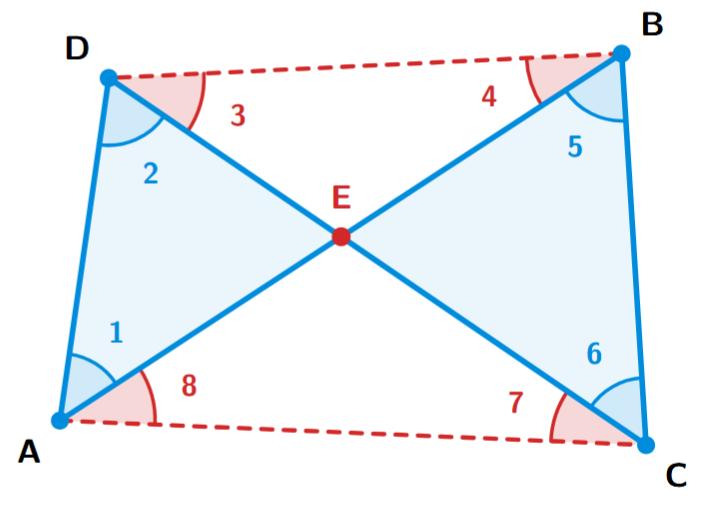
Proof:
Since $AB$ and $CD$ intersect at $E$, we obtain two triangles, $\triangle ADE$ and $\triangle BCE$.
$\angle A + \angle D + \angle AED = 180^\circ$
[Angle sum property of $\triangle ADE$] ... (iii)
$\angle B + \angle C + \angle BEC = 180^\circ$
[Angle sum property of $\triangle BCE$] ... (iv)
Adding equations (iii) and (iv), we get:
$\angle A + \angle B + \angle C + \angle D + (\angle AED + \angle BEC) = 360^\circ$
$\therefore \; \angle A + \angle B + \angle C + \angle D = 360^\circ - (\angle AED + \angle BEC)$
Since $\angle AED > 0^\circ$ and $\angle BEC > 0^\circ$, we have $\angle AED + \angle BEC > 0^\circ$, and therefore:
$\angle A + \angle B + \angle C + \angle D < 360^\circ$
Part 3: Can we construct $ABCD$ such that $\angle A + \angle B + \angle C $$ + \angle D = 2^\circ$?
Theoretically, yes, it is possible to construct a self-intersecting quadrilateral such that $\angle A + \angle B + \angle C + \angle D = 2^\circ$.
For example, if the vertically opposite angles at the intersection point $E$ are $\angle AED = \angle BEC = 179^\circ$, then from $\triangle ADE$ and $\triangle BCE$ we get $\angle A + \angle D = 180^\circ - 179^\circ = 1^\circ$ and $\angle B + \angle C = 180^\circ - 179^\circ = 1^\circ$, giving $\angle A + \angle B + \angle C + \angle D = 2^\circ$.
However, practically, it is impossible to draw such a self-intersecting quadrilateral accurately on paper using standard geometrical instruments, because the four angles $\angle A, \angle B, \angle C, \angle D$ become extremely tiny (each less than $1^\circ$) and the intersecting segments $AB$ and $CD$ appear almost collinear and overlapping.
Question 4. In a parallelogram $ABCD$, two points $P$ and $Q$ are taken on diagonal $BD$ such that $DP = BQ$ (see Fig. 12.34). Show that $APCQ$ is a parallelogram.
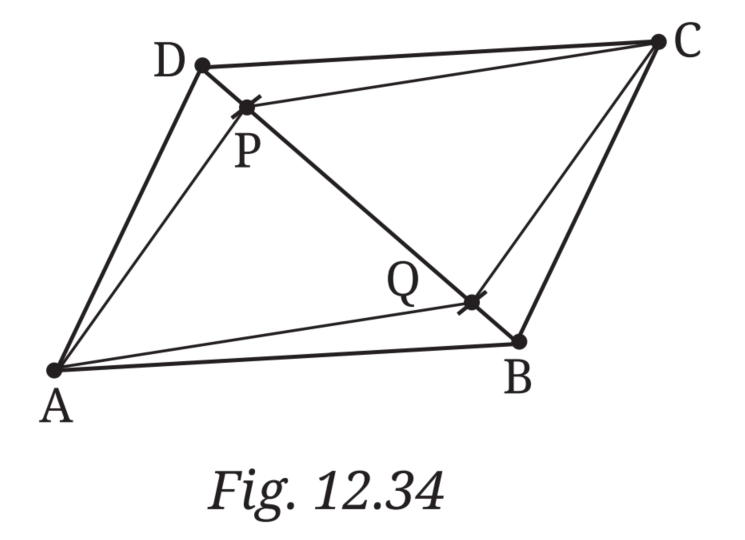
Answer:
Given:
$ABCD$ is a parallelogram.
$P$ and $Q$ are two points on diagonal $BD$ such that $DP = BQ$.
To Prove:
$APCQ$ is a parallelogram.
Proof (Method 1 — Using Congruent Triangles):
Since $ABCD$ is a parallelogram, opposite sides are equal and parallel.
So, $AD = BC$, $AD \parallel BC$, $AB = CD$, and $AB \parallel CD$.
Step 1: Compare $\triangle APD$ and $\triangle CQB$:
$AD = CB$
(Opposite sides of parallelogram $ABCD$)
$\angle ADP = \angle CBQ$
(Alternate interior angles, $AD \parallel BC$)
$DP = BQ$
(Given)
By SAS congruence, $\triangle APD \cong \triangle CQB$.
$AP = CQ$
[CPCTC] ... (i)
Step 2: Compare $\triangle AQB$ and $\triangle CPD$:
$AB = CD$
(Opposite sides of parallelogram $ABCD$)
$\angle ABQ = \angle CDP$
(Alternate interior angles, $AB \parallel CD$)
$BQ = DP$
(Given)
By SAS congruence, $\triangle AQB \cong \triangle CPD$.
$AQ = CP$
[CPCTC] ... (ii)
From (i) and (ii), both pairs of opposite sides of quadrilateral $APCQ$ are equal ($AP = CQ$ and $AQ = CP$).
Therefore, $APCQ$ is a parallelogram.
Alternate Proof (Method 2 — Using Diagonals):
Construction Required: Join diagonal $AC$ to intersect diagonal $BD$ at point $O$.
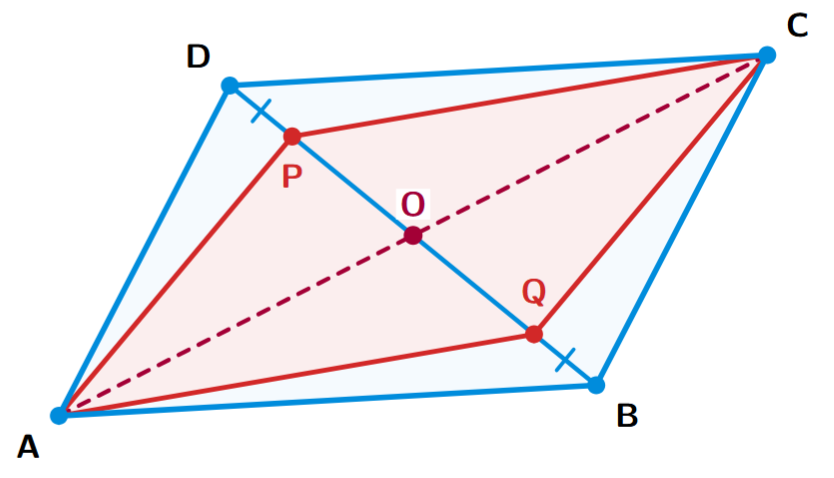
The diagonals of parallelogram $ABCD$ bisect each other at $O$.
$OA = OC$
[Diagonals of parallelogram bisect each other] ... (i)
$OD = OB$
[Diagonals of parallelogram bisect each other] ... (ii)
$DP = BQ$
[Given] ... (iii)
Subtract equation (iii) from equation (ii):
$OD - DP = OB - BQ$
$OP = OQ$
…(iv)
From (i) and (iv), the diagonals $AC$ and $PQ$ of quadrilateral $APCQ$ bisect each other at $O$.
A quadrilateral whose diagonals bisect each other is a parallelogram.
Therefore, $APCQ$ is a parallelogram.
Question 5. A right-triangle shaped cutout of a paper is folded such that point $A$ touches point $B$ (Fig. 12.35). Show that the crease line can be used to find the midpoint of not only $AB$ but also that of $AC$.
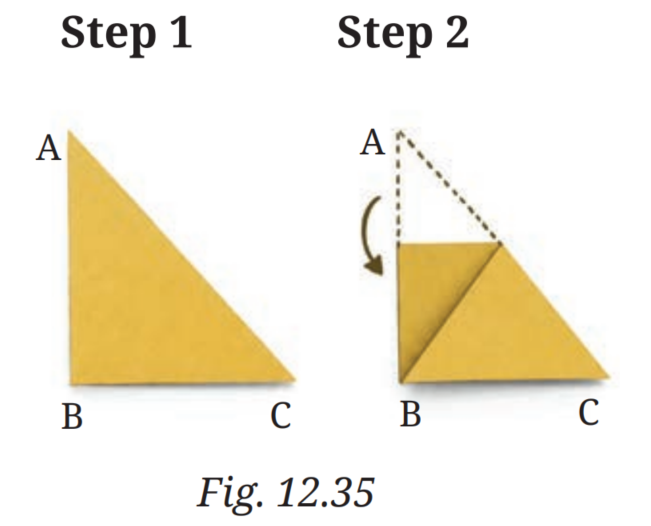
Answer:
Given:
$\triangle ABC$ is a right-angled triangle with $\angle B = 90^\circ$.
The paper is folded so that vertex $A$ touches vertex $B$.
Let the crease line meet $AB$ at $P$ and $AC$ at $Q$.
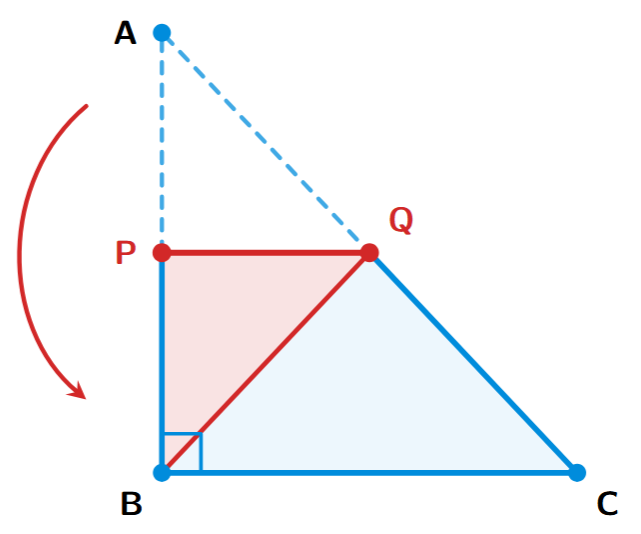
To Prove:
1. $P$ is the midpoint of $AB$.
2. $Q$ is the midpoint of $AC$.
Proof:
Step 1: Show that $P$ is the midpoint of $AB$ and $PQ \perp AB$.
When $A$ is folded onto $B$ along crease $PQ$, segment $AP$ falls exactly onto segment $BP$.
Therefore, $AP = BP$.
So, $P$ is the midpoint of $AB$.
Also, $\angle APQ$ folds onto $\angle BPQ$, so $\angle APQ = \angle BPQ$.
Since $APB$ is a straight line, $\angle APQ + \angle BPQ = 180^\circ$.
Thus, $2\angle APQ = 180^\circ \implies \angle APQ = 90^\circ$.
Step 2: Show that $Q$ is the midpoint of $AC$.
We know $\angle ABC = 90^\circ$ (given) and $\angle APQ = 90^\circ$ (proved above).
Since corresponding angles $\angle APQ$ and $\angle ABC$ are equal ($90^\circ$), we have $PQ \parallel BC$.
Now consider $\triangle ABC$:
1. $P$ is the midpoint of side $AB$.
2. Line $PQ$ is drawn through $P$ parallel to side $BC$ ($PQ \parallel BC$).
By the Converse of the Midpoint Theorem, a line through the midpoint of one side parallel to another side bisects the third side.
Therefore, $PQ$ bisects $AC$ at point $Q$ ($AQ = QC$).
Hence, the crease line gives the midpoints of both $AB$ and $AC$.
Question 6. You saw how to use the Midpoint Theorem to divide a given triangle into $4$ congruent triangles. Can we divide a triangle into $3$ congruent triangles? This exercise shows us how to do that and more, provided we are allowed to cut and reassemble.
(i) Draw medians $AP$, $BQ$ and $CR$ of $\triangle ABC$, meeting in a common point $M$. Cut along each median to get $6$ triangles. Show with justification how to assemble the $6$ pieces into $3$ congruent triangles! (Hint: Align $\triangle MPB$ and $\triangle MPC$ along equal sides $PB$ and $PC$, matching $P$ with itself and $B$ with $C$.) Prove that you get a triangle. What are its side lengths?
(ii) Repeat the procedure with each of the $3$ assembled triangles you got in (i). Show that each of the resulting $9$ triangles has sides $\frac{AB}{3}$, $\frac{BC}{3}$ and $\frac{AC}{3}$.
The procedure and the result above were unnoticed till 2014, when they were discovered by Lee Sallows, an amateur mathematician!
(iii) Naturally, we can next ask about the possibility of cutting a triangle and reassembling it into $2$ congruent triangles. You were asked this question in the chapter Measuring Space: Perimeter and Area. Can you solve this now? (Hint: Use median $AP$ in $\triangle ABC$ and then a median of $\triangle APB$.)
For any two given figures with straight sides, we can ask whether one figure can be cut (using only straight cuts) into pieces and reassembled to make the other. This notion is called scissors congruence. The figures need not be in the plane. Research on such questions at a higher level is ongoing.
Answer:
Part (i): Dividing $\triangle ABC$ into $3$ congruent triangles
Given:
Any triangle $\triangle ABC$, in which $AP$, $BQ$, and $CR$ are the three medians meeting at the centroid $M$.
To Show:
How to cut along the medians into $6$ triangular pieces, reassemble them into $3$ congruent triangles, prove that each assembled figure is a triangle, and find its side lengths.
Construction & Cutting:
Draw the medians $AP$, $BQ$, and $CR$ of $\triangle ABC$, where $P$, $Q$, and $R$ are the midpoints of $BC$, $CA$, and $AB$ respectively, meeting at point $M$. Cut $\triangle ABC$ along each median to obtain $6$ small triangles: $\triangle MPB$, $\triangle MPC$, $\triangle MQC$, $\triangle MQA$, $\triangle MRA$, and $\triangle MRB$.
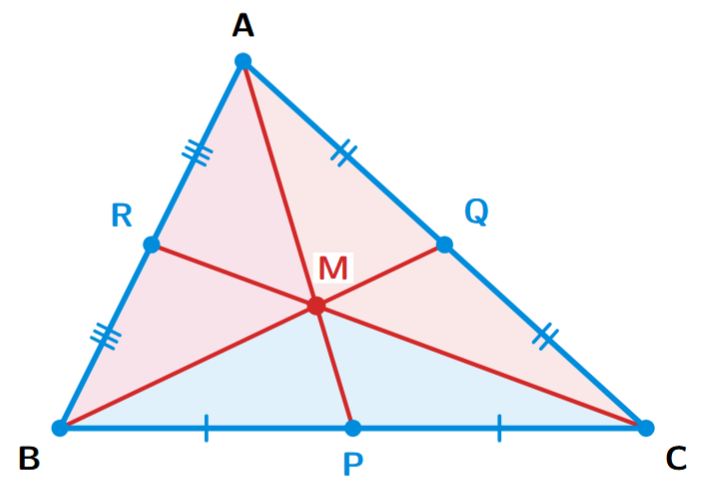
Reassembly & Proof:
1. Take $\triangle MPB$ and $\triangle MPC$. Since $P$ is the midpoint of $BC$, we have $PB = PC$. Align $\triangle MPC$ with $\triangle MPB$ along these equal sides by rotating $\triangle MPC$ by $180^\circ$ about $P$, matching $P$ with itself and $C$ with $B$. Let the new position of $M$ be $Y$, forming $\triangle YPB \cong \triangle MPC$.
2. Similarly, align $\triangle MQA$ with $\triangle MQC$ along equal sides $QA$ and $QC$ (matching $Q$ with itself and $A$ with $C$) so that $M$ goes to $Z$, forming $\triangle ZQC \cong \triangle MQA$.
3. Similarly, align $\triangle MRB$ with $\triangle MRA$ along equal sides $RB$ and $RA$ (matching $R$ with itself and $B$ with $A$) so that $M$ goes to $X$, forming $\triangle XRA \cong \triangle MRB$.
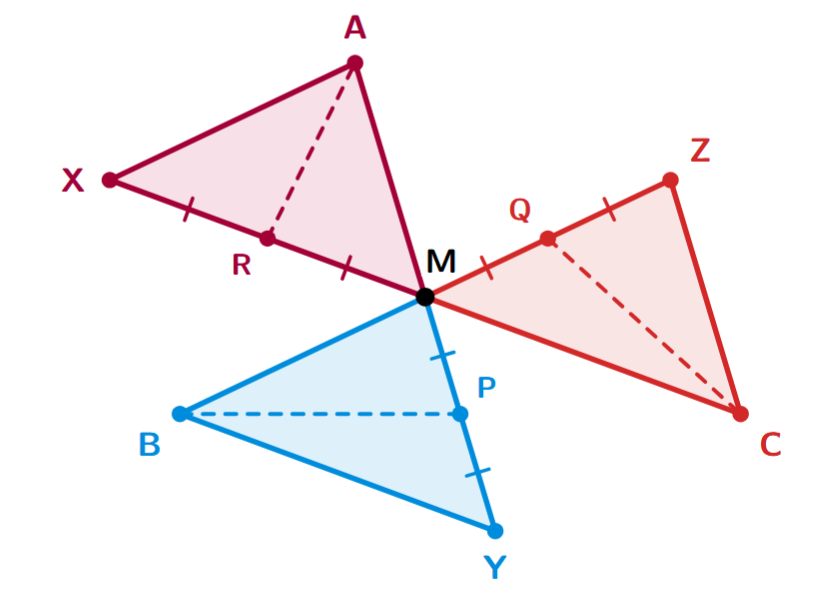
Now let us prove that the assembled shape $MBY$ is a triangle. Since $B$-$P$-$C$ is a straight line, $\angle MPB + \angle MPC = 180^\circ$ (linear pair).
Since $\angle BPY = \angle CPM$ by alignment, we get $\angle MPB + \angle BPY = 180^\circ$.
Since the adjacent angles $\angle MPB$ and $\angle BPY$ form a linear pair, $MPY$ is a straight line segment. Hence, $\triangle MBY$ is a triangle.
By the centroid property of a triangle, the centroid $M$ divides each median in the ratio $2:1$ from the vertex, so:
$AM = \frac{2}{3}AP$ and $MP = \frac{1}{3}AP$
$BM = \frac{2}{3}BQ$ and $MQ = \frac{1}{3}BQ$
$CM = \frac{2}{3}CR$ and $MR = \frac{1}{3}CR$
Now, the side lengths of $\triangle MBY$ are:
$MY = MP + PY = 2MP = 2\left(\frac{1}{3}AP\right) = \frac{2}{3}AP$ (since $PY = MP$)
$MB = \frac{2}{3}BQ$
$BY = MC = \frac{2}{3}CR$
Similarly, in $\triangle MCZ$, the side lengths are $MZ = 2MQ = \frac{2}{3}BQ$, $MC = \frac{2}{3}CR$, and $CZ = MA = \frac{2}{3}AP$.
And in $\triangle MAX$, the side lengths are $MX = 2MR = \frac{2}{3}CR$, $MA = \frac{2}{3}AP$, and $AX = MB = \frac{2}{3}BQ$.
Thus, all three assembled triangles $\triangle MBY$, $\triangle MCZ$, and $\triangle MAX$ have side lengths $\frac{2}{3}AP$, $\frac{2}{3}BQ$, and $\frac{2}{3}CR$ (two-thirds of the medians of $\triangle ABC$).
$\therefore$ By the SSS congruence rule, $\triangle MBY \cong \triangle MCZ \cong \triangle MAX$, and $\triangle ABC$ is reassembled into $3$ congruent triangles.
Part (ii): Repeating the procedure to get $9$ congruent triangles
Consider one of the $3$ assembled triangles from part (i), say $\triangle MBY$. Let us draw its three medians:
1. Since $MP = PY$, point $P$ is the midpoint of $MY$. Hence, $BP$ is the median to side $MY$.
2. Let $G$ be the midpoint of $MB$ and $H$ be the midpoint of $BY$. Then $YG$ and $MH$ are the other two medians of $\triangle MBY$.
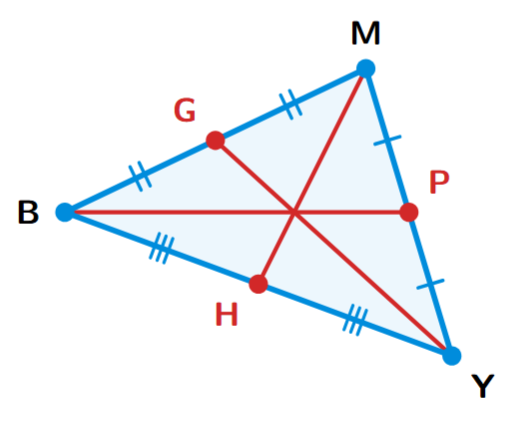
Let us find the lengths of these three medians of $\triangle MBY$:
1. Length of median $BP$:
Since $P$ is the midpoint of side $BC$ in $\triangle ABC$, we have $BP = \frac{1}{2}BC$.
2. Length of median $MH$:
From part (i), $MY = 2MP = AM$ along the straight line $AY$, so $M$ is the midpoint of $AY$. Also, $H$ is the midpoint of $BY$. Therefore, by the Midpoint Theorem in $\triangle ABY$, we have $MH = \frac{1}{2}AB$.
3. Length of median $YG$:
Since $G$ is the midpoint of $BM$, we have $GM = \frac{1}{2}BM = \frac{1}{3}BQ = MQ$. Comparing $\triangle GMY$ and $\triangle QMA$:
$GM = QM$
(Both equal to $\frac{1}{3}BQ$)
$\angle GMY = \angle QMA$
(Vertically opposite angles)
$MY = MA$
(Both equal to $\frac{2}{3}AP$)
By the SAS congruence rule, $\triangle GMY \cong \triangle QMA$. Hence, by CPCT, $YG = QA$. Since $Q$ is the midpoint of $AC$, we get $YG = \frac{1}{2}AC$.
Now, repeating the procedure of part (i) on $\triangle MBY$ (cutting along its medians $BP$, $YG$, and $MH$ into $6$ parts and reassembling them into $3$ congruent triangles), the side lengths of each resulting triangle will be $\frac{2}{3}$ of the medians of $\triangle MBY$:
$\frac{2}{3}(\text{Median } MH) = \frac{2}{3}\left(\frac{1}{2}AB\right) = \frac{AB}{3}$
$\frac{2}{3}(\text{Median } BP) = \frac{2}{3}\left(\frac{1}{2}BC\right) = \frac{BC}{3}$
$\frac{2}{3}(\text{Median } YG) = \frac{2}{3}\left(\frac{1}{2}AC\right) = \frac{AC}{3}$
Performing the same procedure on each of the $3$ congruent triangles ($\triangle MBY$, $\triangle MCZ$, and $\triangle MAX$) gives $3 \times 3 = 9$ congruent triangles, and each of the $9$ resulting triangles has sides $\frac{AB}{3}$, $\frac{BC}{3}$, and $\frac{AC}{3}$.
Part (iii): Cutting $\triangle ABC$ and reassembling it into $2$ congruent triangles
Given:
Any triangle $\triangle ABC$.
Construction & Cutting:
1. Draw the median $AP$ of $\triangle ABC$ (so $P$ is the midpoint of $BC$, meaning $BP = PC$).
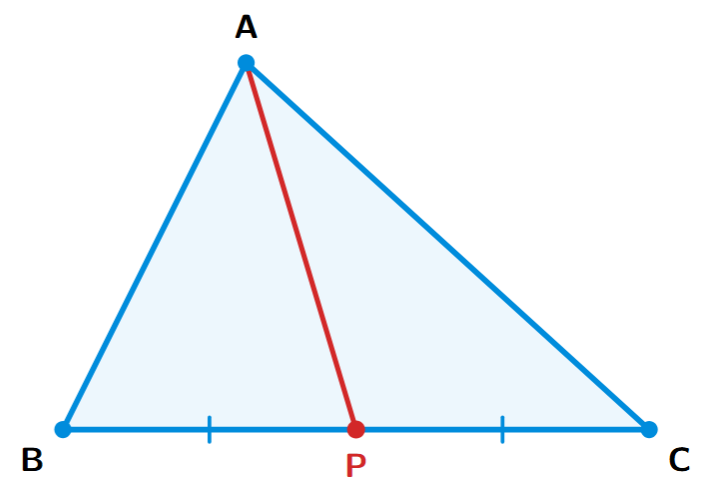
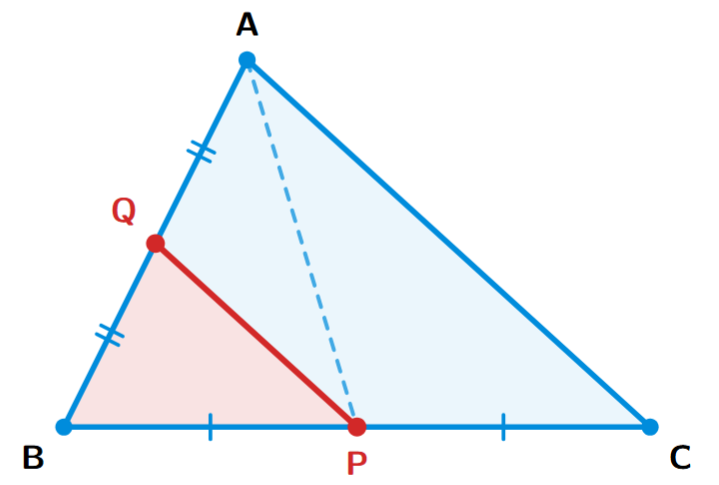
2. Draw the median $PQ$ of $\triangle APB$ (so $Q$ is the midpoint of $AB$, meaning $AQ = QB$).
3. Cut the figure along $PQ$ to get two pieces: $\triangle BPQ$ and quadrilateral $AQPC$.
Reassembly & Proof:
Rotate $\triangle BPQ$ by $180^\circ$ about point $Q$ and align it with quadrilateral $AQPC$ along $BQ$ and $AQ$, matching $Q$ with itself and $B$ with $A$. Let the new position of $P$ be $P'$, forming $\triangle AP'Q \cong \triangle BPQ$.
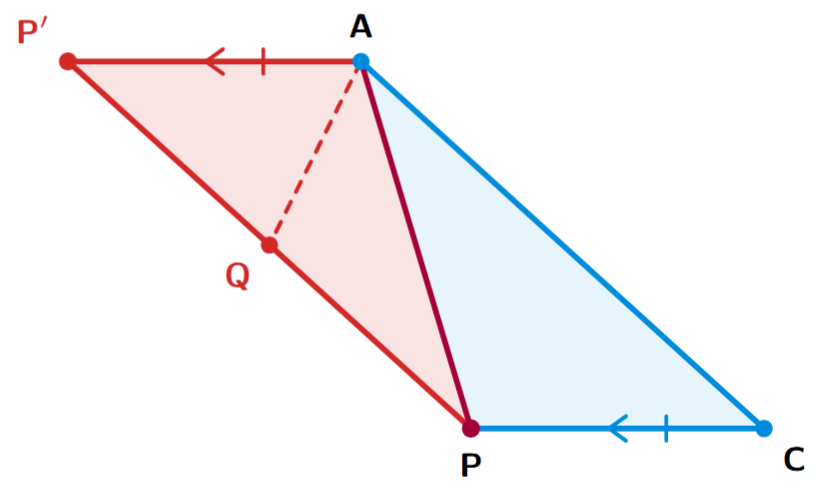
Since $A$-$Q$-$B$ is a straight line, $\angle BQP + \angle AQP = 180^\circ$. By alignment, $\angle AQP' = \angle BQP$, so $\angle AQP' + \angle AQP = 180^\circ$. Hence, $P'QP$ is a straight line segment.
Next, $\angle P'AQ = \angle PBQ$ by alignment. Since $A$-$Q$-$B$ acts as a transversal, these equal alternate interior angles imply that $AP' \parallel PC$.
Also, $AP' = BP$ (by alignment) and $BP = PC$ (since $AP$ is the median of $\triangle ABC$), which gives $AP' = PC$.
Since one pair of opposite sides ($AP'$ and $PC$) of quadrilateral $AP'PC$ is both equal and parallel, $AP'PC$ is a parallelogram.
Now, $AP$ is a diagonal of parallelogram $AP'PC$. Since a diagonal of a parallelogram divides it into two congruent triangles, cutting along $AP$ (together with $PQ$) gives $\triangle APP' \cong \triangle CPA$.
$\therefore$ The given $\triangle ABC$ is cut and reassembled into $2$ congruent triangles.
Question 7. A more general midpoint theorem and its converse. In a quadrilateral $ABCD$, suppose $AB \parallel DC$. Recall that such $ABCD$ is called a trapezium. Let $E$ be the midpoint of $AD$. A line drawn through $E$ intersects side $BC$ at $F$.
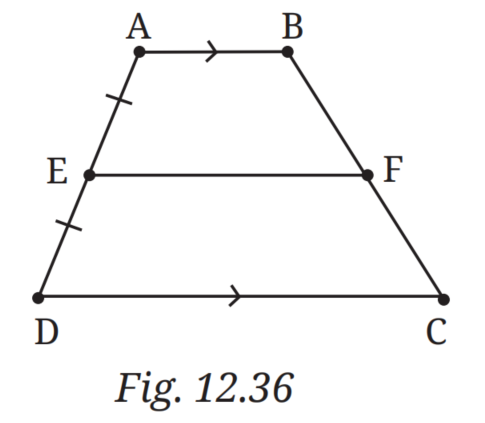
(i) If $EF \parallel AB$, then show that $F$ is the midpoint of $BC$. Conclude that $EF = \frac{AB + CD}{2}$.
(ii) If $F$ is the midpoint of $BC$, then show that $EF \parallel AB$.
There are at least two ways to solve (ii). Do it directly by using the midpoint $M$ of $BD$ and showing that $EM$ and $FM$ are the same lines. Or use (i) along with the same idea used in the second proof of the converse of the Midpoint Theorem. Which way do you think is simpler?
Answer:
Part (i):
Given:
$ABCD$ is a trapezium with $AB \parallel DC$.
$E$ is the midpoint of $AD$, and $EF \parallel AB$ meets $BC$ at $F$.
To Prove:
1. $F$ is the midpoint of $BC$.
2. $EF = \dfrac{AB + CD}{2}$.
Construction Required:
Join diagonal $BD$, and let it intersect $EF$ at point $M$.
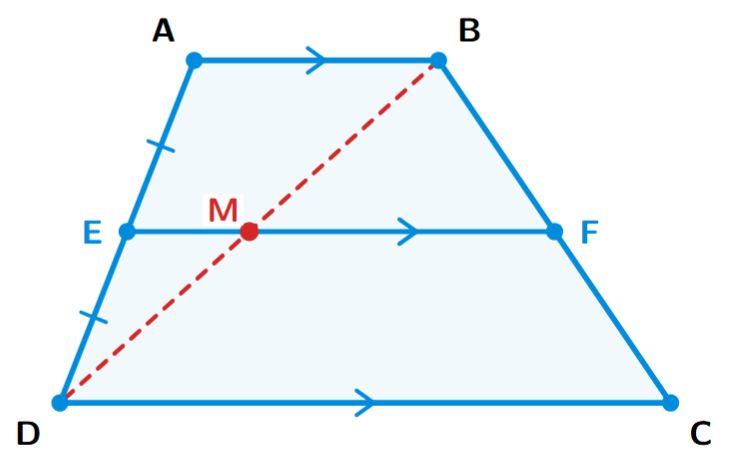
Proof:
Since $AB \parallel DC$ and $EF \parallel AB$, we also have $EF \parallel DC$.
Step 1: In $\triangle ABD$:
$E$ is the midpoint of $AD$, and $EM \parallel AB$ (since $M$ lies on $EF$).
By the Converse of the Midpoint Theorem, $M$ is the midpoint of $BD$.
Also, by the Midpoint Theorem in $\triangle ABD$:
$EM = \dfrac{1}{2}AB$
[Midpoint Theorem in $\triangle ABD$] ... (i)
Step 2: In $\triangle BCD$:
$M$ is the midpoint of $BD$ (proved above), and $MF \parallel DC$ (since $M, F$ lie on $EF$).
By the Converse of the Midpoint Theorem, $F$ is the midpoint of $BC$.
Also, by the Midpoint Theorem in $\triangle BCD$:
$MF = \dfrac{1}{2}CD$
[Midpoint Theorem in $\triangle BCD$] ... (ii)
Step 3: Add equations (i) and (ii):
$EF = EM + MF = \dfrac{1}{2}AB + \dfrac{1}{2}CD$
Therefore, $EF = \dfrac{AB + CD}{2}$.
Part (ii):
Given:
In trapezium $ABCD$ ($AB \parallel DC$), $E$ is the midpoint of $AD$ and $F$ is the midpoint of $BC$.
To Prove:
$EF \parallel AB$.
Proof — Method 1 (Direct Method Using Midpoint $M$ of $BD$):
Construction Required: Join diagonal $BD$ and mark its midpoint $M$. Join $EM$ and $FM$.
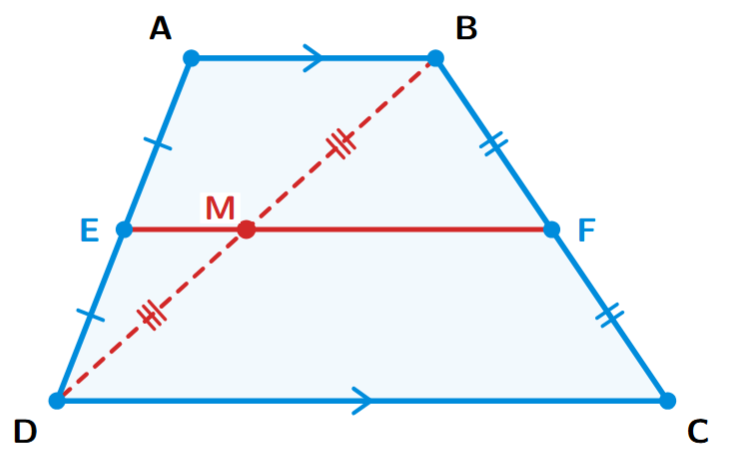
1. In $\triangle ABD$, $E$ and $M$ are the midpoints of $AD$ and $BD$.
By the Midpoint Theorem, $EM \parallel AB$.
2. In $\triangle BCD$, $M$ and $F$ are the midpoints of $BD$ and $BC$.
By the Midpoint Theorem, $FM \parallel DC$.
3. Since $AB \parallel DC$, we also get $FM \parallel AB$.
4. Thus, both lines $EM$ and $FM$ pass through point $M$ and are parallel to the same line $AB$.
5. Only one line can be drawn through a point parallel to a given line.
So, $EM$ and $FM$ must be the exact same line.
Therefore, $E, M,$ and $F$ are collinear, which proves $EF \parallel AB$.
Proof — Method 2 (Using Part (i) and Uniqueness of Midpoint):
1. Through point $E$, draw a line parallel to $AB$ and let it meet $BC$ at point $F'$.
2. Since $E$ is the midpoint of $AD$ and $EF' \parallel AB$, by Part (i), $F'$ must be the midpoint of $BC$.
3. However, we are given that $F$ is the midpoint of $BC$.
4. A line segment has only one unique midpoint, so $F'$ must coincide with $F$ ($F' = F$).
5. Therefore, line $EF$ is the same line as $EF'$, which proves $EF \parallel AB$.
Which Method Is Simpler?
Method 2 is simpler and shorter because it directly uses Part (i) and the uniqueness of the midpoint of $BC$, without needing to construct $BD$ and $M$.
Question 8. The diagonals $AC$ and $BD$ of a parallelogram $ABCD$ intersect at $O$. A line through $O$ meets $AB$ and $CD$ at points $P$ and $Q$ respectively. Show that $O$ is the midpoint of $PQ$. (Multiple proofs are possible. Which is the simplest?)
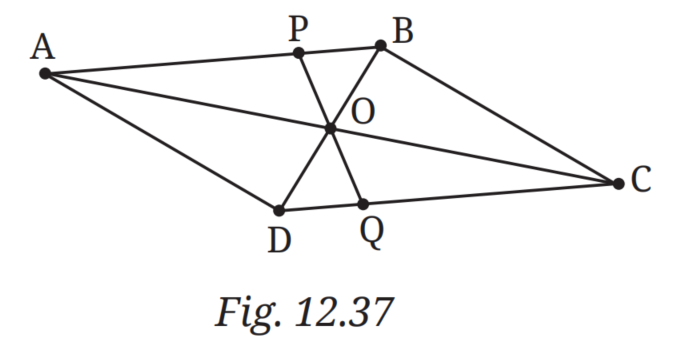
Answer:
Given:
$ABCD$ is a parallelogram whose diagonals $AC$ and $BD$ intersect at $O$.
A line through $O$ meets $AB$ at $P$ and $CD$ at $Q$.
To Prove:
$O$ is the midpoint of $PQ$, i.e., $OP = OQ$.
Proof 1 (Simplest Method — Using ASA Congruence on $\triangle AOP$ and $\triangle COQ$):
In parallelogram $ABCD$, $AB \parallel DC$ and diagonals bisect each other at $O$.
Compare $\triangle AOP$ and $\triangle COQ$:
$\angle OAP = \angle OCQ$
(Alternate interior angles, $AB \parallel DC$)
$OA = OC$
(Diagonals of parallelogram bisect each other)
$\angle AOP = \angle COQ$
(Vertically opposite angles)
By ASA congruence, $\triangle AOP \cong \triangle COQ$.
By CPCTC, $OP = OQ$.
Therefore, $O$ is the midpoint of $PQ$.
Alternate Proof (Proof 2 — Using $\triangle BOP$ and $\triangle DOQ$):
Compare $\triangle BOP$ and $\triangle DOQ$:
$\angle OBP = \angle ODQ$
(Alternate interior angles, $AB \parallel DC$)
$OB = OD$
(Diagonals of parallelogram bisect each other)
$\angle BOP = \angle DOQ$
(Vertically opposite angles)
By ASA congruence, $\triangle BOP \cong \triangle DOQ$.
By CPCTC, $OP = OQ$, so $O$ is the midpoint of $PQ$.
Which Proof Is the Simplest?
Using ASA congruence directly on $\triangle AOP$ and $\triangle COQ$ (or on $\triangle BOP$ and $\triangle DOQ$) is the simplest proof because it requires no extra construction and finishes in just $3$ steps.
Question 9. $ABCD$ is a trapezium with parallel sides $AD = 3\text{ cm}$ and $BC = 5\text{ cm}$. $E$ and $F$ are the midpoints of the non-parallel sides. Find the ratio of the areas of the $4$-gons $AEFD$ and $EBCF$.
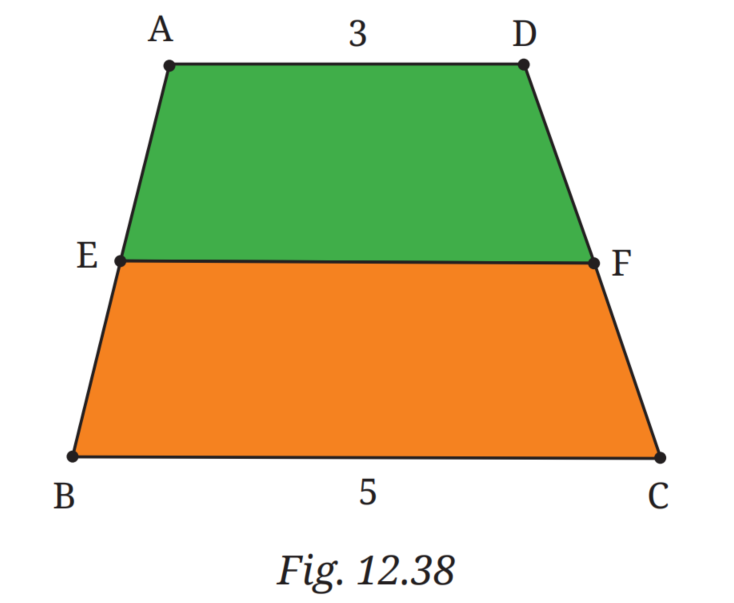
Answer:
Given:
$ABCD$ is a trapezium in which $AD \parallel BC$, $AD = 3\text{ cm}$, and $BC = 5\text{ cm}$.
$E$ and $F$ are the midpoints of the non-parallel sides $AB$ and $DC$ respectively.
To Find:
The ratio of the areas of quadrilaterals $AEFD$ and $EBCF$, i.e., $\text{Area}(AEFD) : \text{Area}(EBCF)$.
Construction Required:
From vertex $A$, draw $AQ \perp BC$ (extended if necessary), intersecting $EF$ at point $P$.
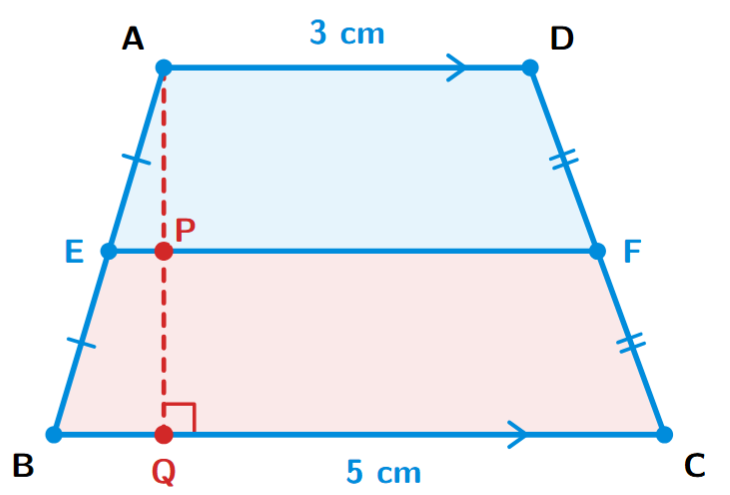
Solution:
Step 1: Find the length and parallelism of $EF$.
In trapezium $ABCD$, $AD \parallel BC$, and $E$ and $F$ are the midpoints of the non-parallel sides $AB$ and $DC$ respectively.
By the midpoint theorem for a trapezium (as proved in Question 7), the line segment joining the midpoints of the non-parallel sides is parallel to the parallel sides and equal to half of their sum:
$EF \parallel AD \parallel BC$
$EF = \dfrac{AD + BC}{2} = \dfrac{3 + 5}{2} = \dfrac{8}{2} = 4\text{ cm}$
Since $AD \parallel EF$ and $EF \parallel BC$, both $AEFD$ and $EBCF$ are trapeziums.
Step 2: Compare the heights of trapeziums $AEFD$ and $EBCF$.
In $\triangle ABQ$, $E$ is the midpoint of $AB$ and $EP \parallel BQ$ (since $EF \parallel BC$).
By the Converse of the Midpoint Theorem, $P$ is the midpoint of $AQ$, so $AP = PQ$.
Also, since $AQ \perp BC$ and $EF \parallel BC$, we have $AP \perp EF$ as well. Let $AP = PQ = h$.
Thus, the height of trapezium $AEFD$ is $h$, and the height of trapezium $EBCF$ is also $h$.
Step 3: Find the areas of trapeziums $AEFD$ and $EBCF$ and their ratio.
We know that the area of a trapezium is $\dfrac{1}{2} \times (\text{sum of parallel sides}) \times \text{height}$.
$\text{Area}(AEFD) = \dfrac{1}{2} \times (AD + EF) \times h $$ = \dfrac{1}{2} \times (3 + 4) \times h = \dfrac{7}{2}h\text{ cm}^2$
$\text{Area}(EBCF) = \dfrac{1}{2} \times (EF + BC) \times h $$ = \dfrac{1}{2} \times (4 + 5) \times h = \dfrac{9}{2}h\text{ cm}^2$
Now, taking the ratio of their areas:
$\dfrac{\text{Area}(AEFD)}{\text{Area}(EBCF)} = \dfrac{\cancel{\frac{1}{2}} \times 7 \times \cancel{h}}{\cancel{\frac{1}{2}} \times 9 \times \cancel{h}} = \dfrac{7}{9}$
$\therefore$ The ratio of the areas of the $4$-gons $AEFD$ and $EBCF$ is $7 : 9$.
Question 10. Consider $4$ points $A$, $B$, $C$, $D$ in the plane with no three collinear. Answer the following questions. Some answers may require you to consider different cases, depending on how the points are positioned in the plane.
(i) How many different quadrilaterals do they form if the quadrilateral is allowed to be self-intersecting or non-convex?
(ii) How many of these quadrilaterals are self-intersecting? How many are convex?
Answer:
Given:
Four points $A$, $B$, $C$, and $D$ lie in a plane such that no three of them are collinear.
To Find:
(i) The number of different quadrilaterals formed if self-intersecting or non-convex quadrilaterals are allowed.
(ii) Among these quadrilaterals, how many are self-intersecting and how many are convex (considering all possible configurations of the four points).
Solution:
Any quadrilateral formed by the four distinct points $A$, $B$, $C$, and $D$ is determined by the cyclic order in which the four vertices are joined (reversing the order gives the same quadrilateral, e.g., $ABCD$ is the same as $ADCB$). Starting from vertex $A$, there are $3$ choices for the vertex opposite to $A$ ($B$, $C$, or $D$), which gives $3$ distinct quadrilaterals:
1. $ABCD$
2. $ABDC$
3. $ACBD$
Depending on how the four non-collinear points are positioned in the plane, there are two possible cases:
Case I (Convex configuration): Each point lies outside the triangle formed by the other three points (the four points form the vertices of a convex quadrilateral).
Case II (Non-convex configuration): One of the four points lies inside the triangle formed by the other three points (for example, $D$ lies inside $\triangle ABC$).
Part (i):
Case I: Points $A$, $B$, $C$, and $D$ are in a convex configuration
Suppose the points $A, B, C, D$ lie in cyclic order around a convex hull.
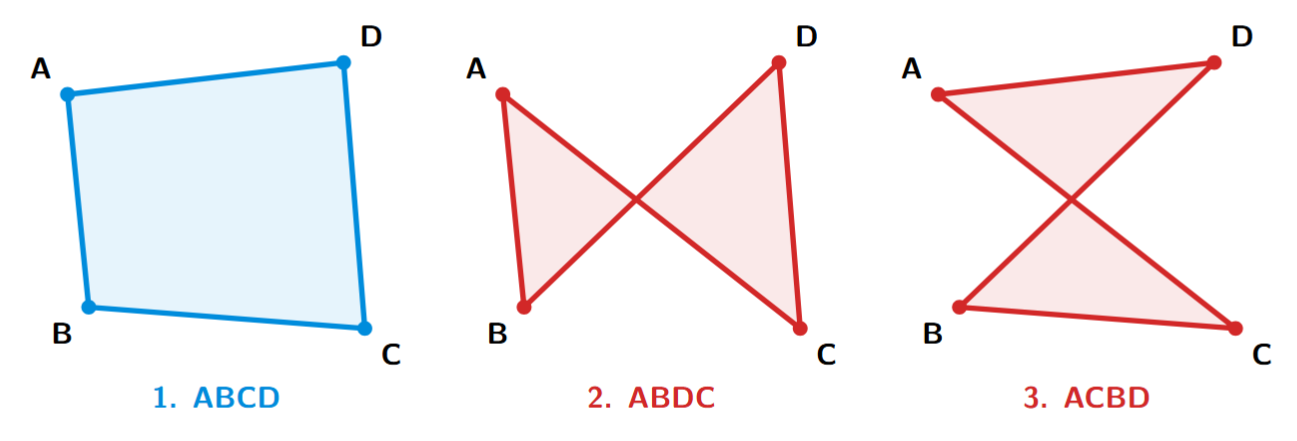
Here:
1. $ABCD$ is a convex quadrilateral.
2. $ABDC$ is a self-intersecting quadrilateral (sides $BD$ and $CA$ intersect).
3. $ACBD$ is a self-intersecting quadrilateral (sides $CB$ and $DA$ intersect).
$\therefore$ If self-intersecting or non-convex quadrilaterals are allowed, they form $3$ different quadrilaterals in total (out of which $2$ are self-intersecting or non-convex, and $1$ is convex).
Case II: Points $A$, $B$, $C$, and $D$ are in a non-convex configuration
Suppose one point (say $D$) lies inside the triangle formed by the other three points ($\triangle ABC$).
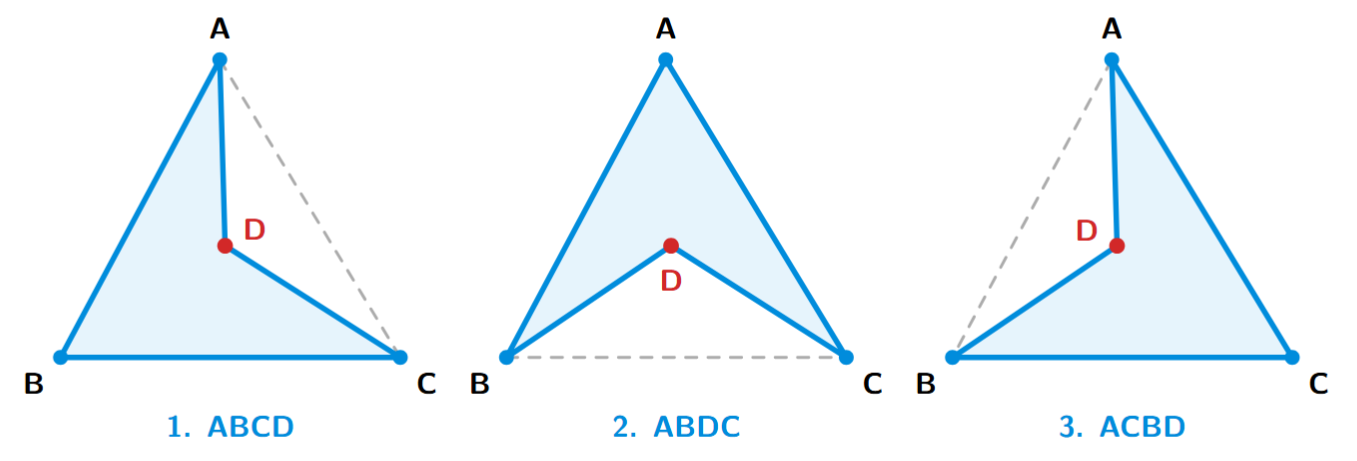
Here:
1. $ABCD$ is a non-convex quadrilateral (with a reflex interior angle at $D$).
2. $ABDC$ is a non-convex quadrilateral (with a reflex interior angle at $D$).
3. $ACBD$ is a non-convex quadrilateral (with a reflex interior angle at $D$).
None of their sides intersect each other because segments $DA$, $DB$, and $DC$ lie entirely inside $\triangle ABC$.
$\therefore$ They form $3$ different quadrilaterals in total (and all $3$ are non-convex).
Part (ii):
Case I: Points $A$, $B$, $C$, and $D$ are in a convex configuration
In this configuration, $ABCD$ is convex, while $ABDC$ and $ACBD$ are self-intersecting.
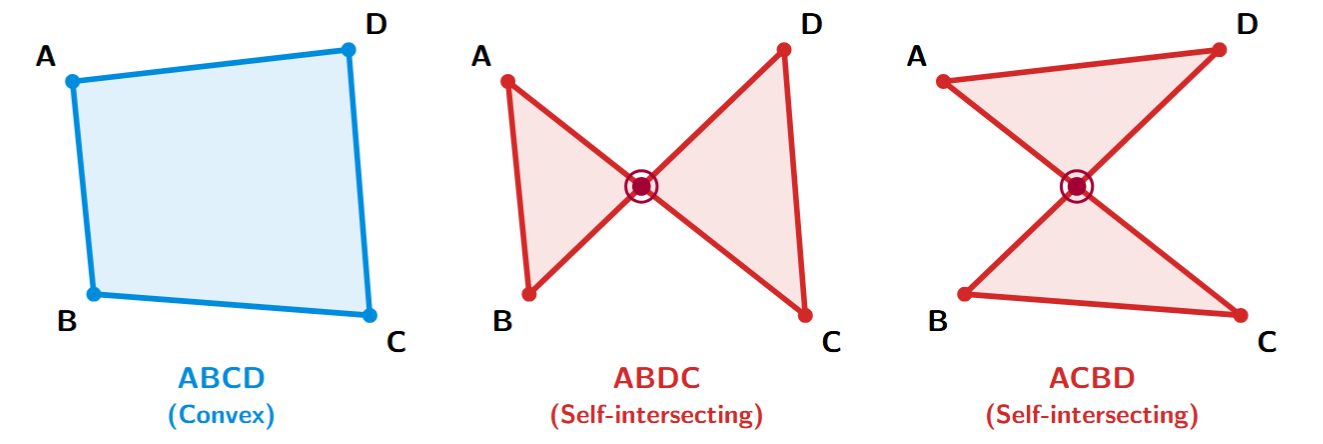
$\therefore$ There are $2$ self-intersecting quadrilaterals and $1$ convex quadrilateral.
Case II: Points $A$, $B$, $C$, and $D$ are in a non-convex configuration
In this configuration, all three quadrilaterals $ABCD$, $ABDC$, and $ACBD$ are non-convex (concave) without any self-intersections.
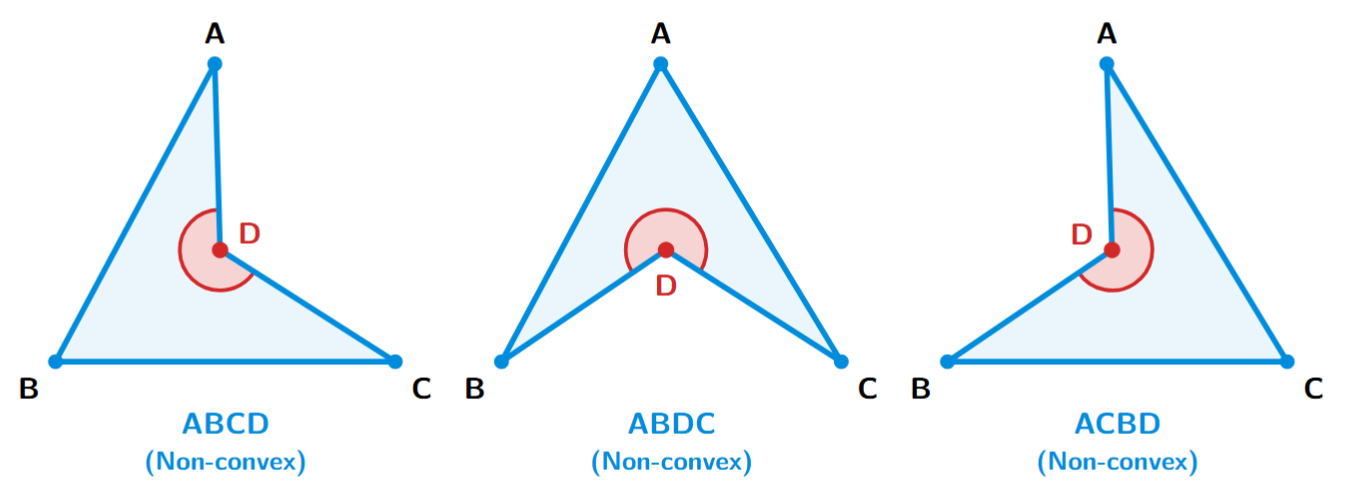
$\therefore$ There are $0$ self-intersecting quadrilaterals and $0$ convex quadrilaterals (all $3$ are non-convex).
Summary:
| Configuration of $A, B, C, D$ | Total Quadrilaterals | Convex | Non-convex | Self-intersecting |
| Case I: Convex configuration | $3$ | $1$ | $0$ | $2$ |
| Case II: Non-convex configuration | $3$ | $0$ | $3$ | $0$ |
Question 11. Suppose $P$ is a point on side $AB$ of $\triangle ABC$ and the line through $P$ parallel to $BC$ meets $AC$ in point $Q$. For parts (i) to (iii), assume $AP = 1$, $AQ = 5$, and see Fig. 12.39.
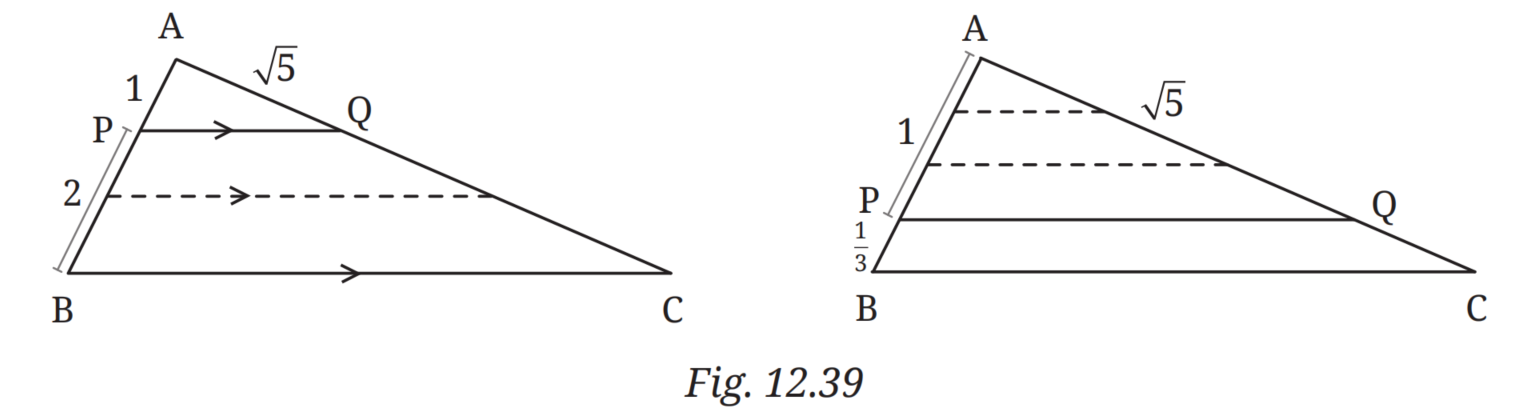
(i) If $PB = 2$ find $QC$. (Hint: See the dotted line)
(ii) If $PB = \frac{1}{3}$ find $QC$. (Hint: See the dotted lines)
(iii) If $PB = \frac{2}{3}$ find $QC$. (Hint: Divide both $PB$ and $AP$ suitably.)
(iv) Show that if $\frac{AP}{PB}$ is a rational number, then $\frac{AP}{PB} = \frac{AQ}{QC}$. In Grade 10, you will prove this equality without assuming $\frac{AP}{PB}$ is rational. That will require a new idea.
Answer:
Given:
In $\triangle ABC$, $P$ is a point on $AB$ and $PQ \parallel BC$ meets $AC$ at $Q$. For parts (i) to (iii), $AP = 1$ and, as shown in Fig. 12.39, $AQ = \sqrt{5}$. (Note: If $AQ = 5$ is taken as printed in the text, simply replace $\sqrt{5}$ with $5$ in the final answers of parts (i) to (iii).)
Part (i):
Given: $AP = 1$, $PB = 2$, $AQ = \sqrt{5}$, and $PQ \parallel BC$.
To Find: $QC$.
Construction & Proof:
Let $R$ be the midpoint of $PB$, so that $PR = RB = 1$. Since $AP = 1$, we have $AP = PR$, which means $P$ is the midpoint of $AR$. Draw the dotted line $RS \parallel BC$ meeting $AC$ at $S$. Also join $BQ$, and let it intersect $RS$ at point $T$.
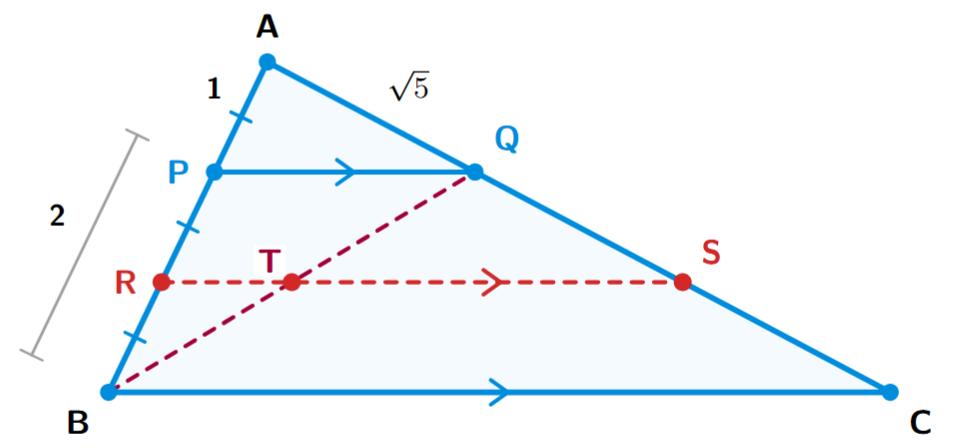
1. In $\triangle ARS$, $P$ is the midpoint of $AR$ and $PQ \parallel RS$ (since both are parallel to $BC$).
By the Converse of the Midpoint Theorem in $\triangle ARS$, $Q$ is the midpoint of $AS$.
$\therefore \; QS = AQ = \sqrt{5}$
2. In $\triangle PBQ$, $R$ is the midpoint of $PB$ and $RT \parallel PQ$.
By the Converse of the Midpoint Theorem in $\triangle PBQ$, $T$ is the midpoint of $BQ$.
3. In $\triangle BQC$, $T$ is the midpoint of $BQ$ and $TS \parallel BC$.
By the Converse of the Midpoint Theorem in $\triangle BQC$, $S$ is the midpoint of $QC$.
$\therefore \; SC = QS = \sqrt{5}$
Therefore, $QC = QS + SC = \sqrt{5} + \sqrt{5} = \mathbf{2\sqrt{5}}$.
Part (ii):
Given: $AP = 1$, $PB = \frac{1}{3}$, $AQ = \sqrt{5}$, and $PQ \parallel BC$.
To Find: $QC$.
Construction & Proof:
Divide $AP = 1$ into $3$ equal parts of length $\frac{1}{3}$ each. Let $S$ be the second division point on $AP$ from $A$, so that $AS = \frac{2}{3}$ and $SP = \frac{1}{3}$. Draw the dotted line $SU \parallel BC$ meeting $AC$ at $U$. Join $BU$, and let $PQ$ intersect $BU$ at $V$.
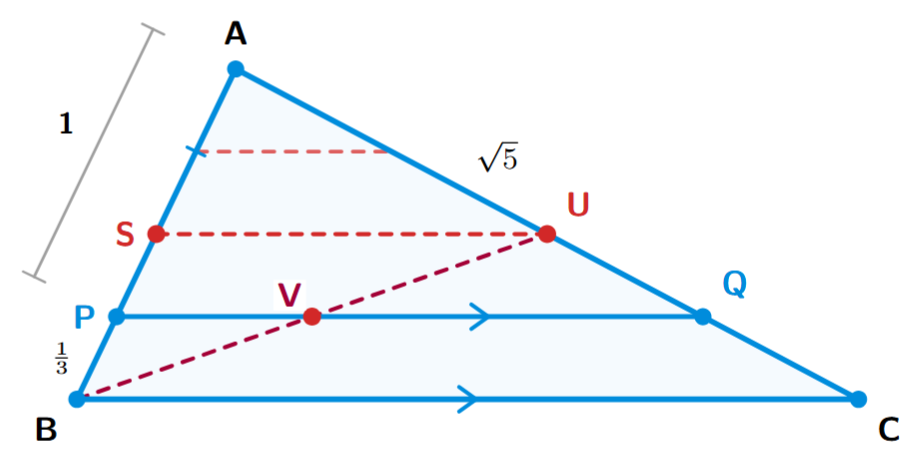
We have $AS = \frac{2}{3}$ and $SB = SP + PB = \frac{1}{3} + \frac{1}{3} = \frac{2}{3}$, so $S$ is the midpoint of $AB$.
1. In $\triangle ABC$, $S$ is the midpoint of $AB$ and $SU \parallel BC$.
By the Converse of the Midpoint Theorem in $\triangle ABC$, $U$ is the midpoint of $AC$, so $AU = UC$.
2. Since $SP = PB = \frac{1}{3}$, $P$ is the midpoint of $BS$. In $\triangle BUS$, $P$ is the midpoint of $BS$ and $PV \parallel SU$.
By the Converse of the Midpoint Theorem in $\triangle BUS$, $V$ is the midpoint of $BU$ ($BV = VU$).
3. In $\triangle BCU$, $V$ is the midpoint of $BU$ and $VQ \parallel BC$.
By the Converse of the Midpoint Theorem in $\triangle BCU$, $Q$ is the midpoint of $UC$, so $UQ = QC$.
Let $QC = x$. Then $UQ = x$, and therefore:
$UC = UQ + QC = x + x = 2x$
$AU = UC = 2x$
$AQ = AU + UQ = 2x + x = 3x$
Since $AQ = \sqrt{5}$, we get:
$3x = \sqrt{5} \implies x = \dfrac{\sqrt{5}}{3}$
Therefore, $QC = \mathbf{\dfrac{\sqrt{5}}{3}}$.
Part (iii):
Given: $AP = 1$, $PB = \frac{2}{3}$, $AQ = \sqrt{5}$, and $PQ \parallel BC$.
To Find: $QC$.
Construction & Solution:
Since $AP = 1 = \frac{3}{3}$ and $PB = \frac{2}{3}$, divide $AP$ into $3$ equal parts and $PB$ into $2$ equal parts, each of length $\frac{1}{3}$. Through $A$ and each of these division points on $AB$, draw lines parallel to $BC$ (and hence parallel to $PQ$), intersecting $AC$.
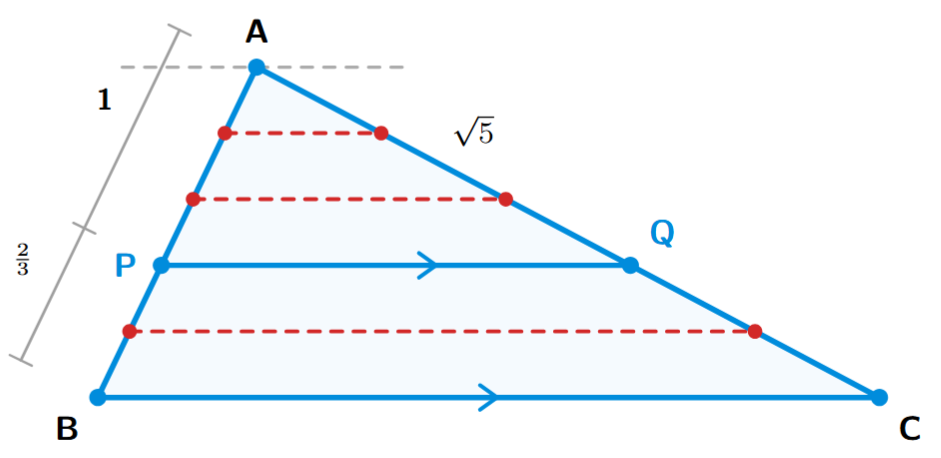
These parallel lines make $3$ equal intercepts on $AP$ and $2$ equal intercepts on $PB$ (each of length $\frac{1}{3}$).
By the Intercept Theorem (parallel lines making equal intercepts on one transversal make equal intercepts on any other transversal), these lines also make $3$ equal intercepts on $AQ$ and $2$ equal intercepts on $QC$.
Let each equal intercept on $AC$ have length $y$. Then:
$AQ = 3y$ and $QC = 2y$
Since $AQ = \sqrt{5}$, we have:
$3y = \sqrt{5} \implies y = \dfrac{\sqrt{5}}{3}$
Therefore, $QC = 2y = 2 \times \dfrac{\sqrt{5}}{3} = \mathbf{\dfrac{2\sqrt{5}}{3}}$.
Part (iv):
Given: In $\triangle ABC$, $PQ \parallel BC$ meets $AB$ at $P$ and $AC$ at $Q$, and $\frac{AP}{PB}$ is a rational number.
To Prove: $\dfrac{AP}{PB} = \dfrac{AQ}{QC}$.
Construction & Proof:
Since $\dfrac{AP}{PB}$ is a rational number, let $\dfrac{AP}{PB} = \dfrac{m}{n}$, where $m$ and $n$ are positive integers.
This means there exists a common length $d$ such that $AP = m \cdot d$ and $PB = n \cdot d$.
Divide $AP$ into $m$ equal parts of length $d$ each, and divide $PB$ into $n$ equal parts of length $d$ each. Through $A$ and every division point on $AB$, draw lines parallel to $BC$ (and thus parallel to $PQ$) meeting $AC$.
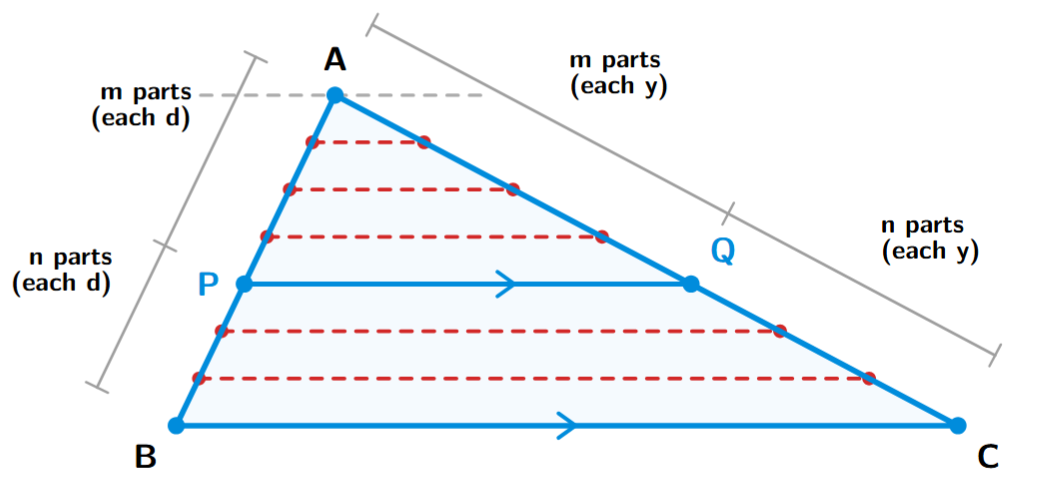
Since these parallel lines make equal intercepts of length $d$ on transversal $AB$, by the Intercept Theorem, they also make equal intercepts on transversal $AC$. Let the length of each equal intercept on $AC$ be $y$.
Since $AP$ has $m$ equal parts and $PB$ has $n$ equal parts, their corresponding segments on $AC$ also have $m$ and $n$ equal parts respectively:
$AQ = m \cdot y$ and $QC = n \cdot y$
Now, taking the ratio of $AQ$ to $QC$:
$\dfrac{AQ}{QC} = \dfrac{m \cdot \cancel{y}}{n \cdot \cancel{y}} = \dfrac{m}{n}$
Since $\dfrac{AP}{PB} = \dfrac{m}{n}$ and $\dfrac{AQ}{QC} = \dfrac{m}{n}$, we conclude that:
$\dfrac{AP}{PB} = \dfrac{AQ}{QC}$ (Hence proved).
Question 12. (i) Suppose $ABCD$ is a parallelogram and $M$, $N$ are midpoints of $AB$ and $CD$ respectively. Show that segments $DM$ and $BN$ trisect segment $AC$.
(ii) Use part (i) to find a procedure to trisect any given segment $PQ$. Find two other ways to trisect $PQ$, one using Exercise 11 above and a third using the Centroid Theorem.
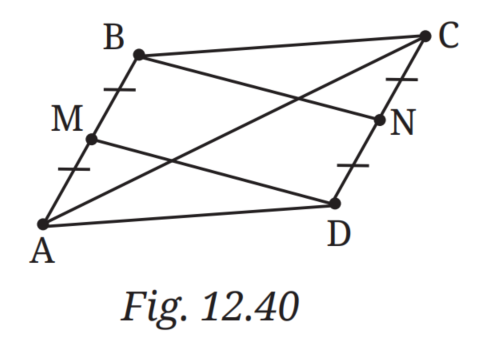
Answer:
Part (i):
Given:
$ABCD$ is a parallelogram. $M$ and $N$ are the midpoints of sides $AB$ and $CD$ respectively. Let segments $DM$ and $BN$ intersect diagonal $AC$ at points $P$ and $Q$ respectively.
To Prove:
Segments $DM$ and $BN$ trisect diagonal $AC$, i.e., $AP = PQ = QC$.
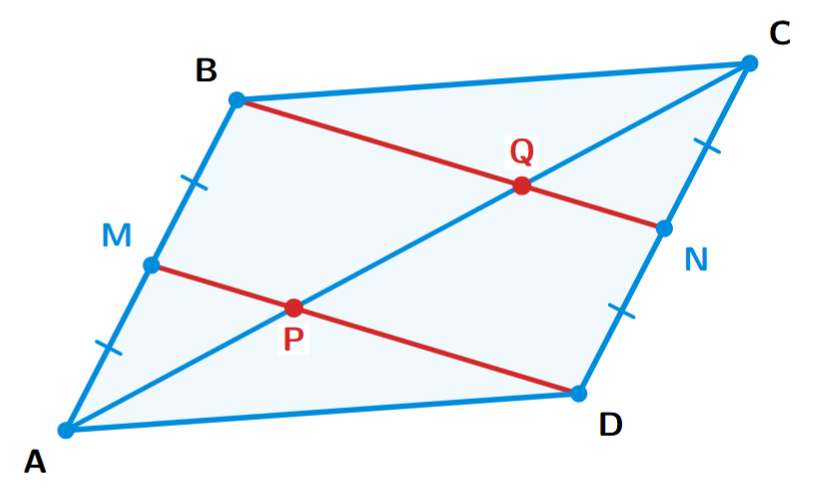
Proof:
Since $ABCD$ is a parallelogram, opposite sides are equal and parallel, so $AB = CD$ and $AB \parallel CD$.
Since $M$ and $N$ are the midpoints of $AB$ and $CD$ respectively, we have:
$MB = \dfrac{AB}{2}$ and $DN = \dfrac{CD}{2}$
Since $AB = CD$, it follows that $MB = DN$. Also, since $AB \parallel CD$, we have $MB \parallel DN$.
Because one pair of opposite sides ($MB$ and $DN$) of quadrilateral $MBND$ is both equal and parallel, $MBND$ is a parallelogram.
Therefore, its opposite sides are parallel, giving $BN \parallel MD$ (so $MP \parallel BQ$ and $QN \parallel PD$).
Now, in $\triangle ABQ$:
$M$ is the midpoint of $AB$ and $MP \parallel BQ$.
By the Converse of the Midpoint Theorem, $P$ is the midpoint of $AQ$, i.e., $AP = PQ$.
Next, in $\triangle CDP$:
$N$ is the midpoint of $CD$ and $QN \parallel PD$.
By the Converse of the Midpoint Theorem, $Q$ is the midpoint of $CP$, i.e., $PQ = QC$.
Combining both results, we obtain:
$AP = PQ = QC$
$\therefore$ Segments $DM$ and $BN$ trisect segment $AC$.
Part (ii): Three Procedures to Trisect Any Given Segment $PQ$
Method 1: Using Part (i) (Parallelogram Method)
Let $PQ$ be the given line segment to be trisected.
1. At point $P$, draw a ray $PA$ making any acute angle $\angle APQ$ with $PQ$.
2. On the opposite side of $PQ$, draw a ray $QB$ at point $Q$ such that $\angle BQP = \angle APQ$ (alternate interior angles), and cut off $BQ = AP$.
3. Join $AQ$ and $BP$ to form quadrilateral $APBQ$.
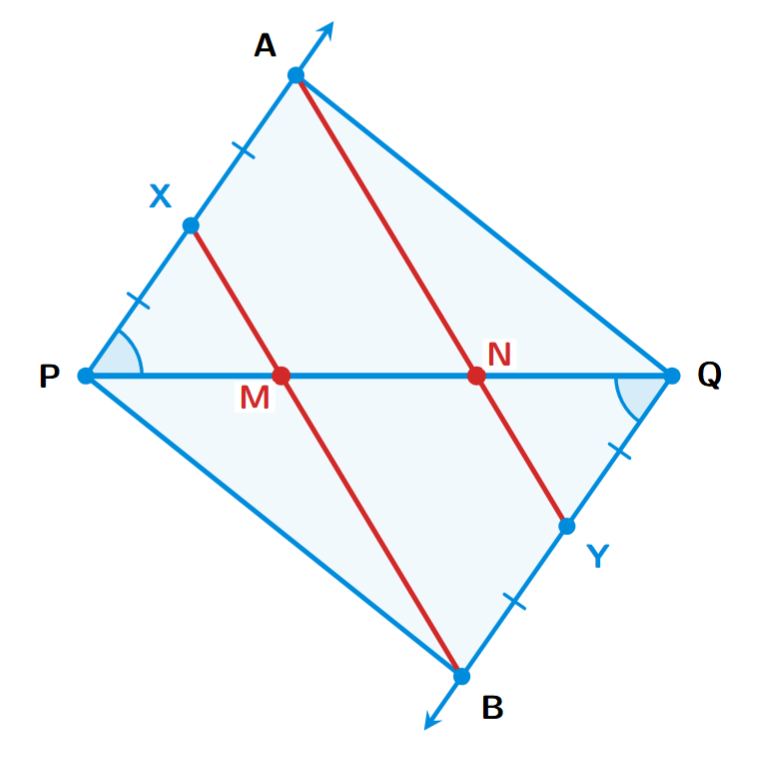
Since alternate interior angles $\angle APQ$ and $\angle BQP$ are equal, we have $AP \parallel BQ$. Since $AP = BQ$ as well, $APBQ$ is a parallelogram with diagonal $PQ$.
4. Find the midpoints $X$ and $Y$ of $AP$ and $BQ$ respectively.
5. Draw segments $BX$ and $AY$, and let them intersect $PQ$ at points $M$ and $N$ respectively.
By Part (i), segments $BX$ and $AY$ trisect the diagonal $PQ$. Thus, $PM = MN = NQ$, and points $M$ and $N$ trisect $PQ$.
Method 2: Using Exercise 11 (Intercept Theorem Method)
1. From endpoint $P$, draw a ray $PX$ making any convenient acute angle with $PQ$.
2. Using a compass, mark three equal segments along ray $PX$ starting from $P$ at points $A_1$, $A_2$, and $A_3$ such that $PA_1 = A_1A_2 = A_2A_3$.
3. Join $A_3Q$ to form $\triangle PA_3Q$.
4. Through $A_1$ and $A_2$, draw lines parallel to $A_3Q$ meeting $PQ$ at points $M$ and $N$ respectively.
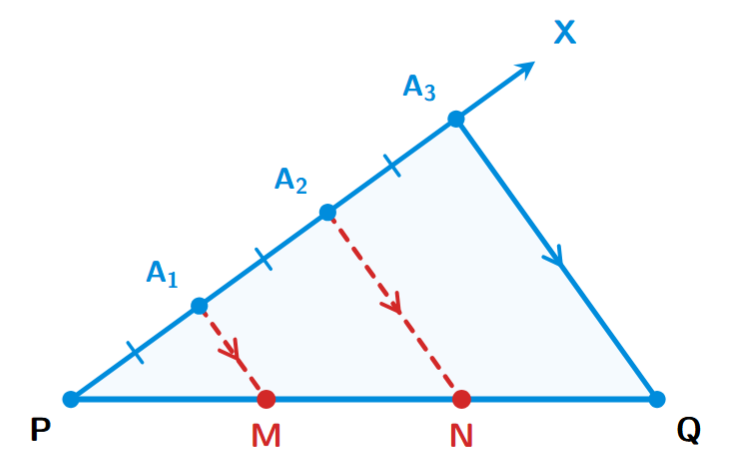
In $\triangle PA_3Q$, by Exercise 11(iv):
Since $A_1M \parallel A_3Q$, we have $\dfrac{PM}{MQ} = \dfrac{PA_1}{A_1A_3} = \dfrac{1}{2}$, which means $PM = \dfrac{1}{3}PQ$.
Since $A_2N \parallel A_3Q$, we have $\dfrac{PN}{NQ} = \dfrac{PA_2}{A_2A_3} = \dfrac{2}{1}$, which means $NQ = \dfrac{1}{3}PQ$.
Therefore, $PM = MN = NQ = \dfrac{1}{3}PQ$, so points $M$ and $N$ trisect segment $PQ$.
Method 3: Using the Centroid Theorem
1. Through endpoint $Q$ of the given segment $PQ$, draw any line not coinciding with $PQ$. Using a compass centered at $Q$, mark points $A$ and $B$ on opposite sides of $Q$ along this line such that $AQ = QB$.
2. Join $PA$ and $PB$ to form $\triangle PAB$. Since $Q$ is the midpoint of $AB$, $PQ$ is a median of $\triangle PAB$.
3. Find the midpoint $D$ of side $PA$ (using a perpendicular bisector), and join $BD$ to draw a second median of $\triangle PAB$. Let $BD$ intersect $PQ$ at point $G$.
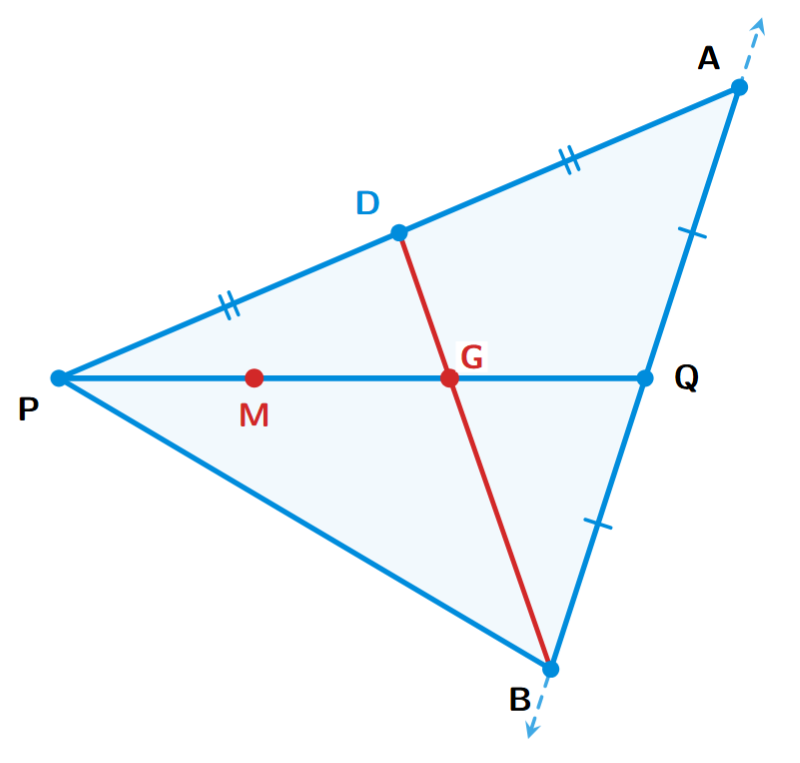
Here, $G$ is the centroid of $\triangle PAB$. By the Centroid Theorem, the centroid divides each median in the ratio $2:1$ from the vertex:
$PG = \dfrac{2}{3}PQ$ and $GQ = \dfrac{1}{3}PQ$
4. Now find the midpoint $M$ of segment $PG$ (or use a compass to mark $PM = GQ$ along $PQ$).
Then $PM = MG = \dfrac{1}{2}PG = \dfrac{1}{2}\left(\dfrac{2}{3}PQ\right) = \dfrac{1}{3}PQ$.
Thus, $PM = MG = GQ = \dfrac{1}{3}PQ$, so points $M$ and $G$ trisect segment $PQ$.
Question 13. Is the Midpoint Theorem for Quadrilaterals (Theorem 9) true when the quadrilateral is non-convex? How about when it is self-intersecting? Experiment and check. The pictures may look strange, but the theorem appears to be true.
(i) Can you explain why this is so? See the geometric reasoning in the text.
(ii) There is one exception: In a very special case the Varignon parallelogram becomes a single segment. When will this happen?
(iii) Does your reasoning apply even when $ABCD$ is non-planar?
Answer:
Yes, the Midpoint Theorem for Quadrilaterals holds true even when the quadrilateral is non-convex or self-intersecting (except in the one special degenerate case discussed in part (ii)).
Given:
A quadrilateral $ABCD$ (which may be non-convex, self-intersecting, or non-planar), where $P, Q, R,$ and $S$ are the midpoints of sides $AB, BC, CD,$ and $DA$ respectively.
Construction Required:
Join $PQ, QR, RS,$ and $SP$ to form the midpoint quadrilateral $PQRS$. Also, join the diagonals $AC$ and $BD$.
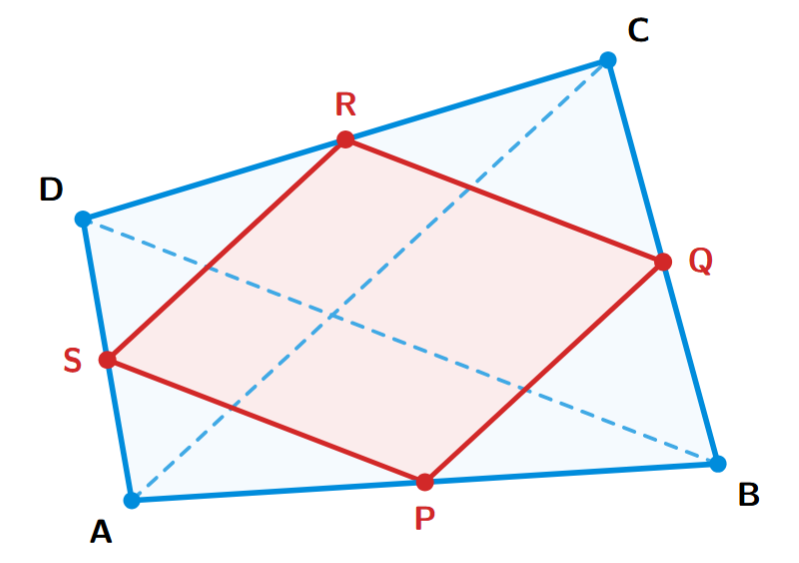
To Explain / Prove:
(i) Why $PQRS$ is a parallelogram even when $ABCD$ is non-convex or self-intersecting.
(ii) The special case in which the Varignon parallelogram $PQRS$ becomes a single line segment.
(iii) Whether the same reasoning applies when $ABCD$ is non-planar.
Solution:
(i) Geometric reasoning for non-convex and self-intersecting quadrilaterals:
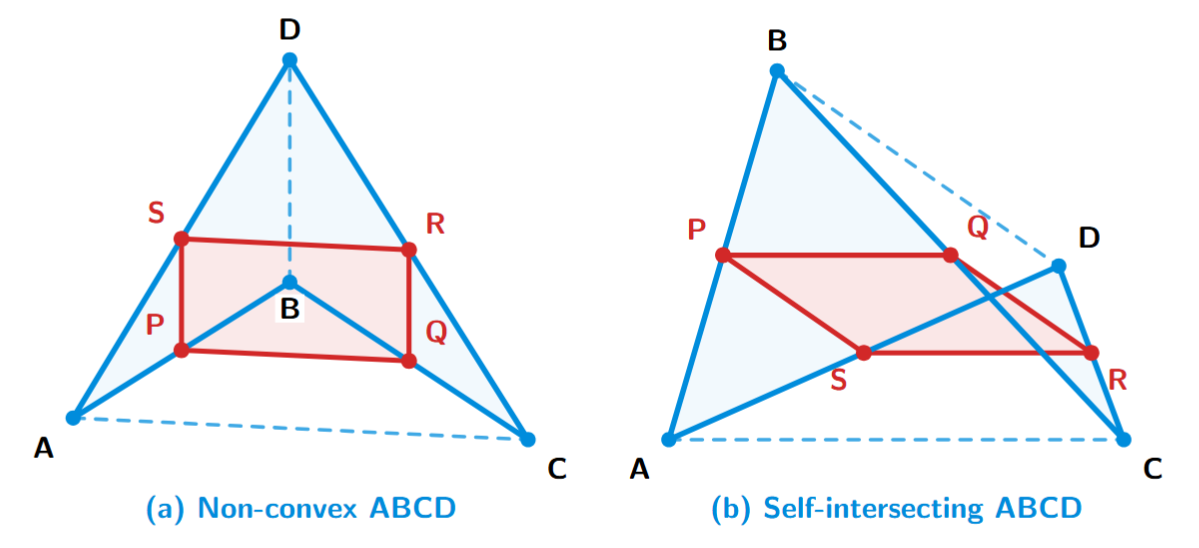
Let $ABCD$ be a quadrilateral, and consider both cases: when $ABCD$ is non-convex and when $ABCD$ is self-intersecting.
In $\triangle ABC$, $P$ and $Q$ are the midpoints of $AB$ and $BC$ respectively.
By the Midpoint Theorem for triangles, we get:
$PQ \parallel AC$ and $PQ = \frac{1}{2}AC$
Similarly, in $\triangle ADC$, $S$ and $R$ are the midpoints of $AD$ and $DC$ respectively.
By the Midpoint Theorem for triangles, we get:
$SR \parallel AC$ and $SR = \frac{1}{2}AC$
Since both $PQ$ and $SR$ are parallel to the same line $AC$ (and equal to $\frac{1}{2}AC$):
$\therefore PQ \parallel SR$ and $PQ = SR$
(Both parallel and equal to $\frac{1}{2}AC$) ... (i)
Now, in $\triangle BAD$, $P$ and $S$ are the midpoints of $AB$ and $AD$ respectively.
By the Midpoint Theorem for triangles, we get:
$PS \parallel BD$ and $PS = \frac{1}{2}BD$
Similarly, in $\triangle BCD$, $Q$ and $R$ are the midpoints of $BC$ and $CD$ respectively.
By the Midpoint Theorem for triangles, we get:
$QR \parallel BD$ and $QR = \frac{1}{2}BD$
Since both $PS$ and $QR$ are parallel to the same line $BD$ (and equal to $\frac{1}{2}BD$):
$\therefore PS \parallel QR$ and $PS = QR$
(Both parallel and equal to $\frac{1}{2}BD$) ... (ii)
Notice that the Midpoint Theorem in each of the four triangles ($\triangle ABC$, $\triangle ADC$, $\triangle BAD$, and $\triangle BCD$) depends only on the vertices of that triangle and remains valid even if the quadrilateral is non-convex or its sides cross each other.
From (i) and (ii), in quadrilateral $PQRS$, both pairs of opposite sides are parallel ($PQ \parallel SR$ and $PS \parallel QR$).
$\therefore PQRS$ is a parallelogram in both non-convex and self-intersecting quadrilaterals.
(ii) Special case when the Varignon parallelogram $PQRS$ becomes a single segment:
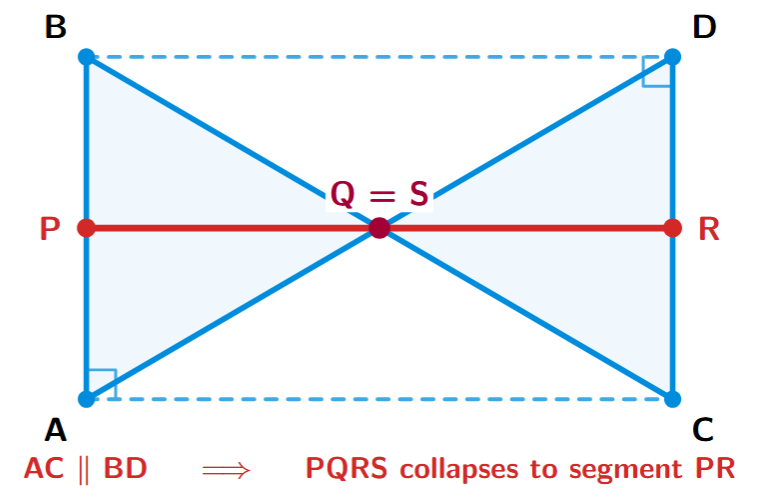
Consider the self-intersecting quadrilateral $ABCD$ formed in such a manner that $ABDC$ is a rectangle (or more generally, whenever the diagonals $AC$ and $BD$ are parallel, i.e., $AC \parallel BD$).
Since $PQ \parallel AC$, $SR \parallel AC$, $PS \parallel BD$, and $QR \parallel BD$, having $AC \parallel BD$ forces all four segments $PQ, QR, RS,$ and $SP$ to be parallel to the same direction and lie on the same straight line.
Specifically, when $ABDC$ is a rectangle, the midpoints $Q$ and $S$ coincide at the centre of the rectangle, and all four points $P, Q, R, S$ become collinear.
In this case, the Varignon parallelogram $PQRS$ reduces to a single line segment $PR$.
(iii) When $ABCD$ is a non-planar quadrilateral:
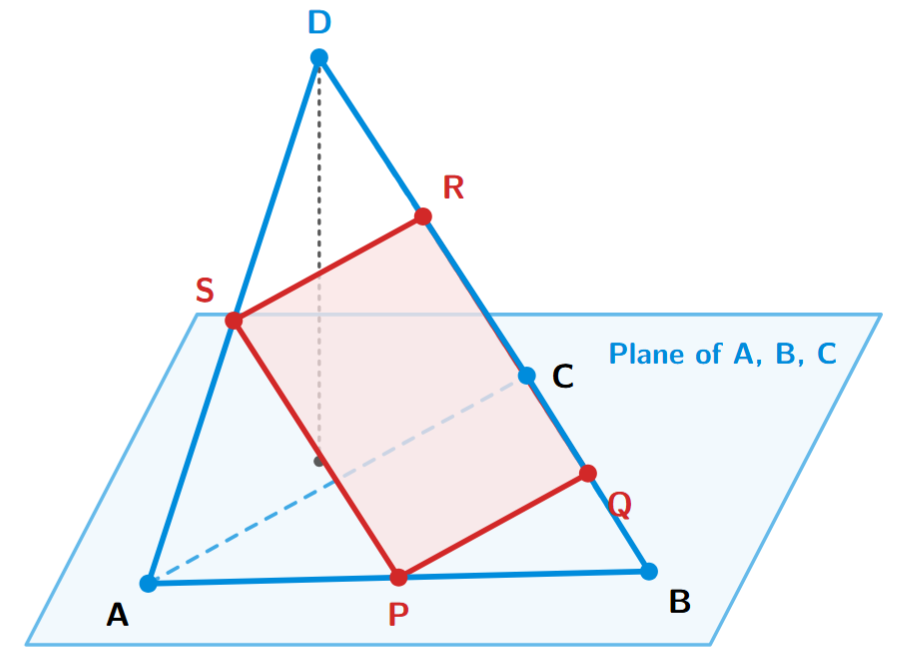
Yes, the reasoning applies even when $ABCD$ is a non-planar (skew) quadrilateral.
Let $ABCD$ be a non-planar quadrilateral, where vertex $D$ does not lie in the plane containing vertices $A, B,$ and $C$.
Even in three-dimensional space, any three vertices still form a flat triangle lying in a single plane ($\triangle ABC$, $\triangle ADC$, $\triangle BAD$, and $\triangle BCD$).
Applying the Midpoint Theorem to each of these four triangles gives:
$PQ \parallel AC$ and $SR \parallel AC \implies PQ \parallel SR$ (with $PQ = SR = \frac{1}{2}AC$)
$PS \parallel BD$ and $QR \parallel BD \implies PS \parallel QR$ (with $PS = QR = \frac{1}{2}BD$)
Since the two parallel lines $PQ$ and $SR$ always define a single flat plane containing all four points $P, Q, R,$ and $S$, the midpoint figure $PQRS$ is still a planar Varignon parallelogram of the non-planar quadrilateral $ABCD$.
Question 14. Let $P$, $Q$, $R$, $S$ be four points on sides $AB$, $BC$, $CD$ and $DA$ respectively of a quadrilateral $ABCD$. Suppose $PQRS$ is a parallelogram. Must $P$, $Q$, $R$ and $S$ be midpoints of the respective sides? This can be considered a possible converse question to Theorem 9.
Answer:
No, if $PQRS$ is a parallelogram, then $P$, $Q$, $R$, and $S$ need not be the midpoints of the corresponding sides $AB$, $BC$, $CD$, and $DA$ of the quadrilateral $ABCD$.
Hence, the converse of the Midpoint Theorem for Quadrilaterals is not true.
Given:
A quadrilateral $ABCD$ with points $P, Q, R, S$ lying on sides $AB, BC, CD, DA$ respectively such that $PQRS$ is a parallelogram.
To Check:
Whether $P, Q, R, S$ must necessarily be the midpoints of $AB, BC, CD, DA$ (which can be disproved by a counterexample).
Solution (By Counterexample):
Let $ABCD$ be a quadrilateral which is also a parallelogram.
Let $P, Q, R,$ and $S$ be the points on sides $AB, BC, CD,$ and $DA$ respectively that divide each side in the ratio $1 : 2$ (taken in cyclic order around $ABCD$).
Clearly, $P, Q, R,$ and $S$ are not the midpoints of the sides (since a midpoint divides a segment in the ratio $1 : 1$, not $1 : 2$).
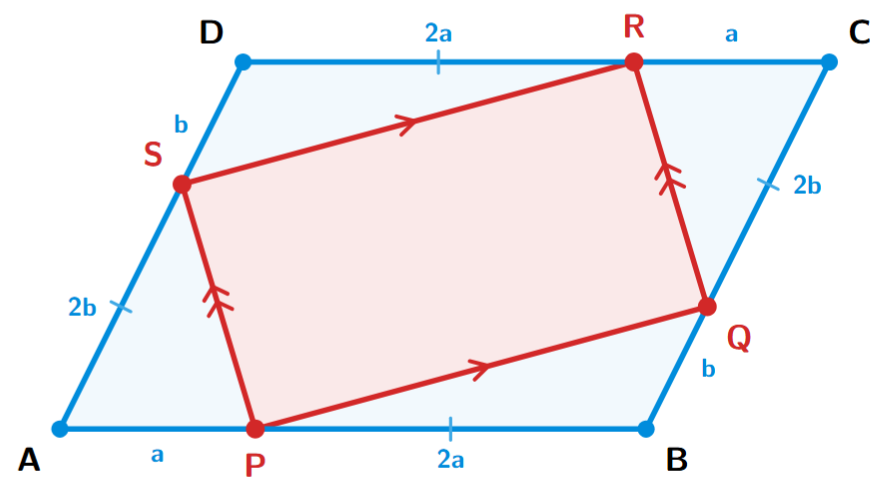
Construction Required:
Join $PQ, QR, RS,$ and $SP$ to form quadrilateral $PQRS$.
Proof that $PQRS$ is a parallelogram:
Since $ABCD$ is a parallelogram, its opposite sides and opposite angles are equal:
$AB = CD$ and $BC = DA$
$\angle A = \angle C$ and $\angle B = \angle D$
Because $P, Q, R, S$ divide $AB, BC, CD, DA$ in the ratio $1 : 2$:
$AP = \frac{1}{3}AB$ and $CR = \frac{1}{3}CD \implies AP = CR$
$PB = \frac{2}{3}AB$ and $RD = \frac{2}{3}CD \implies PB = RD$
$BQ = \frac{1}{3}BC$ and $DS = \frac{1}{3}DA \implies BQ = DS$
$QC = \frac{2}{3}BC$ and $SA = \frac{2}{3}DA \implies QC = SA$
Now, in $\triangle APS$ and $\triangle CRQ$:
$AP = CR$
(Both equal to $\frac{1}{3}AB = \frac{1}{3}CD$)
$\angle A = \angle C$
(Opposite angles of parallelogram $ABCD$)
$SA = QC$
(Both equal to $\frac{2}{3}DA = \frac{2}{3}BC$)
$\therefore \triangle APS \cong \triangle CRQ$ (by SAS congruence rule)
$\therefore PS = RQ$
(By CPCT) ... (i)
Similarly, in $\triangle PBQ$ and $\triangle RDS$:
$PB = RD$
(Both equal to $\frac{2}{3}AB = \frac{2}{3}CD$)
$\angle B = \angle D$
(Opposite angles of parallelogram $ABCD$)
$BQ = DS$
(Both equal to $\frac{1}{3}BC = \frac{1}{3}DA$)
$\therefore \triangle PBQ \cong \triangle RDS$ (by SAS congruence rule)
$\therefore PQ = RS$
(By CPCT) ... (ii)
From equations (i) and (ii), both pairs of opposite sides of quadrilateral $PQRS$ are equal ($PS = RQ$ and $PQ = RS$).
$\therefore PQRS$ is a parallelogram, even though $P, Q, R,$ and $S$ are not the midpoints of $AB, BC, CD,$ and $DA$ respectively.
$\therefore$ The converse of the Midpoint Theorem for Quadrilaterals is not true.
Question 15. (i) Complete the following proof of the Midpoint Theorem. Extend segment $PQ$ beyond $Q$ until point $S$. By how much should we extend $PQ$?
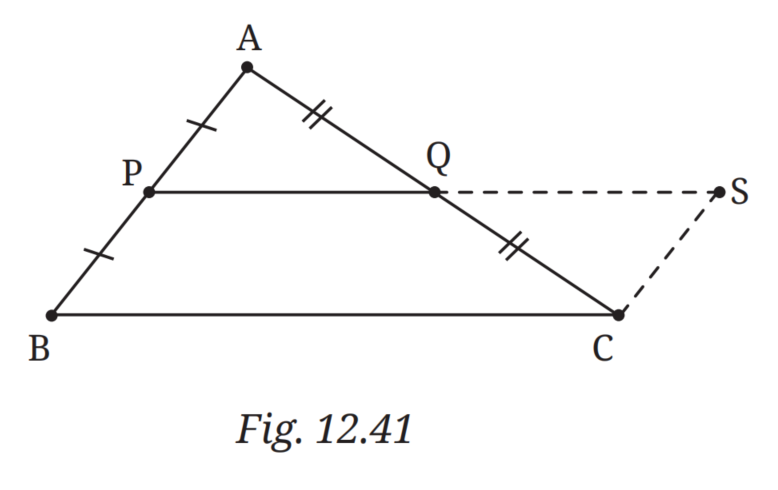
It would be good to be able to prove that $\triangle APQ \cong \triangle CSQ$. (Why?) Use this as a guide to specify the location of $S$ and then complete this proof.
(ii) Give a similar proof of the converse of the Midpoint Theorem (Theorem 7). Start by extending $PQ$ up to a suitable point $S$.
Answer:
Part (i): Proof of the Midpoint Theorem
How much to extend $PQ$ and Why $\triangle APQ \cong \triangle CSQ$ is useful:
We should extend segment $PQ$ beyond $Q$ to point $S$ by a length equal to $PQ$, i.e., so that $PQ = QS$ (making $Q$ the midpoint of $PS$).
Proving $\triangle APQ \cong \triangle CSQ$ is useful because by CPCT it gives $AP = CS$ (and hence $BP = CS$) as well as $\angle APQ = \angle CSQ$ (which proves $AB \parallel CS$, i.e., $BP \parallel CS$). This shows that quadrilateral $BCSP$ is a parallelogram, which directly gives $PQ \parallel BC$ and $PQ = \frac{1}{2}BC$.
Given:
In $\triangle ABC$, $P$ is the midpoint of $AB$ ($AP = BP$) and $Q$ is the midpoint of $AC$ ($AQ = CQ$).
To Prove:
$PQ \parallel BC$ and $PQ = \frac{1}{2}BC$
Construction Required:
Extend $PQ$ beyond $Q$ to point $S$ such that $PQ = QS$. Join $C$ and $S$.
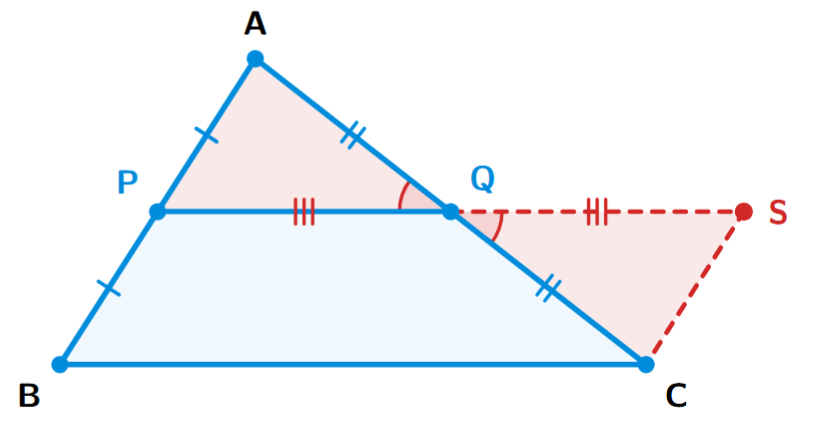
Proof:
In $\triangle APQ$ and $\triangle CSQ$:
$AQ = CQ$
(Given, $Q$ is the midpoint of $AC$)
$\angle AQP = \angle CQS$
(Vertically opposite angles)
$PQ = QS$
(By construction)
$\therefore \triangle APQ \cong \triangle CSQ$ (by SAS congruence rule)
Therefore, by CPCT (Corresponding Parts of Congruent Triangles):
$AP = CS$
(By CPCT) ... (i)
$\angle APQ = \angle CSQ$
(By CPCT) ... (ii)
Since $P$ is the midpoint of $AB$, we have $AP = BP$. Using equation (i), we get:
$BP = CS$
... (iii)
From equation (ii), $\angle APQ$ and $\angle CSQ$ are equal alternate interior angles formed by lines $AB$ and $CS$ with transversal $PS$.
$\therefore AB \parallel CS$, i.e., $BP \parallel CS$
... (iv)
From (iii) and (iv), in quadrilateral $BCSP$, one pair of opposite sides is both equal and parallel ($BP = CS$ and $BP \parallel CS$).
$\therefore BCSP$ is a parallelogram.
Since opposite sides of a parallelogram are equal and parallel:
$PS \parallel BC$ and $PS = BC$
As $Q$ lies on $PS$ and $PQ = QS$, we have $PS = PQ + QS = 2PQ$.
$\therefore PQ \parallel BC$ and $PQ = \frac{1}{2}PS = \frac{1}{2}BC$
Hence, the Midpoint Theorem is proved.
Part (ii): Proof of the Converse of the Midpoint Theorem
Given:
In $\triangle ABC$, $P$ is the midpoint of $AB$ ($AP = BP$) and a line segment $PQ$ is drawn parallel to $BC$ ($PQ \parallel BC$), intersecting $AC$ at $Q$.
To Prove:
$Q$ is the midpoint of $AC$ (i.e., $AQ = CQ$) and $PQ = \frac{1}{2}BC$.
Construction Required:
Draw a line parallel to $AB$ through point $C$. Extend $PQ$ beyond $Q$ to meet this line at point $S$.
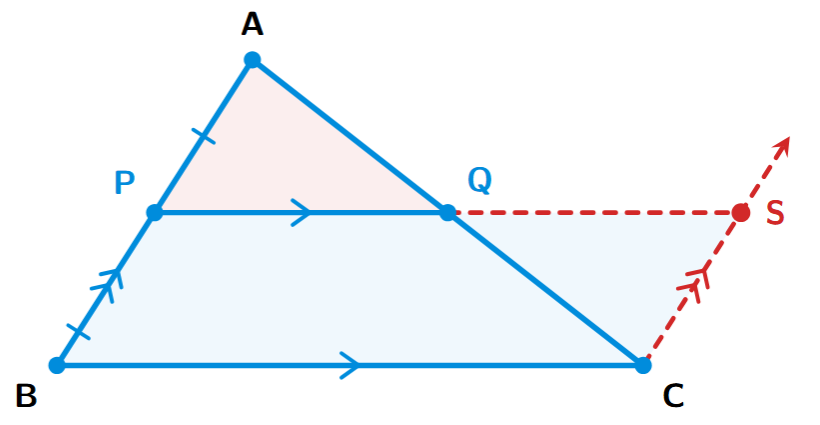
Proof:
In quadrilateral $BCSP$:
$BC \parallel PS$
(Given $PQ \parallel BC$, and $S$ lies on $PQ$ produced)
$BP \parallel CS$
(By construction, $CS \parallel AB$)
Since both pairs of opposite sides are parallel, $BCSP$ is a parallelogram.
Since opposite sides of a parallelogram are equal:
$PS = BC$ and $BP = CS$
Since $P$ is the midpoint of $AB$, we have $AP = BP$.
$\therefore AP = CS$
($\because AP = BP$ and $BP = CS$) ... (i)
Now, in $\triangle APQ$ and $\triangle CSQ$:
$\angle APQ = \angle CSQ$
(Alternate interior angles, $AB \parallel CS$)
$AP = CS$
(From equation (i))
$\angle PAQ = \angle SCQ$
(Alternate interior angles, $AB \parallel CS$)
$\therefore \triangle APQ \cong \triangle CSQ$ (by ASA congruence rule)
By CPCT (Corresponding Parts of Congruent Triangles):
$AQ = CQ$ and $PQ = QS$
Since $PS = PQ + QS = 2PQ$ and $PS = BC$:
$PQ = \frac{1}{2}PS = \frac{1}{2}BC$
Therefore, $Q$ is the midpoint of $AC$ and $PQ = \frac{1}{2}BC$.
Hence, the converse of the Midpoint Theorem is proved.
Question 16. Review all the properties of a rhombus/rectangle/square that you proved in Grade 8. Formulate a converse of each. Decide if the converse is true. There are many possibilities here!
Answer:
Below are the main Grade $8$ properties of a rhombus, rectangle, and square, along with their converses and whether each converse is true.
1. Properties of a Rhombus and Their Converses
| Property of a Rhombus | Converse Statement | Is the Converse True? |
| All four sides of a rhombus are equal. | If all four sides of a quadrilateral are equal, then it is a rhombus. | True (by definition of a rhombus). |
| Opposite angles of a rhombus are equal. | If opposite angles of a quadrilateral are equal, then it is a rhombus. | False (it must be a parallelogram, such as a rectangle, not necessarily a rhombus). |
| The diagonals of a rhombus bisect each other at $90^\circ$. | If the diagonals of a quadrilateral bisect each other at $90^\circ$, then it is a rhombus. | True (proven by SAS congruence on the four triangles). |
| The diagonals of a rhombus are perpendicular to each other. | If the diagonals of a quadrilateral are perpendicular, then it is a rhombus. | False (a kite has perpendicular diagonals without having all sides equal). |
| The diagonals of a rhombus bisect its interior angles. | If the diagonals of a quadrilateral bisect its four interior angles, then it is a rhombus. | True (proven by ASA congruence). |
2. Properties of a Rectangle and Their Converses
| Property of a Rectangle | Converse Statement | Is the Converse True? |
| All four angles of a rectangle are $90^\circ$. | If all four angles of a quadrilateral are $90^\circ$, then it is a rectangle. | True (by definition of a rectangle). |
| Opposite sides of a rectangle are equal. | If opposite sides of a quadrilateral are equal, then it is a rectangle. | False (it could be any parallelogram, not necessarily with $90^\circ$ angles). |
| The diagonals of a rectangle are equal and bisect each other. | If the diagonals of a quadrilateral are equal and bisect each other, then it is a rectangle. | True (bisecting diagonals make it a parallelogram; equal diagonals force $90^\circ$ angles). |
| The diagonals of a rectangle are equal in length. | If the diagonals of a quadrilateral are equal, then it is a rectangle. | False (an isosceles trapezium has equal diagonals without being a rectangle). |
3. Properties of a Square and Their Converses
| Property of a Square | Converse Statement | Is the Converse True? |
| All four sides are equal and all four angles are $90^\circ$. | If all four sides of a quadrilateral are equal and all angles are $90^\circ$, then it is a square. | True (by definition of a square). |
| The diagonals of a square are equal and bisect each other at $90^\circ$. | If the diagonals of a quadrilateral are equal and bisect each other at $90^\circ$, then it is a square. | True (it is both a rhombus and a rectangle, hence a square). |
| The diagonals of a square are equal and perpendicular. | If the diagonals of a quadrilateral are equal and perpendicular, then it is a square. | False (a kite with equal, perpendicular diagonals is not a square). |
Question 17. Show that the sum of angles of a non-planar quadrilateral is always less than $360^\circ$. Can you find a non-planar quadrilateral $ABCD$ for which $\angle A + \angle B + \angle C + \angle D = 2^\circ$?
(Hint: Think of a diagonal, say $AC$, as a hinge around which triangles $ABC$ and $ADC$ can rotate.) What happens to each angle of $ABCD$ as you do this rotation?
Answer:
Given:
Let $ABCD$ be a quadrilateral where vertices $A$, $B$, and $C$ lie in plane $P$ and vertex $D$ does not lie in plane $P$.
$\therefore ABCD$ is a non-planar quadrilateral.
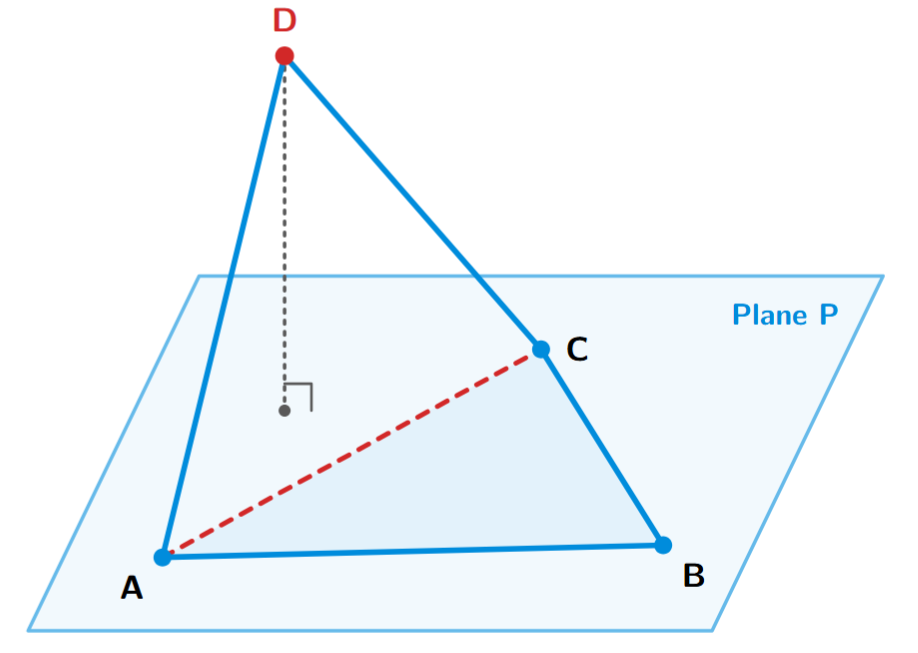
Construction Required:
Join diagonal $AC$.
To Prove:
$\angle A + \angle B + \angle C + \angle D < 360^\circ$
Solution:
In $\triangle ABC$, we have:
$\angle CAB + \angle ABC + \angle BCA = 180^\circ$
$\therefore \angle ABC = 180^\circ - (\angle CAB + \angle BCA)$
... (i)
Also, in $\triangle ADC$, we have:
$\angle CAD + \angle ACD + \angle CDA = 180^\circ$
$\therefore \angle CDA = 180^\circ - (\angle CAD + \angle ACD)$
... (ii)
Non-planar lines $AB$, $AC$, $AD$ meet at $A$, and non-planar lines $CB$, $CA$, $CD$ meet at $C$.
$\therefore \angle DAB < \angle BAC + \angle CAD$
(At vertex $A$) ... (iii)
$\therefore \angle BCD < \angle BCA + \angle ACD$
(At vertex $C$) ... (iv)
Now, adding equations (i) and (ii) with inequations (iii) and (iv):
$\text{Sum of angles of } ABCD = \angle DAB + \angle ABC + \angle BCD + \angle CDA$
$\angle DAB + \angle BCD < \angle BAC + \angle CAD + \angle BCA + \angle ACD$
$\angle ABC + \angle CDA = 360^\circ - (\angle CAB + \angle BCA + \angle CAD + \angle ACD)$
Adding these two relations (since $\angle BAC = \angle CAB$, all interior triangle angles cancel out):
$\therefore \angle DAB + \angle ABC + \angle BCD + \angle CDA < 180^\circ + 180^\circ$
$\therefore \text{Sum of angles of } ABCD < 360^\circ$
$\therefore$ The sum of angles of a non-planar quadrilateral is always less than $360^\circ$.
Rotation and Finding a $2^\circ$ Angle-Sum Quadrilateral:
Effect of rotation around hinge $AC$: As $\triangle ABC$ and $\triangle ADC$ rotate toward each other around $AC$, $\angle B$ and $\angle D$ remain constant, whereas $\angle A$ and $\angle C$ decrease.
Yes, we can find a non-planar quadrilateral $ABCD$ for which $\angle A + \angle B + \angle C + \angle D = 2^\circ$.
For example, choose congruent triangles $\triangle ABC$ and $\triangle ADC$ with $\angle B = 0.5^\circ$ and $\angle D = 0.5^\circ$, and fold them around hinge $AC$ until $\angle A = 0.5^\circ$ and $\angle C = 0.5^\circ$.
$\angle A + \angle B + \angle C + \angle D = 0.5^\circ + 0.5^\circ + 0.5^\circ + 0.5^\circ = 2^\circ$
Question 18. Let us see a third method to tile the plane using a $4$-gon. Focus on only two coloured copies of $SOME$ sharing a vertex. What do you see? It appears that each $4$-gon is just a shifted copy of the other. Let us see exactly how. Draw two copies of $SOME$ as shown in Fig. 12.42 so that the diagonals $EO$ and $E'O'$ are collinear with $O = E'$. Now place a cutout of one copy on top of $SOME$ with diagonal $EO$ drawn on it. Slide this cutout so that segment $EO$ moves along $EO'$ until $EO$ matches $E'O'$. Verify that your cutout exactly matches $S'O'M'E'$.
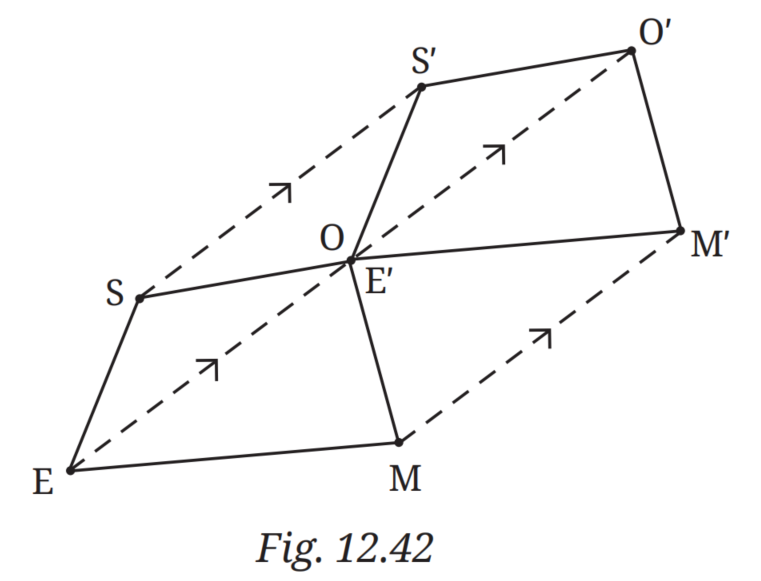
(i) Prove the exact match of $SOME$ with $S'O'M'E'$ using four parallelograms.
(ii) Follow the described procedure along each diagonal of the starting coloured $4$-gon in both directions to get $4$ new $4$-gons. Using these $4$ copies, repeat the procedure $4$ more times to place $4$ new copies, resulting in a $3$ by $3$ grid of $9$ copies exactly like the $9$ coloured copies in Fig. 12.42. These $9$ copies meet each other only at vertices and once again the blank spaces among them also form $4$-gons congruent to $SOME$!
Answer:
Given:
A $4$-gon $SOME$ is slid along the direction of its diagonal $EO$ until $EO$ matches $E'O'$, where $O = E'$ and $E, O, O'$ are collinear.
Let the new positions of vertices $S, O, M,$ and $E$ be $S', O', M',$ and $E'$ respectively.
To Prove:
(i) $4$-gon $S'O'M'E'$ is an exact match (congruent) to $4$-gon $SOME$ using four parallelograms.
(ii) Repeating the sliding procedure along both diagonals creates a $3 \times 3$ grid of $9$ copies whose blank spaces also form $4$-gons congruent to $SOME$.
Solution:
Part (i): Proving $S'O'M'E' \cong SOME$ using four parallelograms
Because every point of $SOME$ is slid by the same distance in the same direction along $EOO'$:
$EE' \parallel MM'$ and $EE' = MM'$
$\therefore$ Quadrilateral $EMM'E'$ is a parallelogram.
$\therefore E'M' \parallel EM$ and $E'M' = EM$
(Opposite sides of parallelogram $EMM'E'$) ... (i)
Similarly, considering the other three parallelograms formed by the slide:
1. In parallelogram $MOO'M'$ ($OO' \parallel MM'$ and $OO' = MM'$):
$M'O' \parallel MO$ and $M'O' = MO$
... (ii)
2. In parallelogram $SOO'S'$ ($SS' \parallel OO'$ and $SS' = OO'$):
$O'S' \parallel OS$ and $O'S' = OS$
... (iii)
3. In parallelogram $ESS'E'$ ($EE' \parallel SS'$ and $EE' = SS'$):
$S'E' \parallel SE$ and $S'E' = SE$
... (iv)
From (i), (ii), (iii), and (iv), the four sides $E'M', M'O', O'S',$ and $S'E'$ are respectively equal and parallel to the four sides $EM, MO, OS,$ and $SE$.
Now, comparing the corresponding angles:
Since $SE \parallel S'E'$, $EM \parallel E'M'$, and $E, O (= E'), O'$ are collinear, we get equal corresponding angles:
$\angle SEO = \angle S'E'O'$ and $\angle OEM = \angle O'E'M'$
Adding these two angles:
$\angle SEM = \angle SEO + \angle OEM$
$\angle SEM = \angle S'E'O' + \angle O'E'M'$
$\therefore \angle SEM = \angle S'E'M'$
Similarly, since each pair of corresponding sides is parallel in the same direction, the other three angles of $S'O'M'E'$ are also equal to the corresponding angles of $SOME$:
$\angle EMO = \angle E'M'O'$, $\angle MOS = \angle M'O'S'$, and $\angle OSE = \angle O'S'E'$
Since all corresponding sides and corresponding angles are equal, $4$-gon $S'O'M'E'$ is an exact match (congruent) to $4$-gon $SOME$.
Part (ii): Forming the $3 \times 3$ grid and blank $4$-gons congruent to $SOME$
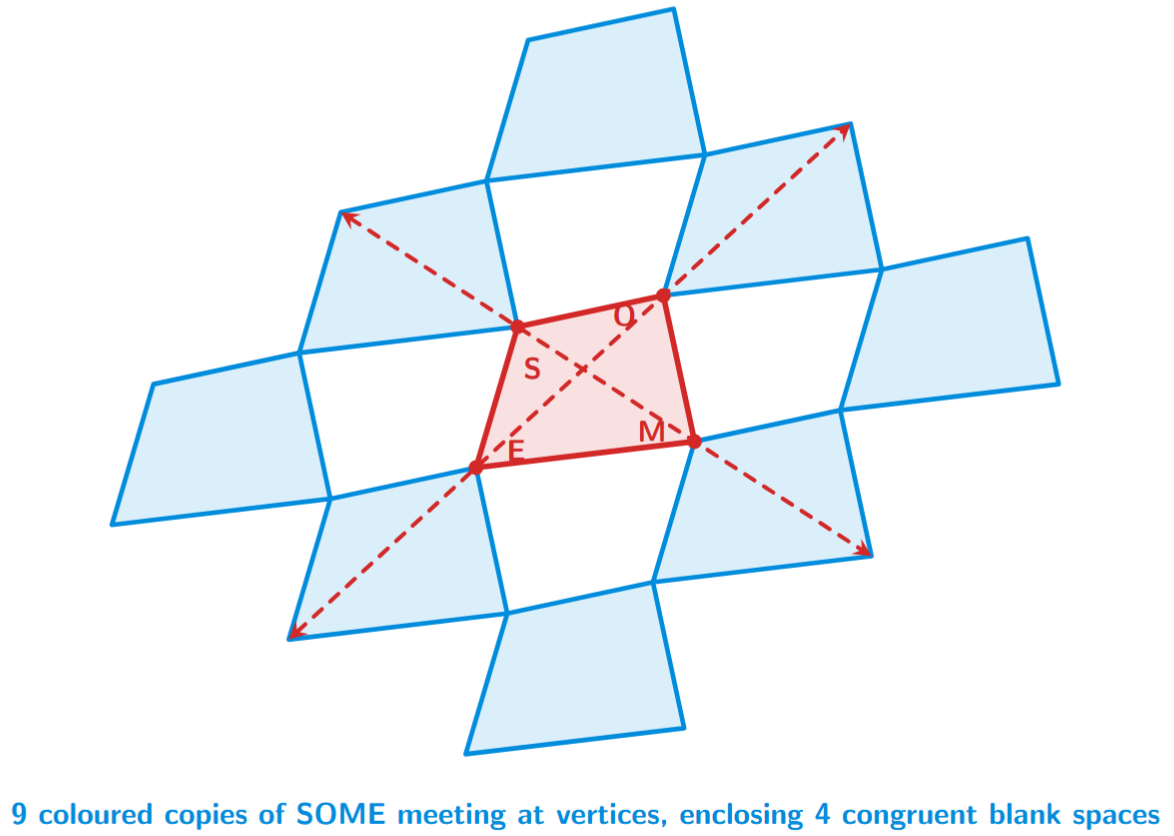
First, slide $SOME$ along diagonal $EO$ in both directions and along diagonal $SM$ in both directions to place $4$ new copies meeting $SOME$ at vertices $E, O, S,$ and $M$.
Next, slide each of those $4$ copies along the second diagonal to place $4$ more corner copies, completing the $3 \times 3$ grid of $9$ copies that meet only at their vertices.
To see why each blank space among them is congruent to $SOME$, consider parallelogram $EMM'E'$ (where $O = E'$) and parallelogram $ESS'E'$:
In $\triangle OEM$ and $\triangle MM'E'$: $OE = MM'$, $EM = M'E'$, and $OM = E'M$ (common side, as $O = E'$).
$\therefore \triangle OEM \cong \triangle MM'E'$ (by SSS congruence rule)
Similarly, in $\triangle OES$ and $\triangle SS'E'$: $OE = SS'$, $ES = S'E'$, and $OS = E'S$ (common side, as $O = E'$).
$\therefore \triangle OES \cong \triangle SS'E'$ (by SSS congruence rule)
Thus, in each blank space enclosed between four surrounding coloured copies, the two triangular halves formed by the diagonal are congruent to $\triangle OEM$ and $\triangle OES$.
Hence, each blank space forms a $4$-gon congruent to $SOME$, and repeating this procedure tiles the entire plane.
Question 19. Is there a $4$-gon with given side lengths?
(i) Recall the following fact about triangles and check it by construction. For given positive numbers $a$, $b$, $c$, is there a triangle whose sides have these lengths? The answer is Yes exactly when the sum of any two numbers is greater than the third. If we arrange the numbers in increasing order (suppose $a \le b \le c$), then this amounts to requiring $a + b > c$. (Hint: Start by drawing a segment of length $c$.)
(ii) Suppose a $4$-gon has $2$, $5$, $11$ as three side lengths. Can the length of the fourth side be $100$? Can it be $10$? Can it be $1$? What are the possible lengths of the fourth side?
(iii) For given positive numbers $a$, $b$, $c$, $d$, how will you decide if there is a $4$-gon whose sides have these lengths?
Answer:
Part (i): Triangle Inequality and Check by Construction
A triangle with side lengths $a$, $b$, and $c$ can be drawn if and only if the sum of any two sides is greater than the third side, i.e.:
$a + b > c$, $\quad b + c > a$, $\quad \text{and} \quad a + c > b$
When arranged in increasing order such that $a \le b \le c$, we already have $b + c > a$ and $a + c > b$ (since $c \ge b \ge a > 0$). Thus, the requirement reduces simply to:
$a + b > c$
(Triangle inequality condition) ... (i)
Check by Construction:
1. Draw a line segment $AB$ of length $c$.
2. With $A$ as centre and radius $a$, draw an arc; with $B$ as centre and radius $b$, draw another arc.
3. For the two arcs to intersect at a point $C$ (not on line $AB$) to form $\triangle ABC$, the sum of the two radii must exceed the distance $AB$, i.e., $a + b > c$ (and since $c \ge b \ge a$, we automatically have $b - a < c$).
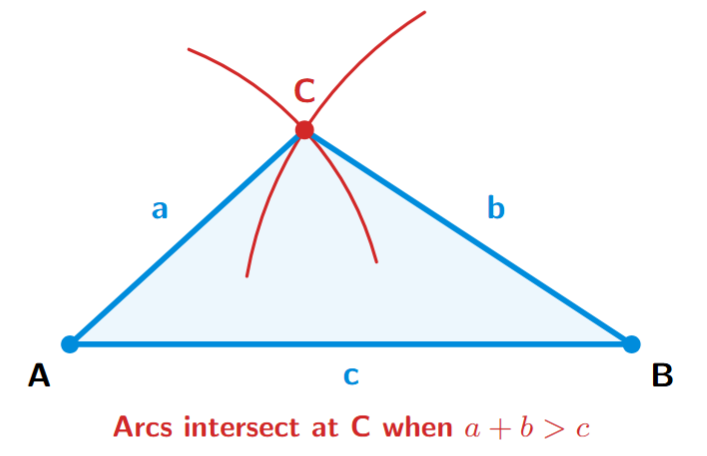
Part (iii): General Condition for a $4$-gon with Sides $a, b, c, d$
Given:
Let $ABCD$ be a quadrilateral with side lengths $AB = a$, $BC = b$, $CD = c$, and $DA = d$.
Construction Required:
Join diagonal $AC$, and let $AC = p$.
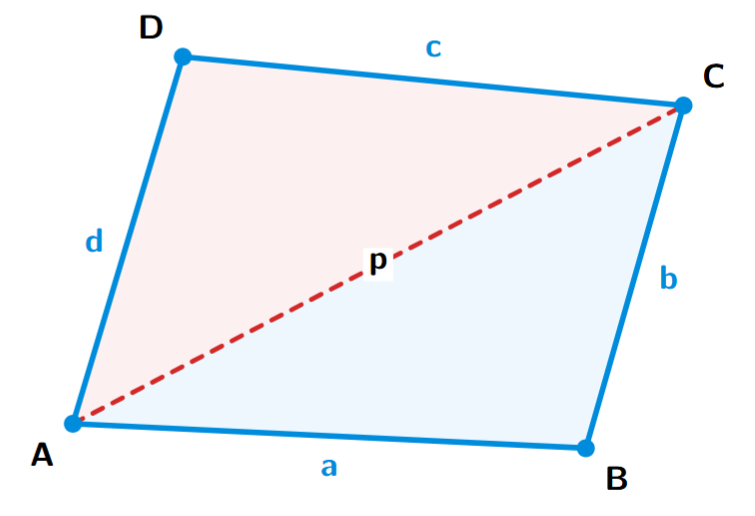
Proof of Necessary and Sufficient Condition:
In $\triangle ABC$, by the triangle inequality:
$a + b > p$
... (ii)
In $\triangle ADC$, by the triangle inequality:
$c + p > d$
... (iii)
Combining inequations (ii) and (iii):
$d < c + p < c + (a + b)$
$\therefore d < a + b + c$, i.e., $a + b + c > d$
Similarly, by considering the other sides and diagonals, we can show that:
$b + c + d > a$, $\quad c + d + a > b$, $\quad \text{and} \quad d + a + b > c$
This condition is also sufficient (when $a \le b \le c \le d$ and $a + b + c > d$, we have $d - c < a + b$, so we can always pick a diagonal length $p$ strictly between $d - c$ and $\min(a + b, c + d)$ to construct $\triangle ABC$ and $\triangle ADC$).
Therefore, a $4$-gon with side lengths $a, b, c, d$ exists if and only if the sum of any three sides is greater than the fourth side.
If arranged in increasing order ($a \le b \le c \le d$), this condition reduces simply to:
$a + b + c > d$
Part (ii): Checking Possible Fourth Side Lengths for Sides $2, 5, 11$
Given three side lengths of the $4$-gon are $2$, $5$, and $11$.
Case 1: Can the fourth side be $100$?
Here, the sides in increasing order are $2 \le 5 \le 11 \le 100$.
Checking whether $2 + 5 + 11 > 100$:
$18 > 100$, which is false.
$\therefore$ No, $100$ cannot be the fourth side.
Case 2: Can the fourth side be $10$?
Here, the sides in increasing order are $2 \le 5 \le 10 \le 11$.
Checking whether $2 + 5 + 10 > 11$:
$17 > 11$, which is true.
$\therefore$ Yes, $10$ can be the fourth side.
Case 3: Can the fourth side be $1$?
Here, the sides in increasing order are $1 \le 2 \le 5 \le 11$.
Checking whether $1 + 2 + 5 > 11$:
$8 > 11$, which is false.
$\therefore$ No, $1$ cannot be the fourth side.
Finding all possible lengths of the fourth side:
Let the length of the fourth side be $x$ ($x > 0$), so the sides are $2, 5, 11,$ and $x$.
Applying the quadrilateral inequality condition (sum of any three sides is greater than the fourth):
$2 + 5 + 11 > x \implies x < 18$
$5 + 11 + x > 2 \implies x > -14$
$11 + x + 2 > 5 \implies x > -8$
$x + 2 + 5 > 11 \implies x > 4$
Combining all four inequalities, we get:
$4 < x < 18$
Therefore, the length of the fourth side must be strictly greater than $4$ and strictly less than $18$ (i.e., $4 < x < 18$).
Question 20. Counting diagonals of a polygon.
(i) How should we define a diagonal of an $n$-gon? How many diagonals does an $n$-gon have? Make a table for small values of $n$. A $3$-gon has no diagonals. A $4$-gon has $2$. How many diagonals does a $5$-gon have? A $6$-gon? Try to find a pattern and guess the answers for $n = 7$ and $n = 8$. Check your guesses by systematic counting.
(ii) Can you guess a formula for the number of diagonals? How many diagonals get added when we increase the number of sides by $1$? Can you now justify why the formula you guessed is true for all $n$?
Answer:
Part (i): Definition, Table, Pattern, and Systematic Counting
Definition: A diagonal of an $n$-gon is defined as a line segment connecting any two non-adjacent vertices of the $n$-gon.
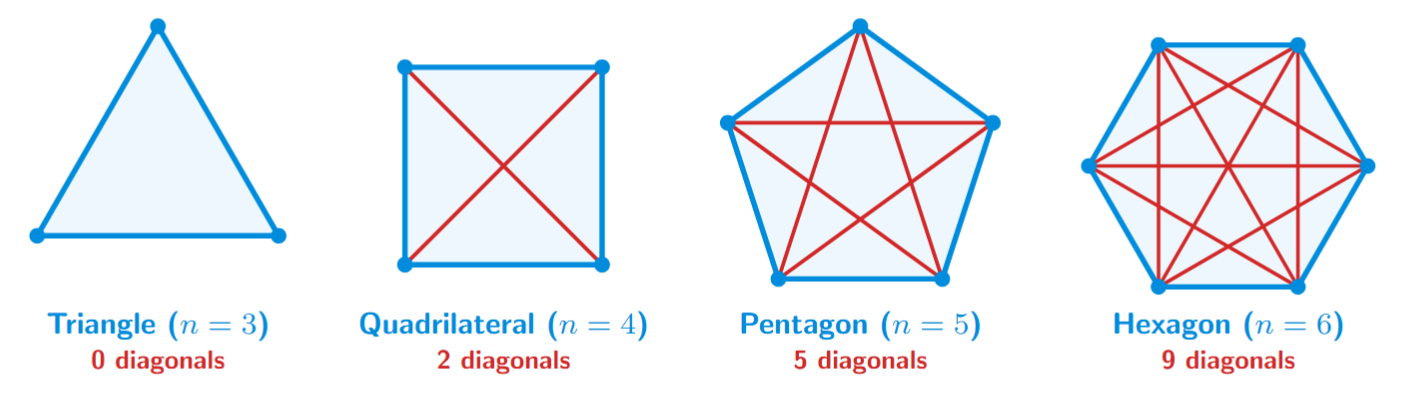
Finding the number of diagonals for small values of $n$:
For $n = 3$ (triangle), there are no two non-adjacent vertices, so it has $0$ diagonals.
For $n = 4$ (quadrilateral), there are $2$ diagonals.
For $n = 5$ (pentagon), there are $5$ diagonals.
For $n = 6$ (hexagon), there are $9$ diagonals.
Pattern and Guesses for $n = 7$ and $n = 8$:
Notice the consecutive differences in the number of diagonals: $0 \xrightarrow{+2} 2 \xrightarrow{+3} 5 \xrightarrow{+4} 9$.
Continuing this pattern ($+5$ and $+6$), we guess:
For $n = 7$: $9 + 5 = 14$ diagonals.
For $n = 8$: $14 + 6 = 20$ diagonals.
| No. of sides of $n$-gon ($n$) | No. of diagonals ($D(n)$) |
| $3$ | $0$ |
| $4$ | $2$ |
| $5$ | $5$ |
| $6$ | $9$ |
| $7$ | $14$ |
| $8$ | $20$ |
Checking by Systematic Counting:
Let $D(n)$ be the number of diagonals of an $n$-gon, where $n \ge 3$.
Let $P$ be any vertex of the $n$-gon. Excluding $P$ itself and the $2$ vertices adjacent to $P$, there are $(n - 3)$ non-adjacent vertices.
$\therefore$ The number of diagonals drawn from vertex $P$ is $(n - 3)$.
Since there are $n$ vertices, drawing diagonals from every vertex gives $n(n - 3)$ segments.
However, each diagonal connects two vertices, so every diagonal is counted twice (once from each end).
$\therefore D(n) = \frac{n(n - 3)}{2}$
(For all $n \ge 3$) ... (i)
Checking our guesses for $n = 7$ and $n = 8$ using (i):
$D(7) = \frac{7(7 - 3)}{2} = \frac{7 \times \cancel{4}^{2}}{\cancel{2}_{1}} = 14$
$D(8) = \frac{8(8 - 3)}{2} = \frac{\cancel{8}^{4} \times 5}{\cancel{2}_{1}} = 20$
Thus, our guesses of $14$ diagonals for $n = 7$ and $20$ diagonals for $n = 8$ are confirmed.
Part (ii): Formula, Increase When Sides Increase by $1$, and Justification
Formula: The number of diagonals in an $n$-gon is given by $D(n) = \frac{n(n - 3)}{2}$.
Increase in diagonals when the number of sides increases by $1$:
Let the number of sides of the $n$-gon be increased by $1$, so the new number of sides is $n + 1$.
$D(n + 1) = \frac{(n + 1)(n + 1 - 3)}{2} = \frac{(n + 1)(n - 2)}{2}$
Now, finding the increase in the number of diagonals:
$\text{Increase} = D(n + 1) - D(n)$
$\text{Increase} = \frac{(n + 1)(n - 2)}{2} - \frac{n(n - 3)}{2}$
$\text{Increase} = \frac{n^2 - n - 2}{2} - \frac{n^2 - 3n}{2}$
$\text{Increase} = \frac{n^2 - n - 2 - n^2 + 3n}{2}$
$\text{Increase} = \frac{2n - 2}{2} = \frac{\cancel{2}^{1}(n - 1)}{\cancel{2}_{1}} = n - 1$
Therefore, $n - 1$ diagonals get added when the number of sides increases from $n$ to $n + 1$.
Justification that the formula is true for all $n \ge 3$:
When we add a new vertex between two adjacent vertices $A$ and $B$ of an $n$-gon to form an $(n + 1)$-gon:
1. The old side $AB$ becomes $1$ new diagonal.
2. The new vertex connects to all $(n - 2)$ vertices other than $A$ and $B$, adding $(n - 2)$ new diagonals.
Thus, at every step from $n$ to $n + 1$, exactly $1 + (n - 2) = n - 1$ diagonals are added.
Since $D(3) = \frac{3(3 - 3)}{2} = 0$ is true, and adding $(n - 1)$ diagonals to $\frac{n(n - 3)}{2}$ always yields $\frac{(n + 1)(n - 2)}{2}$, the formula $D(n) = \frac{n(n - 3)}{2}$ holds true for all $n \ge 3$.
Question 21. Sum of angles of a polygon. What is the sum of angles of a (planar non-self-intersecting) $n$-gon? We know that the answer is $180^\circ$ for $n = 3$ and $360^\circ$ for $n = 4$. Find the next few values. Then find a formula in terms of $n$ and prove it.
Answer:
Given:
A planar non-self-intersecting $n$-gon ($n \ge 3$).
The sum of interior angles is $180^\circ$ for $n = 3$ and $360^\circ$ for $n = 4$.
To Find and Prove:
1. The next few values of the sum of interior angles (for $n = 5, 6, 7, 8$).
2. A general formula in terms of $n$ for the sum of all interior angles of an $n$-gon, and its proof.
Finding the Next Few Values:
By dividing each polygon from one vertex into triangles (using non-intersecting diagonals):
For $n = 5$ (pentagon): $3$ triangles $\implies 3 \times 180^\circ = 540^\circ$
For $n = 6$ (hexagon): $4$ triangles $\implies 4 \times 180^\circ = 720^\circ$
For $n = 7$ (heptagon): $5$ triangles $\implies 5 \times 180^\circ = 900^\circ$
For $n = 8$ (octagon): $6$ triangles $\implies 6 \times 180^\circ = 1080^\circ$
| No. of Sides ($n$) | Polygon | No. of Triangles | Sum of Interior Angles |
| $3$ | Triangle | $1$ | $1 \times 180^\circ = 180^\circ$ |
| $4$ | Quadrilateral | $2$ | $2 \times 180^\circ = 360^\circ$ |
| $5$ | Pentagon | $3$ | $3 \times 180^\circ = 540^\circ$ |
| $6$ | Hexagon | $4$ | $4 \times 180^\circ = 720^\circ$ |
| $7$ | Heptagon | $5$ | $5 \times 180^\circ = 900^\circ$ |
| $8$ | Octagon | $6$ | $6 \times 180^\circ = 1080^\circ$ |
From the pattern above, the formula for the sum of interior angles of an $n$-gon is $(n - 2) \times 180^\circ$.
Proof of the Formula:
Construction Required:
Consider a planar non-self-intersecting $n$-gon and pick any vertex $P$ (or triangulate using $(n - 3)$ non-intersecting diagonals from $P$).
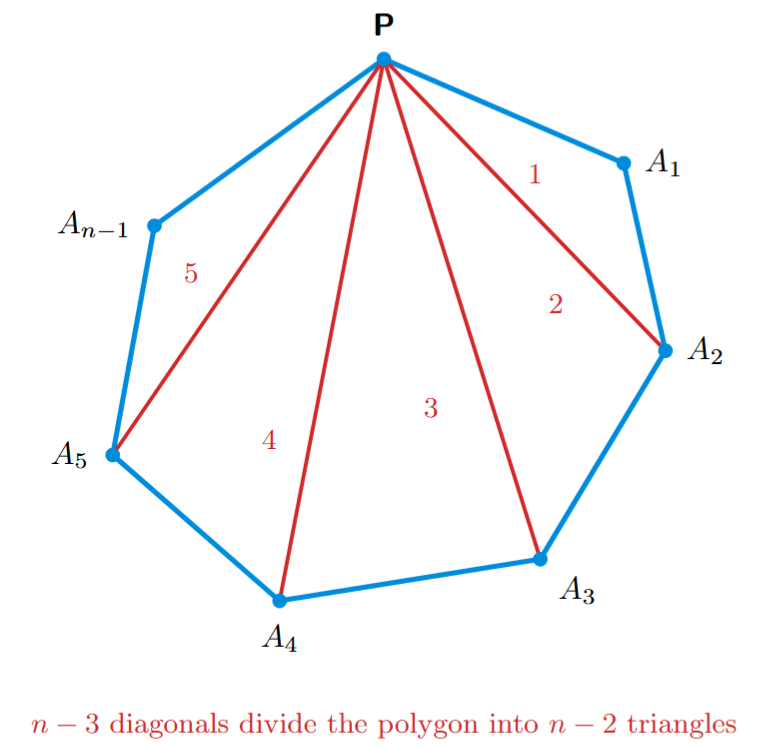
Let $P$ be a vertex of the $n$-gon.
Excluding $P$ itself and the $2$ vertices adjacent to $P$, there are $(n - 3)$ remaining vertices.
$\therefore$ The number of diagonals drawn from vertex $P$ is $(n - 3)$.
These $(n - 3)$ diagonals divide the $n$-gon into $(n - 2)$ triangles.
We know that the sum of interior angles in any triangle is $180^\circ$.
$\therefore \text{Sum of all interior angles of the } n\text{-gon} $$ = \text{Sum of angles of all } (n - 2) \text{ triangles}$
$\therefore \text{Sum of all angles of an } n\text{-gon} = (n - 2)180^\circ$
Hence, the sum of interior angles of a planar non-self-intersecting $n$-gon is $(n - 2)180^\circ$.
Alternate Proof (Using an Interior Point):
Take a point $O$ inside the $n$-gon and join $O$ to each of the $n$ vertices (for a convex or star-shaped $n$-gon). This divides the $n$-gon into $n$ triangles.
The total sum of angles of all $n$ triangles is $n \times 180^\circ$.
Out of this, the angles around the interior point $O$ form a complete angle of $360^\circ$, which are not interior angles of the $n$-gon.
$\therefore \text{Sum of interior angles} = n \times 180^\circ - 360^\circ$
$\therefore \text{Sum of interior angles} = n \times 180^\circ - 2 \times 180^\circ$
$\therefore \text{Sum of interior angles} = (n - 2)180^\circ$
Hence proved.
Question 22. Multiple converses to a theorem. Let us see how multiple statements can be considered converses to the Midpoint Theorem and how Theorem 7 is one of them.
To formulate a converse we should express the original statement in “If … then …” form. For a complex statement, there may be multiple ways to do that. The Midpoint Theorem starts with $\triangle ABC$ and points $P$ and $Q$ on sides $AB$ and $AC$ respectively. The theorem has two assumptions and two conclusions, which we have named for further discussion.
Assumptions: (P MID) $P$ is the midpoint of $AB$, and (Q MID) $Q$ is the midpoint of $AC$.
Conclusions: (PRLL) $PQ \parallel BC$, and (HALF) $PQ = \frac{BC}{2}$.
Let us use these four named conditions to discuss various possible statements.
(i) A natural converse of the Midpoint Theorem would be: “If (PRLL) and (HALF) are true, then (P MID) and (Q MID) are true.” Write out this statement fully. Experiment and see that it seems to be true! Prove the statement. (Hint: Try to run a proof of the Midpoint Theorem backwards.)
(ii) To see Theorem 7 as a converse of the Midpoint Theorem, we first write the Midpoint Theorem as follows: “Suppose $P$ is the midpoint of side $AB$ of $\triangle ABC$ and $Q$ is a point on side $AC$. If $Q$ is the midpoint of $AC$ then $PQ \parallel BC$.” (Also $PQ = \frac{BC}{2}$, but let us set that aside for now.) Write the converse of the second sentence in quotes by keeping the first sentence the same. Verify that Theorem 7 is what you get! (And $PQ = \frac{BC}{2}$ also follows.) Now write Theorem 7 in terms of the four named conditions.
(iii) The discussion so far suggests that it is reasonable to take two of the four listed statements as assumptions and ask if the other two are true. Verify that only one such combination remains to be examined. “If (P MID) and (HALF) are true, then can we conclude (Q MID) and/or (PRLL)?” Write this out in words. This is a precise version of question (1) stated before Theorem 7. Can you answer it?
In the text, why did we focus only on Theorem 7 among the multiple possibilities? Because Theorem 7 turns out to be particularly useful. It is still important to pursue various avenues while exploring a subject: often it is only after examining multiple possibilities that we can judge what is most valuable.
Answer:
Part (i): Natural Converse of the Midpoint Theorem
Statement in Full:
Let $ABC$ be a triangle, and let $P$ and $Q$ be points on sides $AB$ and $AC$ respectively. If $PQ \parallel BC$ and $PQ = \frac{BC}{2}$, then $P$ is the midpoint of $AB$ and $Q$ is the midpoint of $AC$.
Given:
In $\triangle ABC$, $P$ and $Q$ are points on sides $AB$ and $AC$ respectively such that $PQ \parallel BC$ and $PQ = \frac{1}{2}BC$.
To Prove:
$P$ is the midpoint of $AB$ ($AP = PB$) and $Q$ is the midpoint of $AC$ ($AQ = QC$).
Construction Required:
From $C$, draw a line $l$ parallel to $BA$. Extend $PQ$ beyond $Q$ to intersect line $l$ at point $R$.
Proof:
In quadrilateral $BCRP$:
$PR \parallel BC$ (Since $PQ \parallel BC$ and $R$ lies on $PQ$ produced)
$PB \parallel CR$ (By construction, $l \parallel BA$)
Since both pairs of opposite sides are parallel, $BCRP$ is a parallelogram.
$\therefore PB = CR$ and $PR = BC$
(Opposite sides of a parallelogram) ... (i)
Since we are given $PQ = \frac{1}{2}BC$ and from (i) $PR = BC$, we get:
$PQ = \frac{1}{2}PR$
$\therefore PQ = QR$
(Since $Q$ lies on $PR$) ... (ii)
Now, in $\triangle APQ$ and $\triangle CRQ$:
$\angle APQ = \angle CRQ$
(Alternate interior angles, $AB \parallel CR$)
$PQ = QR$
(From equation (ii))
$\angle AQP = \angle CQR$
(Vertically opposite angles)
$\therefore \triangle APQ \cong \triangle CRQ$ (by ASA congruence rule)
By CPCT (Corresponding Parts of Congruent Triangles):
$AP = CR$ and $AQ = QC$
Using $PB = CR$ from (i), we obtain:
$AP = PB$
$\therefore P$ is the midpoint of $AB$, and $Q$ is the midpoint of $AC$.
Part (ii): Theorem 7 as a Converse
Keeping the first sentence the same and taking the converse of the second sentence gives:
“Suppose $P$ is the midpoint of side $AB$ of $\triangle ABC$ and $Q$ is a point on side $AC$. If $PQ \parallel BC$, then $Q$ is the midpoint of $AC$.” (And $PQ = \frac{BC}{2}$ also follows.)
This is precisely Theorem 7 (the Converse of the Midpoint Theorem).
Theorem 7 in terms of the four named conditions:
If (P MID) and (PRLL) are true, then (Q MID) is true (and (HALF) also follows).
Part (iii): Examining the Remaining Combination
Verifying that only one combination remains:
From the four conditions — (P MID), (Q MID), (PRLL), and (HALF) — there are $6$ ways to choose $2$ assumptions:
1. (P MID) and (Q MID) $\rightarrow$ Original Midpoint Theorem.
2. (PRLL) and (HALF) $\rightarrow$ Proved in part (i).
3. (P MID) and (PRLL) $\rightarrow$ Theorem 7, in part (ii).
4. (Q MID) and (PRLL) $\rightarrow$ Equivalent to case 3 by swapping $B, P$ with $C, Q$.
5. (P MID) and (HALF) $\rightarrow$ The remaining combination to examine.
6. (Q MID) and (HALF) $\rightarrow$ Equivalent to case 5 by swapping $B, P$ with $C, Q$.
Thus, up to symmetry, only one combination remains: (P MID) and (HALF).
Writing this statement in words:
“In $\triangle ABC$, let $P$ be the midpoint of side $AB$ and $Q$ be a point on side $AC$. If $PQ = \frac{BC}{2}$, can we conclude that $Q$ is the midpoint of $AC$ and/or $PQ \parallel BC$?”
Answer and Counterexample:
No, we cannot necessarily conclude either (Q MID) or (PRLL).
Reasoning: Let $Q'$ be the midpoint of $AC$. By the Midpoint Theorem, $PQ' \parallel BC$ and $PQ' = \frac{1}{2}BC$.
If we draw a circle (arc) with centre $P$ and radius $PQ' = \frac{1}{2}BC$, it can intersect side $AC$ at a second point $Q \ne Q'$ whenever $PQ'$ is not perpendicular to $AC$ and $PA$ or $PC$ is greater than $\frac{1}{2}BC$ (forming an isosceles triangle $\triangle PQQ'$ with $PQ = PQ' = \frac{1}{2}BC$).
For instance, take $\triangle ABC$ with vertices $A(4, 8)$, $B(-4, -2)$, and $C(4, -8)$:
Midpoint of $AB$ is $P(0, 3)$, midpoint of $AC$ is $Q'(4, 0)$, and $BC = 10$ (so $\frac{BC}{2} = 5$).
Choose $Q(4, 6)$ on side $AC$: then $PQ = \sqrt{(4 - 0)^2 + (6 - 3)^2} = 5 = \frac{BC}{2}$.
Here, both (P MID) and (HALF) are true, yet $Q$ is not the midpoint of $AC$ (since $AQ = 2$ and $QC = 14$) and $PQ$ is not parallel to $BC$.
Question 23. Validity of tiling methods. Show using reasoning that each of the three tiling methods we saw produces a tiling of the plane using the given $4$-gon. You have to prove that when we place new copies using any of the three procedures, the entire plane is covered with no gaps and no overlaps. First, think carefully about what it means to prove this. Then find a proof for each procedure.
Answer:
What It Means to Prove a Valid Tiling of the Plane:
To show that a method produces a valid tiling of the plane using a given planar (non-self-intersecting) $4$-gon $ABCD$, we must prove two conditions:
1. No gaps (Full coverage): Every point in the plane is covered by (lies inside or on the boundary of) at least one copy of the $4$-gon.
2. No overlaps (Disjoint interiors): The interiors of any two distinct copies do not intersect.
A key geometric fact for any planar $4$-gon $ABCD$ is that the sum of its interior angles is:
$\angle A + \angle B + \angle C + \angle D = 360^\circ$
(Angle sum property of a $4$-gon) ... (i)
Proof for Method 1 (Rotating by $180^\circ$ Around the Midpoints of Sides):
Procedure: Rotate the $4$-gon $ABCD$ by $180^\circ$ around the midpoint of each of its sides, and continue doing so on the new copies.
No overlaps and exact edge matching: When $ABCD$ is rotated by $180^\circ$ around the midpoint $M$ of any side (say $AB$), point $A$ maps to $B$ and $B$ maps to $A$. Thus, the new copy lies completely on the opposite side of line $AB$ and shares the entire side $AB$ with no gap and no overlap.
No gaps around vertices: Around every vertex of the tiling, four copies meet such that one of each angle $\angle A$, $\angle B$, $\angle C$, and $\angle D$ is placed adjacent to the next. By (i), their sum is $360^\circ$, so they fit together around every vertex without leaving any gap or overlapping.
Covering the entire plane: Two successive $180^\circ$ rotations around midpoints of adjacent sides translate the tile along a diagonal. Repeating these shifts in two independent directions generates a grid that covers every point of the plane.
Proof for Method 2 (Forming a $2$-Tile Block / Translating Parallel Strips):
Procedure: Join a $4$-gon $ABCD$ with a copy rotated by $180^\circ$ about the midpoint of one side (say $CD$) to form a $2$-tile unit (a central-symmetric hexagon), and repeat this unit edge-to-edge along strips to cover the plane.
No gaps and no overlaps along strips: Because the rotated copy shares side $CD$ identically on the opposite side of $CD$, the two tiles do not overlap. Moreover, the three pairs of opposite edges of the resulting $2$-tile block are equal in length and parallel (since a $180^\circ$ rotation reverses the direction of each side while preserving its length).
Covering the entire plane: Shifting copies of this $2$-tile block along the direction of its equal parallel sides forms an infinite strip without gaps or overlaps. Shifting this strip sideways so its outer boundary edges match the equal parallel edges of the next strip fills the entire plane seamlessly, with the four angles at every vertex summing to $360^\circ$.
Proof for Method 3 (Sliding Along Both Diagonals — Grid with Congruent Blank Spaces):
Procedure: As seen in Question 18, slide copies of the $4$-gon $SOME$ along both diagonals $EO$ and $SM$ in both directions to form a grid of translated tiles meeting at vertices, and fill the blank spaces between them.
No overlaps between translated tiles: As proved in Question 18(i) using four parallelograms ($EMM'E'$, $MOO'M'$, $SOO'S'$, and $ESS'E'$), each shifted copy is congruent to $SOME$ and lies strictly outside the interior of the adjacent shifted copies, meeting them only at shared vertices.
No gaps (Blank spaces are exact congruent copies): As proved in Question 18(ii), each blank space enclosed between four surrounding translated copies is divided by its diagonal into two triangles congruent to $\triangle OEM$ and $\triangle OES$ (since $\triangle OEM \cong \triangle MM'E'$ and $\triangle OES \cong \triangle SS'E'$). Thus, each blank space is filled exactly by a $180^\circ$-rotated copy congruent to $SOME$ with no gaps and no overlaps.
Covering the entire plane: Because the two diagonals $EO$ and $SM$ are not parallel, repeating the slides along both diagonals in both directions extends the grid infinitely in all directions, ensuring every point in the plane is covered.
Conclusion:
In all three methods, adjacent tiles share boundaries seamlessly, angles around every vertex sum to $360^\circ$, interiors remain disjoint, and the pattern extends infinitely in two independent directions. Therefore, all three procedures produce valid tilings of the entire plane with no gaps and no overlaps.
Question 24. What fraction of the square is shaded?
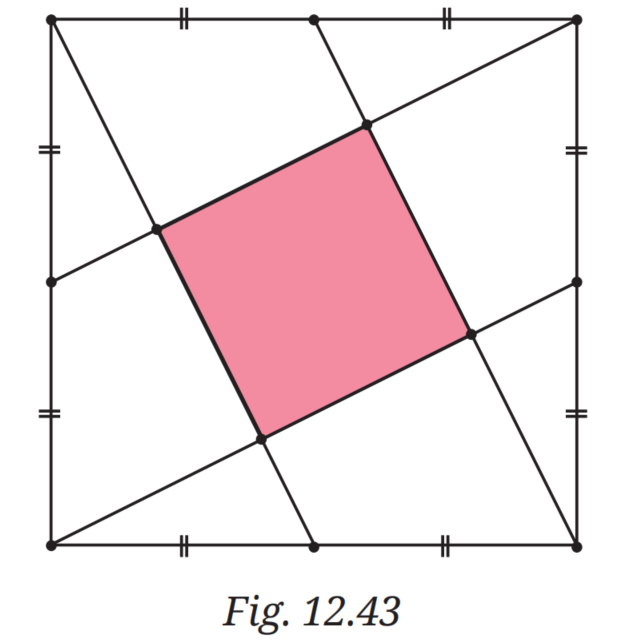
Answer:
Given:
Let the outer square be $ABCD$, and let $E$, $F$, $G$, and $H$ be the midpoints of sides $AB$, $BC$, $CD$, and $DA$ respectively.
The line segments $DE$, $AF$, $BG$, and $CH$ are drawn from the vertices to the midpoints of the sides, enclosing the central shaded region $PQRS$ (where $P$ lies on $DE$ and $AF$, $Q$ on $AF$ and $BG$, $R$ on $BG$ and $CH$, and $S$ on $CH$ and $DE$).
To Find:
The fraction of the square $ABCD$ that is shaded, i.e., $\frac{\text{Area of shaded region } PQRS}{\text{Area of square } ABCD}$.
Solution:
Since $ABCD$ is a square, all its sides are equal:
$AB = BC = CD = DA$
$\therefore \frac{1}{2}AB = \frac{1}{2}CD \implies EB = DG$
Also, $EB \parallel DG$ (since $AB \parallel CD$).
$\therefore EBGD$ is a parallelogram.
$\therefore DE \parallel BG$
(Opposite sides of parallelogram $EBGD$) ... (i)
Similarly, $AFCH$ is a parallelogram, so $AF \parallel CH$.
Now, in $\triangle ABF$ and $\triangle BCG$:
$AB = BC$, $\quad \angle ABF = \angle BCG = 90^\circ$, $\quad \text{and} \quad BF = CG$
$\therefore \triangle ABF \cong \triangle BCG$ (by SAS congruence rule)
By CPCT, $\angle BAQ = \angle CBG$.
Since $\angle ABQ + \angle CBG = \angle ABC = 90^\circ$, we get $\angle ABQ + \angle BAQ = 90^\circ$.
$\therefore \angle AQB = 90^\circ$
(Angle sum property in $\triangle ABQ$) ... (ii)
Similarly, the angles at $P$, $Q$, $R$, and $S$ are all $90^\circ$, and by the symmetry of square $ABCD$, $PQRS$ is a square.
Next, in $\triangle ABQ$, $E$ is the midpoint of $AB$ and $EP \parallel BQ$ (from (i), as $DE \parallel BG$).
Therefore, by the Converse of the Midpoint Theorem:
$P$ is the midpoint of $AQ$ and $EP = \frac{1}{2}BQ$
Similarly, in $\triangle BCR$, $\triangle CDS$, and $\triangle DAP$:
1. $Q$ is the midpoint of $BR$ and $FQ = \frac{1}{2}CR$.
2. $R$ is the midpoint of $CS$ and $GR = \frac{1}{2}DS$.
3. $S$ is the midpoint of $DP$ and $HS = \frac{1}{2}AP$.
Let the side of the shaded square $PQRS$ be $x$, so:
$PQ = QR = RS = SP = x$
Since $P$ is the midpoint of $AQ$, we have $AP = PQ = x$, which gives $AQ = 2x$.
Using symmetry ($\triangle ABQ \cong \triangle BCR \cong \triangle CDS \cong \triangle DAP$):
$AP = BQ = CR = DS = x$
$AQ = BR = CS = DP = 2x$
$HS = EP = FQ = GR = \frac{x}{2}$
Since $\angle AQB = 90^\circ$ from (ii), $\triangle ABQ$ is a right-angled triangle with base $BQ = x$ and height $AQ = 2x$:
$\text{Area of } \triangle ABQ = \frac{1}{2} \times BQ \times AQ$
$\text{Area of } \triangle ABQ = \frac{1}{\cancel{2}_{1}} \times x \times \cancel{2}^{1}x = x^2$
Similarly:
$\text{Area of } \triangle BCR = \text{Area of } \triangle CDS = \text{Area of } \triangle DAP = x^2$
These $4$ triangles and the shaded square $PQRS$ together cover the entire square $ABCD$ without overlapping:
$\text{Area of } 4 \text{ triangles} = 4 \times x^2 = 4x^2$
$\text{Area of shaded square } PQRS = x^2$
$\therefore \text{Area of square } ABCD = 4x^2 + x^2 = 5x^2$
Now, finding the shaded fraction:
$\frac{\text{Area of square } PQRS}{\text{Area of square } ABCD} = \frac{\cancel{x^2}^{1}}{5\cancel{x^2}_{1}} = \frac{1}{5}$
Therefore, $\frac{1}{5}$ (one-fifth) of the outer square is shaded.