
Chapter 14 Math of Space: Surface Area and Volume (Class 9 - Latest Maths NCERT (Ganita Manjari II) Solutions)
Looking for clear and accurate NCERT Solutions for Chapter 14: Math of Space: Surface Area and Volume? You’ve come to the right place! This page provides comprehensive, step-by-step answers to help you understand the measurement of three-dimensional objects. Learn how surface area describes the area covering the outside of a solid, while volume measures the space it occupies, and discover how these ideas are applied in mathematical problems.
Our solutions guide you through calculations involving surface area and volume using clear methods, relevant formulas, and worked examples. We explain the steps involved in identifying the required measurements, selecting the appropriate formula, substituting values, and expressing answers in the correct units. These explanations help you distinguish between square units used for area and cubic units used for volume while improving your accuracy in solving numerical problems.
Whether you are working through textbook exercises or revising formulas for three-dimensional shapes, these resources are designed to make each solution easier to follow. Curated by learningspot.co based on the Ganita Manjari II textbook, our solutions provide structured explanations and step-by-step answers to support your understanding and help you prepare effectively for your Class 9 Mathematics examinations.
| Content On This Page | ||
|---|---|---|
| Exercise Set 14.1 | Exercise Set 14.2 | Exercise Set 14.3 |
| Exercise Set 14.4 | End-of-Chapter Exercises | |
Exercise Set 14.1
Question 1. The volume of a cube is $64\text{ cm}^3$. What is its total surface area?
Answer:
Given:
Volume of the cube $= 64\text{ cm}^3$.
To Find:
The total surface area of the cube.
Solution:
Let the length of each edge (side) of the cube be $a\text{ cm}$.
We know that:
$\text{Volume of a cube} = a^3$
Substituting the given volume:
$a^3 = 64$
$a = \sqrt[3]{64} = \sqrt[3]{4 \times 4 \times 4} = 4\text{ cm}$
Now, the total surface area (TSA) of a cube is given by:
$\text{Total Surface Area} = 6a^2$
Substituting $a = 4\text{ cm}$:
$\text{Total Surface Area} = 6 \times (4)^2$
$\text{Total Surface Area} = 6 \times 16 = 96\text{ cm}^2$
Therefore, the total surface area of the cube is $96\text{ cm}^2$.
Question 2. How many small cubes with side $20\text{ cm}$ can be packed tight in a cubical box with side $2\text{ m}$?
Answer:
Given:
Side of the large cubical box ($A$) $= 2\text{ m} = 2 \times 100\text{ cm} = 200\text{ cm}$ (since $1\text{ m} = 100\text{ cm}$)
Side of each small cube ($a$) $= 20\text{ cm}$
To Find:
The number of small cubes that can be packed tightly inside the cubical box.
Solution:
Volume of the large cubical box $= A^3 = (200 \times 200 \times 200)\text{ cm}^3$
Volume of one small cube $= a^3 = (20 \times 20 \times 20)\text{ cm}^3$
Since the side length $200\text{ cm}$ is completely divisible by $20\text{ cm}$, the small cubes fit tightly with no empty space.
$\text{Number of small cubes} = \frac{\text{Volume of the cubical box}}{\text{Volume of one small cube}}$
$\text{Number of small cubes} = \frac{\cancel{200}^{10} \times \cancel{200}^{10} \times \cancel{200}^{10}}{\cancel{20}_{1} \times \cancel{20}_{1} \times \cancel{20}_{1}}$
$\text{Number of small cubes} = 10 \times 10 \times 10 = 1000$
Therefore, $1000$ small cubes can be packed tightly in the cubical box.
Question 3. The dimensions of a godown are $40\text{ m} \times 25\text{ m} \times 10\text{ m}$. If it is filled with cuboidal boxes, each of dimensions $2\text{ m} \times 1.25\text{ m} \times 1\text{ m}$, then find the number of boxes.
Answer:
Given:
Dimensions of the cuboidal godown:
Length ($L$) $= 40\text{ m}$, Breadth ($B$) $= 25\text{ m}$, Height ($H$) $= 10\text{ m}$
Dimensions of each cuboidal box:
Length ($l$) $= 2\text{ m}$, Breadth ($b$) $= 1.25\text{ m}$, Height ($h$) $= 1\text{ m}$
To Find:
The total number of cuboidal boxes that can fill the godown.
Solution:
Volume of the godown $= L \times B \times H$
$\text{Volume of the godown} = 40 \times 25 \times 10 = 10000\text{ m}^3$
Volume of one cuboidal box $= l \times b \times h$
$\text{Volume of one box} = 2 \times 1.25 \times 1 = 2.5\text{ m}^3$
Number of boxes that can be stored in the godown:
$\text{Number of boxes} = \frac{\text{Volume of the godown}}{\text{Volume of one box}}$
$\text{Number of boxes} = \frac{10000}{2.5} = \frac{\cancel{100000}^{4000}}{\cancel{25}_{1}} = 4000$
Therefore, the number of boxes is $4000$.
Question 4. Two cubes each of volume $125\text{ cm}^3$ are joined end to end. Find the surface area of the resulting cuboid.
Answer:
Given:
Volume of each cube $= 125\text{ cm}^3$.
To Find:
The surface area of the resulting cuboid formed by joining the two cubes end to end.
Solution:
Let the side (edge) of each cube be $a\text{ cm}$.
$\text{Volume of one cube} = a^3 = 125$
$a = \sqrt[3]{125} = \sqrt[3]{5 \times 5 \times 5} = 5\text{ cm}$
When two cubes of edge $5\text{ cm}$ are joined end to end, the resulting solid is a cuboid as shown below:
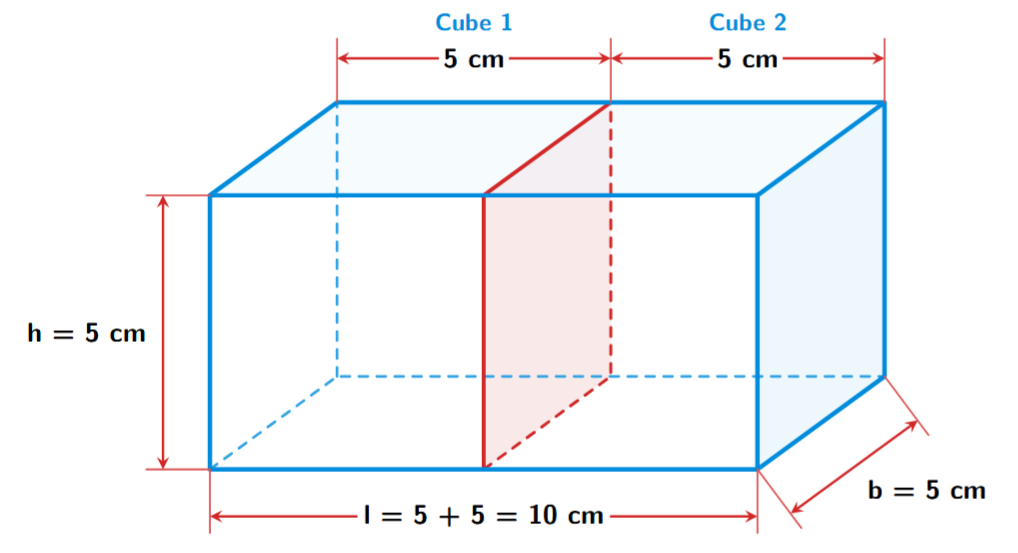
The dimensions of the resulting cuboid are:
Length ($l$) $= 5\text{ cm} + 5\text{ cm} = 10\text{ cm}$
Breadth ($b$) $= 5\text{ cm}$
Height ($h$) $= 5\text{ cm}$
The total surface area of a cuboid is given by:
$\text{Surface Area} = 2(lb + bh + hl)$
Substituting $l = 10\text{ cm}$, $b = 5\text{ cm}$, and $h = 5\text{ cm}$:
$\text{Surface Area} = 2(10 \times 5 + 5 \times 5 + 5 \times 10)$
$\text{Surface Area} = 2(50 + 25 + 50)$
$\text{Surface Area} = 2 \times 125 = 250\text{ cm}^2$
Therefore, the surface area of the resulting cuboid is $250\text{ cm}^2$.
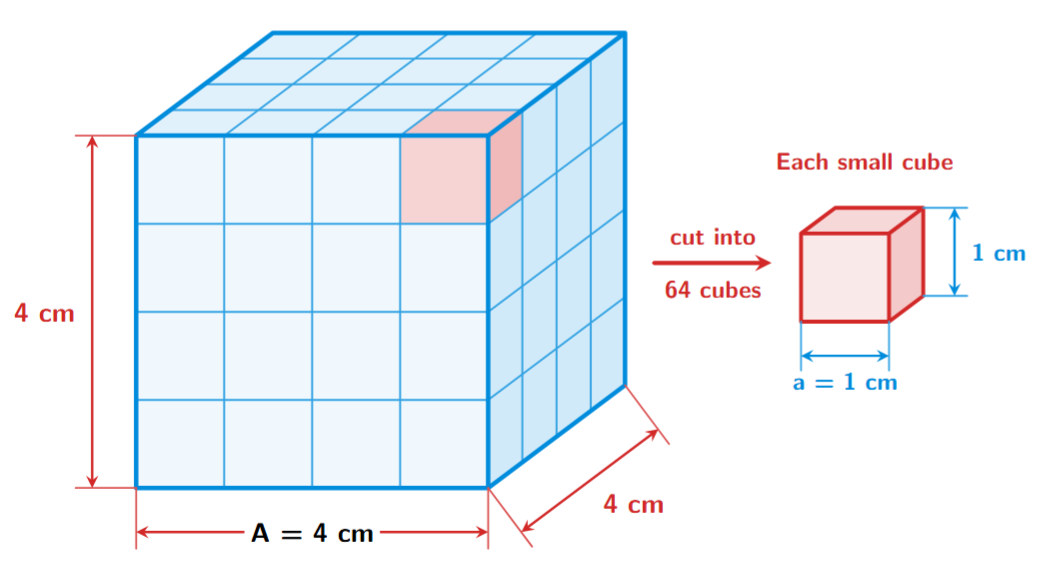
Question 5. A cube of side $4\text{ cm}$ is cut into cubes of side $1\text{ cm}$. What is the ratio of the surface areas of the original cube and all the cut-out cubes? (Note that there is no change in volume but a big change in the surface area. This property has major consequences in the biological world.)
Answer:
Given:
Side of the original cube ($A$) $= 4\text{ cm}$.
Side of each smaller cut-out cube ($a$) $= 1\text{ cm}$.
To Find:
The ratio of the total surface area of the original cube to the total surface area of all the cut-out cubes.
Solution:
1. Total surface area of the original cube:
$\text{Surface area of original cube} = 6A^2 = 6 \times (4)^2 = 6 \times 16 = 96\text{ cm}^2$
2. Number of smaller cubes of side $1\text{ cm}$:
$\text{Number of cubes} = \frac{\text{Volume of original cube}}{\text{Volume of one small cube}} = \frac{A^3}{a^3} = \frac{4^3}{1^3} = \frac{64}{1} = 64$
3. Total surface area of all $64$ cut-out cubes:
$\text{Surface area of one small cube} = 6a^2 = 6 \times (1)^2 = 6\text{ cm}^2$
$\text{Total surface area of } 64\text{ small cubes} = 64 \times 6 = 384\text{ cm}^2$
4. Finding the required ratio:
$\text{Required ratio} = \frac{\text{Surface area of original cube}}{\text{Total surface area of all cut-out cubes}} = \frac{\cancel{96}^{1}}{\cancel{384}_{4}} = \frac{1}{4}$
Therefore, the ratio of the surface areas of the original cube and all the cut-out cubes is $1 : 4$.
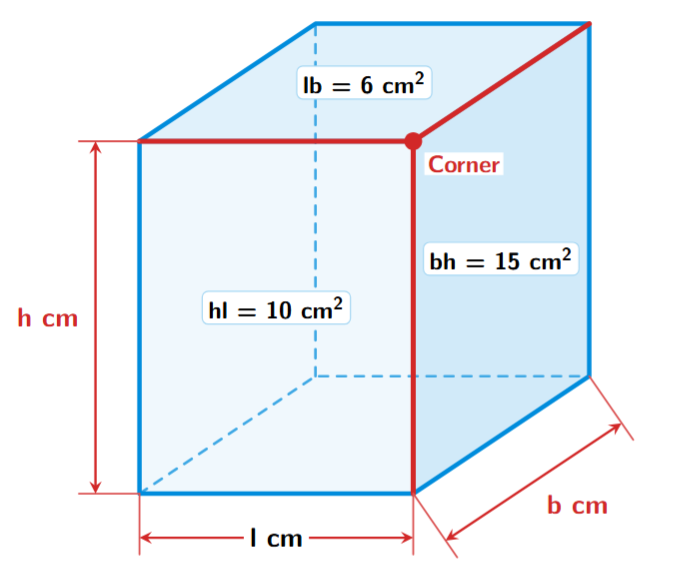
Question 6. The surface areas of the three faces of a cuboid that meet at one of the corners of the cuboid are $6\text{ cm}^2$, $15\text{ cm}^2$, and $10\text{ cm}^2$ respectively. What is the volume of the cuboid?
Answer:
Given:
Let the length, breadth, and height of the cuboid be $l\text{ cm}$, $b\text{ cm}$, and $h\text{ cm}$ respectively.
The areas of the three faces meeting at one corner are:
$lb = 6\text{ cm}^2$
(Given) ... (i)
$bh = 15\text{ cm}^2$
(Given) ... (ii)
$hl = 10\text{ cm}^2$
(Given) ... (iii)
To Find:
The volume of the cuboid ($V = lbh$).
Solution:
Multiplying equations (i), (ii), and (iii) together:
$(lb) \times (bh) \times (hl) = 6 \times 15 \times 10$
$l^2 b^2 h^2 = 900$
$(lbh)^2 = 900$
Taking the positive square root on both sides (since volume is positive):
$lbh = \sqrt{900} = 30$
Since $\text{Volume} = lbh$, the volume of the cuboid is $30\text{ cm}^3$.
Alternate Solution (By Finding Each Dimension):
From equation (i), $b = \frac{6}{l}$, and from equation (iii), $h = \frac{10}{l}$.
Substituting $b$ and $h$ into equation (ii):
$\left(\frac{6}{l}\right) \times \left(\frac{10}{l}\right) = 15$
$\frac{60}{l^2} = 15 \implies l^2 = \frac{\cancel{60}^{4}}{\cancel{15}_{1}} = 4 \implies l = 2\text{ cm}$
Then, $b = \frac{6}{2} = 3\text{ cm}$ and $h = \frac{10}{2} = 5\text{ cm}$.
$\text{Volume of the cuboid} = l \times b \times h = 2 \times 3 \times 5 = 30\text{ cm}^3$
Hence, the volume of the cuboid is $30\text{ cm}^3$.
Question 7. A cube of side $5\text{ cm}$ is painted on all its faces. If it is sliced into $1\text{ cm}^3$ cubes, how many of these $1\text{ cm}^3$ cubes have
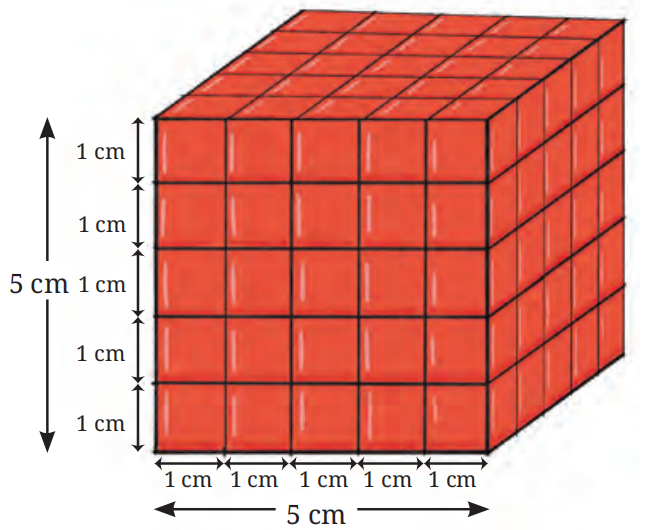
(i) exactly three faces painted?
(ii) exactly two faces painted?
(iii) exactly one face painted?
(iv) no face painted?
Answer:
Given:
Side of the large painted cube $= 5\text{ cm}$
Volume of each smaller cube $= 1\text{ cm}^3$, which means the side of each smaller cube $= 1\text{ cm}$.
Therefore, the number of smaller cubes along each edge of the large cube is:
$n = \frac{5\text{ cm}}{1\text{ cm}} = 5$
Total number of $1\text{ cm}^3$ cubes formed $= n^3 = 5^3 = 5 \times 5 \times 5 = 125$.
To Find:
The number of $1\text{ cm}^3$ cubes having:
(i) exactly three faces painted
(ii) exactly two faces painted
(iii) exactly one face painted
(iv) no face painted
Solution:
(i) Cubes with exactly three faces painted:
The smaller cubes that have three faces exposed to the outside lie strictly at the corners (vertices) of the large cube.
Since a cube has $8$ corners (vertices), every corner cube has $3$ painted faces.
$\text{Number of cubes with 3 faces painted} = 8$
Therefore, $8$ cubes have exactly three faces painted.
(ii) Cubes with exactly two faces painted:
The smaller cubes that have two faces painted lie along the edges of the large cube, excluding the $2$ corner cubes at the ends of each edge.
Number of such cubes on each edge $= n - 2 = 5 - 2 = 3$
Since a cube has $12$ edges:
$\text{Number of cubes with 2 faces painted} = 12 \times (n - 2) $$ = 12 \times 3 = 36$
Therefore, $36$ cubes have exactly two faces painted.
(iii) Cubes with exactly one face painted:
The smaller cubes that have only one face painted lie in the middle portion of each face of the large cube (excluding the outer border cubes along the edges and corners).
Each face is a $5 \times 5$ grid of unit squares. Removing the outer border leaves a $(n - 2) \times (n - 2)$ grid on each face:
Number of such cubes on each face $= (n - 2)^2 = (5 - 2)^2 = 3^2 = 9$
Since a cube has $6$ faces:
$\text{Number of cubes with 1 face painted} = 6 \times (n - 2)^2 $$ = 6 \times 9 = 54$
Therefore, $54$ cubes have exactly one face painted.
(iv) Cubes with no face painted:
The smaller cubes with no face painted lie completely in the interior of the large cube (forming an inner unpainted cube after removing the outer layer of $1\text{ cm}$ thickness from all sides).
The side of this inner unpainted cube has $(n - 2) = (5 - 2) = 3$ unit cubes along each dimension.
$\text{Number of cubes with 0 faces painted} = (n - 2)^3 $$ = (5 - 2)^3 = 3^3 = 27$
Therefore, $27$ cubes have no face painted.
Alternate Method for (iv) & Verification:
We can also find the number of cubes with no face painted by subtracting the total number of painted cubes from the total number of $1\text{ cm}^3$ cubes:
$\text{Total painted cubes} = 8 + 36 + 54 = 98$
$\text{Cubes with no face painted} = \text{Total cubes} - \text{Total painted cubes} $$ = 125 - 98 = 27$
Summary Table:
| Type of Smaller Cube | Location in Large Cube | Formula (for $n = 5$) | Number of Cubes |
| (i) 3 faces painted | Corners (Vertices) | $8$ | $8$ |
| (ii) 2 faces painted | Along the $12$ edges | $12(n - 2)$ | $36$ |
| (iii) 1 face painted | Centre of the $6$ faces | $6(n - 2)^2$ | $54$ |
| (iv) No face painted | Interior of the cube | $(n - 2)^3$ | $27$ |
| Total | Entire Cube | $n^3$ | $125$ |
Question 8. Find a cuboid with edges whose lengths are integers (in $\text{cm}$), given that it has a total surface area of exactly $100\text{ cm}^2$.
(i) Is there more than one such cuboid?
(ii) Can you find them all?
(iii) Show that you have found them all
Answer:
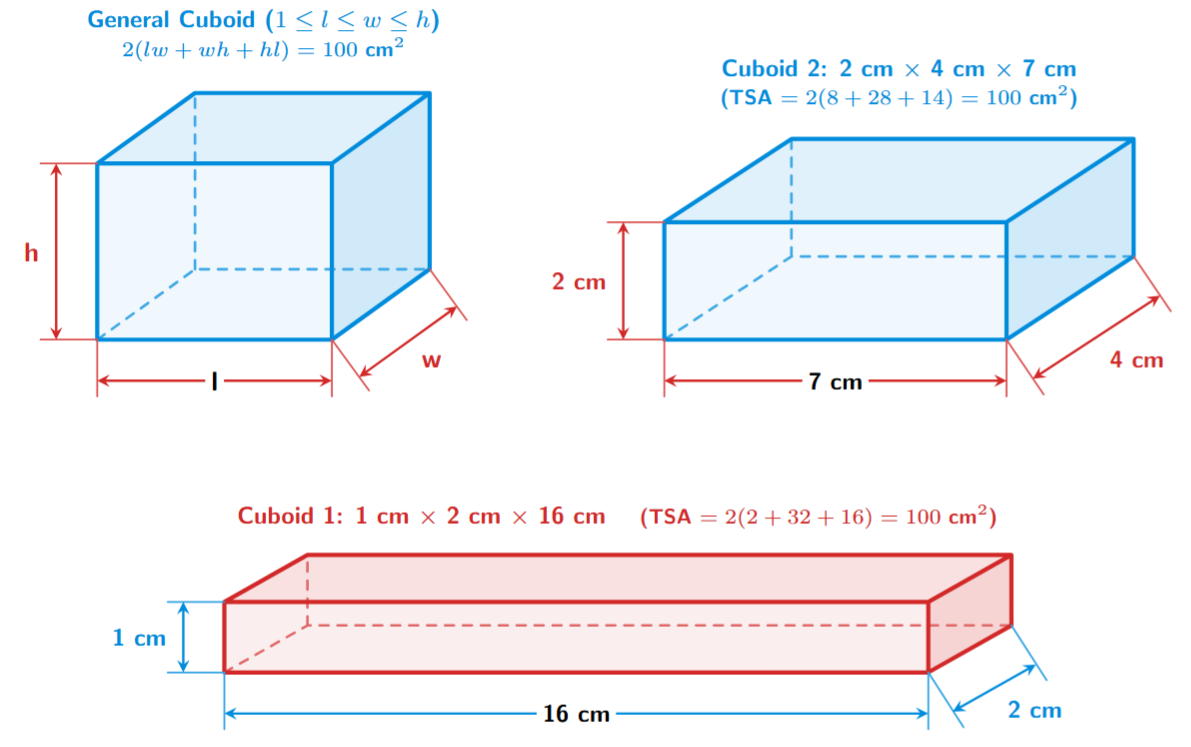
Given:
Total surface area of the cuboid $= 100\text{ cm}^2$.
Let the edges of the cuboid be $l$, $w$, and $h$ (positive integers, in $\text{cm}$) such that:
$1 \le l \le w \le h$
(Ordering the edges) ... (i)
To Find:
A cuboid with integer edge lengths having total surface area $100\text{ cm}^2$, and:
(i) Whether there is more than one such cuboid.
(ii) All such cuboids.
(iii) A proof that all such cuboids have been found.
Solution:
Total surface area of the cuboid $= 100\text{ cm}^2$
$2(lw + wh + hl) = 100$
$lw + wh + hl = \frac{\cancel{100}^{50}}{\cancel{2}_{1}}$
$lw + wh + hl = 50$
... (ii)
Limiting the smallest edge:
Since $l \le w \le h$, each of $lw$, $wh$, and $hl$ is at least $l \times l = l^2$.
So, from equation (ii):
$3l^2 \le 50$
$l^2 \le 16.\overline{6}$
$l \le 4$
So we only need to check $l = 1, 2, 3, 4$.
A useful trick (Factorising):
Adding $l^2$ to both sides of equation (ii) lets us factorise:
$lw + wh + hl + l^2 = 50 + l^2$
$w(l + h) + l(h + l) = 50 + l^2$
$(w + l)(h + l) = 50 + l^2$
... (iii)
Checking All Possible Cases for $l$:
Case 1: $l = 1$
$(w + 1)(h + 1) = 50 + 1^2$
$(w + 1)(h + 1) = 51$
Since $w \ge 1$, we have $w + 1 \ge 2$ and $w + 1 \le h + 1$.
Writing $51$ as a product of two factors gives $51 = 3 \times 17$ (the only other factorisation, $1 \times 51$, would give $w = 0$).
So, $w + 1 = 3$ and $h + 1 = 17$.
$w = 2\text{ cm}$ and $h = 16\text{ cm}$
Cuboid 1: $1\text{ cm} \times 2\text{ cm} \times 16\text{ cm}$.
Case 2: $l = 2$
$(w + 2)(h + 2) = 50 + 2^2$
$(w + 2)(h + 2) = 54$
Here, $w + 2 \ge 4$ (because $w \ge 2$) and $w + 2 \le h + 2$.
The factor pairs of $54$ are $1 \times 54$, $2 \times 27$, $3 \times 18$, and $6 \times 9$.
Only $6 \times 9$ is allowed, so $w + 2 = 6$ and $h + 2 = 9$.
$w = 4\text{ cm}$ and $h = 7\text{ cm}$
Cuboid 2: $2\text{ cm} \times 4\text{ cm} \times 7\text{ cm}$.
Case 3: $l = 3$
$(w + 3)(h + 3) = 50 + 3^2$
$(w + 3)(h + 3) = 59$
Here, $w + 3 \ge 6$ (because $w \ge 3$) and $w + 3 \le h + 3$.
Since $59$ is prime, it has no factor pair with both factors at least $6$.
Therefore, no cuboid is possible for $l = 3$.
Case 4: $l = 4$
$(w + 4)(h + 4) = 50 + 4^2$
$(w + 4)(h + 4) = 66$
Here, $8 \le w + 4 \le h + 4$ (because $w \ge 4$).
Then $(w + 4)^2 \le 66$, which forces $w + 4 = 8$ (since $9^2 = 81 > 66$).
However, $8$ does not divide $66$.
Therefore, no cuboid is possible for $l = 4$.
Final Answers:
One such cuboid is $1\text{ cm} \times 2\text{ cm} \times 16\text{ cm}$ (or $2\text{ cm} \times 4\text{ cm} \times 7\text{ cm}$).
(i) Yes, there is more than one such cuboid.
(ii) There are exactly two such cuboids: $1\text{ cm} \times 2\text{ cm} \times 16\text{ cm}$ and $2\text{ cm} \times 4\text{ cm} \times 7\text{ cm}$.
(iii) The smallest edge $l$ can only be $1, 2, 3,$ or $4$ (because $3l^2 \le 50$), and for each of these values we checked every possible factor pair of $50 + l^2$. Only the two cuboids above work, so we have found them all. (Arranging the same three edges in a different order gives the same cuboid.)
Exercise Set 14.2
Question 1. Two cylinders, $A$ and $B$, are given. The radius of cylinder $B$ is twice that of cylinder $A$, and the height of cylinder $B$ is half that of cylinder $A$. Find the ratio of the curved surface area of $A$ to the curved surface area of $B$. Also find the ratio of the volume of $A$ to the volume of $B$.
Answer:
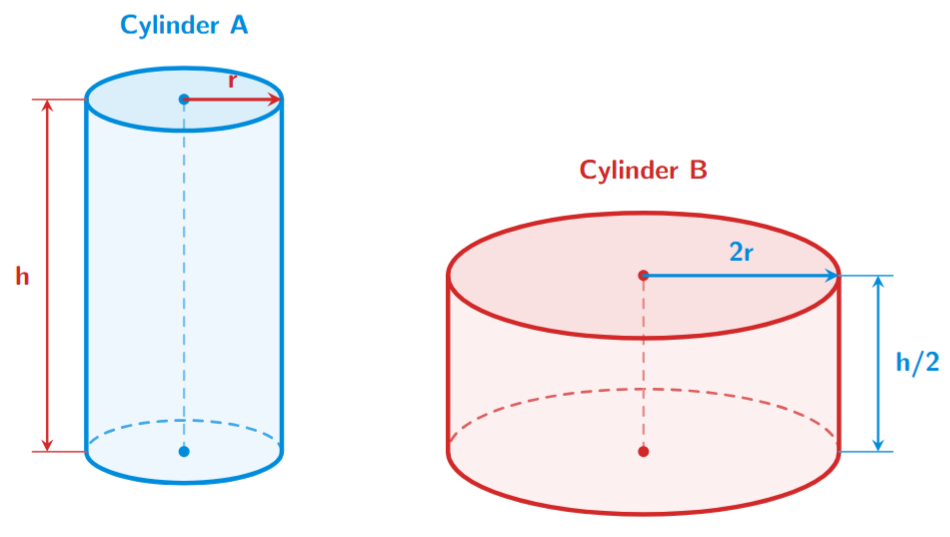
Given:
Let the radius and height of cylinder $A$ be $r$ and $h$ respectively.
According to the question, for cylinder $B$:
Radius of cylinder $B$, $r_B = 2r$
(Twice that of $A$) ... (i)
Height of cylinder $B$, $h_B = \frac{h}{2}$
(Half that of $A$) ... (ii)
To Find:
(a) The ratio of the curved surface area (CSA) of cylinder $A$ to the curved surface area of cylinder $B$.
(b) The ratio of the volume of cylinder $A$ to the volume of cylinder $B$.
Solution:
(a) Ratio of the Curved Surface Areas:
We know that the curved surface area of a cylinder is $2\pi \times \text{radius} \times \text{height}$.
$\text{CSA of cylinder } A = 2\pi r h$
Using (i) and (ii), the curved surface area of cylinder $B$ is:
$\text{CSA of cylinder } B = 2\pi r_B h_B$
$\text{CSA of cylinder } B = 2\pi (2r)\left(\frac{h}{2}\right)$
$\text{CSA of cylinder } B = 2\pi \times \cancel{2}^{1}r \times \frac{h}{\cancel{2}_{1}}$
$\text{CSA of cylinder } B = 2\pi r h$
Now, finding the required ratio:
$\frac{\text{CSA of cylinder } A}{\text{CSA of cylinder } B} = \frac{2\pi r h}{2\pi r h}$
$\frac{\text{CSA of cylinder } A}{\text{CSA of cylinder } B} = \frac{\cancel{2\pi r h}^{1}}{\cancel{2\pi r h}_{1}} = \frac{1}{1}$
Therefore, the ratio of the curved surface area of $A$ to that of $B$ is $1 : 1$.
(b) Ratio of the Volumes:
We know that the volume of a cylinder is $\pi \times (\text{radius})^2 \times \text{height}$.
$\text{Volume of cylinder } A = \pi r^2 h$
Using (i) and (ii), the volume of cylinder $B$ is:
$\text{Volume of cylinder } B = \pi r_B^2 h_B$
$\text{Volume of cylinder } B = \pi (2r)^2 \left(\frac{h}{2}\right)$
$\text{Volume of cylinder } B = \pi \times \cancel{4}^{2}r^2 \times \frac{h}{\cancel{2}_{1}}$
$\text{Volume of cylinder } B = 2\pi r^2 h$
Now, finding the required ratio:
$\frac{\text{Volume of cylinder } A}{\text{Volume of cylinder } B} = \frac{\pi r^2 h}{2\pi r^2 h}$
$\frac{\text{Volume of cylinder } A}{\text{Volume of cylinder } B} = \frac{\cancel{\pi r^2 h}^{1}}{2\cancel{\pi r^2 h}_{1}} = \frac{1}{2}$
Therefore, the ratio of the volume of $A$ to the volume of $B$ is $1 : 2$.
Alternate Solution (By Taking Numerical Values):
Let cylinder $A$ have radius $r = 1\text{ unit}$ and height $h = 2\text{ units}$.
Then, cylinder $B$ will have radius $r_B = 2 \times 1 = 2\text{ units}$ and height $h_B = \frac{2}{2} = 1\text{ unit}$.
Curved Surface Areas:
$\text{CSA of } A = 2\pi (1)(2) = 4\pi\text{ sq. units}$
$\text{CSA of } B = 2\pi (2)(1) = 4\pi\text{ sq. units}$
$\text{Ratio} = \frac{\cancel{4\pi}^{1}}{\cancel{4\pi}_{1}} = 1 : 1$
Volumes:
$\text{Volume of } A = \pi (1)^2 (2) = 2\pi\text{ cubic units}$
$\text{Volume of } B = \pi (2)^2 (1) = 4\pi\text{ cubic units}$
$\text{Ratio} = \frac{\cancel{2\pi}^{1}}{\cancel{4\pi}_{2}} = 1 : 2$
Hence, the ratio of curved surface areas is $1 : 1$ and the ratio of volumes is $1 : 2$.
Question 2. The radii of two cylinders are in the ratio $2:3$, and their heights are in the ratio $3:2$. Find (a) the ratio of their volumes, and (b) the ratio of their curved surface areas.
Answer:
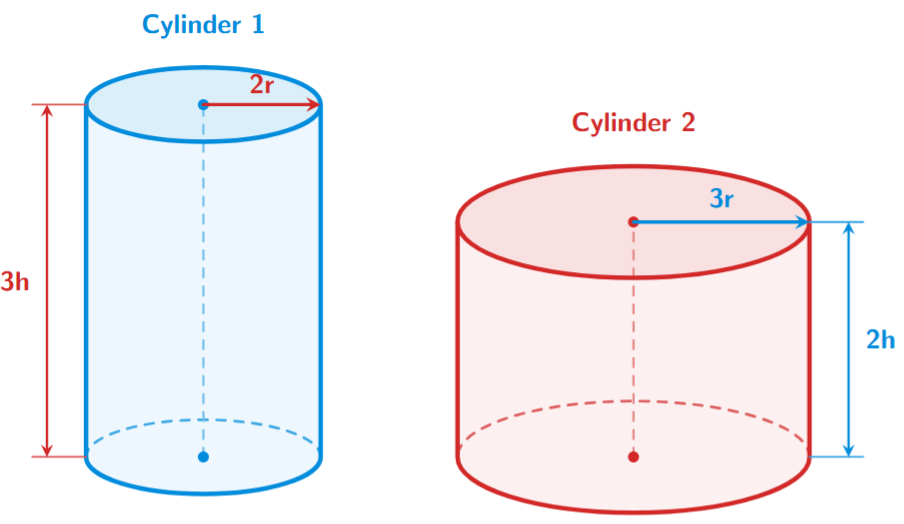
Given:
Ratio of the radii of the two cylinders, $r_1 : r_2 = 2 : 3$.
Ratio of the heights of the two cylinders, $h_1 : h_2 = 3 : 2$.
Let the radii of the two cylinders be $r_1 = 2r$ and $r_2 = 3r$ (where $r > 0$).
$r_1 = 2r$, $r_2 = 3r$
(From $r_1 : r_2 = 2 : 3$) ... (i)
Let the heights of the two cylinders be $h_1 = 3h$ and $h_2 = 2h$ (where $h > 0$).
$h_1 = 3h$, $h_2 = 2h$
(From $h_1 : h_2 = 3 : 2$) ... (ii)
To Find:
(a) The ratio of their volumes ($V_1 : V_2$).
(b) The ratio of their curved surface areas ($\text{CSA}_1 : \text{CSA}_2$).
Solution:
(a) Ratio of their volumes:
We know that the volume of a cylinder is $\pi r^2 h$.
Using (i) and (ii), the volume of the first cylinder is:
$V_1 = \pi r_1^2 h_1$
$V_1 = \pi (2r)^2 (3h)$
$V_1 = \pi (4r^2)(3h)$
$V_1 = 12\pi r^2 h$
Similarly, the volume of the second cylinder is:
$V_2 = \pi r_2^2 h_2$
$V_2 = \pi (3r)^2 (2h)$
$V_2 = \pi (9r^2)(2h)$
$V_2 = 18\pi r^2 h$
Now, finding the ratio of their volumes:
$\frac{V_1}{V_2} = \frac{12\pi r^2 h}{18\pi r^2 h}$
$\frac{V_1}{V_2} = \frac{\cancel{12}^{2}\cancel{\pi r^2 h}}{\cancel{18}_{3}\cancel{\pi r^2 h}} = \frac{2}{3}$
Therefore, the ratio of their volumes is $2 : 3$.
(b) Ratio of their curved surface areas:
We know that the curved surface area (CSA) of a cylinder is $2\pi r h$.
Using (i) and (ii), the curved surface area of the first cylinder is:
$\text{CSA}_1 = 2\pi r_1 h_1$
$\text{CSA}_1 = 2\pi (2r)(3h)$
$\text{CSA}_1 = 12\pi r h$
Similarly, the curved surface area of the second cylinder is:
$\text{CSA}_2 = 2\pi r_2 h_2$
$\text{CSA}_2 = 2\pi (3r)(2h)$
$\text{CSA}_2 = 12\pi r h$
Now, finding the ratio of their curved surface areas:
$\frac{\text{CSA}_1}{\text{CSA}_2} = \frac{12\pi r h}{12\pi r h}$
$\frac{\text{CSA}_1}{\text{CSA}_2} = \frac{\cancel{12\pi r h}^{1}}{\cancel{12\pi r h}_{1}} = \frac{1}{1}$
Therefore, the ratio of their curved surface areas is $1 : 1$.
Alternate Solution (Using Direct Ratios):
We are given $\frac{r_1}{r_2} = \frac{2}{3}$ and $\frac{h_1}{h_2} = \frac{3}{2}$.
(a) Ratio of volumes:
$\frac{V_1}{V_2} = \frac{\cancel{\pi} r_1^2 h_1}{\cancel{\pi} r_2^2 h_2}$
$\frac{V_1}{V_2} = \left(\frac{r_1}{r_2}\right)^2 \times \left(\frac{h_1}{h_2}\right)$
$\frac{V_1}{V_2} = \left(\frac{2}{3}\right)^2 \times \left(\frac{3}{2}\right)$
$\frac{V_1}{V_2} = \frac{\cancel{4}^{2}}{\cancel{9}_{3}} \times \frac{\cancel{3}^{1}}{\cancel{2}_{1}} = \frac{2}{3}$
So, $V_1 : V_2 = 2 : 3$.
(b) Ratio of curved surface areas:
$\frac{\text{CSA}_1}{\text{CSA}_2} = \frac{\cancel{2\pi} r_1 h_1}{\cancel{2\pi} r_2 h_2}$
$\frac{\text{CSA}_1}{\text{CSA}_2} = \left(\frac{r_1}{r_2}\right) \times \left(\frac{h_1}{h_2}\right)$
$\frac{\text{CSA}_1}{\text{CSA}_2} = \frac{\cancel{2}^{1}}{\cancel{3}_{1}} \times \frac{\cancel{3}^{1}}{\cancel{2}_{1}} = \frac{1}{1}$
So, $\text{CSA}_1 : \text{CSA}_2 = 1 : 1$.
Question 3. The edge of a cube measures $r\text{ cm}$. The largest possible right circular cylinder is cut out of the cube. What do you think is the volume of the cylinder (in $\text{cm}^3$)?
Answer:
Given:
Length of each edge of the cube $= r\text{ cm}$.
The largest possible right circular cylinder is cut out from this cube.
To Find:
The volume of the cylinder (in $\text{cm}^3$).
Solution:
For the largest possible right circular cylinder to fit inside a cube of edge $r\text{ cm}$, its circular base must touch all four edges of the square face of the cube, and its height must equal the edge of the cube:
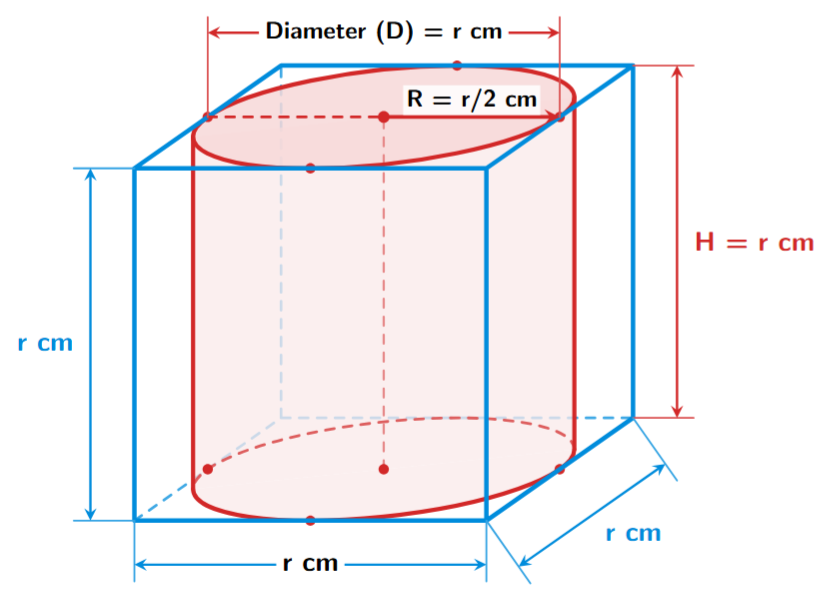
Diameter of the base of the cylinder $= r\text{ cm}$
Radius of the cylinder ($R$) $= \frac{r}{2}\text{ cm}$
Height of the cylinder ($H$) $= r\text{ cm}$
Now, the volume of the cylinder is given by:
$V = \pi R^2 H$
Substituting $R = \frac{r}{2}$ and $H = r$:
$V = \pi \left(\frac{r}{2}\right)^2 (r) = \pi \left(\frac{r^2}{4}\right) r = \frac{\pi r^3}{4}\text{ cm}^3$
(Taking $\pi \approx \frac{22}{7}$, this can also be written as $V \approx \frac{\cancel{22}^{11}}{7 \times \cancel{4}_{2}} r^3 = \frac{11}{14}r^3\text{ cm}^3$.)
Therefore, the volume of the largest possible cylinder is $\frac{\pi r^3}{4}\text{ cm}^3$.
Question 4. The radius of the base of a cylinder is increased by $10\%$. At the same time, the height of the cylinder is decreased by $x\%$. Given that the volume of the cylinder remains unchanged, find the value of $x$.
Answer:
Given:
Let the original radius of the cylinder be $r$ and the original height be $h$.
Then, original volume ($V_1$) $= \pi r^2 h$.
The radius is increased by $10\%$ and the height is decreased by $x\%$, while the volume remains unchanged.
To Find:
The value of $x$.
Solution:
New radius ($R$) after a $10\%$ increase:
$R = r + 10\% \text{ of } r = r + \frac{10}{100}r = r + 0.1r = 1.1r = \frac{11}{10}r$
New height ($H$) after an $x\%$ decrease:
$H = h - x\% \text{ of } h = h\left(1 - \frac{x}{100}\right) = h\left(\frac{100 - x}{100}\right)$
New volume ($V_2$):
$V_2 = \pi R^2 H = \pi \left(\frac{11}{10}r\right)^2 h\left(\frac{100 - x}{100}\right) = \pi r^2 h \cdot \frac{121}{100} \cdot \left(\frac{100 - x}{100}\right)$
Since the volume remains unchanged ($V_2 = V_1$):
$\pi r^2 h \cdot \frac{121}{100} \cdot \left(\frac{100 - x}{100}\right) = \pi r^2 h$
Dividing both sides by $\pi r^2 h$:
$\frac{121(100 - x)}{10000} = 1$
$121(100 - x) = 10000$
$100 - x = \frac{10000}{121}$
$x = 100 - \frac{10000}{121} = \frac{12100 - 10000}{121} = \frac{2100}{121} = 17\frac{43}{121} \approx 17.36$
Therefore, the value of $x$ is $\frac{2100}{121} = 17\frac{43}{121}$ (or approximately $17.36$).
Alternate Solution (By Taking Numerical Values):
Let original radius $r = 10$ units and original height $h = 100$ units.
$\text{Original Volume} = \pi (10)^2 (100) = 10000\pi$
After a $10\%$ increase, new radius $R = 10 + 1 = 11$ units.
Let the new height be $H$. Since volume is unchanged:
$\pi (11)^2 H = 10000\pi \implies 121 H = 10000 \implies H = \frac{10000}{121}$
Percentage decrease in height ($x\%$):
$x = \frac{h - H}{h} \times 100 = \frac{100 - \frac{10000}{121}}{\cancel{100}} \times \cancel{100} = \frac{2100}{121} = 17\frac{43}{121} \approx 17.36$
Hence, $x = 17\frac{43}{121} \approx 17.36$.
Question 5. A solid metallic cube of side $12\text{ cm}$ is melted and recast into solid cylindrical rods, each having radius $2\text{ cm}$ and height $12\text{ cm}$. Find:
(i) the volume of the cube,
(ii) the volume of one cylindrical rod,
(iii) the approximate number of complete cylindrical rods that can be formed. ($\pi \approx \frac{22}{7}$)
Answer:
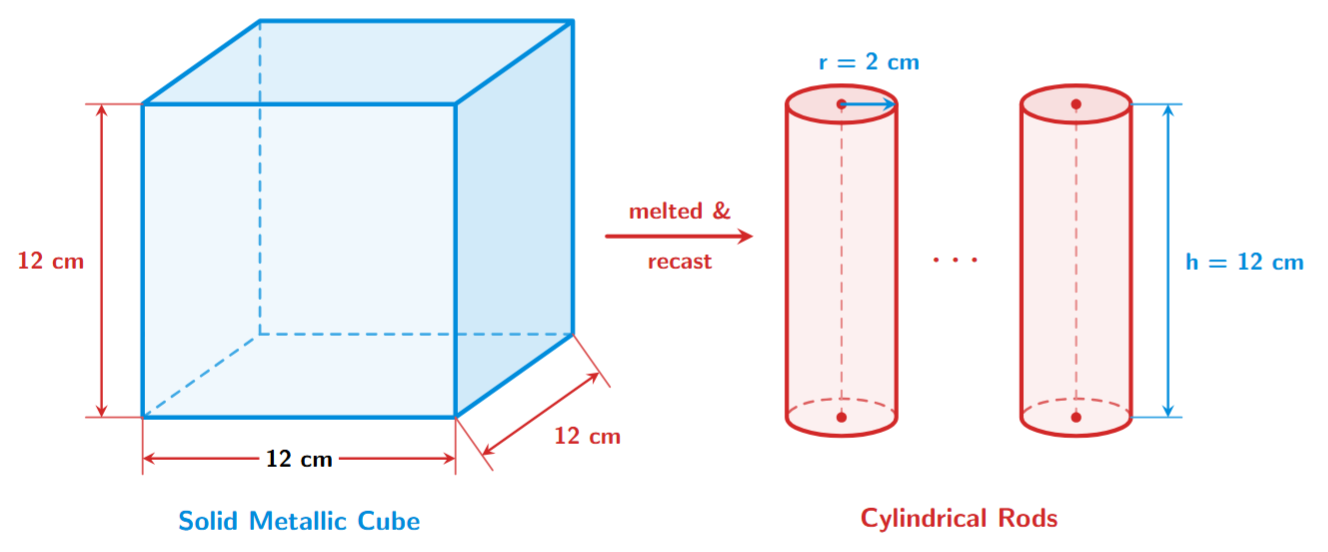
Given:
Side of the solid metallic cube, $a = 12\text{ cm}$.
Radius of each cylindrical rod, $r = 2\text{ cm}$.
Height of each cylindrical rod, $h = 12\text{ cm}$.
Value of $\pi \approx \frac{22}{7}$.
To Find:
(i) The volume of the cube.
(ii) The volume of one cylindrical rod.
(iii) The approximate number of complete cylindrical rods that can be formed.
Solution:
(i) Volume of the cube:
We know that the volume of a cube of side $a$ is $a^3$.
$\text{Volume of the cube} = a^3$
$\text{Volume of the cube} = 12^3$
$\text{Volume of the cube} = 12 \times 12 \times 12$
$\text{Volume of the cube} = 1728\text{ cm}^3$
... (i)
Therefore, the volume of the cube is $1728\text{ cm}^3$.
(ii) Volume of one cylindrical rod:
We know that the volume of a cylinder is $\pi r^2 h$.
$\text{Volume of one rod} = \pi r^2 h$
$\text{Volume of one rod} \approx \frac{22}{7} \times (2)^2 \times 12$
$\text{Volume of one rod} \approx \frac{22}{7} \times 4 \times 12$
$\text{Volume of one rod} \approx \frac{22 \times 48}{7}$
$\text{Volume of one rod} \approx \frac{1056}{7}\text{ cm}^3$
... (ii)
$\text{Volume of one rod} \approx 150\frac{6}{7}\text{ cm}^3 \approx 150.86\text{ cm}^3$
Therefore, the volume of one cylindrical rod is $\frac{1056}{7}\text{ cm}^3$ (or approximately $150.86\text{ cm}^3$).
(iii) Approximate number of complete cylindrical rods that can be formed:
When a solid cube is melted and recast into cylindrical rods, the total volume remains conserved.
$\text{Number of rods} = \frac{\text{Volume of the cube}}{\text{Volume of one cylindrical rod}}$
Using equations (i) and (ii):
$\text{Number of rods} \approx \frac{1728}{\left(\frac{1056}{7}\right)}$
$\text{Number of rods} \approx \frac{1728 \times 7}{1056}$
$\text{Number of rods} \approx \frac{\cancel{1728}^{144} \times 7}{\cancel{1056}_{88}}$
$\text{Number of rods} \approx \frac{\cancel{144}^{18} \times 7}{\cancel{88}_{11}}$
$\text{Number of rods} \approx \frac{126}{11} = 11\frac{5}{11} \approx 11.45$
Since we need the number of complete cylindrical rods, we take the whole-number part (ignoring the fractional leftover metal).
Therefore, $11$ complete cylindrical rods can be formed.
Alternate Method for (iii) (Direct Cancellation Before Multiplying):
$\text{Number of rods} = \frac{a^3}{\pi r^2 h}$
$\text{Number of rods} \approx \frac{12 \times 12 \times \cancel{12}^{1}}{\frac{22}{7} \times 2 \times 2 \times \cancel{12}_{1}}$
$\text{Number of rods} \approx \frac{12 \times \cancel{12}^{3} \times 7}{22 \times \cancel{4}_{1}}$
$\text{Number of rods} \approx \frac{\cancel{12}^{6} \times 3 \times 7}{\cancel{22}_{11}}$
$\text{Number of rods} \approx \frac{126}{11} \approx 11.45$
Hence, approximately $11$ complete cylindrical rods can be formed.
Exercise Set 14.3
For $\pi$, use one of the following approximations: $\pi \approx \frac{22}{7}$ or $\pi \approx 3.14$
Question 1. Find the total surface area of a cone, if its slant height is $21\text{ m}$ and diameter of its base is $24\text{ m}$.
Answer:
Given:
Slant height of the cone ($l$) $= 21\text{ m}$.
Diameter of the base ($d$) $= 24\text{ m}$.
Therefore, radius of the base ($r$) $= \frac{\cancel{24}^{12}}{\cancel{2}_{1}} = 12\text{ m}$.
To Find:
The total surface area of the cone.
Solution:
The total surface area (TSA) of a cone is given by:
$\text{Total Surface Area} = \pi r(l + r)$
Taking $\pi \approx \frac{22}{7}$ and substituting $r = 12\text{ m}$ and $l = 21\text{ m}$:
$\text{Total Surface Area} \approx \frac{22}{7} \times 12 \times (21 + 12)$
$\text{Total Surface Area} \approx \frac{22}{7} \times 12 \times 33$
$\text{Total Surface Area} \approx \frac{8712}{7} = 1244\frac{4}{7}\text{ m}^2 \approx 1244.57\text{ m}^2$
Therefore, the total surface area of the cone is $1244\frac{4}{7}\text{ m}^2$ (or approximately $1244.57\text{ m}^2$).
Question 2. Find the curved surface area of a right circular cone whose slant height is $10\text{ cm}$ and base radius is $7\text{ cm}$.
Answer:
Given:
Slant height of the cone ($l$) $= 10\text{ cm}$.
Radius of the base ($r$) $= 7\text{ cm}$.
To Find:
The curved surface area of the right circular cone.
Solution:
The curved surface area (CSA) of a right circular cone is given by:
$\text{Curved Surface Area} = \pi r l$
Taking $\pi \approx \frac{22}{7}$ and substituting $r = 7\text{ cm}$ and $l = 10\text{ cm}$:
$\text{Curved Surface Area} \approx \frac{22}{\cancel{7}_{1}} \times \cancel{7}^{1} \times 10$
$\text{Curved Surface Area} \approx 22 \times 10 = 220\text{ cm}^2$
Therefore, the curved surface area of the cone is approximately $220\text{ cm}^2$.
Question 3. The height of a cone is $16\text{ cm}$, and its base radius is $12\text{ cm}$. Find the curved surface area and the total surface area of the cone.
Answer:
Given:
Height of the cone ($h$) $= 16\text{ cm}$.
Radius of the base ($r$) $= 12\text{ cm}$.
To Find:
(i) The curved surface area (CSA) of the cone.
(ii) The total surface area (TSA) of the cone.
Solution:
Step 1: Find the slant height ($l$) of the cone:
$l = \sqrt{r^2 + h^2}$
$l = \sqrt{12^2 + 16^2} = \sqrt{144 + 256} = \sqrt{400} = 20\text{ cm}$
Step 2: Find the Curved Surface Area (CSA):
Taking $\pi \approx 3.14$:
$\text{CSA} = \pi r l \approx 3.14 \times 12 \times 20 = 3.14 \times 240 = 753.6\text{ cm}^2$
Step 3: Find the Total Surface Area (TSA):
$\text{TSA} = \text{CSA} + \pi r^2$
$\text{Area of base} = \pi r^2 \approx 3.14 \times (12)^2 = 3.14 \times 144 = 452.16\text{ cm}^2$
$\text{TSA} \approx 753.6 + 452.16 = 1205.76\text{ cm}^2$
Therefore, the curved surface area is approximately $753.6\text{ cm}^2$ and the total surface area is approximately $1205.76\text{ cm}^2$.
Question 4. A cone has a height of $15\text{ cm}$. If its volume is $1570\text{ cm}^3$, find the radius of the base.
Answer:
Given:
Height of the cone ($h$) $= 15\text{ cm}$.
Volume of the cone ($V$) $= 1570\text{ cm}^3$.
To Find:
The radius of the base ($r$) of the cone.
Solution:
The volume of a cone is given by:
$V = \frac{1}{3}\pi r^2 h$
Taking $\pi \approx 3.14$ and substituting $V = 1570\text{ cm}^3$ and $h = 15\text{ cm}$:
$1570 \approx \frac{1}{\cancel{3}_{1}} \times 3.14 \times r^2 \times \cancel{15}^{5}$
$1570 \approx 3.14 \times 5 \times r^2$
$1570 \approx 15.7 \times r^2$
$r^2 \approx \frac{1570}{15.7} = \frac{\cancel{15700}^{100}}{\cancel{157}_{1}} = 100$
Taking the positive square root on both sides (since radius is positive):
$r \approx \sqrt{100} = 10\text{ cm}$
Therefore, the radius of the base of the cone is $10\text{ cm}$.
Question 5. The curved surface area of a cone is $308\text{ cm}^2$ and its slant height is $14\text{ cm}$. Find (i) the radius of the base, (ii) the total surface area of the cone.
Answer:
Given:
Curved surface area of the cone ($\text{CSA}$) $= 308\text{ cm}^2$.
Slant height of the cone ($l$) $= 14\text{ cm}$.
To Find:
(i) The radius of the base ($r$).
(ii) The total surface area ($\text{TSA}$) of the cone.
Solution:
(i) Finding the radius of the base ($r$):
We know that:
$\text{CSA of a cone} = \pi r l$
Taking $\pi \approx \frac{22}{7}$ and substituting $\text{CSA} = 308\text{ cm}^2$ and $l = 14\text{ cm}$:
$308 \approx \frac{22}{\cancel{7}_{1}} \times r \times \cancel{14}^{2}$
$308 \approx 44r$
$r \approx \frac{\cancel{308}^{7}}{\cancel{44}_{1}} = 7\text{ cm}$
Therefore, the radius of the base is $7\text{ cm}$.
(ii) Finding the total surface area ($\text{TSA}$) of the cone:
$\text{TSA} = \text{CSA} + \text{Area of the circular base} = \text{CSA} + \pi r^2$
$\text{Area of base} \approx \frac{22}{\cancel{7}_{1}} \times \cancel{7}^{1} \times 7 = 154\text{ cm}^2$
$\text{TSA} \approx 308 + 154 = 462\text{ cm}^2$
Therefore, the total surface area of the cone is approximately $462\text{ cm}^2$.
Question 6. A joker’s cap is in the form of a right circular cone of base radius $7\text{ cm}$ and height $24\text{ cm}$. Find the area of the sheet required to make $10$ such caps.
Answer:
Given:
Base radius of the conical cap ($r$) $= 7\text{ cm}$.
Height of the conical cap ($h$) $= 24\text{ cm}$.
Number of caps $= 10$.
To Find:
The area of the sheet required to make $10$ such caps.
Solution:
Step 1: Find the slant height ($l$) of one conical cap:
$l = \sqrt{r^2 + h^2}$
$l = \sqrt{7^2 + 24^2} = \sqrt{49 + 576} = \sqrt{625} = 25\text{ cm}$
Step 2: Find the curved surface area (CSA) of one cap:
Since a joker's cap is open at the base, the area of the sheet required for $1$ cap equals its curved surface area. Taking $\pi \approx \frac{22}{7}$:
$\text{CSA of } 1\text{ cap} = \pi r l \approx \frac{22}{\cancel{7}_{1}} \times \cancel{7}^{1} \times 25 = 22 \times 25 = 550\text{ cm}^2$
Step 3: Find the area of sheet required for $10$ such caps:
$\text{Total area of sheet required} \approx 10 \times 550 = 5500\text{ cm}^2$
Therefore, the area of the sheet required to make $10$ such caps is approximately $5500\text{ cm}^2$.
Question 7. What length of tarpaulin $3\text{ m}$ wide is required to make a conical tent of height $8\text{ m}$ and base radius $6\text{ m}$? Assume that the extra length of material that is required for stitching margins and wastage in cutting is $20\text{ cm}$.
Answer:
Given:
Height of the conical tent ($h$) $= 8\text{ m}$.
Radius of the base ($r$) $= 6\text{ m}$.
Width of the tarpaulin $= 3\text{ m}$.
Extra length required for stitching margins and wastage $= 20\text{ cm} = \frac{20}{100}\text{ m} = 0.2\text{ m}$.
To Find:
The total length of tarpaulin required to make the conical tent.
Solution:
Step 1: Find the slant height ($l$) of the tent:
$l = \sqrt{r^2 + h^2} = \sqrt{6^2 + 8^2} = \sqrt{36 + 64} = \sqrt{100} = 10\text{ m}$
Step 2: Find the curved surface area (CSA) of the tent:
Taking $\pi \approx 3.14$:
$\text{CSA of the tent} = \pi r l \approx 3.14 \times 6 \times 10 = 188.4\text{ m}^2$
Step 3: Find the length of tarpaulin needed:
Let the length of tarpaulin covering the curved surface of the tent be $L\text{ m}$. Then:
$\text{Area of rectangular tarpaulin} = \text{CSA of tent}$
$L \times 3 \approx 188.4$
$L \approx \frac{\cancel{188.4}^{62.8}}{\cancel{3}_{1}} = 62.8\text{ m}$
Adding the extra length of $0.2\text{ m}$ for stitching margins and wastage:
$\text{Total length of tarpaulin required} \approx 62.8 + 0.2 = 63\text{ m}$
(Note: If $\pi \approx \frac{22}{7}$ is used, $\text{CSA} \approx \frac{1320}{7}\text{ m}^2$, giving $L \approx 62.86\text{ m}$ and total length $\approx 63.06\text{ m}$.)
Therefore, the length of tarpaulin required is approximately $63\text{ m}$.
Question 8. A right triangle with sides $6\text{ cm}$, $8\text{ cm}$ and $10\text{ cm}$ is rotated through $360^\circ$ about the side of $8\text{ cm}$. Find the volume and the curved surface area of the solid so formed.
Answer:
Given:
A right-angled triangle has sides $6\text{ cm}$, $8\text{ cm}$, and $10\text{ cm}$ (since $6^2 + 8^2 = 36 + 64 = 100 = 10^2$, the sides $6\text{ cm}$ and $8\text{ cm}$ are perpendicular, and $10\text{ cm}$ is the hypotenuse).
It is rotated through $360^\circ$ about the side of $8\text{ cm}$.
To Find:
The volume and the curved surface area of the solid so formed.
Solution:
When the right triangle is revolved $360^\circ$ about the side of length $8\text{ cm}$, the solid generated is a right circular cone as shown below:
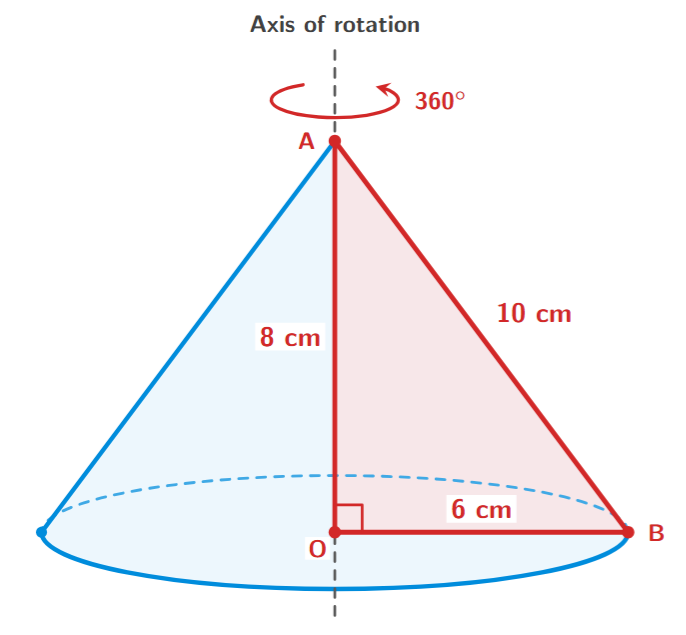
The dimensions of the cone formed are:
Height ($h$) $= 8\text{ cm}$
Radius of the base ($r$) $= 6\text{ cm}$
Slant height ($l$) $= 10\text{ cm}$
1. Volume of the cone:
$V = \frac{1}{3}\pi r^2 h = \frac{1}{\cancel{3}_{1}} \times \pi \times \cancel{6}^{2} \times 6 \times 8 = 96\pi\text{ cm}^3$
Taking $\pi \approx 3.14$:
$V \approx 96 \times 3.14 = 301.44\text{ cm}^3$
(If $\pi \approx \frac{22}{7}$, $V \approx \frac{96 \times 22}{7} = \frac{2112}{7} = 301\frac{5}{7}\text{ cm}^3 \approx 301.71\text{ cm}^3$.)
2. Curved surface area (CSA) of the cone:
$\text{CSA} = \pi r l = \pi \times 6 \times 10 = 60\pi\text{ cm}^2$
Taking $\pi \approx 3.14$:
$\text{CSA} \approx 60 \times 3.14 = 188.4\text{ cm}^2$
(If $\pi \approx \frac{22}{7}$, $\text{CSA} \approx \frac{60 \times 22}{7} = \frac{1320}{7} = 188\frac{4}{7}\text{ cm}^2 \approx 188.57\text{ cm}^2$.)
Therefore, the volume of the cone is $96\pi\text{ cm}^3$ ($\approx 301.44\text{ cm}^3$) and its curved surface area is $60\pi\text{ cm}^2$ ($\approx 188.4\text{ cm}^2$).
Question 9. Suppose you have a cup in the shape of a right circular cone. Fill it with water to half the depth of the cone.
What fraction of the volume of the cup is occupied by the water?
Answer:
Given:
Let the conical cup have total depth (height) $H$ and base radius $R$ (at the open top).
The cup is filled with water to half its depth, so the height of the water cone is $h = \frac{H}{2}$.
To Find:
The fraction of the volume of the cup occupied by the water ($\frac{V_{\text{water}}}{V_{\text{cup}}}$).
Solution:
Consider a vertical cross-section of the conical cup with vertex $O$ at the bottom, top centre $A$, top rim point $B$, water surface centre $C$, and water surface edge $D$, as shown below:
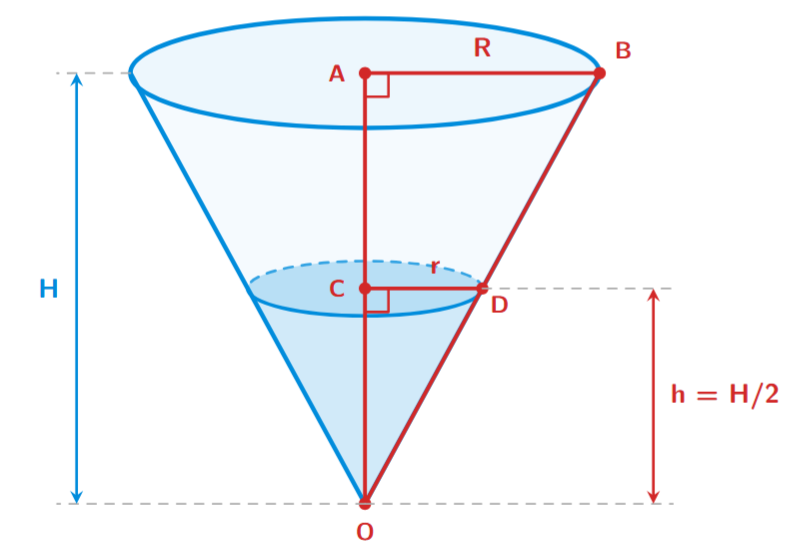
Let $r = CD$ be the radius of the top circular surface of the water.
In $\triangle OCD$ and $\triangle OAB$:
$\angle OCD = \angle OAB = 90^\circ$
(Right circular cone)
$\angle COD = \angle AOB$
(Common angle)
By AA similarity criterion, $\triangle OCD \sim \triangle OAB$. Therefore, their corresponding sides are proportional:
$\frac{CD}{AB} = \frac{OC}{OA}$
$\frac{r}{R} = \frac{h}{H} = \frac{H / 2}{H} = \frac{1}{2}$
$r = \frac{R}{2}$
…(i)
Now, the volume of the full conical cup is:
$V_{\text{cup}} = \frac{1}{3}\pi R^2 H$
…(ii)
The water forms a smaller cone of radius $r = \frac{R}{2}$ and height $h = \frac{H}{2}$, so its volume is:
$V_{\text{water}} = \frac{1}{3}\pi r^2 h = \frac{1}{3}\pi \left(\frac{R}{2}\right)^2 \left(\frac{H}{2}\right)$
$V_{\text{water}} = \frac{1}{3}\pi \left(\frac{R^2}{4}\right)\left(\frac{H}{2}\right) = \frac{1}{8}\left(\frac{1}{3}\pi R^2 H\right)$
Using equation (ii):
$V_{\text{water}} = \frac{1}{8} V_{\text{cup}}$
Therefore, the fraction of the volume of the cup occupied by the water is $\frac{1}{8}$.
Exercise Set 14.4
Question 1. A ball bearing has a radius of $0.7\text{ cm}$. Find its surface area.
Answer:
Given:
A ball bearing is spherical in shape with radius ($r$) $= 0.7\text{ cm}$.
To Find:
The surface area of the ball bearing.
Solution:
The surface area of a sphere of radius $r$ is given by:
$\text{Surface Area} = 4\pi r^2$
Taking $\pi \approx \frac{22}{7}$ and substituting $r = 0.7\text{ cm}$:
$\text{Surface Area} \approx 4 \times \frac{22}{\cancel{7}_{1}} \times \cancel{0.7}^{0.1} \times 0.7$
$\text{Surface Area} \approx 88 \times 0.07 = 6.16\text{ cm}^2$
Therefore, the surface area of the ball bearing is approximately $6.16\text{ cm}^2$.
Question 2. Two solid spheres made of the same metal have weights $5920\text{ g}$ and $740\text{ g}$. Determine the radius of the larger sphere, if the diameter of the smaller one is $5\text{ cm}$.
Answer:
Given:
Weight of the larger sphere ($W_1$) $= 5920\text{ g}$.
Weight of the smaller sphere ($W_2$) $= 740\text{ g}$.
Diameter of the smaller sphere ($d_2$) $= 5\text{ cm}$, so its radius ($r_2$) $= \frac{5}{2}\text{ cm} = 2.5\text{ cm}$.
Both solid spheres are made of the same metal (hence, they have the same density).
To Find:
The radius of the larger sphere ($r_1$).
Solution:
Let the radius of the larger sphere be $r_1\text{ cm}$ and the density of the metal be $\rho\text{ g/cm}^3$.
Since $\text{Weight} = \text{Volume} \times \text{Density}$, for two spheres made of the same metal, the ratio of their weights is equal to the ratio of their volumes:
$\frac{W_1}{W_2} = \frac{\text{Volume of larger sphere} \times \rho}{\text{Volume of smaller sphere} \times \rho} = \frac{\frac{4}{3}\pi r_1^3}{\frac{4}{3}\pi r_2^3}$
Cancelling the common factor $\frac{4}{3}\pi$ and substituting the given weights:
$\left(\frac{r_1}{r_2}\right)^3 = \frac{5920}{740} = \frac{\cancel{592}^{8}}{\cancel{74}_{1}} = 8$
Taking the cube root on both sides:
$\frac{r_1}{r_2} = \sqrt[3]{8} = 2$
$r_1 = 2r_2$
Substituting $r_2 = 2.5\text{ cm}$:
$r_1 = 2 \times 2.5 = 5\text{ cm}$
Therefore, the radius of the larger sphere is $5\text{ cm}$.
Question 3. The diameter of the moon is approximately one fourth the diameter of the earth. Given that the moon and earth are both roughly spherical, find the ratio of their surface areas.
Answer:
Given:
Let the diameter of the earth be $d$. Then, the radius of the earth ($R$) $= \frac{d}{2}$.
Since the diameter of the moon is $\frac{1}{4}$ of the diameter of the earth:
Diameter of the moon $= \frac{d}{4}$
Radius of the moon ($r$) $= \frac{1}{2} \times \frac{d}{4} = \frac{1}{4}\left(\frac{d}{2}\right) = \frac{R}{4}$
To Find:
The ratio of the surface area of the moon to the surface area of the earth.
Solution:
Surface area of a sphere $= 4\pi (\text{radius})^2$.
$\text{Surface area of the moon} = 4\pi r^2 = 4\pi \left(\frac{R}{4}\right)^2 = 4\pi \left(\frac{R^2}{16}\right)$
$\text{Surface area of the earth} = 4\pi R^2$
Taking the ratio of the surface area of the moon to that of the earth:
$\frac{\text{Surface area of the moon}}{\text{Surface area of the earth}} = \frac{\cancel{4\pi} \left(\frac{\cancel{R^2}}{16}\right)}{\cancel{4\pi} \cancel{R^2}} = \frac{1}{16}$
Therefore, the ratio of their surface areas (Moon : Earth) is $1 : 16$.
Question 4. Find (i) the curved surface area and (ii) the total surface area of a hemisphere of radius $21\text{ cm}$.
Answer:
Given:
Radius of the hemisphere ($r$) $= 21\text{ cm}$.
To Find:
(i) The curved surface area (CSA) of the hemisphere.
(ii) The total surface area (TSA) of the hemisphere.
Solution:
(i) Curved surface area of the hemisphere:
$\text{CSA} = 2\pi r^2$
Taking $\pi \approx \frac{22}{7}$ and substituting $r = 21\text{ cm}$:
$\text{CSA} \approx 2 \times \frac{22}{\cancel{7}_{1}} \times \cancel{21}^{3} \times 21$
$\text{CSA} \approx 44 \times 63 = 2772\text{ cm}^2$
Therefore, the curved surface area of the hemisphere is approximately $2772\text{ cm}^2$.
(ii) Total surface area of the hemisphere:
$\text{TSA} = 3\pi r^2$
Taking $\pi \approx \frac{22}{7}$ and substituting $r = 21\text{ cm}$:
$\text{TSA} \approx 3 \times \frac{22}{\cancel{7}_{1}} \times \cancel{21}^{3} \times 21$
$\text{TSA} \approx 66 \times 63 = 4158\text{ cm}^2$
Therefore, the total surface area of the hemisphere is approximately $4158\text{ cm}^2$.
Alternate Way for (ii):
$\text{TSA} = \text{CSA} + \text{Area of circular base} = 2\pi r^2 + \pi r^2$
$\text{Area of circular base} \approx \frac{22}{\cancel{7}_{1}} \times \cancel{21}^{3} \times 21 = 22 \times 63 = 1386\text{ cm}^2$
$\text{TSA} \approx 2772 + 1386 = 4158\text{ cm}^2$
Question 5. Metal spheres, each of radius $2\text{ cm}$, are packed into a rectangular box of internal dimensions $16\text{ cm} \times 8\text{ cm} \times 8\text{ cm}$. When $16$ spheres are packed, the box is filled with preservative liquid. Find the volume of this liquid. Round your answer to the nearest integer.
Answer:
Given:
Internal dimensions of the rectangular (cuboidal) box $= 16\text{ cm} \times 8\text{ cm} \times 8\text{ cm}$.
Radius of each metal sphere ($r$) $= 2\text{ cm}$.
Number of metal spheres packed inside the box $= 16$.
To Find:
The volume of the preservative liquid filled in the box (rounded to the nearest integer).
Solution:
Step 1: Find the internal volume of the rectangular box:
$\text{Volume of the box} = l \times b \times h = 16 \times 8 \times 8 = 1024\text{ cm}^3$
Step 2: Find the total volume of $16$ metal spheres:
$\text{Volume of } 1\text{ sphere} = \frac{4}{3}\pi r^3 = \frac{4}{3} \times \pi \times (2)^3 = \frac{32}{3}\pi\text{ cm}^3$
$\text{Volume of } 16\text{ spheres} = 16 \times \frac{32}{3}\pi = \frac{512}{3}\pi\text{ cm}^3$
Taking $\pi \approx 3.14$:
$\text{Volume of } 16\text{ spheres} \approx \frac{512}{3} \times 3.14 = \frac{1607.68}{3} \approx 535.89\text{ cm}^3$
Step 3: Find the volume of the preservative liquid:
The preservative liquid occupies the empty space inside the box not occupied by the $16$ spheres:
$\text{Volume of liquid} = \text{Volume of the box} - \text{Volume of } 16\text{ spheres}$
$\text{Volume of liquid} \approx 1024 - 535.89 = 488.11\text{ cm}^3$
Rounding to the nearest integer, the volume of the liquid is $488\text{ cm}^3$.
(Note: Even if $\pi \approx \frac{22}{7}$ is used, $\text{Volume of } 16\text{ spheres} \approx 536.38\text{ cm}^3$, giving $\text{Volume of liquid} \approx 1024 - 536.38 = 487.62\text{ cm}^3$, which also rounds to $488\text{ cm}^3$.)
Therefore, the volume of the preservative liquid is $488\text{ cm}^3$.
Question 6. The radius of a sphere is increased by $10\%$. Show that the volume increases by approximately $33.1\%$.
Answer:
Given:
Let the original radius of the sphere be $r$.
The radius is increased by $10\%$.
To Show:
The volume of the sphere increases by $33.1\%$.
Solution:
Original volume of the sphere ($V_1$):
$V_1 = \frac{4}{3}\pi r^3$
…(i)
After a $10\%$ increase, the new radius ($R$) becomes:
$R = r + 10\% \text{ of } r = r + \frac{10}{100}r = r + 0.1r = 1.1r$
New volume of the sphere ($V_2$):
$V_2 = \frac{4}{3}\pi R^3 = \frac{4}{3}\pi (1.1r)^3$
Since $(1.1)^3 = 1.1 \times 1.1 \times 1.1 = 1.331$:
$V_2 = 1.331 \left(\frac{4}{3}\pi r^3\right)$
Using equation (i):
$V_2 = 1.331 V_1$
Increase in volume $= V_2 - V_1 = 1.331 V_1 - V_1 = 0.331 V_1$.
Percentage increase in volume:
$\text{Percentage increase} = \frac{V_2 - V_1}{V_1} \times 100\% $$ = \frac{0.331 \cancel{V_1}}{\cancel{V_1}} \times 100\% = 33.1\%$
Hence, it is shown that the volume of the sphere increases by $33.1\%$.
Question 7. The radius of a sphere is increased by $x\%$. The volume of the sphere increases by $72.8\%$. Find the value of $x$.
Answer:
Given:
Let the original radius of the sphere be $r$.
Then, original volume ($V_1$) $= \frac{4}{3}\pi r^3$.
The radius is increased by $x\%$ and the volume increases by $72.8\%$.
To Find:
The value of $x$.
Solution:
New radius ($R$) after an $x\%$ increase:
$R = r + \frac{x}{100}r = r\left(1 + \frac{x}{100}\right)$
Therefore, the new volume ($V_2$) in terms of $x$ is:
$V_2 = \frac{4}{3}\pi R^3 = \frac{4}{3}\pi r^3 \left(1 + \frac{x}{100}\right)^3 = V_1\left(1 + \frac{x}{100}\right)^3$
…(i)
Also, since the volume increases by $72.8\%$:
$V_2 = V_1 + \frac{72.8}{100}V_1 = V_1(1 + 0.728) = 1.728 V_1$
…(ii)
Equating equations (i) and (ii):
$V_1\left(1 + \frac{x}{100}\right)^3 = 1.728 V_1$
Dividing both sides by $V_1$:
$\left(1 + \frac{x}{100}\right)^3 = 1.728 = \frac{1728}{1000} = \left(\frac{12}{10}\right)^3 = (1.2)^3$
Taking the cube root on both sides:
$1 + \frac{x}{100} = 1.2$
$\frac{x}{100} = 1.2 - 1 = 0.2$
$x = 0.2 \times 100 = 20$
Therefore, the value of $x$ is $20$.
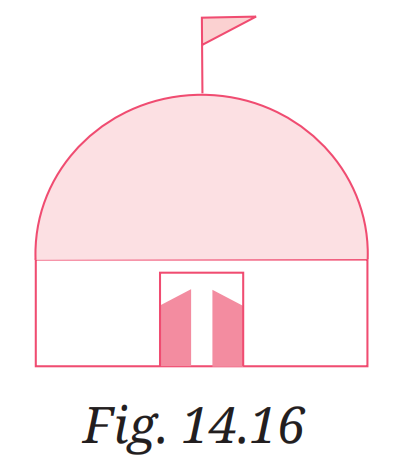
Question 8. The hemispherical dome of a building needs to be painted (see Fig. 14.16). If the circumference of the base of the dome is $35.2\text{ m}$, find the cost of painting it, given the cost of painting is ₹$10$ per $100\text{ cm}^2$.
Answer:
Given:
Circumference of the circular base of the hemispherical dome ($C$) $= 35.2\text{ m}$.
Rate of painting $= \textsf{₹}10\text{ per }100\text{ cm}^2$.
To Find:
The total cost of painting the hemispherical dome.
Solution:
Step 1: Find the radius ($r$) of the hemispherical dome:
Let the radius of the base of the dome be $r\text{ m}$. Using $\pi \approx \frac{22}{7}$:
$2\pi r = 35.2$
$2 \times \frac{22}{7} \times r \approx 35.2$
$\frac{44}{7}r \approx 35.2$
$r \approx \frac{\cancel{35.2}^{0.8} \times 7}{\cancel{44}_{1}} = 5.6\text{ m}$
Step 2: Find the curved surface area (CSA) of the dome:
Only the outer curved surface of the hemispherical dome is to be painted:
$\text{CSA of the dome} = 2\pi r^2 \approx 2 \times \frac{22}{\cancel{7}_{1}} \times \cancel{5.6}^{0.8} \times 5.6$
$\text{CSA of the dome} \approx 44 \times 0.8 \times 5.6 = 35.2 \times 5.6 = 197.12\text{ m}^2$
Converting the area from $\text{m}^2$ to $\text{cm}^2$ (since $1\text{ m} = 100\text{ cm}$, so $1\text{ m}^2 = 100 \times 100 = 10000\text{ cm}^2$):
$\text{CSA in cm}^2 \approx 197.12 \times 10000 = 19,71,200\text{ cm}^2$
Step 3: Find the cost of painting:
Cost of painting $100\text{ cm}^2$ $= \textsf{₹}10$.
Cost of painting $1\text{ cm}^2$ $= \textsf{₹}\frac{10}{100}$.
$\text{Total cost of painting} \approx \textsf{₹}\left(\frac{\cancel{10}^{1}}{\cancel{100}_{10}} \times 19,71,200\right) = \textsf{₹}1,97,120$
Therefore, the cost of painting the hemispherical dome is approximately $\textsf{₹}1,97,120$.
End-of-Chapter Exercises
For guesstimate problems, make a guess first before solving.
Question 1. Estimate how many scoops of ice cream can be obtained from a cuboidal container of dimensions $10\text{ cm} \times 15\text{ cm} \times 20\text{ cm}$.
Answer:
Initial Guess:
Before calculating, let us guess that around $40\text{ to }50\text{ scoops}$ of ice cream can be obtained from a family-sized tub of this size.
Given:
Dimensions of the cuboidal ice cream container $= 10\text{ cm} \times 15\text{ cm} \times 20\text{ cm}$.
To Estimate:
The number of ice cream scoops that can be obtained from the container.
Solution:
Step 1: Find the volume of ice cream in the container:
$\text{Volume of container} = 10 \times 15 \times 20 = 3000\text{ cm}^3$ (which equals $3\text{ litres}$)
Step 2: Assume the size of one scoop and find its volume:
Assume each scoop is approximately spherical with a diameter of $5\text{ cm}$, so its radius is $r = 2.5\text{ cm}$.
$\text{Volume of } 1\text{ scoop} = \frac{4}{3}\pi r^3 \approx \frac{4}{3} \times 3.14 \times (2.5)^3$
$\text{Volume of } 1\text{ scoop} \approx \frac{4}{3} \times 3.14 \times 15.625 \approx 65.42\text{ cm}^3$
Step 3: Estimate the number of scoops:
$\text{Number of scoops} = \frac{\text{Volume of container}}{\text{Volume of } 1\text{ scoop}} \approx \frac{3000}{65.42} \approx 45.86 \approx 46$
Therefore, approximately $46\text{ scoops}$ (around $45\text{ to }50$ scoops) of ice cream can be obtained from the container, which matches our initial guess closely.
Question 2. A cube of integer side length $a$ is made of unit cubes. Write an expression giving the number of unit cubes to be added to make a cube of side length $a + 1$.
Answer:
Given:
Original cube has side length $= a$ (made of unit cubes of side $1$).
New cube to be formed has side length $= a + 1$.
To Find:
An algebraic expression for the number of unit cubes to be added.
Solution:
Number of unit cubes in the original cube of side $a$ $= a^3$.
Number of unit cubes in the new cube of side $(a + 1)$ $= (a + 1)^3$.
Number of unit cubes to be added:
$\text{Number of unit cubes added} = (a + 1)^3 - a^3$
Using the algebraic identity $(x + y)^3 = x^3 + 3x^2y + 3xy^2 + y^3$:
$= (a^3 + 3a^2 + 3a + 1) - a^3$
$= 3a^2 + 3a + 1$
Therefore, the required expression for the number of unit cubes to be added is $(a + 1)^3 - a^3$, which simplifies to $3a^2 + 3a + 1$.
Question 3. Solve the following:
(i) Could a person drink enough water in a lifetime to fill an entire room the size of your classroom?
(ii) Estimate the number of bricks used to build the walls of your classroom.
Answer:
(i) Lifetime water consumption compared to a classroom's volume:
Initial Guess:
Let us guess No—a classroom looks much larger than all the water a person drinks in their lifetime (probably enough to fill only about half the room).
Solution for (i):
Step 1: Estimate the volume of a typical classroom:
Assume a standard classroom has length $= 8\text{ m}$, breadth $= 6\text{ m}$, and height $= 3\text{ m}$.
$\text{Volume of classroom} = 8 \times 6 \times 3 = 144\text{ m}^3$
Since $1\text{ m}^3 = 1000\text{ litres}$:
$\text{Capacity of classroom} = 144 \times 1000 = 1,44,000\text{ litres}$
Step 2: Estimate the total water a person drinks in a lifetime:
Assume a person drinks about $3\text{ litres}$ of water per day and lives for $75\text{ years}$.
$\text{Number of days in } 75\text{ years} \approx 75 \times 365 = 27,375\text{ days}$
$\text{Total water drunk in a lifetime} \approx 3 \times 27,375 = 82,125\text{ litres} $$ \approx 82.1\text{ m}^3$
Step 3: Compare the two volumes:
Since $82,125\text{ litres} < 1,44,000\text{ litres}$, a person’s lifetime drinking water fills only a little more than half of the classroom ($\approx 57\%$).
Therefore, No, a person generally cannot drink enough water in a lifetime to fill an entire standard classroom (unless the room is unusually small, under $\sim 80\text{ m}^3$).
(ii) Estimating the number of bricks in the walls of a classroom:
Initial Guess:
Let us guess around $8,000\text{ to }12,000\text{ bricks}$.
Solution for (ii):
Step 1: Estimate the net surface area of the four walls:
Taking the same classroom dimensions ($l = 8\text{ m}$, $b = 6\text{ m}$, $h = 3\text{ m}$):
$\text{Total area of } 4\text{ walls} = 2(l + b)h = 2(8 + 6) \times 3 = 84\text{ m}^2$
Subtracting the area of $1$ door ($\approx 2.4\text{ m}^2$) and $2$ windows ($\approx 3.6\text{ m}^2$), i.e., $6\text{ m}^2$ of openings:
$\text{Net wall area} = 84 - 6 = 78\text{ m}^2$
Step 2: Estimate the volume of the brick walls:
Assume a standard brick wall thickness of $20\text{ cm} = 0.2\text{ m}$:
$\text{Volume of walls} = 78 \times 0.2 = 15.6\text{ m}^3$
Step 3: Divide by the volume of one brick (with mortar):
A standard modular Indian brick including mortar measures about $20\text{ cm} \times 10\text{ cm} \times 10\text{ cm} = 0.2\text{ m} \times 0.1\text{ m} \times 0.1\text{ m}$:
$\text{Volume of } 1\text{ brick (with mortar)} = 0.2 \times 0.1 \times 0.1 = 0.002\text{ m}^3$
$\text{Estimated number of bricks} = \frac{15.6}{0.002} = \frac{\cancel{15600}^{7800}}{\cancel{2}_{1}} = 7,800$
Therefore, approximately $7,800\text{ bricks}$ (about $8,000$ bricks) are used to build the walls of the classroom.
Question 4. You are given two options: (A) one chocolate cube of side $50\text{ mm}$, (B) hundred chocolate cubes of side $10\text{ mm}$. Which option gives you more chocolate?
Answer:
Given:
Option (A): $1$ chocolate cube of side $A = 50\text{ mm}$.
Option (B): $100$ chocolate cubes, each of side $a = 10\text{ mm}$.
To Find:
Which option gives a greater volume of chocolate.
Solution:
1. Volume of chocolate in Option (A):
$\text{Volume in Option (A)} = A^3 = (50)^3 = 50 \times 50 \times 50 $$ = 1,25,000\text{ mm}^3$
2. Volume of chocolate in Option (B):
$\text{Volume of } 1\text{ small cube} = a^3 = (10)^3 = 10 \times 10 \times 10 $$ = 1000\text{ mm}^3$
$\text{Total volume in Option (B)} = 100 \times 1000 = 1,00,000\text{ mm}^3$
3. Comparison:
$1,25,000\text{ mm}^3 > 1,00,000\text{ mm}^3$
Option (A) provides $25,000\text{ mm}^3$ ($25\text{ cm}^3$) more chocolate than Option (B).
Therefore, Option (A) gives you more chocolate.
Question 5. If all the people in the world are crowded together in one location, how much area would it cover?
Answer:
Initial Guess:
Before calculating, let us guess that all the people in the world standing close together might cover an area roughly the size of a large city, around $1000\text{ to }3000\text{ km}^2$.
To Estimate:
The total area covered if the entire world population stands crowded together in one place.
Solution:
Step 1: Estimate the world population:
Current world population $\approx 8\text{ billion} = 8 \times 10^9\text{ people}$.
Step 2: Estimate the area occupied by one person in a tight crowd:
Standing shoulder-to-shoulder in a tight crowd, assume each person occupies a square of $0.5\text{ m} \times 0.5\text{ m}$:
$\text{Area per person} = 0.5 \times 0.5 = 0.25\text{ m}^2$ (i.e., $4$ people per $\text{m}^2$)
Step 3: Calculate the total area required:
$\text{Total area} \approx (8 \times 10^9) \times 0.25\text{ m}^2 = 2 \times 10^9\text{ m}^2$
Converting $\text{m}^2$ to $\text{km}^2$ (since $1\text{ km} = 1000\text{ m}$, so $1\text{ km}^2 = 10^6\text{ m}^2$):
$\text{Total area in km}^2 \approx \frac{2 \times 10^9}{10^6} = 2000\text{ km}^2$
(Note: For comparison, $2000\text{ km}^2$ is just a little larger than the National Capital Territory of Delhi, which has an area of about $1484\text{ km}^2$. If each person is given slightly more standing room of $0.5\text{ m}^2$, the area would be $4000\text{ km}^2$, roughly the size of Goa, which is $3702\text{ km}^2$.)
Therefore, all the people in the world crowded together would cover an area of approximately $2000\text{ km}^2$ (about $2000\text{ to }4000\text{ km}^2$ depending on how tightly packed they are).
Question 6. A school provides milk to its students in cylindrical glasses, each with a diameter of $7\text{ cm}$. If each glass is filled with milk to a height of $12\text{ cm}$, how many litres of milk are needed to serve $1600$ students? Use $1000\text{ cm}^3 = 1\text{ litre}$.
Answer:
Given:
Diameter of each cylindrical glass ($d$) $= 7\text{ cm}$, so its radius ($r$) $= \frac{7}{2}\text{ cm} = 3.5\text{ cm}$.
Height of milk in each glass ($h$) $= 12\text{ cm}$.
Number of students $= 1600$.
To Find:
The quantity of milk (in litres) needed to serve $1600$ students.
Solution:
Step 1: Find the volume of milk in one cylindrical glass:
Taking $\pi \approx \frac{22}{7}$:
$\text{Volume of milk in } 1\text{ glass} = \pi r^2 h \approx \frac{22}{\cancel{7}_{1}} \times \frac{\cancel{7}^{1}}{\cancel{2}_{1}} \times \frac{7}{\cancel{2}_{1}} \times \cancel{12}^{3}$
$\text{Volume of milk in } 1\text{ glass} \approx 22 \times 7 \times 3 = 462\text{ cm}^3$
Step 2: Find the total volume of milk needed for $1600$ students:
$\text{Total volume of milk} \approx 1600 \times 462 = 7,39,200\text{ cm}^3$
Step 3: Convert the volume into litres ($1000\text{ cm}^3 = 1\text{ litre}$):
$\text{Quantity of milk in litres} \approx \frac{7,39,200}{1000} = 739.2\text{ litres}$
Therefore, approximately $739.2\text{ litres}$ of milk are needed to serve $1600$ students.
Question 7. The surface area of a sphere of radius $5\text{ cm}$ is five times the area of the curved surface of a cone of radius $4\text{ cm}$. Find the height and the volume of the cone.
Answer:
Given:
Radius of the sphere ($R$) $= 5\text{ cm}$.
Radius of the cone ($r$) $= 4\text{ cm}$.
Surface area of the sphere $= 5 \times (\text{Curved surface area of the cone})$.
To Find:
The height ($h$) and the volume ($V$) of the cone.
Solution:
Step 1: Find the slant height ($l$) of the cone:
Let the slant height of the cone be $l\text{ cm}$ and its vertical height be $h\text{ cm}$.
$\text{Surface area of the sphere} = 4\pi R^2 = 4\pi (5)^2 = 100\pi\text{ cm}^2$
$\text{Curved surface area of the cone} = \pi r l = \pi (4) l = 4\pi l\text{ cm}^2$
According to the given condition:
$100\pi = 5 \times (4\pi l)$
$100\pi = 20\pi l$
$l = \frac{\cancel{100}^{5}\cancel{\pi}}{\cancel{20}_{1}\cancel{\pi}} = 5\text{ cm}$
Step 2: Find the vertical height ($h$) of the cone:
Using the relation $l^2 = r^2 + h^2$:
$h = \sqrt{l^2 - r^2} = \sqrt{5^2 - 4^2} = \sqrt{25 - 16} = \sqrt{9} = 3\text{ cm}$
Step 3: Find the volume ($V$) of the cone:
$V = \frac{1}{3}\pi r^2 h = \frac{1}{\cancel{3}_{1}} \times \pi \times (4)^2 \times \cancel{3}^{1} = 16\pi\text{ cm}^3$
Taking $\pi \approx \frac{22}{7}$:
$V \approx 16 \times \frac{22}{7} = \frac{352}{7} = 50\frac{2}{7}\text{ cm}^3 \approx 50.29\text{ cm}^3$
(If $\pi \approx 3.14$ is used, $V \approx 16 \times 3.14 = 50.24\text{ cm}^3$.)
Therefore, the height of the cone is $3\text{ cm}$ and its volume is $16\pi\text{ cm}^3$ (approximately $50.29\text{ cm}^3$).
Question 8. Take Earth to be a perfect sphere with radius $6370\text{ km}$. Take Jupiter to be a perfect sphere with radius $69,900\text{ km}$. Take the Sun to be a perfect sphere with radius $6,95,700\text{ km}$. Compute approximately:
(i) the ratio of the volume of Jupiter to the volume of the Earth;
(ii) the ratio of the volume of the Sun to the volume of the Earth.
(Calculator can be used.)
Answer:
Given:
Radius of the Earth ($R_E$) $= 6370\text{ km}$.
Radius of Jupiter ($R_J$) $= 69,900\text{ km}$.
Radius of the Sun ($R_S$) $= 6,95,700\text{ km}$.
To Find:
(i) The approximate ratio $\frac{\text{Volume of Jupiter}}{\text{Volume of the Earth}}$.
(ii) The approximate ratio $\frac{\text{Volume of the Sun}}{\text{Volume of the Earth}}$.
Solution:
Since the volume of a sphere of radius $R$ is $V = \frac{4}{3}\pi R^3$, the ratio of the volumes of any two spheres equals the cube of the ratio of their radii.
(i) Ratio of the volume of Jupiter to the volume of the Earth:
$\frac{V_J}{V_E} = \frac{\frac{4}{3}\pi R_J^3}{\frac{4}{3}\pi R_E^3} = \left(\frac{R_J}{R_E}\right)^3$
$\frac{V_J}{V_E} = \left(\frac{69,900}{6370}\right)^3 = \left(\frac{6990}{637}\right)^3 \approx (10.9733)^3 \approx 1321.34$
Therefore, the ratio of the volume of Jupiter to the volume of the Earth is approximately $1321 : 1$ (about $1321$ Earths could fit inside Jupiter).
(ii) Ratio of the volume of the Sun to the volume of the Earth:
$\frac{V_S}{V_E} = \frac{\frac{4}{3}\pi R_S^3}{\frac{4}{3}\pi R_E^3} = \left(\frac{R_S}{R_E}\right)^3$
$\frac{V_S}{V_E} = \left(\frac{6,95,700}{6370}\right)^3 = \left(\frac{69570}{637}\right)^3 \approx (109.2151)^3 \approx 13,02,710$
Therefore, the ratio of the volume of the Sun to the volume of the Earth is approximately $13,02,710 : 1$ (about $13\text{ lakh}$ or $1.3 \times 10^6$ Earths could fit inside the Sun).
Question 9. Show that the volume of a sphere is equal to $\frac{2}{3}$ of the volume of the smallest cylinder which encloses it.
Answer:
Given:
Let a sphere of radius $r$ be enclosed tightly inside the smallest possible right circular cylinder.
To Show:
$\text{Volume of the sphere} = \frac{2}{3} \times (\text{Volume of the enclosing cylinder})$.
Solution:
For the cylinder to tightly enclose the sphere (touching its top, bottom, and curved side), the radius and height of the cylinder must be:
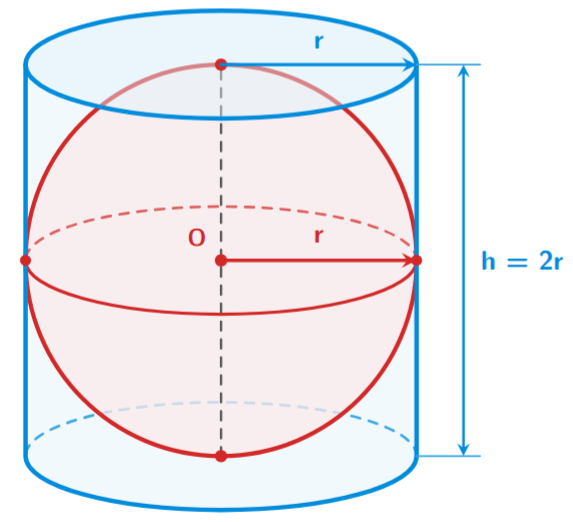
Radius of the cylinder ($R$) $= r$
Height of the cylinder ($h$) $= \text{Diameter of the sphere} = 2r$
Now, the volume of the sphere is:
$V_{\text{sphere}} = \frac{4}{3}\pi r^3$
…(i)
The volume of the enclosing cylinder is:
$V_{\text{cylinder}} = \pi R^2 h = \pi (r)^2 (2r) = 2\pi r^3$
Taking $\frac{2}{3}$ of the volume of the cylinder:
$\frac{2}{3} V_{\text{cylinder}} = \frac{2}{3} (2\pi r^3) = \frac{4}{3}\pi r^3$
From equation (i), this is equal to $V_{\text{sphere}}$.
Hence, it is shown that $V_{\text{sphere}} = \frac{2}{3} V_{\text{cylinder}}$.
Question 10. Suppose the Earth is perfectly spherical. A string is wrapped tightly around the equator of the Earth. Another string, $1$ metre longer, is placed around the Earth so that it forms a larger circle, staying the same distance above the ground everywhere.
How high above the ground is the second string?
Repeat this for: (i) the Moon (ii) Jupiter (iii) a volleyball. Are you surprised by the three answers? Why or why not?
Answer:
Given:
Let the radius of the spherical Earth (or any sphere) be $R\text{ metres}$.
Length of the first string wrapped tightly around the equator $= C_1 = 2\pi R\text{ metres}$.
Length of the second string $= C_2 = (2\pi R + 1)\text{ metres}$.
To Find:
The height ($h$) of the second string above the surface for the Earth, (i) the Moon, (ii) Jupiter, and (iii) a volleyball, and whether the results are surprising.
Solution:
Let the second string be at a uniform height $h\text{ metres}$ above the ground everywhere. Then it forms a concentric circle of radius $(R + h)\text{ metres}$.
Its circumference is:
$C_2 = 2\pi(R + h) = 2\pi R + 2\pi h$
Since the second string is $1\text{ metre}$ longer than the first string ($C_2 = 2\pi R + 1$):
$2\pi R + 2\pi h = 2\pi R + 1$
Subtracting $2\pi R$ from both sides:
$2\pi h = 1$
$h = \frac{1}{2\pi}\text{ metres}$
Taking $\pi \approx 3.1416$ (or $\frac{22}{7}$):
$h \approx \frac{1}{2 \times 3.1416} \approx 0.159\text{ m} \approx 15.9\text{ cm}$
Therefore, the second string is approximately $15.9\text{ cm}$ (or $0.159\text{ m}$) above the ground around the Earth.
Repeating for (i) the Moon, (ii) Jupiter, and (iii) a volleyball:
Notice that in the derivation above, the radius $R$ of the sphere cancels out completely. Therefore, the height $h = \frac{1}{2\pi}\text{ m} \approx 15.9\text{ cm}$ does not depend on the size of the sphere at all!
(i) For the Moon: $h = \frac{1}{2\pi}\text{ m} \approx \mathbf{15.9\text{ cm}}$.
(ii) For Jupiter: $h = \frac{1}{2\pi}\text{ m} \approx \mathbf{15.9\text{ cm}}$.
(iii) For a volleyball: $h = \frac{1}{2\pi}\text{ m} \approx \mathbf{15.9\text{ cm}}$.
Question 11. We have a cylinder with a base radius of $r\text{ cm}$ and height $h\text{ cm}$. A square pyramid is fitted inside it. The square base of the pyramid lies on the base of the cylinder, its corners on the boundary of the cylinder. The apex of the pyramid lies on the top of the cylinder. Find the ratio of the volume of this pyramid to the volume of the cylinder.
Answer:
Given:
Base radius of the cylinder $= r\text{ cm}$ and height of the cylinder $= h\text{ cm}$.
A square pyramid is inscribed inside the cylinder such that its square base has all four vertices on the circular base of the cylinder, and its apex lies on the top face of the cylinder.
To Find:
The ratio of the volume of the square pyramid to the volume of the cylinder.
Solution:
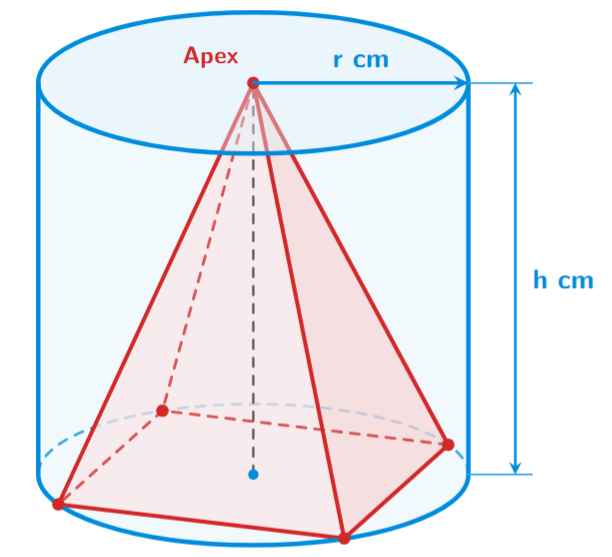
Step 1: Find the volume of the cylinder:
$V_{\text{cylinder}} = \pi r^2 h\text{ cm}^3$
…(i)
Step 2: Find the area of the square base and volume of the pyramid:
Since all four corners of the square base lie on the circular base of radius $r\text{ cm}$, the diagonal ($d$) of the square equals the diameter of the circle:
$d = 2r\text{ cm}$
Let the side of the square base be $a\text{ cm}$. By Pythagoras' theorem, $a^2 + a^2 = d^2$:
$2a^2 = (2r)^2 = 4r^2$
$\text{Area of square base} = a^2 = \frac{\cancel{4}^{2} r^2}{\cancel{2}_{1}} = 2r^2\text{ cm}^2$
Since the apex of the pyramid lies on the top of the cylinder, the height of the pyramid is $h\text{ cm}$.
Volume of the square pyramid:
$V_{\text{pyramid}} = \frac{1}{3} \times \text{Area of base} \times \text{height} = \frac{1}{3}(2r^2)h = \frac{2}{3}r^2 h\text{ cm}^3$
…(ii)
Step 3: Find the required ratio:
Dividing equation (ii) by equation (i):
$\frac{V_{\text{pyramid}}}{V_{\text{cylinder}}} = \frac{\frac{2}{3}\cancel{r^2 h}}{\pi \cancel{r^2 h}} = \frac{2}{3\pi}$
(Taking $\pi \approx \frac{22}{7}$, this is approximately $\frac{2}{3 \times \frac{22}{7}} = \frac{\cancel{2}^{1} \times 7}{3 \times \cancel{22}_{11}} = \frac{7}{33}$.)
Therefore, the ratio of the volume of the pyramid to the volume of the cylinder is $2 : 3\pi$ (or approximately $7 : 33$).
Question 12. What is the change in volume when:
(i) the length of a cuboid with dimensions $l$, $w$, $h$ is increased by $1$ unit?
(a) $1$ cubic unit
(b) $(lwh + 1)$ cubic unit
(c) $wh$ cubic units
(d) $lw$ cubic units
(e) $lh$ cubic units
(ii) the radius of a cylinder with dimensions $r$, $h$ is increased by $1$ unit?
(a) $1$ cubic unit
(b) $\pi r^2 h$ cubic units
(c) $\pi r^2$ cubic units
(d) $2\pi rh + 2\pi h$ cubic units
(e) $2\pi rh + \pi h$ cubic units
(iii) the radius of a sphere is decreased by $1$ unit?
Answer:
To Find:
The change in volume in each of the three cases.
Solution:
(i) Length of a cuboid increased by $1$ unit:
Original volume ($V_1$) $= lwh$
New length $= (l + 1)$ units, while width $w$ and height $h$ remain unchanged.
New volume ($V_2$) $= (l + 1)wh = lwh + wh$
Change in volume $= V_2 - V_1 = (lwh + wh) - lwh $$ = wh\text{ cubic units}$
Therefore, the correct option is (c) $wh$ cubic units.
(ii) Radius of a cylinder increased by $1$ unit:
Original volume ($V_1$) $= \pi r^2 h$
New radius $= (r + 1)$ units, while height $h$ remains unchanged.
New volume ($V_2$) $= \pi(r + 1)^2 h = \pi(r^2 + 2r + 1)h $$ = \pi r^2 h + 2\pi rh + \pi h$
Change in volume $= V_2 - V_1 = (\pi r^2 h + 2\pi rh + \pi h) - \pi r^2 h $$ = 2\pi rh + \pi h\text{ cubic units}$
Therefore, the correct option is (e) $2\pi rh + \pi h$ cubic units.
(iii) Radius of a sphere decreased by $1$ unit:
Let the original radius of the sphere be $r$ units (with $r > 1$).
Original volume ($V_1$) $= \frac{4}{3}\pi r^3$
New radius $= (r - 1)$ units.
New volume ($V_2$) $= \frac{4}{3}\pi(r - 1)^3 = \frac{4}{3}\pi(r^3 - 3r^2 + 3r - 1) $$ = \frac{4}{3}\pi r^3 - 4\pi r^2 + 4\pi r - \frac{4}{3}\pi$
Decrease in volume ($V_1 - V_2$):
$V_1 - V_2 = \frac{4}{3}\pi r^3 - \left(\frac{4}{3}\pi r^3 - 4\pi r^2 + 4\pi r - \frac{4}{3}\pi\right) $$ = 4\pi r^2 - 4\pi r + \frac{4}{3}\pi = \frac{4}{3}\pi(3r^2 - 3r + 1)$
Therefore, the volume decreases by $4\pi r^2 - 4\pi r + \frac{4}{3}\pi$ cubic units (or equivalently, $\Delta V = V_2 - V_1 = -\frac{4}{3}\pi(3r^2 - 3r + 1)$ cubic units).
Question 13. Given a cube with volume $V$, express its total surface area $S$ in terms of $V$.
Answer:
Given:
A cube has volume $V$ and total surface area $S$.
To Find:
An expression for $S$ in terms of $V$.
Solution:
Let the length of each edge (side) of the cube be $a$.
The volume of the cube is given by:
$V = a^3$
Taking the cube root on both sides to express $a$ in terms of $V$:
$a = V^{\frac{1}{3}} = \sqrt[3]{V}$
…(i)
The total surface area ($S$) of the cube is given by:
$S = 6a^2$
Substituting $a = V^{\frac{1}{3}}$ from equation (i):
$S = 6\left(V^{\frac{1}{3}}\right)^2 = 6V^{\frac{2}{3}} = 6\sqrt[3]{V^2}$
Therefore, the total surface area $S$ in terms of $V$ is $S = 6V^{\frac{2}{3}}$ (or $S = 6\sqrt[3]{V^2}$).
Question 14. Given a cube with total surface area $S$, express its volume $V$ in terms of $S$.
Answer:
Given:
A cube has total surface area $S$ and volume $V$.
To Find:
An expression for $V$ in terms of $S$.
Solution:
Let the length of each edge (side) of the cube be $a$.
The total surface area of the cube is given by:
$S = 6a^2$
Solving for $a$ (since edge length $a > 0$):
$a^2 = \frac{S}{6}$
$a = \sqrt{\frac{S}{6}} = \left(\frac{S}{6}\right)^{\frac{1}{2}}$
…(i)
The volume ($V$) of the cube is given by:
$V = a^3$
Substituting $a = \left(\frac{S}{6}\right)^{\frac{1}{2}}$ from equation (i):
$V = \left[\left(\frac{S}{6}\right)^{\frac{1}{2}}\right]^3 = \left(\frac{S}{6}\right)^{\frac{3}{2}} = \frac{S\sqrt{S}}{6\sqrt{6}}$
Therefore, the volume $V$ in terms of $S$ is $V = \left(\frac{S}{6}\right)^{\frac{3}{2}}$ (or $V = \frac{S\sqrt{S}}{6\sqrt{6}}$).
Question 15. A cylindrical glass of height $25\text{ cm}$ and radius $4\text{ cm}$ has water up to a height of $16\text{ cm}$. A crow wants to drink water from this glass. The water must be at a height of $20\text{ cm}$ for the crow to reach it. There are some marbles lying around. How many marbles of radius $1\text{ cm}$ should the crow drop into the glass to make the water reach the required height?
Answer:
Given:
Radius of the cylindrical glass ($R$) $= 4\text{ cm}$, Total height of the glass $= 25\text{ cm}$.
Initial height of water ($h_1$) $= 16\text{ cm}$.
Required height of water ($h_2$) $= 20\text{ cm}$.
Radius of each spherical marble ($r$) $= 1\text{ cm}$.
To Find:
The number of marbles ($n$) the crow should drop into the glass to raise the water level to $20\text{ cm}$.
Solution:
Step 1: Find the volume of water to be displaced (raised):
$\text{Required rise in water level } (\Delta h) = h_2 - h_1 = 20 - 16 = 4\text{ cm}$
The volume corresponding to this cylindrical rise in water is:
$V_{\text{rise}} = \pi R^2 \Delta h = \pi \times (4)^2 \times 4 = 64\pi\text{ cm}^3$
Step 2: Find the volume of one spherical marble:
$V_{\text{marble}} = \frac{4}{3}\pi r^3 = \frac{4}{3}\pi (1)^3 = \frac{4}{3}\pi\text{ cm}^3$
Step 3: Find the number of marbles ($n$):
When $n$ marbles are dropped and completely submerged, the total volume of the marbles equals the displaced volume of the water rise:
$n \times V_{\text{marble}} = V_{\text{rise}}$
$n \times \frac{4}{3}\pi = 64\pi$
$n = \frac{\cancel{64}^{16}\cancel{\pi} \times 3}{\cancel{4}_{1}\cancel{\pi}} = 16 \times 3 = 48$
(Verification: Initial water volume $= \pi(4)^2(16) = 256\pi\text{ cm}^3$. Adding $48$ marbles adds $48 \times \frac{4}{3}\pi = 64\pi\text{ cm}^3$, giving total volume $320\pi\text{ cm}^3$, which fills the cylinder of radius $4\text{ cm}$ to a height of $\frac{320\pi}{16\pi} = 20\text{ cm}$.)
Therefore, the crow should drop $48$ marbles into the glass.
Question 16. Find the volume of ink in a new ball point pen. Take the necessary measurements and make approximations, as needed.
Answer:
Measurements and Approximations:
Take a standard transparent Indian ballpoint pen refill (such as a Cello or Reynolds jotter refill) and measure the ink column inside the plastic tube using a ruler:
| Quantity | Estimated Measurement |
| Shape of the ink column | Right circular cylinder |
| Inner diameter of the refill tube ($d$) | $2\ \text{mm} = 0.2\ \text{cm}$ |
| Radius of the ink column ($r = \frac{d}{2}$) | $1\ \text{mm} = 0.1\ \text{cm}$ |
| Height (length) of the ink column ($h$) | $10\ \text{cm}$ |
To Find:
The volume ($V$) of ink in the new ballpoint pen.
Formula Used:
$\text{Volume of a cylinder } (V) = \pi r^2 h$
$\left(\text{Taking } \pi \approx 3.14\right)$ ... (i)
Solution:
Substituting the measured values $r = 0.1\ \text{cm}$ and $h = 10\ \text{cm}$ into equation (i):
$V = 3.14 \times (0.1)^2 \times 10$
$V = 3.14 \times 0.01 \times 10$
$V = 0.314\ \text{cm}^3$
$\left(\text{Since } 1\ \text{cm}^3 = 1\ \text{mL}\right)$
Converting into cubic millimetres ($1\ \text{cm}^3 = 1000\ \text{mm}^3$):
$V = 0.314 \times 1000 = 314\ \text{mm}^3$
Therefore, the volume of ink in a new ballpoint pen is approximately $0.314\ \text{cm}^3$ (or $0.314\ \text{mL}$ / $314\ \text{mm}^3$).
Question 17. Solve:
(i) A ball of chapati dough of radius $6\text{ cm}$ is prepared. Estimate how many chapatis can be made from it?
(ii) Cut a coconut/muskmelon in half and find out the approximate volume of edible coconut flesh/fruit by taking the necessary measurements.
Answer:
Part (i):
Given:
Radius of the large dough ball ($R$) $= 6\ \text{cm}$
(Given)
Assumption:
In a typical Indian household, a medium-sized chapati (phulka) is rolled from a small spherical dough ball (peda / loia) of approximate radius $r = 2\ \text{cm}$ (diameter $4\ \text{cm}$).
To Find:
The estimated number of chapatis ($n$) that can be made from the large dough ball.
Solution:
The volume of the large spherical dough ball is:
$V_{\text{large}} = \frac{4}{3} \pi R^3 = \frac{4}{3} \times \pi \times (6)^3$
$V_{\text{large}} = \frac{4}{\cancel{3}} \times \pi \times \cancel{216}^{72} = 288\pi\ \text{cm}^3$
The volume of one small spherical dough ball (for $1$ chapati) is:
$V_{\text{small}} = \frac{4}{3} \pi r^3 = \frac{4}{3} \times \pi \times (2)^3 = \frac{32}{3}\pi\ \text{cm}^3$
Therefore, the number of chapatis ($n$) is:
$n = \frac{V_{\text{large}}}{V_{\text{small}}} = \frac{288\cancel{\pi}}{\frac{32}{3}\cancel{\pi}}$
$n = \frac{\cancel{288}^{9} \times 3}{\cancel{32}_{1}} = 9 \times 3 = 27$
Alternate Solution for Part (i) (Using rolled chapati dimensions):
When rolled out, a medium chapati forms a thin circular disc (cylinder) of approximate radius $r_c = 7\ \text{cm}$ (diameter $14\ \text{cm}$) and thickness $t = 0.2\ \text{cm}$ ($2\ \text{mm}$).
Volume of $1$ rolled chapati $= \pi r_c^2 t = \pi \times (7)^2 \times 0.2 = 9.8\pi\ \text{cm}^3$
Number of chapatis ($n$) $= \frac{288\cancel{\pi}}{9.8\cancel{\pi}} = \frac{2880}{98} \approx 29.39 \approx 29$
Hence, approximately $27$ to $29$ medium-sized chapatis can be made from the dough ball.
Part (ii):
Measurements and Approximations:
Consider a mature Indian coconut (nariyal) cut cleanly into two halves. After removing the outer hard shell, the edible white flesh forms a hollow hemisphere (a hemispherical shell).
| Measurement | Approximate Value |
| Outer radius of the edible white flesh ($R$) | $5\ \text{cm}$ |
| Thickness of the edible white flesh ($t$) | $1\ \text{cm}$ |
| Inner radius of the hollow cavity ($r = R - t$) | $5 - 1 = 4\ \text{cm}$ |
To Find:
The approximate volume of edible coconut flesh in one half as well as in the whole coconut.
Formula Used:
$\text{Volume of a hemispherical shell } = \frac{2}{3}\pi (R^3 - r^3)$
Solution:
Volume of edible flesh in one half of the coconut:
$V_{\text{half}} = \frac{2}{3} \times \frac{22}{7} \times (5^3 - 4^3)$
$V_{\text{half}} = \frac{44}{21} \times (125 - 64)$
$V_{\text{half}} = \frac{44}{21} \times 61 = \frac{2684}{21} \approx 127.81\ \text{cm}^3$
Total volume of edible flesh in the whole coconut:
$V_{\text{whole}} = 2 \times V_{\text{half}} = 2 \times \frac{2684}{21} = \frac{5368}{21} \approx 255.62\ \text{cm}^3$
Therefore, the approximate volume of edible coconut flesh is $127.81\ \text{cm}^3$ in one half, and about $255.62\ \text{cm}^3$ (approx. $256\ \text{cm}^3$) in the whole coconut.
Question 18. Looking at the Ganita Manjari, Grade 9, Part 2 textbook, Sheela wonders:
(i) If all the pages of this textbook were laid out side-by-side on the floor would they cover the entire classroom floor?
(ii) What is the maximum number of textbooks that can fit in an empty storeroom of dimensions $15\text{ ft} \times 20\text{ ft} \times 30\text{ ft}$?
Answer:
Measurements and Assumptions (Standard NCERT Textbook Dimensions):
| Dimension / Detail | Estimated Value |
| Length of the textbook ($l$) | $28\ \text{cm} = 0.28\ \text{m}$ |
| Breadth of the textbook ($b$) | $21\ \text{cm} = 0.21\ \text{m}$ |
| Thickness of the textbook ($h$) | $1\ \text{cm}$ |
| Number of pages in Part 2 | $\approx 180\ \text{pages}$ (i.e., $\frac{180}{2} = 90\ \text{sheets/leaves}$) |
| Typical Indian classroom floor dimensions | $8\ \text{m} \times 6\ \text{m}$ (Area $= 48\ \text{m}^2$) |
Part (i):
Solution:
Area of one physical sheet (leaf) of the textbook:
$A_{\text{sheet}} = l \times b = 0.28\ \text{m} \times 0.21\ \text{m} = 0.0588\ \text{m}^2$
Since each sheet has $2$ pages (front and back), $180$ pages correspond to $90$ physical sheets.
Total floor area covered by laying out all $90$ sheets side-by-side:
$A_{\text{total}} = 90 \times 0.0588 = 5.292\ \text{m}^2$
(Note: Even if all $180$ numbered pages were somehow printed one-sided and laid out separately, the area would be $180 \times 0.0588 = 10.584\ \text{m}^2$.)
Comparing with a typical Indian classroom floor area of $48\ \text{m}^2$:
$5.292\ \text{m}^2 \ll 48\ \text{m}^2$
In fact, the sheets would cover only about $\frac{5.292}{48} \times 100 \approx 11\%$ of the classroom floor.
Therefore, No, laying out all the pages of the textbook side-by-side would not cover the entire classroom floor.
Part (ii):
Given:
Dimensions of the empty storeroom $= 15\ \text{ft} \times 20\ \text{ft} \times 30\ \text{ft}$.
Solution:
Converting the storeroom dimensions into centimetres using $1\ \text{ft} = 30.48\ \text{cm}$:
Length ($L$) $= 30 \times 30.48 = 914.4\ \text{cm}$
Breadth ($B$) $= 20 \times 30.48 = 609.6\ \text{cm}$
Height ($H$) $= 15 \times 30.48 = 457.2\ \text{cm}$
Volume of the storeroom ($V_{\text{room}}$):
$V_{\text{room}} = 914.4 \times 609.6 \times 457.2 = 25,48,51,618.56\ \text{cm}^3$
Volume of $1$ textbook ($V_{\text{book}}$):
$V_{\text{book}} = l \times b \times h = 28 \times 21 \times 1 = 588\ \text{cm}^3$
First, calculating the theoretical upper limit using volumes:
$\text{Theoretical maximum} = \frac{25,48,51,618.56}{588} \approx 4,33,421\ \text{textbooks}$
Now, checking the actual number of whole textbooks that can be packed along the edges without cutting any book:
1. In the main orientation ($28\ \text{cm}$ along $L$, $21\ \text{cm}$ along $B$, $1\ \text{cm}$ along $H$):
Along $914.4\ \text{cm}$: $\frac{914.4}{28} \approx 32.66 \implies 32\ \text{books}$ (remaining space $= 914.4 - 896 = 18.4\ \text{cm}$)
Along $609.6\ \text{cm}$: $\frac{609.6}{21} \approx 29.03 \implies 29\ \text{books}$ (remaining space $= 609.6 - 609 = 0.6\ \text{cm}$)
Along $457.2\ \text{cm}$: $\frac{457.2}{1} = 457.2 \implies 457\ \text{books}$ (remaining space $= 0.2\ \text{cm}$)
Number of books in the main stack $= 32 \times 29 \times 457 = 4,24,096\ \text{books}$.
2. In the remaining side space ($18.4\ \text{cm} \times 609.6\ \text{cm} \times 457.2\ \text{cm}$), we can rotate the books ($1\ \text{cm}$ along $18.4\ \text{cm}$, $28\ \text{cm}$ along $609.6\ \text{cm}$, $21\ \text{cm}$ along $457.2\ \text{cm}$):
Additional books $= 18 \times 21 \times 21 = 7,938\ \text{books}$.
Total packed books $= 4,24,096 + 7,938 = 4,32,034\ \text{books}$.
Therefore, a maximum of approximately $4,32,034$ (about $4.32\ \text{lakh}$) textbooks can fit in the empty storeroom.
Question 19. If the entire human population decided to climb into one giant cube, how long would the side have to be?
Answer:
Assumptions and Estimates:
1. Total human population ($P$): Approximately $8.2\ \text{billion}$ ($8.2 \times 10^9$ or $820\ \text{crore}$ people).
2. Average mass of a human being: Accounting for men, women, and children worldwide, the average mass is approximately $65\ \text{kg}$.
3. Density of the human body: Almost equal to that of water, i.e., $1000\ \text{kg/m}^3$.
To Find:
The length of the side ($a$) of the giant cube required to hold the entire human population.
Solution:
The average volume of one human body ($V_1$) is:
$V_1 = \frac{\text{Mass}}{\text{Density}} = \frac{65}{1000} = 0.065\ \text{m}^3$
Total volume ($V$) occupied by $8.2 \times 10^9$ people:
$V = P \times V_1 = 8.2 \times 10^9 \times 0.065$
$V = 5.33 \times 10^8\ \text{m}^3 = 533 \times 10^6\ \text{m}^3$
Let the side of the giant cube be $a\ \text{metres}$. Then:
$a^3 = 533 \times 10^6$
$\left(\text{Volume of a cube } = a^3\right)$
Taking the cube root on both sides:
$a = \sqrt[3]{533 \times 10^6} = \sqrt[3]{533} \times 10^2$
Since $8^3 = 512$ and $8.11^3 \approx 533.4$, we get $\sqrt[3]{533} \approx 8.108$.
$a \approx 8.108 \times 100 \approx 810.8\ \text{m} \approx 811\ \text{m}$
Alternate Solution (Including realistic standing/packing space):
Humans are not rectangular blocks and cannot pack without small air gaps around limbs. If each person is allotted a compact standing space of $0.5\ \text{m} \times 0.3\ \text{m} \times 1.67\ \text{m} \approx 0.25\ \text{m}^3$:
Total volume ($V'$) $= 8.2 \times 10^9 \times 0.25 = 2.05 \times 10^9\ \text{m}^3 $$ = 2050 \times 10^6\ \text{m}^3$
Side of the cube ($a'$) $= \sqrt[3]{2050 \times 10^6} \approx 12.70 \times 100 = 1270\ \text{m} $$ \approx 1.27\ \text{km}$
Therefore, if packed tightly by body volume, the side of the giant cube would have to be approximately $811\ \text{m}$ (less than $1\ \text{km}$); and if packed standing closely with small air spaces, the side would be about $1.27\ \text{km}$.
Question 20. The Earth’s surface has an estimated volume of $1.38\text{ billion km}^3$ of water. Suppose the Earth is a perfect sphere and all this water forms a uniform layer completely covering the Earth’s surface, like a thin water bubble. Estimate the thickness of this water layer. The Earth’s radius is $\sim 6371\text{ km}$.
(i) Write an expression that gives the thickness of this water layer.
(ii) Simplify the expression in (i) using a calculator.
Answer:
Given:
Radius of the Earth ($R$) $= 6371\ \text{km}$
Volume of water ($V$) $= 1.38\ \text{billion km}^3 = 1.38 \times 10^9\ \text{km}^3$
To Find:
(i) An expression for the thickness ($t$) of the uniform water layer.
(ii) The simplified numerical value of the thickness ($t$) using a calculator.
Part (i):
Let the thickness of the uniform water layer covering the Earth be $t\ \text{km}$.
Then, the outer radius of the water-covered Earth is $(R + t)\ \text{km}$.
The water forms a hollow spherical shell around the Earth. Therefore, the volume of water ($V$) equals the difference between the volume of the outer sphere and the volume of the Earth:
$V = \frac{4}{3}\pi (R + t)^3 - \frac{4}{3}\pi R^3$
$\left(\text{Volume of sphere } = \frac{4}{3}\pi r^3\right)$
$V = \frac{4}{3}\pi \left[(R + t)^3 - R^3\right]$
Multiplying both sides by $\frac{3}{4\pi}$:
$(R + t)^3 - R^3 = \frac{3V}{4\pi}$
$(R + t)^3 = R^3 + \frac{3V}{4\pi}$
Taking the cube root on both sides:
$R + t = \sqrt[3]{R^3 + \frac{3V}{4\pi}}$
$t = \sqrt[3]{R^3 + \frac{3V}{4\pi}} - R$
... (i)
Substituting $R = 6371$ and $V = 1.38 \times 10^9$ into equation (i), we get the required expression:
$t = \sqrt[3]{6371^3 + \frac{3 \times 1.38 \times 10^9}{4\pi}} - 6371$
Part (ii):
Simplifying the expression step by step using a calculator (taking $\pi \approx 3.14159265$):
$6371^3 = 258,596,602,811\ \text{km}^3$
$\frac{3 \times 1.38 \times 10^9}{4\pi} = \frac{4.14 \times 10^9}{12.56637061} \approx 329,450,732\ \text{km}^3$
Adding the two values inside the cube root:
$6371^3 + \frac{3 \times 1.38 \times 10^9}{4\pi} \approx 258,596,602,811 + 329,450,732 $$ = 258,926,053,543$
Now taking the cube root:
$\sqrt[3]{258,926,053,543} \approx 6373.7044\ \text{km}$
Subtracting $6371\ \text{km}$:
$t \approx 6373.7044 - 6371 = 2.7044\ \text{km} \approx 2.70\ \text{km}$
Converting to metres ($1\ \text{km} = 1000\ \text{m}$):
$t \approx 2.7044 \times 1000 = 2704.4\ \text{m} \approx 2704\ \text{m}$
Therefore, the thickness of the uniform water layer covering the Earth would be approximately $2.70\ \text{km}$ (about $2704\ \text{m}$).
Question 21. Give the dimension of a cuboid whose volume is halved when its surface area is doubled.
Answer:
Given:
Let the initial cuboid have length $l$, breadth $b$, and height $h$.
Initial Volume, $V_1 = lbh$
... (i)
Initial Surface Area, $S_1 = 2(lb + bh + hl)$
... (ii)
To Find:
The dimensions of a cuboid $(l, b, h)$ and its modified dimensions $(l', b', h')$ such that the new volume $V_2 = \frac{1}{2}V_1$ while the new surface area $S_2 = 2S_1$.
Solution:
Suppose we double the length and breadth ($l' = 2l$, $b' = 2b$) and divide the height by $8$ ($h' = \frac{h}{8}$).
Then the new volume is automatically halved:
$V_2 = l' \times b' \times h'$
$V_2 = (2l)(2b)\left(\frac{h}{8}\right) = \frac{\cancel{4}^{1}}{\cancel{8}_{2}}lbh = \frac{1}{2}V_1$
Now, we require the new total surface area $S_2$ to be double $S_1$ ($S_2 = 2S_1$):
$2\left[(2l)(2b) + (2b)\left(\frac{h}{8}\right) + \left(\frac{h}{8}\right)(2l)\right] = 2 \times 2(lb + bh + hl)$
Dividing both sides by $2$:
$4lb + \frac{bh}{4} + \frac{hl}{4} = 2lb + 2bh + 2hl$
$4lb - 2lb = \left(2 - \frac{1}{4}\right)bh + \left(2 - \frac{1}{4}\right)hl$
$2lb = \frac{7}{4}bh + \frac{7}{4}hl$
Dividing every term by $lbh$:
$\frac{2}{h} = \frac{7}{4l} + \frac{7}{4b}$
Choosing $l = 14\text{ cm}$ and $b = 14\text{ cm}$:
$\frac{2}{h} = \frac{\cancel{7}^{1}}{4 \times \cancel{14}_{2}} + \frac{\cancel{7}^{1}}{4 \times \cancel{14}_{2}}$
$\frac{2}{h} = \frac{1}{8} + \frac{1}{8} = \frac{2}{8} = \frac{1}{4}$
$\therefore h = 8\text{ cm}$
Verification:
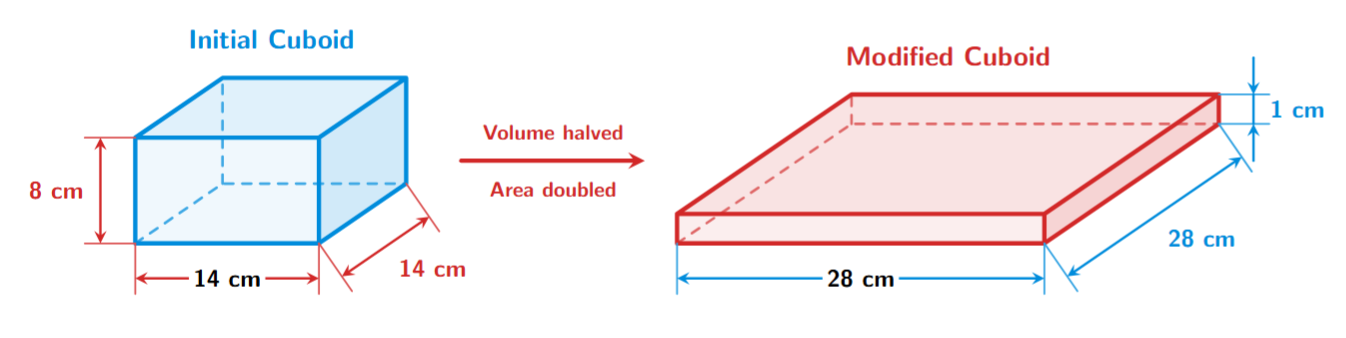
For the initial cuboid of dimensions $14\text{ cm} \times 14\text{ cm} \times 8\text{ cm}$:
$V_1 = 14 \times 14 \times 8 = 1568\text{ cm}^3$
$S_1 = 2(14 \times 14 + 14 \times 8 + 8 \times 14) = 2(196 + 112 + 112) $$ = 840\text{ cm}^2$
Changing the dimensions to $28\text{ cm} \times 28\text{ cm} \times 1\text{ cm}$ (doubling $l$ and $b$, dividing $h$ by $8$):
$V_2 = 28 \times 28 \times 1 = 784\text{ cm}^3 = \frac{1}{2}V_1$ (Volume is halved)
$S_2 = 2(28 \times 28 + 28 \times 1 + 1 \times 28) = 2(784 + 28 + 28) $$ = 1680\text{ cm}^2 = 2S_1$ (Surface area is doubled)
Therefore, a cuboid of dimensions $14\text{ cm} \times 14\text{ cm} \times 8\text{ cm}$ (changing to $28\text{ cm} \times 28\text{ cm} \times 1\text{ cm}$) has its volume halved when its surface area is doubled.
Alternate Example (Keeping Breadth Same):
If we multiply length by $4$ ($l' = 4l$), keep breadth the same ($b' = b$), and divide height by $8$ ($h' = \frac{h}{8}$), then $V_2 = \frac{1}{2}V_1$ and $S_2 = 2S_1$ gives $\frac{2}{h} = \frac{15}{8l} + \frac{3}{2b}$.
Taking $l = 15\text{ cm}, b = 12\text{ cm}, h = 8\text{ cm}$ gives $V_1 = 1440\text{ cm}^3$ and $S_1 = 792\text{ cm}^2$.
The modified cuboid $60\text{ cm} \times 12\text{ cm} \times 1\text{ cm}$ has $V_2 = 720\text{ cm}^3$ (halved) and $S_2 = 1584\text{ cm}^2$ (doubled).
Question 22. Project: Find the volume of your house making necessary approximations. Present how you solved it.
Answer:
Project Title: Estimating the Volume of My House
Method of Measurement & Necessary Approximations:
Consider a typical single-storey Indian 2 BHK house (or flat). To find its approximate interior volume, the following steps and approximations were made:
1. Approximating shapes: Every room in the house is approximated as a cuboid (rectangular prism), ignoring small pillars, door/window alcoves, and wall niches.
2. Measuring dimensions: Using a measuring tape, the length ($l$) and breadth ($b$) of each room were measured in metres.
3. Uniform ceiling height: The ceiling height ($h$) throughout the house is uniform and measured to be $3\ \text{m}$ (approximately $10\ \text{ft}$, which is standard in Indian homes).
4. Ignoring furniture & wall thickness: Furniture (beds, cupboards, kitchen counter) is ignored to calculate the total interior air space, and internal partition wall thickness is excluded in the room-by-room sum.
Observations and Calculations (Room-by-Room):
Using the formula $\text{Volume of a cuboid } (V) = l \times b \times h$ (with $h = 3\ \text{m}$):
| Section of the House | Length ($l$) | Breadth ($b$) | Height ($h$) | Floor Area ($l \times b$) | Volume ($l \times b \times h$) |
| Living Room (Hall) | $5\ \text{m}$ | $4\ \text{m}$ | $3\ \text{m}$ | $20\ \text{m}^2$ | $60\ \text{m}^3$ |
| Master Bedroom | $4\ \text{m}$ | $3.5\ \text{m}$ | $3\ \text{m}$ | $14\ \text{m}^2$ | $42\ \text{m}^3$ |
| Second Bedroom | $3.5\ \text{m}$ | $3\ \text{m}$ | $3\ \text{m}$ | $10.5\ \text{m}^2$ | $31.5\ \text{m}^3$ |
| Kitchen | $3\ \text{m}$ | $2.5\ \text{m}$ | $3\ \text{m}$ | $7.5\ \text{m}^2$ | $22.5\ \text{m}^3$ |
| Bathroom & Toilet | $2.5\ \text{m}$ | $2\ \text{m}$ | $3\ \text{m}$ | $5\ \text{m}^2$ | $15\ \text{m}^3$ |
| Passage / Verandah | $3\ \text{m}$ | $2\ \text{m}$ | $3\ \text{m}$ | $6\ \text{m}^2$ | $18\ \text{m}^3$ |
| Total | - | - | - | $63\ \text{m}^2$ | $189\ \text{m}^3$ |
Adding the volumes of all rooms:
$V_{\text{interior}} = 60 + 42 + 31.5 + 22.5 + 15 + 18 = 189\ \text{m}^3$
(Alternatively, since the height $h = 3\ \text{m}$ is constant: $V_{\text{interior}} = \text{Total Floor Area} \times h = 63 \times 3 = 189\ \text{m}^3$.)
Alternate Method (Outer Structure Volume including Walls and Roof Slab):
If we also include the volume occupied by the outer $9$-inch ($0.23\ \text{m}$) brick walls, inner partition walls, and the $0.15\ \text{m}$ thick RCC roof slab, the entire house can be approximated as one single large cuboid of outer dimensions $9\ \text{m} \times 8\ \text{m}$ (built-up area $= 72\ \text{m}^2$) and total outer height $3.15\ \text{m}$:
$V_{\text{outer}} = 9 \times 8 \times 3.15 = 226.8\ \text{m}^3$
Conclusion:
By decomposing the house into cuboidal rooms and summing their volumes, the approximate interior volume of the house is $189\ \text{m}^3$ (and including walls and the roof slab, the total outer structural volume is approximately $226.8\ \text{m}^3$).