

Chapter 9 Propositions and Their Converses (Class 9 - Latest Maths NCERT (Ganita Manjari II) Solutions)
Looking for clear and accurate NCERT Solutions for Chapter 9: Propositions and Their Converses? You’ve come to the right place! This page provides step-by-step solutions to help you understand mathematical statements, logical reasoning, and the relationship between a proposition and its converse. Learn how to identify statements, examine their truth values, and understand how the order of conditions affects the validity of a mathematical claim.
Our solutions explain how conditional statements of the form “If P, then Q” can be transformed into their converse, “If Q, then P.” Through clear explanations and worked examples, you will learn why the truth of a statement does not necessarily guarantee the truth of its converse. We break down the reasoning behind each answer to help you distinguish valid conclusions, identify counterexamples, and develop confidence in mathematical arguments.
Whether you are practising textbook exercises or strengthening your logical thinking for examinations, these resources are designed to make mathematical reasoning easier to follow. Curated by learningspot.co based on the Ganita Manjari II textbook, our solutions provide systematic explanations and step-by-step answers to help you master the chapter and prepare effectively for your Class 9 Mathematics examinations.
| Content On This Page | ||
|---|---|---|
| Exercise Set 9.1 | ||
Exercise Set 9.1
Frame the converse for each of the propositions in Questions 1–12. Then, determine if each of the two statements is true or not. Justify the true statements and give a counterexample for each false statement.
Question 1. If two lines are parallel, then the corresponding angles formed by a transversal are equal.
Answer:
Original Statement: If two lines are parallel, then the corresponding angles formed by a transversal are equal.
Truth Value: True
Justification:
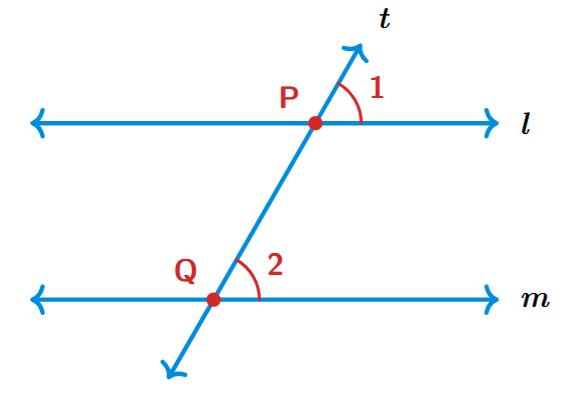
Let two parallel lines $l$ and $m$ be cut by a transversal $t$.
Let $\angle 1$ and $\angle 2$ be a pair of corresponding angles.
By the Corresponding Angles Axiom, corresponding angles formed by parallel lines are equal.
Thus, $\angle 1 = \angle 2$. Hence, the statement is true.
Converse: If the corresponding angles formed by a transversal with two lines are equal, then the two lines are parallel.
Truth Value: True
Justification:
Let a transversal $t$ cut two lines $l$ and $m$ at points $P$ and $Q$ such that $\angle 1 = \angle 2$.
By the Converse of the Corresponding Angles Axiom, the two lines are parallel.
Question 2. If a quadrilateral is a square, then all its angles are equal.
Answer:
Original Statement: If a quadrilateral is a square, then all its angles are equal.
Truth Value: True
Justification:
In a square, all four sides are equal and every interior angle is a right angle ($90^\circ$).
Since each angle measures $90^\circ$, all its angles are equal.
Converse: If all the angles of a quadrilateral are equal, then it is a square.
Truth Value: False
Counterexample:
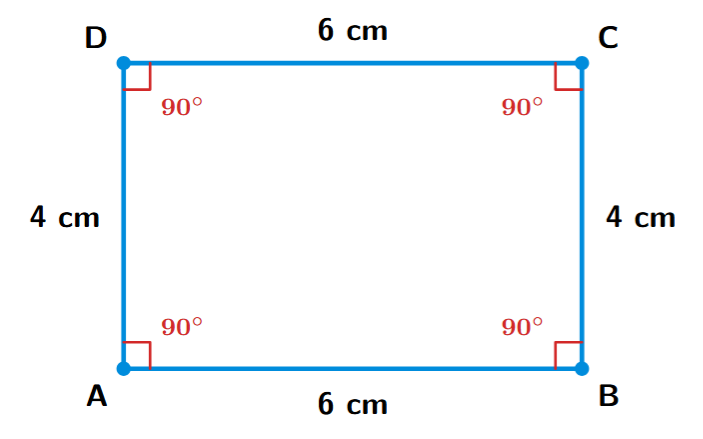
Consider a rectangle $ABCD$ with $AB = CD = 6\text{ cm}$ and $BC = DA = 4\text{ cm}$.
In this rectangle, $\angle A = \angle B = \angle C = \angle D = 90^\circ$, so all its angles are equal.
However, its adjacent sides are unequal ($6\text{ cm} \neq 4\text{ cm}$).
Hence, $ABCD$ is not a square, so the converse is false.
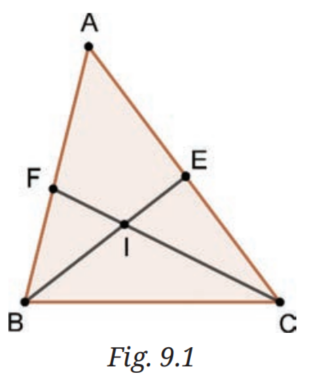
Question 3. Given any $\triangle ABC$, let us bisect the angles at $B$ and $C$. The bisectors meet at the incentre $I$ of the triangle.
Now extend the bisectors beyond $I$ till they meet the opposite sides at $E$ and $F$ respectively, as shown.
Proposition: If $AB = AC$, then $IE = IF$.
Answer:
Original Proposition: In $\triangle ABC$, if $AB = AC$, then $IE = IF$.
Truth Value: True
Given:
In $\triangle ABC$, $AB = AC$. The bisectors of $\angle ABC$ and $\angle ACB$ meet at the incentre $I$, and when extended beyond $I$, they meet sides $AC$ and $AB$ at $E$ and $F$ respectively.
To Prove:
$IE = IF$
Proof:
In $\triangle ABC$:
$AB = AC$
(Given)
$\angle ABC = \angle ACB$
[Angles opposite to equal sides are equal]
Dividing both sides by $2$, we get $\frac{1}{2}\angle ABC = \frac{1}{2}\angle ACB$.
Since $BE$ bisects $\angle ABC$ and $CF$ bisects $\angle ACB$, we have $\angle IBF = \angle IBC = \frac{1}{2}\angle ABC$ and $\angle ICE = \angle ICB = \frac{1}{2}\angle ACB$. Therefore:
$\angle IBF = \angle ICE$ and $\angle IBC = \angle ICB$
... (i)
Now, in $\triangle IBC$, since $\angle IBC = \angle ICB$:
$IB = IC$
[Sides opposite to equal angles are equal] ... (ii)
In $\triangle IBF$ and $\triangle ICE$:
$\angle IBF = \angle ICE$
[From (i)]
$IB = IC$
[From (ii)]
$\angle BIF = \angle CIE$
[Vertically opposite angles]
Therefore, $\triangle IBF \cong \triangle CIE$ by the ASA congruence rule.
$IF = IE$
[By CPCT]
Hence, $IE = IF$. Proved.
Converse Proposition: In $\triangle ABC$, if $IE = IF$, then $AB = AC$.
Truth Value: False
Counterexample:
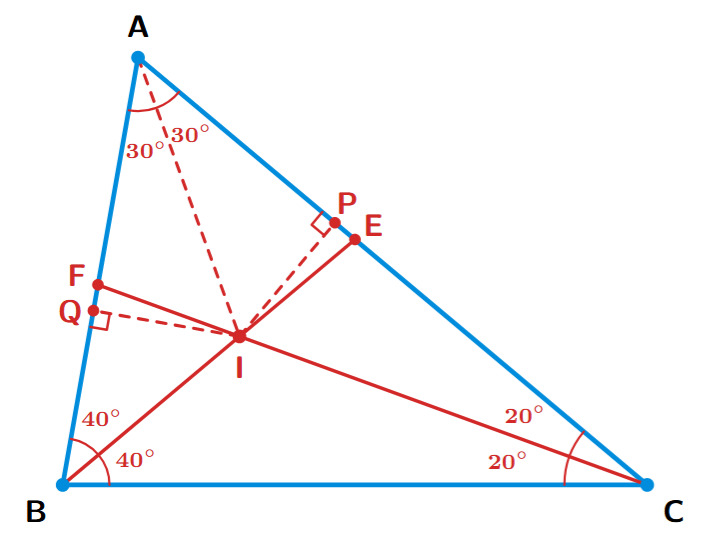
Consider a scalene $\triangle ABC$ with $\angle A = 60^\circ$, $\angle B = 80^\circ$, and $\angle C = 40^\circ$ ($\angle A + \angle B + \angle C = 180^\circ$).
Construction Required:
Join $AI$, and from $I$ draw perpendiculars $IP \perp AC$ and $IQ \perp AB$ meeting $AC$ at $P$ and $AB$ at $Q$ respectively.
Justification:
Since $I$ is the incentre of $\triangle ABC$, the line $AI$ bisects $\angle A = 60^\circ$, so $\angle IAB = \angle IAC = 30^\circ$.
Also, $BE$ bisects $\angle B = 80^\circ$ and $CF$ bisects $\angle C = 40^\circ$, giving:
$\angle ABE = \angle CBE = 40^\circ$ and $\angle ACF = \angle BCF = 20^\circ$.
In $\triangle AIB$, both $\angle IAB = 30^\circ$ and $\angle IBA = 40^\circ$ are acute, so the foot of the perpendicular $Q$ lies strictly on segment $AB$. Similarly, in $\triangle AIC$, both $\angle IAC = 30^\circ$ and $\angle ICA = 20^\circ$ are acute, so $P$ lies strictly on segment $AC$. Thus, $\angle IAQ = \angle IAP = 30^\circ$.
Now, in $\triangle IAP$ and $\triangle IAQ$:
$\angle IPA = \angle IQA = 90^\circ$
[By construction]
$\angle IAP = \angle IAQ = 30^\circ$
[$AI$ bisects $\angle A$]
$IA = IA$
[Common side]
Thus, $\triangle IAP \cong \triangle IAQ$ by the AAS congruence rule.
$IP = IQ$
[By CPCT] ... (iii)
Next, in $\triangle ABE$, by the angle sum property:
$\angle AEB = 180^\circ - (\angle BAE + \angle ABE) = 180^\circ - (60^\circ + 40^\circ) = 80^\circ$
In $\triangle AIE$, both $\angle IAE = 30^\circ$ and $\angle IEA = 80^\circ$ are acute, so $P$ lies strictly between $A$ and $E$ on $AC$. Hence:
$\angle IEP = \angle AEB = 80^\circ$
... (iv)
Similarly, in $\triangle BCF$, by the angle sum property:
$\angle BFC = 180^\circ - (\angle CBF + \angle BCF) = 180^\circ - (80^\circ + 20^\circ) = 80^\circ$
In $\triangle BIF$, both $\angle IBF = 40^\circ$ and $\angle IFB = 80^\circ$ are acute, so $Q$ lies strictly between $B$ and $F$ on $AB$. Hence:
$\angle IFQ = \angle BFC = 80^\circ$
... (v)
Now, in $\triangle IPE$ and $\triangle IQF$:
$\angle IPE = \angle IQF = 90^\circ$
[By construction]
$\angle IEP = \angle IFQ = 80^\circ$
[From (iv) and (v)]
$IP = IQ$
[From (iii)]
Thus, $\triangle IPE \cong \triangle IQF$ by the AAS congruence rule.
$IE = IF$
[By CPCT]
However, since $\angle B = 80^\circ \neq 40^\circ = \angle C$, the sides opposite to them are unequal, so $AB \neq AC$ (in fact, $AC > AB$).
Therefore, $IE = IF$ does not imply $AB = AC$, which proves that the converse proposition is False.
Question 4. If $x = y$, then $a + x = a + y$, where $x$, $y$ and $a$ are any three numbers.
This proposition and its converse are routinely used while solving equations.
Answer:
Original Statement: If $x = y$, then $a + x = a + y$, where $x$, $y$ and $a$ are any three numbers.
Truth Value: True
Justification:
Given that $x = y$.
Adding the same number $a$ to equal quantities gives equal sums, so $a + x = a + y$.
This follows from Euclid's Second Axiom (if equals are added to equals, the wholes are equal).
Converse: If $a + x = a + y$, then $x = y$, where $x$, $y$ and $a$ are any three numbers.
Truth Value: True
Justification:
Given that $a + x = a + y$.
Subtracting $a$ from both sides gives $(a + x) - a = (a + y) - a$, which simplifies to $x = y$.
This follows from Euclid's Third Axiom (if equals are subtracted from equals, the remainders are equal).
Question 5. If $a$ and $b$ are perfect squares, then $ab$ is a perfect square.
Answer:
Original Statement: If $a$ and $b$ are perfect squares, then $ab$ is a perfect square.
Truth Value: True
Justification:
Since $a$ and $b$ are perfect squares, let $a = m^2$ and $b = n^2$ for some integers $m$ and $n$.
Multiplying them gives $ab = m^2 \times n^2 = (mn)^2$.
Since $mn$ is also an integer, $(mn)^2$ is a perfect square.
Hence, $ab$ is a perfect square.
Converse: If $ab$ is a perfect square, then $a$ and $b$ are perfect squares.
Truth Value: False
Counterexample:
Let $a = 2$ and $b = 8$.
Then $ab = 2 \times 8 = 16 = 4^2$, which is a perfect square.
However, neither $2$ nor $8$ is a perfect square. Hence, the converse is false.
In Questions 6 and 7, $x$ and $y$ are real numbers.
Question 6. If $x = y$, then $x^2 = y^2$.
Answer:
Original Statement: If $x = y$, then $x^2 = y^2$.
Truth Value: True
Justification:
Given that $x = y$.
Squaring both sides gives $x \times x = y \times y$, so $x^2 = y^2$.
Hence, the original statement is true.
Converse: If $x^2 = y^2$, then $x = y$.
Truth Value: False
Counterexample:
Let $x = 2$ and $y = -2$.
Here, $x^2 = 2^2 = 4$ and $y^2 = (-2)^2 = 4$, so $x^2 = y^2$.
However, $x \neq y$ since $2 \neq -2$. Hence, the converse is false.
Question 7. If $x = y$, then $x^3 = y^3$.
Answer:
Original Statement: If $x = y$, then $x^3 = y^3$.
Truth Value: True
Justification:
Given that $x = y$.
Cubing both sides gives $x \times x \times x = y \times y \times y$, so $x^3 = y^3$.
Hence, the original statement is true.
Converse: If $x^3 = y^3$, then $x = y$.
Truth Value: True
Justification:
Given that $x^3 = y^3$, which can be written as $x^3 - y^3 = 0$.
Using the algebraic identity $x^3 - y^3 = (x - y)(x^2 + xy + y^2)$, we get:
$(x - y)(x^2 + xy + y^2) = 0$
Thus, either $x - y = 0$ or $x^2 + xy + y^2 = 0$.
If $x^2 + xy + y^2 = 0$, multiplying by $2$ gives $(x + y)^2 + x^2 + y^2 = 0$.
Since the square of a real number is always non-negative, this holds only when $x = 0$ and $y = 0$.
In both cases, $x = y$. Hence, the converse is true.
In Questions 8–12, $n$ is a positive integer.
Question 8. If $n$ is divisible by 24, then it is divisible by both 4 and 6.
Answer:
Original Statement: If $n$ is divisible by $24$, then it is divisible by both $4$ and $6$.
Truth Value: True
Justification:
Since $n$ is divisible by $24$, let $n = 24k$ for some positive integer $k$.
We can write $n = 4 \times (6k)$, so $n$ is divisible by $4$.
We can also write $n = 6 \times (4k)$, so $n$ is divisible by $6$.
Hence, $n$ is divisible by both $4$ and $6$.
Converse: If $n$ is divisible by both $4$ and $6$, then it is divisible by $24$.
Truth Value: False
Counterexample:
Let $n = 12$.
$12$ is divisible by both $4$ and $6$ (since $12 = 4 \times 3$ and $12 = 6 \times 2$).
However, $12$ is not divisible by $24$. Hence, the converse is false.
Question 9. If $n$ is divisible by 60, then it is divisible by both 5 and 12.
Answer:
Original Statement: If $n$ is divisible by $60$, then it is divisible by both $5$ and $12$.
Truth Value: True
Justification:
Since $n$ is divisible by $60$, let $n = 60k$ for some positive integer $k$.
We can write $n = 5 \times (12k)$, so $n$ is divisible by $5$.
We can also write $n = 12 \times (5k)$, so $n$ is divisible by $12$.
Hence, $n$ is divisible by both $5$ and $12$.
Converse: If $n$ is divisible by both $5$ and $12$, then it is divisible by $60$.
Truth Value: True
Justification:
Since $n$ is divisible by both $5$ and $12$, $n$ is a common multiple of $5$ and $12$.
The numbers $5$ and $12$ are coprime ($\text{HCF}(5, 12) = 1$), so their LCM is $5 \times 12 = 60$.
Every common multiple of two numbers is divisible by their LCM.
Therefore, $n$ is divisible by $60$. Hence, the converse is true.
Question 10. If $n$ is the square of a prime number, then it has exactly 3 factors.
Answer:
Original Statement: If $n$ is the square of a prime number, then it has exactly $3$ factors.
Truth Value: True
Justification:
Let $n = p^2$, where $p$ is a prime number.
Since $p$ is prime, its only factors are $1$ and $p$.
Therefore, the only factors of $p^2$ are $1$, $p$, and $p^2$.
Since $p > 1$, these three factors are distinct. Hence, $n$ has exactly $3$ factors.
Converse: If $n$ has exactly $3$ factors, then $n$ is the square of a prime number.
Truth Value: True
Justification:
Let $n$ be a positive integer with exactly $3$ factors.
Clearly $n > 1$, because $1$ has only $1$ factor.
Thus, $1$ and $n$ are two distinct factors of $n$. Let the third factor be $d$, where $1 < d < n$.
Since $d$ divides $n$, we can write $n = d \times q$ for some integer $q$ with $1 < q < n$.
This means $q$ is also a factor of $n$.
Since $n$ has only three factors ($1$, $d$, and $n$), we must have $q = d$, so $n = d^2$.
Moreover, $d$ must be prime; otherwise $d$ would have a factor $k$ ($1 < k < d$), giving $n$ a fourth factor.
Therefore, $n$ is the square of a prime number. Hence, the converse is true.
Question 11. If $n$ is a product of two unequal prime numbers, then it has exactly 4 divisors.
Answer:
Original Statement: If $n$ is a product of two unequal prime numbers, then it has exactly $4$ divisors.
Truth Value: True
Justification:
Let $n = p \times q$, where $p$ and $q$ are two unequal prime numbers ($p \neq q$).
Since $p$ and $q$ are prime, the only positive divisors of $n$ are $1$, $p$, $q$, and $pq$.
Because $p \neq q$ and $p, q > 1$, all four divisors are distinct.
Hence, $n$ has exactly $4$ divisors.
Converse: If $n$ has exactly $4$ divisors, then $n$ is a product of two unequal prime numbers.
Truth Value: False
Counterexample:
Let $n = 8$.
The divisors of $8$ are $1$, $2$, $4$, and $8$, so it has exactly $4$ divisors.
However, $8 = 2^3$ is not a product of two unequal prime numbers. Hence, the converse is false.
Question 12. If $n$ and $n + 3$ have no factors in common, then $n$ is not a multiple of 3.
Answer:
Original Statement: If $n$ and $n + 3$ have no factors in common, then $n$ is not a multiple of $3$.
Truth Value: True
Justification:
Note that "no factors in common" means no common factor greater than $1$.
Suppose $n$ were a multiple of $3$, so $n = 3k$ for some positive integer $k$.
Then $n + 3 = 3k + 3 = 3(k + 1)$, which is also a multiple of $3$.
Thus, $n$ and $n + 3$ would have $3$ as a common factor, contradicting the given condition.
Therefore, $n$ cannot be a multiple of $3$. Hence, the original statement is true.
Converse: If $n$ is not a multiple of $3$, then $n$ and $n + 3$ have no factors in common.
Truth Value: True
Justification:
Suppose $n$ is not a multiple of $3$.
Let $d$ be any positive common factor of $n$ and $n + 3$.
Then $d$ must divide their difference, which is $(n + 3) - n = 3$.
The only positive factors of $3$ are $1$ and $3$, so $d$ can only be $1$ or $3$.
Since $n$ is not a multiple of $3$, $d$ cannot be $3$, so $d = 1$.
Thus, $n$ and $n + 3$ have no common factors other than $1$. Hence, the converse is true.
Question 13. There are no known ‘neat’ expressions that generate only primes! Find counterexamples to the following claims.
(i) All numbers of the form $4n^2 + 1$ are prime.
(ii) All numbers of the form $n^2 + n + 11$ are prime.
(iii) All numbers of the form $4^n + 3$ are prime.
Answer:
(i) Claim: All numbers of the form $4n^2 + 1$ are prime.
Counterexample: Let $n = 4$.
Substituting $n = 4$, we get $4(4)^2 + 1 = 4(16) + 1 = 64 + 1 = 65$.
Since $65 = 5 \times 13$, $65$ is a composite number (not prime).
(ii) Claim: All numbers of the form $n^2 + n + 11$ are prime.
Counterexample: Let $n = 10$.
Substituting $n = 10$, we get $10^2 + 10 + 11 = 100 + 10 + 11 = 121$.
Since $121 = 11 \times 11$, $121$ is a composite number (not prime).
(iii) Claim: All numbers of the form $4^n + 3$ are prime.
Counterexample: Let $n = 4$.
Substituting $n = 4$, we get $4^4 + 3 = 256 + 3 = 259$.
Since $259 = 7 \times 37$, $259$ is a composite number (not prime).
Question 14. Find counterexamples to the following statements.
(i) If $n$ is a prime number, then $2^n - 1$ is a prime number.
(ii) If $n$ is an even number, then $2^n + 1$ is a prime number.
Answer:
(i) Statement: If $n$ is a prime number, then $2^n - 1$ is a prime number.
Counterexample: Let $n = 11$ (which is a prime number).
Substituting $n = 11$, we get $2^{11} - 1 = 2048 - 1 = 2047$.
Since $2047 = 23 \times 89$, $2047$ is a composite number (not prime).
(ii) Statement: If $n$ is an even number, then $2^n + 1$ is a prime number.
Counterexample: Let $n = 6$ (which is an even number).
Substituting $n = 6$, we get $2^6 + 1 = 64 + 1 = 65$.
Since $65 = 5 \times 13$, $65$ is a composite number (not prime).
Question 15. Consider the statement: ‘If a number is divisible by 8, then it is divisible by both 2 and 4’.
(i) Justify the statement.
(ii) Recall the divisibility shortcuts that we have studied for different numbers. To check whether a given number is divisible by 8, is it enough to check whether it is divisible by 2 and 4? Why or why not?
Answer:
(i) Justification:
Let $n$ be an integer divisible by $8$.
Then we can write $n = 8k$ for some integer $k$.
Rewriting this, we get $n = 2 \times (4k)$, so $n$ is divisible by $2$.
Similarly, $n = 4 \times (2k)$, so $n$ is divisible by $4$.
Hence, if a number is divisible by $8$, it is divisible by both $2$ and $4$.
(ii) Answer: No, it is not enough to check whether a number is divisible by $2$ and $4$.
Reason:
Checking divisibility by $2$ and $4$ relies on the converse: ‘If a number is divisible by both $2$ and $4$, then it is divisible by $8$’.
This converse is false because $2$ and $4$ are not coprime ($\text{LCM}(2, 4) = 4$, not $8$).
Every multiple of $4$ is divisible by both $2$ and $4$, even when it is not divisible by $8$.
Counterexample: Consider $n = 12$. It is divisible by both $2$ and $4$, but $12$ is not divisible by $8$.
Question 16. Recall that a shortcut to check whether a given number is divisible by 3 is to add the digits of the number and check if the sum is a multiple of 3. Express the relationship between ‘a number is divisible by 3’ and ‘sum of the digits is a multiple of 3’ using ‘If-then’ sentences.
Answer:
Because the divisibility test for $3$ works in both directions, the relationship can be expressed using two ‘If-then’ sentences (a statement and its converse):
1. If a number is divisible by $3$, then the sum of its digits is a multiple of $3$.
2. If the sum of the digits of a number is a multiple of $3$, then the number is divisible by $3$.
Both statements are true. Together, they show that a number is divisible by $3$ if and only if the sum of its digits is a multiple of $3$.
Question 17. We have identified different types of quadrilaterals — squares, rectangles, parallelograms, rhombi, kites and trapezia. One can identify more types (e.g., we could create a category of quadrilaterals that have equal-length opposite sides).
Suppose we have identified a category of quadrilaterals called $Q$, and we have to construct a quadrilateral of this type. For this, we are to use two thin sticks, put them together as diagonals so that the quadrilateral obtained by joining their endpoints is of type $Q$ (see Fig. 9.2).
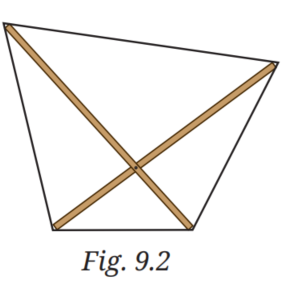
(i) Suppose $Q$ satisfies the following property.
If a quadrilateral is of type $Q$, then it has equal-length diagonals.
(a) Should the two sticks be of equal length? Why or why not?
(b) Will it matter how the two sticks are put together?
(ii) Instead of the property mentioned above, suppose $Q$ satisfies the following property.
If a quadrilateral has equal diagonals, then it is of type $Q$.
What will be your answers to (a) and (b) now?
Answer:
(i) Property: If a quadrilateral is of type $Q$, then it has equal-length diagonals.
(a) Answer: Yes, the two sticks must be of equal length.
Reason: Every quadrilateral of type $Q$ has equal-length diagonals. If the two sticks are unequal in length, the resulting quadrilateral can never be of type $Q$.
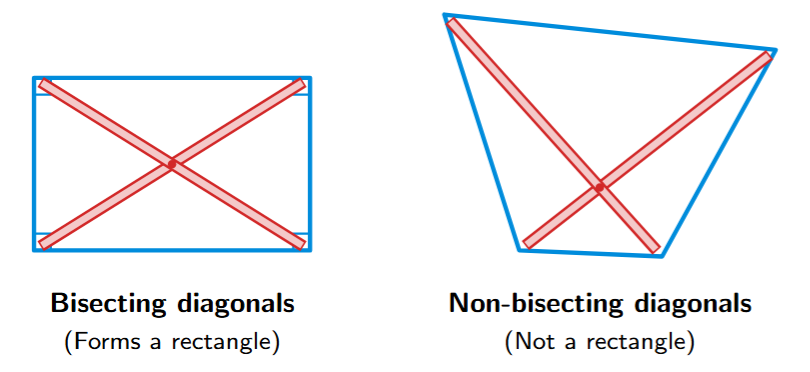
(b) Answer: Yes, it will matter how the two sticks are put together.
Reason: The given property does not state the converse. Having equal diagonals alone does not guarantee that the quadrilateral is of type $Q$.
For example, $Q$ could be the category of rectangles. Even with two equal sticks, placing them without bisecting each other will not form a rectangle.
(ii) Property: If a quadrilateral has equal diagonals, then it is of type $Q$.
(a) Answer: To guarantee that the quadrilateral is of type $Q$, we should take two sticks of equal length.
Reason: By the given property, equal sticks ensure that the quadrilateral has equal diagonals and is therefore of type $Q$.
However, unequal sticks are not strictly ruled out, because the property does not say whether quadrilaterals with unequal diagonals can belong to $Q$. Still, unequal sticks will not guarantee a quadrilateral of type $Q$.
(b) Answer: No, once two sticks of equal length are placed intersecting each other as diagonals, it will not matter how they are put together.
Reason: Regardless of the angle or point of intersection of the two sticks, the resulting quadrilateral will have equal diagonals. By the given property, it is guaranteed to be of type $Q$.