

Chapter 9 Some Applications Of Trigonometry (Class 10 - Maths Old NCERT Textbook Solutions)
Welcome to Chapter 9: Some Applications of Trigonometry! This chapter serves as a practical bridge between abstract trigonometric identities and real-world measurements, demonstrating how to calculate inaccessible heights and distances. Mastering the application of trigonometric ratios is a vital milestone in a student's mathematical journey, as it provides the essential numerical framework for fields like surveying, navigation, and engineering, and the sophisticated reasoning required in higher mathematical and scientific studies.
The chapter mainly focuses on visualizing physical scenarios through right-angled triangles and understanding key concepts such as the line of sight, angle of elevation, and angle of depression. Students will explore how the horizontal level and parallel lines help determine that the angle of elevation from one point is equal to the angle of depression from another. Crucially, the solutions provide systematic methods for selecting the most appropriate ratio—sine, cosine, or tangent—to link known angles with unknown dimensions in a geometric model.
Practical applications are highlighted through a diverse range of problems, including finding the height of towers, trees, and buildings, as well as calculating the width of rivers and distances between objects. Students will learn to leverage labeled diagrams to solve complex multi-triangle scenarios, such as determining the height of a cloud or a flagpole from multiple observation points. To support effective learning, this page provides clear step-by-step solutions, logical explanations, and practical examples for every exercise, reinforcing both theoretical structure and computational fluency. With well-structured content prepared by learningspot.co, students can confidently master the applications of trigonometry and build a solid foundation for future mathematical excellence.
| Content On This Page | ||
|---|---|---|
| Example 1 to 7 (Before Exercise 9.1) | Exercise 9.1 | |
Example 1 to 7 (Before Exercise 9.1)
Example 1. A tower stands vertically on the ground. From a point on the ground, which is 15 m away from the foot of the tower, the angle of elevation of the top of the tower is found to be 60°. Find the height of the tower.
Answer:
Given
The distance from the point on the ground to the foot of the tower is 15 m.
The angle of elevation of the top of the tower from that point is 60°.
To Find
The height of the tower.
Solution
Let's represent the situation with a right-angled triangle ABC.
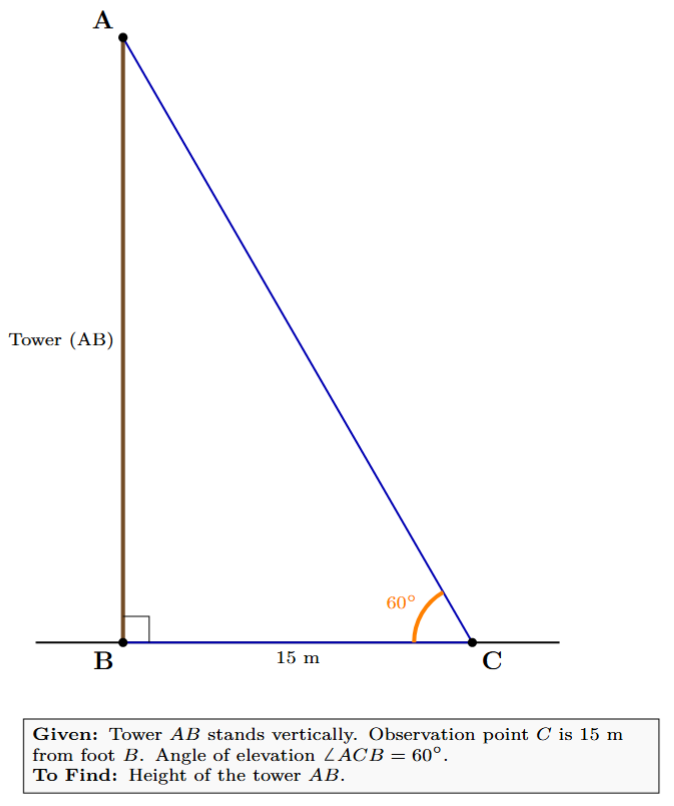
Let AB be the height of the tower, which we need to find. Let this be 'h' meters.
Let C be the point on the ground from where the tower is observed.
The distance from the foot of the tower (B) to the point of observation (C) is BC = 15 m.
The angle of elevation, $\angle ACB = 60^\circ$.
The tower stands vertically, so the triangle ABC is right-angled at B.
In the right-angled $\triangle ABC$, with respect to the angle C:
AB is the side opposite to the angle (Perpendicular).
BC is the side adjacent to the angle (Base).
We need to find the opposite side (h) and we are given the adjacent side (15 m). The trigonometric ratio that relates the opposite side and the adjacent side is the tangent (tan).
So, we have:
$\tan(\angle ACB) = \frac{\text{Opposite Side}}{\text{Adjacent Side}} = \frac{AB}{BC}$
Substituting the given values into the equation:
$\tan 60^\circ = \frac{h}{15}$
We know that the value of $\tan 60^\circ = \sqrt{3}$.
So, the equation becomes:
$\sqrt{3} = \frac{h}{15}$
To find 'h', we multiply both sides by 15:
$h = 15 \times \sqrt{3}$
$h = 15\sqrt{3}$ m
Hence, the height of the tower is $15\sqrt{3}$ m.
Example 2. An electrician has to repair an electric fault on a pole of height 5 m. She needs to reach a point 1.3m below the top of the pole to undertake the repair work (see Fig. 9.5). What should be the length of the ladder that she should use which, when inclined at an angle of 60° to the horizontal, would enable her to reach the required position? Also, how far from the foot of the pole should she place the foot of the ladder? (You may take $\sqrt{3}$ = 1.73)

Answer:
Given
Total height of the electric pole, AD = 5 m.
The repair point B is 1.3 m below the top of the pole, so AB = 1.3 m.
The angle of inclination of the ladder with the horizontal, $\angle BCD = 60^\circ$.
The value to be used for the square root of 3 is $\sqrt{3} = 1.73$.
To Find
1. The length of the ladder (BC).
2. The distance of the foot of the ladder from the foot of the pole (DC).
Solution
First, we need to determine the height from the ground to the point where the repair is needed. Let this height be BD.
Height BD = Total height of the pole (AD) - Distance from the top (AB)
$BD = 5 \text{ m} - 1.3 \text{ m} = 3.7 \text{ m}$
Now, we have a right-angled triangle BDC, where $\angle D = 90^\circ$.
1. Finding the length of the ladder (BC):
In the right-angled $\triangle BDC$, we know the side opposite to the angle $\angle C$ (which is BD) and we need to find the hypotenuse (BC).
We use the sine trigonometric ratio:
$\sin C = \frac{\text{Opposite Side}}{\text{Hypotenuse}} = \frac{BD}{BC}$
Substituting the known values:
$\sin 60^\circ = \frac{3.7}{BC}$
We know that $\sin 60^\circ = \frac{\sqrt{3}}{2}$.
$\frac{\sqrt{3}}{2} = \frac{3.7}{BC}$
Solving for BC:
$BC = \frac{3.7 \times 2}{\sqrt{3}} = \frac{7.4}{\sqrt{3}}$
Using the given value $\sqrt{3} = 1.73$:
$BC = \frac{7.4}{1.73} \approx 4.277$ m
Rounding to two decimal places, the length of the ladder is 4.28 m.
2. Finding the distance from the foot of the pole (DC):
In the same right-angled $\triangle BDC$, we need to find the side adjacent to $\angle C$ (which is DC).
We use the tangent trigonometric ratio:
$\tan C = \frac{\text{Opposite Side}}{\text{Adjacent Side}} = \frac{BD}{DC}$
Substituting the known values:
$\tan 60^\circ = \frac{3.7}{DC}$
We know that $\tan 60^\circ = \sqrt{3}$.
$\sqrt{3} = \frac{3.7}{DC}$
Solving for DC:
$DC = \frac{3.7}{\sqrt{3}}$
Using the given value $\sqrt{3} = 1.73$:
$DC = \frac{3.7}{1.73} \approx 2.138$ m
Rounding to two decimal places, the distance is 2.14 m.
Therefore, the length of the ladder should be 4.28 m, and she should place the foot of the ladder 2.14 m away from the foot of the pole.
Example 3. An observer 1.5 m tall is 28.5 m away from a chimney. The angle of elevation of the top of the chimney from her eyes is 45°. What is the height of the chimney?
Answer:
Given
Height of the observer, $CD = 1.5$ m.
Distance between the observer and the chimney, $DB = 28.5$ m.
Angle of elevation, $\angle ACE = 45^\circ$.
To Find
Height of the chimney, $AB$.
Construction
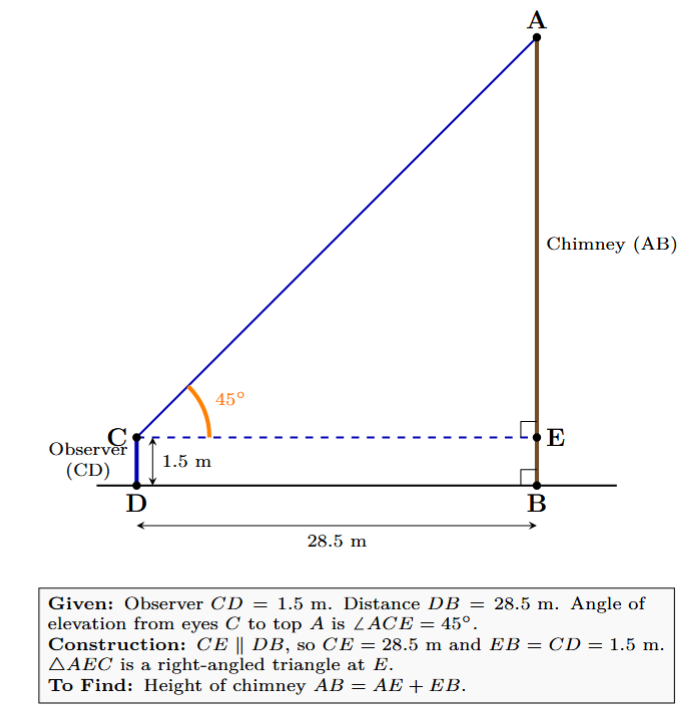
Draw $CE$ horizontally from the observer's eyes $C$ to meet the chimney $AB$ at $E$, such that $CE \parallel DB$.
Since $CE$ is horizontal and $AB$ is vertical, $\angle AEC = 90^\circ$.
Also, $CE = DB = 28.5$ m and $EB = CD = 1.5$ m.
Solution
The total height of the chimney is
$AB = AE + EB$
In right-angled $\triangle AEC$,
$\tan \angle ACE = \frac{AE}{CE}$
Substituting $\angle ACE = 45^\circ$ and $CE = 28.5$ m,
$\tan 45^\circ = \frac{AE}{28.5}$
Since $\tan 45^\circ = 1$,
$1 = \frac{AE}{28.5}$
Therefore,
$AE = 28.5$ m
Now, the height of the chimney is
$AB = AE + EB$
$AB = 28.5 + 1.5$
$AB = 30$ m
Hence, the height of the chimney is $30$ metres.
Example 4. From a point P on the ground the angle of elevation of the top of a 10 m tall building is 30°. A flag is hoisted at the top of the building and the angle of elevation of the top of the flagstaff from P is 45°. Find the length of the flagstaff and the distance of the building from the point P. (You may take $\sqrt{3}$ = 1.732)
Answer:
Given
Height of the building, $AB = 10$ m.
Angle of elevation of the top of the building, $\angle APB = 30^\circ$.
Angle of elevation of the top of the flagstaff, $\angle CPB = 45^\circ$.
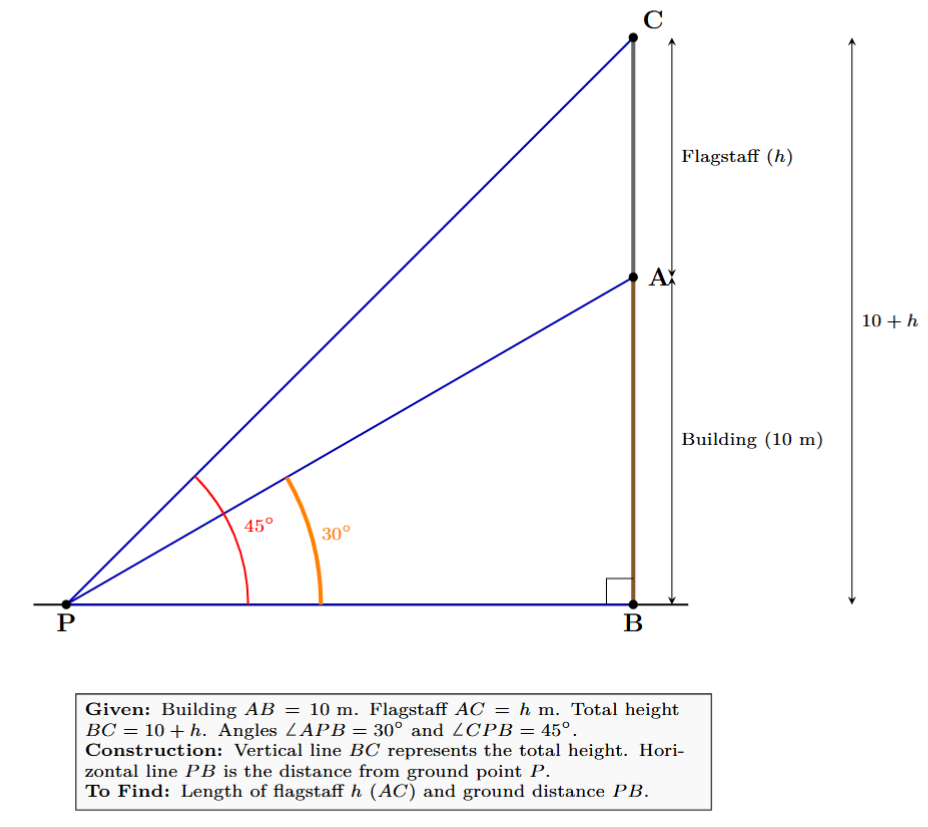
Let the length of the flagstaff, $AC = h$ m.
The total height, $BC = 10 + h$ m.
To Find
(i) Length of the flagstaff, $AC = h$.
(ii) Distance of the building from point $P$, $PB$.
Construction
Let $AB$ represent the building and $AC$ represent the flagstaff erected on top of it. Join $P$ to $A$ and $C$. Since the building is vertical and the ground is horizontal, $\angle PBA = 90^\circ$.
Solution
(i) Distance of the building from point P
In right-angled $\triangle PAB$,
$\tan 30^\circ = \frac{AB}{PB}$
Substituting $AB = 10$ m and $\tan 30^\circ = \frac{1}{\sqrt{3}}$,
$\frac{1}{\sqrt{3}} = \frac{10}{PB}$
Therefore,
$PB = 10\sqrt{3}$ m
Taking $\sqrt{3} = 1.732$,
$PB = 10 \times 1.732 = 17.32$ m
Hence, the distance of the building from point $P$ is $17.32$ m.
(ii) Length of the flagstaff
In right-angled $\triangle PBC$, the total height of the building and flagstaff is $BC = AB + AC = 10 + h$.
Using the tangent ratio,
$\tan 45^\circ = \frac{BC}{PB}$
Since $\tan 45^\circ = 1$ and $PB = 10\sqrt{3}$ m,
$1 = \frac{10+h}{10\sqrt{3}}$
Therefore,
$10+h = 10\sqrt{3}$
$h = 10\sqrt{3}-10$
$h = 10(\sqrt{3}-1)$ m
Taking $\sqrt{3} = 1.732$,
$h = 10(1.732-1)$
$h = 10 \times 0.732 = 7.32$ m
Hence, the length of the flagstaff is $7.32$ m.
Final Answers
(i) Distance of the building from point $P = 10\sqrt{3}$ m $\approx 17.32$ m.
(ii) Length of the flagstaff $= 10(\sqrt{3}-1)$ m $\approx 7.32$ m.
Example 5. The shadow of a tower standing on a level ground is found to be 40 m longer when the Sun’s altitude is 30° than when it is 60°. Find the height of the tower.
Answer:
Given
Let the height of the tower $AB = h$ m.
Angle of elevation when the shadow is shorter, $\angle ACB = 60^\circ$.
Angle of elevation when the shadow is longer, $\angle ADB = 30^\circ$.
The difference between the lengths of the two shadows, $CD = 40$ m.
To Find
The height of the tower, $h$.
Construction
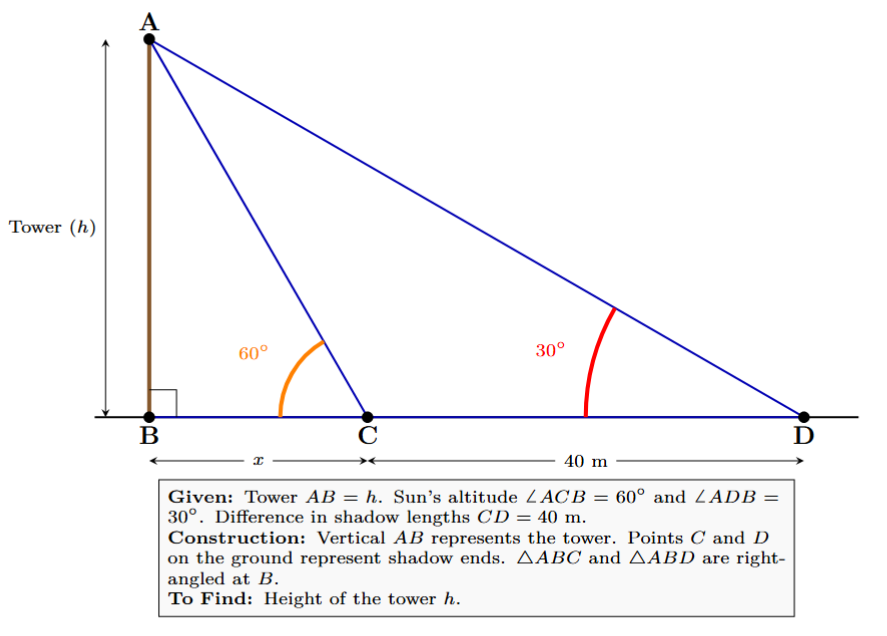
Let $AB$ be the vertical tower, with $B$ as its base. Let $C$ and $D$ be the endpoints of the shadows when the Sun's altitude is $60^\circ$ and $30^\circ$, respectively. Join $A$ to $C$ and $A$ to $D$.
Since the tower is vertical and the ground is horizontal, $\angle ABC = \angle ABD = 90^\circ$.
Solution
Let the length of the shorter shadow be $BC = x$ m.
Since $CD = 40$ m, the length of the longer shadow is
$BD = BC + CD = x + 40$ m
In right-angled $\triangle ABC$:
Using the tangent ratio,
$\tan 60^\circ = \frac{AB}{BC}$
$\sqrt{3} = \frac{h}{x}$
Therefore,
$h = x\sqrt{3}$
In right-angled $\triangle ABD$:
Using the tangent ratio,
$\tan 30^\circ = \frac{AB}{BD}$
$\frac{1}{\sqrt{3}} = \frac{h}{x+40}$
Therefore,
$x+40 = h\sqrt{3}$
Substituting $h = x\sqrt{3}$,
$x+40 = x\sqrt{3}\times\sqrt{3}$
$x+40 = 3x$
$40 = 2x$
$x = 20$ m
Now, the height of the tower is
$h = x\sqrt{3}$
$h = 20\sqrt{3}$ m
Taking $\sqrt{3} \approx 1.732$,
$h \approx 20 \times 1.732 = 34.64$ m
Final Answer
Hence, the height of the tower is $20\sqrt{3}$ m, or approximately $34.64$ m.
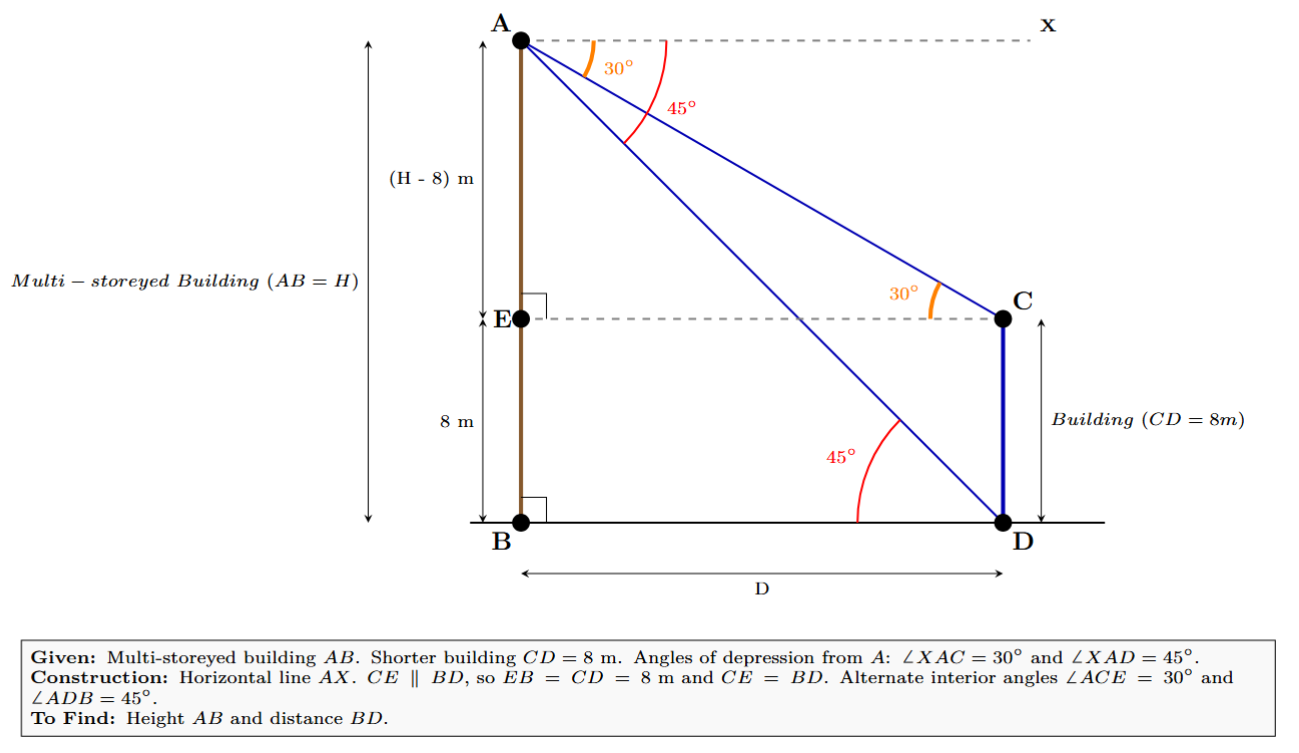
Example 6. The angles of depression of the top and the bottom of an 8 m tall building from the top of a multi-storeyed building are 30° and 45°, respectively. Find the height of the multi-storeyed building and the distance between the two buildings.
Answer:
Given
Height of the shorter building, $CD = 8$ m.
Angle of depression from $A$ to the top of the shorter building, $\angle XAC = 30^\circ$.
Angle of depression from $A$ to the bottom of the shorter building, $\angle XAD = 45^\circ$.
To Find
1. The height of the multi-storeyed building, $AB$.
2. The distance between the two buildings, $BD$.
Construction
Draw a horizontal line $AX$ through the top $A$ of the multi-storeyed building. Through $C$, draw a horizontal line $CE$ parallel to $BD$, meeting $AB$ at $E$.
Since $CE \parallel BD$, $CE = BD$ and $EB = CD = 8$ m.
Solution
Let the height of the multi-storeyed building be $AB = H$ m and the distance between the two buildings be $BD = d$ m.
Since $EB = CD = 8$ m,
$AE = AB - EB = (H - 8)$ m
Also, since $CE \parallel BD$ and $EB \perp BD$, we have $AE \perp CE$. Thus, $\triangle AEC$ and $\triangle ABD$ are right-angled at $E$ and $B$, respectively.
Step 1: Find the distance between the buildings.
In right-angled $\triangle ABD$,
$\tan \angle ADB = \frac{AB}{BD}$
Since $AX \parallel BD$, the angle of depression $\angle XAD = 45^\circ$ equals the angle of elevation $\angle ADB$.
Therefore,
$\tan 45^\circ = \frac{H}{d}$
$1 = \frac{H}{d}$
$d = H$
Hence,
$BD = AB = H$ m
Step 2: Find the height of the multi-storeyed building.
In right-angled $\triangle AEC$,
$\tan \angle ACE = \frac{AE}{CE}$
Since $AX \parallel CE$, the angle of depression $\angle XAC = 30^\circ$ equals the angle of elevation $\angle ACE$.
Also, $AE = H - 8$ and $CE = BD = d = H$.
Therefore,
$\tan 30^\circ = \frac{H - 8}{H}$
$\frac{1}{\sqrt{3}} = \frac{H - 8}{H}$
Cross-multiplying,
$H = \sqrt{3}(H - 8)$
$H = H\sqrt{3} - 8\sqrt{3}$
$8\sqrt{3} = H\sqrt{3} - H$
$8\sqrt{3} = H(\sqrt{3} - 1)$
Therefore,
$H = \frac{8\sqrt{3}}{\sqrt{3} - 1}$
Rationalising the denominator,
$H = \frac{8\sqrt{3}}{\sqrt{3} - 1} \times \frac{\sqrt{3} + 1}{\sqrt{3} + 1}$
$H = \frac{8\sqrt{3}(\sqrt{3} + 1)}{3 - 1}$
$H = \frac{8(3 + \sqrt{3})}{2}$
$H = 4(3 + \sqrt{3})$ m
Final Answer
The height of the multi-storeyed building is $4(3 + \sqrt{3})$ m.
Since $BD = H$, the distance between the two buildings is also $4(3 + \sqrt{3})$ m.
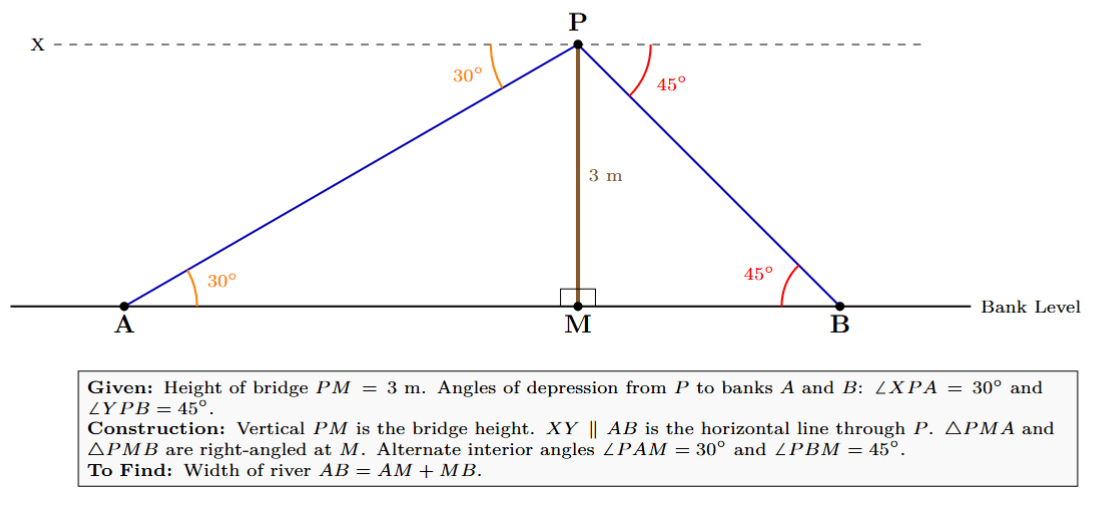
Example 7. From a point on a bridge across a river, the angles of depression of the banks on opposite sides of the river are 30° and 45°, respectively. If the bridge is at a height of 3 m from the banks, find the width of the river.
Answer:
Given
Height of the bridge above the river banks, $PM = 3$ m.
Angle of depression to bank $A$, $\angle XPA = 30^\circ$.
Angle of depression to bank $B$, $\angle YPB = 45^\circ$.
To Find
The width of the river, $AB$.
Construction
Let $P$ be the point on the bridge directly above $M$ on the river bank level. Draw the vertical line $PM$ perpendicular to $AB$. Through $P$, draw the horizontal line $XY$ parallel to $AB$, meeting the lines of sight $PA$ and $PB$.
Since $XY \parallel AB$, the alternate interior angles are $\angle PAM = 30^\circ$ and $\angle PBM = 45^\circ$.
Solution
The width of the river is the sum of the distances from $M$ to the two banks:
$AB = AM + MB$
Step 1: Find $AM$.
In right-angled $\triangle PMA$,
$\tan \angle PAM = \frac{PM}{AM}$
$\tan 30^\circ = \frac{3}{AM}$
$\frac{1}{\sqrt{3}} = \frac{3}{AM}$
Cross-multiplying,
$AM = 3\sqrt{3}$ m
Step 2: Find $MB$.
In right-angled $\triangle PMB$,
$\tan \angle PBM = \frac{PM}{MB}$
$\tan 45^\circ = \frac{3}{MB}$
$1 = \frac{3}{MB}$
Therefore,
$MB = 3$ m
Step 3: Calculate the width of the river.
We know that
$AB = AM + MB$
$AB = 3\sqrt{3} + 3$
$AB = 3(\sqrt{3} + 1)$ m
Final Answer
Hence, the width of the river is $3(\sqrt{3} + 1)$ m.
Exercise 9.1
Question 1. A circus artist is climbing a 20 m long rope, which is tightly stretched and tied from the top of a vertical pole to the ground. Find the height of the pole, if the angle made by the rope with the ground level is 30° (see Fig. 9.11).

Answer:
Given:
Length of the rope = 20 m.
The rope is tied from the top of a vertical pole to the ground.
The angle made by the rope with the ground level = $30^\circ$.
To Find:
The height of the pole.
Solution:
Let AB be the vertical pole, with A being the top and B being the foot on the ground.
Let C be the point on the ground where the rope is tied.
AC is the length of the rope, AC = 20 m.
The angle made by the rope with the ground is $\angle$ACB = $30^\circ$.
We have a right-angled triangle ABC, right-angled at B (since the pole is vertical).
In $\triangle$ ABC, we need to find the height of the pole AB, which is the side opposite to the angle $\angle$ACB = $30^\circ$.
We are given the length of the hypotenuse AC = 20 m.
The trigonometric ratio that relates the opposite side and the hypotenuse is sine.
$\sin C = \frac{\text{Side opposite to } \angle \text{C}}{\text{Hypotenuse}} = \frac{AB}{AC}$
Substitute the given values:
$\sin 30^\circ = \frac{AB}{20}$
We know that the value of $\sin 30^\circ$ is $\frac{1}{2}$.
$\frac{1}{2} = \frac{AB}{20}$
Solve for AB:
$2 \times AB = 1 \times 20$
$AB = \frac{20}{2}$
$AB = 10$ m
The height of the pole is 10 metres.
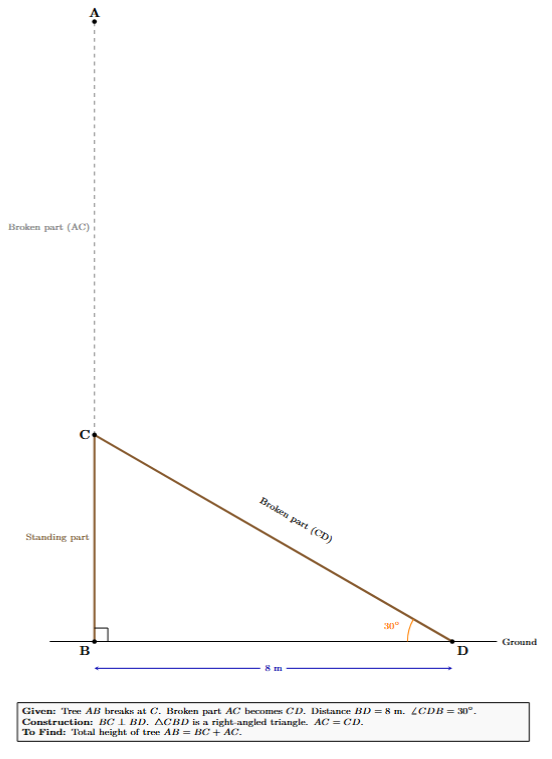
Question 2. A tree breaks due to storm and the broken part bends so that the top of the tree touches the ground making an angle 30° with it. The distance between the foot of the tree to the point where the top touches the ground is 8 m. Find the height of the tree.
Answer:
Given
The distance between the foot of the tree and the point where its top touches the ground, $BD = 8$ m.
The angle made by the broken part with the ground, $\angle CDB = 30^\circ$.
To Find
The original height of the tree, $AB$.
Construction
Let $AB$ be the original tree. It breaks at point $C$, and the broken part $AC$ touches the ground at point $D$. The standing part is $BC$, and $BD = 8$ m. Since the tree is vertical and the ground is horizontal, $\angle CBD = 90^\circ$.
Solution
The original height of the tree is the sum of the standing part and the broken part:
$AB = BC + AC$
Step 1: Find the length of the standing part, $BC$.
In right-angled $\triangle BCD$,
$\tan \angle CDB = \frac{BC}{BD}$
Substituting the given values,
$\tan 30^\circ = \frac{BC}{8}$
$\frac{1}{\sqrt{3}} = \frac{BC}{8}$
Therefore,
$BC = \frac{8}{\sqrt{3}}$ m
Step 2: Find the length of the broken part, $AC$.
In right-angled $\triangle BCD$, $AC$ is the hypotenuse of $\triangle ACD$? Since $A$, $C$, and $B$ lie on the same vertical line, the broken part is $AD$ in the given figure. Thus, the length of the broken part is $AD$.
Using the cosine ratio in right-angled $\triangle BCD$ to find the slant length corresponding to the broken part,
$\cos 30^\circ = \frac{BD}{AD}$
$\frac{\sqrt{3}}{2} = \frac{8}{AD}$
Cross-multiplying,
$AD = \frac{16}{\sqrt{3}}$ m
Step 3: Find the original height of the tree.
The original height is the sum of the standing part and the broken part:
$AB = BC + AC$
Using the lengths obtained above,
$AB = \frac{8}{\sqrt{3}} + \frac{16}{\sqrt{3}}$
$AB = \frac{24}{\sqrt{3}}$ m
Rationalising the denominator,
$AB = \frac{24}{\sqrt{3}} \times \frac{\sqrt{3}}{\sqrt{3}}$
$AB = \frac{24\sqrt{3}}{3}$
$AB = 8\sqrt{3}$ m
Final Answer
Hence, the original height of the tree is $8\sqrt{3}$ m.
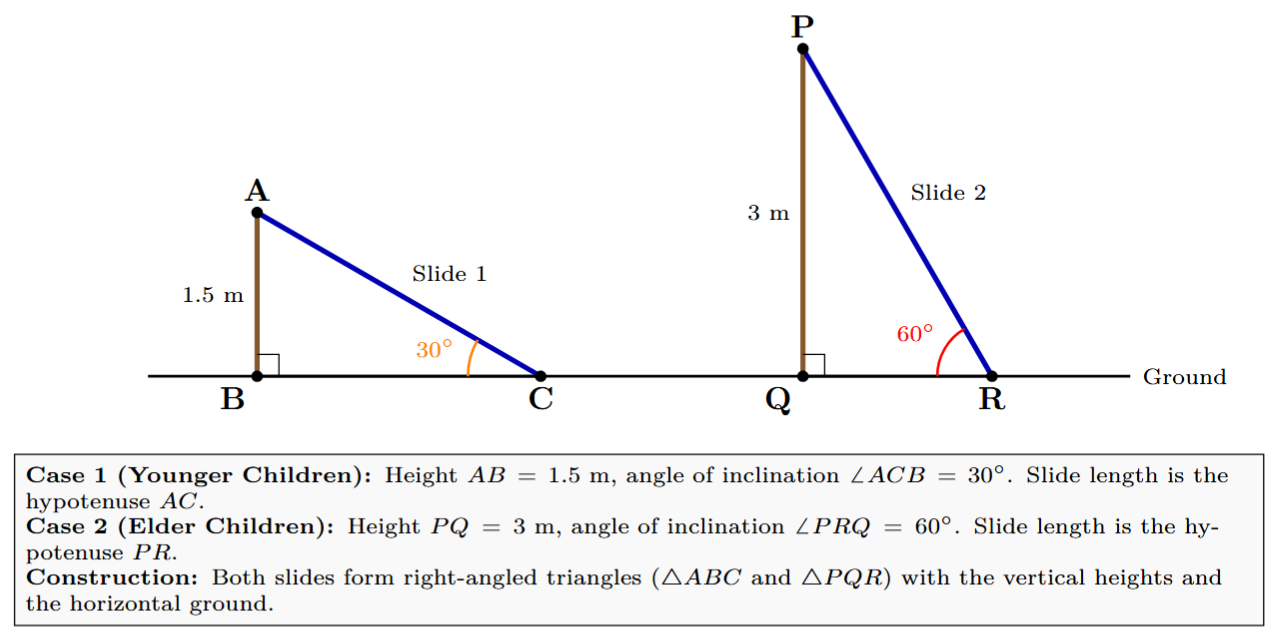
Question 3. A contractor plans to install two slides for the children to play in a park. For the children below the age of 5 years, she prefers to have a slide whose top is at a height of 1.5 m, and is inclined at an angle of 30° to the ground, whereas for elder children, she wants to have a steep slide at a height of 3m, and inclined at an angle of 60° to the ground. What should be the length of the slide in each case?
Answer:
We need to find the length of each slide. In both cases, the slide forms the hypotenuse of a right-angled triangle.
Case 1: Slide for children below 5 years
Given:
Height of the slide, $AB = 1.5$ m.
Angle of inclination, $\angle ACB = 30^\circ$.
To Find: Length of the slide, $AC$.
In right-angled $\triangle ABC$, using the sine ratio,
$\sin 30^\circ = \frac{AB}{AC}$
Since $\sin 30^\circ = \frac{1}{2}$,
$\frac{1}{2} = \frac{1.5}{AC}$
$AC = 1.5 \times 2 = 3$ m
Therefore, the length of the slide for younger children is 3 m.
Case 2: Slide for elder children
Given:
Height of the slide, $PQ = 3$ m.
Angle of inclination, $\angle PRQ = 60^\circ$.
To Find: Length of the slide, $PR$.
In right-angled $\triangle PQR$, using the sine ratio,
$\sin 60^\circ = \frac{PQ}{PR}$
Since $\sin 60^\circ = \frac{\sqrt{3}}{2}$,
$\frac{\sqrt{3}}{2} = \frac{3}{PR}$
$PR = \frac{6}{\sqrt{3}} = \frac{6\sqrt{3}}{3} = 2\sqrt{3}$ m
Therefore, the length of the slide for elder children is $2\sqrt{3}$ m.
Final Answers:
(i) Length of the slide for younger children = 3 m.
(ii) Length of the slide for elder children = $2\sqrt{3}$ m.
Question 4. The angle of elevation of the top of a tower from a point on the ground, which is 30 m away from the foot of the tower, is 30°. Find the height of the tower.
Answer:
Given
Distance from the foot of the tower to the point of observation = 30 m.
Angle of elevation of the top of the tower = 30°.
To Find
The height of the tower.
Solution
Let AB be the tower of height $h$ and C be the point on the ground.
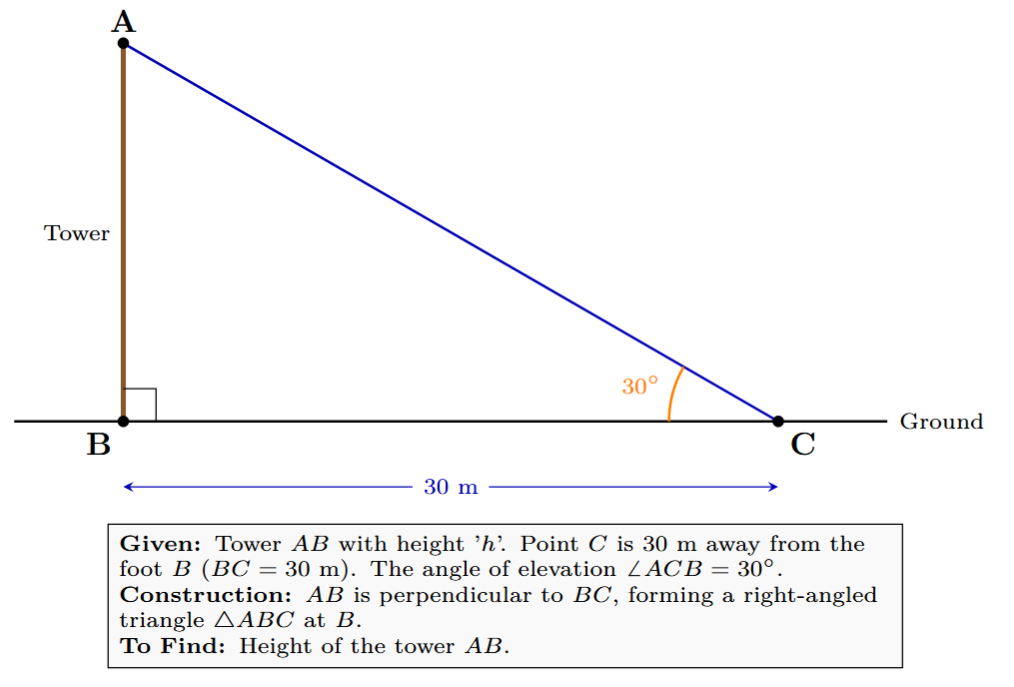
The distance BC = 30 m.
The angle of elevation, $\angle ACB = 30^\circ$.
In the right-angled triangle ABC, we need to find the opposite side (AB) and we know the adjacent side (BC).
We use the tangent ratio:
$\tan(\angle ACB) = \frac{\text{Opposite Side}}{\text{Adjacent Side}} = \frac{AB}{BC}$
$\tan 30^\circ = \frac{h}{30}$
Since $\tan 30^\circ = \frac{1}{\sqrt{3}}$:
$\frac{1}{\sqrt{3}} = \frac{h}{30}$
$h = \frac{30}{\sqrt{3}}$
Rationalizing the denominator:
$h = \frac{30\sqrt{3}}{3} = 10\sqrt{3}$ m.
Therefore, the height of the tower is $10\sqrt{3}$ m.
Question 5. A kite is flying at a height of 60 m above the ground. The string attached to the kite is temporarily tied to a point on the ground. The inclination of the string with the ground is 60°. Find the length of the string, assuming that there is no slack in the string.
Answer:
Given
Height of the kite above the ground = 60 m.
Angle of inclination of the string with the ground = $60^\circ$.
To Find
The length of the string.
Solution
Let A be the position of the kite, B be the point on the ground directly below the kite, and C be the point where the string is tied to the ground.
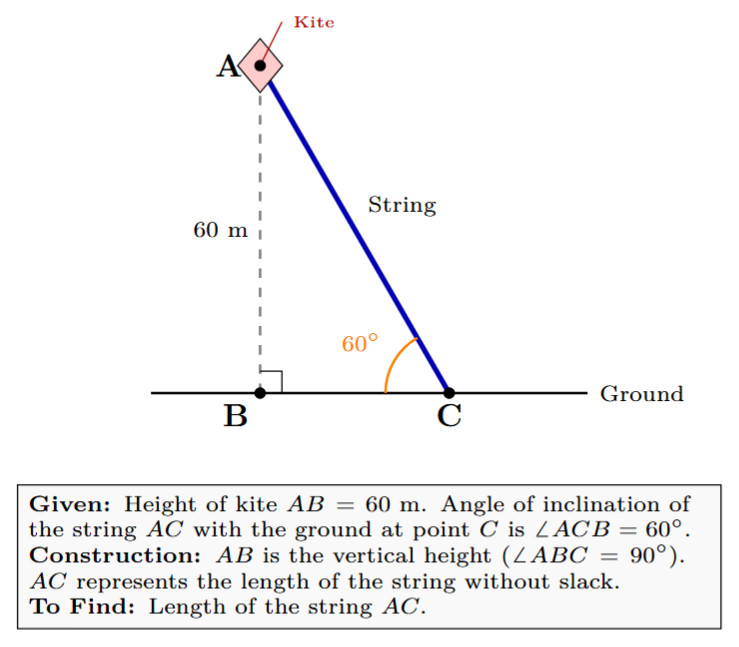
From the figure,
$AB = 60$ m and $\angle ACB = 60^\circ$.
Since $AB$ is vertical and $BC$ lies along the ground, $\angle ABC = 90^\circ$.
In right-angled $\triangle ABC$, the length of the string $AC$ is the hypotenuse, and $AB$ is the side opposite $\angle ACB$.
Using the sine ratio,
$\sin 60^\circ = \frac{AB}{AC}$
Substituting $AB = 60$ m and $\sin 60^\circ = \frac{\sqrt{3}}{2}$,
$\frac{\sqrt{3}}{2} = \frac{60}{AC}$
$AC = \frac{120}{\sqrt{3}}$
Rationalising the denominator,
$AC = \frac{120\sqrt{3}}{3} = 40\sqrt{3}$ m
Therefore, the length of the string is $40\sqrt{3}$ m.
Question 6. A 1.5 m tall boy is standing at some distance from a 30 m tall building. The angle of elevation from his eyes to the top of the building increases from 30° to 60° as he walks towards the building. Find the distance he walked towards the building.
Answer:
Given
Height of the building, $AB = 30$ m.
Height of the boy = 1.5 m.
Initial angle of elevation = $30^\circ$.
Final angle of elevation = $60^\circ$.
To Find
The distance walked by the boy towards the building.
Solution
Let $AB$ be the building of height 30 m. Initially, the boy is standing at point $C$, and after walking towards the building, he reaches point $D$. Let $P$ and $R$ be the positions of his eyes at the initial and final positions, respectively.
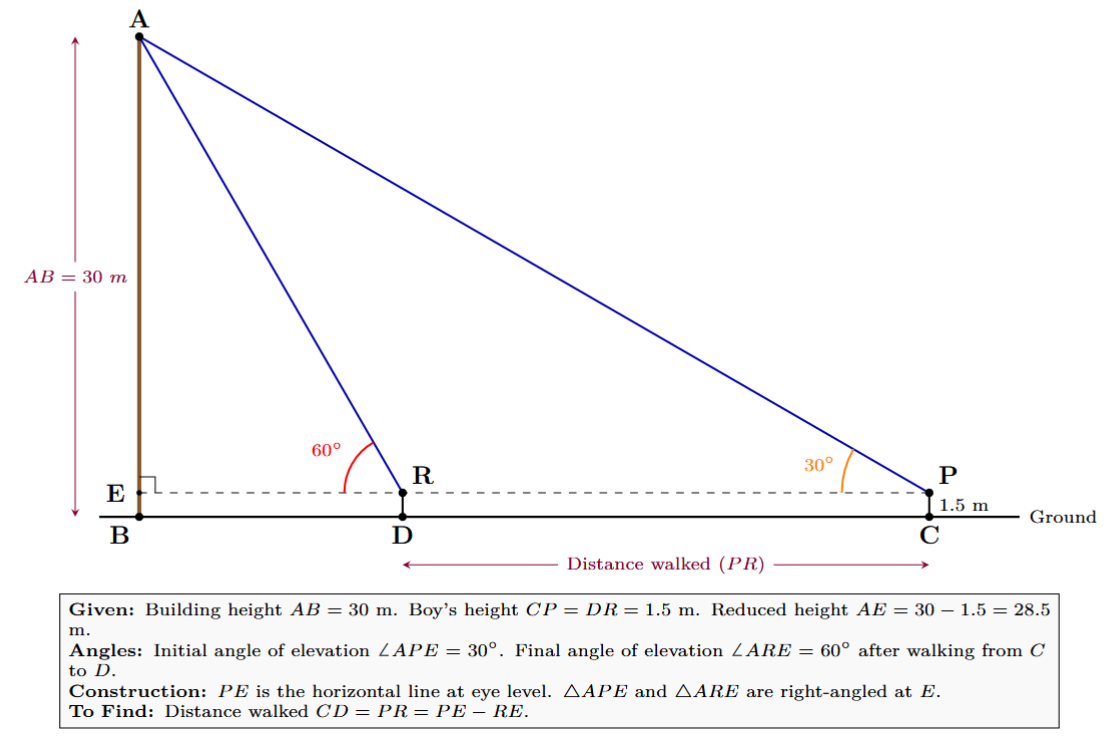
Draw a horizontal line through the boy's eye level, meeting the building at $E$.
The vertical distance from the top of the building to the boy's eye level is
$AE = AB - EB = 30 - 1.5 = 28.5$ m.
Let $PE = x$ m and $RE = y$ m. Since the boy walks towards the building, the distance walked is
$CD = PR = PE - RE = x-y$.
1. Finding the initial distance, $PE$
In right-angled $\triangle APE$, the angle of elevation is $\angle APE = 30^\circ$.
Using the tangent ratio,
$\tan 30^\circ = \frac{AE}{PE}$
$\frac{1}{\sqrt{3}} = \frac{28.5}{x}$
$x = 28.5\sqrt{3}$ m.
2. Finding the final distance, $RE$
In right-angled $\triangle ARE$, the angle of elevation is $\angle ARE = 60^\circ$.
Using the tangent ratio,
$\tan 60^\circ = \frac{AE}{RE}$
$\sqrt{3} = \frac{28.5}{y}$
$y = \frac{28.5}{\sqrt{3}}$ m.
3. Finding the distance walked
The distance walked by the boy is
$CD = PE - RE$
$= 28.5\sqrt{3} - \frac{28.5}{\sqrt{3}}$
$= 28.5\left(\frac{3-1}{\sqrt{3}}\right)$
$= \frac{57}{\sqrt{3}} = 19\sqrt{3}$ m.
Therefore, the distance walked by the boy towards the building is $19\sqrt{3}$ m.
Question 7. From a point on the ground, the angles of elevation of the bottom and the top of a transmission tower fixed at the top of a 20 m high building are 45° and 60° respectively. Find the height of the tower.
Answer:
Given
Height of the building, $AB = 20$ m.
Angle of elevation to the bottom of the tower, $\angle APB = 45^\circ$.
Angle of elevation to the top of the tower, $\angle CPB = 60^\circ$.
To Find
The height of the transmission tower, $AC$.
Solution
Let $AB$ be the building of height 20 m and $AC$ be the transmission tower fixed on top of the building. Let $P$ be the observation point on the ground and $PB = x$ m.
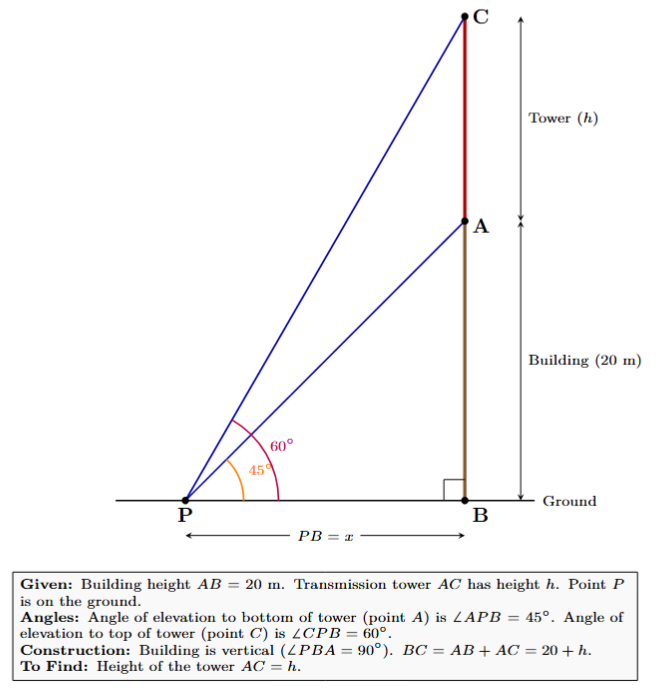
Let the height of the transmission tower be $AC = h$ m.
The total height from the ground to the top of the tower is
$BC = AB + AC = 20 + h$.
1. Finding the horizontal distance $PB$
In right-angled $\triangle APB$,
$\tan 45^\circ = \frac{AB}{PB}$
$1 = \frac{20}{x}$
$x = 20$ m.
Therefore, $PB = 20$ m.
2. Finding the height of the tower
In right-angled $\triangle CPB$, using the tangent ratio,
$\tan 60^\circ = \frac{BC}{PB}$
$\sqrt{3} = \frac{20+h}{20}$
$20\sqrt{3} = 20+h$
$h = 20\sqrt{3}-20$
$h = 20(\sqrt{3}-1)$ m.
Therefore, the height of the transmission tower is $20(\sqrt{3}-1)$ m.
Question 8. A statue, 1.6 m tall, stands on the top of a pedestal. From a point on the ground, the angle of elevation of the top of the statue is 60° and from the same point the angle of elevation of the top of the pedestal is 45°. Find the height of the pedestal.
Answer:
Given
Height of the statue = 1.6 m.
Angle of elevation to the top of the pedestal = $45^\circ$.
Angle of elevation to the top of the statue = $60^\circ$.
To Find
The height of the pedestal.
Solution
Let $AB$ be the pedestal of height $h$ m and $AC$ be the statue of height 1.6 m standing on it. Let $P$ be the point on the ground from which the angles of elevation are measured.
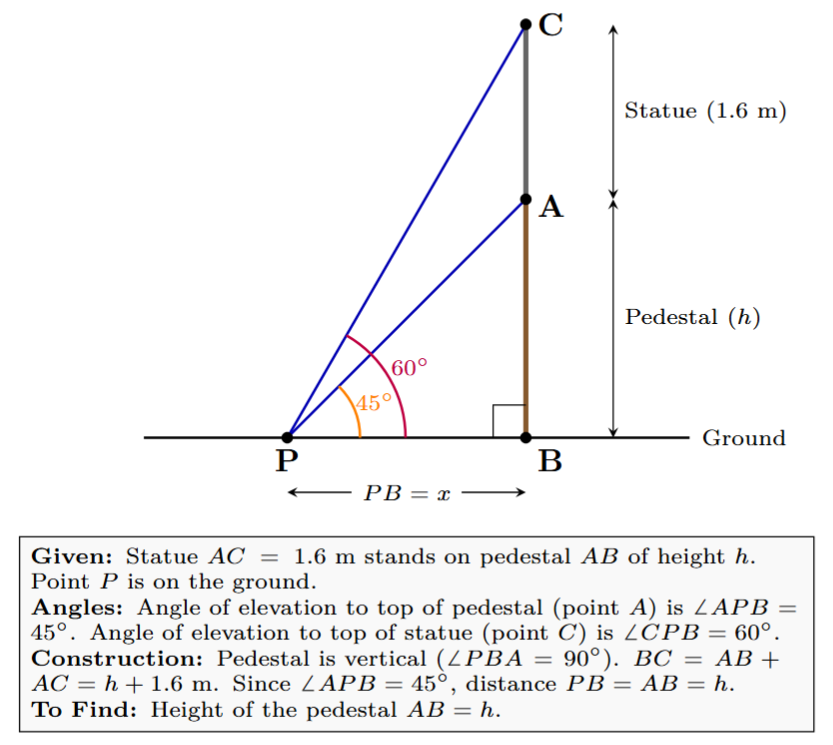
In the right-angled triangle $PAB$:
$\tan 45^\circ = \frac{AB}{PB}$
$1 = \frac{h}{PB}$
$PB = h$
$PB = h$
... (i)
The total height from the ground to the top of the statue is:
$BC = AB + AC = h + 1.6$
In the right-angled triangle $PBC$:
$\tan 60^\circ = \frac{BC}{PB}$
$\sqrt{3} = \frac{h + 1.6}{PB}$
Substituting $PB = h$ from equation (i):
$\sqrt{3} = \frac{h + 1.6}{h}$
$h\sqrt{3} = h + 1.6$
$h\sqrt{3} - h = 1.6$
$h(\sqrt{3} - 1) = 1.6$
$h = \frac{1.6}{\sqrt{3} - 1}$
Rationalizing the denominator:
$h = \frac{1.6}{\sqrt{3} - 1} \times \frac{\sqrt{3} + 1}{\sqrt{3} + 1}$
$h = \frac{1.6(\sqrt{3} + 1)}{3 - 1}$
$h = 0.8(\sqrt{3} + 1)$ m
Therefore, the height of the pedestal is $0.8(\sqrt{3} + 1)$ metres, approximately 2.19 m.
Question 9. The angle of elevation of the top of a building from the foot of the tower is 30° and the angle of elevation of the top of the tower from the foot of the building is 60°. If the tower is 50 m high, find the height of the building.
Answer:
Given
Height of the tower = 50 m.
Angle of elevation of the building's top from the tower's foot = 30°.
Angle of elevation of the tower's top from the building's foot = 60°.
To Find
The height of the building.
Solution
Let AB be the building of height $h$ and CD be the tower of height 50 m.
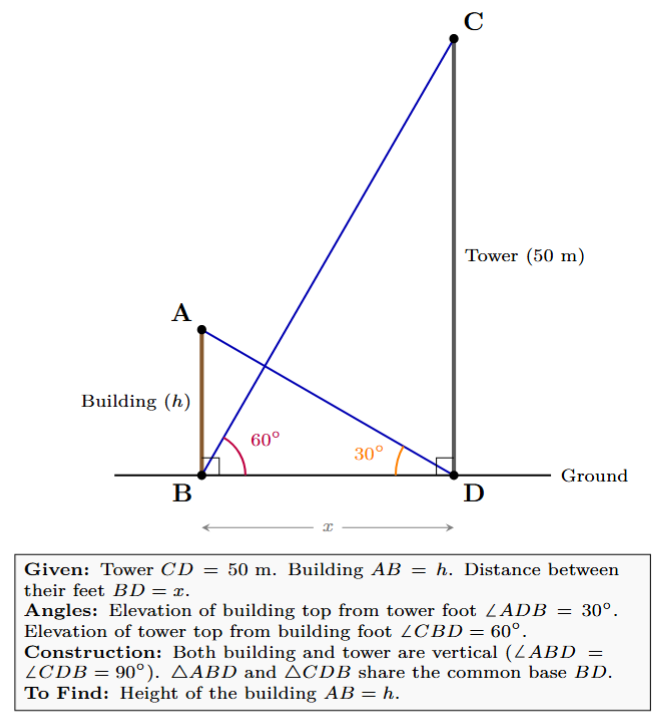
Let the distance between the building and the tower be BD = $x$ m.
In the right-angled triangle CBD:
$\tan 60^\circ = \frac{CD}{BD} \implies \sqrt{3} = \frac{50}{x} \implies x = \frac{50}{\sqrt{3}}$ m.
In the right-angled triangle ABD:
$\tan 30^\circ = \frac{AB}{BD} \implies \frac{1}{\sqrt{3}} = \frac{h}{x}$
$h = \frac{x}{\sqrt{3}}$
Substitute the value of $x$ we found:
$h = \frac{50/\sqrt{3}}{\sqrt{3}} = \frac{50}{\sqrt{3} \times \sqrt{3}} = \frac{50}{3}$ m.
The height can be written as $16\frac{2}{3}$ m.
Therefore, the height of the building is $\frac{50}{3}$ m.
Question 10. Two poles of equal heights are standing opposite each other on either side of the road, which is 80 m wide. From a point between them on the road, the angles of elevation of the top of the poles are 60° and 30°, respectively. Find the height of the poles and the distances of the point from the poles.
Answer:
Given
Two poles of equal height.
Width of the road = 80 m.
Angles of elevation from a point on the road are 60° and 30°.
To Find
1. The height of the poles.
2. The distances of the point from the poles.
Solution
Let AB and CD be the two poles of equal height $h$. Let P be the point on the road BD.
The width of the road is BD = 80 m.
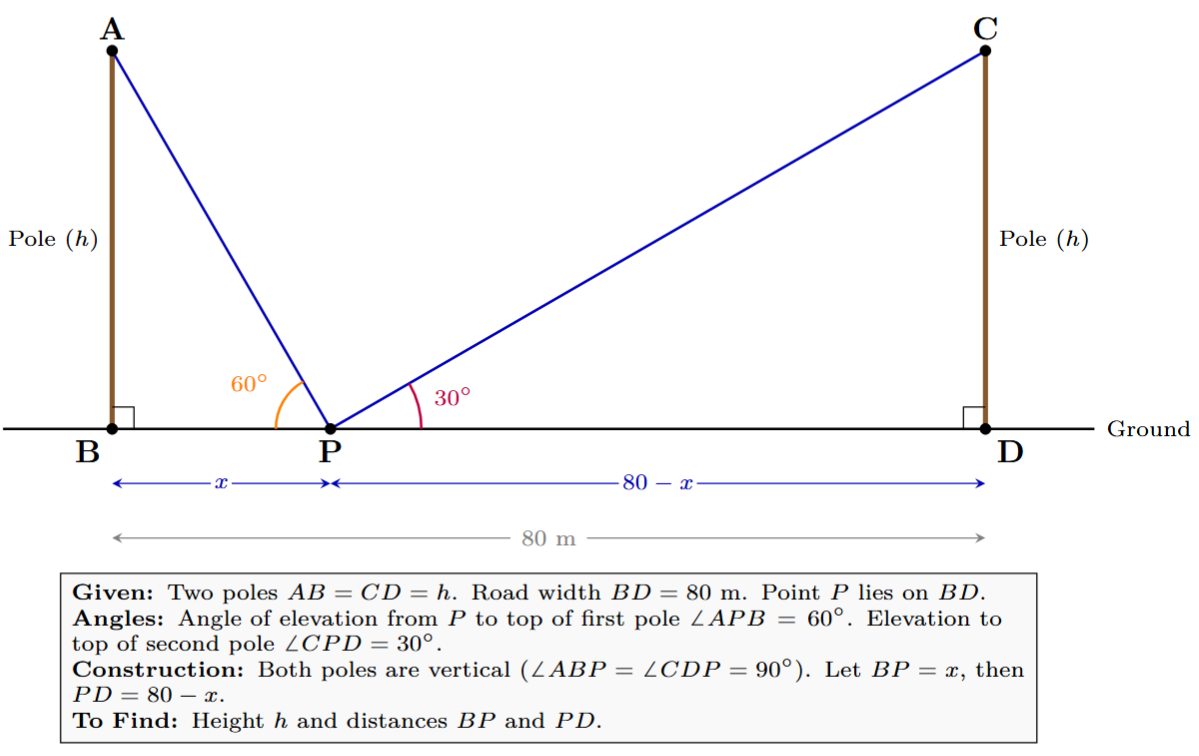
Let the distance BP = $x$ m. Then PD = (80 - $x$) m.
In the right-angled triangle ABP:
$\tan 60^\circ = \frac{AB}{BP} \implies \sqrt{3} = \frac{h}{x} \implies h = x\sqrt{3}$
$h = x\sqrt{3}$
...(i)
In the right-angled triangle CDP:
$\tan 30^\circ = \frac{CD}{PD} \implies \frac{1}{\sqrt{3}} = \frac{h}{80 - x} \implies h = \frac{80 - x}{\sqrt{3}}$
$h = \frac{80 - x}{\sqrt{3}}$
...(ii)
Equating the expressions for $h$ from (i) and (ii):
$x\sqrt{3} = \frac{80 - x}{\sqrt{3}}$
$x\sqrt{3} \times \sqrt{3} = 80 - x$
$3x = 80 - x$
$4x = 80 \implies x = 20$ m.
Now find the other distance:
PD = 80 - $x$ = 80 - 20 = 60 m.
Now find the height $h$ using equation (i):
$h = x\sqrt{3} = 20\sqrt{3}$ m.
Therefore, the height of the poles is $20\sqrt{3}$ m, and the distances of the point from the poles are 20 m and 60 m.
Question 11. A TV tower stands vertically on a bank of a canal. From a point on the other bank directly opposite the tower, the angle of elevation of the top of the tower is 60°. From another point 20 m away from this point on the line joing this point to the foot of the tower, the angle of elevation of the top of the tower is 30° (see Fig. 9.12). Find the height of the tower and the width of the canal.

Answer:
Given
Let $AB$ be the TV tower and $BC$ be the width of the canal, as shown in the figure.
The angle of elevation from point $C$ on the opposite bank is $\angle ACB = 60^\circ$.
From point $D$, which is 20 m farther from $C$ along the same straight line, the angle of elevation is $\angle ADB = 30^\circ$.
The distance $CD = 20$ m.
To Find
1. The height of the tower ($AB$).
2. The width of the canal ($BC$).
Solution
Let the height of the tower, $AB$, be $h$ m and the width of the canal, $BC$, be $x$ m.
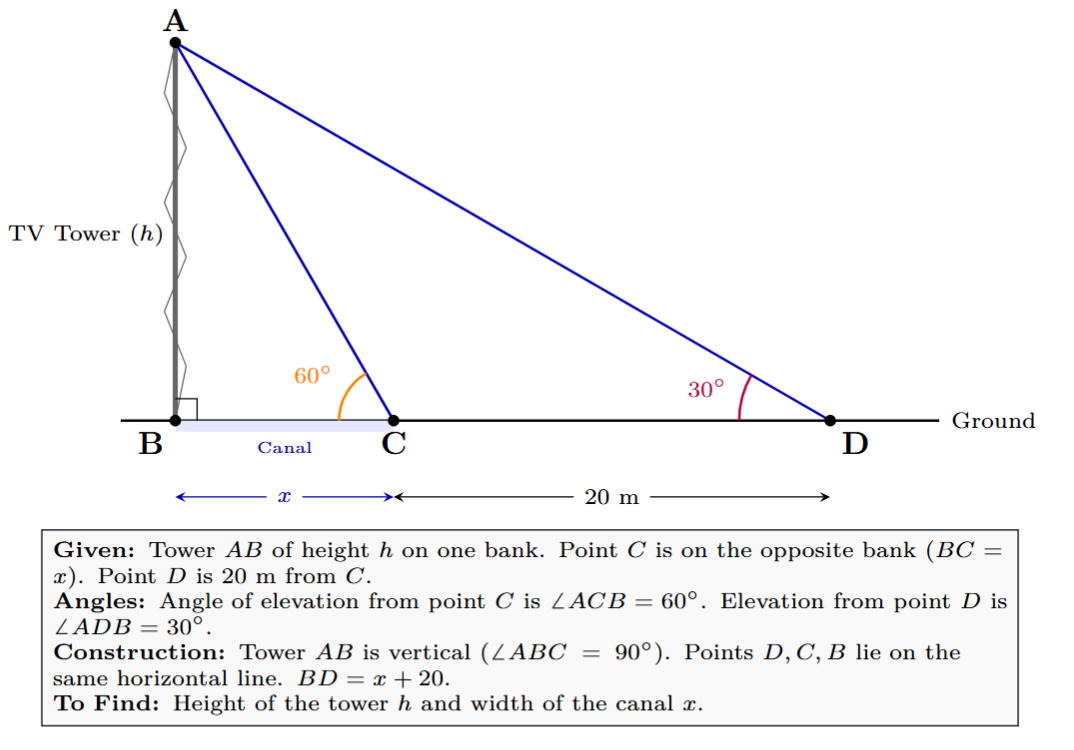
Consider the right-angled triangle $ABC$.
$\tan \angle ACB = \frac{AB}{BC}$
$\tan 60^\circ = \frac{h}{x}$
$\sqrt{3} = \frac{h}{x}$
$h = x\sqrt{3}$
... (i)
Now, consider the right-angled triangle $ABD$.
The distance $BD = BC + CD = (x + 20)$ m.
$\tan \angle ADB = \frac{AB}{BD}$
$\tan 30^\circ = \frac{h}{x + 20}$
$\frac{1}{\sqrt{3}} = \frac{h}{x + 20}$
$h = \frac{x + 20}{\sqrt{3}}$
... (ii)
Substituting $h = x\sqrt{3}$ from equation (i) into equation (ii):
$x\sqrt{3} = \frac{x + 20}{\sqrt{3}}$
$3x = x + 20$
$3x - x = 20$
$2x = 20$
$x = \frac{20}{2} = 10$ m.
Therefore, the width of the canal is $BC = 10$ m.
Substituting $x = 10$ into equation (i):
$h = x\sqrt{3}$
$h = 10\sqrt{3}$ m.
Therefore, the height of the TV tower is $10\sqrt{3}$ m and the width of the canal is 10 m.
Question 12. From the top of a 7 m high building, the angle of elevation of the top of a cable tower is 60° and the angle of depression of its foot is 45°. Determine the height of the tower.
Answer:
Given
Height of the building = 7 m.
Angle of elevation of the top of a cable tower from the top of the building = 60°.
Angle of depression of the foot of the tower from the top of the building = 45°.
To Find
The height of the cable tower.
Solution
Let AB be the 7 m high building and CD be the cable tower.
Draw a horizontal line AE from A to the tower CD.
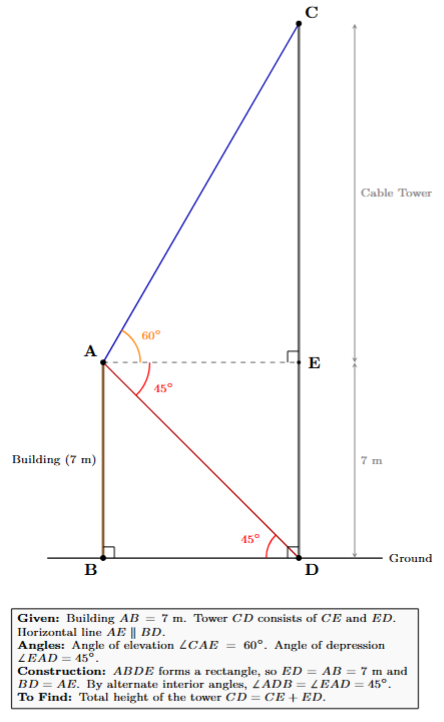
From the figure, we have a rectangle ABDE.
So, AB = ED = 7 m and BD = AE.
The height of the tower is CD = CE + ED.
The angle of elevation of C from A is $\angle CAE = 60^\circ$.
The angle of depression of D from A is equal to the alternate interior angle $\angle ADB = 45^\circ$.
First, consider the right-angled triangle ABD:
$\tan(\angle ADB) = \frac{AB}{BD}$
$\tan 45^\circ = \frac{7}{BD}$
$1 = \frac{7}{BD} \implies BD = 7$ m.
Since BD = AE, we have AE = 7 m.
Now, consider the right-angled triangle CAE:
$\tan(\angle CAE) = \frac{CE}{AE}$
$\tan 60^\circ = \frac{CE}{7}$
$\sqrt{3} = \frac{CE}{7} \implies CE = 7\sqrt{3}$ m.
The total height of the tower is CD = CE + ED.
Height of tower = $7\sqrt{3} + 7$
Height of tower = $7(\sqrt{3} + 1)$ m.
Therefore, the height of the tower is $7(\sqrt{3} + 1)$ m.
Question 13. As observed from the top of a 75 m high lighthouse from the sea-level, the angles of depression of two ships are 30° and 45°. If one ship is exactly behind the other on the same side of the lighthouse, find the distance between the two ships.
Answer:
Given
Height of the lighthouse = 75 m.
Angles of depression of two ships are 30° and 45°.
The ships are on the same side of the lighthouse, one behind the other.
To Find
The distance between the two ships.
Solution
Let AB be the 75 m high lighthouse. Let C and D be the positions of the two ships.
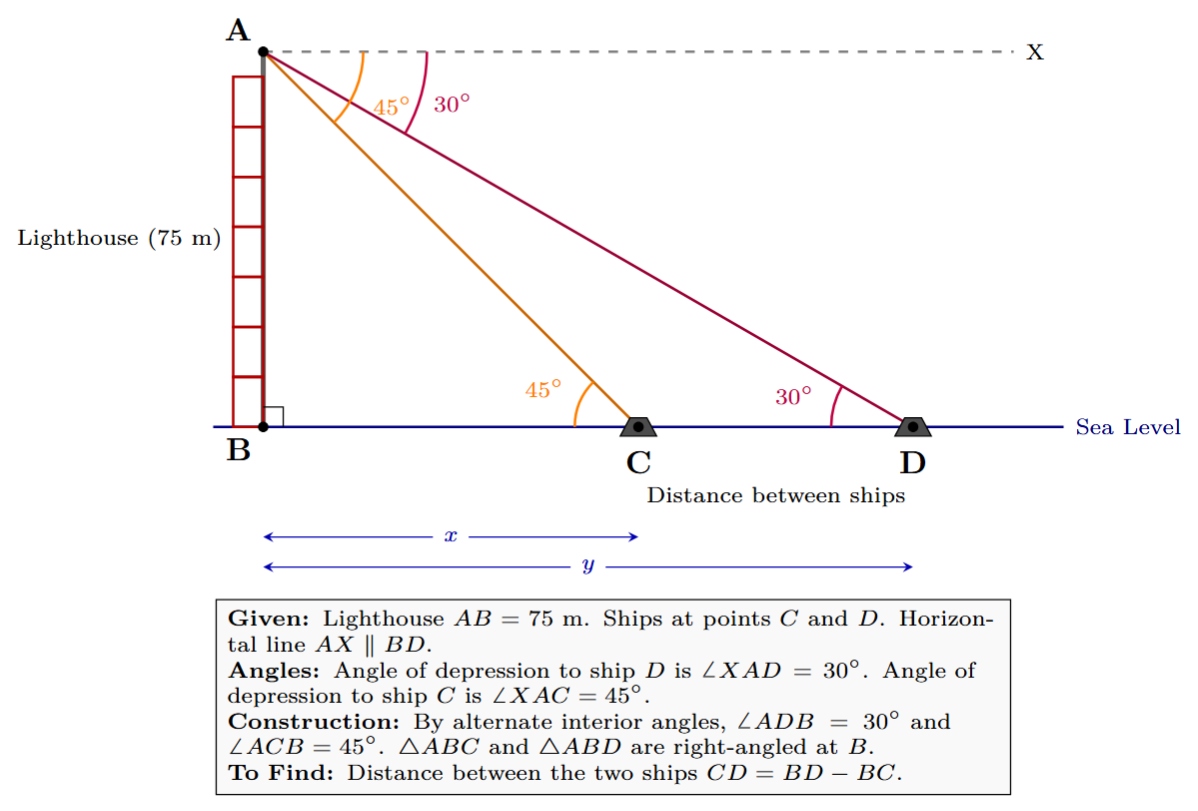
The ship with the larger angle of depression (45°) will be closer to the lighthouse. So, let the angle of depression to C be 45° and to D be 30°.
The corresponding angles of elevation from the ships to the top of the lighthouse are $\angle ACB = 45^\circ$ and $\angle ADB = 30^\circ$ (alternate interior angles).
We need to find the distance between the ships, which is CD.
First, consider the right-angled triangle ABC:
$\tan(\angle ACB) = \frac{AB}{BC}$
$\tan 45^\circ = \frac{75}{BC}$
$1 = \frac{75}{BC} \implies BC = 75$ m.
Now, consider the right-angled triangle ABD:
$\tan(\angle ADB) = \frac{AB}{BD}$
$\tan 30^\circ = \frac{75}{BD}$
$\frac{1}{\sqrt{3}} = \frac{75}{BD} \implies BD = 75\sqrt{3}$ m.
The distance between the two ships is CD = BD - BC.
CD = $75\sqrt{3} - 75$
CD = $75(\sqrt{3} - 1)$ m.
Therefore, the distance between the two ships is $75(\sqrt{3} - 1)$ m.
Question 14. A 1.2 m tall girl spots a balloon moving with the wind in a horizontal line at a height of 88.2 m from the ground. The angle of elevation of the balloon from the eyes of the girl at any instant is 60°. After some time, the angle of elevation reduces to 30° (see Fig. 9.13). Find the distance travelled by the balloon during the interval.

Answer:
Given
Height of the girl = 1.2 m.
Height of the balloon from the ground = 88.2 m.
Initial angle of elevation of the balloon = $60^\circ$.
Final angle of elevation of the balloon = $30^\circ$.
To Find
The distance travelled by the balloon during the interval.
Solution
Let $A$ and $B$ be the initial and final positions of the balloon, respectively. Let $E$ be the position of the girl's eyes, and let $P$ and $Q$ be the points vertically below $A$ and $B$ on the horizontal line through $E$.
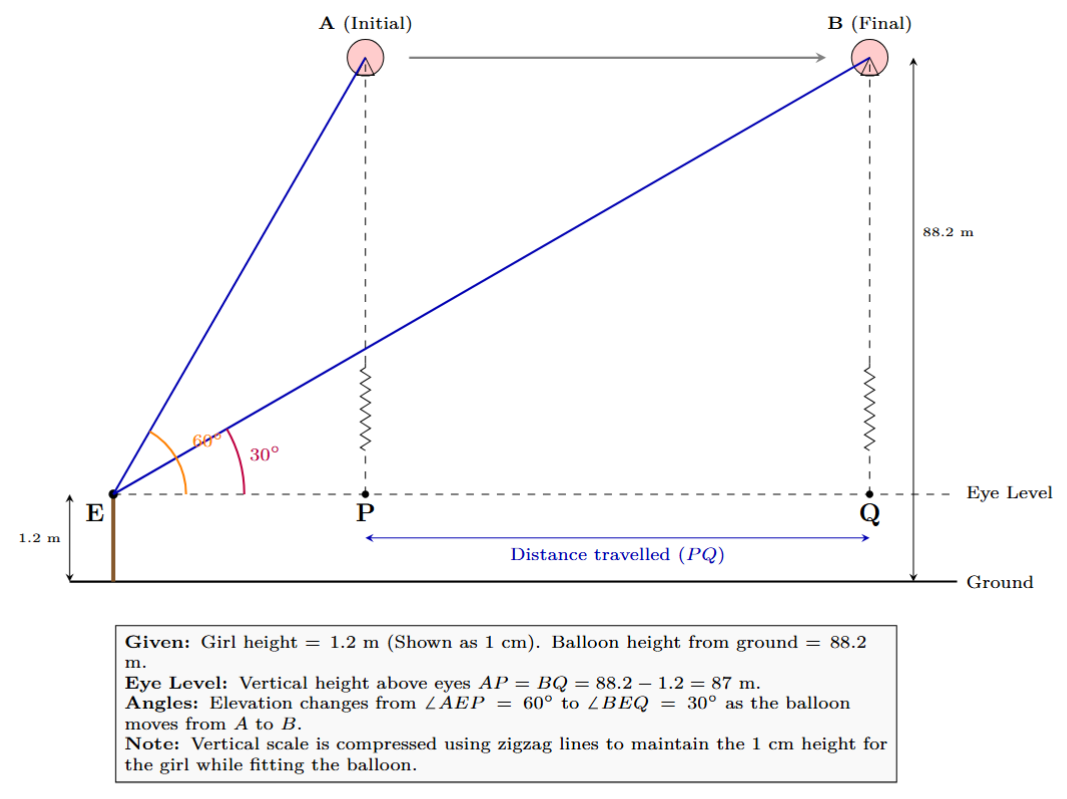
The vertical height of the balloon above the girl's eye level is:
$AP = BQ = 88.2 - 1.2 = 87$ m.
In the right-angled triangle $AEP$:
$\tan 60^\circ = \frac{AP}{EP}$
$\sqrt{3} = \frac{87}{EP}$
$EP = \frac{87}{\sqrt{3}}$ m.
$EP = \frac{87}{\sqrt{3}}$ m
... (i)
Now, in the right-angled triangle $BEQ$:
$\tan 30^\circ = \frac{BQ}{EQ}$
$\frac{1}{\sqrt{3}} = \frac{87}{EQ}$
$EQ = 87\sqrt{3}$ m.
$EQ = 87\sqrt{3}$ m
... (ii)
Since the balloon moves horizontally, the distance travelled is $AB = PQ$. Also, $EQ = EP + PQ$.
Therefore,
$PQ = EQ - EP$
$PQ = 87\sqrt{3} - \frac{87}{\sqrt{3}}$
$PQ = 87\left(\sqrt{3} - \frac{1}{\sqrt{3}}\right)$
$PQ = 87\left(\frac{3 - 1}{\sqrt{3}}\right)$
$PQ = \frac{174}{\sqrt{3}}$
Rationalizing the denominator:
$PQ = \frac{174\sqrt{3}}{3} = 58\sqrt{3}$ m.
Therefore, the distance travelled by the balloon is $58\sqrt{3}$ m.
Question 15. A straight highway leads to the foot of a tower. A man standing at the top of the tower observes a car at an angle of depression of 30°, which is approaching the foot of the tower with a uniform speed. Six seconds later, the angle of depression of the car is found to be 60°. Find the time taken by the car to reach the foot of the tower from this point.
Answer:
Given
A car is approaching a tower with uniform speed.
Initial angle of depression from the top of the tower is 30°.
After 6 seconds, the angle of depression is 60°.
To Find
The time taken by the car to reach the foot of the tower from the second point of observation.
Solution
Let AB be the tower of height $h$. Let the initial position of the car be C and its position after 6 seconds be D. The foot of the tower is B.
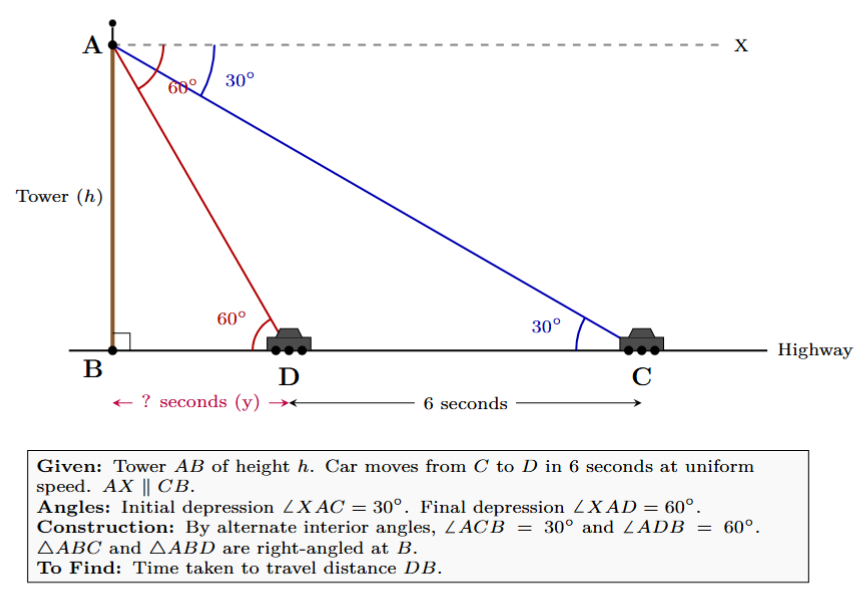
The angles of depression from A to C and D are 30° and 60° respectively. The corresponding angles of elevation from C and D are:
$\angle ACB = 30^\circ$
$\angle ADB = 60^\circ$
Let the uniform speed of the car be $v$ m/s. The distance covered in 6 seconds is CD.
Distance CD = Speed $\times$ Time = $v \times 6 = 6v$ m.
Let the distance from the second observation point D to the foot of the tower be DB = $y$ m.
In the right-angled triangle ABD:
$\tan 60^\circ = \frac{AB}{DB} = \frac{h}{y}$
$\sqrt{3} = \frac{h}{y} \implies h = y\sqrt{3}$
$h = y\sqrt{3}$
...(i)
In the right-angled triangle ABC:
The base is CB = CD + DB = $6v + y$.
$\tan 30^\circ = \frac{AB}{CB} = \frac{h}{6v + y}$
$\frac{1}{\sqrt{3}} = \frac{h}{6v + y} \implies h = \frac{6v + y}{\sqrt{3}}$
$h = \frac{6v + y}{\sqrt{3}}$
...(ii)
Equating the expressions for $h$ from equations (i) and (ii):
$y\sqrt{3} = \frac{6v + y}{\sqrt{3}}$
$y\sqrt{3} \times \sqrt{3} = 6v + y$
$3y = 6v + y$
$2y = 6v \implies y = 3v$
Now, we need to find the time taken by the car to travel the distance DB = $y$. Let this time be $t$.
Time = $\frac{\text{Distance}}{\text{Speed}}$
$t = \frac{y}{v}$
Substitute $y = 3v$ into the equation:
$t = \frac{3v}{v} = 3$ seconds.
Therefore, the time taken by the car to reach the foot of the tower from this point is 3 seconds.
Question 16. The angles of elevation of the top of a tower from two points at a distance of 4 m and 9 m from the base of the tower and in the same straight line with it are complementary. Prove that the height of the tower is 6 m.
Answer:
Given
Two points C and D are on the same straight line from the base of a tower B.
Distance of point C from the base, BC = 4 m.
Distance of point D from the base, BD = 9 m.
The angles of elevation from C and D to the top of the tower are complementary.
To Prove
The height of the tower is 6 m.
Proof
Let AB be the tower of height $h$ meters.
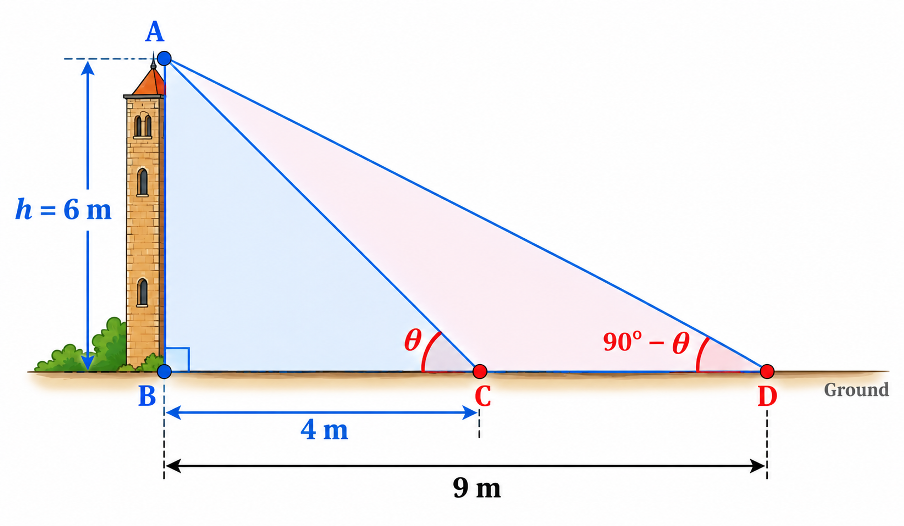
Let the angle of elevation from point C, $\angle ACB = \theta$.
Since the angles are complementary, the angle of elevation from point D is $\angle ADB = 90^\circ - \theta$.
Consider the right-angled triangle ABC:
$\tan(\angle ACB) = \frac{AB}{BC}$
$\tan \theta = \frac{h}{4}$
...(i)
Now, consider the right-angled triangle ABD:
$\tan(\angle ADB) = \frac{AB}{BD}$
$\tan(90^\circ - \theta) = \frac{h}{9}$
Using the identity $\tan(90^\circ - \theta) = \cot \theta$:
$\cot \theta = \frac{h}{9}$
...(ii)
Now, we multiply equation (i) by equation (ii):
$(\tan \theta) \times (\cot \theta) = \left( \frac{h}{4} \right) \times \left( \frac{h}{9} \right)$
Using the identity $\tan \theta \times \cot \theta = 1$:
$1 = \frac{h^2}{36}$
$h^2 = 36$
Taking the square root on both sides:
$h = \pm 6$
Since height cannot be negative, we take the positive value.
$h = 6$ m
Thus, it is proved that the height of the tower is 6 m.